

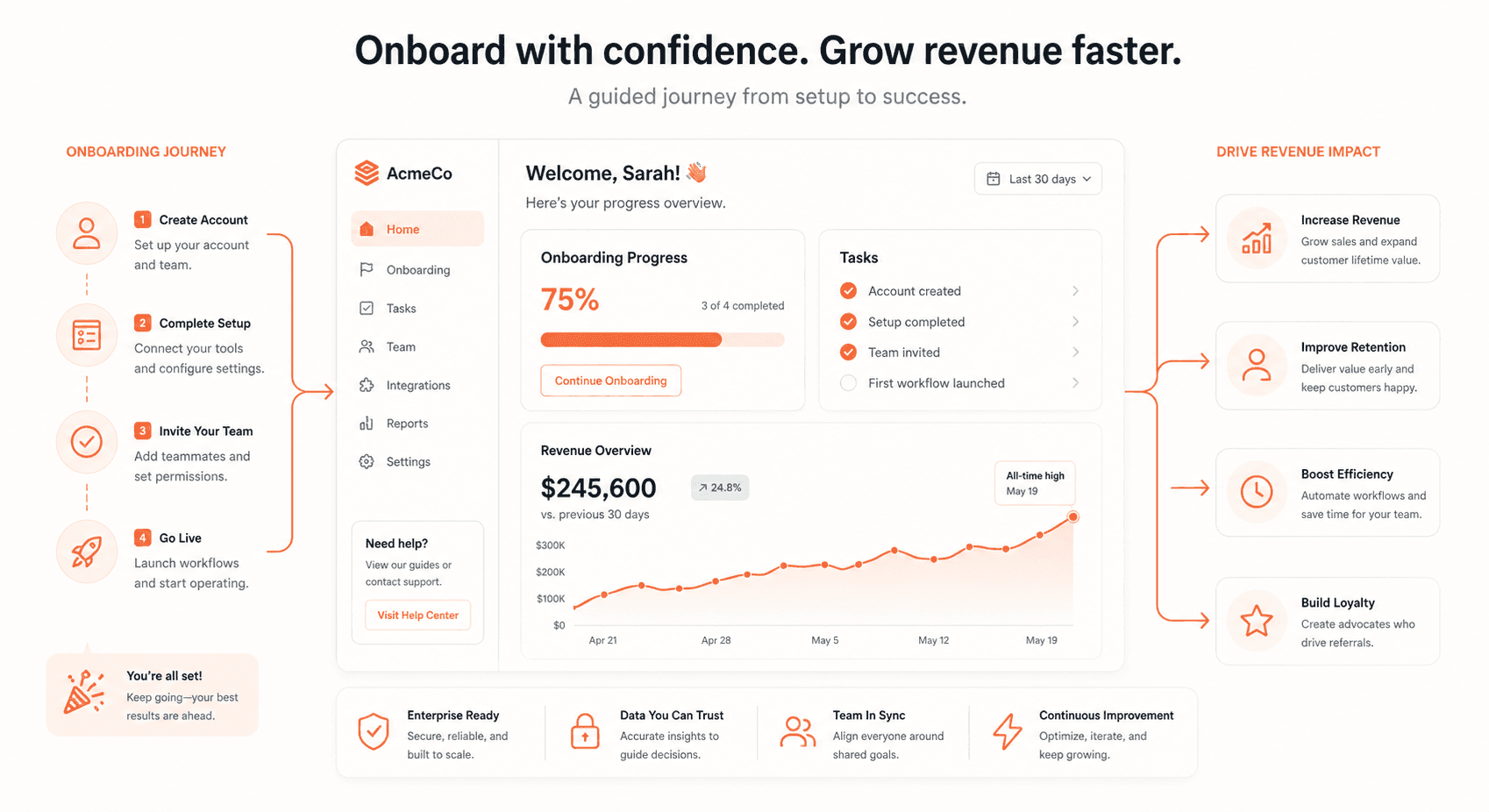
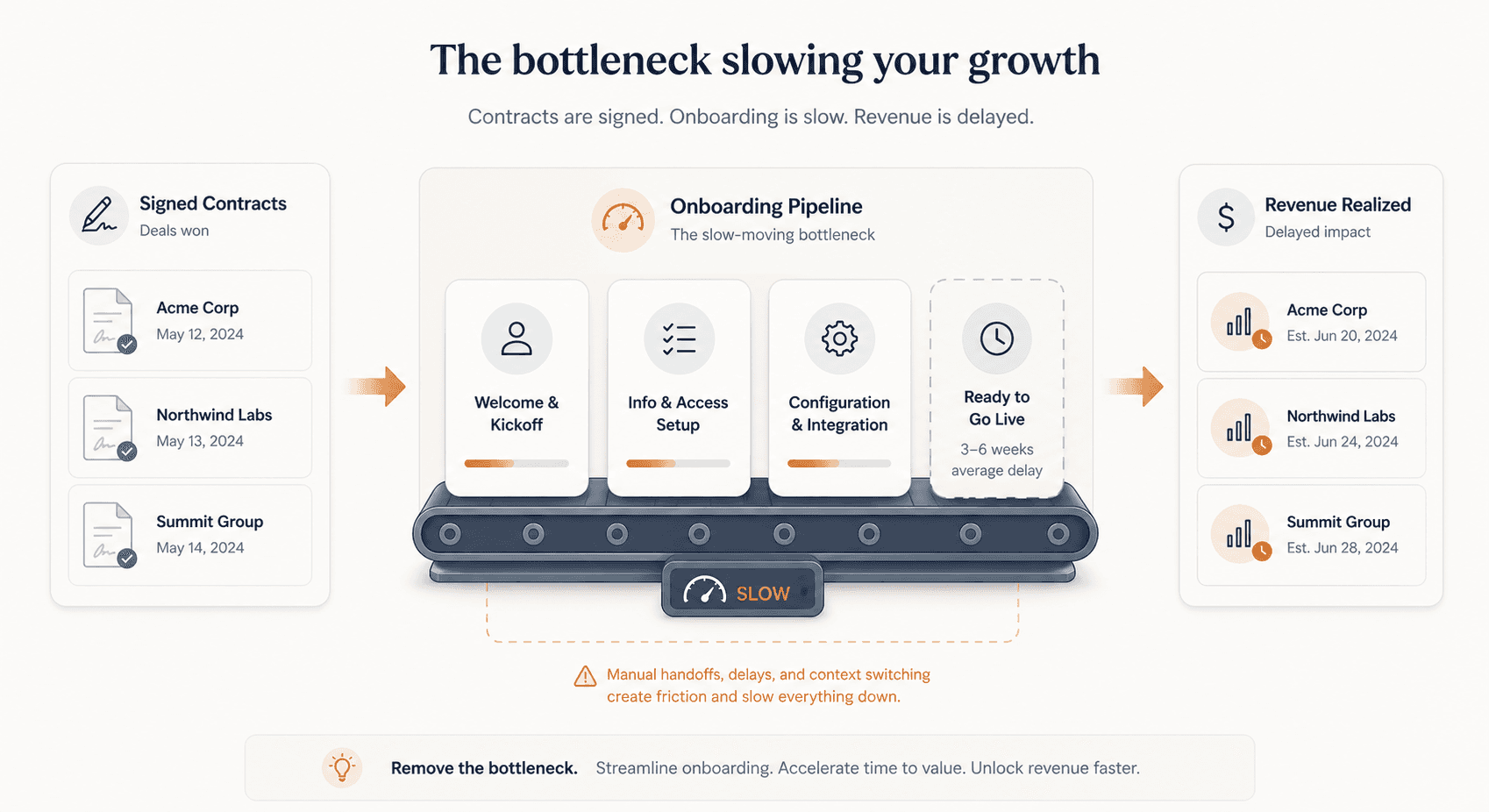
Your customer onboarding process might be the biggest roadblock between signed deals and actual revenue. If you're watching weeks or months pass before customers start using and paying for your product, you're not alone – and you're losing money every day.
This guide is for product managers, customer success leaders, and revenue operations teams who need to turn their slow, manual onboarding into a revenue-generating machine. We'll show you exactly why your current process is bleeding revenue and what to do about it.
You'll discover how to automate manual processes that create delays and frustration for both your team and customers. We'll cover strategic process design that accelerates time to value, getting customers to their "aha moment" faster. Plus, you'll learn how to start expansion conversations during onboarding – turning your biggest cost center into your biggest growth opportunity.
Stop treating onboarding like a necessary evil. It's time to make it your secret weapon for faster revenue recognition and sustainable growth.
How Slow Onboarding Blocks Your Revenue Stream
Revenue Recognition Delays in Consumption-Based Models
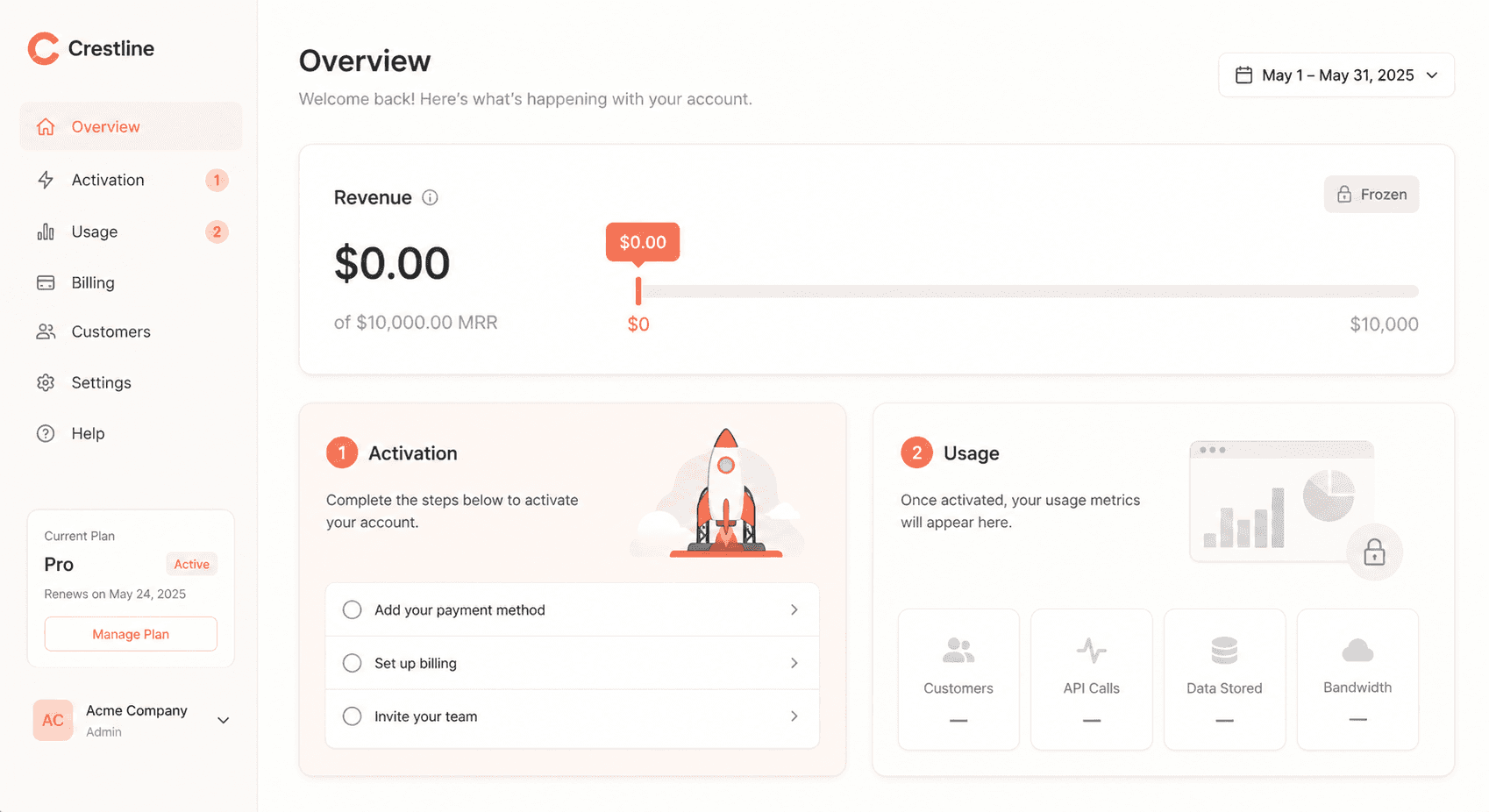
In consumption-based SaaS models, your revenue pipeline remains frozen until customers actively engage with your product. Your slow onboarding problems directly translate to delayed revenue recognition, creating a cascading effect across your business metrics. When your customer onboarding process extends beyond optimal timeframes, you're essentially postponing the moment when actual usage begins – and without usage, there's no revenue to recognize.
Your consumption-based model depends entirely on customer activation and adoption, both of which are contingent on effective onboarding UX strategies. Every day your customers spend in extended onboarding phases represents lost revenue opportunities. While your customers struggle through lengthy setup processes, your revenue recognition remains at zero, regardless of the contract value they've committed to.
This revenue recognition delay becomes particularly problematic when you consider that activation, usage, and adoption are directly tied to how quickly and effectively you can get customers operational. Your product onboarding optimization efforts should focus on compressing this timeline to accelerate when meaningful consumption begins.
Missing Upsell Opportunities During Extended Onboarding
Your extended onboarding periods create blind spots in your revenue expansion strategy. When customers are stuck in lengthy onboarding workflows, you cannot initiate meaningful upsell conversations because they haven't yet experienced the full value of your base offering. This timing misalignment costs your business significant expansion revenue potential.
During slow onboarding, your customer success teams lack the foundational usage data and customer feedback needed to identify expansion opportunities. Without customers actively using your product, you cannot demonstrate the ROI that typically drives upgrade decisions. Your upsell conversations become theoretical rather than data-driven, significantly reducing their effectiveness.
Your automated onboarding workflow should be designed to accelerate customers to value realization, creating natural conversation points for expansion. When onboarding drags on, these strategic moments pass by, and you miss the optimal window when customers are most receptive to additional investment in your solution.
Lack of Usage Data for Customer Health Decisions
Your slow customer onboarding process creates a data void that hampers critical customer health decisions. Without customers actively using your product, you cannot collect the usage patterns and engagement metrics necessary to assess account health, predict churn risk, or identify success indicators.
This absence of usage data during extended onboarding periods leaves your customer success teams operating blind. You cannot distinguish between customers who are progressing well versus those at risk of churning because the onboarding bottlenecks prevent meaningful product interaction. Your customer health scoring models remain incomplete, making it impossible to prioritize intervention efforts effectively.
Your time to value acceleration efforts should prioritize getting customers to a point where they generate meaningful usage data quickly. Without this information, your customer success onboarding strategies lack the insights needed to make informed decisions about resource allocation and support prioritization.
No Measurable ROI for Customers
During extended onboarding periods, your customers cannot demonstrate measurable ROI from their investment in your solution. This lack of tangible value realization creates internal pressure within their organizations and increases the likelihood of buyer's remorse or contract cancellation.
Your customers need to show early wins and value delivery to their stakeholders, but slow onboarding prevents them from achieving these demonstrable outcomes. Without measurable ROI, your customers cannot justify their purchase decisions internally, potentially leading to reduced satisfaction and future expansion challenges.
Your streamline user onboarding initiatives should focus on identifying and accelerating the delivery of early value indicators that customers can measure and report internally. These quick wins during the onboarding phase become crucial for maintaining customer confidence and setting the foundation for long-term success and expansion opportunities.
Transform Onboarding Into a Revenue Enablement System
Design Onboarding as Part of Your Core Product Experience
Your customer onboarding process shouldn't be an afterthought bolted onto your product, it needs to become an integral part of your core product experience. When you treat onboarding with the same level of attention as your main product features, you transform it from a necessary hurdle into a powerful revenue enablement system.
Apply the same rigorous design principles to your onboarding that you use for product development. This means conducting user research to understand where customers struggle, A/B testing different onboarding flows, and iterating based on data rather than assumptions. Your onboarding experience should feel as polished and intuitive as your main product interface, creating a seamless transition that builds confidence from the very first interaction.
The key is to approach onboarding optimization with the same methodical testing framework you'd use for any core feature. Track user behavior patterns, identify drop-off points, and continuously refine the experience based on real usage data. When customers encounter friction during onboarding, they're already forming negative impressions that can impact their entire relationship with your product.
Build Standardized Flows with Light Customization Options
Creating an efficient onboarding revenue impact requires striking the perfect balance between standardization and personalization. Your standardized onboarding flows should serve as the foundation that ensures every customer receives a consistent, high-quality experience while maintaining the efficiency needed to scale your operations.
Focus on building core workflows that guide customers through essential setup steps and early value discovery, regardless of their specific use case. These standardized paths should be thoroughly tested and optimized to eliminate common bottlenecks that slow down progress. However, within this framework, incorporate light customization options that allow customers to tailor their experience without derailing the overall flow.
Light customization might include industry-specific templates, role-based feature highlights, or use-case scenarios that help customers see immediate relevance. The goal is to help customers achieve first value efficiently while avoiding the complexity and resource drain of fully custom onboarding experiences. This approach allows you to maintain consistent time-to-value metrics across your customer base while still addressing individual needs.
Focus on Time-to-Usage as Your Primary Success Metric
Now that we've established the framework for standardized flows, your onboarding KPIs need to shift toward what actually drives revenue growth. Time-to-usage should become your primary success metric, specifically measuring the time it takes for customers to complete the smallest measurable action that unlocks revenue potential in your product.
This represents a fundamental shift from traditional onboarding metrics that focus on completion rates or feature adoption. Instead, you're measuring the speed at which customers reach their first moment of genuine value the point where they begin to see concrete returns from their investment in your solution. This metric directly correlates with revenue outcomes because customers who reach value faster are more likely to expand their usage, renew contracts, and become advocates.
Identify what this smallest measurable action looks like for your specific product. It might be completing their first project, processing their first transaction, or successfully integrating with their existing tools. Once defined, structure your entire onboarding experience around accelerating progress toward this critical milestone. Every step, every interaction, and every piece of communication should be evaluated based on whether it moves customers closer to this moment of first usage.
Create Shared Dashboards for Sales and CS Alignment
With this focus on time-to-usage metrics in mind, creating shared dashboards becomes essential for aligning your sales and customer success teams around onboarding progress. These dashboards should provide real-time visibility into where each customer stands in their journey toward first usage, enabling both teams to celebrate early activation wins as meaningful revenue milestones.
Your shared dashboard should track onboarding progress and time-to-first-usage across your entire customer base, giving both sales and customer success teams the data they need to intervene when progress stalls. When teams can see which customers are advancing quickly toward first value and which ones are struggling, they can allocate resources more effectively and provide targeted support where it's needed most.
This alignment transforms onboarding from a handoff between teams into a collaborative effort focused on revenue enablement. Sales teams gain insight into how their closed deals are progressing, while customer success teams can identify at-risk accounts earlier in the relationship. Most importantly, both teams can celebrate early activation wins together, reinforcing the connection between successful onboarding and long-term customer value. This shared visibility ensures that everyone remains focused on the ultimate goal: getting customers to value as quickly as possible to drive sustainable revenue growth.
Automate Manual Processes That Slow Customer Progress
Eliminate Spreadsheet Management and Email Chasing
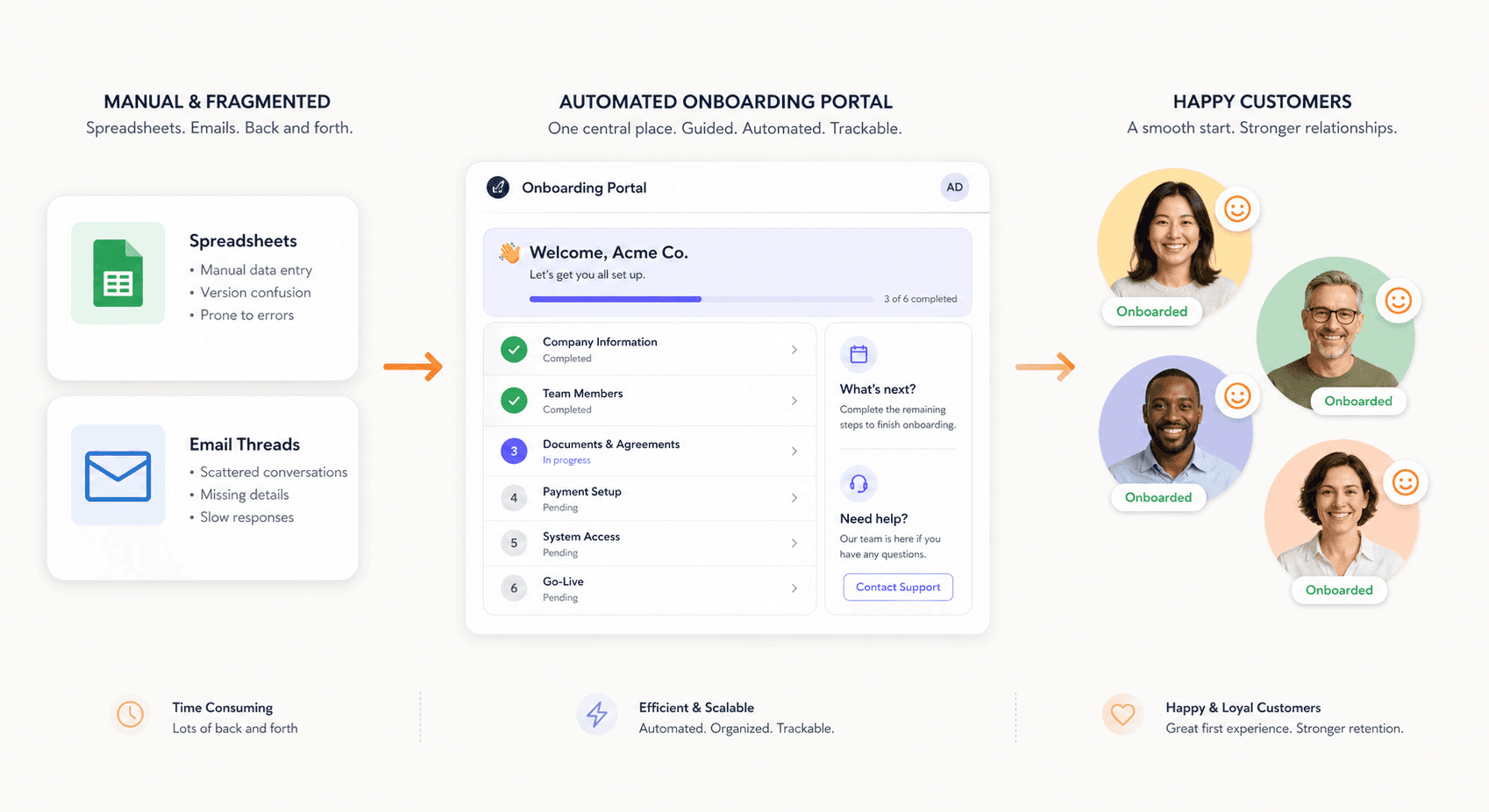
Your customer onboarding process likely suffers from a critical bottleneck that's draining your CS team's productivity and frustrating your customers: manual spreadsheet management and endless email chasing. When your team spends valuable time copying tasks between spreadsheets, tracking progress manually, and constantly following up with customers via email, you're creating unnecessary friction in your customer onboarding process.
This manual approach doesn't just slow down your internal operations—it directly impacts your customers' journey to value. Every hour your team spends updating spreadsheets is an hour not spent helping customers achieve their goals. The ripple effect extends to your customers, who experience delays, confusion, and a lack of visibility into their onboarding progress. These slow onboarding problems compound over time, creating a revenue-blocking bottleneck that affects your entire business.
You need to recognize that spreadsheet-based tracking systems create information silos and communication gaps. When onboarding data lives in multiple spreadsheets managed by different team members, you lose the ability to provide customers with real-time updates on their progress. This opacity leads to frustrated customers who feel left in the dark about their onboarding journey.
Implement Dedicated Customer-Facing Onboarding Portals
Now that we've identified the problems with manual processes, your next step involves implementing dedicated customer-facing onboarding platforms or portals. These platforms must be distinct from your internal project management tools to ensure customers can follow their path clearly and complete it faster.
Your customers need a centralized hub where they can see exactly where they stand in the onboarding process, what tasks require their attention, and what comes next. This dedicated portal becomes their single source of truth, eliminating confusion and reducing the need for constant check-ins with your team.
When you provide customers with their own onboarding portal, you're giving them ownership of their journey. They can log in at any time to check their progress, access resources, and complete required tasks without waiting for your team to provide updates. This transparency accelerates the entire customer onboarding process and improves the customer experience significantly.
Your portal should display clear progress indicators, upcoming milestones, and easy access to all necessary resources. This approach to product onboarding optimization ensures customers never feel lost or uncertain about their next steps.
Use Automated Task Delivery and Progress Tracking
With your dedicated portal in place, you need to implement automated task delivery, reminders, and progress tracking within your onboarding process. This automation eliminates the manual work that previously consumed your team's time while ensuring customers receive timely guidance throughout their journey.
Automated task delivery means your customers receive the right information at the right time without requiring manual intervention from your team. As they complete one milestone, the system automatically delivers the next set of tasks and resources. This seamless flow maintains momentum and prevents the stalls that typically occur when customers wait for manual updates.
Progress tracking automation provides real-time visibility for both your team and your customers. You can identify potential bottlenecks before they become problems, while customers can see their advancement toward their goals. This automated onboarding workflow reduces the administrative burden on your customer success team while improving the overall onboarding experience.
Your automated system should trigger reminders when customers haven't engaged with specific tasks for predetermined periods. These gentle nudges keep the onboarding momentum alive without requiring constant manual follow-up from your team.
Leverage Self-Service Tools for Common Questions
The final component of your automation strategy involves leveraging self-service onboarding tools and platforms for common questions. By allowing customers to access information like handbooks, policies, and build personalized plans independently, you remove another layer of manual intervention that slows down the onboarding process.
Your self-service tools should anticipate the most frequent questions customers ask during onboarding and provide immediate, accessible answers. This approach to streamline user onboarding reduces the volume of support tickets your team handles while providing customers with instant gratification when they need information.
Consider implementing searchable knowledge bases, interactive tutorials, and guided workflows that customers can navigate independently. These resources should be integrated directly into your onboarding portal, ensuring customers don't need to search multiple locations for answers.
When you empower customers to find answers and complete tasks independently, you're accelerating their time to value while freeing your team to focus on high-value activities that drive revenue growth. This self-service approach represents a fundamental shift from reactive support to proactive enablement in your customer onboarding process.
Accelerate Time-to-Value Through Strategic Process Design
Identify the Smallest Revenue-Generating Action
Your customer onboarding process needs a clear north star, and that should be the smallest measurable action that unlocks revenue for your customers. Instead of overwhelming new users with comprehensive feature tours or extensive training modules, you need to identify the precise moment when your product begins delivering tangible value that translates into revenue generation.
This smallest revenue-generating action becomes your onboarding success metric because it represents the critical point where customers transition from passive observers to active value creators. When you focus your entire customer onboarding process around reaching this milestone, you eliminate unnecessary friction and accelerate time to value acceleration for every new user.
Your product onboarding optimization strategy should reverse-engineer from this revenue moment. Map out every step that leads to this action, then ruthlessly eliminate any component that doesn't directly contribute to reaching this goal. This approach transforms slow onboarding problems into streamlined pathways that drive immediate business outcomes.
Streamline Steps Using Onboarding Technology
Now that you've identified your revenue-generating north star, you need to leverage technology solutions to eliminate onboarding bottlenecks that slow customer progress. Automated software tutorials and intelligent prompts can guide your customers through the process faster while reducing the manual intervention required from your team.
Your automated onboarding workflow should include interactive walkthroughs that adapt to user behavior, ensuring each customer receives personalized guidance based on their specific use case and progress pace. These technology solutions help you streamline user onboarding by providing real-time assistance exactly when customers need it most.
Smart prompts and contextual hints can prevent customers from getting stuck on complex features, while automated check-ins ensure no one falls through the cracks during their onboarding journey. This technological approach to customer success onboarding reduces time-to-value while maintaining the quality of the experience.
Create On-Demand Video Resources for Faster Learning
Your customers absorb information at different rates and prefer various learning styles, making on-demand video resources essential for accelerating your customer onboarding process. These videos provide a cost-effective way to deliver consistent training while allowing customers to learn at their own pace and revisit complex concepts as needed.
Video content promotes faster information absorption compared to text-based tutorials or static documentation. When you create targeted video resources that focus on specific onboarding milestones, you enable customers to quickly grasp essential concepts and move through your process more efficiently.
Your video library should address the most common questions and challenges that emerge during onboarding, reducing support requests while empowering customers to self-serve their way to success. This approach supports your overall onboarding best practices by providing scalable education that doesn't require additional staff resources.
Build Cohorts for Collaborative Customer Experiences
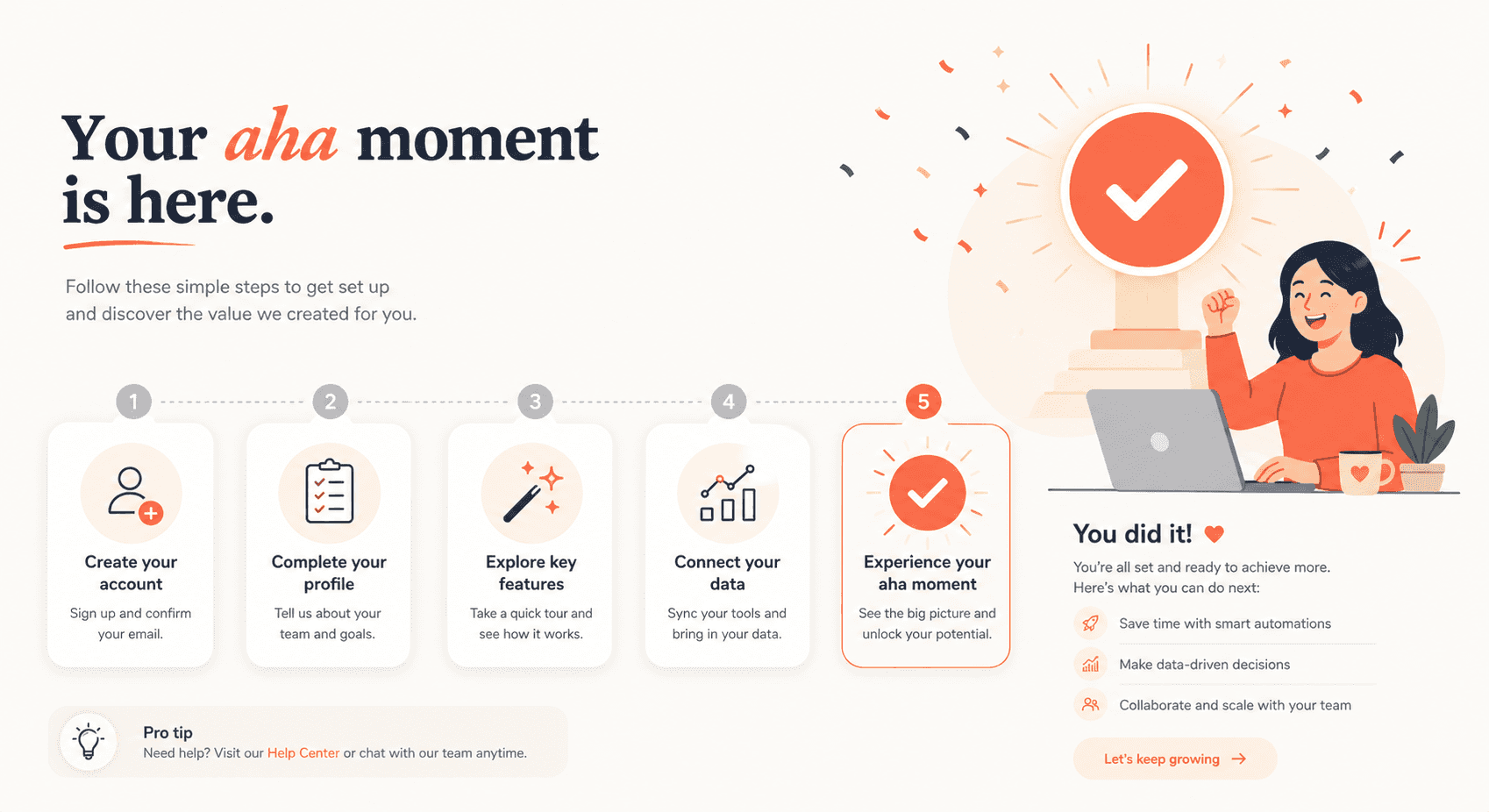
Previously, we've focused on individual customer journeys, but building cohorts of new customers creates powerful collaborative experiences that can significantly accelerate time to value acceleration. When you group customers with similar onboarding timelines or use cases together, you foster an environment where they can share their journeys and learn from each other's experiences.
These collaborative customer experiences allow participants to bond over shared challenges and discoveries, creating a sense of community that extends beyond the initial onboarding period. Customers in cohorts often develop a better understanding of their role in utilizing your product because they can observe how peers approach similar problems and opportunities.
Your cohort-based approach transforms onboarding from a solitary experience into a social learning environment where customers feel supported by both your team and their peers. This collaborative model often leads to higher completion rates, increased engagement, and stronger long-term relationships with your product and brand.
Start Expansion Conversations During Onboarding
Monitor Usage Growth Signals Early
When your customers begin their journey with your product, you have a unique opportunity to identify expansion potential from day one of the customer onboarding process. Rather than waiting weeks or months to discover growth opportunities, you can establish monitoring systems that track usage patterns as they develop during the initial setup phase.
Your onboarding process becomes a valuable data collection period where customer behavior reveals their true needs and potential. By implementing usage tracking from the moment customers first log in, you gain insights into how quickly they adopt features, which functionalities they gravitate toward, and where they might be pushing against the boundaries of their current package.
This early monitoring approach transforms your onboarding from a simple setup process into an intelligence-gathering operation. You'll notice when customers are utilizing features at higher rates than their plan typically supports, when they're exploring advanced functionality, or when their team size grows beyond their initial subscription. These signals become your roadmap for strategic expansion conversations that feel natural and timely rather than pushy or premature.
Trigger Upsell Discussions When Customers Outgrow Packages
Now that you have systems in place to monitor usage growth signals, you can proactively initiate expansion conversations at the optimal moment. Instead of adhering to rigid timelines that might miss these crucial windows, your approach should be responsive to actual customer behavior and needs demonstrated during their onboarding experience.
When your monitoring systems indicate that customers are approaching or exceeding their plan limitations during setup, this becomes the perfect trigger for upsell discussions. Your customers are actively experiencing the value of your product and simultaneously encountering the natural boundaries of their current package. This creates an ideal scenario where expansion feels like a logical next step rather than an unwanted sales pitch.
The key is timing these conversations to coincide with moments of high engagement and demonstrated value realization. Your customer success onboarding team should be equipped with real-time data that shows usage patterns, enabling them to reach out when customers are most receptive to hearing about enhanced capabilities or increased capacity.
Use Onboarding Insights for Product Development Decisions
Previously, many organizations treat onboarding data as purely operational information, but you can leverage these insights to drive strategic product development decisions that ultimately impact your revenue potential. The patterns you observe during customer setup reveal valuable intelligence about feature adoption, user preferences, and common friction points that extend far beyond the onboarding process itself.
Your product development teams should have direct access to onboarding analytics that highlight which features customers adopt most quickly, where they encounter difficulties, and what additional capabilities they seek during their initial experience. This information becomes invaluable for prioritizing development resources and creating features that naturally drive expansion opportunities.
When you notice consistent patterns in how customers use your product during onboarding, these insights should inform decisions about feature development, package structuring, and pricing strategies. The data collected during these early interactions often reveals unmet needs that represent future revenue opportunities through new feature development or service offerings.
Celebrate Early Activation Wins as Revenue Milestones
With this in mind, transforming your perspective on early customer successes can significantly impact your long-term revenue growth strategy. Rather than viewing initial feature adoption or workflow completion simply as onboarding checkpoints, you should recognize these moments as direct contributors to your revenue pipeline and celebrate them accordingly.
Each activation milestone your customers achieve during onboarding represents a step closer to expansion opportunities and reduced churn risk. When customers successfully implement key features or reach usage thresholds, these wins indicate increased product stickiness and higher likelihood of future growth within their account.
Your approach to celebrating these milestones should reinforce the connection between customer success and business growth. By acknowledging these achievements as revenue-contributing events, you create a culture that recognizes the direct relationship between effective onboarding and long-term customer value. This perspective helps your team maintain focus on activities that drive both immediate activation and future expansion potential throughout the customer onboarding process.
Extend Onboarding for Long-Term Revenue Growth
Continue Engagement Beyond Initial Setup Phase
Now that we've covered the importance of starting expansion conversations during onboarding, you need to recognize that your customer onboarding process shouldn't end when users complete their initial setup. Extending your onboarding throughout your customer's first year creates a powerful foundation for long-term revenue growth and significantly impacts retention rates.
Your traditional approach might focus solely on getting customers up and running quickly, but this short-sighted strategy misses crucial opportunities for deeper engagement. When you continue your onboarding process beyond the initial setup phase, you're essentially creating multiple touchpoints that keep your product top-of-mind and demonstrate ongoing value. This extended engagement approach transforms what many consider a cost center into a revenue-generating engine.
The key lies in understanding that your customers' needs evolve as they become more familiar with your product. What seemed complex during initial setup becomes routine, and they're ready for more sophisticated features and use cases. By maintaining structured engagement throughout their first year, you position yourself to capture expansion opportunities that would otherwise slip through the cracks.
Your extended onboarding strategy should include regular check-ins, progressive feature introductions, and milestone celebrations that acknowledge their growing expertise. This approach not only strengthens the customer relationship but also provides valuable data about usage patterns and potential expansion opportunities.
Implement Advanced Learning Opportunities
With this extended engagement framework in mind, you must create advanced learning opportunities that move customers beyond basic setup into more sophisticated product usage. Your customers who successfully navigate initial onboarding are primed for deeper engagement, but without structured advanced learning paths, they often plateau in their product adoption.
During your extended onboarding period, you should implement progressive learning modules that build upon foundational knowledge. These advanced opportunities allow your customers to develop more sophisticated skills and discover features they might never have explored independently. This strategic approach to customer education directly impacts your onboarding revenue impact by increasing product stickiness and feature adoption.
Your advanced learning curriculum should be carefully sequenced, introducing more complex functionalities as customers demonstrate mastery of prerequisite skills. Consider creating specialized tracks for different user roles or use cases within your customer's organization. This personalized approach to onboarding best practices ensures that each user receives relevant, actionable training that enhances their daily workflows.
The beauty of implementing these advanced learning opportunities lies in their dual benefit: customers become more proficient users who extract greater value from your product, while you gain insights into which features drive the most engagement and satisfaction.
Monitor Customer Retention Throughout First Year
Previously, we've established that extended onboarding creates more engagement opportunities, but you must also systematically monitor customer retention throughout their first year to understand the true impact of your onboarding program quality. The length and quality of your customer onboarding process significantly influences long-term retention rates, making this monitoring essential for optimizing your revenue outcomes.
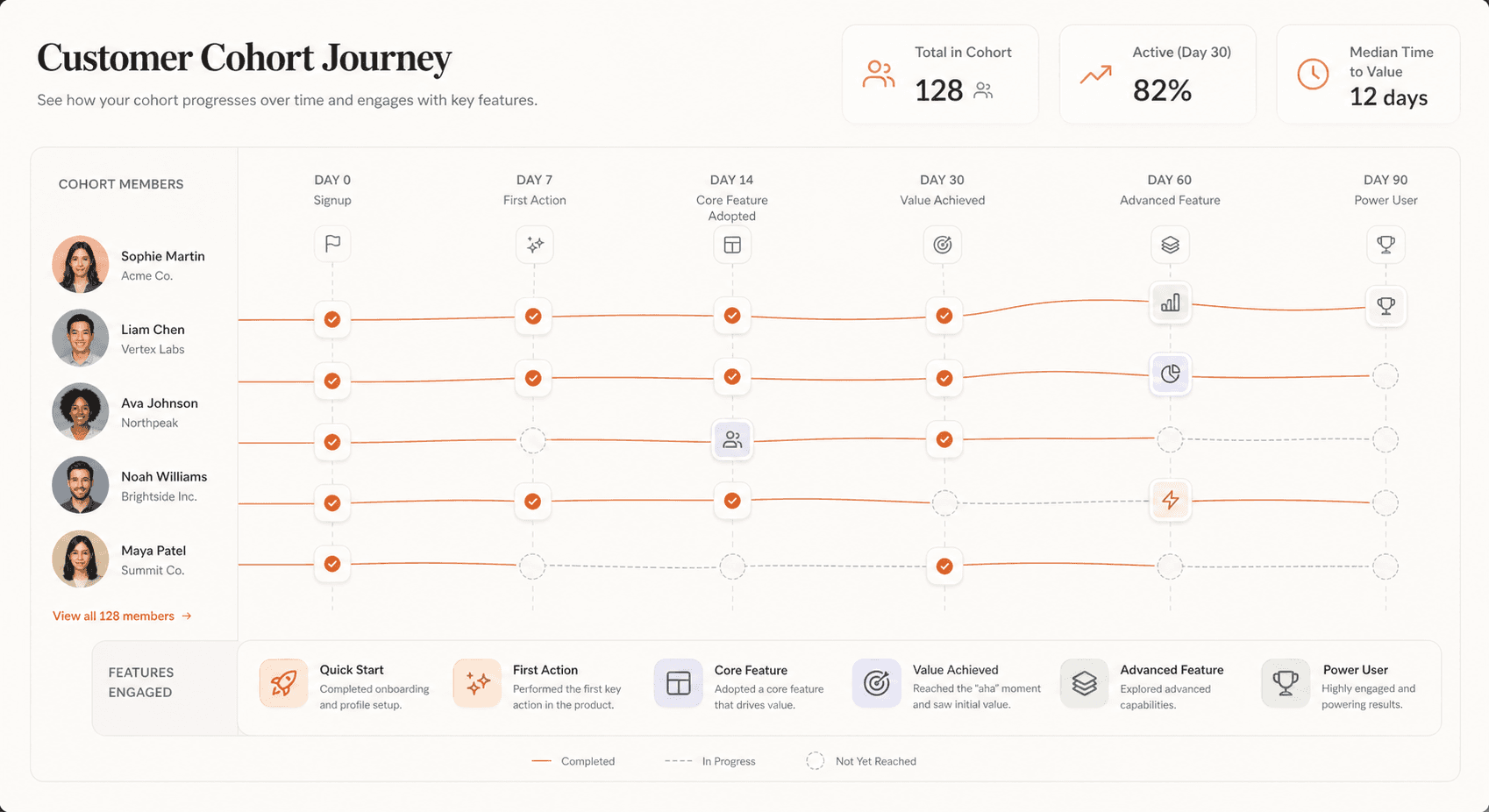
Your retention monitoring should track multiple metrics beyond simple subscription renewals. Look at feature adoption rates, support ticket frequency, user engagement scores, and expansion activity throughout the first twelve months. This comprehensive view helps you identify potential churn risks early while also highlighting successful onboarding patterns you can replicate.
When you analyze retention data in conjunction with onboarding program participation, you'll likely discover strong correlations between extended engagement and customer lifetime value. Customers who participate in advanced learning opportunities and maintain regular contact with your team during their first year typically show higher retention rates and increased product usage.
Your monitoring system should include automated alerts for customers showing declining engagement patterns. This early warning system allows you to intervene with targeted re-engagement campaigns or additional support before retention becomes a serious concern.
Adapt Processes for Internal Customer Transitions
Now that you understand the importance of continuous monitoring, you need to address one of the most overlooked aspects of extended onboarding: adapting your processes for internal customer transitions. When your customers experience role changes or departmental moves within their organization, they essentially need "reboarding" to maintain their product proficiency and engagement levels.
These internal transitions represent both a risk and an opportunity for your revenue growth. Without proper support during role changes, previously engaged users might reduce their product usage or fail to transfer their knowledge to new team members. However, when you proactively address these transitions with adapted onboarding processes, you can strengthen relationships and identify new expansion opportunities within the organization.
Your reboarding process should include role-specific training modules, updated access permissions, and introductions to features relevant to their new responsibilities. This approach ensures that transitioning users receive the necessary training and support to remain productive and engaged with your product.
Additionally, internal transitions often signal organizational growth or restructuring, which can present natural expansion opportunities. By maintaining close relationships with users throughout these changes, you position yourself to understand evolving needs and propose solutions that support their new objectives.
Conclusion
Slow onboarding isn't just an operational hiccup, it's a revenue roadblock that costs you real money every day. When your customers can't get up and running quickly, you can't recognize revenue, start expansion conversations, or prove value. By transforming your onboarding into a strategic revenue enablement system, you accelerate time-to-value and create the foundation for healthy, growing accounts.
The path forward is clear: automate manual processes that slow customer progress, design strategic workflows that drive usage-based activation, and extend onboarding beyond initial setup to support long-term revenue growth. Stop asking "How do we close more deals?" and start asking "How do we get customers using and paying faster?" Your revenue engine depends on it, and your customers deserve it.




About the author
I’m the founder of Hashbyt, an AI-first frontend and UI/UX SaaS partner helping 200+ SaaS companies scale faster through intelligent, growth-driven design. My work focuses on building modern frontend systems, design frameworks, and product modernization strategies that boost revenue, improve user adoption, and help SaaS founders turn their UI into a true growth engine.
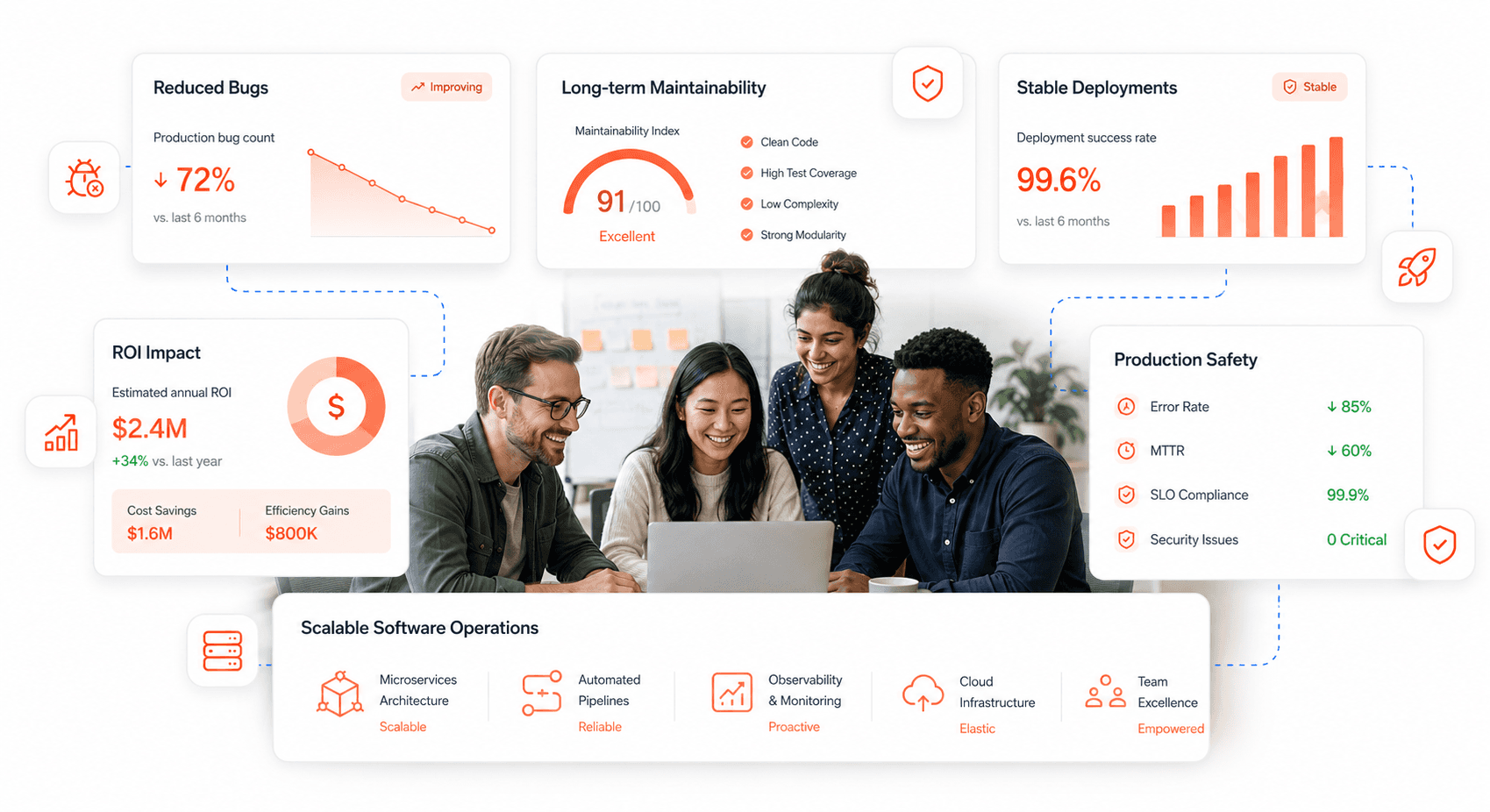
Is a clunky UI holding back your growth?
Is a clunky UI holding back your growth?
▶︎
Transform slow, frustrating dashboards into intuitive interfaces that ensure effortless user adoption.
▶︎
Transform slow, frustrating dashboards into intuitive interfaces that ensure effortless user adoption.
