

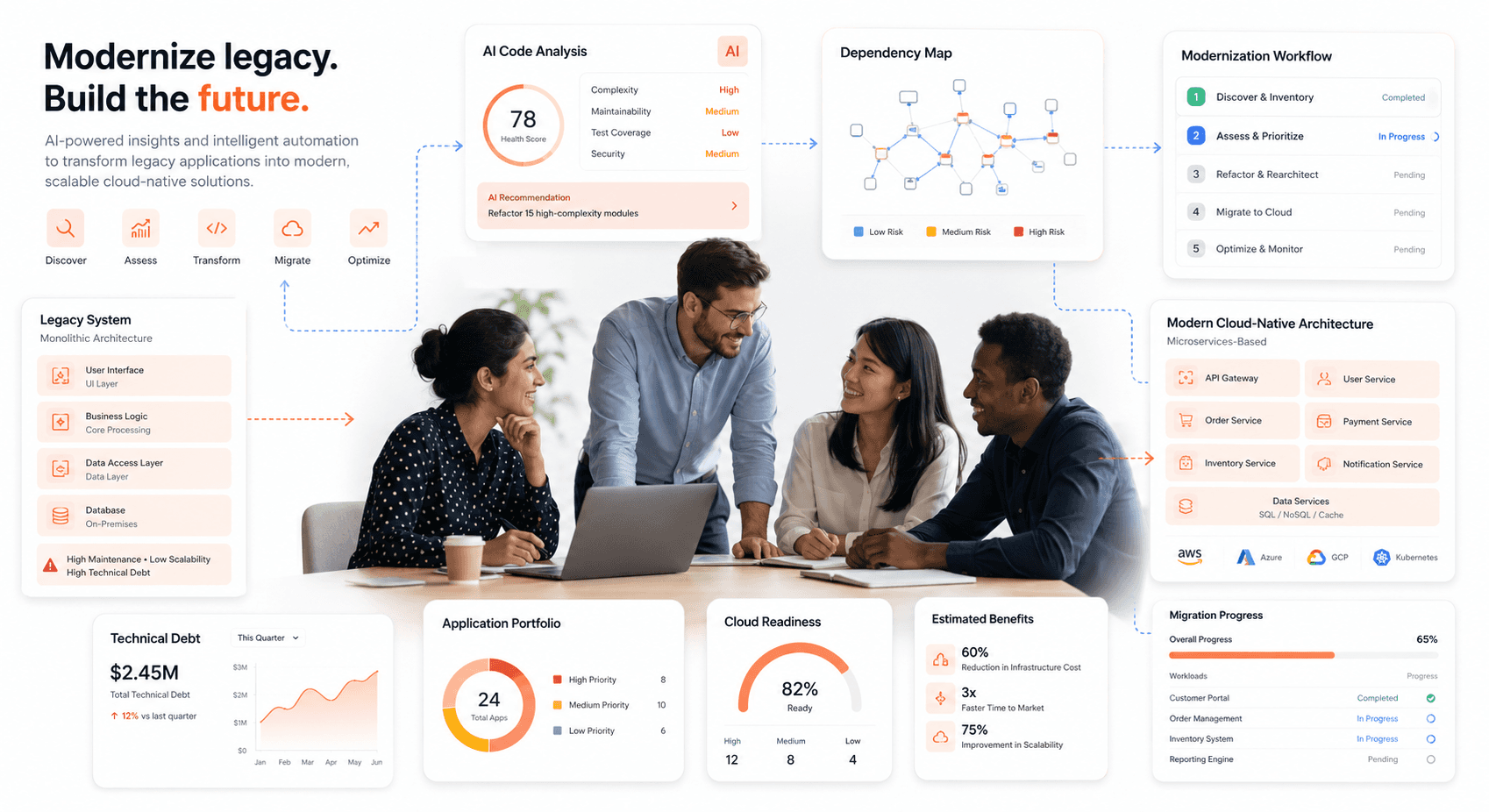
AI app modernization has fundamentally changed what is possible for engineering teams managing complex legacy systems. Teams using AI-driven modernization workflows are cutting refactoring time by 30–50% and reducing production bugs by over 40%, not by replacing developers with AI, but by making AI a daily collaborator that makes every stage of the modernization journey faster, safer, and more predictable. This guide walks through the complete legacy system modernization AI process from initial AI-powered discovery and assessment through to distributed system transformation giving engineering teams, architects, and tech leads a practical framework they can use immediately.
This guide is for engineering teams, architects, and tech leads working with complex legacy systems who need to modernize faster while reducing risk. You'll learn how AI can cut refactoring time by 30-50% and slash production bugs by over 40% transformation.
We'll walk through conducting comprehensive AI-powered discovery and assessment to understand your current system's technical debt and modernization opportunities. You'll also discover how to validate AI capabilities through proof of concept testing, ensuring the tools actually work for your specific codebase before committing to a full migration. Finally, we'll cover creating AI-assisted migration roadmaps and planning that prioritize modules for maximum business value while minimizing disruption.
The goal isn't replacing your developers with AI, it's turning AI into your team's daily collaborator to make modernization faster, safer, and more predictable.
AI App Modernization Phase 1: Conducting Comprehensive AI-Powered Discovery and Assessment
Performing thorough legacy system audits with AI tools like Sourcegraph Cody
Legacy system audits traditionally rely on manual processes, static analysis tools, and subjective evaluations that often fall short in uncovering the true depth of system complexity. However, AI-powered tools are transforming this foundational phase by introducing unprecedented accuracy, speed, and depth to the assessment process.
Modern AI-driven audit tools can automatically document applications, their interdependencies, and system performance metrics by analyzing API calls, data flow diagrams, and runtime logs to create real-time maps of system behavior. These tools employ advanced static and dynamic analysis capabilities, where static analysis evaluates syntax and structural issues including cognitive complexity, dead code, and potential bugs, while dynamic analysis runs real-time simulations to uncover performance bottlenecks, concurrency issues, and memory leaks.
AI-powered platforms can scale across thousands of files and modules, completing comprehensive audits in days rather than weeks. They provide deep analysis using compiler graphs combined with AI summarization of business logic, offering a unified model that analyzes across code, APIs, data flows, and UI layers. This approach generates auto-generated dependency graphs with runtime flow, data lineage, and API path mapping that manual processes often miss or only partially capture.
The audit process also includes creating searchable knowledge bases from entire codebases, tickets, wikis, databases, and other relevant sources. These AI tools can parse legacy languages specifically and integrate multiple data sources natively, providing strong contextual understanding to support accurate system assessment and modernization planning.
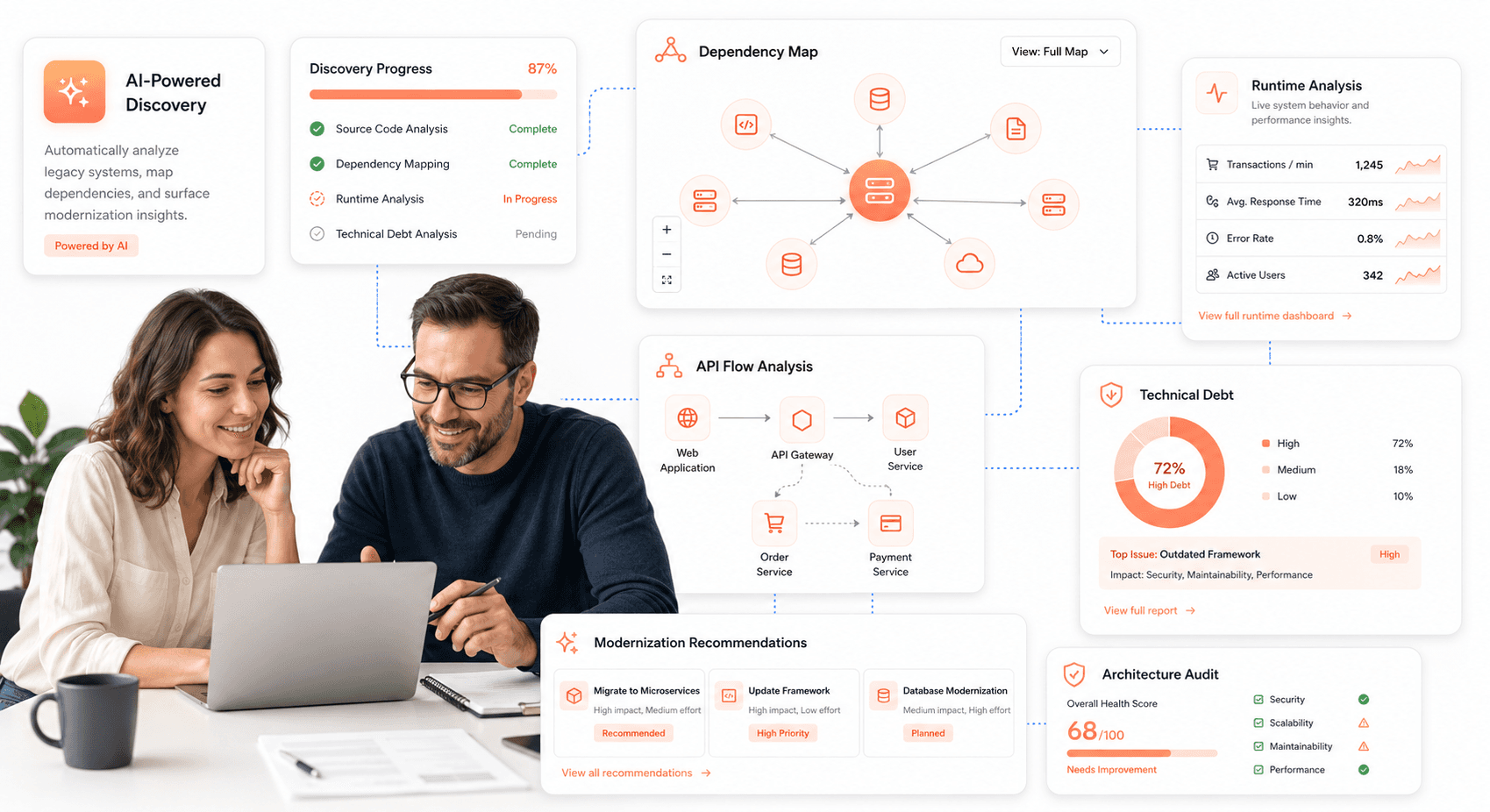
Generating technical debt reports highlighting critical modernization areas
AI-enhanced technical debt analysis goes far beyond traditional manual reviews by performing both comprehensive static and dynamic code evaluations. These advanced systems generate detailed technical debt reports that prioritize issues based on severity and business impact, providing organizations with actionable insights rather than generic estimates or subjective scoring.
The AI-driven approach evaluates multiple dimensions of technical debt simultaneously. Static analysis examines code complexity by measuring cyclomatic complexity to assess readability and scalability, identifies security vulnerabilities that may compromise data or operations, and highlights integration challenges with newer technologies. Dynamic analysis complements this by running real-time simulations to detect performance bottlenecks, concurrency issues, and memory leaks that only manifest during system execution.
Modern AI platforms deliver severity-ranked technical debt insights tied directly to impact on performance, cost, and scalability. Unlike traditional assessments that provide disconnected scans across siloed tools, AI-powered solutions offer unified analysis that maps security risks and anti-patterns inline with code and architecture. This integration ensures that technical debt reports include comprehensive visibility into how logic connects to business processes through UI-to-logic flow maps, API documentation, and natural language summaries accessible to business teams.
These reports adapt to varying levels of system access, accommodating situations where full codebase or infrastructure data isn't available while still providing directional insights. The AI-generated outputs are traceable, validated by subject matter experts, and tailored to specific system architectures, ensuring that every recommendation aligns with real-world operational constraints and business objectives.
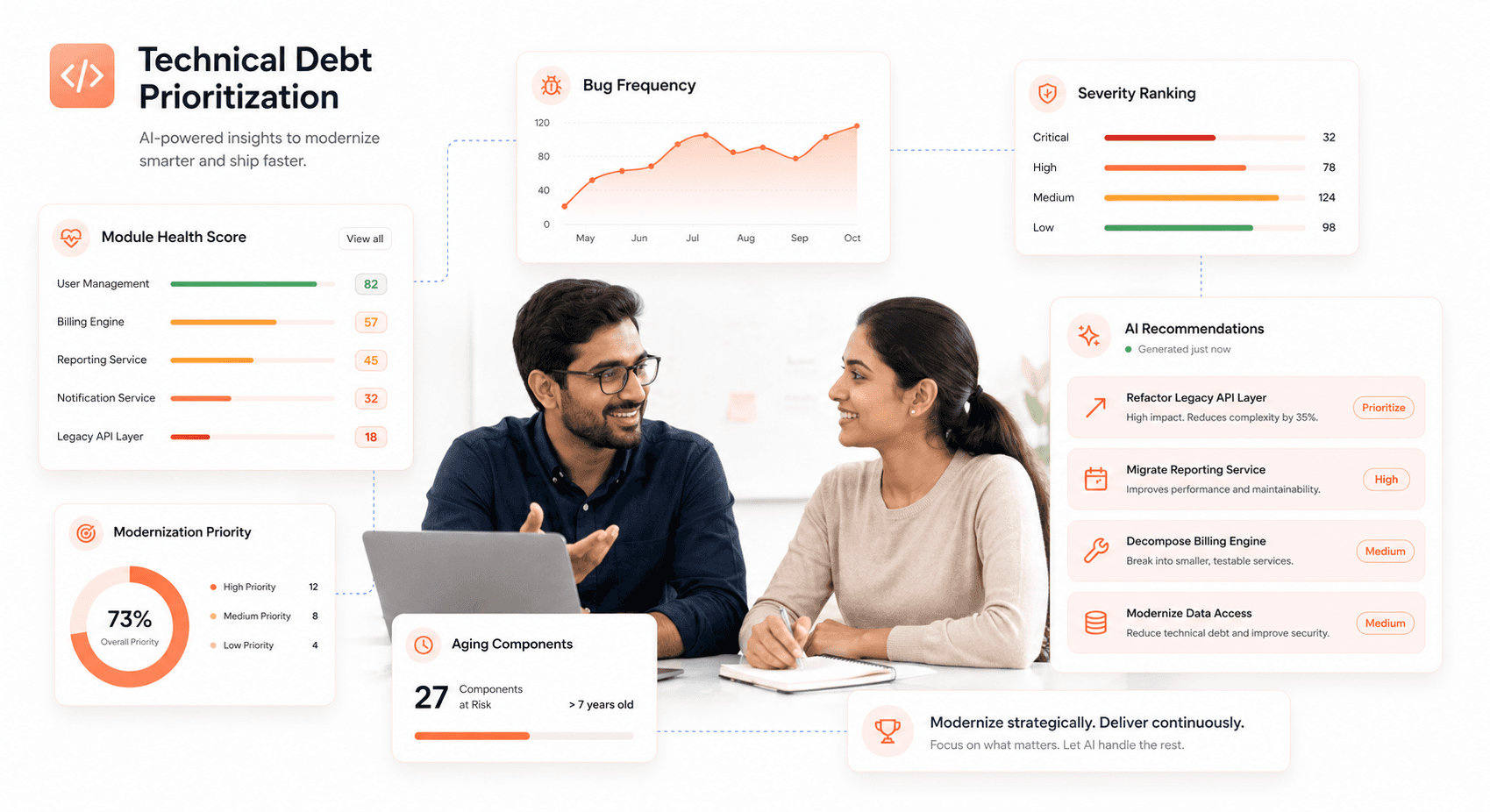
Identifying modules with highest priority based on age and bug frequency
AI-powered discovery tools excel at analyzing system usage patterns, module autonomy, frequency of changes, and resource utilization to identify the most critical modernization candidates. By evaluating legacy systems comprehensively, AI models can assess the coupling and scalability of individual modules, helping define clear boundaries for potential microservices while maintaining system integrity.
The prioritization process leverages multiple data sources including runtime logs, issue tracking systems, and code repository history to create comprehensive priority matrices. AI tools can sync with platforms like Jira and Redmine to surface related code patterns and automatically generate fix recommendations with detailed implementation guides. This integration allows for real-time analysis of bug frequency patterns, identifying modules that exhibit high maintenance overhead or frequent production issues.
Before AI-powered discovery can surface meaningful insights, teams managing aging AngularJS codebases need a clear picture of their frontend architecture, our guide to angular frontend modernization covers exactly what that assessment looks like in practice.
Business-critical modules that demonstrate frequent updates are automatically flagged as high-priority candidates for standalone services, while legacy dependencies are identified for phased refactoring approaches. The AI analysis considers factors such as module age, technical debt accumulation, security vulnerability exposure, and integration complexity to generate weighted priority scores.
Advanced AI platforms provide visual diagrams of proposed modernization sequences, enabling teams to plan transitions effectively and iteratively. These tools generate natural language summaries that explain the business logic and operational impact of each prioritized module, ensuring that modernization decisions align with both technical requirements and business continuity needs. The result is a data-driven modernization roadmap that focuses effort on modules with the highest return on investment and lowest implementation risk.
Phase 2: Validating AI Code Refactoring Capabilities Through Proof of Concept Testing
Selecting small legacy system components for trial modernization
Now that we have completed our comprehensive AI-powered discovery and assessment, the next critical phase involves careful selection of pilot components for proof of concept testing. The key to successful AI-driven modernization lies in choosing manageable, well-defined legacy system components that can serve as effective testing grounds without disrupting critical business operations.
Focus on isolated modules with clear input-output boundaries, such as specific API endpoints, data processing functions, or standalone utilities. These components should represent typical challenges found throughout your legacy codebase while remaining small enough to complete validation within days rather than weeks. Consider selecting components that have existing documentation, established test cases, or frequent usage patterns that will provide clear comparison metrics.
Testing AI code conversion tools like Claude Codeconvert for API updates
With targeted components identified, the validation process centers on testing AI code conversion capabilities under controlled conditions. AI-powered tools can analyze legacy code patterns, understand business logic, and generate modernized equivalents that maintain functional integrity while adopting current architectural standards.
During this testing phase, experienced developers should maintain close oversight of the conversion process, documenting both successful transformations and areas where AI tools require additional guidance. This hands-on evaluation helps establish realistic expectations for AI effectiveness across different code complexity levels and identifies specific scenarios where human expertise remains essential.
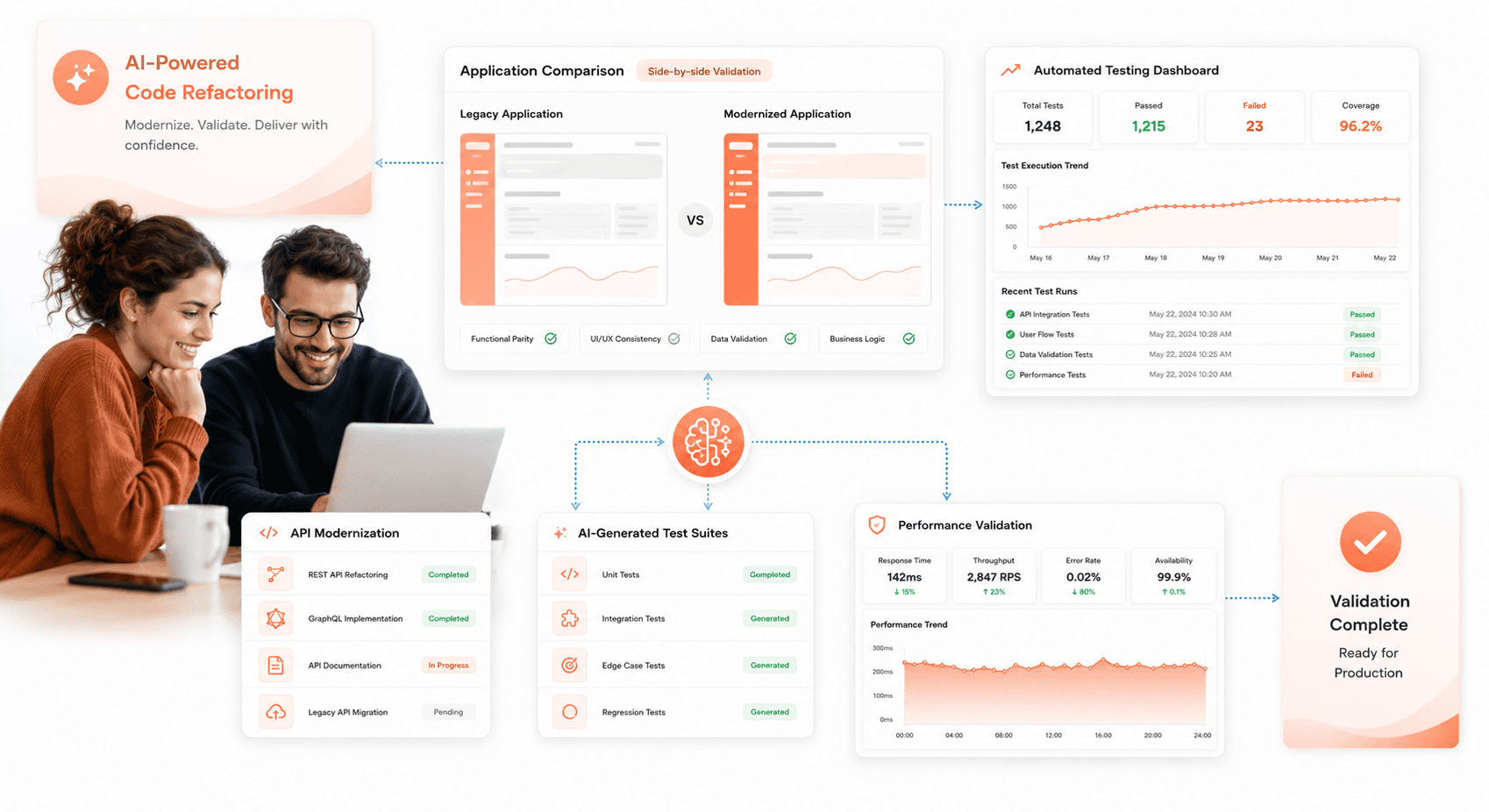
Comparing old and new system outputs using AI-generated test suites
Validation requires rigorous comparison between legacy and modernized system outputs to ensure functional equivalence. AI-generated test suites provide comprehensive coverage by automatically creating test scenarios that exercise both systems under identical conditions, capturing edge cases and boundary conditions that manual testing might overlook.
These automated comparisons should measure performance metrics, data accuracy, error handling, and behavioral consistency across various input scenarios. The testing process validates not only that the modernized code produces correct results but also that it maintains the reliability and predictability that business operations depend upon.
Assessing AI effectiveness under experienced developer supervision
The final validation component involves systematic assessment of AI tool effectiveness with experienced developer oversight. This evaluation focuses on measuring accuracy rates, identifying common failure patterns, and establishing guidelines for when human intervention becomes necessary during the modernization process.
Experienced developers should document the types of legacy code structures that AI handles effectively versus those requiring manual refinement. This creates a knowledge base that informs broader modernization planning, helping teams set realistic timelines and resource allocation for full-scale implementation while building confidence in AI-assisted development workflows.
Phase 3: Building Your AI Migration Roadmap - Dependency Mapping, Phased Strategies, and Success Metrics
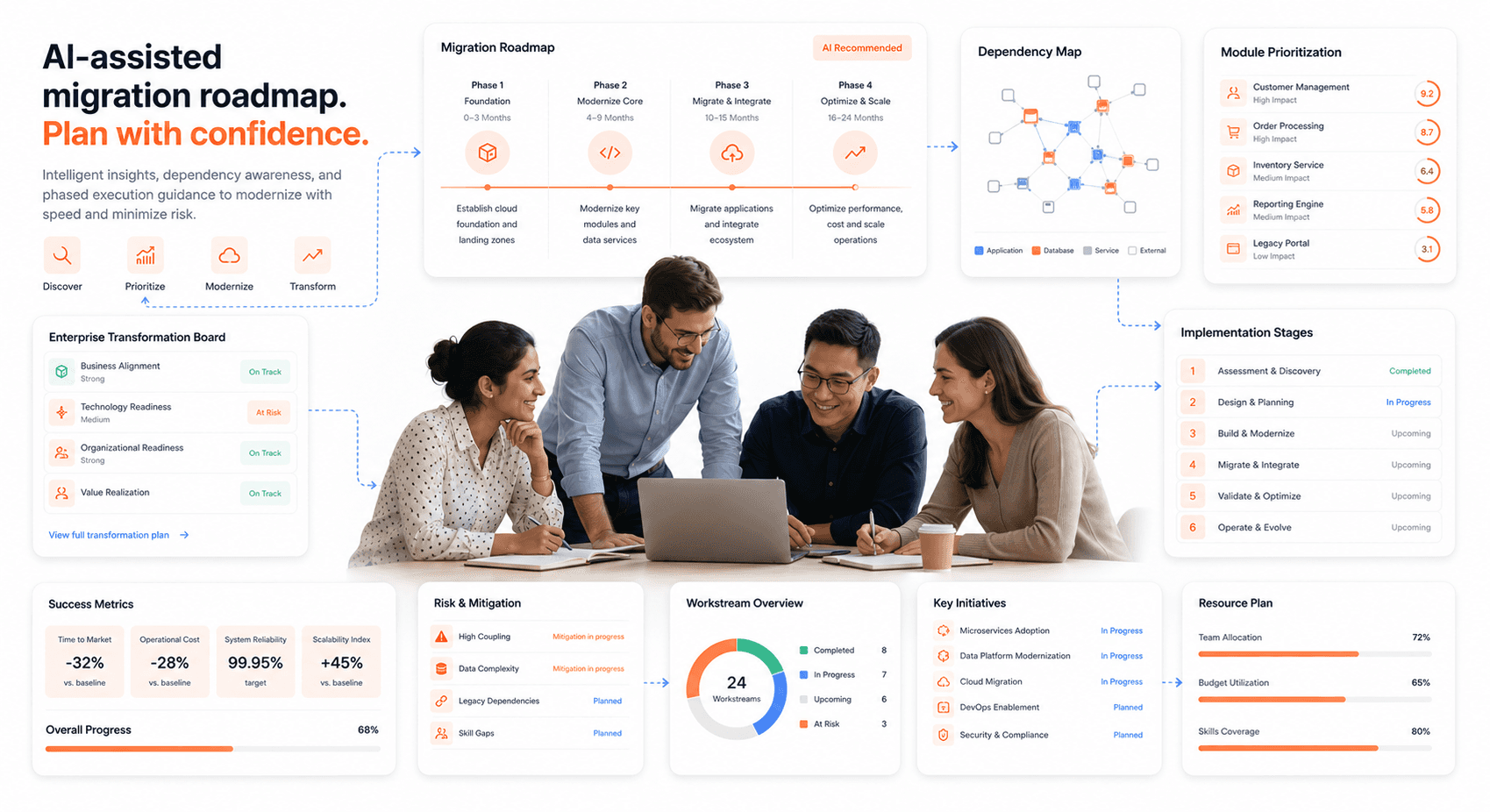
Developing dependency maps and module prioritization with AI analysis
Now that we have covered the initial discovery and assessment phase, the next critical step involves leveraging AI to create comprehensive dependency maps and establish clear module prioritization strategies. AI-powered analysis tools excel at identifying complex interdependencies between legacy systems, applications, and databases that traditional mapping methods often miss. These automated systems can analyze millions of records and applications across multiple departments, as demonstrated by major organizations like Coca-Cola during their migration to Google Cloud.
The AI analysis process begins by examining existing IT systems to understand how various components interact with one another. This includes identifying data flows, API dependencies, and integration points that could impact migration sequencing. By using predictive analytics and machine learning models, AI tools can forecast potential compatibility issues and highlight critical pathways that require careful handling during the modernization process.
Module prioritization becomes significantly more accurate when AI algorithms evaluate factors such as business criticality, technical complexity, and interdependency risks. The system can recommend which modules should be migrated first based on their impact on overall operations and the likelihood of successful transition with minimal disruption.
Designing phased implementation strategies that minimize risk and maximize value
With dependency mapping complete, AI-driven planning enables the creation of sophisticated phased implementation strategies that address the complexity of migration processes while minimizing operational risks. Traditional migration methods often rely heavily on manual configurations and lack the automation necessary to handle complex legacy systems, leading to extended timelines and inflated costs.
For teams modernising enterprise-scale systems specifically, our enterprise app modernization guide covers the portfolio assessment framework and ROI business case that supports AI-assisted phased planning.
AI-powered migration platforms streamline these processes by automatically identifying optimal migration sequences and predicting resource requirements for each phase. The system analyzes workload patterns, usage statistics, and performance metrics to determine the most efficient order of operations. This approach ensures that critical business functions remain operational while less essential systems undergo transformation.
The phased strategy also incorporates real-time monitoring capabilities that enable continuous assessment of migration progress. AI algorithms can detect anomalies, predict potential issues, and automatically adjust the implementation timeline to prevent service disruptions. This dynamic approach allows businesses to maintain customer trust and operational efficiency throughout the modernization journey.
Risk mitigation strategies are embedded within each phase, with AI tools providing predictive insights about potential challenges and recommended mitigation approaches. The system can schedule migration activities during off-peak times to reduce business interruption, similar to how Johnson & Johnson achieved minimal downtime during their Azure migration.
Establishing success metrics and performance benchmarks for each stage
Previously established dependency maps and phased strategies now require comprehensive metrics frameworks to measure modernization success. AI-assisted planning excels at defining quantifiable success metrics that align with both technical objectives and business goals. These metrics encompass performance improvements, cost optimization targets, and operational efficiency gains that can be tracked throughout each migration phase.
Performance benchmarking leverages AI's ability to analyze historical data and predict expected outcomes for each modernization stage. The system establishes baseline measurements from current legacy systems and projects anticipated improvements in areas such as processing speed, scalability, and resource utilization. Real-time monitoring tools, combined with AI-driven validation, ensure that actual performance meets or exceeds these benchmarks.
Success metrics also include data integrity measurements, security compliance indicators, and user experience improvements. AI algorithms continuously compare actual results against established benchmarks, providing early warning signals when performance deviates from expected outcomes. This enables proactive adjustments to migration strategies before issues impact business operations.
Cost-related benchmarks are particularly important, as AI-powered cost optimization tools can accurately forecast infrastructure needs and prevent unnecessary expenses. Organizations like Johnson & Johnson achieved significant cost savings through Azure's AI-driven resource optimization, demonstrating the value of establishing clear financial success metrics from the outset.
Determining optimal AI tool deployment across different modernization phases
With this comprehensive planning foundation in place, the final step involves strategically deploying AI tools across different phases of the modernization journey. The deployment strategy must align with the specific requirements and complexity levels of each migration stage, ensuring that the most appropriate AI capabilities are utilized when and where they provide maximum value.
Early phases typically benefit from AI tools focused on discovery, assessment, and dependency mapping. These tools leverage artificial intelligence and predictive analytics to identify compatibility issues and optimize workloads before physical migration begins. As the process advances, deployment shifts toward automation tools that handle workload configurations, security compliance, and resource allocation with minimal manual intervention.
Advanced phases require sophisticated AI capabilities for real-time migration monitoring, automated error detection, and dynamic resource scaling. Machine learning algorithms become particularly valuable during these stages, as they can learn from migration patterns and continuously improve their recommendations for subsequent phases.
The deployment strategy also considers the specialized requirements of different system types. For instance, AI Foundation Models (LLMs) migration requires specific tools for adjusting prompts, pipelines, and frameworks, while traditional application migration focuses more on compatibility and performance optimization. Specialized migration frameworks, such as those designed for transitions between specific platforms, are deployed based on the technical stack being modernized.
Tool integration across phases ensures seamless handoffs and consistent data flow throughout the modernization process. AI-driven coordination mechanisms manage the activation and deactivation of different tools as the project progresses, maintaining operational continuity while optimizing resource utilization at each stage.
Phase 4: Daily AI Development Workflows, Code Generation, Testing, Documentation, and Code Review
Accelerating component and service creation with AI code generation
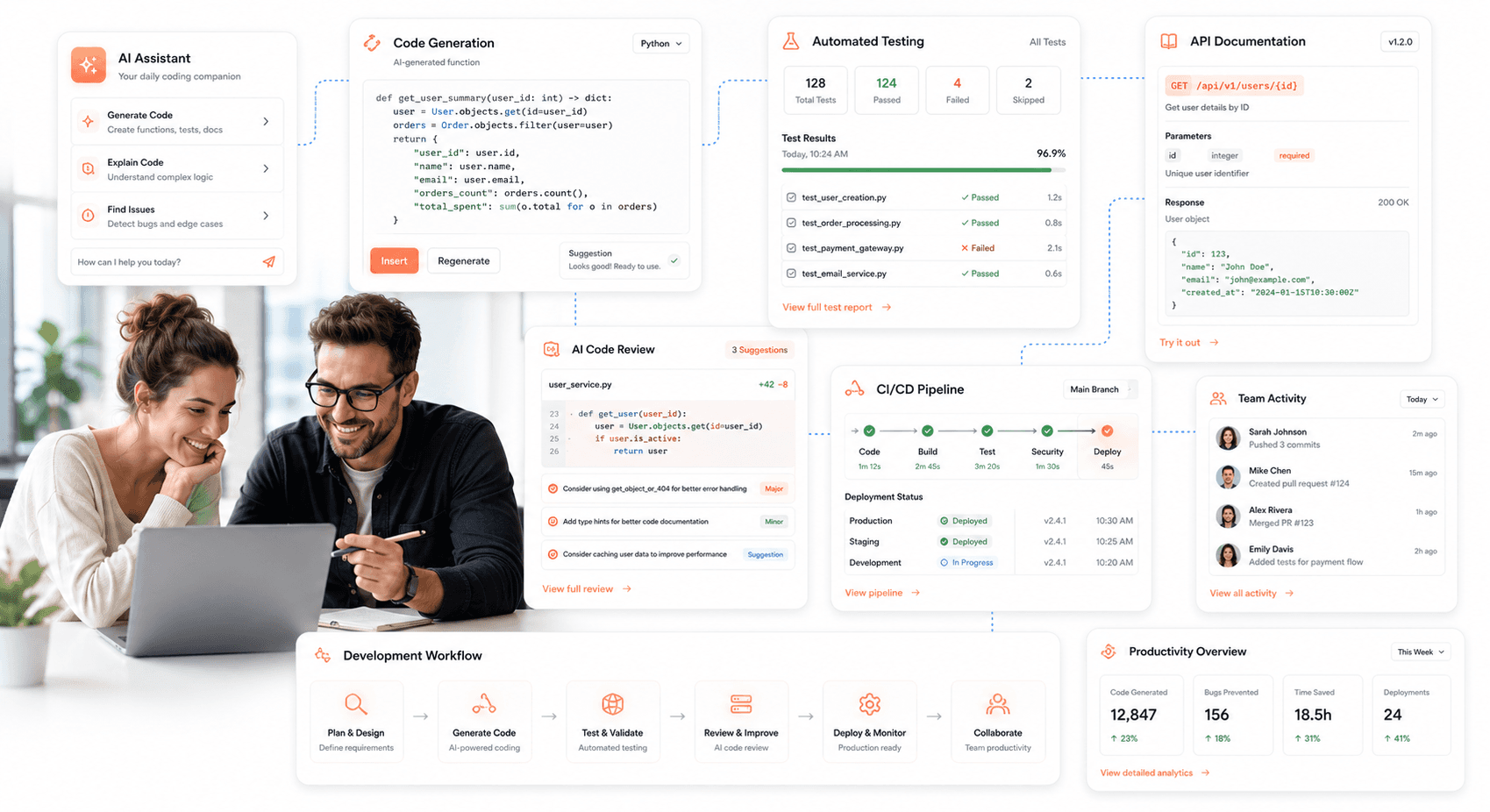
AI-powered code generation transforms component and service creation by automating repetitive development tasks while maintaining code quality. Modern AI workflow automation tools enable developers to generate functional components through natural language prompts, dramatically reducing time-to-value for new features. These platforms allow teams to specify requirements in plain English and receive production-ready code that follows established patterns and conventions.
The most effective AI code generation workflows incorporate built-in evaluations and versioning systems. Teams can compare different code variants side-by-side, test generated components against golden datasets, and promote only implementations that meet quality thresholds. This approach ensures that AI-generated code maintains reliability while accelerating development cycles.
Low-code AI platforms bridge the gap between technical and non-technical team members, enabling product managers and designers to contribute to component creation without deep programming knowledge. Engineers can then extend these initial implementations using SDKs and custom nodes, adding sophisticated logic and integrations as needed.
Automating comprehensive test suite development including end-to-end testing
AI workflow automation revolutionizes test suite development by generating comprehensive test cases that cover both unit and end-to-end scenarios. These systems analyze component behavior patterns and automatically create test scenarios that validate functionality across different user paths and edge cases.
Modern AI testing workflows incorporate regression testing capabilities that continuously evaluate new changes against established baselines. When code modifications are made, AI systems can automatically generate additional test cases to cover new functionality while ensuring existing features remain intact. This automated approach significantly reduces the manual effort required to maintain comprehensive test coverage.
Teams that want to validate the user-facing layer before automating test coverage should first conduct a UX audit, it surfaces friction patterns that automated test suites won't catch without a human baseline.
The integration of AI-powered test generation with existing development workflows enables teams to achieve higher test coverage with less manual intervention. AI systems can identify potential failure points and generate specific test cases targeting these vulnerabilities, resulting in more robust applications and reduced production incidents.
Streamlining documentation creation for APIs and legacy modules
AI workflow automation transforms documentation creation from a time-consuming manual process into an efficient automated workflow. These systems analyze code structure, API endpoints, and legacy module functionality to generate comprehensive documentation that stays synchronized with actual implementation.
Modern documentation automation workflows can process existing codebases and extract meaningful descriptions, parameter definitions, and usage examples. AI systems analyze function signatures, return types, and code comments to create detailed API documentation that includes practical examples and integration guidelines.
For legacy modules, AI-powered documentation tools excel at reverse-engineering complex systems and creating clear explanations of functionality that may lack original documentation. These workflows can identify dependencies, data flows, and integration points, producing documentation that helps teams understand and maintain older systems more effectively.
Enhancing code review processes with AI-powered analysis tools
AI-enhanced code review processes provide real-time analysis that identifies potential issues, suggests improvements, and ensures adherence to coding standards. These systems complement human reviewers by catching common errors, security vulnerabilities, and performance bottlenecks that might be overlooked during manual reviews.
Advanced AI code review workflows incorporate context-aware analysis that considers project-specific patterns and conventions. The systems learn from previous review decisions and team preferences, providing increasingly relevant suggestions over time. This approach maintains consistency across development teams while reducing the time required for comprehensive code reviews.
AI-powered analysis tools provide detailed traces and metrics for every review, enabling teams to track code quality improvements and identify patterns in common issues. These insights help establish better coding practices and inform training decisions for development teams, creating a continuous improvement cycle that enhances overall code quality.
Phase 5: AI-Driven Modernization Architecture - Microservices, CI/CD Integration, and Proactive Monitoring
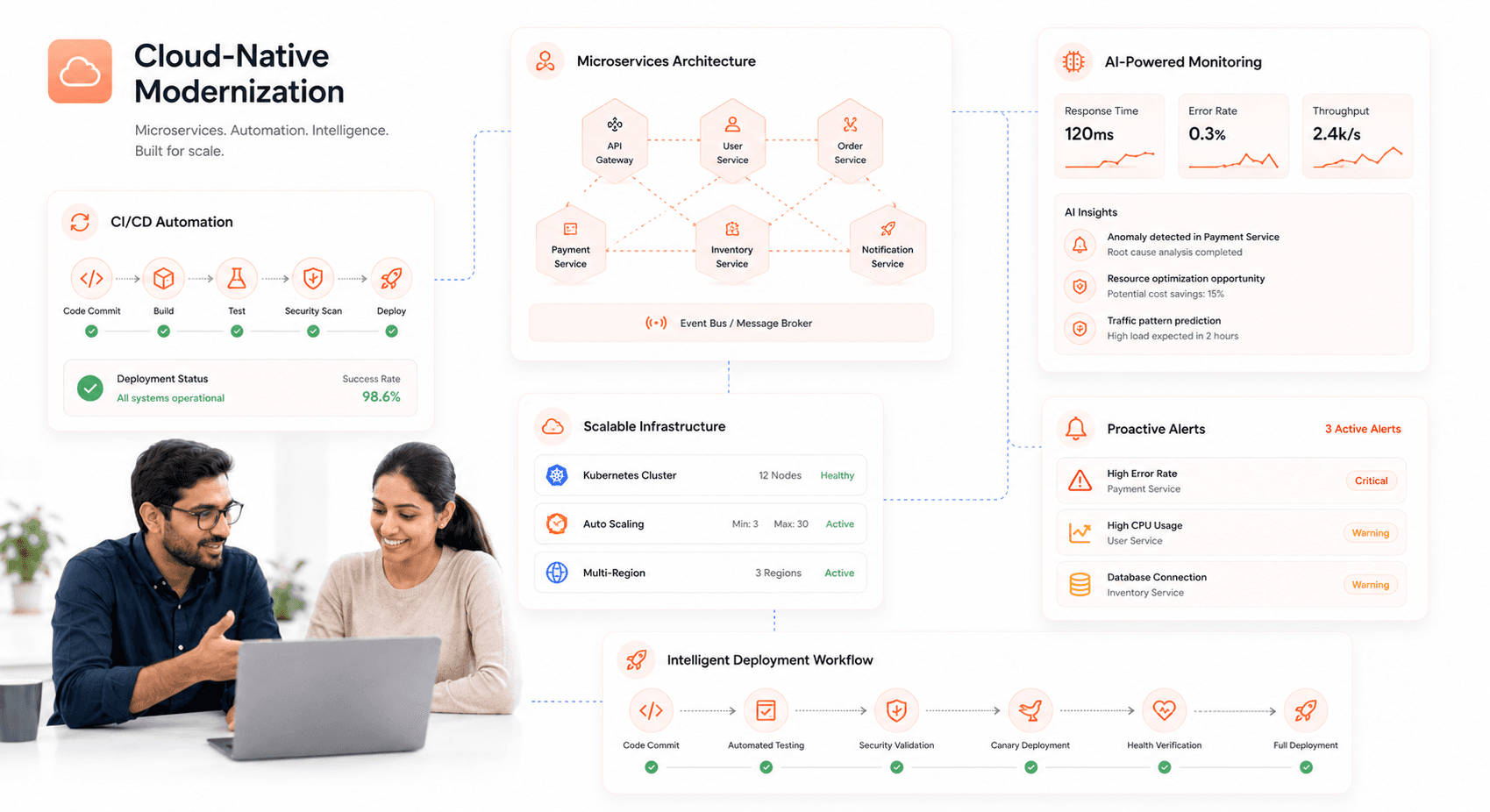
Utilizing AI for system architecture analysis and microservices recommendations
Now that we have established the foundation through discovery and proof of concept testing, AI-driven architectural analysis becomes the cornerstone of effective modernization. Modern AI platforms combine static and dynamic analysis with data science to reveal architectural debt and enable domain-driven design approaches that were previously impossible with traditional methods.
Runtime insights provide the critical context that LLMs need to make meaningful architectural decisions beyond simple code upgrades. While LLMs excel at upgrading code and containerizing workloads, they require system-wide visibility and business alignment to modernize the architecture of complex applications effectively. This is where AI-augmented platforms generate structured refactoring plans that guide code assistants in transforming Java and .NET monoliths into cloud-native services delivering results up to 15 times faster than traditional manual methods.
The architectural analysis process visualizes complex application structures, revealing hidden dependencies and technical debt patterns that impact modernization decisions. For enterprises managing applications with millions of lines of code and thousands of classes, AI platforms provide insights that traditional tools simply cannot deliver, enabling teams to break massive monoliths into manageable, modular blocks instead of attempting to modernize one enormous system.
Implementing intelligent testing and system comparison methodologies
With architectural insights established, intelligent testing methodologies become essential for validating modernization decisions and ensuring system reliability throughout the transformation process. AI-powered testing frameworks provide automated system comparison capabilities that identify performance differences, functional gaps, and integration issues between legacy and modernized components.
These methodologies leverage runtime analysis to understand application behavior under various conditions, enabling teams to establish baseline performance metrics and validate that modernized services meet or exceed original system capabilities. The intelligent testing approach reduces the risk associated with architectural changes by providing continuous feedback on system health and performance characteristics.
Automated comparison systems track key metrics including response times, throughput, error rates, and resource utilization, allowing teams to make data-driven decisions about service extraction timing and rollback strategies. This approach ensures that modernization efforts deliver measurable improvements rather than simply moving complexity from one system to another.
Integrating AI into CI/CD pipelines for automated optimization and rollbacks
Previously established testing methodologies now integrate seamlessly into CI/CD pipelines, where AI provides continuous oversight and automated decision-making capabilities. This integration enables teams to detect and remediate complexity in both monolithic and distributed applications as part of the standard software development lifecycle.
AI-enhanced pipelines automatically optimize deployment strategies based on real-time system performance data, application complexity metrics, and historical deployment outcomes. When issues arise, intelligent rollback mechanisms can automatically revert changes while preserving data integrity and minimizing service disruption.
The continuous modernization approach ensures that technical debt doesn't accumulate over time, with AI monitoring code quality metrics, architectural drift, and performance degradation patterns. This proactive approach prevents the architectural complexity that typically builds up in distributed environments, maintaining system scalability and resilience throughout the application lifecycle.
Deploying AI-powered monitoring for proactive issue detection and maintenance
With CI/CD integration established, AI-powered monitoring extends beyond traditional metrics to provide deep architectural insights that prevent issues before they impact operations. Modern monitoring platforms use OpenTelemetry to deliver comprehensive visibility across distributed environments, identifying potential problems through pattern recognition and anomaly detection algorithms.
Proactive monitoring systems track architectural drift and prevent service sprawl in distributed applications, maintaining the benefits achieved through initial modernization efforts. These platforms provide ongoing oversight that helps teams avoid the complexity traps that often emerge as applications scale and evolve over time.
The monitoring approach focuses on preventing the types of morning alerts that typically plague IT teams failed API calls, delayed data synchronization, and stalled workflows caused by system integration issues. By identifying these patterns before they become critical problems, AI-powered monitoring enables teams to shift from reactive firefighting to proactive system optimization and innovation.
Phase 6: AI App Modernization Plans – Stakeholder Documentation, Phase Execution, and Version-Controlled Roadmaps
Creating Shareable Markdown-Based Modernization Strategies for Stakeholders
Now that we have covered the technical assessment and proof of concept phases, creating shareable documentation becomes critical for stakeholder alignment. Markdown-based modernization strategies serve as the foundation for cross-team communication, providing a format that's both developer-friendly and accessible to business stakeholders.
Effective modernization documentation must balance technical detail with strategic clarity. Rather than dwelling in granular features, elevate your approach and focus on themes that resonate across different organizational levels. A holistic view ensures your modernization strategy doesn't exist in a vacuum, particularly when it's part of a more extensive solution suite.
SaaS teams running modernization alongside active product development should also reference our SaaS product development checklist to ensure infrastructure, security, and deployment requirements are captured in the same planning phase.
Key components of shareable modernization strategies include:
Strategic Intent linking the modernization project to corporate strategy and goals
Value Proposition demonstrating the measurable benefits of the modernization effort
Competitive Environment analysis showing how modernized systems relate to market positioning
Feasibility Assessment indicating that objectives can be realistically achieved
Financial Model illustrating projected costs and benefits with clear ROI metrics
The documentation should provide context that only project managers typically possess - a 360-degree view of stakeholder perspectives that shaped the modernization strategy. Explain why decisions were made and how various opinions and insights were synthesized into the final plan.
Establishing Clear Phase-by-Phase Execution Paths with Prioritized Actions
With stakeholder-aligned documentation in place, the next critical step involves breaking down the modernization journey into manageable phases with clearly prioritized actions. This phase-by-phase approach prevents the common pitfall of jumping from idea to implementation without sufficient consideration of project objectives.
Successful modernization execution requires balancing short-term wins with long-term objectives. Your roadmap should quickly address pain points or improve key metrics while still accomplishing significant strategic initiatives. When there isn't room for both immediate and future goals, consider creating distinct execution paths for different timelines.
Essential elements of phase-by-phase planning include:
Phase Type | Focus Areas | Key Deliverables |
|---|---|---|
Discovery | Current state assessment, stakeholder alignment | Baseline documentation, risk assessment |
Foundation | Core infrastructure modernization | Platform upgrades, security improvements |
Enhancement | Feature modernization, performance optimization | User experience improvements, scalability gains |
Innovation | Advanced capabilities, competitive advantages | New functionality, market differentiation |
Leave room for technical debt within your primary modernization roadmap. Creating separate documentation for "have-to-dos" often results in these critical items being continuously pushed out, amplifying their impact and cost over time. Address technical debt proactively to prevent future crises.
Prioritization should be grounded in research rather than intuition. Base estimates on past performance data to ensure realistic timelines. Acknowledge risks openly - not every initiative will be successful, and identifying known unknowns demonstrates responsible planning.
Building Version-Controlled Documentation That Integrates with Engineering Workflows
Previously, we've established the importance of stakeholder-aligned documentation and phased execution planning. With this foundation in mind, version-controlled documentation becomes the operational backbone that integrates modernization planning with daily engineering workflows.
Version-controlled modernization documentation serves multiple critical functions beyond simple record-keeping. It creates a living system that evolves with the project while maintaining historical context and decision rationale. This approach ensures that engineering teams, product managers, and stakeholders all work from the same source of truth.
Integration with engineering workflows requires documentation that:
Maintains consistency across all team members and project phases
Provides regular updates as modernization progresses and requirements evolve
Supports collaborative editing allowing multiple contributors to add value
Tracks decision history showing how and why specific modernization choices were made
Links directly to code repositories creating seamless connections between planning and implementation
The documentation should expose the process used to arrive at modernization decisions. Share the methodologies and steps taken to prioritize initiatives, as well as limitations imposed by current resources and team capabilities. This transparency builds confidence among stakeholders that decisions are data-driven and well-considered.
Effective version control also enables consistent communication about project status. Stakeholders need regular updates about modernization progress, and version-controlled documentation provides a reliable mechanism for sharing these updates. Even brief status notes give confidence that the project remains on track while keeping everyone informed of current developments.
The integration extends beyond simple documentation storage. Modern version control systems enable automated workflows that can trigger notifications, generate reports, and maintain synchronization between planning documents and actual implementation progress. This automation reduces manual overhead while ensuring that documentation remains current and actionable throughout the modernization journey.
Supporting Complex Distributed System Modernization
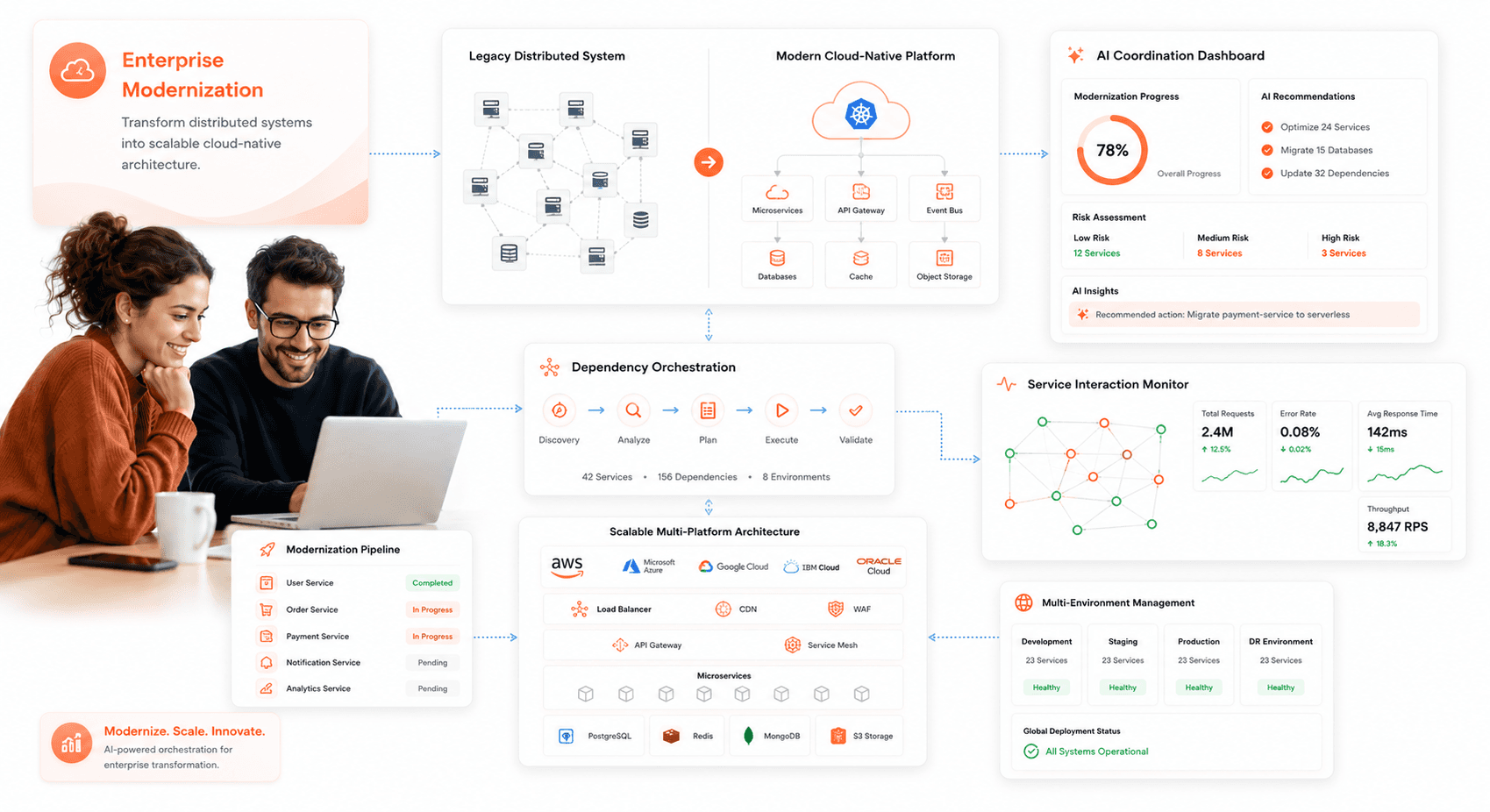
Analyzing Real Service Interactions and Dependencies in Distributed Architectures
Now that we have covered the planning phases of AI-driven modernization, it's time to address one of the most complex challenges: understanding the intricate web of dependencies within distributed systems. Traditional distributed computing architectures, originally designed around MapReduce paradigms and embarrassingly parallel problems, often fail to capture the dense, all-to-all communication patterns that modern applications require.
Teams modernising distributed systems often discover frontend performance bottlenecks that need addressing in parallel — our guide to best frontend frameworks for SaaS in 2026 covers which architectures support the real-time data and API-first patterns that distributed modernization requires.
AI-powered discovery tools can analyze actual service interactions by examining network traffic patterns, API call graphs, and data flow dependencies. These tools excel at identifying communication bottlenecks that aren't immediately obvious through static code analysis. For instance, when analyzing transformer-based architectures where every token potentially attends to every other token, AI can map the quadratic communication requirements that grow with system scale.
The analysis should focus on three critical areas:
Communication overhead patterns - Understanding how data movement between services impacts performance and energy consumption
Memory access dependencies - Identifying services that require frequent synchronization across massive parameter spaces
Temporal coupling relationships - Discovering services that exhibit phase-dependent behavior requiring different resource allocation strategies
Identifying Tightly Coupled Distributed Monoliths Requiring Intervention
Previously, we've seen how distributed systems often evolve into what appears to be microservices but function as distributed monoliths. AI analysis can detect these anti-patterns by examining synchronous communication requirements and identifying services that cannot function independently.
The key indicators of distributed monoliths include:
Pattern | Description | AI Detection Method |
|---|---|---|
Synchronous Dependencies | Services requiring immediate responses from multiple other services | Transaction flow analysis |
Shared Database Coupling | Multiple services directly accessing the same data store | Data access pattern mapping |
Cascading Failure Points | Single service failures causing system-wide outages | Fault propagation modeling |
AI-driven assessment tools can analyze these patterns across thousands of service interactions, something that would be impossible through manual review. The analysis should particularly focus on services that assume synchronous updates to maintain consistency - a principle borrowed from database systems that may be unnecessarily restrictive for modern AI workloads.
Generating Architectural Prompts for System-Level Improvements and Optimization
With this understanding of service dependencies, AI can generate specific architectural recommendations that address the unique demands of modern distributed systems. These prompts should focus on three core principles for AI-native distributed system design:
Asynchronous-First Design Recommendations
AI can identify opportunities to embrace bounded asynchrony, particularly in systems where training or processing is inherently robust to some inconsistency. The generated prompts might suggest replacing synchronous parameter servers with asynchronous alternatives that can tolerate and benefit from controlled inconsistency.
Hierarchical Communication Optimization
Rather than flat all-to-all communication patterns, AI can recommend hierarchical structures that exploit natural computational dependencies. For transformer architectures, this means optimizing attention patterns within layers differently from cross-layer dependencies, creating multi-tier communication strategies.
Adaptive Resource Allocation Strategies
AI-generated architectural prompts should account for phase-dependent behavior in distributed systems. Early processing phases might require different communication precision than later optimization phases, suggesting dynamic resource allocation approaches rather than static workload treatment.
Enabling Coordinated Transformation Across Multiple Services and Technologies
The final aspect of supporting complex distributed system modernization involves orchestrating changes across heterogeneous technology stacks. As organizations approach the limits of traditional scaling approaches and move toward specialized, heterogeneous computing architectures, coordination becomes increasingly critical.
Cross-layer optimization represents the most promising frontier for this coordination. AI can identify opportunities where:
Mixed-precision computation can be exploited intelligently across service boundaries
Gradient updates can use different precision than forward passes, reducing bandwidth requirements by 50% or more
Hardware-specific optimizations can be implemented while maintaining system portability
The transformation strategy should also prepare for the post-GPU era, where quantum-classical hybrid systems, neuromorphic processors, and optical computing platforms will require entirely new distributed computing paradigms. Organizations that succeed in this transition will be those that understand how to orchestrate complex, heterogeneous distributed systems rather than simply scaling traditional architectures.
AI-assisted coordination tools can manage the complexity of upgrading multiple services simultaneously while maintaining system availability and performance. This includes generating migration sequences that minimize risk, identifying rollback points, and ensuring that architectural improvements align with both current operational requirements and future scalability needs.
Conclusion
AI-driven app modernization represents a fundamental shift in how teams approach legacy system transformation. By implementing comprehensive discovery and assessment, validating capabilities through proof-of-concept testing, and creating AI-assisted migration roadmaps, organizations can significantly reduce refactoring time and production bugs. The most successful teams treat AI as a daily collaborator throughout their development workflows, leveraging it for advanced architectural strategies and generating actionable modernization plans that align cross-functional teams.
The evidence is compelling—teams using AI-assisted modernization are cutting refactoring time by 30-50% and reducing production bugs by over 40-50%. However, success ultimately depends on combining powerful AI tools with experienced developers who can guide the implementation process. As you embark on your modernization journey, remember that AI enhances human expertise rather than replacing it, making it possible to tackle even the most complex distributed system transformations with confidence and efficiency.




About the author
I’m the founder of Hashbyt, an AI-first frontend and UI/UX SaaS partner helping 200+ SaaS companies scale faster through intelligent, growth-driven design. My work focuses on building modern frontend systems, design frameworks, and product modernization strategies that boost revenue, improve user adoption, and help SaaS founders turn their UI into a true growth engine.
Is a clunky UI holding back your growth?
Is a clunky UI holding back your growth?
▶︎
Transform slow, frustrating dashboards into intuitive interfaces that ensure effortless user adoption.
▶︎
Transform slow, frustrating dashboards into intuitive interfaces that ensure effortless user adoption.
