

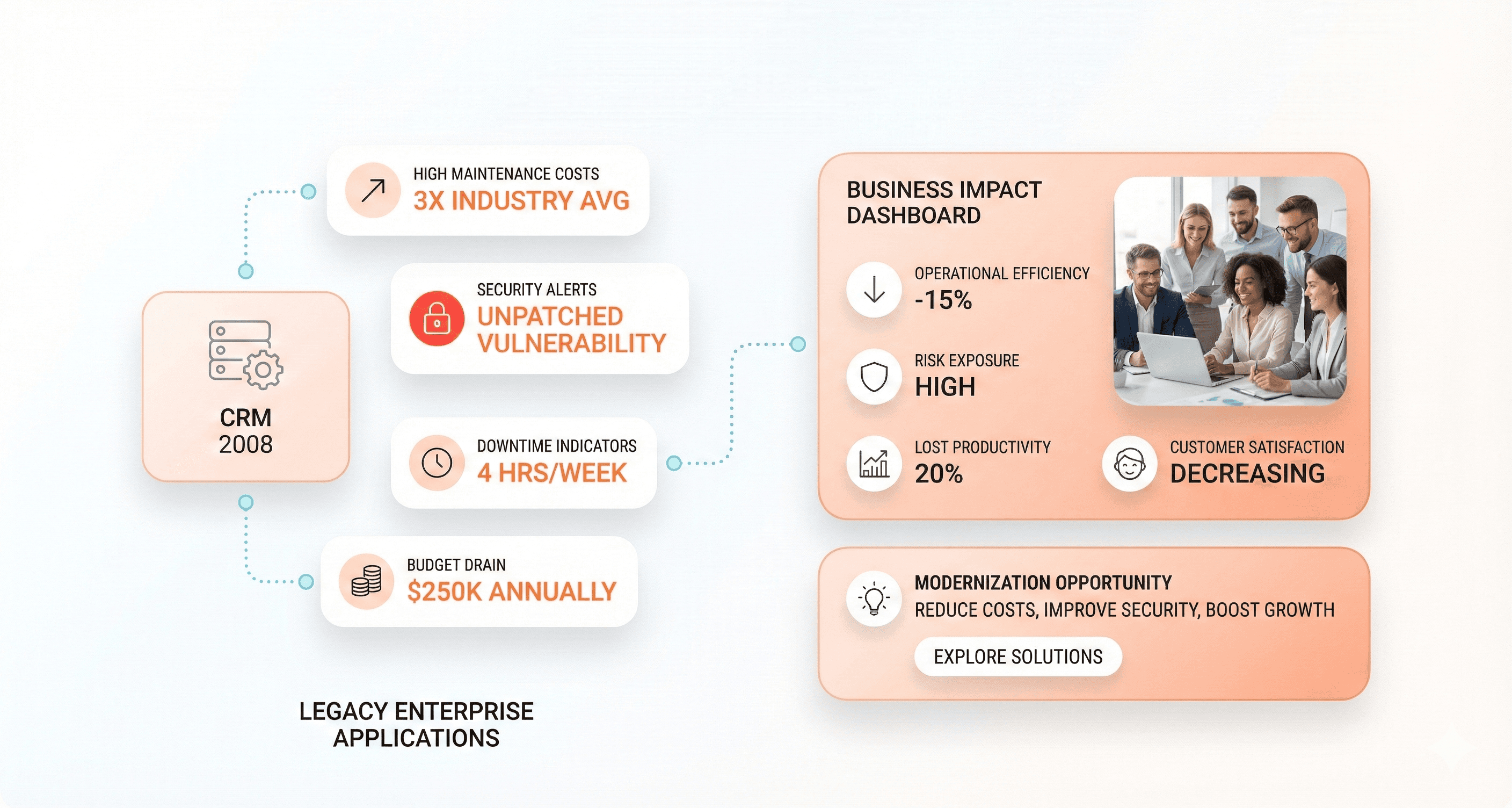
Legacy applications are holding your business back, and enterprise app modernization is how IT leaders break free. These aging systems drain IT budgets, frustrate users, and introduce security risks that slow innovation. Industry data shows enterprises spend 60–80% of their IT budget just maintaining legacy systems, leaving less than 30% for growth and innovation.
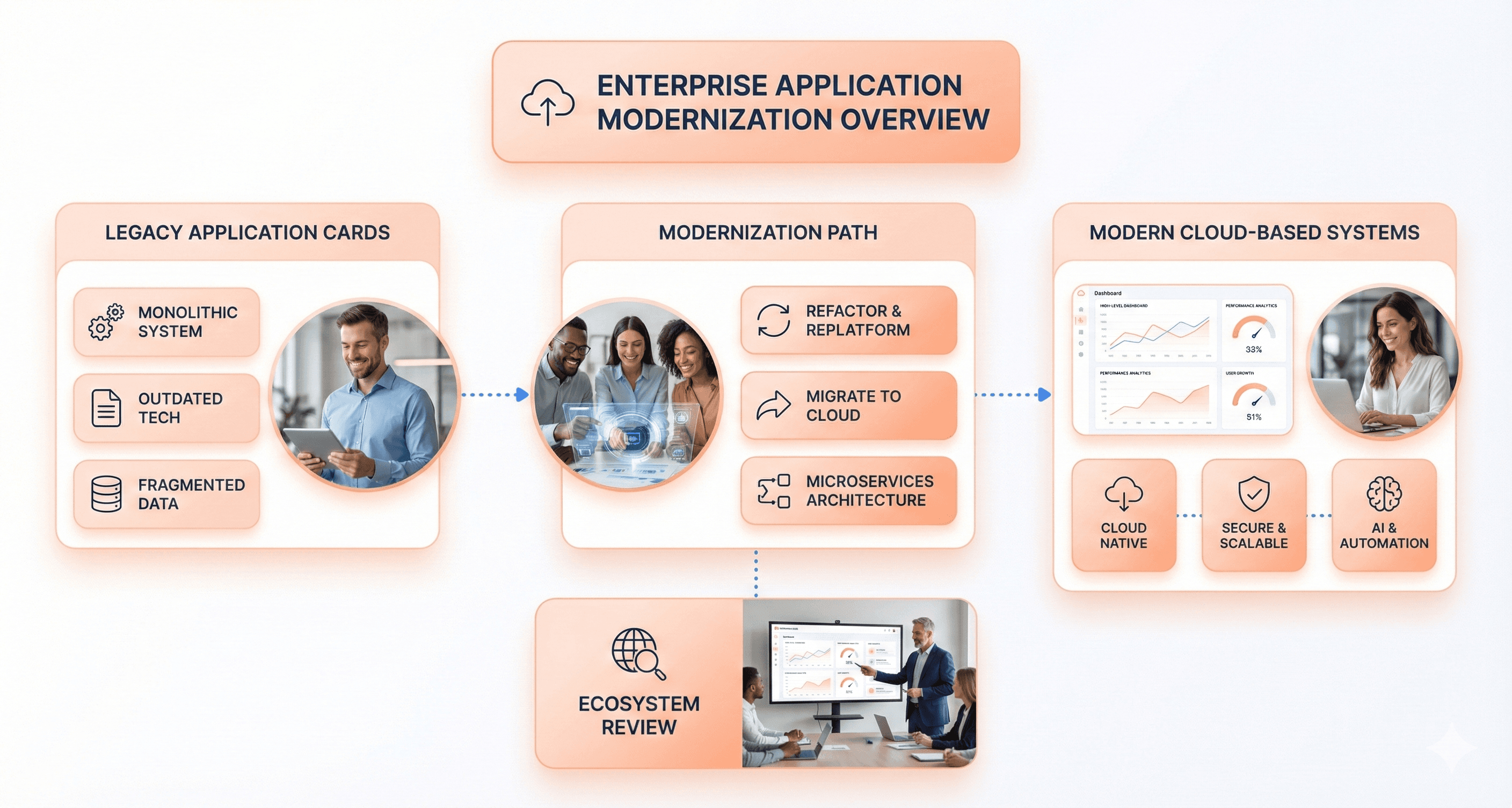
This guide explains how enterprise app modernization helps IT leaders transform legacy systems into secure, scalable, cloud-ready applications. It covers assessment frameworks, application modernization strategy selection, roadmap planning, security, ROI measurement, and the 2026 trends reshaping how enterprises modernize, including agentic AI-assisted refactoring.
As enterprises push toward digital transformation, legacy software becomes a critical barrier to scalability, compliance, and speed. Implementing the right legacy modernization services can help eliminate these barriers and unlock long-term growth.
This guide explains how enterprise app modernization helps IT leaders transform legacy systems into secure, scalable, cloud-ready applications. It covers assessment frameworks, modernization strategies, roadmap planning, security, and ROI measurement. Learn how to reduce operational costs, improve performance, and future-proof enterprise architecture while minimizing disruption across business-critical systems.
Why Enterprise App Modernization Is a Business Imperative in 2026
Hidden Costs and Risks of Legacy Enterprise Systems
Legacy applications drain resources through excessive maintenance costs, security vulnerabilities, and integration challenges. In 2026, many enterprises are modernizing legacy systems specifically to support AI initiatives, real-time analytics, internal developer platforms, and cloud-native architectures that older monolithic systems cannot efficiently support.
These outdated systems often require specialized talent that's increasingly scarce and expensive, while consuming significant portions of IT budgets. Hidden costs emerge from system downtime, compliance gaps, and missed business opportunities due to technological constraints.
How to Measure ROI from Application Modernization
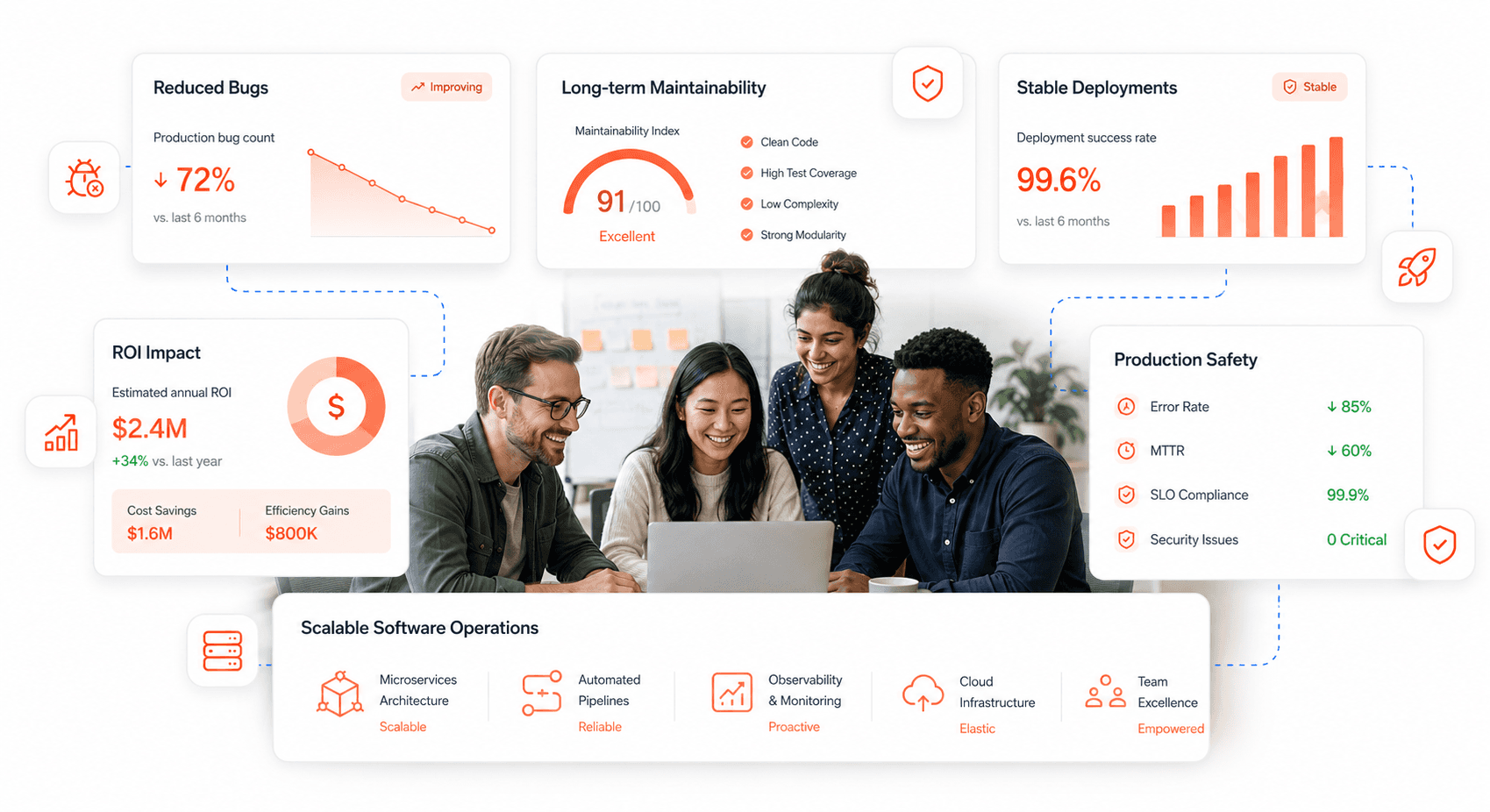
Smart organizations measure modernization success through tangible metrics like reduced operational costs, improved user productivity, enhanced system performance, developer velocity, cloud efficiency, operational resilience, and AI-readiness. Track key indicators such as deployment frequency, mean time to recovery, and user satisfaction scores. Calculate total cost of ownership over three to five years, including infrastructure savings, reduced maintenance overhead, and increased development velocity.
For benchmark data and a UX-specific audit framework, see our 2026 Enterprise UX Modernisation Report.
How to Assess Your Systems for Legacy Application Modernization
Application modernization must directly support broader business objectives like digital transformation, market expansion, or customer experience enhancement. Map each modernization initiative to specific business outcomes, whether improving time-to-market for new features, enabling data-driven decision making, or supporting remote workforce capabilities. This alignment ensures stakeholder buy-in and demonstrates clear value to executive leadership.
Enterprise App Modernization Assessment: Portfolio Evaluation Framework
Conducting Comprehensive Application Assessments
Modern portfolio assessments increasingly evaluate whether applications are:
cloud-native compatible,
API-ready,
AI-integratable,
containerization-ready,
and capable of supporting modern observability and automation workflows.
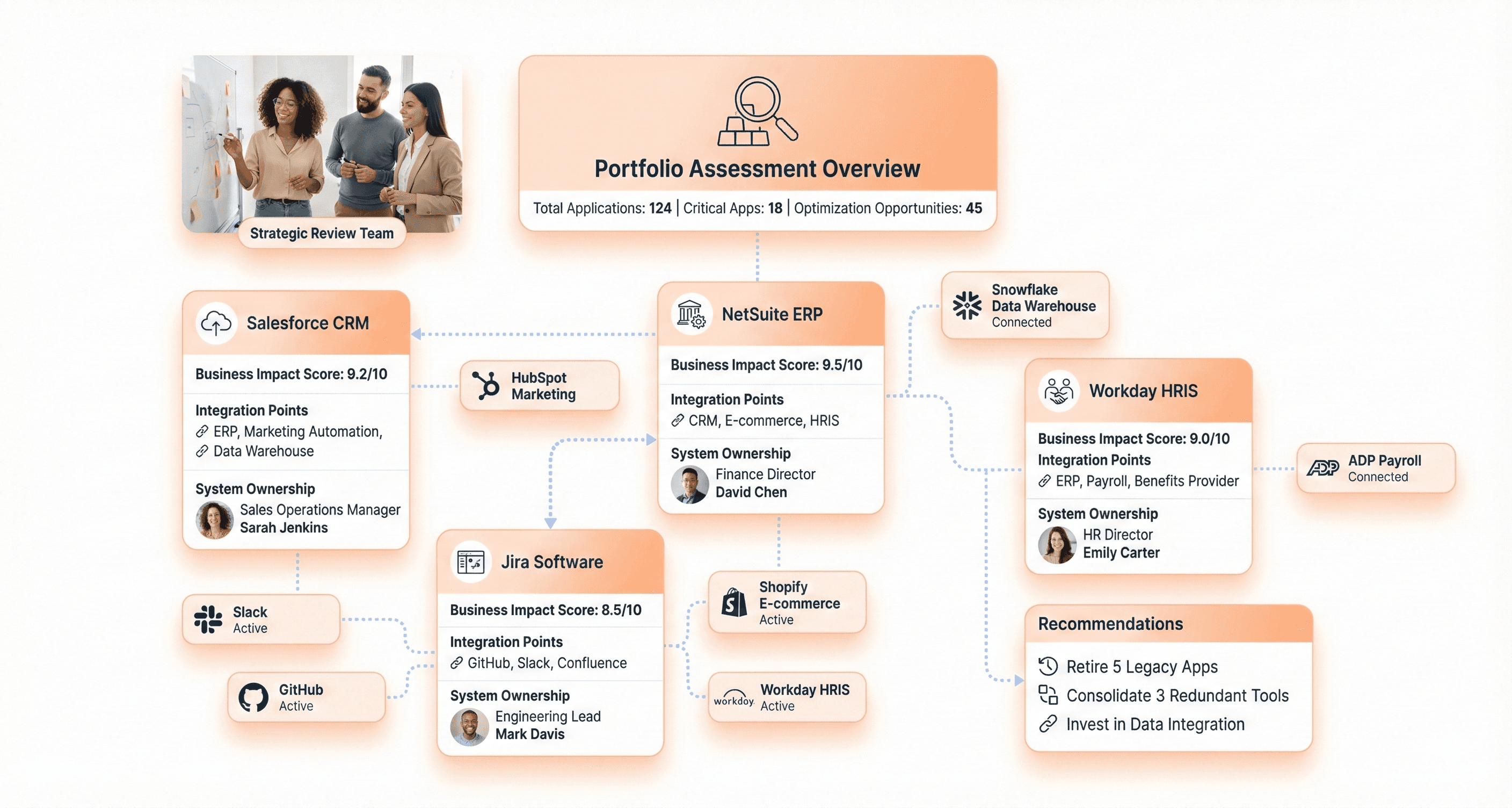
Start your modernization journey by creating a detailed inventory of every application in your enterprise ecosystem. Document technical specifications, business functions, user bases, and maintenance costs for each system. This assessment reveals which applications drain resources through outdated technologies, security vulnerabilities, or poor performance metrics.
Focus on gathering quantitative data about system performance, downtime incidents, and support tickets alongside qualitative feedback from end users and IT teams. Applications running on legacy platforms or requiring frequent manual interventions often emerge as prime modernization candidates during this evaluation phase.
Mapping Enterprise Application Dependencies
Enterprise applications rarely operate in isolation, making dependency mapping critical for successful modernization. Visual mapping tools help identify how data flows between systems, which APIs connect different platforms, and where single points of failure might disrupt business operations.
Pay special attention to shared databases, authentication systems, and middleware components that multiple applications depend on. Understanding these connections prevents costly surprises during migration and helps sequence modernization efforts to minimize business disruption.
Prioritizing Applications Based on Business Impact
Rank applications using a scoring matrix that weighs business criticality against technical debt and modernization complexity. Customer-facing systems that directly impact revenue typically receive highest priority, followed by applications supporting critical business processes.
Consider factors like user adoption rates, regulatory compliance requirements, and competitive advantages when assigning priority scores. Applications with high business value but manageable technical complexity often provide the best return on modernization investment.
Identifying Quick Wins vs Long-term Projects
Separate modernization candidates into quick wins that deliver immediate value and complex projects requiring extended timelines.
Quick wins might include cloud migration of stateless applications, API wrapper implementations, or user interface refreshes that improve user experience without major architectural changes.
Long-term projects typically involve core business systems requiring extensive re-architecture, data migration, or complete platform replacements. Balance your modernization portfolio with both types to maintain momentum while tackling complex challenges that drive significant business transformation.
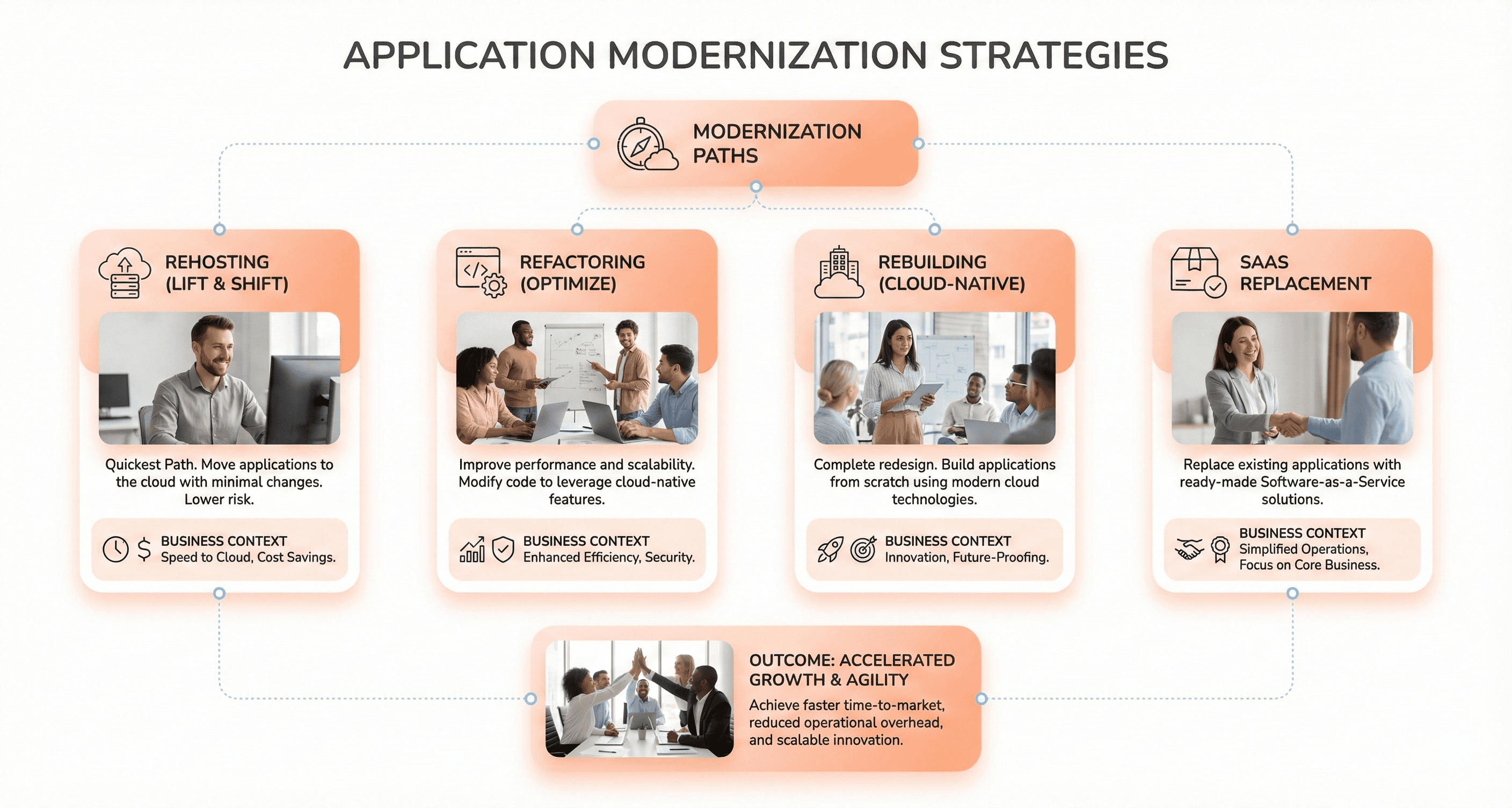
Application Modernization Strategy: Rehost, Refactor, Rebuild, or Replace, Which Fits Your Enterprise?
Rehosting Legacy Applications to the Cloud
Rehosting is the fastest way to modernize legacy systems without touching core architecture, a lift-and-shift approach that moves applications to cloud infrastructure and reduces data center costs while improving scalability. McKinsey research shows early cloud adopters report 20–30% cost reductions and 40% faster time-to-market making rehosting the lowest-risk entry point for enterprises beginning their modernization journey. Early cloud adoption report 20–30% cost reductions and 40% faster time-to-market according to McKinsey, making rehosting the preferred first step for risk-averse IT leaders.
Refactoring Legacy Code for Performance and Scalability
Selective code improvements unlock better performance without full application rewrites. Teams focus on bottlenecks, outdated frameworks, and inefficient database queries. This targeted approach balances investment with results, delivering measurable improvements in response times and user experience.
Rebuilding Applications with Modern Architecture
This strategy suits applications central to business operations requiring extensive customization. AI readiness is now a primary driver: Gartner predicts 40% of enterprise applications will be integrated with task-specific AI agents by the end of 2026, up from less than 5% today, and only cloud-native, API-first architectures can support this workload. Rebuilt applications are the only modernization path that fully enables AI integration. Complete application reconstruction using microservices, containers, and cloud-native patterns maximizes long-term benefits. Modern enterprise architectures increasingly combine:
microservices
event-driven systems
Kubernetes orchestration
API-first platforms
and AI-ready data pipelines
to improve scalability and operational flexibility.
Replacing Legacy Systems with SaaS Solutions
Commercial software-as-a-service platforms eliminate custom development overhead for standard business functions. Modern SaaS solutions provide enterprise-grade security, compliance, and feature richness that surpasses most legacy systems. This approach works best for non-differentiating applications like HR, finance, and customer support systems.
How to Build an Enterprise App Modernization Roadmap That Actually Ships
Creating Phased Implementation Timelines
Breaking down your modernization project into manageable phases prevents overwhelming your team and reduces business disruption. Start with low-risk, high-impact applications that deliver quick wins and build momentum. Create 3-6 month sprints focusing on specific application clusters or business functions, allowing time for testing and user feedback between phases.
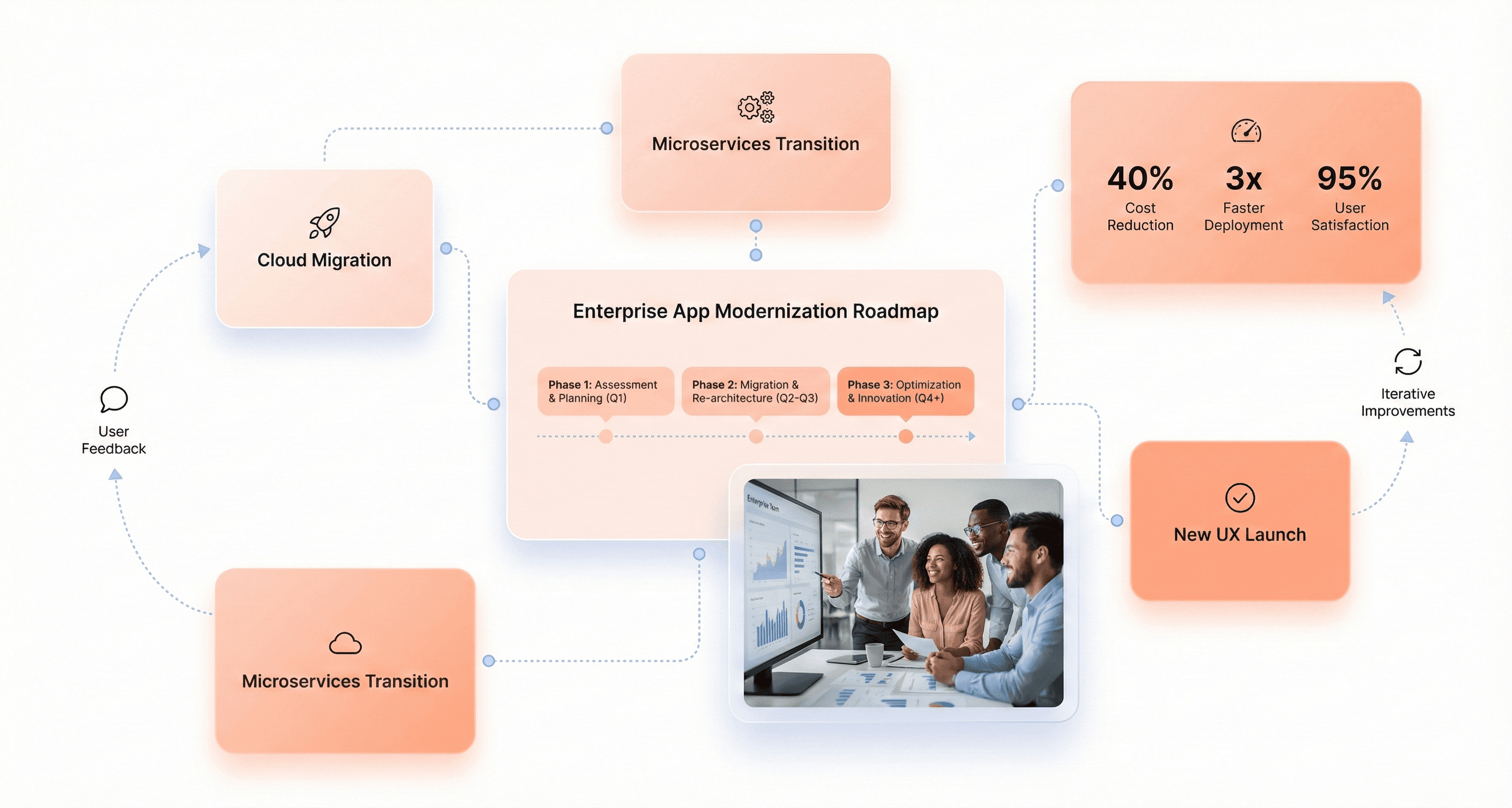
Establishing Resource Requirements and Budget Planning
Accurate resource planning requires mapping technical skills, infrastructure needs, and external vendor support across each phase. Budget for both obvious costs like cloud migration and hidden expenses such as staff training, data migration, and temporary system redundancies. Most enterprises allocate 20-30% contingency funds for unexpected challenges during modernization projects.
Setting Measurable Success Metrics and KPIs
Define clear metrics before starting each phase to track progress and justify continued investment. Focus on business outcomes like reduced operational costs, improved user satisfaction scores, and faster deployment cycles rather than purely technical metrics. Establish baseline measurements for application performance, security incidents, and maintenance hours to demonstrate tangible improvements throughout your modernization journey.
Cloud Architecture for Enterprise Application Modernization: Infrastructure, Microservices & DevOps
Selecting Cloud Platforms and Deployment Models
Choosing the right cloud platform determines your modernization success. In 2026, many enterprise modernization strategies are shifting toward platform engineering models that abstract cloud complexity through internal developer platforms, enabling faster deployments and standardized infrastructure governance across teams.
AWS, Azure, and Google Cloud each offer unique strengths, AWS leads in service breadth, Azure excels in hybrid integration, and Google Cloud dominates in AI/ML capabilities. Multi-cloud strategies provide vendor flexibility but increase complexity. Consider your existing infrastructure, security requirements, and team expertise when selecting deployment models between public, private, hybrid, or edge computing approaches.
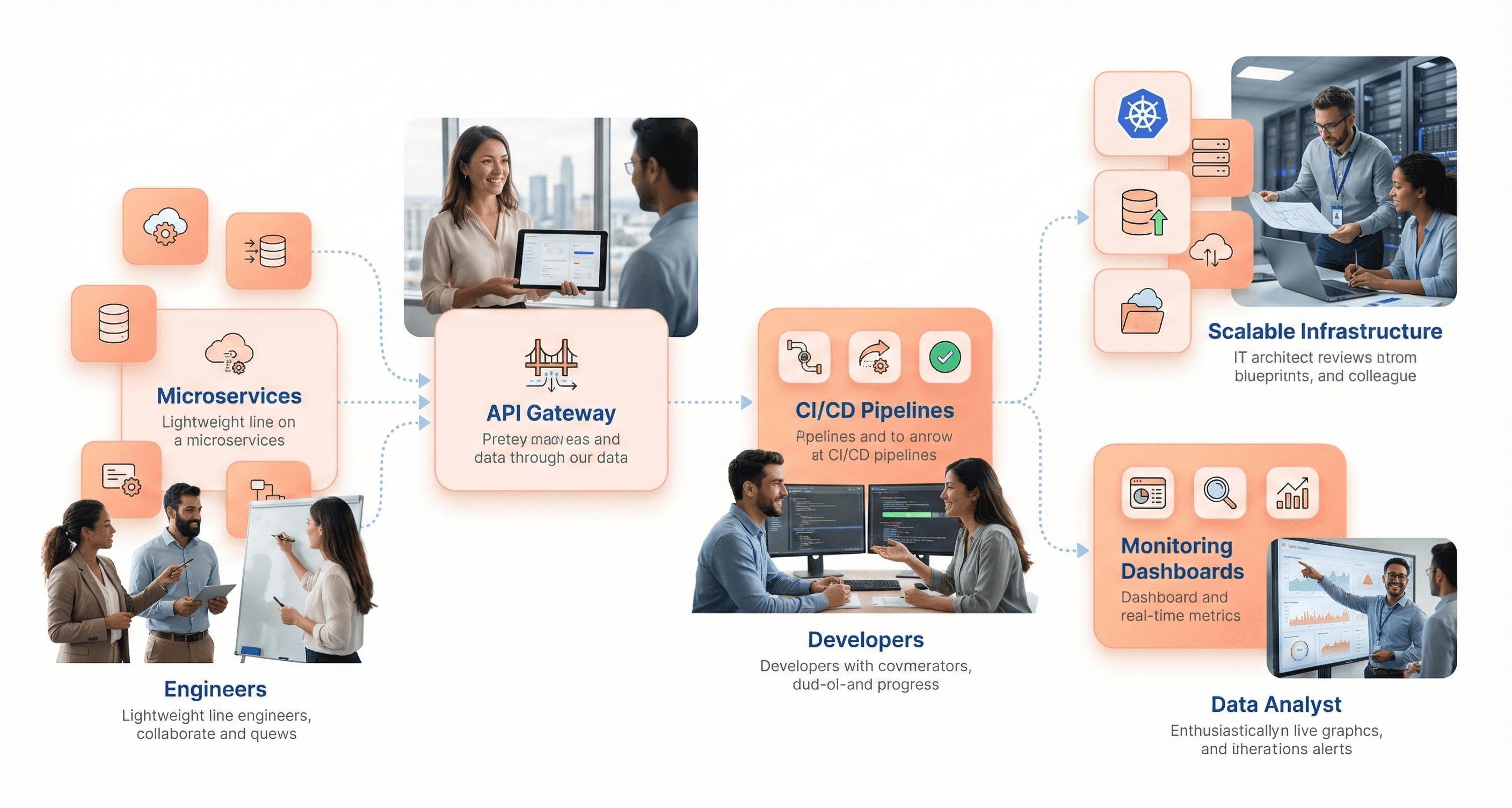
Implementing Microservices and API-First Design
Breaking monolithic applications into microservices enables independent scaling, faster deployments, and technology diversity. Start by identifying bounded contexts and business capabilities to define service boundaries.
API-first design ensures seamless communication between services and external systems.
Event-driven architectures using Kafka, Pulsar, and real-time streaming platforms are also becoming increasingly common in modern enterprise modernization initiatives focused on scalability, resilience, and AI-powered analytics.
Implement robust API gateways, service mesh architecture, and distributed tracing to manage inter-service communication effectively while maintaining data consistency across your microservices ecosystem.
Ensuring Scalability and Performance Optimization
Auto-scaling mechanisms and load balancing strategies handle traffic fluctuations automatically. Modern scalability strategies increasingly rely on:
observability platforms
distributed tracing
AI-assisted monitoring
and automated incident response systems
to maintain reliability across complex distributed architectures
Implement horizontal scaling for stateless services and vertical scaling for resource-intensive operations. Database optimization through sharding, read replicas, and caching layers dramatically improves response times.
Monitor application performance using APM tools and implement circuit breakers to prevent cascade failures. Container orchestration platforms like Kubernetes provide dynamic resource allocation and self-healing capabilities for optimal performance.
Integrating DevOps and Automation Tools
CI/CD pipelines accelerate deployment cycles while reducing human error. Platform engineering and Internal Developer Platforms (IDPs) are increasingly evolving beyond traditional DevOps models by providing standardized self-service infrastructure, deployment automation, and developer workflow optimization at enterprise scale.
Jenkins, GitLab CI, or Azure DevOps automate code integration, testing, and deployment processes. Infrastructure as Code (IaC) tools like Terraform and CloudFormation ensure consistent environment provisioning.
Monitoring and logging solutions provide real-time insights into application health. Security scanning tools integrated into pipelines catch vulnerabilities early, while automated rollback mechanisms protect against failed deployments.
Security & Compliance in Enterprise App Modernization
Applying Zero-Trust Security to Modernized Applications
Zero-trust architecture assumes no user or system should be trusted by default, even inside your network perimeter. This approach requires continuous verification of every access request, treating each interaction as potentially hostile. Modern enterprises adopt zero-trust principles by implementing multi-factor authentication, micro-segmentation, and real-time threat detection across all applications and infrastructure components.
Meeting Industry-Specific Compliance Standards
Industry | Key Standards | Critical Focus Areas |
|---|---|---|
Healthcare | HIPAA, HITECH | Patient data protection, audit trails |
Financial | SOX, PCI DSS | Transaction security, data integrity |
Manufacturing | ITAR, EAR | Export controls, intellectual property |
Government | FedRAMP, FISMA | Authorization boundaries, continuous monitoring |
Different industries face unique regulatory requirements that directly impact modernization efforts. Healthcare organizations must comply with HIPAA regulations, while financial institutions navigate SOX and PCI DSS standards. Manufacturing companies often deal with export control regulations, and government contractors must meet FedRAMP requirements. Your application modernization strategy should map these compliance obligations in the portfolio assessment phase, before a single line of code is changed.
Securing Data Migration and Storage
Data migration represents one of the highest-risk phases of modernization projects. Encryption becomes your first line of defense, protecting information both in transit and at rest. Establish secure migration pipelines that include data validation, integrity checks, and rollback capabilities. Cloud storage solutions offer advanced security features like automatic encryption, but configuration mistakes can expose sensitive information to unauthorized access.
Managing Identity and Access Control
Modern identity management systems provide centralized control over user permissions and application access. Single sign-on (SSO) solutions reduce password fatigue while improving security through centralized authentication. Role-based access control (RBAC) ensures users receive appropriate permissions based on their job functions, while privileged access management (PAM) protects administrative accounts from compromise.
SSO Benefits: Reduced password complexity, centralized authentication, improved user experience
RBAC Implementation: Define roles clearly, assign minimum necessary permissions, regular access reviews
PAM Controls: Vault privileged credentials, session recording, just-in-time access provisioning
Regular Audits: Quarterly access reviews, automated compliance reporting, and deactivation of unused accounts.
Common Enterprise App Modernization Challenges (and Solutions)
Managing Change Resistance and User Adoption
Employee resistance often becomes the biggest roadblock in modernization projects. Teams worry about job security, learning new systems, and disrupting familiar workflows. Smart organizations address these concerns early by involving key users in the planning process and highlighting personal benefits like improved efficiency and reduced manual tasks. Training programs should start before the rollout, not after, giving people time to build confidence with new tools.
Communication plays a huge role in winning hearts and minds. Regular updates, success stories from pilot groups, and clear explanations of why changes are necessary help build momentum. Creating internal champions who can mentor colleagues and provide peer-to-peer support makes the transition feel less overwhelming for everyone involved.
Handling Data Migration and System Downtime
Data migration carries serious risks that can derail entire projects if not handled carefully. Legacy systems often contain inconsistent formats, duplicate records, and undocumented dependencies that surface only during the transfer process. Running parallel systems during the transition period helps minimize risks, though it requires extra resources and careful coordination between old and new environments.
Downtime windows need strategic planning to reduce business disruption. Many organizations choose phased migrations, moving non-critical applications first to test processes and identify potential issues. Having robust rollback plans becomes essential when things go wrong, and they often do during complex enterprise migrations.
Maintaining Business Continuity During Transitions
Keeping operations running smoothly while overhauling core systems requires careful orchestration. Critical business processes can't stop for modernization projects, so teams must design transition strategies that maintain service levels throughout the change period. This often means running dual systems temporarily, which increases costs but provides necessary safety nets.
Risk management becomes paramount during these transitions. Having detailed contingency plans, backup systems, and clear escalation procedures helps teams respond quickly when problems arise. Regular testing of failover mechanisms and maintaining close communication with business stakeholders ensures everyone stays aligned on priorities and potential impacts throughout the modernization journey.
Measuring ROI and Performance After Modernization
Tracking Key Performance Indicators Post-Launch
Metric Category | Key Indicators | Target Benchmarks |
|---|---|---|
Performance | Response time, throughput | 95% improvement |
User Experience | Adoption rate, task completion | 80% user satisfaction |
Financial | Cost reduction, ROI | 25% operational savings |
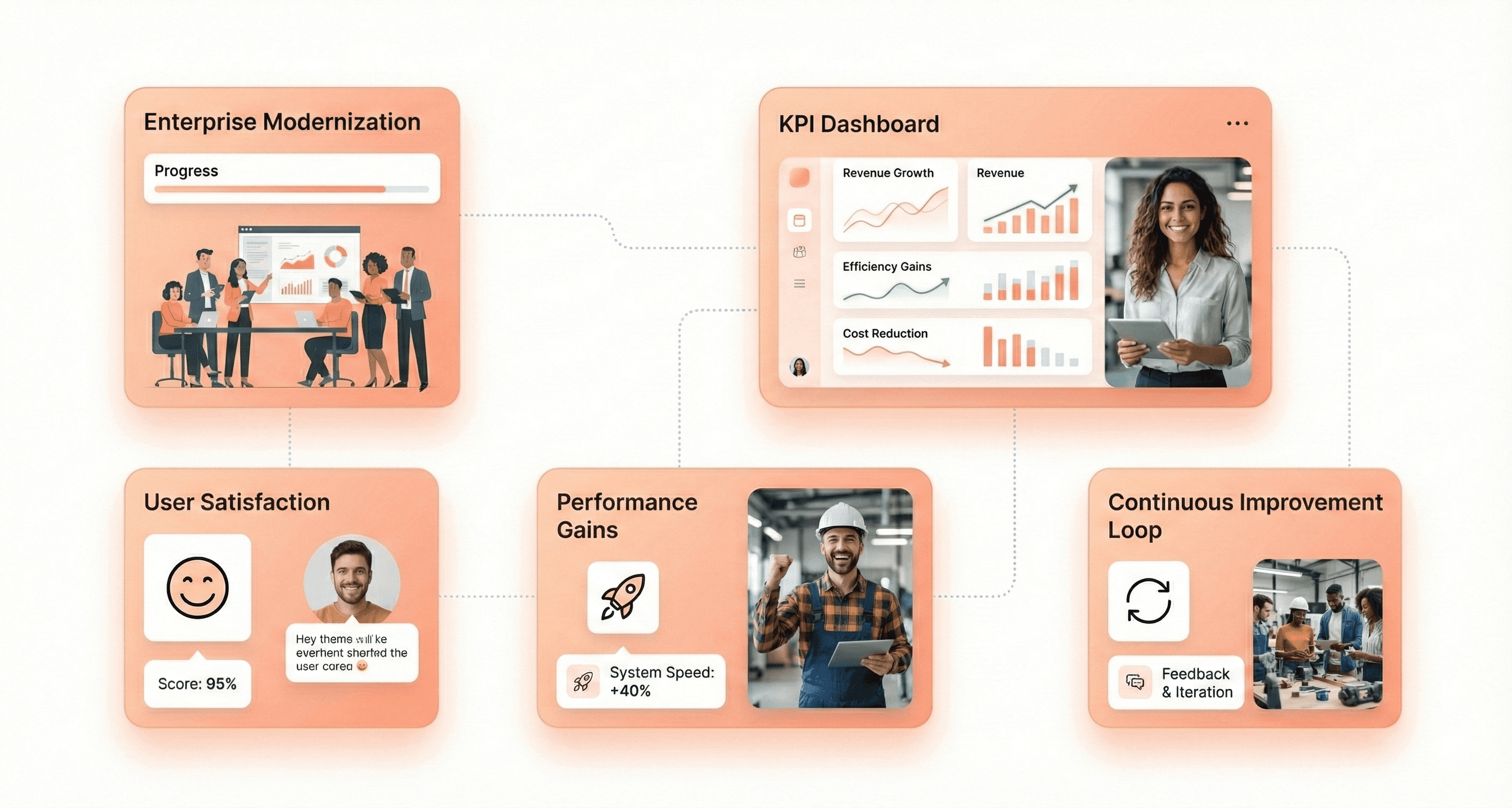
Successful modernization requires establishing clear KPIs before launch and monitoring them consistently afterward. Focus on metrics that directly impact your business: application response times, user adoption rates, system uptime, and cost savings. Create dashboards that track both technical metrics like API response times and business metrics such as employee productivity gains. Set up automated alerts for critical thresholds to catch issues before they affect users.
Gathering User Feedback and Satisfaction Metrics
Regular user feedback collection through surveys, interviews, and usage analytics provides essential insights for optimization. Deploy feedback mechanisms directly within your modernized applications to capture real-time user sentiment. Track user journey analytics to identify pain points and areas where the modernization delivers the most value. Combine quantitative data with qualitative feedback to understand not just what users do, but why they behave certain ways.
Planning Continuous Improvement and Updates
Modernization isn't a one-time event but an ongoing process that requires dedicated resources and planning. Establish regular release cycles that incorporate user feedback, security patches, and feature enhancements. Create a backlog of improvements prioritized by business impact and user demand. Build automated testing and deployment pipelines to make frequent updates manageable and reduce risk.
Scaling Modernization Efforts Across the Organization
Once you've proven success with initial applications, develop a repeatable framework for scaling modernization across your entire portfolio. Document lessons learned, create standardized processes, and establish centers of excellence to share knowledge. Prioritize applications based on business criticality and modernization complexity. Build internal capabilities through training and knowledge transfer to reduce dependence on external consultants and create sustainable modernization practices.
Enterprise App Modernization Trends Shaping 2026: Agentic AI, MACH Architecture & FinOps
Agentic AI-Driven Refactoring
The most significant shift in enterprise app modernization in 2026 is the emergence of agentic AI tools that autonomously map legacy dependencies, propose refactoring plans, and execute repetitive code transformation tasks. Microsoft Azure AI Foundry, GitHub Copilot Workspace, and specialist tools like those from SoftServe report automated code refactoring reducing migration effort by up to 50%, while cutting modernization timelines from 18 months to 5–7 months for comparable projects. Gartner estimates 40% of enterprise applications will include task-specific AI agents by the end of 2026, and only cloud-native architectures can support these workloads.
MACH Architecture as the Modernization Blueprint
MACH (Microservices, API-first, Cloud-native, Headless) has become the dominant architectural blueprint for enterprise application modernization strategy in 2026. Rather than replacing one monolith with another tightly coupled platform, MACH allows enterprises to build from interchangeable, best-of-breed components that can be independently upgraded or replaced as technology evolves. This composable approach directly addresses the "strained transformer" failure pattern, where modernization investment is added on top of legacy systems, compounding technical debt instead of reducing it.
FinOps-Native Modernization
As cloud costs rise, 2026 modernization projects are built with FinOps principles from the start, monitoring resource usage, optimising workloads, and building inference economics directly into architecture decisions. Enterprises that modernize without a FinOps layer often discover cloud costs exceed legacy maintenance costs within 18 months. The best application modernization strategies now treat cost governance as a first-class architectural concern, not an afterthought.
Final Thoughts: Turning Modernization into Competitive Advantage
Successful enterprise app modernization isn't just about keeping up with technology trends, it's about setting your business up for long-term competitive advantage. The organisations that invest in enterprise application modernization today are the ones that will be able to deploy AI, integrate real-time analytics, and respond to market shifts in days rather than quarters.
The modernization journey requires careful planning, from assessing what you have now to picking the right approach and building a roadmap that actually works. You'll need to tackle architecture decisions, security concerns, and the inevitable bumps along the way, but the payoff is worth it.
The companies that invest in modernizing their applications today are the ones that will stay competitive tomorrow.
Start by taking an honest look at your current app portfolio, then choose a strategy that fits your budget and timeline. Remember, success isn't measured just by completing the technical migration, it's about creating applications that drive real business value and can adapt to whatever comes next. Your modernization effort is an investment in your company's future, so make it count.
In 2026, enterprise modernization is no longer only about replacing legacy infrastructure. The most successful organizations are modernizing to become:
AI-ready
cloud-native
platform-driven
highly observable
and operationally resilient.
Enterprise modernization has evolved from a technical upgrade initiative into a long-term competitive strategy that directly impacts innovation speed, developer productivity, security posture, and future AI capabilities.
Modernization isn't just an IT project; it's a core business strategy. If you're ready to stop managing legacy risk and start driving growth, our team can help you build the roadmap.




About the author
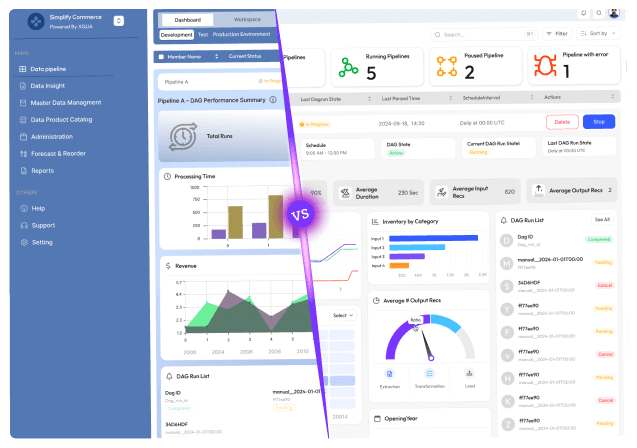
I’m the founder of Hashbyt, an AI-first frontend and UI/UX SaaS partner helping 200+ SaaS companies scale faster through intelligent, growth-driven design. My work focuses on building modern frontend systems, design frameworks, and product modernization strategies that boost revenue, improve user adoption, and help SaaS founders turn their UI into a true growth engine.
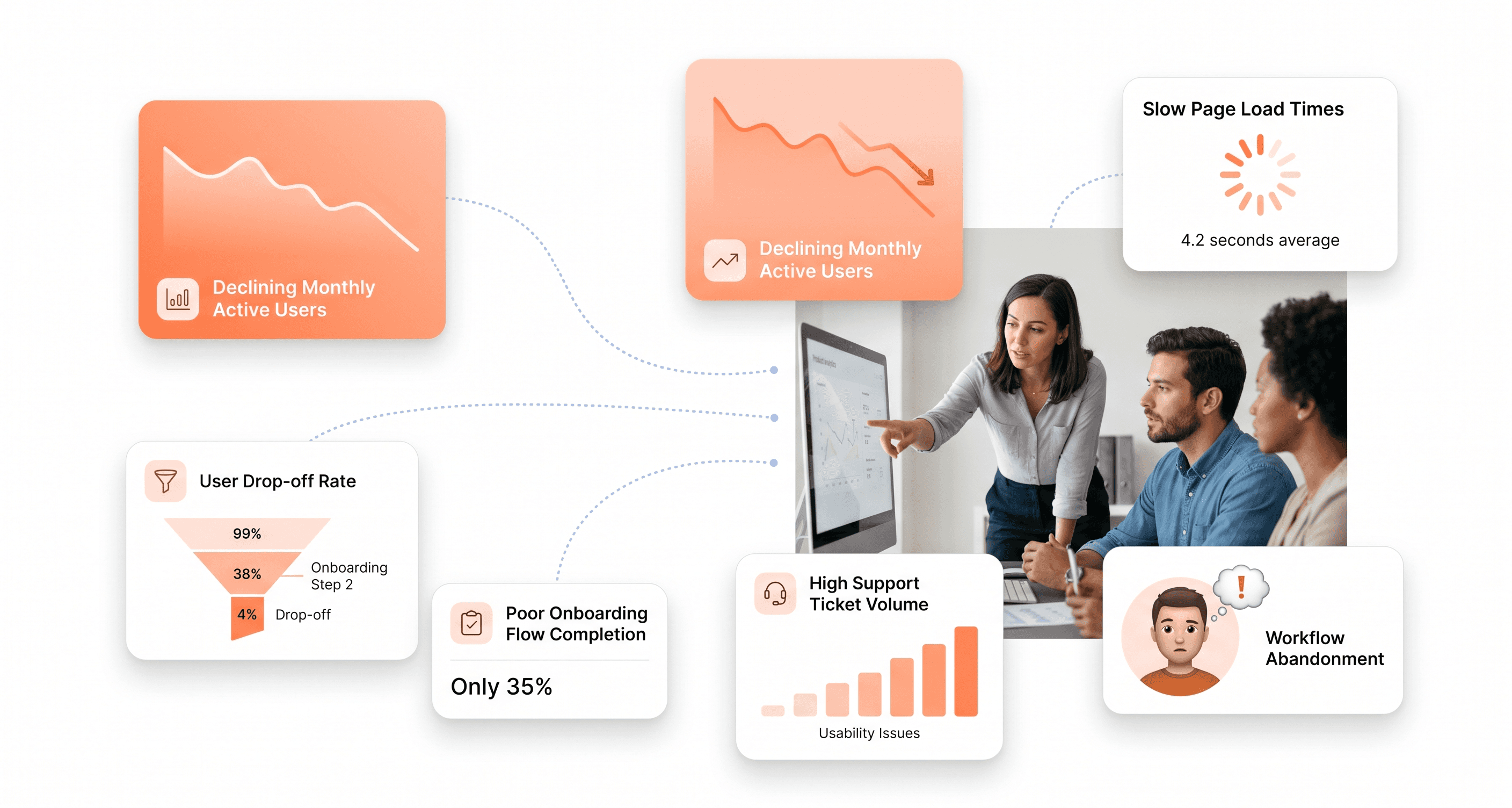
Is a clunky UI holding back your growth?
Is a clunky UI holding back your growth?
▶︎
Transform slow, frustrating dashboards into intuitive interfaces that ensure effortless user adoption.
▶︎
Transform slow, frustrating dashboards into intuitive interfaces that ensure effortless user adoption.
