


Quick answer (updated September 2026): Frontend frameworks are toolkits for building a web app's user interface. React is the most used (44.7% of developers in the 2025 Stack Overflow survey), followed by Angular and Vue; Next.js is the leading React meta-framework, and Svelte, SolidJS and Qwik focus on speed. Pick by team skills, app size and SEO needs.
The frontend framework you choose shapes your app's performance, hiring and maintenance costs for years. This guide compares React, Angular, Vue, Next.js, Svelte, SolidJS and Qwik on popularity, performance, developer experience, SEO support and hiring, using current versions and 2025 survey data.
What Is a Frontend Framework?
A frontend framework is a set of ready-made JavaScript code, conventions and tools for building the part of a website or web app that runs in the browser: the user interface. Instead of changing the page by hand with DOM calls, you describe what the interface should look like for a given state, and the framework keeps the screen in sync when that state changes. Most frameworks are built around reusable components, and many add routing, data loading and a build step. Some, such as React, are UI libraries that rely on other packages for routing and data; others, such as Angular, ship all of this in one package. Meta-frameworks such as Next.js, Nuxt and SvelteKit sit on top of them and add server-side rendering, static generation and file-based routing.
Frontend development focuses on creating the visual and interactive elements of a website or web application - essentially the user interface that visitors see and interact with. Frontend developers specialize in developing and designing the user interface (UI) and user experience (UX) of websites and web applications using web languages such as HTML, CSS, and JavaScript.
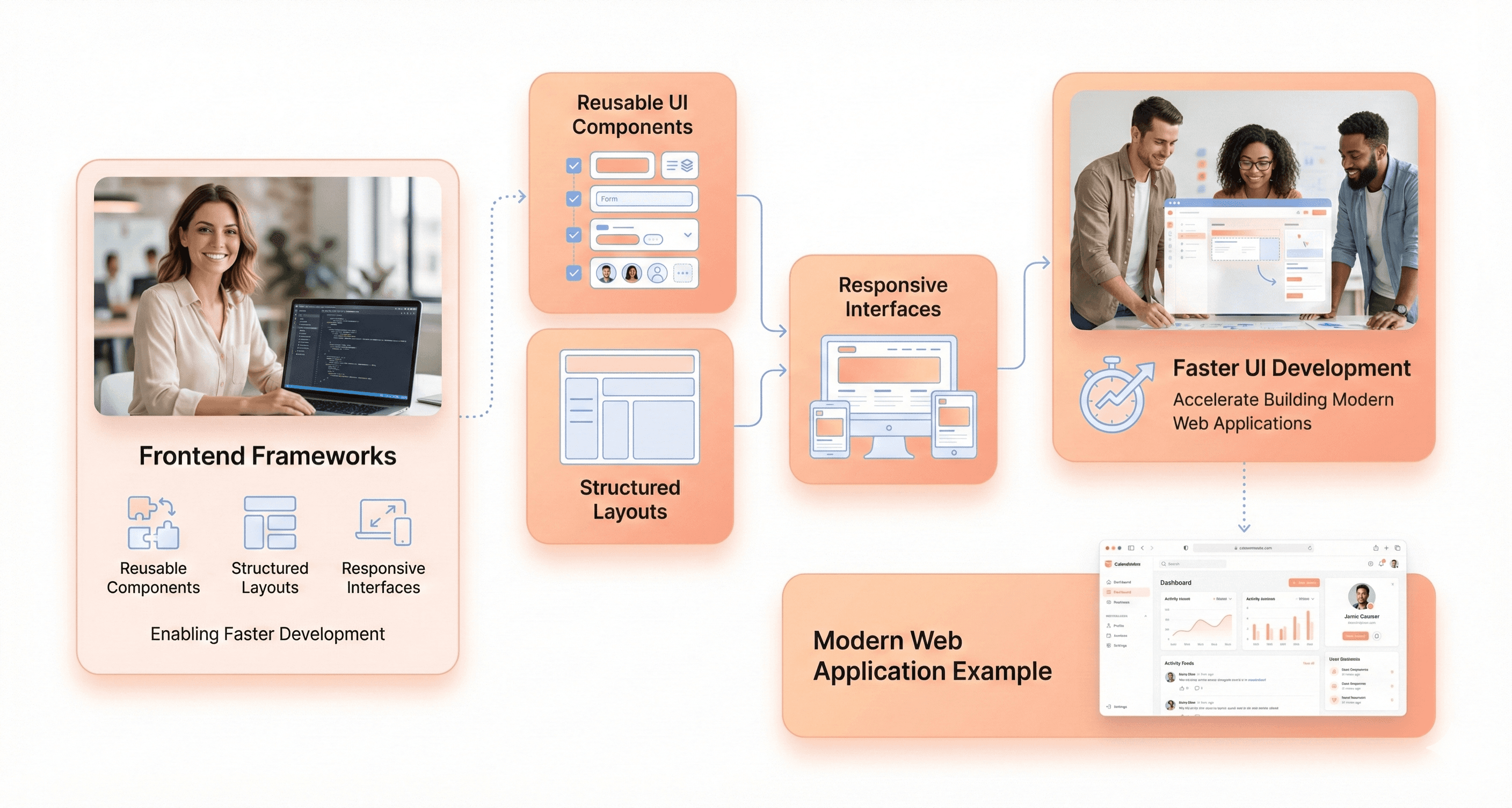
What to Look For in a Frontend Framework
Table: Comparison of Core Features That Define an Excellent Frontend Framework
Feature | Description | Benefit |
|---|---|---|
Scalability & Flexibility | Manages both small and enterprise-grade applications | Ensures project adaptability and maintainability |
Performance Optimization | Optimizes loading and updates only changed components | Improves rendering speed and UX |
Developer Experience | Offers clean syntax, good documentation, and debugging tools | Reduces learning curve and increases productivity |
Mobile-First Approach | Focuses on responsiveness and mobile rendering | Enhances SEO and accessibility |
Security & Integration | Includes built-in protection and compatibility tools | Reduces risk and simplifies ecosystem management |
Community & Ecosystem | Provides community support and continuous updates | Ensures long-term framework stability |
Frontend Frameworks by Popularity (2026)
React is still the most popular frontend framework by a wide margin. In the Stack Overflow 2025 Developer Survey (23,678 respondents to the web frameworks question), 44.7% of developers said they had done extensive work with React in the past year, followed by Next.js (20.8%), Angular (18.2%) and Vue.js (17.6%). Svelte (7.2%), Astro (4.5%) and Nuxt (4.0%) form the next tier. SolidJS and Qwik were not listed in that survey.
Framework | Type | Latest version on npm (release date) | Stack Overflow 2025 usage | npm weekly downloads (21 to 27 Sep 2026) | Best for |
|---|---|---|---|---|---|
React | UI library | 19.3.0 (9 Sep 2026) | 44.7% | 203.2M | Interactive apps and dashboards; largest hiring pool |
Next.js | React meta-framework | 16.3.6 (22 Sep 2026) | 20.8% | 67.8M | SEO-led sites and full-stack React apps |
Angular | Full framework | 22.2.0 (23 Sep 2026) | 18.2% | 7.0M | Large enterprise apps with big teams |
Vue.js | Progressive framework | 3.5.43 (17 Sep 2026) | 17.6% | 18.1M | Product teams that want a gentle learning curve |
Svelte | Compiler-based framework | 5.57.1 (18 Sep 2026) | 7.2% | 6.9M | Fast, lightweight UIs with less code |
Astro | Content-first meta-framework | 7.3.5 (24 Sep 2026) | 4.5% | 6.8M | Content and marketing sites that ship little JavaScript |
Nuxt | Vue meta-framework | 4.5.2 (5 Aug 2026) | 4.0% | 2.3M | SSR and static sites built with Vue |
SolidJS | Fine-grained reactive library | 1.9.15 (17 Aug 2026) | Not listed | 6.4M | Performance-critical interfaces |
Qwik | Resumable framework | 1.20.1 (23 Sep 2026) | Not listed | 62K | Sites where Time to Interactive is the priority |
Sources: Stack Overflow Developer Survey 2025, "Web frameworks and technologies", all respondents; versions and release dates from the npm registry; weekly downloads from api.npmjs.org for 21 to 27 September 2026, checked on 29 September 2026. Download counts include CI runs and installs pulled in by other packages, so treat them as a rough signal of reach rather than a count of projects. Qwik 2 is in beta under the new @qwik.dev/core package, which is not included above.
Popularity is not the same as satisfaction. In the same survey, 62.4% of developers who used Svelte want to keep using it, compared with 52.1% for React, 50.9% for Vue.js and 44.7% for Angular. The State of JavaScript 2025 survey tells a similar story for Solid: used by about 10% of respondents, but rated highest for satisfaction for the fifth year running.
The Top Frontend Frameworks in 2026: React, Angular, Vue, Next.js and Svelte
Table: Feature and Performance Comparison of Leading Frontend Frameworks in 2026
Framework | Key Strength | Ideal Use Case | Learning Curve | Rendering model |
|---|---|---|---|---|
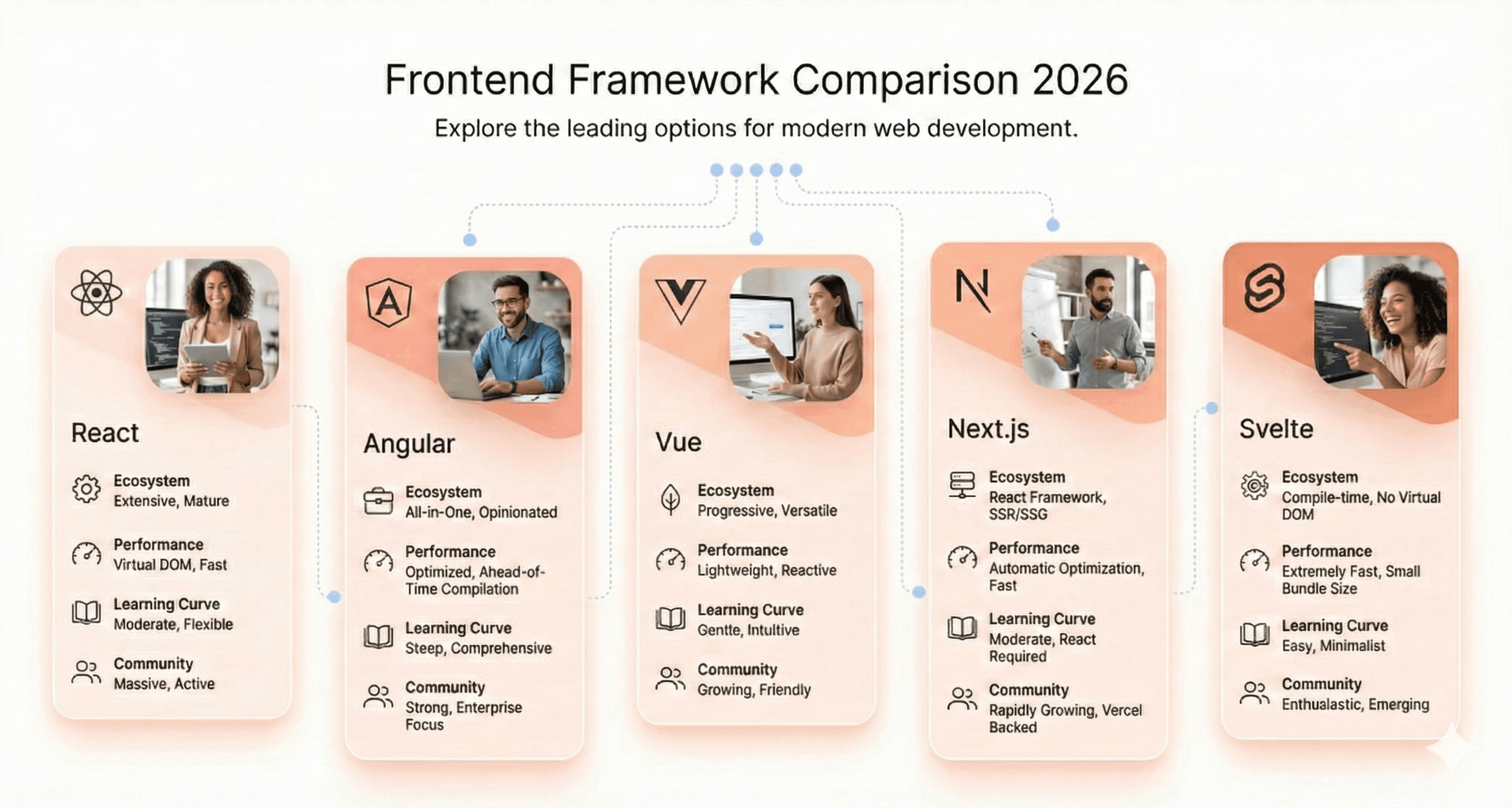
React | Vast ecosystem, flexible architecture | SPAs, dashboards, social apps | Moderate | Virtual DOM; Server Components via frameworks |
Angular | Enterprise-grade structure | Large-scale corporate apps | Steep | Compiled templates with signals |
Vue.js | Simplicity + performance | SMB websites, prototypes | Easy | Virtual DOM with fine-grained reactivity |
Next.js | SEO-first React framework | Marketing & content-heavy sites | Moderate | SSR, SSG and streaming on top of React |
Svelte | Compile-time optimization | Lightweight, high-speed apps | Easy | Compiler output, no virtual DOM |
React Framework: Ecosystem, Use Cases, and Performance
Key Points:
Uses Virtual DOM for efficient UI rendering and updates.
Encourages reusable component-based development.
Backed by extensive community support and third-party libraries.
React is now governed by the React Foundation, an independent body hosted by the Linux Foundation, with eight Platinum founding members: Amazon, Callstack, Expo, Huawei, Meta, Microsoft, Software Mansion, and Vercel. The foundation officially launched on 24 February 2026, when ownership of React, React Native and JSX passed from Meta to the foundation.
React 19.3, released on 9 September 2026, is the current stable release; it made the <ViewTransition> component and Fragment Refs stable. Earlier additions include the React Compiler (1.0 in October 2025), which memoises components automatically and reduces the need for manual useMemo and useCallback, and React 19.2's <Activity /> component, Partial Pre-rendering APIs and useEffectEvent. React Server Components are now fully stable and production-ready across frameworks like Next.js 16.
Also Read: React vs Vue vs Angular: Which Should You Choose?
React's unidirectional data flow simplifies data management and enhances application performance, making it particularly suitable for large-scale applications including single-page applications (SPAs), e-commerce platforms, and social media applications. The framework's JSX syntax allows developers to write HTML-like code directly in JavaScript, though this can present a learning curve for newcomers.
The ecosystem surrounding React is unparalleled, with extensive community support, comprehensive documentation, and a vast library of third-party tools and components. Meta's own products, including Facebook and Instagram, are built with React.
Angular Framework for Enterprise Web Applications
Key Points:
Built on TypeScript for cleaner, maintainable code.
Offers two-way data binding for real-time synchronization.
Best suited for enterprise-scale and complex web applications.
Angular represents Google's comprehensive approach to frontend development, offering a TypeScript-based, full-featured framework designed specifically for enterprise-level applications. Built on TypeScript from the ground up, Angular provides robust features including two-way data binding, dependency injection, and a modular architecture that promotes code organization and reusability.
The framework's two-way data binding enables automatic synchronization between the model and view layers, while its built-in dependency injection system efficiently manages component dependencies. Angular's directive system allows developers to create custom HTML elements and modify existing element behavior, providing extensive customization capabilities.
Angular excels in enterprise environments where structured development approaches and comprehensive tooling are essential. The framework's modular architecture supports scalability and maintainability for large, complex applications, making it ideal for financial systems, healthcare platforms, and enterprise-level e-commerce solutions.
However, Angular's comprehensive nature comes with a steeper learning curve and larger bundle sizes compared to lighter alternatives. The framework's complexity may be unnecessary for smaller, simpler applications, but it provides unmatched structure and tooling for ambitious web projects. Notable companies using Angular include Google, Microsoft, and IBM.
Angular 22, released on 3 June 2026, is the current major version (22.2.0 on npm as of 29 September 2026). Components without an explicit changeDetection setting now default to OnPush, and TypeScript 6.0 or later is required. Angular 21 is in long-term support until June 2027; our Angular 21 features, signals and AI tooling guide covers zoneless change detection, Vitest and Signal Forms.
Angular versions 2 to 19 no longer receive official support. Teams still running them, or legacy AngularJS, should plan an upgrade; our step-by-step AngularJS to Angular migration playbook covers hybrid mode, ngUpgrade and Angular Elements with realistic timelines.
Vue.js Framework for Fast and Flexible Web Development
Key Points:
Lightweight and easy to integrate into existing projects.
Uses reactive data binding for dynamic UI updates.
Ideal for small to medium-scale applications with flexible structures.
Vue.js has established itself as the progressive framework that bridges the gap between simplicity and functionality. Developed by Evan You, Vue offers a lightweight, flexible, and easy-to-learn approach to frontend development, making it particularly attractive for developers seeking rapid development cycles without sacrificing capability.
Built on the Model-View-ViewModel (MVVM) architecture pattern, Vue provides reactive data binding that automatically updates the UI based on data changes. The framework's component-based architecture enables the creation of reusable, modular, and composable UI elements, while its Virtual DOM implementation ensures efficient performance by reducing direct DOM manipulations.
Vue's progressive nature means it can be incrementally adopted into existing projects, making it an excellent choice for teams transitioning from traditional web development approaches. The framework's powerful reactivity system enables efficient and responsive UI updates, while maintaining a gentle learning curve that makes it accessible to developers at all skill levels.
Vue 3.5 is still the current stable line (3.5.43 on npm as of 29 September 2026). According to the Vue 3.5 release notes, its reactivity refactor cut memory usage by 56% and made some operations on large, deeply reactive arrays up to 10× faster. Vue 3.6 reached release-candidate stage in July 2026 (3.6.0-rc.9 on 18 September 2026). Its headline feature is Vapor Mode, an opt-in compilation strategy that skips the virtual DOM for fine-grained updates without changing how components are written. Teams still on Vue 2, which reached end of life on 31 December 2023, can see our Vue 3 migration services.
Next.js for SEO-Optimized and Full-Stack React Apps
Key Points:
Provides built-in SSR and static site generation (SSG).
Enables fast page loads and excellent SEO optimization.
Ideal for content-driven and marketing-focused web projects.
Next.js has emerged as the leading React-based framework, developed by Vercel to address the specific needs of modern web applications requiring superior SEO performance and optimal user experience. The framework enables server-side rendering (SSR), static site generation (SSG), and hybrid approaches out of the box, making it ideal for applications where search engine optimization and performance are critical.
Next.js 16, released on 21 October 2025, is the current major version (16.3.6 on npm as of 29 September 2026). According to the release notes, Turbopack became the default bundler, with 2–5× faster production builds and up to 10× faster Fast Refresh. Cache Components build on Partial Pre-Rendering with an explicit 'use cache' directive, built-in React Compiler support is stable (opt-in), Next.js DevTools MCP adds AI-assisted debugging, and proxy.ts replaces middleware.ts. Next.js 16.2 followed on 18 March 2026 and 16.3 on 3 August 2026.
Also Read: Next.js vs React in 2026: Which is Best for SaaS?
The framework excels in building scalable web applications that demand fast page loads, excellent SEO capabilities, and rich user experiences. Its server-side rendering capabilities ensure that content is immediately available to search engines and users, while client-side navigation maintains the smooth experience of single-page applications.
Next.js is particularly valuable for content-heavy websites, e-commerce platforms, and marketing sites where SEO performance directly impacts business outcomes. Major brands including TikTok, Notion, Hulu, Nike, and Vercel's own platform rely on Next.js for production applications, demonstrating its capability to handle high-traffic, performance-critical applications across diverse industries.
On 3 December 2025 the React team disclosed CVE-2025-55182 (CVSS 10.0), a remote code execution flaw in React Server Components that affected Next.js 15.x and 16.x apps. Patched releases were published for every affected release line, so upgrade to the latest patch of the line you are on. If you are still moving an older React or Pages Router app forward, our Next.js migration services can help. See our deep-dive on Next.js 16 features, Turbopack, and Cache Components for the full upgrade rationale.
Svelte Framework for High-Performance Web Applications
Key Benefits:
Compiles code into pure JavaScript for faster execution.
Removes runtime overhead for lighter bundle sizes.
Ideal for high-performance and mobile-first applications.
Svelte 5, released as stable in October 2024 (5.57.1 on npm as of 29 September 2026), is a ground-up rewrite of the framework and the biggest release in its history. The core compile-time approach is retained, but Svelte 5 introduces Runes: a signals-based reactivity API that replaces the previous $: reactive declarations with explicit primitives $state, $derived and $effect. This gives developers fine-grained control over reactivity while making component logic more predictable and debuggable. Svelte 5 is almost fully backwards-compatible with Svelte 4, and automated migration tooling is available. In early 2025, the team also introduced Asynchronous Svelte, an experimental feature for async reactivity using await expressions directly in components.
The framework's innovative approach involves reactive data binding and a component-based architecture implemented through compile-time transformations rather than runtime abstractions. This results in faster rendering performance and smaller application bundles, making Svelte particularly attractive for performance-critical applications and mobile development.
Svelte's simple syntax and intuitive development patterns reduce the learning curve typically associated with modern frameworks, while its compile-time optimizations deliver performance that rivals hand-optimized vanilla JavaScript. The framework eliminates much of the boilerplate code required by other frameworks, enabling developers to focus on application logic rather than framework-specific patterns.
The framework is especially well-suited for applications requiring excellent performance, including mobile applications and simple e-commerce websites. The Stack Overflow Developer Survey 2025 edition found that 62.4% of developers who used Svelte want to keep using it, ahead of React (52.1%) and Vue.js (50.9%). While Svelte's ecosystem is smaller compared to React or Angular, its growing community continues to develop tools and resources that support its expanding adoption.
Emerging High-Performance Frontend Frameworks in 2026
Astro for Content-Heavy Sites
Astro is a content-first framework that renders pages to HTML on the server and ships no client-side JavaScript by default. Interactive parts are added as "islands", and each island can be written in React, Vue, Svelte, Solid or another supported UI framework. That makes it a strong fit for blogs, documentation and marketing sites where most of the page is static. Astro 7 was released in June 2026 (7.3.5 on npm as of 29 September 2026), and 4.5% of respondents to the Stack Overflow 2025 survey reported using it.
SolidJS: Fine-Grained Reactivity for Performance-Critical UIs
SolidJS is a high-performance declarative JavaScript framework created by Ryan Carniato that represents a significant departure from traditional virtual DOM approaches. This modern frontend framework uses fine-grained reactivity and compiles to efficient DOM operations without requiring a virtual DOM, making it ideal for performance-critical applications where minimal overhead is essential.
The framework's key innovation lies in its reactive update system that only updates changed components, so it does no virtual DOM diffing at all. In the State of JavaScript 2025 survey, Solid was used by about 10% of respondents but has had the highest satisfaction of any front-end framework for five years running. Version 1.9 is the current stable line, and Solid 2.0 reached release-candidate stage in August 2026. This makes it particularly suitable for building modern, reactive web applications and real-time applications where speed is paramount.
When to use SolidJS:
Performance-critical UIs where minimal overhead is essential
Building modern, reactive web apps with a need for fast rendering
Applications requiring real-time updates and interactions
When not to use SolidJS:
When you need a mature ecosystem or a large developer community support
For teams unfamiliar with fine-grained reactivity concepts
Notable users: Adoption is still concentrated in open-source and performance-focused projects. The solid-js package had about 6.4 million npm downloads in the week to 27 September 2026, a figure that includes installs pulled in as a dependency of other tools.
Qwik Framework for Instant Loading Web Applications
Qwik represents a cutting-edge approach to web framework architecture, created by the team at Builder.io with a single focus: fast page loads through resumability. Instead of re-running the app in the browser, Qwik picks up where the server left off, which keeps the JavaScript needed for Time to Interactive (TTI) very small.
The framework's groundbreaking architecture shifts away from traditional server-side rendering and client-side rendering approaches by implementing resumability - a technique that allows the application state to be serialized on the server and resumed on the client without requiring full re-execution of the application logic.
Because Qwik resumes rather than hydrates, it downloads and runs a component's code only when a user interacts with it. Qwik 1.20 is the current stable release; Qwik 2 is in beta under the new @qwik.dev/core package name.
When to use Qwik:
Performance-first applications that require instant loading
Building modern websites where user experience and speed are top priorities
Projects where Time to Interactive is a critical success metric
When not to use Qwik:
For projects that require a mature ecosystem or traditional component models
If your team prefers conventional SSR/CSR approaches and established patterns
Notable users: Builder.io leads the adoption, with growing interest in the performance-focused development community.
Nuxt.js for Vue-Based SSR and Static Sites
Nuxt 4, first released on 15 July 2025, is the current major version (4.5.2 on npm as of 29 September 2026). It is built on Vue 3 and uses Vite by default. Nuxt 4 introduced a cleaner project structure with an app/ directory, smarter built-in data fetching, improved TypeScript support, and a faster CLI, while deliberately minimising breaking changes. NuxtLabs, the company behind Nuxt, was acquired by Vercel in 2025, resulting in previously premium tools including Nuxt Studio and Nuxt UI Premium being released for free. Nuxt 5 is in planning, pending the Nitro v3 backend engine.
The framework excels in providing developers with minimal configuration while delivering maximum functionality. Nuxt's architecture simplifies the development of fast, SEO-friendly Vue applications by handling complex routing, state management, and build optimization automatically. Recent updates in Vue 3.5 have improved SSR performance and memory usage with features like lazy hydration and useId().
Nuxt.js addresses the common challenges developers face when building Vue applications that require excellent SEO performance and fast loading times. The framework's built-in features eliminate the need for extensive configuration and setup, allowing teams to focus on building features rather than infrastructure.
When to use Nuxt.js:
Building Vue applications that require server-side rendering or static generation
Content-heavy sites where SEO and performance are critical success factors
Projects that benefit from Vue's ecosystem but need enhanced SSR capabilities
When not to use Nuxt.js:
Small projects that don't require SSR or wouldn't benefit from Nuxt's advanced features
Applications where the additional framework overhead isn't justified
Notable users: Louis Vuitton, Upwork, and GitLab demonstrate Nuxt.js's capability in enterprise environments.
Alpine.js for Lightweight JavaScript Interactivity
Alpine.js represents a minimalist approach to frontend reactivity, offering a lightweight JavaScript framework that brings declarative reactivity directly to HTML without the complexity of full-scale frameworks. This framework provides many of Vue's reactive features in a much smaller footprint, making it perfect for enhancing server-rendered pages without requiring a complete single-page application architecture.
The framework's philosophy centers on progressive enhancement, allowing developers to add interactivity to existing HTML without restructuring their entire application. Alpine.js excels in scenarios where traditional static sites need just enough JavaScript to create engaging user interactions without the overhead of larger frameworks.
Alpine.js has gained significant traction in the Laravel ecosystem through tools like Livewire, and is widely adopted by companies like Statamic and Tailwind Labs. Its HTML-first approach makes it particularly appealing for developers who prefer working closer to web standards while still benefiting from modern reactive patterns.
When to use Alpine.js:
Adding simple interactivity to static or server-rendered sites
When you want reactivity without the overhead of a full SPA framework
Progressive enhancement of existing HTML-based projects
When not to use Alpine.js:
Building full-scale applications with complex routing or extensive state management needs
Projects that require extensive tooling or need to scale to large, complex interfaces
Notable users: The Laravel ecosystem extensively uses Alpine.js through Livewire, while Statamic and Tailwind Labs demonstrate its effectiveness in modern web development workflows.
Frontend Framework Performance: What the Benchmarks Show
Runtime Speed and Rendering Performance Comparison
The most widely cited public source for raw runtime speed is the js-framework-benchmark project provides standardized performance metrics across multiple frameworks by measuring specific operations including creating 1,000 rows, replacing all rows, partial updates, row selection, row swapping, and row removal.
Runtime performance analysis demonstrates that frameworks handle DOM manipulation operations differently. Timings depend on the machine and browser used, so compare frameworks within the same published run rather than quoting absolute figures from articles. The partial update benchmark, which measures time to update every 10th row in a 10,000-row table, reveals how efficiently frameworks handle selective DOM updates - a critical factor for real-world application responsiveness.
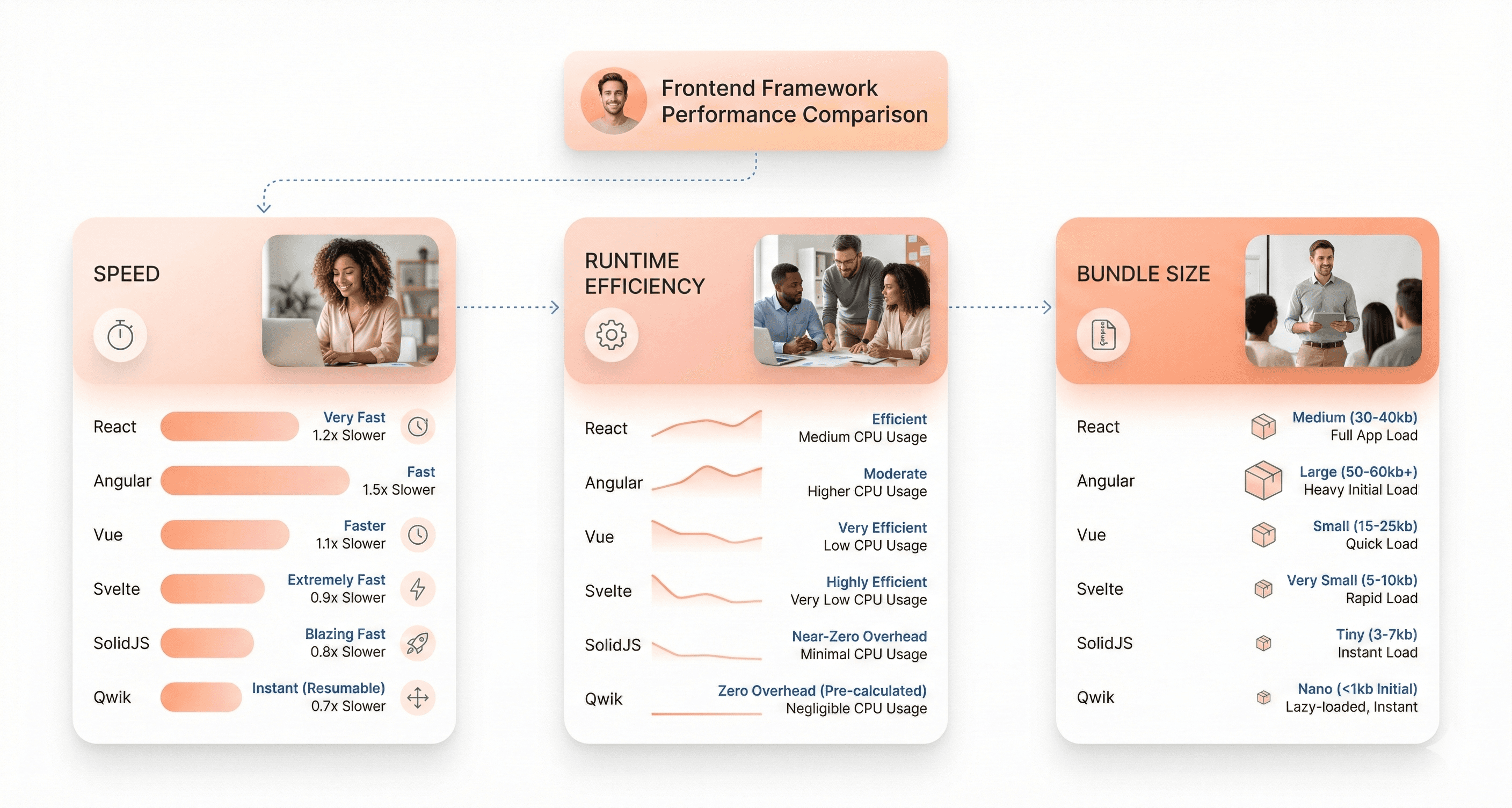
Row selection performance, measured as the duration to highlight a row in response to user interaction, varies considerably between keyed and non-keyed implementations. Keyed frameworks maintain a 1:1 relationship between data items and DOM nodes, which can impact performance differently than non-keyed approaches that may reuse existing DOM nodes for new data.
Developer Experience, Ecosystem, and Hiring Considerations
Learning Curve and Developer Onboarding
Table: Learning Curve and Ecosystem Maturity Overview
Framework | Learning Curve | Community Strength | Ecosystem Tools | Hiring Availability |
|---|---|---|---|---|
React | Moderate | Very Strong | Vast | Excellent |
Angular | Steep | Strong | Enterprise-grade CLI | High |
Vue.js | Easy | Strong | Growing steadily | Good |
Svelte | Easy | Moderate | Improving rapidly | Limited |
SolidJS | Moderate | Emerging | Early stage | Limited |
Qwik | Moderate | New | Early development | Limited |
The learning curve for different frontend frameworks varies significantly, making this a crucial factor when selecting the right tool for your project and team. Vue.js, Svelte, and Alpine.js consistently rank as the most approachable frameworks, with intuitive syntax that allows developers to become productive quickly. Vue's clean structure and straightforward directives make it particularly beginner-friendly, while Svelte eliminates the complexity of virtual DOM concepts.
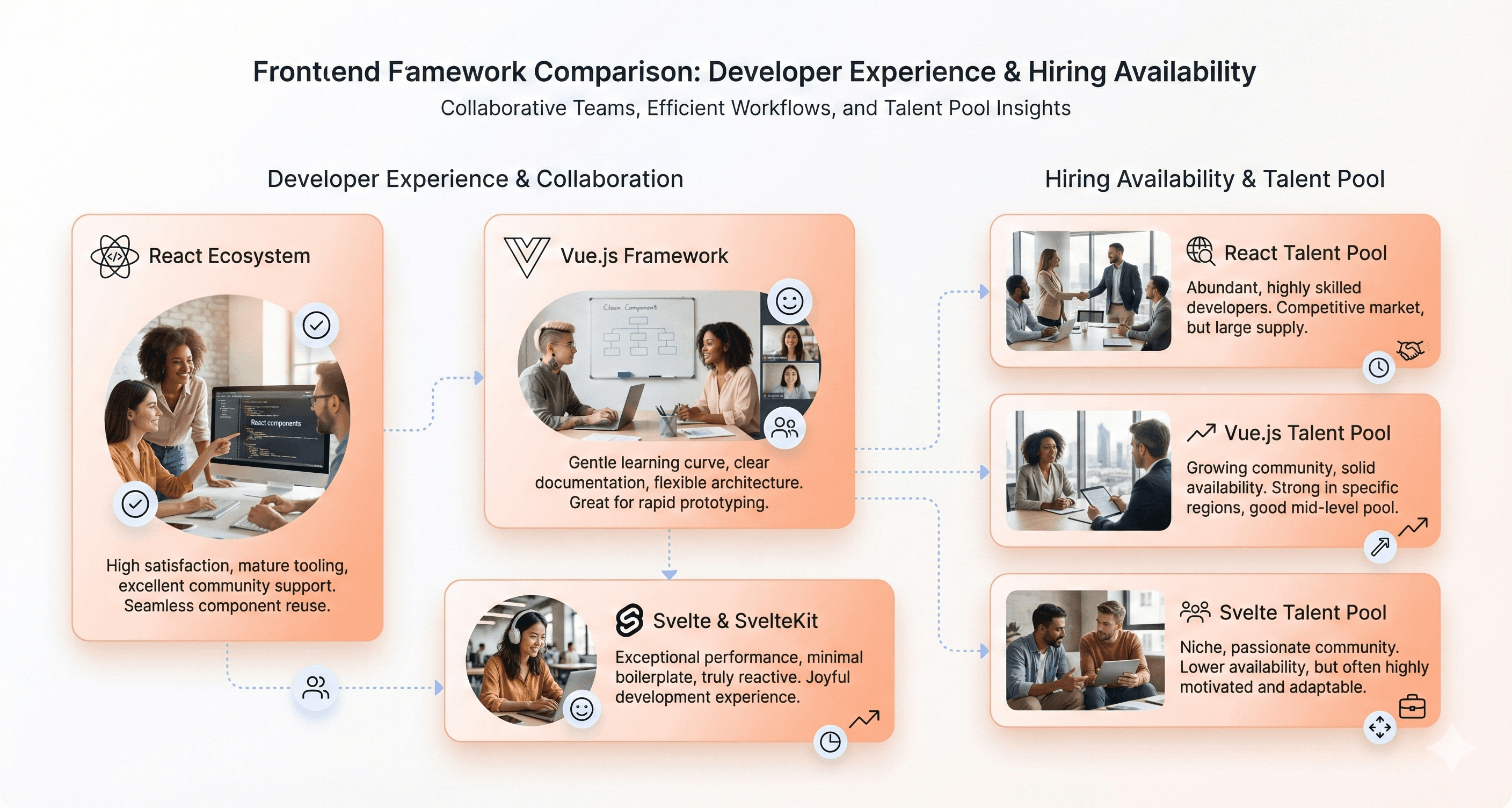
React presents a moderate learning curve that becomes manageable once developers grasp JSX and hooks concepts. While initially straightforward for those familiar with JavaScript, mastering advanced patterns like server components and state management can add complexity. Next.js and Nuxt.js simplify the development experience through built-in routing and conventions, making them accessible despite being built on top of React and Vue respectively.
On the steeper end of the spectrum, Angular requires significant upfront investment due to its reliance on TypeScript, dependency injection, decorators, and modular architecture. While challenging for newcomers, this complexity provides structure that benefits large-scale applications. Qwik and SolidJS introduce novel paradigms that require adjustment periods, even for experienced developers, due to their unique approaches to reactivity and resumability.
Community, Tooling, and Ecosystem Maturity
Community support and ecosystem maturity play decisive roles in framework selection, directly impacting development speed and long-term project sustainability. React dominates this category with massive community support, offering the most extensive ecosystem of libraries, tools, and third-party components. Since February 2026 React has been owned by the React Foundation, whose founding members include Meta, Microsoft, Amazon and Vercel.
Angular benefits from Google's corporate backing and maintains a strong presence in enterprise environments, providing comprehensive official tooling and regular updates. Vue.js has cultivated a passionate community, particularly strong in regions like China and Europe, with robust official libraries including Vue Router and Pinia, which replaced Vuex as the recommended state library.
Next.js and Nuxt.js leverage their underlying frameworks' communities while building growing ecosystems around their specific features. Svelte has seen rapid community growth despite being newer, with highly engaged contributors actively expanding its ecosystem. SolidJS and Qwik represent emerging communities that are smaller but enthusiastic, while Alpine.js benefits from strong integration within the Laravel ecosystem.
The emerging frameworks like SolidJS, Qwik, and newer versions of Svelte are building active communities, though they currently offer fewer third-party libraries and resources compared to established frameworks.
Frontend Developer Hiring Availability by Framework
The availability of skilled developers varies significantly across frontend frameworks, directly impacting project timelines and hiring costs. React developers command the largest talent pool globally, making it easier to find qualified candidates — but signal-to-noise still matters. Use our React developer hiring checklist for SaaS founders to evaluate scalability, performance, and team fit before extending an offer.
Angular developers are particularly prevalent in enterprise environments, with many experienced professionals specializing in large-scale applications. The framework's corporate adoption ensures a steady supply of developers trained in enterprise-grade development practices.
Vue.js has a growing talent pool, especially among developers who appreciate its gentle learning curve and progressive adoption approach. While smaller than React's community, Vue developers are often highly skilled and passionate about the framework.
Next.js developers typically come from React backgrounds, making the transition relatively smooth and expanding the available talent pool. Similarly, Nuxt.js attracts Vue developers looking to build server-side rendered applications.
The newer frameworks face challenges in talent availability. Svelte, SolidJS, and Qwik have smaller but growing developer communities. Organizations choosing these frameworks may need to invest in training existing team members or specifically seek developers interested in cutting-edge technologies.
Documentation Quality and Developer Tooling
Documentation quality and development tooling significantly impact developer productivity and project success rates. React offers comprehensive documentation backed by Meta's resources, complemented by extensive community-generated tutorials and guides. Its tooling includes React Developer Tools. Create React App was deprecated in February 2025, and the React team now recommends starting with a framework such as Next.js or React Router, or a build tool such as Vite. If you still maintain a Create React App or class-component codebase, our React migration services cover the move to a modern setup.
Angular provides exceptionally detailed official documentation, reflecting Google's enterprise-focused approach. The Angular CLI stands out as one of the most robust development tools, handling project setup, code generation, and build optimization seamlessly.
Vue.js is renowned for its clear, well-organized documentation that makes complex concepts accessible. The Vite-based create-vue scaffolding tool and Vue DevTools provide excellent development experiences, while the framework's progressive nature is well-reflected in its structured learning materials.
Svelte offers clean, comprehensive documentation that explains its unique compile-time approach effectively. SvelteKit has enhanced the development experience with excellent tooling for full-stack applications. Next.js and Nuxt.js both provide outstanding documentation with practical examples and clear migration paths.
SolidJS and Qwik, despite being newer, have invested heavily in documentation quality, recognizing its importance for framework adoption. Alpine.js maintains simple, straightforward documentation that matches its lightweight philosophy, making it easy for developers to integrate reactive features into existing projects.
How to Choose a Frontend Framework for Your Project
Table: Which frontend framework fits which project
Project Type | Recommended Frameworks | Key Advantage |
|---|---|---|
Small to Medium Projects | Vue.js, Svelte, Alpine.js | Lightweight, fast setup |
Enterprise-Level Applications | Angular, React | Scalable and structured |
Performance-Critical & Real-Time Apps | Svelte, SolidJS, Qwik | Exceptional speed |
SEO-Focused or Content-Heavy Sites | Next.js, Nuxt.js | Built-in SSR and SSG |
Experimental or Prototype Builds | Vue.js, Svelte | Quick learning curve |
Small and Mid-Size Projects
For small to medium-sized projects, Vue.js stands out as the optimal choice with its progressive nature and gentle learning curve. Vue offers the perfect balance between a full-fledged framework and a lightweight library, making it easy to integrate into existing projects without overwhelming developers with complex configurations.
Alpine.js emerges as an excellent alternative for projects requiring simple interactivity on static or server-rendered sites. With its lightweight footprint and declarative reactivity, Alpine provides Vue-like reactive features without the overhead of a full single-page application framework. This makes it ideal for enhancing traditional websites with modern interactive elements.
Svelte presents another compelling option for small to medium applications, particularly those requiring excellent performance. Its compile-time optimization approach eliminates virtual DOM overhead, resulting in highly optimized vanilla JavaScript that runs exceptionally fast. This framework excels in mobile applications and simple e-commerce websites where performance is crucial.
For teams seeking rapid prototyping capabilities, Vue combined with Nuxt.js offers streamlined development with built-in routing and conventions, though Nuxt may be overkill for projects that don't require server-side rendering or static generation capabilities.
Frontend Frameworks for Enterprise Web Applications
When building enterprise-level applications, Angular dominates as the framework of choice due to its comprehensive feature set and opinionated architecture. Angular provides everything needed out of the box, including robust form processing, validation, HTTP communication, and dependency injection - essential features for complex business applications.
Angular's TypeScript foundation offers significant advantages in enterprise environments, providing strong typing that improves code maintainability and reduces runtime errors. The framework's modular architecture allows organizations to structure large applications effectively, while its extensive CLI capabilities streamline development workflows through automated code generation.
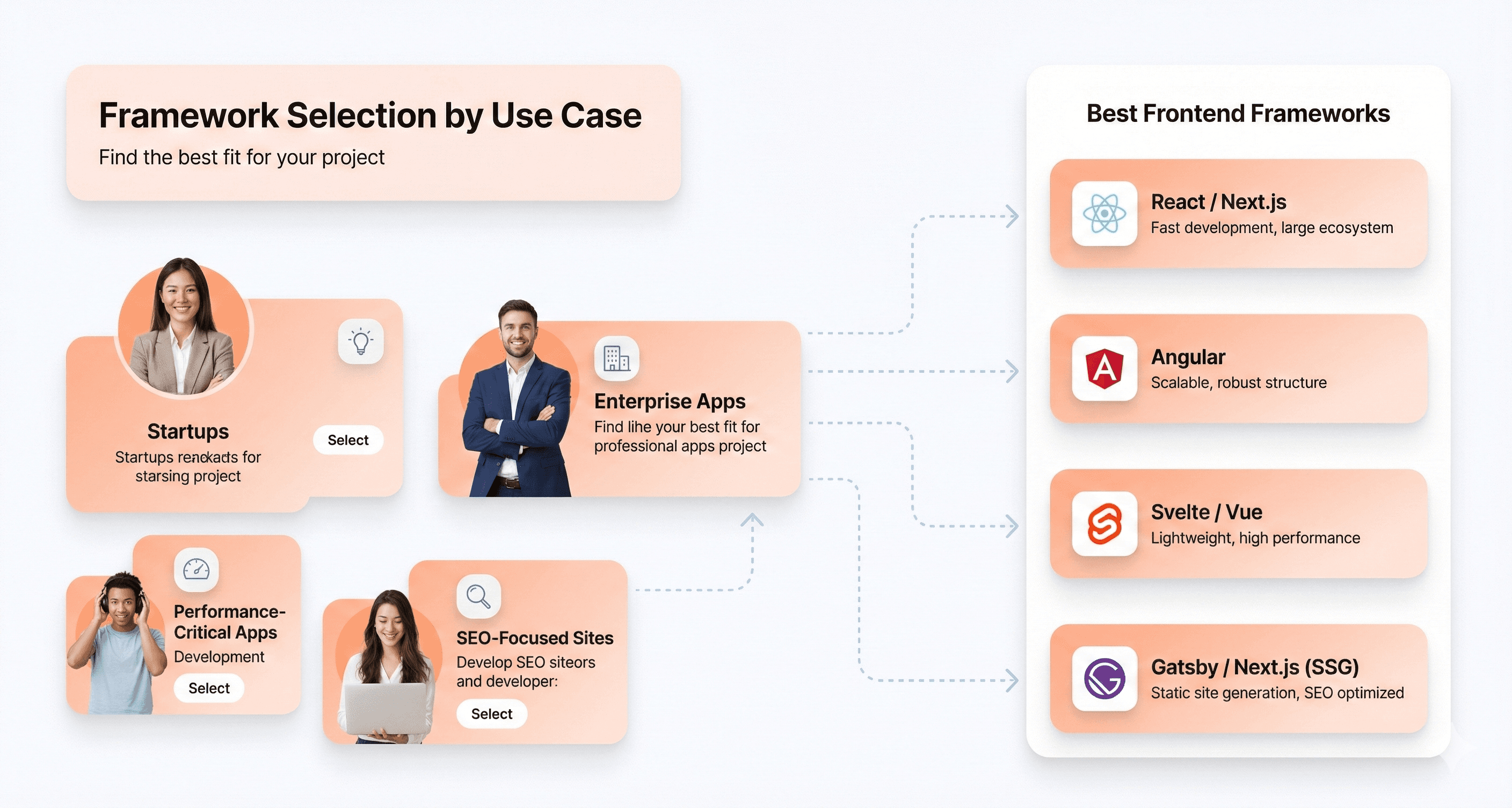
React, when combined with enterprise-grade state management solutions and routing libraries, can also serve enterprise needs effectively. However, teams must invest additional effort in establishing architectural patterns and selecting appropriate third-party libraries to match the comprehensive tooling provided by Angular or Ember.
Best Frameworks for Performance-Critical and Real-Time Apps
For applications where performance is paramount, SolidJS leads the pack with its fine-grained reactivity system that compiles to efficient DOM operations without virtual DOM overhead. This framework delivers React-like flexibility while achieving performance that rivals vanilla JavaScript, making it perfect for reactive, performant interfaces and real-time applications.
Qwik introduces revolutionary performance concepts through resumability and partial hydration, enabling ultra-fast page loads and lightning-fast Time to Interactive (TTI). Its innovative architecture allows applications to pause and resume execution on the client side, making it ideal for performance-first applications where user experience and speed are top priorities.
Svelte continues to excel in performance-critical scenarios through its compile-time optimization approach. By eliminating the virtual DOM entirely and producing highly optimized vanilla JavaScript, Svelte delivers exceptional runtime performance particularly beneficial for mobile applications and performance-sensitive web applications.
When building real-time applications requiring immediate user feedback and data synchronization, these frameworks' minimal overhead and efficient update mechanisms ensure smooth user experiences even under heavy load conditions.
Best Frontend Frameworks for SEO and Content-Heavy Sites
For content-heavy websites requiring strong SEO performance, Next.js emerges as the clear leader among React-based solutions. Built on React, Next.js provides server-side rendering (SSR), static site generation (SSG), and incremental static regeneration out of the box, ensuring optimal search engine visibility and fast page loads.
Nuxt.js serves the same role within the Vue ecosystem, offering Vue-based applications comprehensive SSR and SSG capabilities with minimal configuration. Nuxt's modular architecture and intuitive routing make it particularly suitable for content management systems and marketing websites requiring excellent SEO performance.
Both Next.js and Nuxt.js excel at handling content-heavy sites where search engine optimization and performance matter most. Their built-in image optimization, automatic code splitting, and sophisticated caching mechanisms ensure content loads quickly while maintaining high search engine rankings.
For simpler content sites not requiring full framework overhead, Alpine.js can enhance server-rendered pages with modern interactivity while preserving SEO benefits. This approach works particularly well for content management systems built with traditional server-side technologies that need selective JavaScript enhancement without compromising search engine crawlability.
Where Modern Frontend Frameworks Are Heading: Trends That Define 2026 and Beyond
AI and Automation Trends in Frontend Development
Artificial Intelligence has become an integral part of modern frontend development, fundamentally transforming how developers approach their daily workflows. AI-powered development tools are now capable of generating code, optimizing performance, and even designing user interfaces, allowing developers to focus on more creative aspects of development.
AI-Generated Code represents one of the most significant breakthroughs in developer productivity. Tools like GitHub Copilot enable developers to describe functionality in natural language, with AI generating the corresponding code snippets automatically. This capability dramatically reduces development time for routine tasks and helps maintain coding consistency across projects.
Beyond code generation, AI is revolutionizing user experience personalization — see how AI-driven UI generation is rewiring SaaS frontends for what production teams are actually shipping in 2026. This personalisation happens in application code and AI services rather than in the frameworks themselves.
The integration of AI into design systems is also gaining momentum, with platforms like Figma incorporating AI features that help developers and designers collaborate more efficiently. These AI-driven design systems are helping automate repetitive tasks, reduce errors, and ensure consistent design implementation across applications.
Growth of SSR, SSG, and Edge Rendering
The rise of server-side rendering (SSR) and static site generation (SSG) has become mainstream in 2026, driven by frameworks like Next.js, Nuxt.js, and SvelteKit. These techniques significantly improve performance, SEO, and user experience by delivering pre-rendered content to browsers, addressing the limitations of traditional client-side rendering.
Hybrid Rendering approaches are gaining traction as developers combine SSR and client-side rendering (CSR) to create dynamic, fast-loading applications. This approach allows developers to optimize different parts of their applications based on specific requirements - using SSR for initial page loads and SEO-critical content, while leveraging CSR for dynamic interactions.
Edge Computing is increasingly becoming the standard for content delivery, with content being rendered at the edge to reduce latency and improve global accessibility. This distributed approach ensures that users worldwide experience faster load times and more responsive applications.
Static site generation has evolved beyond simple blogs and marketing sites to support complex web applications. Modern SSG solutions offer incremental static regeneration, allowing developers to update content without rebuilding entire sites, making them suitable for dynamic content scenarios while maintaining the performance benefits of static generation.
Compile-Time Optimization and WebAssembly Advances
Frontend frameworks in 2026 are achieving unprecedented performance levels through advanced compilation techniques and optimization strategies. WebAssembly (Wasm) has matured significantly, enabling developers to build high-performance web applications that rival native apps for computationally intensive tasks such as video editing, 3D rendering, and gaming directly in browsers.
Cross-Platform Compatibility through WebAssembly allows developers to write code in languages like Rust, C++, and Go, making it easier to port existing applications to the web while maintaining high performance. The binary compilation format of Wasm reduces load times and improves runtime performance significantly compared to traditional JavaScript execution.
Frameworks like Svelte are pioneering compile-time optimizations by shifting much of the work to build time rather than runtime. This approach generates highly efficient imperative code that minimizes runtime overhead, resulting in faster applications with smaller bundle sizes.
Modern JavaScript engines continue to evolve with advanced optimization techniques, including better tree-shaking, code splitting, and lazy loading capabilities. These improvements enable frameworks to deliver only the necessary code to users, reducing initial bundle sizes and improving perceived performance.
Frontend Framework Sustainability and Long-Term Support
Framework sustainability has become a critical consideration for development teams planning long-term projects. The community and ecosystem strength serves as a key indicator of framework longevity, with established frameworks like React, Vue, and Angular maintaining robust communities that contribute to extensive libraries, tools, and resources.
Corporate backing plays a crucial role in framework sustainability. Angular's support from Google, React's move to the vendor-neutral React Foundation, and Vue's growing corporate sponsorship provide confidence in long-term maintenance and development. However, emerging frameworks like Svelte demonstrate that strong community adoption can also ensure sustainability without major corporate sponsorship.
The learning curve and developer experience significantly impact framework adoption and long-term viability. Frameworks that prioritize developer ergonomics, comprehensive documentation, and intuitive APIs tend to maintain stronger communities and longer lifespans in the rapidly evolving frontend landscape.
Backward compatibility and migration paths have become essential features for mature frameworks — and AI-powered frontend modernization in 2026 is making once-painful upgrades dramatically faster. Successful frameworks now provide clear upgrade paths and maintain compatibility across versions, reducing the technical debt associated with framework updates and ensuring that applications built today will remain maintainable in the future.
The trend toward framework-agnostic solutions like Web Components is also influencing long-term sustainability considerations, as they provide standardized ways to create reusable components that work across different frameworks, reducing vendor lock-in and improving code portability.
Conclusion
React, Angular and Vue still carry most production work in 2026, and React alone was used by 44.7% of respondents to the Stack Overflow 2025 survey. React keeps the largest ecosystem and hiring pool, while Vue.js provides an excellent balance of simplicity and power for smaller teams.
Angular remains the go-to choice for enterprise applications requiring structure and scalability, while emerging frameworks like Svelte, SolidJS, and Qwik are pushing performance boundaries with innovative approaches to reactivity and compilation.
Success in choosing the right framework comes down to aligning your selection with specific project requirements, team expertise, and long-term goals. Whether you prioritize hiring ease with React, development speed with Vue, enterprise structure with Angular, or cutting-edge performance with Svelte, the key is understanding your constraints and objectives.
As these frameworks continue to evolve with features like improved SSR, better hydration, and enhanced developer experience, the future of frontend development looks increasingly performance-focused and developer-friendly. The best framework for 2026 isn't a universal answer; it's the one that best serves your unique use case and sets your project up for sustainable growth.




About the author
I’m the founder of Hashbyt, an AI-first frontend and UI/UX SaaS partner helping 200+ SaaS companies scale faster through intelligent, growth-driven design. My work focuses on building modern frontend systems, design frameworks, and product modernization strategies that boost revenue, improve user adoption, and help SaaS founders turn their UI into a true growth engine.
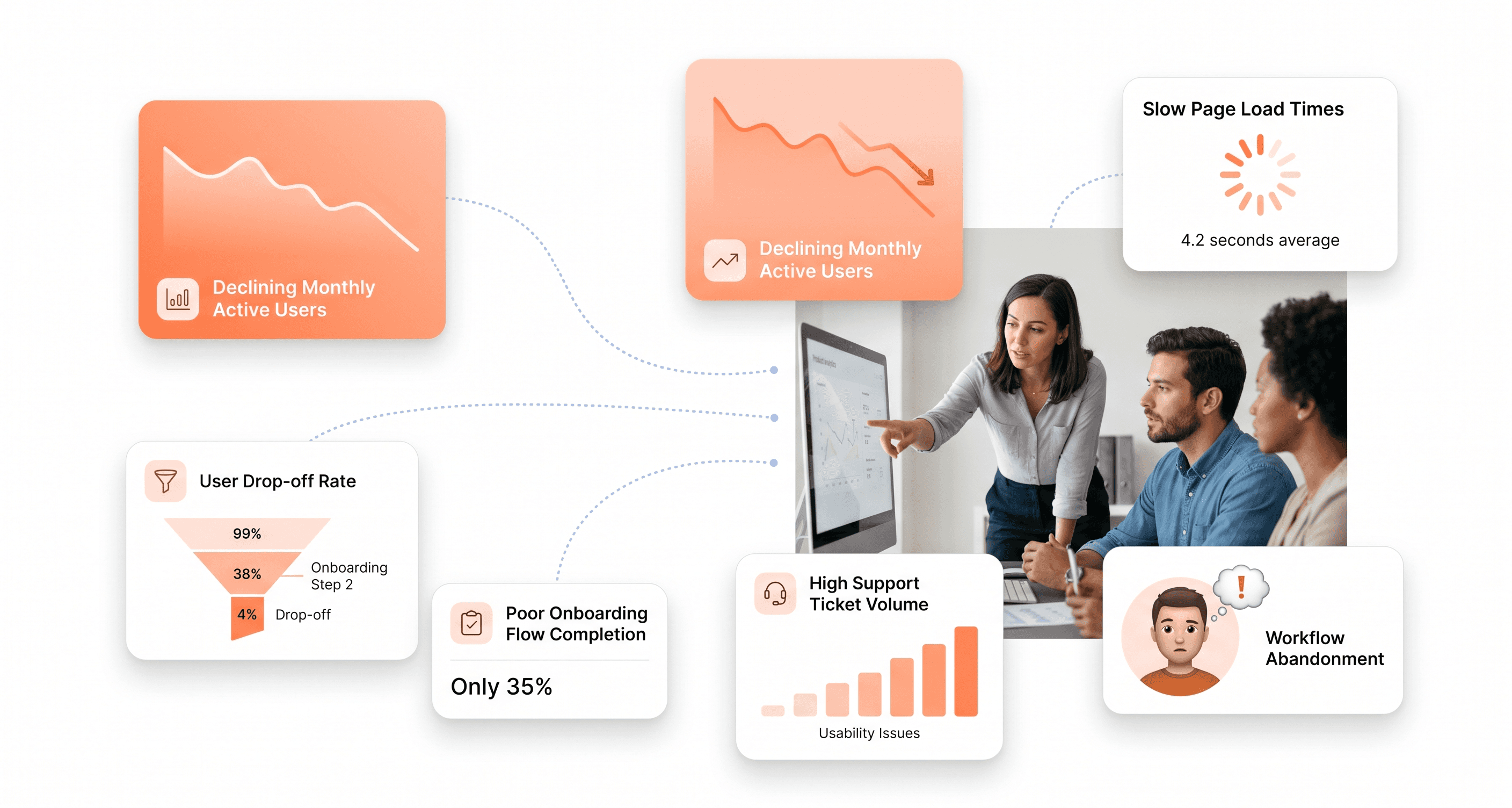
Is a clunky UI holding back your growth?
Is a clunky UI holding back your growth?
▶︎
Transform slow, frustrating dashboards into intuitive interfaces that ensure effortless user adoption.
▶︎
Transform slow, frustrating dashboards into intuitive interfaces that ensure effortless user adoption.
