
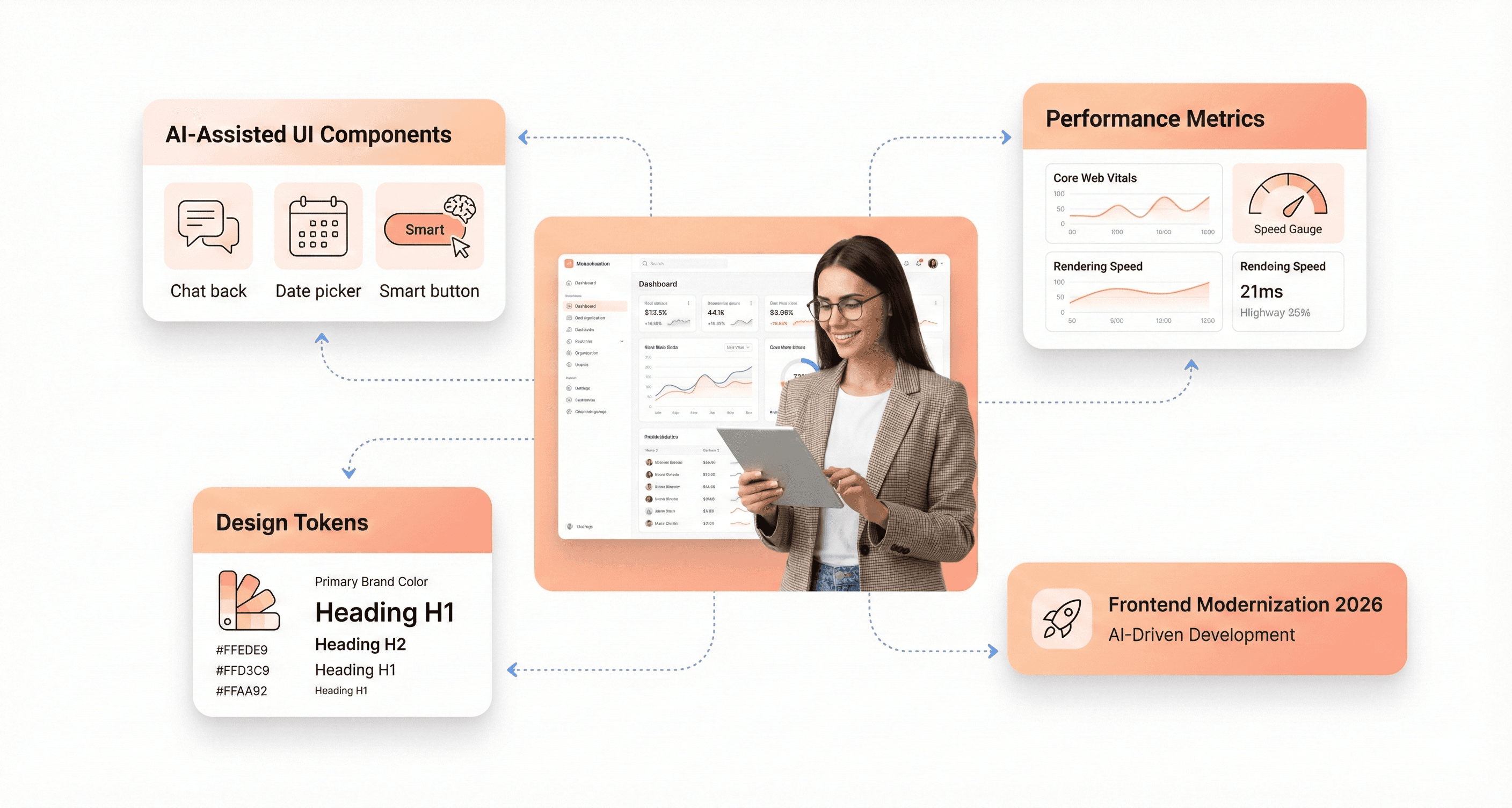
AI in Frontend Modernization: What’s Changing in 2026
Posted on
Frontend Development
Posted at
Jan 2, 2026
Jan 2, 2026
Min read
10

I hope you found this post valuable. If you’re looking for proven frontend and design expertise to elevate your product, feel free to reach out.


AI-powered frontend development is reshaping how developers build web applications in 2026. Frontend engineers, technical leads, and development teams need to understand how AI agents are moving beyond simple code suggestions to autonomous development partners that handle entire workflows.
This transformation affects three critical areas of frontend modernization. First, AI agents now take complete ownership of UI development cycles, from reading Figma designs to generating responsive React components and self-correcting based on browser output. Second, automated bug detection and performance optimization happen proactively, with AI agents scanning codebases continuously to fix issues before they impact users. Finally, the relationship between developers and AI is evolving from assistance to collaboration, where AI agents maintain long-term memory of your codebase and enforce design systems while developers focus on architecture and UX decisions.
The shift from manual coding to AI-guided development isn't replacing frontend engineers, it's amplifying their impact on the parts of development that matter most.
AI Agents Transform UI Development from Code Generation to Autonomous Creation
End-to-end UI screen construction from design to deployment
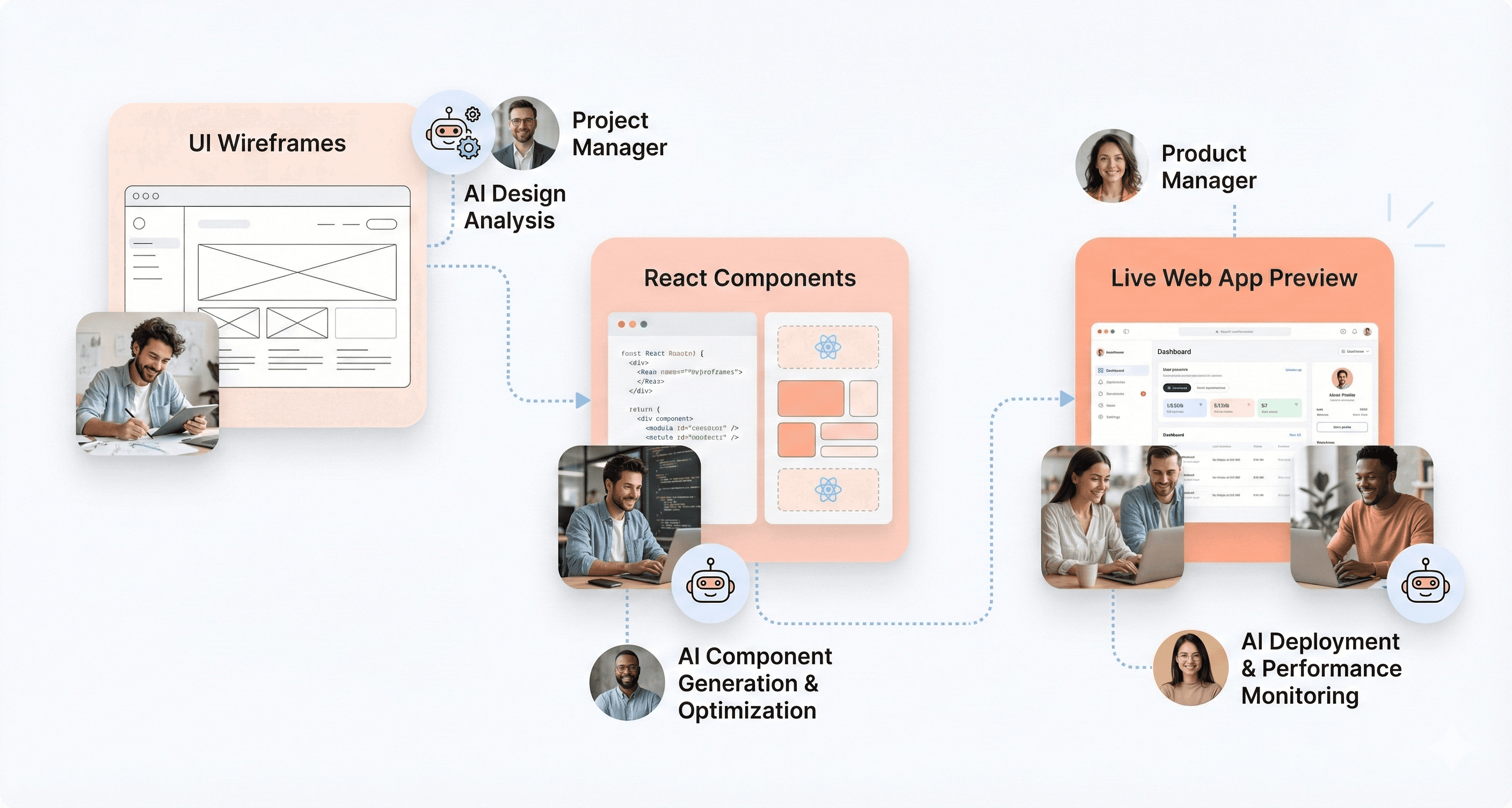
The transformation of AI-powered frontend development in 2026 represents a fundamental shift from traditional code generation to truly autonomous UI creation. These AI agents now orchestrate the entire development pipeline, handling everything from initial design interpretation to production deployment without requiring manual intervention at each step.

Modern AI development systems can take a design concept and autonomously generate responsive product detail pages, automatically pulling data from Product Information Management (PIM) systems while adhering to established design system tokens. This capability extends beyond simple template generation, these agents reason through complex multi-step processes, creating associated development tickets and coordinating with backend systems seamlessly.
Automatic component breakdown and responsive layout application
AI agents in 2026 have evolved sophisticated capabilities for component architecture analysis and responsive design implementation. These systems automatically decompose complex UI designs into reusable components while ensuring optimal responsive behavior across different screen sizes and device types.
The autonomous breakdown process analyzes visual hierarchies, identifies repeating patterns, and creates component libraries that maintain design consistency. These AI systems understand the relationship between visual elements and translate them into efficient component structures that follow modern frontend development best practices.
For responsive layout applications, these agents leverage an advanced understanding of CSS Grid, Flexbox, and modern layout techniques to ensure interfaces adapt flawlessly across devices. They automatically generate breakpoint-specific styles and implement fluid typography and spacing systems without requiring manual specification.
Self-correction capabilities based on rendered output analysis
A defining characteristic of AI-powered frontend development in 2026 is the implementation of self-correction mechanisms that analyze rendered output and automatically adjust code to meet design specifications. These systems continuously monitor the visual output of generated code against original design intentions.
When discrepancies are detected between expected and actual rendered results, the AI agents automatically iterate on the codebase, adjusting CSS properties, component logic, or layout structures until the output matches the design requirements. This self-correction capability extends to cross-browser compatibility, ensuring consistent rendering across different browsers and devices.
The analysis process includes performance metrics evaluation, accessibility compliance checking, and visual regression testing, allowing the system to optimize not just for visual accuracy but also for technical performance and user experience standards.
Shift from manual coding to guided UI orchestration
The role of frontend developers is fundamentally changing from hands-on coding to strategic UI orchestration. Instead of writing individual components and styling rules, developers now focus on defining system guardrails, establishing design principles, and managing the AI agents that handle code execution.
This orchestration model transforms developers into system curators who define the parameters within which AI agents operate. They establish design system governance rules, performance benchmarks, and accessibility standards that guide autonomous development processes.
The transition empowers development teams to focus on higher-level architectural decisions, user experience strategy, and system integration challenges while AI agents handle the implementation details. This shift enables faster iteration cycles, reduced development overhead, and more consistent output quality across projects.
Human oversight remains crucial for brand-specific nuance, ethical considerations, and strategic product decisions that require human judgment and creativity. The partnership between human developers and AI agents creates a more efficient and scalable approach to frontend development that leverages the strengths of both human creativity and machine precision.
Automated Bug Detection and Resolution Reduces Developer Debugging Time
70% Reduction in Manual Bug Fixing Through AI Agent Automation
AI-powered bug detection systems are achieving unprecedented efficiency gains in frontend development workflows. According to industry data, organizations implementing AI-driven testing methods report detection rates of 90-95% while cutting overall testing time by 50-70%. This dramatic improvement stems from AI's ability to analyze historical bug data, code changes, and test execution results to identify patterns that indicate potential issues before they manifest.

The transformation becomes particularly evident when considering that 38% of developers traditionally spend up to a quarter of their time fixing bugs, while 26% dedicate up to half their development time to bug resolution instead of creating new features. AI automation directly addresses this bottleneck by shifting from reactive debugging to proactive defect prevention through predictive analytics and pattern recognition.
Machine learning models trained on vast datasets of code patterns excel at detecting complex issues like security vulnerabilities, performance bottlenecks, and semantic flaws that could lead to runtime failures. Unlike traditional tools that struggle with false positives, AI systems learn to recognize legitimate coding patterns, reducing false alerts by up to 60% and ensuring developers receive actionable insights rather than noise.
Complete Debugging Workflow from Reproduction to Pull Request Submission
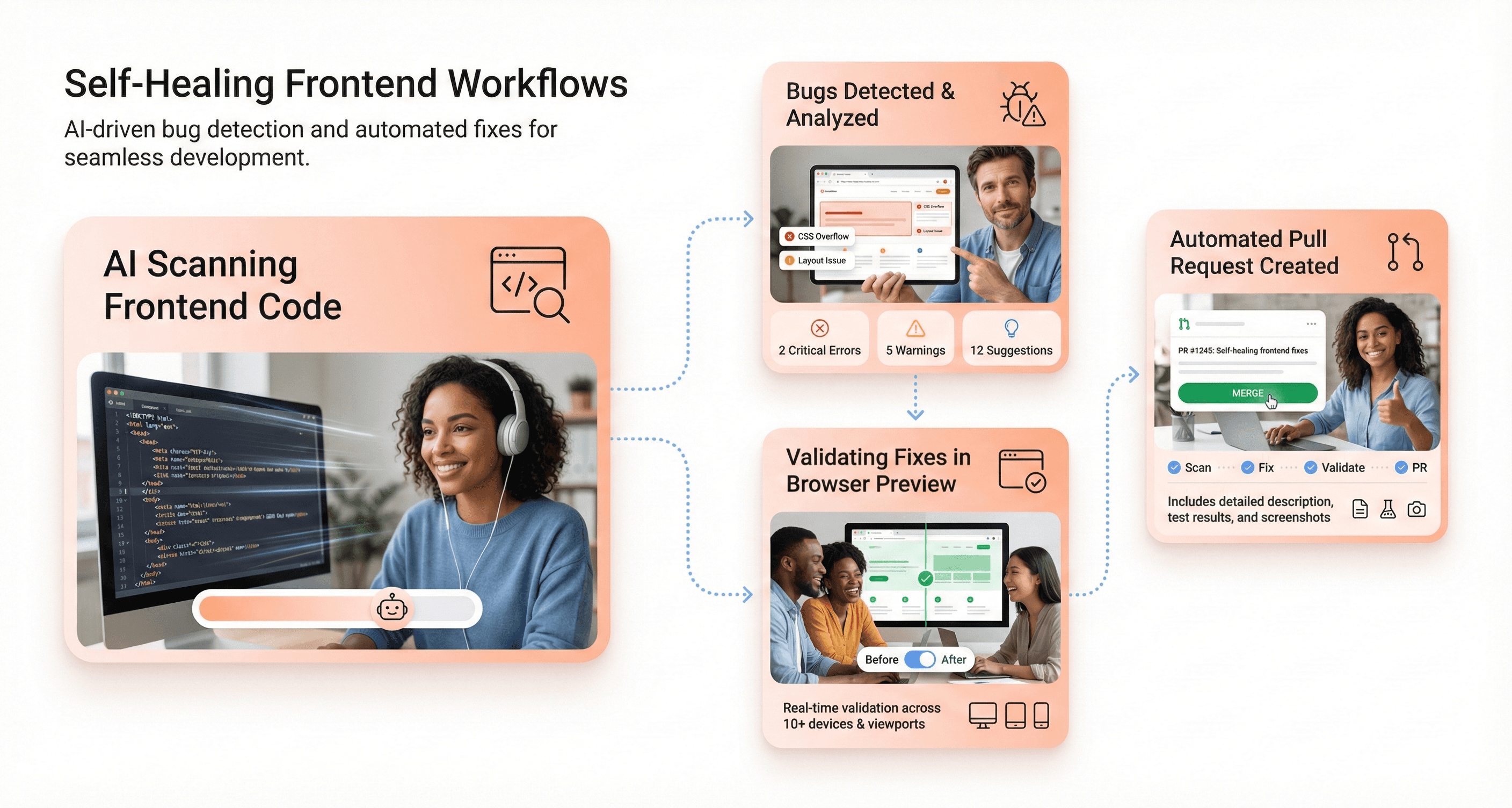
Modern AI debugging agents now handle the entire bug resolution lifecycle autonomously. These systems begin by analyzing error reports and automatically generating reproduction steps, examining stack traces, and comparing findings to historical bug data to pinpoint root causes. The AI then creates comprehensive bug reports that include everything developers need: clear reproduction steps, probable causes, and priority levels based on business impact analysis.
Self-healing test systems represent a critical component of this automated workflow. When application UI or code changes occur, AI agents detect modifications and adjust test scripts accordingly without manual intervention. For example, if a button's location shifts or an element ID updates, the system automatically modifies the test script to maintain coverage. This capability extends beyond simple updates to recognize when entire workflows are altered, adjusting test logic to match new application behavior.
The integration with development platforms like GitHub and Slack enables seamless workflow automation. Bug reports are automatically generated and submitted as pull requests, complete with proposed fixes that have been validated through the AI's analysis. This end-to-end automation allows teams to maintain continuous development velocity while ensuring comprehensive quality assurance.
Real-time Error Analysis Using Console, Network, and Profiler Data
AI systems excel at synthesizing multiple data streams to provide comprehensive error analysis. By monitoring console outputs, network requests, and performance profiler data simultaneously, AI agents can identify subtle issues that might escape traditional debugging methods. This multi-dimensional analysis approach enables detection of performance dips, memory leaks, and inefficient algorithms even when applications appear to function correctly on the surface.
Static analysis powered by AI inspects code without execution, identifying patterns that might lead to problems by understanding code context rather than just syntax. Dynamic analysis complements this by evaluating code during runtime, monitoring performance metrics and identifying anomalies as they occur. The combination provides comprehensive coverage that catches both obvious errors and deeply hidden issues.
The real-time aspect proves crucial for maintaining development momentum. As developers commit changes, AI systems immediately analyze the impact across console logs, network behavior, and performance metrics, providing instant feedback that prevents issues from propagating through the development pipeline. This immediate analysis capability transforms debugging from a time-consuming reactive process into a seamless part of the development workflow.
Validated Fixes Through Headless Browser Testing
AI-driven testing platforms now employ headless browser environments to validate proposed fixes before they reach production. This validation process ensures that AI-generated solutions actually resolve the identified issues without introducing new problems. Headless browsers provide a controlled testing environment where AI agents can execute proposed fixes, run comprehensive test suites, and verify that the solution addresses the root cause effectively.
The validation process includes automated regression testing to ensure that fixes don't break existing functionality. AI systems analyze the proposed changes' impact across the entire codebase, identifying potential side effects and testing related components thoroughly. This comprehensive approach provides confidence that automated fixes maintain application stability while resolving the targeted issues.
Platforms like Ranger demonstrate the effectiveness of this approach by combining AI-powered test creation with human oversight to ensure reliable results. The system automatically generates test cases, validates fixes through headless browser testing, and provides detailed reports on fix effectiveness. This blend of automation and validation creates a robust debugging workflow that delivers consistent, reliable results while maintaining the speed advantages of AI-driven development.
Proactive Performance Optimization Happens Before Issues Impact Users
Continuous code scanning for React performance bottlenecks
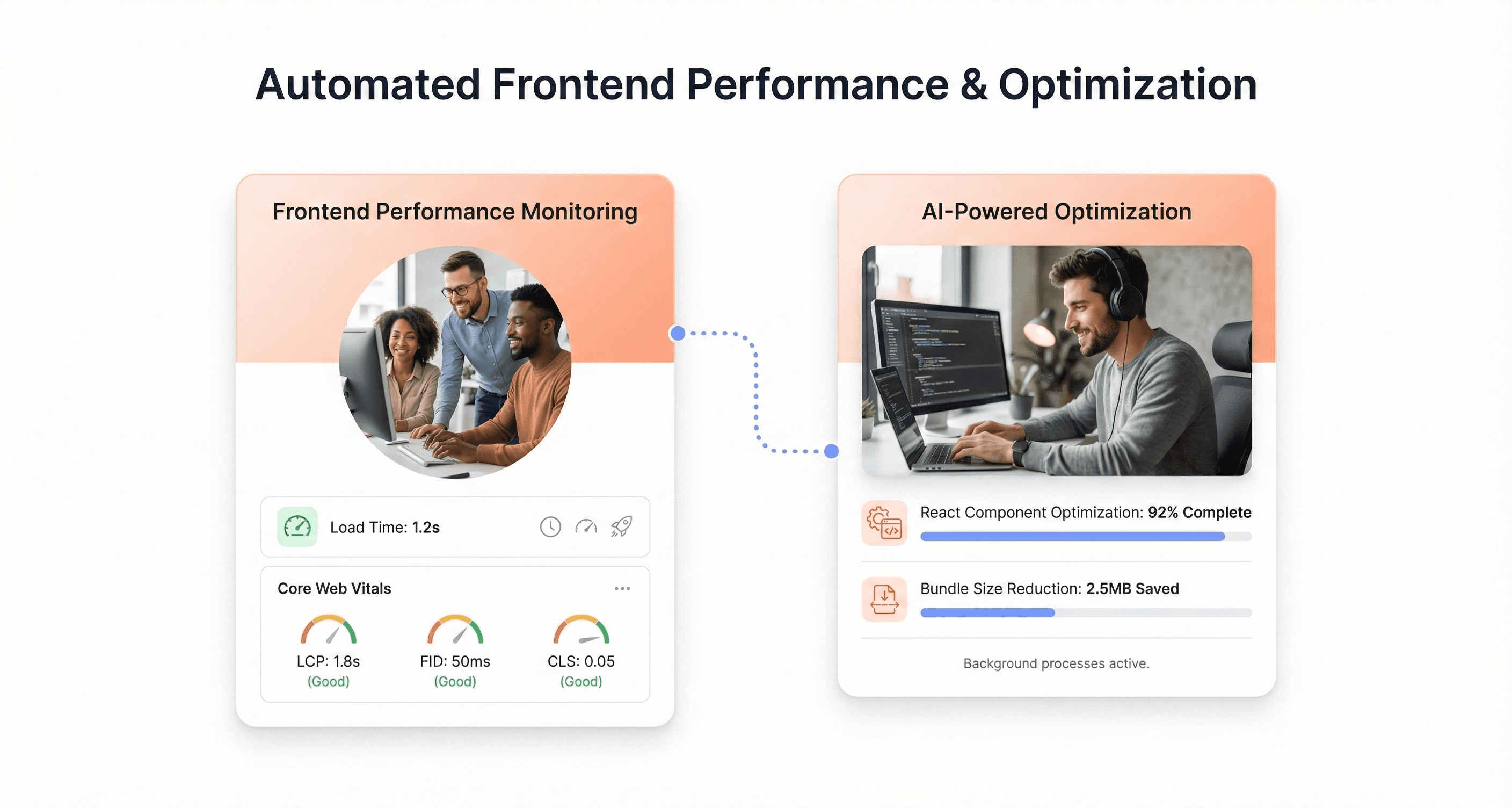
AI-powered performance optimization systems now continuously monitor React applications for emerging bottlenecks before they impact users. These intelligent systems analyze code patterns, component hierarchies, and runtime behavior to identify performance degradation in real-time. Unlike traditional monitoring that relies on static thresholds, machine learning algorithms establish dynamic baselines across multiple performance dimensions simultaneously — including page load times, Core Web Vitals metrics, and JavaScript execution times.

The continuous scanning process leverages pattern recognition across the entire frontend stack, monitoring front-end metrics like load times, JavaScript execution delays, and render performance. These AI systems can detect subtle changes in component behavior, identifying when new features or code deployments introduce performance regressions that might escape conventional monitoring tools.
Automatic component rewriting and memoization optimization
Modern AI development tools now automatically rewrite React components to optimize performance without developer intervention. These systems analyze component usage patterns and automatically implement React.memo, useMemo, and useCallback optimizations where they provide the greatest performance benefit. The AI evaluates component render frequency, prop complexity, and dependency chains to determine optimal memoization strategies.
The automated rewriting process goes beyond simple memoization, restructuring component hierarchies to minimize unnecessary re-renders and optimizing state management patterns. This proactive approach ensures that frontend performance optimization AI continuously improves application efficiency as the codebase evolves.
Smart bundle splitting and lazy loading implementation
AI-powered bundle optimization analyzes user navigation patterns and code usage statistics to implement intelligent code splitting automatically. These systems determine optimal chunk boundaries based on actual user behavior rather than arbitrary size limits, creating bundles that align with real-world usage patterns. The AI continuously learns from user interactions to refine splitting strategies and minimize load times for critical user paths.
Smart lazy loading implementation extends beyond simple route-based splitting, identifying opportunities to defer non-critical components and resources based on viewport visibility and user interaction patterns. This intelligent approach to resource loading ensures users receive the fastest possible experience without manual optimization efforts from development teams.
Background performance improvements without developer intervention
AI systems now operate autonomously in the background, implementing performance optimizations without requiring developer awareness or approval for non-breaking changes. These systems continuously analyze runtime performance data and automatically apply improvements like resource prefetching, cache optimization, and script execution ordering. The AI maintains detailed logs of all optimizations, allowing teams to understand what changes were made while focusing their attention on feature development.
Background optimization extends to third-party script management, where AI systems monitor tag execution times, detect errors, and automatically implement fixes for common performance issues. This proactive performance management transforms site speed from a reactive maintenance task into an autonomous growth engine that protects revenue by preventing issues before customers experience them.
Test Generation and Maintenance Becomes Fully Automated
Comprehensive test coverage through AI-powered user flow identification
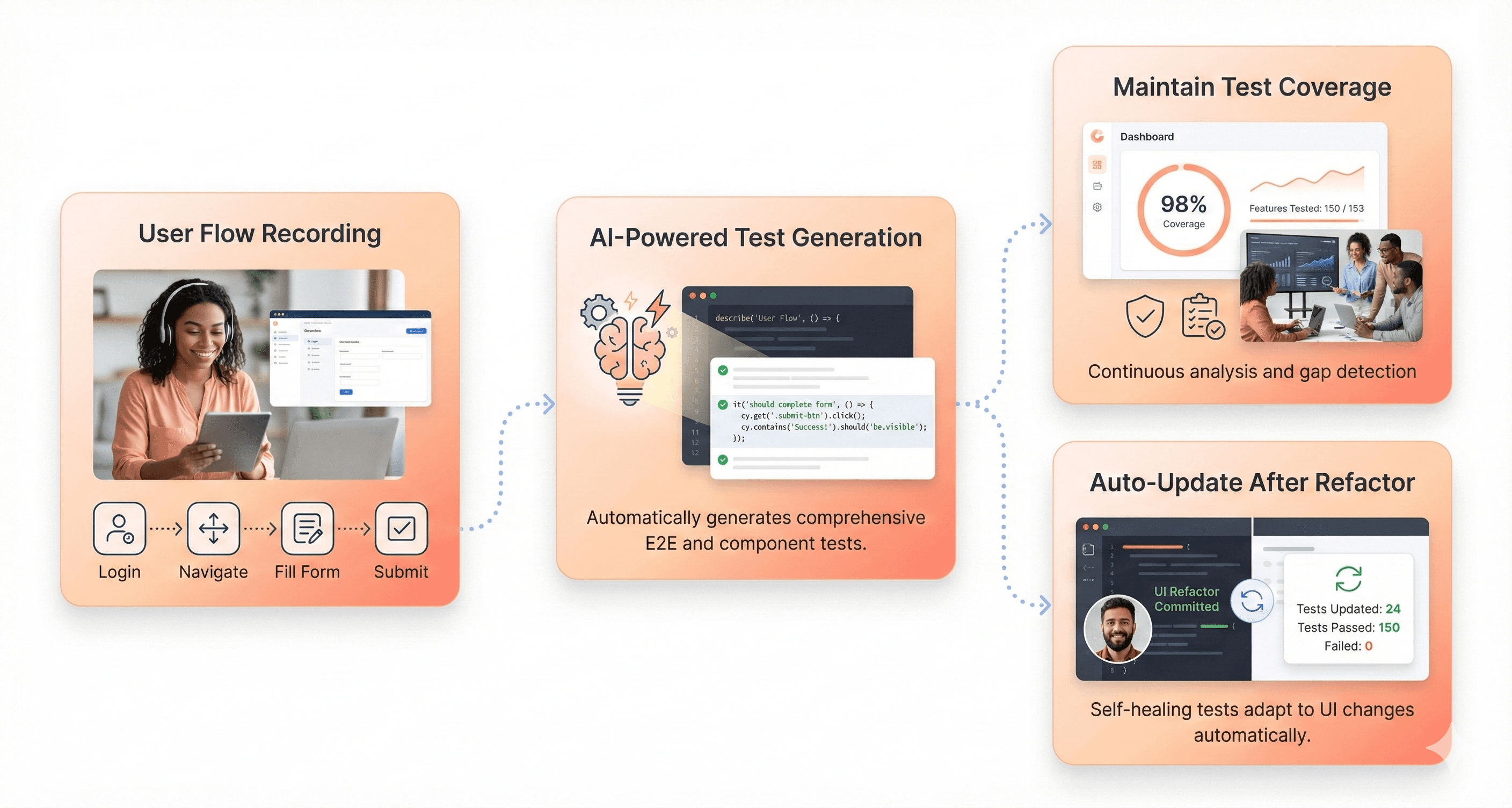
Now that we've explored how AI agents are transforming UI development, the next frontier in AI frontend development 2026 focuses on intelligent test generation that automatically identifies and covers complex user workflows. Modern AI testing platforms analyze React component code and requirements to automatically generate comprehensive test cases that simulate real user interactions. These systems parse component functionality directly from the codebase, inferring intent and mapping out critical user flows that human testers might overlook.

AI-powered frontend development tools now excel at understanding component relationships and state dependencies, creating test scenarios that cover edge cases and interaction patterns. This approach ensures that subtle bugs in component interactions are caught early in the development process, significantly improving code quality before deployment.
Automatic Jest and React Testing Library test creation
The evolution of automated testing frameworks has reached a point where AI can generate complete Jest and React Testing Library test suites without manual intervention. These intelligent systems create tests for:
Component prop validation and rendering behavior
React hook functionality and state management
User interaction simulations and event handling
Component lifecycle and effect testing
AI testing agents integrate seamlessly with popular development environments including Visual Studio Code, Cursor, and other AI-powered editors, making test generation a natural part of the development workflow. The generated tests follow best practices and maintain consistency with existing testing patterns in the codebase.
Self-healing tests that adapt to code refactors
One of the most significant advances in Frontend development testing is the emergence of self-healing tests that automatically adapt to code changes. When components are refactored or updated, AI-powered testing systems analyze the changes and automatically update test cases to maintain compatibility. This eliminates the traditional maintenance burden where developers had to manually update tests after every code change.
These intelligent systems understand the intent behind tests rather than just their syntax, allowing them to preserve test validity even when implementation details change. In real-world benchmarks, AI-powered testing platforms have demonstrated significant improvements, boosting test pass rates from 42% to 93% after just one iteration of automated optimization.
Continuous test execution and failure resolution
Modern AI testing platforms provide continuous monitoring through scheduled test execution that runs hourly, daily, weekly, or monthly based on project needs. When tests fail, the system doesn't just report the failure—it actively analyzes the root cause and provides specific fix recommendations. This AI-powered UI/UX approach ensures that issues are resolved quickly without requiring extensive developer intervention.
The platforms offer smart test group management, allowing teams to organize critical test suites by functionality such as user authentication, session management, or core business logic. Automated failure resolution includes pinpoint feedback delivery and suggested code fixes, creating a self-repairing development environment that maintains code quality autonomously.
State Management and API Integration Shifts to Agent-Driven Architecture
Automated API Client Generation from Schema Analysis
AI-powered frontend development in 2026 fundamentally transforms how developers handle API integration through intelligent schema analysis. Modern AI agents automatically parse OpenAPI specifications, GraphQL schemas, and REST documentation to generate fully-typed client libraries without manual intervention. These systems analyze endpoint structures, parameter requirements, and response formats to create optimized API clients that handle authentication, error handling, and request/response transformations seamlessly.
The state management architecture shifts from traditional manual configuration to autonomous AI orchestration, where agents continuously monitor API schemas for changes and automatically update client code accordingly. This eliminates the tedious process of manually maintaining API interfaces and ensures frontend applications remain synchronized with backend services without developer intervention.
Smart React Query Key Management and Caching Logic
With the evolution of AI state management, React Query key generation becomes fully automated through intelligent pattern recognition. AI agents analyze component hierarchies, data dependencies, and user interaction patterns to create optimal caching strategies that maximize performance while minimizing memory usage. These systems automatically generate cache invalidation rules based on data relationships and user behavior patterns.
The AI-driven approach to cache key management eliminates common pitfalls like cache key collisions and unnecessary network requests. Agents continuously monitor application performance metrics and adjust caching strategies in real-time, ensuring optimal data freshness while maintaining responsive user experiences across different usage scenarios.
Form Validation Schema Creation Without Boilerplate Code
AI agents revolutionize form handling by automatically generating comprehensive validation schemas from component analysis and user input patterns. These systems examine form structures, field types, and business logic requirements to create robust validation rules without requiring manual schema definition. The agents understand complex validation requirements like cross-field dependencies, conditional validations, and async validation scenarios.
The autonomous form validation generation extends beyond simple field-level checks to include sophisticated business rule validation, real-time error messaging, and accessibility compliance. This AI-powered approach significantly reduces development time while ensuring consistent validation behavior across entire applications.
Complex State Logic Maintenance Through AI Orchestration
Now that we've covered automated generation capabilities, AI orchestration transforms how complex state logic is maintained and evolved over time. Drawing from the reference content on LangGraph's state management principles, AI agents maintain conversation-like memory of application state changes, similar to how AI agents track previous instructions in conversational contexts.
These AI development partners implement sophisticated state management strategies that adapt to changing application requirements. The agents analyze state transitions, identify optimization opportunities, and automatically refactor state logic to maintain performance as applications scale. This autonomous maintenance ensures that complex state management remains efficient and bug-free without constant developer oversight.
Long-Term Codebase Memory Creates Specialized Development Partners
Persistent understanding of project naming conventions and architecture
AI development agents in 2026 are revolutionizing how codebases maintain consistency through persistent memory systems that understand and enforce project-specific conventions. These agents utilize sophisticated memory architectures that go far beyond simple vector databases, incorporating what developers describe as "unprecedented continuity from session to session" through intelligent issue tracking and context management.
The breakthrough comes from agents that store their understanding in git-backed databases, creating a hybrid system that combines the queryability of databases with the versioning capabilities of version control. This approach enables AI agents to maintain a deep understanding of naming patterns, architectural decisions, and structural conventions that persist across development sessions.
Adaptive learning of team coding styles and design patterns
Modern AI agents demonstrate remarkable adaptability in learning team-specific coding styles through what engineers call "distillation" - the process of turning raw development history, code reviews, and documentation into actionable context. Rather than relying on generic programming patterns, these agents develop specialized knowledge about how specific teams structure their code, handle error cases, and implement design patterns.
The most effective systems employ multiple memory types working in concert: scratchpad memory for immediate reasoning, episodic memory for session continuity, semantic knowledge bases for long-term understanding, and symbolic memory for hard constraints and rules. This multi-layered approach allows agents to distinguish between project-specific conventions and general programming practices.
Specialized AI agents tailored to specific codebases
The evolution toward specialized AI development partners represents a fundamental shift from generic coding assistants to codebase-specific agents that understand the unique characteristics of individual projects. These agents maintain structured data solutions that act as persistent, AI-agnostic memory systems, enabling them to provide contextually relevant suggestions based on the specific architecture and patterns of each codebase.
Developers report that working with specialized agents feels like collaborating with a team member who has intimate knowledge of the project's history and conventions. The agents can reference previous architectural decisions, understand why certain patterns were chosen over alternatives, and maintain consistency with established coding standards without requiring constant guidance.
Improved suggestions through extended collaboration history
Extended collaboration history enables AI agents to provide increasingly sophisticated suggestions by maintaining detailed records of development decisions, bug fixes, and architectural evolution. The most advanced systems implement graph-based reasoning that connects facts and decisions rather than simply storing isolated pieces of information.
This historical context allows agents to avoid repeating past mistakes and build upon successful patterns. When agents encounter similar problems to those solved previously, they can reference the historical solutions and adapt them to current contexts. The memory systems also enable agents to track the evolution of coding preferences and architectural decisions over time, ensuring that suggestions remain aligned with the project's current direction rather than outdated patterns.
The debugging capabilities of these memory-enhanced agents represent a significant advancement over traditional development tools. When issues arise, agents can trace through their memory of past decisions and identify potential root causes based on historical patterns, making the debugging process more systematic and informed by the project's complete development history.
Design System Enforcement Ensures Consistent User Experiences
Automatic spacing and layout consistency validation
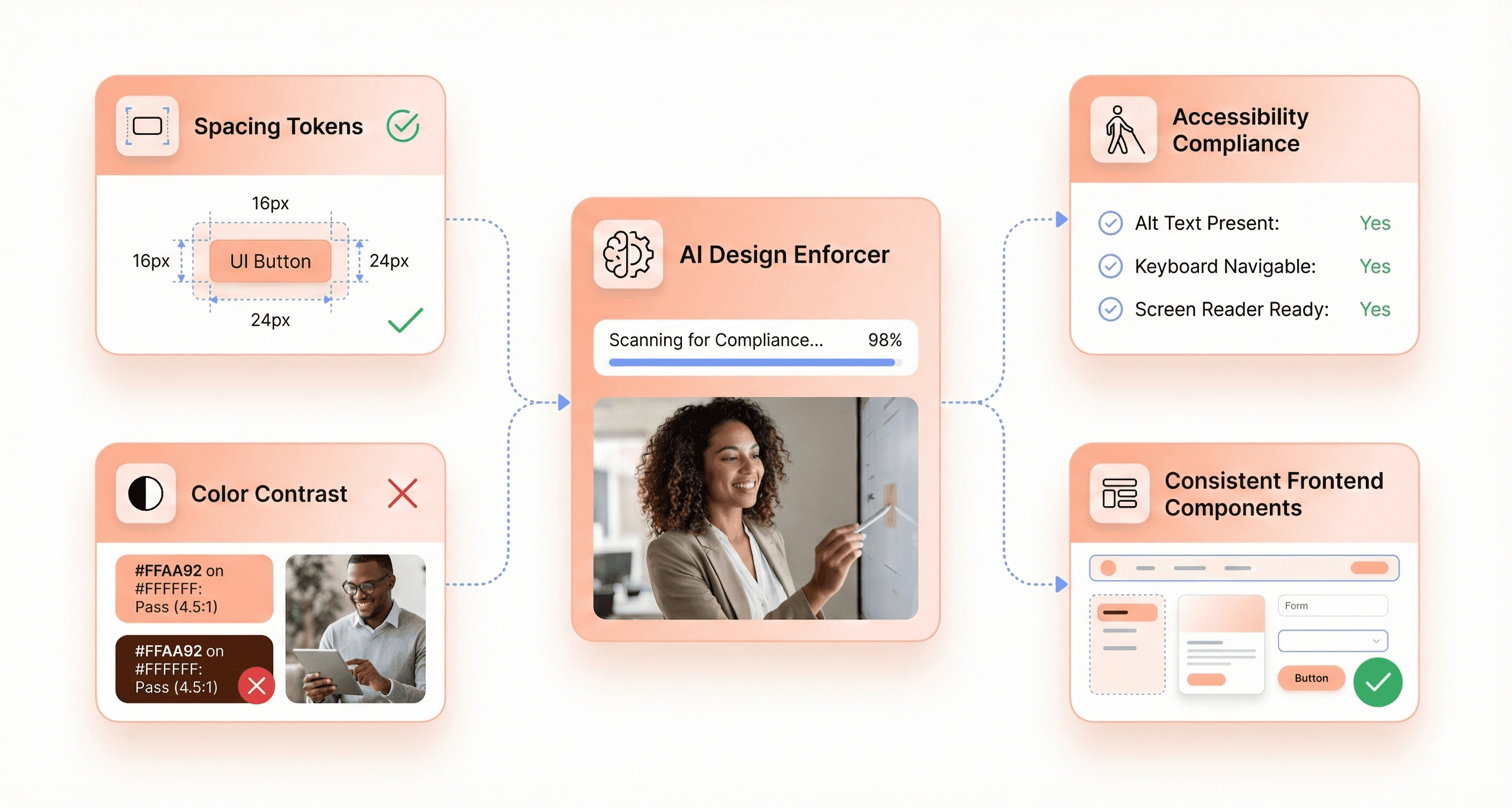
AI-powered spacing and layout validation transforms how teams maintain visual consistency across frontend applications. These systems work by establishing design tokens as the foundation for automated checks, using structured data formats like JSON, YAML, or Markdown to make guidelines machine-readable. When developers implement components, AI linters scan for spacing inconsistencies in real-time, comparing rendered layouts against predefined token values.

The validation process relies on rule-based systems that centralize design tokens through platforms like Style Dictionary, creating a single source of truth for spacing standards. AI tools can instantly detect when developers use incorrect padding values, margin inconsistencies, or unapproved spacing combinations. For example, if a component uses 16px spacing instead of the approved token spacing-medium, the system flags the deviation and suggests the correct token.
Computer vision techniques enhance these capabilities by analyzing visual layouts pixel by pixel. Tools like Applitools and Percy perform aesthetic regression testing within CI/CD pipelines, identifying even minor shifts in component spacing across different screen sizes and devices. This proactive approach ensures spacing consistency before issues reach production.
Real-time accessibility and ARIA compliance checking
AI-driven accessibility validation automatically ensures frontend applications meet WCAG standards through continuous monitoring and real-time feedback. These systems leverage metadata fields that provide context about component accessibility requirements, including semantic roles, ARIA attributes, and interaction patterns.
During development, AI tools scan for common accessibility violations such as missing alt text, improper heading structures, and insufficient color contrast ratios. The systems compare design implementations against accessibility tokens that define compliant color combinations and typography scales. When violations are detected, AI provides immediate feedback with suggested corrections, preventing accessibility debt from accumulating.
Machine learning models enhance accessibility checking by learning patterns from approved accessible designs. These models gradually adapt to understand specific accessibility requirements for different component types, improving accuracy over time. For instance, AI can recognize when form inputs lack proper labeling or when interactive elements don't have adequate focus states.
The real-time nature of these checks means accessibility compliance becomes part of the development workflow rather than an afterthought. Teams receive instant notifications about violations through integrated alerts in their design tools and development environments, enabling immediate corrections before code reaches production.
Design token management and responsive variant generation
Modern frontend development increasingly relies on centralized design token management to maintain consistency across platforms and frameworks. AI systems enhance this approach by automatically generating responsive variants and managing token hierarchies at scale. These systems work with three distinct token layers: primitive tokens storing raw values, semantic tokens adding contextual meaning, and component tokens applying to specific UI elements.
AI-powered token management enables automatic global updates across entire design systems. When a primary color token changes, AI systems detect all instances where that token is referenced and apply updates seamlessly across web, iOS, and Android platforms. This eliminates the manual hunt-and-replace process that typically accompanies design system updates.
For responsive design, AI generates appropriate token variants based on screen size breakpoints and device constraints. The system analyzes existing responsive patterns and automatically creates mobile, tablet, and desktop variants of spacing, typography, and layout tokens. This ensures consistent responsive behavior without requiring manual specification of every variant.
Metadata enhancement allows AI to understand token relationships and usage contexts. By capturing information about when specific tokens should be used, AI can suggest appropriate alternatives and prevent inappropriate token combinations. This contextual understanding enables more sophisticated validation and automated optimization of token usage across large codebases.
Semantic HTML structure optimization
AI systems optimize semantic HTML structure by analyzing component hierarchies and ensuring proper accessibility landmarks. These tools examine the relationship between design components and their underlying HTML implementation, identifying opportunities to improve semantic meaning and screen reader compatibility.
Automated structure analysis reviews heading hierarchies, ensuring logical progression from H1 to H6 elements and preventing skipped heading levels that confuse assistive technologies. AI tools scan for missing landmark roles, such as navigation, main content areas, and complementary sections, automatically suggesting appropriate ARIA roles and semantic HTML elements.
The optimization process extends to component token validation, where AI ensures that visual design patterns align with semantic HTML structures. For example, when a design uses card-like components, AI verifies that the underlying markup uses appropriate article or section elements rather than generic divs, improving both accessibility and SEO performance.
Machine learning capabilities enable these systems to learn from approved HTML patterns within an organization's codebase. Over time, AI develops understanding of preferred semantic structures for specific component types, providing increasingly accurate suggestions for HTML optimization. This learning process helps maintain consistency with established development patterns while gradually improving overall code quality.
Cross-Stack AI Collaboration Streamlines Full-Stack Development
Machine-to-machine communication between frontend and backend agents
AI development agents are revolutionizing cross-stack collaboration through sophisticated machine-to-machine communication protocols. In 2026, frontend and backend AI agents communicate directly to coordinate development tasks, eliminating traditional communication bottlenecks between development teams. These agents establish real-time data pipelines and shared knowledge bases, enabling seamless information exchange about application requirements, performance metrics, and deployment strategies.
The collaborative AI framework facilitates continuous integration between frontend and backend systems through automated protocol negotiation. AI agents analyze project specifications and automatically determine optimal communication channels, data formats, and synchronization schedules. This machine-to-machine coordination ensures that changes in backend services immediately trigger corresponding updates in frontend components, maintaining system-wide consistency without manual intervention.
Automated endpoint generation and API documentation creation
Modern AI-powered development workflows automate the entire API lifecycle from conception to documentation. Backend agents analyze frontend requirements and automatically generate appropriate endpoints with optimal data structures and response formats. These agents consider performance implications, security requirements, and scalability factors when designing API contracts.
Simultaneously, AI agents create comprehensive API documentation that updates dynamically as endpoints evolve. This automated documentation generation includes code examples, parameter descriptions, and integration guides tailored to specific frontend frameworks. The AI systems maintain version control for API changes and automatically generate migration guides for breaking changes, ensuring smooth transitions across development cycles.
Seamless type generation and optimistic update implementation
AI agents excel at maintaining type safety across the entire application stack through automated type generation and synchronization. When backend schemas change, AI systems immediately propagate corresponding TypeScript interfaces and type definitions to frontend applications. This seamless type generation eliminates manual type maintenance and reduces runtime errors significantly.
Optimistic update implementation becomes fully automated as AI agents analyze user interaction patterns and API response times to determine optimal update strategies. The agents intelligently decide when to apply optimistic updates based on network conditions, data sensitivity, and user experience requirements. This automated approach ensures responsive user interfaces while maintaining data consistency across distributed systems.
Coordinated testing across entire application stack
Cross-functional AI collaboration extends to comprehensive testing strategies that span the entire application stack. AI agents coordinate test generation, execution, and maintenance across frontend, backend, and integration layers simultaneously. These agents analyze code changes and automatically generate corresponding test cases that verify functionality across all system boundaries.
The collaborative testing framework enables AI agents to share testing insights and coordinate test execution schedules for maximum efficiency. Backend agents provide mock data and service responses that frontend agents use for component testing, while integration agents verify end-to-end functionality. This coordinated approach significantly reduces debugging time and ensures robust application quality through automated cross-stack validation.
React Compiler Eliminates Manual Performance Optimization
Automatic build-time optimization without mental overhead
React Compiler 1.0 represents a fundamental shift in how developers approach frontend performance optimization AI. This build-time tool automatically handles memoization without requiring developers to constantly analyze component rendering patterns or make manual optimization decisions. The compiler analyzes component data flow and mutability to eliminate unnecessary renders, working seamlessly on both React and React Native applications without code rewrites.
Meta's production-ready compiler has been battle-tested on major applications, demonstrating that automated performance handling can deliver substantial improvements without developer intervention. The tool ships with integrated diagnostics through eslint-plugin-react-hooks and includes first-party templates for Expo, Vite, and Next.js, making adoption straightforward across different development environments.
Elimination of manual useMemo and useCallback implementation
Previously, developers relied heavily on manual useMemo and useCallback implementations to prevent unnecessary re-renders. The React compiler optimization eliminates this mental overhead by automatically handling memoization at build time. Unlike manual implementations, the compiler covers conditional paths that developers often miss when manually optimizing components.
Real-world metrics demonstrate the effectiveness of this automated approach:
Sanity Studio: 1,231 out of 1,411 components compiled successfully, resulting in 20-30% overall reduction in render time and latency
Wakelet: 10% improvement in LCP (2.6s to 2.4s) and 15% improvement in INP (275ms to 240ms)
Meta Quest Store: Up to 12% faster initial loads and more than 2.5 times faster interactions
The compiler's ability to handle optimization automatically means developers can focus on feature development rather than performance micro-management.
Cleaner codebases through automated performance handling
With automated performance optimization, codebases become significantly cleaner as developers no longer need to scatter memoization hooks throughout their components. Independent testing on a 15,000-line application revealed dramatic improvements in specific interactions, such as theme toggle blocking time dropping from 280ms to zero.
The compiler represents a shift in React performance optimization philosophy, moving from manual developer intervention to automated build-time analysis. While the React team recommends keeping useMemo and useCallback as escape hatches for precise control over effect dependencies, the majority of optimization work becomes automated.
Meta-proven technology ready for widespread adoption
The compiler's development traces back to React team's exploration with Prepack in 2017, with the current approach demonstrated in 2021 and reaching stability through extensive real-world testing. Meta's internal usage across major applications validates the technology's production readiness for AI-powered frontend development.
Compatibility extends to React 17 and later through the optional react-compiler-runtime package, enabling incremental adoption for teams not ready for React 19. Next.js 16 lists React Compiler support as stable, with the team recommending version 15.3.1 or later for optimal integration. Expo SDK 54 enables the compiler out of the box, while Vite offers compiler-enabled starters for new applications.
Next.js and Meta-Frameworks Evolve with AI-Powered Edge Computing
React Server Components reduce client-side JavaScript load
Next.js and meta-frameworks are fundamentally transforming how we approach JavaScript delivery in 2026. React Server Components have evolved from experimental to production-standard, representing a paradigm shift where the server becomes the primary rendering environment rather than an afterthought. This architectural change directly addresses the performance bottlenecks that have plagued client-heavy applications for years.
The core benefit lies in drastically reducing the JavaScript bundle size shipped to browsers. Traditional React applications require the entire component tree to be hydrated on the client, meaning users download framework code, component logic, and data fetching utilities even for static content. React Server Components eliminate this overhead by rendering on the server and sending only the necessary interactive pieces to the client
This server-first approach means applications can deliver complex, data-rich interfaces while maintaining minimal JavaScript footprints. Components that previously required heavy client-side libraries for data processing, formatting, or business logic now execute entirely on the server. The result is faster page loads, improved Core Web Vitals scores, and better performance on slower devices and networks.
Enhanced edge computing integration for global performance
Edge computing has moved from buzzword to standard practice, fundamentally changing how Next.js applications scale globally. The framework's tight integration with edge platforms enables applications to run code close to users geographically, reducing round-trip times from hundreds of milliseconds to tens of milliseconds.
Next.js 16's advanced rendering strategies allow developers to mix static generation, server-side rendering, and client-side rendering within the same application, with each strategy optimized for edge deployment. This hybrid approach means static content can be cached at edge nodes while dynamic components render at the nearest server location to users.
The platform's native edge-aware capabilities ensure that whether users are in Tokyo, London, or New York, they experience sub-50ms response times. This global performance consistency eliminates the traditional trade-offs between international reach and application speed, making truly global applications feasible without complex infrastructure management.
AI-powered adaptive rendering based on real-time conditions
AI integration in Next.js extends beyond development tooling to runtime optimization. The framework increasingly suggests optimal rendering strategies, caching policies, and data-fetching patterns during development, but more importantly, it adapts these strategies based on real-time user conditions and device capabilities.
Machine learning algorithms analyze user behavior patterns, device performance metrics, and network conditions to automatically adjust rendering strategies. For users on high-performance devices with fast connections, the system might prioritize rich client-side interactions. For users on slower devices or limited networks, the same application automatically shifts toward server-rendered, lightweight experiences.
This adaptive rendering happens transparently, with the framework making intelligent decisions about what to pre-render, what to cache, and what to compute on demand. The result is personalized performance optimization that doesn't require manual configuration or complex feature detection logic.
Improved experiences for users on slower connections and devices
The evolution toward server-first architectures particularly benefits users on slower connections and devices. By shipping minimal JavaScript and leveraging edge computing, Next.js applications in 2026 provide substantially better experiences for users who were previously underserved by heavy client-side applications.
Smart caching and revalidation strategies ensure that users receive a functional experience even on intermittent connections. The framework's declarative approach to cache lifetimes and invalidation eliminates many custom caching layers while providing more predictable behavior under varying network conditions.
Progressive enhancement becomes automatic, with critical functionality working immediately while enhanced features load progressively. This approach ensures that performance improvements benefit all users, but especially those on older devices or slower networks who need optimization the most.

Conclusion
The transformation of frontend development in 2026 represents a fundamental shift from manual coding to AI-powered automation. From autonomous UI creation and automated bug detection to proactive performance optimization and intelligent state management, AI agents are evolving into specialized development partners that understand your codebase's unique patterns and requirements. These changes don't eliminate the need for skilled developers, they amplify human creativity by handling repetitive tasks and enabling focus on architecture, user experience, and strategic decision-making.
Success in this new landscape requires embracing AI as a collaborative tool while strengthening core competencies in React fundamentals, system architecture, and UX intuition. The developers who thrive will be those who learn to guide AI effectively, understand when to trust automation and when to intervene with human judgment, and leverage these technologies to ship faster, cleaner, and more performant applications. The future of frontend development isn't about replacing human creativity, it's about creating powerful partnerships between human insight and artificial intelligence that deliver extraordinary digital experiences.
AI-powered frontend development is reshaping how developers build web applications in 2026. Frontend engineers, technical leads, and development teams need to understand how AI agents are moving beyond simple code suggestions to autonomous development partners that handle entire workflows.
This transformation affects three critical areas of frontend modernization. First, AI agents now take complete ownership of UI development cycles, from reading Figma designs to generating responsive React components and self-correcting based on browser output. Second, automated bug detection and performance optimization happen proactively, with AI agents scanning codebases continuously to fix issues before they impact users. Finally, the relationship between developers and AI is evolving from assistance to collaboration, where AI agents maintain long-term memory of your codebase and enforce design systems while developers focus on architecture and UX decisions.
The shift from manual coding to AI-guided development isn't replacing frontend engineers, it's amplifying their impact on the parts of development that matter most.
AI Agents Transform UI Development from Code Generation to Autonomous Creation
End-to-end UI screen construction from design to deployment
The transformation of AI-powered frontend development in 2026 represents a fundamental shift from traditional code generation to truly autonomous UI creation. These AI agents now orchestrate the entire development pipeline, handling everything from initial design interpretation to production deployment without requiring manual intervention at each step.

Modern AI development systems can take a design concept and autonomously generate responsive product detail pages, automatically pulling data from Product Information Management (PIM) systems while adhering to established design system tokens. This capability extends beyond simple template generation, these agents reason through complex multi-step processes, creating associated development tickets and coordinating with backend systems seamlessly.
Automatic component breakdown and responsive layout application
AI agents in 2026 have evolved sophisticated capabilities for component architecture analysis and responsive design implementation. These systems automatically decompose complex UI designs into reusable components while ensuring optimal responsive behavior across different screen sizes and device types.
The autonomous breakdown process analyzes visual hierarchies, identifies repeating patterns, and creates component libraries that maintain design consistency. These AI systems understand the relationship between visual elements and translate them into efficient component structures that follow modern frontend development best practices.
For responsive layout applications, these agents leverage an advanced understanding of CSS Grid, Flexbox, and modern layout techniques to ensure interfaces adapt flawlessly across devices. They automatically generate breakpoint-specific styles and implement fluid typography and spacing systems without requiring manual specification.
Self-correction capabilities based on rendered output analysis
A defining characteristic of AI-powered frontend development in 2026 is the implementation of self-correction mechanisms that analyze rendered output and automatically adjust code to meet design specifications. These systems continuously monitor the visual output of generated code against original design intentions.
When discrepancies are detected between expected and actual rendered results, the AI agents automatically iterate on the codebase, adjusting CSS properties, component logic, or layout structures until the output matches the design requirements. This self-correction capability extends to cross-browser compatibility, ensuring consistent rendering across different browsers and devices.
The analysis process includes performance metrics evaluation, accessibility compliance checking, and visual regression testing, allowing the system to optimize not just for visual accuracy but also for technical performance and user experience standards.
Shift from manual coding to guided UI orchestration
The role of frontend developers is fundamentally changing from hands-on coding to strategic UI orchestration. Instead of writing individual components and styling rules, developers now focus on defining system guardrails, establishing design principles, and managing the AI agents that handle code execution.
This orchestration model transforms developers into system curators who define the parameters within which AI agents operate. They establish design system governance rules, performance benchmarks, and accessibility standards that guide autonomous development processes.
The transition empowers development teams to focus on higher-level architectural decisions, user experience strategy, and system integration challenges while AI agents handle the implementation details. This shift enables faster iteration cycles, reduced development overhead, and more consistent output quality across projects.
Human oversight remains crucial for brand-specific nuance, ethical considerations, and strategic product decisions that require human judgment and creativity. The partnership between human developers and AI agents creates a more efficient and scalable approach to frontend development that leverages the strengths of both human creativity and machine precision.
Automated Bug Detection and Resolution Reduces Developer Debugging Time
70% Reduction in Manual Bug Fixing Through AI Agent Automation
AI-powered bug detection systems are achieving unprecedented efficiency gains in frontend development workflows. According to industry data, organizations implementing AI-driven testing methods report detection rates of 90-95% while cutting overall testing time by 50-70%. This dramatic improvement stems from AI's ability to analyze historical bug data, code changes, and test execution results to identify patterns that indicate potential issues before they manifest.

The transformation becomes particularly evident when considering that 38% of developers traditionally spend up to a quarter of their time fixing bugs, while 26% dedicate up to half their development time to bug resolution instead of creating new features. AI automation directly addresses this bottleneck by shifting from reactive debugging to proactive defect prevention through predictive analytics and pattern recognition.
Machine learning models trained on vast datasets of code patterns excel at detecting complex issues like security vulnerabilities, performance bottlenecks, and semantic flaws that could lead to runtime failures. Unlike traditional tools that struggle with false positives, AI systems learn to recognize legitimate coding patterns, reducing false alerts by up to 60% and ensuring developers receive actionable insights rather than noise.
Complete Debugging Workflow from Reproduction to Pull Request Submission
Modern AI debugging agents now handle the entire bug resolution lifecycle autonomously. These systems begin by analyzing error reports and automatically generating reproduction steps, examining stack traces, and comparing findings to historical bug data to pinpoint root causes. The AI then creates comprehensive bug reports that include everything developers need: clear reproduction steps, probable causes, and priority levels based on business impact analysis.
Self-healing test systems represent a critical component of this automated workflow. When application UI or code changes occur, AI agents detect modifications and adjust test scripts accordingly without manual intervention. For example, if a button's location shifts or an element ID updates, the system automatically modifies the test script to maintain coverage. This capability extends beyond simple updates to recognize when entire workflows are altered, adjusting test logic to match new application behavior.
The integration with development platforms like GitHub and Slack enables seamless workflow automation. Bug reports are automatically generated and submitted as pull requests, complete with proposed fixes that have been validated through the AI's analysis. This end-to-end automation allows teams to maintain continuous development velocity while ensuring comprehensive quality assurance.
Real-time Error Analysis Using Console, Network, and Profiler Data
AI systems excel at synthesizing multiple data streams to provide comprehensive error analysis. By monitoring console outputs, network requests, and performance profiler data simultaneously, AI agents can identify subtle issues that might escape traditional debugging methods. This multi-dimensional analysis approach enables detection of performance dips, memory leaks, and inefficient algorithms even when applications appear to function correctly on the surface.
Static analysis powered by AI inspects code without execution, identifying patterns that might lead to problems by understanding code context rather than just syntax. Dynamic analysis complements this by evaluating code during runtime, monitoring performance metrics and identifying anomalies as they occur. The combination provides comprehensive coverage that catches both obvious errors and deeply hidden issues.
The real-time aspect proves crucial for maintaining development momentum. As developers commit changes, AI systems immediately analyze the impact across console logs, network behavior, and performance metrics, providing instant feedback that prevents issues from propagating through the development pipeline. This immediate analysis capability transforms debugging from a time-consuming reactive process into a seamless part of the development workflow.
Validated Fixes Through Headless Browser Testing
AI-driven testing platforms now employ headless browser environments to validate proposed fixes before they reach production. This validation process ensures that AI-generated solutions actually resolve the identified issues without introducing new problems. Headless browsers provide a controlled testing environment where AI agents can execute proposed fixes, run comprehensive test suites, and verify that the solution addresses the root cause effectively.
The validation process includes automated regression testing to ensure that fixes don't break existing functionality. AI systems analyze the proposed changes' impact across the entire codebase, identifying potential side effects and testing related components thoroughly. This comprehensive approach provides confidence that automated fixes maintain application stability while resolving the targeted issues.
Platforms like Ranger demonstrate the effectiveness of this approach by combining AI-powered test creation with human oversight to ensure reliable results. The system automatically generates test cases, validates fixes through headless browser testing, and provides detailed reports on fix effectiveness. This blend of automation and validation creates a robust debugging workflow that delivers consistent, reliable results while maintaining the speed advantages of AI-driven development.
Proactive Performance Optimization Happens Before Issues Impact Users
Continuous code scanning for React performance bottlenecks
AI-powered performance optimization systems now continuously monitor React applications for emerging bottlenecks before they impact users. These intelligent systems analyze code patterns, component hierarchies, and runtime behavior to identify performance degradation in real-time. Unlike traditional monitoring that relies on static thresholds, machine learning algorithms establish dynamic baselines across multiple performance dimensions simultaneously — including page load times, Core Web Vitals metrics, and JavaScript execution times.

The continuous scanning process leverages pattern recognition across the entire frontend stack, monitoring front-end metrics like load times, JavaScript execution delays, and render performance. These AI systems can detect subtle changes in component behavior, identifying when new features or code deployments introduce performance regressions that might escape conventional monitoring tools.
Automatic component rewriting and memoization optimization
Modern AI development tools now automatically rewrite React components to optimize performance without developer intervention. These systems analyze component usage patterns and automatically implement React.memo, useMemo, and useCallback optimizations where they provide the greatest performance benefit. The AI evaluates component render frequency, prop complexity, and dependency chains to determine optimal memoization strategies.
The automated rewriting process goes beyond simple memoization, restructuring component hierarchies to minimize unnecessary re-renders and optimizing state management patterns. This proactive approach ensures that frontend performance optimization AI continuously improves application efficiency as the codebase evolves.
Smart bundle splitting and lazy loading implementation
AI-powered bundle optimization analyzes user navigation patterns and code usage statistics to implement intelligent code splitting automatically. These systems determine optimal chunk boundaries based on actual user behavior rather than arbitrary size limits, creating bundles that align with real-world usage patterns. The AI continuously learns from user interactions to refine splitting strategies and minimize load times for critical user paths.
Smart lazy loading implementation extends beyond simple route-based splitting, identifying opportunities to defer non-critical components and resources based on viewport visibility and user interaction patterns. This intelligent approach to resource loading ensures users receive the fastest possible experience without manual optimization efforts from development teams.
Background performance improvements without developer intervention
AI systems now operate autonomously in the background, implementing performance optimizations without requiring developer awareness or approval for non-breaking changes. These systems continuously analyze runtime performance data and automatically apply improvements like resource prefetching, cache optimization, and script execution ordering. The AI maintains detailed logs of all optimizations, allowing teams to understand what changes were made while focusing their attention on feature development.
Background optimization extends to third-party script management, where AI systems monitor tag execution times, detect errors, and automatically implement fixes for common performance issues. This proactive performance management transforms site speed from a reactive maintenance task into an autonomous growth engine that protects revenue by preventing issues before customers experience them.
Test Generation and Maintenance Becomes Fully Automated
Comprehensive test coverage through AI-powered user flow identification
Now that we've explored how AI agents are transforming UI development, the next frontier in AI frontend development 2026 focuses on intelligent test generation that automatically identifies and covers complex user workflows. Modern AI testing platforms analyze React component code and requirements to automatically generate comprehensive test cases that simulate real user interactions. These systems parse component functionality directly from the codebase, inferring intent and mapping out critical user flows that human testers might overlook.

AI-powered frontend development tools now excel at understanding component relationships and state dependencies, creating test scenarios that cover edge cases and interaction patterns. This approach ensures that subtle bugs in component interactions are caught early in the development process, significantly improving code quality before deployment.
Automatic Jest and React Testing Library test creation
The evolution of automated testing frameworks has reached a point where AI can generate complete Jest and React Testing Library test suites without manual intervention. These intelligent systems create tests for:
Component prop validation and rendering behavior
React hook functionality and state management
User interaction simulations and event handling
Component lifecycle and effect testing
AI testing agents integrate seamlessly with popular development environments including Visual Studio Code, Cursor, and other AI-powered editors, making test generation a natural part of the development workflow. The generated tests follow best practices and maintain consistency with existing testing patterns in the codebase.
Self-healing tests that adapt to code refactors
One of the most significant advances in Frontend development testing is the emergence of self-healing tests that automatically adapt to code changes. When components are refactored or updated, AI-powered testing systems analyze the changes and automatically update test cases to maintain compatibility. This eliminates the traditional maintenance burden where developers had to manually update tests after every code change.
These intelligent systems understand the intent behind tests rather than just their syntax, allowing them to preserve test validity even when implementation details change. In real-world benchmarks, AI-powered testing platforms have demonstrated significant improvements, boosting test pass rates from 42% to 93% after just one iteration of automated optimization.
Continuous test execution and failure resolution
Modern AI testing platforms provide continuous monitoring through scheduled test execution that runs hourly, daily, weekly, or monthly based on project needs. When tests fail, the system doesn't just report the failure—it actively analyzes the root cause and provides specific fix recommendations. This AI-powered UI/UX approach ensures that issues are resolved quickly without requiring extensive developer intervention.
The platforms offer smart test group management, allowing teams to organize critical test suites by functionality such as user authentication, session management, or core business logic. Automated failure resolution includes pinpoint feedback delivery and suggested code fixes, creating a self-repairing development environment that maintains code quality autonomously.
State Management and API Integration Shifts to Agent-Driven Architecture
Automated API Client Generation from Schema Analysis
AI-powered frontend development in 2026 fundamentally transforms how developers handle API integration through intelligent schema analysis. Modern AI agents automatically parse OpenAPI specifications, GraphQL schemas, and REST documentation to generate fully-typed client libraries without manual intervention. These systems analyze endpoint structures, parameter requirements, and response formats to create optimized API clients that handle authentication, error handling, and request/response transformations seamlessly.
The state management architecture shifts from traditional manual configuration to autonomous AI orchestration, where agents continuously monitor API schemas for changes and automatically update client code accordingly. This eliminates the tedious process of manually maintaining API interfaces and ensures frontend applications remain synchronized with backend services without developer intervention.
Smart React Query Key Management and Caching Logic
With the evolution of AI state management, React Query key generation becomes fully automated through intelligent pattern recognition. AI agents analyze component hierarchies, data dependencies, and user interaction patterns to create optimal caching strategies that maximize performance while minimizing memory usage. These systems automatically generate cache invalidation rules based on data relationships and user behavior patterns.
The AI-driven approach to cache key management eliminates common pitfalls like cache key collisions and unnecessary network requests. Agents continuously monitor application performance metrics and adjust caching strategies in real-time, ensuring optimal data freshness while maintaining responsive user experiences across different usage scenarios.
Form Validation Schema Creation Without Boilerplate Code
AI agents revolutionize form handling by automatically generating comprehensive validation schemas from component analysis and user input patterns. These systems examine form structures, field types, and business logic requirements to create robust validation rules without requiring manual schema definition. The agents understand complex validation requirements like cross-field dependencies, conditional validations, and async validation scenarios.
The autonomous form validation generation extends beyond simple field-level checks to include sophisticated business rule validation, real-time error messaging, and accessibility compliance. This AI-powered approach significantly reduces development time while ensuring consistent validation behavior across entire applications.
Complex State Logic Maintenance Through AI Orchestration
Now that we've covered automated generation capabilities, AI orchestration transforms how complex state logic is maintained and evolved over time. Drawing from the reference content on LangGraph's state management principles, AI agents maintain conversation-like memory of application state changes, similar to how AI agents track previous instructions in conversational contexts.
These AI development partners implement sophisticated state management strategies that adapt to changing application requirements. The agents analyze state transitions, identify optimization opportunities, and automatically refactor state logic to maintain performance as applications scale. This autonomous maintenance ensures that complex state management remains efficient and bug-free without constant developer oversight.
Long-Term Codebase Memory Creates Specialized Development Partners
Persistent understanding of project naming conventions and architecture
AI development agents in 2026 are revolutionizing how codebases maintain consistency through persistent memory systems that understand and enforce project-specific conventions. These agents utilize sophisticated memory architectures that go far beyond simple vector databases, incorporating what developers describe as "unprecedented continuity from session to session" through intelligent issue tracking and context management.
The breakthrough comes from agents that store their understanding in git-backed databases, creating a hybrid system that combines the queryability of databases with the versioning capabilities of version control. This approach enables AI agents to maintain a deep understanding of naming patterns, architectural decisions, and structural conventions that persist across development sessions.
Adaptive learning of team coding styles and design patterns
Modern AI agents demonstrate remarkable adaptability in learning team-specific coding styles through what engineers call "distillation" - the process of turning raw development history, code reviews, and documentation into actionable context. Rather than relying on generic programming patterns, these agents develop specialized knowledge about how specific teams structure their code, handle error cases, and implement design patterns.
The most effective systems employ multiple memory types working in concert: scratchpad memory for immediate reasoning, episodic memory for session continuity, semantic knowledge bases for long-term understanding, and symbolic memory for hard constraints and rules. This multi-layered approach allows agents to distinguish between project-specific conventions and general programming practices.
Specialized AI agents tailored to specific codebases
The evolution toward specialized AI development partners represents a fundamental shift from generic coding assistants to codebase-specific agents that understand the unique characteristics of individual projects. These agents maintain structured data solutions that act as persistent, AI-agnostic memory systems, enabling them to provide contextually relevant suggestions based on the specific architecture and patterns of each codebase.
Developers report that working with specialized agents feels like collaborating with a team member who has intimate knowledge of the project's history and conventions. The agents can reference previous architectural decisions, understand why certain patterns were chosen over alternatives, and maintain consistency with established coding standards without requiring constant guidance.
Improved suggestions through extended collaboration history
Extended collaboration history enables AI agents to provide increasingly sophisticated suggestions by maintaining detailed records of development decisions, bug fixes, and architectural evolution. The most advanced systems implement graph-based reasoning that connects facts and decisions rather than simply storing isolated pieces of information.
This historical context allows agents to avoid repeating past mistakes and build upon successful patterns. When agents encounter similar problems to those solved previously, they can reference the historical solutions and adapt them to current contexts. The memory systems also enable agents to track the evolution of coding preferences and architectural decisions over time, ensuring that suggestions remain aligned with the project's current direction rather than outdated patterns.
The debugging capabilities of these memory-enhanced agents represent a significant advancement over traditional development tools. When issues arise, agents can trace through their memory of past decisions and identify potential root causes based on historical patterns, making the debugging process more systematic and informed by the project's complete development history.
Design System Enforcement Ensures Consistent User Experiences
Automatic spacing and layout consistency validation
AI-powered spacing and layout validation transforms how teams maintain visual consistency across frontend applications. These systems work by establishing design tokens as the foundation for automated checks, using structured data formats like JSON, YAML, or Markdown to make guidelines machine-readable. When developers implement components, AI linters scan for spacing inconsistencies in real-time, comparing rendered layouts against predefined token values.

The validation process relies on rule-based systems that centralize design tokens through platforms like Style Dictionary, creating a single source of truth for spacing standards. AI tools can instantly detect when developers use incorrect padding values, margin inconsistencies, or unapproved spacing combinations. For example, if a component uses 16px spacing instead of the approved token spacing-medium, the system flags the deviation and suggests the correct token.
Computer vision techniques enhance these capabilities by analyzing visual layouts pixel by pixel. Tools like Applitools and Percy perform aesthetic regression testing within CI/CD pipelines, identifying even minor shifts in component spacing across different screen sizes and devices. This proactive approach ensures spacing consistency before issues reach production.
Real-time accessibility and ARIA compliance checking
AI-driven accessibility validation automatically ensures frontend applications meet WCAG standards through continuous monitoring and real-time feedback. These systems leverage metadata fields that provide context about component accessibility requirements, including semantic roles, ARIA attributes, and interaction patterns.
During development, AI tools scan for common accessibility violations such as missing alt text, improper heading structures, and insufficient color contrast ratios. The systems compare design implementations against accessibility tokens that define compliant color combinations and typography scales. When violations are detected, AI provides immediate feedback with suggested corrections, preventing accessibility debt from accumulating.
Machine learning models enhance accessibility checking by learning patterns from approved accessible designs. These models gradually adapt to understand specific accessibility requirements for different component types, improving accuracy over time. For instance, AI can recognize when form inputs lack proper labeling or when interactive elements don't have adequate focus states.
The real-time nature of these checks means accessibility compliance becomes part of the development workflow rather than an afterthought. Teams receive instant notifications about violations through integrated alerts in their design tools and development environments, enabling immediate corrections before code reaches production.
Design token management and responsive variant generation
Modern frontend development increasingly relies on centralized design token management to maintain consistency across platforms and frameworks. AI systems enhance this approach by automatically generating responsive variants and managing token hierarchies at scale. These systems work with three distinct token layers: primitive tokens storing raw values, semantic tokens adding contextual meaning, and component tokens applying to specific UI elements.
AI-powered token management enables automatic global updates across entire design systems. When a primary color token changes, AI systems detect all instances where that token is referenced and apply updates seamlessly across web, iOS, and Android platforms. This eliminates the manual hunt-and-replace process that typically accompanies design system updates.
For responsive design, AI generates appropriate token variants based on screen size breakpoints and device constraints. The system analyzes existing responsive patterns and automatically creates mobile, tablet, and desktop variants of spacing, typography, and layout tokens. This ensures consistent responsive behavior without requiring manual specification of every variant.
Metadata enhancement allows AI to understand token relationships and usage contexts. By capturing information about when specific tokens should be used, AI can suggest appropriate alternatives and prevent inappropriate token combinations. This contextual understanding enables more sophisticated validation and automated optimization of token usage across large codebases.
Semantic HTML structure optimization
AI systems optimize semantic HTML structure by analyzing component hierarchies and ensuring proper accessibility landmarks. These tools examine the relationship between design components and their underlying HTML implementation, identifying opportunities to improve semantic meaning and screen reader compatibility.
Automated structure analysis reviews heading hierarchies, ensuring logical progression from H1 to H6 elements and preventing skipped heading levels that confuse assistive technologies. AI tools scan for missing landmark roles, such as navigation, main content areas, and complementary sections, automatically suggesting appropriate ARIA roles and semantic HTML elements.
The optimization process extends to component token validation, where AI ensures that visual design patterns align with semantic HTML structures. For example, when a design uses card-like components, AI verifies that the underlying markup uses appropriate article or section elements rather than generic divs, improving both accessibility and SEO performance.
Machine learning capabilities enable these systems to learn from approved HTML patterns within an organization's codebase. Over time, AI develops understanding of preferred semantic structures for specific component types, providing increasingly accurate suggestions for HTML optimization. This learning process helps maintain consistency with established development patterns while gradually improving overall code quality.
Cross-Stack AI Collaboration Streamlines Full-Stack Development
Machine-to-machine communication between frontend and backend agents
AI development agents are revolutionizing cross-stack collaboration through sophisticated machine-to-machine communication protocols. In 2026, frontend and backend AI agents communicate directly to coordinate development tasks, eliminating traditional communication bottlenecks between development teams. These agents establish real-time data pipelines and shared knowledge bases, enabling seamless information exchange about application requirements, performance metrics, and deployment strategies.
The collaborative AI framework facilitates continuous integration between frontend and backend systems through automated protocol negotiation. AI agents analyze project specifications and automatically determine optimal communication channels, data formats, and synchronization schedules. This machine-to-machine coordination ensures that changes in backend services immediately trigger corresponding updates in frontend components, maintaining system-wide consistency without manual intervention.
Automated endpoint generation and API documentation creation
Modern AI-powered development workflows automate the entire API lifecycle from conception to documentation. Backend agents analyze frontend requirements and automatically generate appropriate endpoints with optimal data structures and response formats. These agents consider performance implications, security requirements, and scalability factors when designing API contracts.
Simultaneously, AI agents create comprehensive API documentation that updates dynamically as endpoints evolve. This automated documentation generation includes code examples, parameter descriptions, and integration guides tailored to specific frontend frameworks. The AI systems maintain version control for API changes and automatically generate migration guides for breaking changes, ensuring smooth transitions across development cycles.
Seamless type generation and optimistic update implementation
AI agents excel at maintaining type safety across the entire application stack through automated type generation and synchronization. When backend schemas change, AI systems immediately propagate corresponding TypeScript interfaces and type definitions to frontend applications. This seamless type generation eliminates manual type maintenance and reduces runtime errors significantly.
Optimistic update implementation becomes fully automated as AI agents analyze user interaction patterns and API response times to determine optimal update strategies. The agents intelligently decide when to apply optimistic updates based on network conditions, data sensitivity, and user experience requirements. This automated approach ensures responsive user interfaces while maintaining data consistency across distributed systems.
Coordinated testing across entire application stack
Cross-functional AI collaboration extends to comprehensive testing strategies that span the entire application stack. AI agents coordinate test generation, execution, and maintenance across frontend, backend, and integration layers simultaneously. These agents analyze code changes and automatically generate corresponding test cases that verify functionality across all system boundaries.
The collaborative testing framework enables AI agents to share testing insights and coordinate test execution schedules for maximum efficiency. Backend agents provide mock data and service responses that frontend agents use for component testing, while integration agents verify end-to-end functionality. This coordinated approach significantly reduces debugging time and ensures robust application quality through automated cross-stack validation.
React Compiler Eliminates Manual Performance Optimization
Automatic build-time optimization without mental overhead
React Compiler 1.0 represents a fundamental shift in how developers approach frontend performance optimization AI. This build-time tool automatically handles memoization without requiring developers to constantly analyze component rendering patterns or make manual optimization decisions. The compiler analyzes component data flow and mutability to eliminate unnecessary renders, working seamlessly on both React and React Native applications without code rewrites.
Meta's production-ready compiler has been battle-tested on major applications, demonstrating that automated performance handling can deliver substantial improvements without developer intervention. The tool ships with integrated diagnostics through eslint-plugin-react-hooks and includes first-party templates for Expo, Vite, and Next.js, making adoption straightforward across different development environments.
Elimination of manual useMemo and useCallback implementation
Previously, developers relied heavily on manual useMemo and useCallback implementations to prevent unnecessary re-renders. The React compiler optimization eliminates this mental overhead by automatically handling memoization at build time. Unlike manual implementations, the compiler covers conditional paths that developers often miss when manually optimizing components.
Real-world metrics demonstrate the effectiveness of this automated approach:
Sanity Studio: 1,231 out of 1,411 components compiled successfully, resulting in 20-30% overall reduction in render time and latency
Wakelet: 10% improvement in LCP (2.6s to 2.4s) and 15% improvement in INP (275ms to 240ms)
Meta Quest Store: Up to 12% faster initial loads and more than 2.5 times faster interactions
The compiler's ability to handle optimization automatically means developers can focus on feature development rather than performance micro-management.
Cleaner codebases through automated performance handling
With automated performance optimization, codebases become significantly cleaner as developers no longer need to scatter memoization hooks throughout their components. Independent testing on a 15,000-line application revealed dramatic improvements in specific interactions, such as theme toggle blocking time dropping from 280ms to zero.
The compiler represents a shift in React performance optimization philosophy, moving from manual developer intervention to automated build-time analysis. While the React team recommends keeping useMemo and useCallback as escape hatches for precise control over effect dependencies, the majority of optimization work becomes automated.
Meta-proven technology ready for widespread adoption
The compiler's development traces back to React team's exploration with Prepack in 2017, with the current approach demonstrated in 2021 and reaching stability through extensive real-world testing. Meta's internal usage across major applications validates the technology's production readiness for AI-powered frontend development.
Compatibility extends to React 17 and later through the optional react-compiler-runtime package, enabling incremental adoption for teams not ready for React 19. Next.js 16 lists React Compiler support as stable, with the team recommending version 15.3.1 or later for optimal integration. Expo SDK 54 enables the compiler out of the box, while Vite offers compiler-enabled starters for new applications.
Next.js and Meta-Frameworks Evolve with AI-Powered Edge Computing
React Server Components reduce client-side JavaScript load
Next.js and meta-frameworks are fundamentally transforming how we approach JavaScript delivery in 2026. React Server Components have evolved from experimental to production-standard, representing a paradigm shift where the server becomes the primary rendering environment rather than an afterthought. This architectural change directly addresses the performance bottlenecks that have plagued client-heavy applications for years.
The core benefit lies in drastically reducing the JavaScript bundle size shipped to browsers. Traditional React applications require the entire component tree to be hydrated on the client, meaning users download framework code, component logic, and data fetching utilities even for static content. React Server Components eliminate this overhead by rendering on the server and sending only the necessary interactive pieces to the client
This server-first approach means applications can deliver complex, data-rich interfaces while maintaining minimal JavaScript footprints. Components that previously required heavy client-side libraries for data processing, formatting, or business logic now execute entirely on the server. The result is faster page loads, improved Core Web Vitals scores, and better performance on slower devices and networks.
Enhanced edge computing integration for global performance
Edge computing has moved from buzzword to standard practice, fundamentally changing how Next.js applications scale globally. The framework's tight integration with edge platforms enables applications to run code close to users geographically, reducing round-trip times from hundreds of milliseconds to tens of milliseconds.
Next.js 16's advanced rendering strategies allow developers to mix static generation, server-side rendering, and client-side rendering within the same application, with each strategy optimized for edge deployment. This hybrid approach means static content can be cached at edge nodes while dynamic components render at the nearest server location to users.
The platform's native edge-aware capabilities ensure that whether users are in Tokyo, London, or New York, they experience sub-50ms response times. This global performance consistency eliminates the traditional trade-offs between international reach and application speed, making truly global applications feasible without complex infrastructure management.
AI-powered adaptive rendering based on real-time conditions
AI integration in Next.js extends beyond development tooling to runtime optimization. The framework increasingly suggests optimal rendering strategies, caching policies, and data-fetching patterns during development, but more importantly, it adapts these strategies based on real-time user conditions and device capabilities.
Machine learning algorithms analyze user behavior patterns, device performance metrics, and network conditions to automatically adjust rendering strategies. For users on high-performance devices with fast connections, the system might prioritize rich client-side interactions. For users on slower devices or limited networks, the same application automatically shifts toward server-rendered, lightweight experiences.
This adaptive rendering happens transparently, with the framework making intelligent decisions about what to pre-render, what to cache, and what to compute on demand. The result is personalized performance optimization that doesn't require manual configuration or complex feature detection logic.
Improved experiences for users on slower connections and devices
The evolution toward server-first architectures particularly benefits users on slower connections and devices. By shipping minimal JavaScript and leveraging edge computing, Next.js applications in 2026 provide substantially better experiences for users who were previously underserved by heavy client-side applications.
Smart caching and revalidation strategies ensure that users receive a functional experience even on intermittent connections. The framework's declarative approach to cache lifetimes and invalidation eliminates many custom caching layers while providing more predictable behavior under varying network conditions.
Progressive enhancement becomes automatic, with critical functionality working immediately while enhanced features load progressively. This approach ensures that performance improvements benefit all users, but especially those on older devices or slower networks who need optimization the most.

Conclusion
The transformation of frontend development in 2026 represents a fundamental shift from manual coding to AI-powered automation. From autonomous UI creation and automated bug detection to proactive performance optimization and intelligent state management, AI agents are evolving into specialized development partners that understand your codebase's unique patterns and requirements. These changes don't eliminate the need for skilled developers, they amplify human creativity by handling repetitive tasks and enabling focus on architecture, user experience, and strategic decision-making.
Success in this new landscape requires embracing AI as a collaborative tool while strengthening core competencies in React fundamentals, system architecture, and UX intuition. The developers who thrive will be those who learn to guide AI effectively, understand when to trust automation and when to intervene with human judgment, and leverage these technologies to ship faster, cleaner, and more performant applications. The future of frontend development isn't about replacing human creativity, it's about creating powerful partnerships between human insight and artificial intelligence that deliver extraordinary digital experiences.

Stuck with slow releases and high IT costs?
▶︎
Launch 2.5x faster with our AI-driven frontend workflows, specialized for SaaS.
▶︎
Cut IT costs by up to 50% and boost user adoption by 2x with our proprietary frameworks.

Stuck with slow releases and high IT costs?
▶︎
Launch 2.5x faster with our AI-driven frontend workflows, specialized for SaaS.
▶︎
Cut IT costs by up to 50% and boost user adoption by 2x with our proprietary frameworks.

Stuck with slow releases and high IT costs?
▶︎
Launch 2.5x faster with our AI-driven frontend workflows, specialized for SaaS.
▶︎
Cut IT costs by up to 50% and boost user adoption by 2x with our proprietary frameworks.
Frequently Asked Questions
We're ready to answer your questions
Slow releases, clunky dashboards, and frustrated users? You've got questions about how to fix them. We have the Frontend-First answers that unlock growth. Let's talk solutions.
AI-powered frontend modernization refers to upgrading legacy front-end systems using artificial intelligence to automate UI creation, optimize performance, enforce design systems, and improve UX. In 2026, AI agents assist with component generation, testing, accessibility, and performance optimization while developers focus on architecture and product decisions.
Answer
What is AI-powered frontend modernization?
Question
In 2026, AI moves beyond code suggestions into autonomous development workflows. AI agents can read design files, generate responsive UI components, detect bugs, optimize performance, and maintain tests continuously. This reduces manual effort and allows frontend developers to focus on UX, system design, and strategic improvements.
Answer
How does AI change frontend development workflows in 2026?
Question
No. AI agents are not replacing frontend developers. They amplify developer impact by handling repetitive tasks such as debugging, testing, and optimization. Human developers remain essential for architecture decisions, design judgment, accessibility, ethics, and brand-specific UX strategy.
Answer
Are AI agents replacing frontend developers?
Question
Frontend modernization improves performance, accessibility, security, and user experience. Legacy front-end systems often suffer from slow load times, poor UX, and technical debt. Modernized frontends using AI and server-first architectures deliver faster, more reliable, and scalable web applications that rank better on search engines and retain users.
Answer
Why is frontend modernization important for web app development?
Question
AI improves UI and UX consistency by enforcing design systems, validating spacing and layout rules, checking accessibility compliance, and generating responsive variants automatically. AI agents maintain long-term memory of design tokens and coding standards, ensuring consistent experiences across all screens and platforms.
Answer
How does AI improve UI and UX consistency across applications?
Question
Frequently Asked Questions
We're ready to answer your questions
Slow releases, clunky dashboards, and frustrated users? You've got questions about how to fix them. We have the Frontend-First answers that unlock growth. Let's talk solutions.
AI-powered frontend modernization refers to upgrading legacy front-end systems using artificial intelligence to automate UI creation, optimize performance, enforce design systems, and improve UX. In 2026, AI agents assist with component generation, testing, accessibility, and performance optimization while developers focus on architecture and product decisions.
Answer
What is AI-powered frontend modernization?
Question
In 2026, AI moves beyond code suggestions into autonomous development workflows. AI agents can read design files, generate responsive UI components, detect bugs, optimize performance, and maintain tests continuously. This reduces manual effort and allows frontend developers to focus on UX, system design, and strategic improvements.
Answer
How does AI change frontend development workflows in 2026?
Question
No. AI agents are not replacing frontend developers. They amplify developer impact by handling repetitive tasks such as debugging, testing, and optimization. Human developers remain essential for architecture decisions, design judgment, accessibility, ethics, and brand-specific UX strategy.
Answer
Are AI agents replacing frontend developers?
Question
Frontend modernization improves performance, accessibility, security, and user experience. Legacy front-end systems often suffer from slow load times, poor UX, and technical debt. Modernized frontends using AI and server-first architectures deliver faster, more reliable, and scalable web applications that rank better on search engines and retain users.
Answer
Why is frontend modernization important for web app development?
Question
AI improves UI and UX consistency by enforcing design systems, validating spacing and layout rules, checking accessibility compliance, and generating responsive variants automatically. AI agents maintain long-term memory of design tokens and coding standards, ensuring consistent experiences across all screens and platforms.
Answer
How does AI improve UI and UX consistency across applications?
Question
Frequently Asked Questions
We're ready to answer your questions
Slow releases, clunky dashboards, and frustrated users? You've got questions about how to fix them. We have the Frontend-First answers that unlock growth. Let's talk solutions.
AI-powered frontend modernization refers to upgrading legacy front-end systems using artificial intelligence to automate UI creation, optimize performance, enforce design systems, and improve UX. In 2026, AI agents assist with component generation, testing, accessibility, and performance optimization while developers focus on architecture and product decisions.
Answer
What is AI-powered frontend modernization?
Question
In 2026, AI moves beyond code suggestions into autonomous development workflows. AI agents can read design files, generate responsive UI components, detect bugs, optimize performance, and maintain tests continuously. This reduces manual effort and allows frontend developers to focus on UX, system design, and strategic improvements.
Answer
How does AI change frontend development workflows in 2026?
Question
No. AI agents are not replacing frontend developers. They amplify developer impact by handling repetitive tasks such as debugging, testing, and optimization. Human developers remain essential for architecture decisions, design judgment, accessibility, ethics, and brand-specific UX strategy.
Answer
Are AI agents replacing frontend developers?
Question
Frontend modernization improves performance, accessibility, security, and user experience. Legacy front-end systems often suffer from slow load times, poor UX, and technical debt. Modernized frontends using AI and server-first architectures deliver faster, more reliable, and scalable web applications that rank better on search engines and retain users.
Answer
Why is frontend modernization important for web app development?
Question
AI improves UI and UX consistency by enforcing design systems, validating spacing and layout rules, checking accessibility compliance, and generating responsive variants automatically. AI agents maintain long-term memory of design tokens and coding standards, ensuring consistent experiences across all screens and platforms.
Answer
How does AI improve UI and UX consistency across applications?
Question

About the author
Author Name:
Parth G
|
Founder of
Hashbyt
I’m the founder of Hashbyt, an AI-first frontend and UI/UX SaaS partner helping 200+ SaaS companies scale faster through intelligent, growth-driven design. My work focuses on building modern frontend systems, design frameworks, and product modernization strategies that boost revenue, improve user adoption, and help SaaS founders turn their UI into a true growth engine.
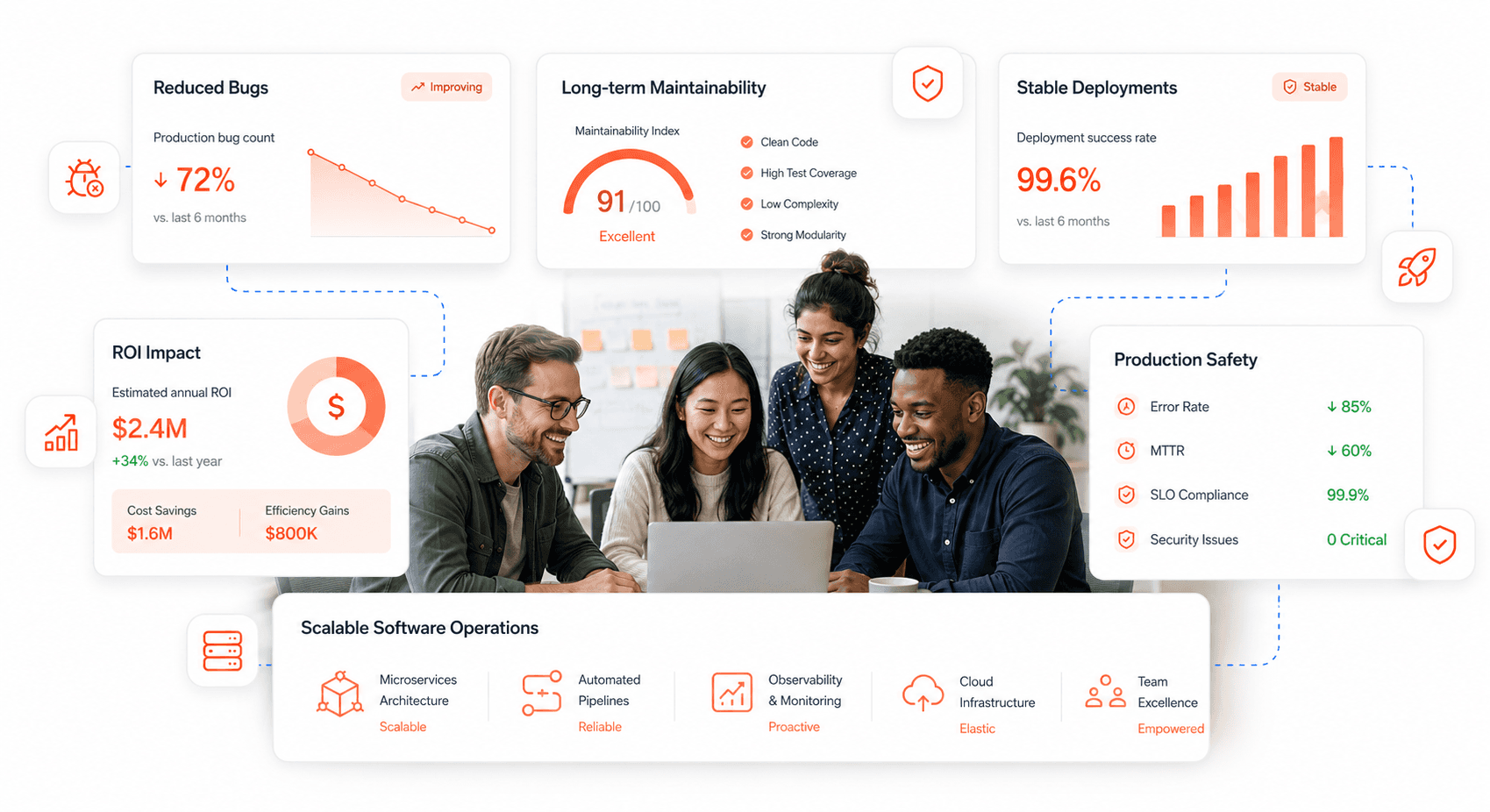
Related Blogs
Related Blogs
Is a clunky UI holding back your growth?
▶︎
Transform slow, frustrating dashboards into intuitive interfaces that ensure effortless user adoption.
▶︎
Transform slow, frustrating dashboards into intuitive interfaces that ensure effortless user adoption.
Is a clunky UI holding back your growth?
▶︎
Transform slow, frustrating dashboards into intuitive interfaces that ensure effortless user adoption.
▶︎
Transform slow, frustrating dashboards into intuitive interfaces that ensure effortless user adoption.
Is a clunky UI holding back your growth?
▶︎
Transform slow, frustrating dashboards into intuitive interfaces that ensure effortless user adoption.
▶︎
Transform slow, frustrating dashboards into intuitive interfaces that ensure effortless user adoption.