

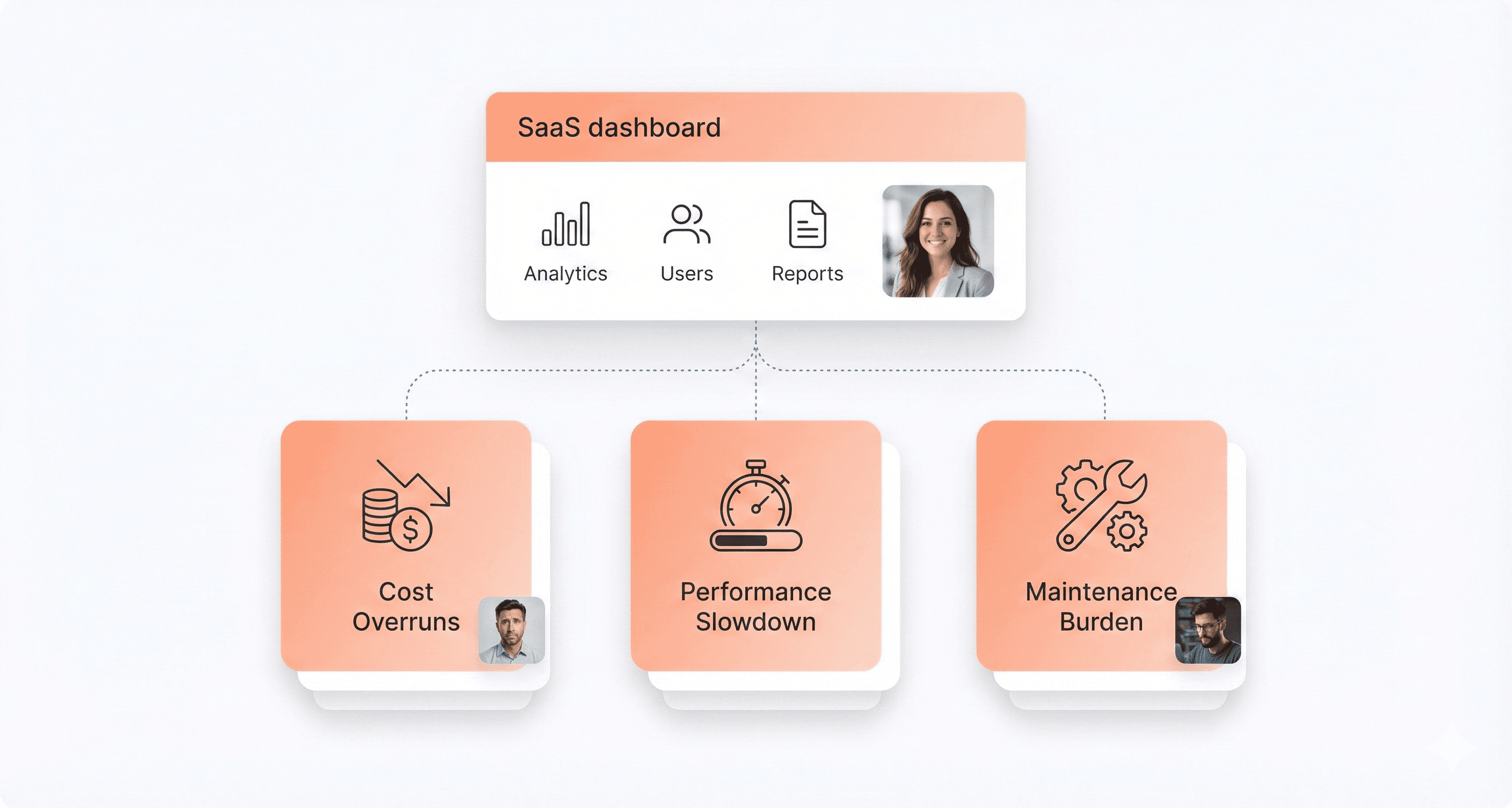
Quick answer: Modern frontend development helps manage technical debt by making it visible and cheap to pay down in small steps. A shared design system and component library remove duplicated UI code, automated tests in CI catch regressions before release, and scheduled dependency upgrades stop frameworks going stale. Micro-frontends and the strangler fig pattern let teams replace legacy screens one at a time while the product stays live.
Technical debt is the future work you create when you choose the quick fix over the right fix. In a SaaS frontend it shows up as slower releases, fragile screens and an inconsistent interface, and most of its cost stays hidden until a simple change takes weeks. This guide is for engineering leads, product managers and founders. It covers how to measure, prioritise and reduce frontend debt, then where it comes from, what it costs and why it persists.
How Teams Can Manage Frontend Technical Debt
Short answer: treat frontend debt like any other product work. Measure a few signals that show where it slows you down, rank items by what they cost the business, and pay the debt down in small, reversible steps alongside feature work rather than in one big rewrite.
Measure it with signals you already have
Lead time for changes to existing screens: if small UI changes take longer each quarter, debt is the likely cause
Change failure rate and escaped regressions: how often a release breaks something users can see
New bugs versus closed bugs: if new UI bugs outpace fixes, debt is growing faster than the team repays it
Dependency age: how many major versions behind your framework and key libraries are, and whether any have reached end of life
Performance and accessibility: Core Web Vitals (LCP, INP and CLS) and WCAG failures on the screens users rely on most
UI consistency: duplicated components, one-off styles and screens that bypass the design system
UI-related support tickets: confusion and bugs that reach customers
Prioritise by business impact, not by code smell
Not all debt needs repaying. Debt in code that rarely changes and rarely breaks can wait. Rank each item with three questions: how often the team changes this area, how much the debt slows or breaks those changes, and how exposed the business is if it fails (revenue flows, security, accessibility or compliance). Keep debt in the same backlog as features, describe each item by the symptom stakeholders will recognise, and agree a fixed share of every sprint with product so debt work is not traded away under deadline pressure.
Pay it down incrementally with modern frontend practices
Strangler fig and micro-frontends: build new screens alongside the legacy app and move users to them one area at a time, until the old code can be switched off. Hashbyt's legacy application modernisation work uses micro-frontends and the strangler fig pattern so legacy systems stay live while outdated UI is replaced. Our guide to micro frontend architecture explains when micro-frontends are worth the extra complexity
Design system and component library: one tested set of components and design tokens replaces near-duplicate buttons, tables and forms, so a fix lands everywhere at once. See our enterprise design system development service
Automated tests in CI: unit, component, visual regression and end-to-end tests make refactoring safe, because the pipeline tells you when behaviour changes
Scheduled dependency upgrades: small, regular upgrades cost less than a forced migration later. React 19.3 was released in September 2026, and Angular 22 (June 2026) is the current Angular major, with Angular now planning one major release a year. For AngularJS apps, an incremental AngularJS to React migration avoids a risky big-bang rewrite
Guardrails for new code: type checking, linting, bundle size budgets and code review, including review of AI-generated code, stop new debt arriving faster than you remove it
Frontend technical debt: symptom, cost and fix
Symptom | Hidden cost | Fix |
|---|---|---|
Small UI changes take weeks | Slower feature delivery and missed roadmap dates | Refactor the most-changed areas first, adding tests before you change them |
Releases regularly break existing screens | Hotfixes, support tickets and lost user trust | Component, visual regression and end-to-end tests in CI |
Several versions of the same button, table or form | Inconsistent UX, and every fix repeated many times | A design system with shared components and design tokens |
Framework or libraries past end of life | Unpatched security issues and a forced migration later | Scheduled upgrades, or incremental migration for frameworks such as AngularJS |
A legacy frontend nobody wants to touch | Stalled rewrites and teams blocked on one release train | Strangler fig pattern, with micro-frontends where teams need independent releases |
Slow pages and failing accessibility checks | Frustrated users, lost conversions and compliance exposure | Performance budgets, Core Web Vitals monitoring and WCAG audits |
Undocumented quick fixes | New developers take longer to ship safely | Log each debt item in the backlog with an owner and the reason it exists |
Example: when Hashbyt modernised the legacy wealth management platform of Silver Oak Wealth Advisors, the team built a reusable React component library and a design system with Storybook and design tokens, and integrated it with the existing APIs. The platform reached WCAG 2.1 AA across its interfaces, and UI-related support tickets fell by 65%.
What Frontend Technical Debt Is and Where It Comes From
Defining technical debt beyond simple code shortcuts
When you think about technical debt, you might initially picture rushed code or quick fixes that developers implement to meet tight deadlines. However, technical debt encompasses far more than these surface-level shortcuts. Technical debt represents all the development work you need to do in the future that you skipped to maintain agility and profitability in the present.
Unlike financial debt, technical debt is inevitable in your development process. Frameworks become obsolete, new testing methodologies emerge, and you learn new design practices on the job. Even the cleanest codebases accumulate technical debt over time by virtue of technological advancements.
Martin Fowler's Technical Debt Quadrant categorizes this debt into four distinct types based on whether it's reckless versus prudent and deliberate versus inadvertent, helping you understand the various situations under which your organization might incur technical debt.
Your technical debt can manifest as architectural debt when your system's foundation lacks scalability or maintainability. It appears as code debt through rushed development and inconsistent coding practices. You'll also encounter infrastructure debt from outdated deployment processes, process debt from poor collaboration workflows, and security debt when your team cuts corners on encryption or vulnerability patching.
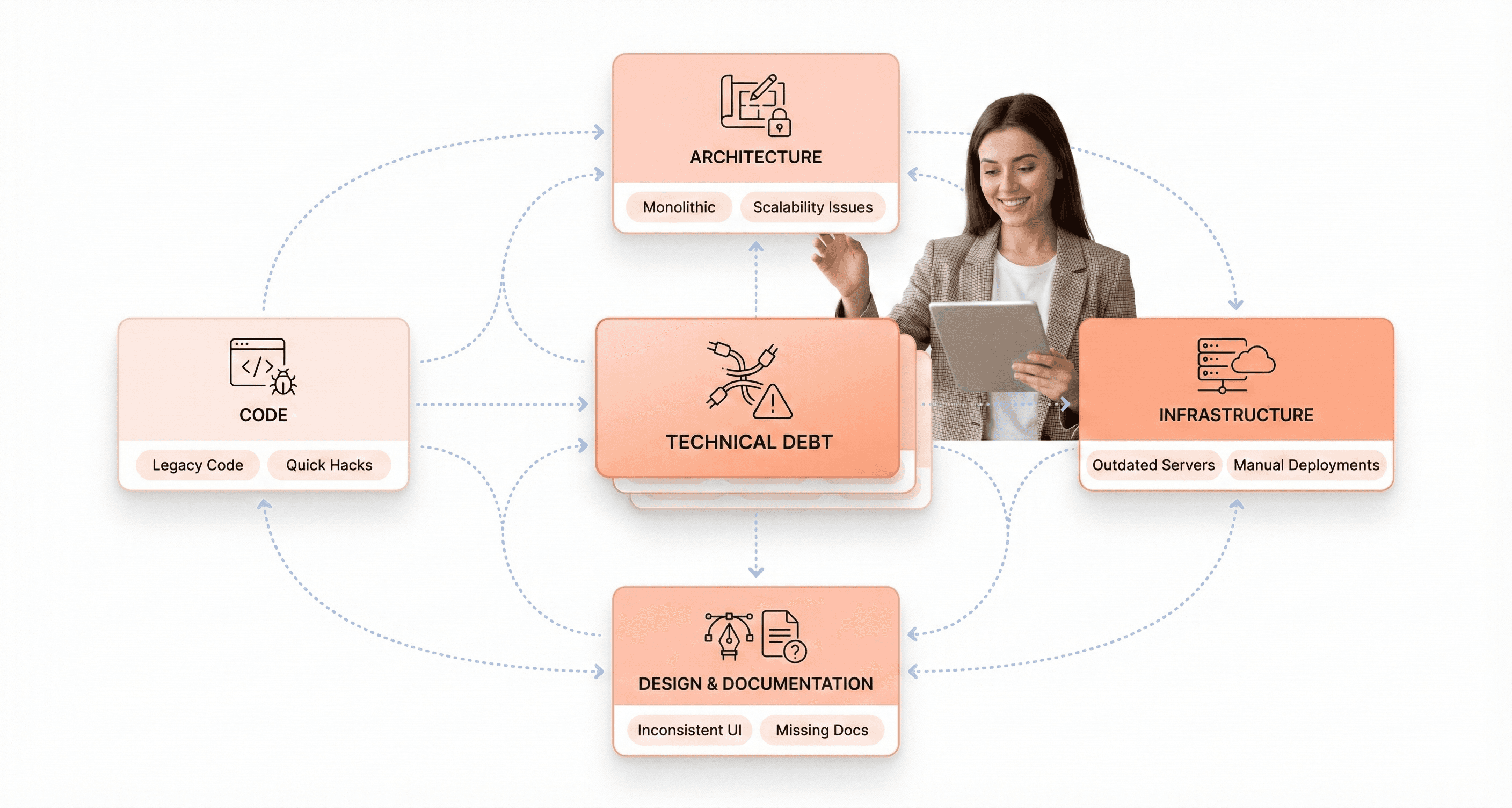
Common manifestations in frontend applications
In your frontend development environment, technical debt accumulates through several distinct patterns that directly impact your user interface and overall application performance. Poor coordination between your frontend and middleware teams represents one of the most common sources of debt.
When your frontend team bypasses the middleware team to make quick changes and meet deadlines, these temporary fixes rarely receive proper permanent solutions later, creating compound problems during subsequent modifications.
Documentation issues plague your frontend applications significantly. Outdated, poor, or completely absent documentation makes even the smallest changes break your code, leaving team members confused about implementation decisions. This becomes particularly critical for frontend development since proper documentation helps align your designers and developers on the same page.
Design debt accumulates when your design team fails to follow best practices, such as not testing designs with users to expedite shipping or leaving inconsistent page designs to save time. Your organizational architecture can also contribute to debt when design and development teams work as separate entities, with designers throwing designs "over the wall" to developers, creating chaos and subsequent technical debt.
Legacy systems and backward compatibility issues create substantial debt in your frontend applications. When a framework changes without a backward-compatible upgrade path, every screen built on the old version becomes debt. AngularJS is the clearest case: Angular 2 and later were a rewrite, and AngularJS support officially ended in January 2022, so teams still running it carry unpatched code as well as a migration backlog.
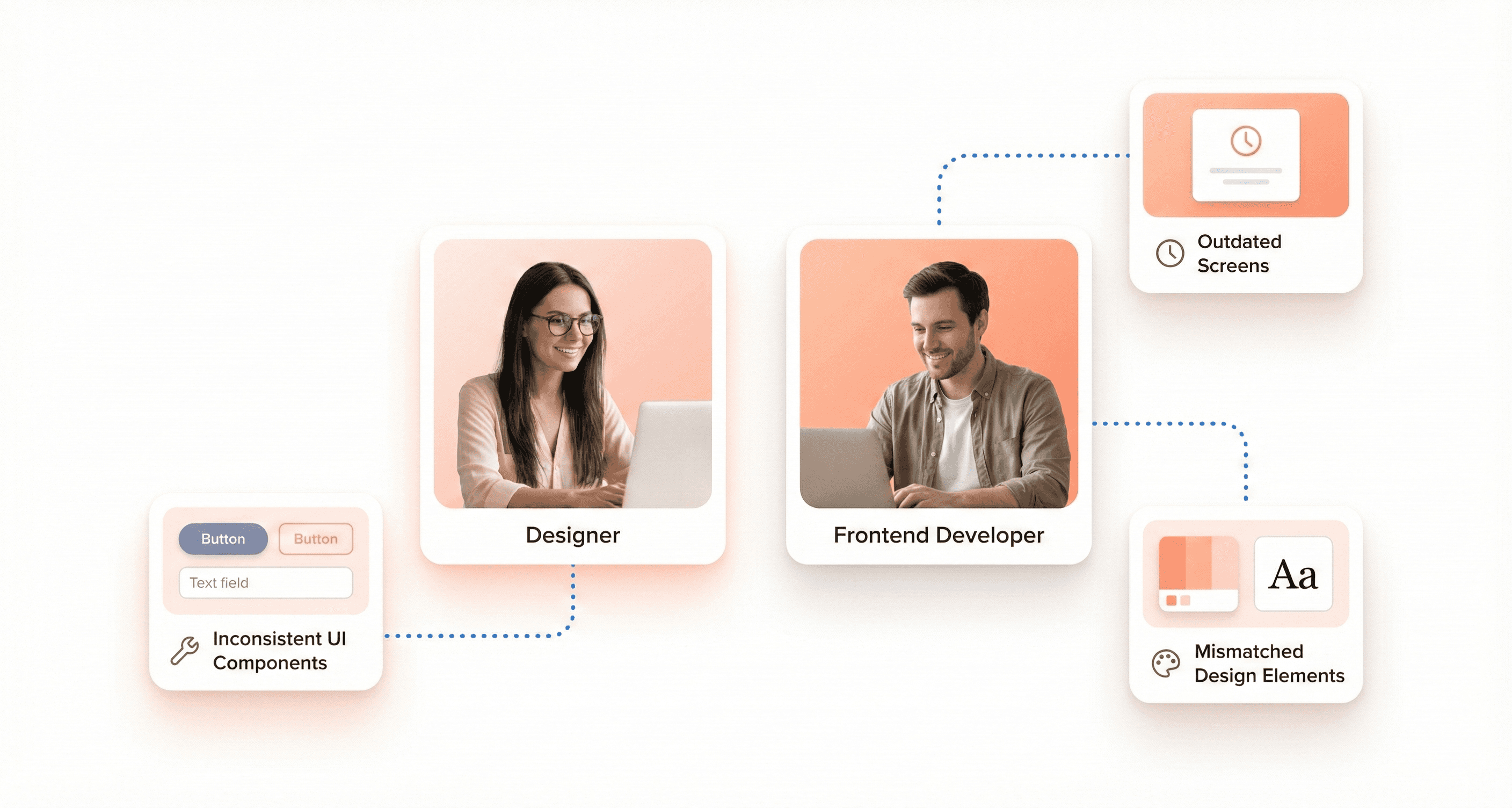
The "it works on my machine" mentality that creates long-term problems
The "it works on my machine" mentality represents a dangerous mindset that creates extensive long-term problems in your frontend development process. This approach typically emerges when your developers focus solely on immediate functionality without considering broader system implications or team collaboration requirements.
When your team members adopt this mentality, they often implement solutions that function perfectly in their isolated development environment but fail to account for different configurations, dependencies, or user scenarios. Your lack of code automation compounds this problem significantly. As your codebase grows bigger and more complex, failing to deploy proper automation leads to confusion and chaotic product development lifecycles, making scaling a distant dream for your organization.
Unnecessary locked dependencies from open-source libraries and frameworks contribute to this problematic mindset. While these libraries might fit your immediate needs, they aren't always the perfect solution for your business requirements. When you borrow from these libraries, you also inherit multiple dependencies that eventually require minor refactoring and complicate long-term maintenance of your codebase.
Your testing practices suffer under this mentality as well. Without comprehensive test coverage, you remain unsure whether changes in your codebase will break existing functionality. This uncertainty forces your team into reactive debugging cycles rather than proactive development, ultimately creating more technical debt as quick fixes accumulate without proper validation or documentation.

The Real Financial Impact of Accumulated Technical Debt
How inefficient code compounds costs over time
Inefficient frontend code behaves like debt with interest. Each time you delay a code quality fix, the next change in that area takes a little longer and carries a little more risk, and the extra effort grows as more features are built on top of the weak foundation.
This vicious cycle begins when your team prioritizes rapid delivery of new features over code quality and long-term system health. Under pressure to stay competitive, you may cut corners, leaving behind unresolved issues that accumulate over time. As your technical debt accumulates, it becomes increasingly difficult to repay, each new feature or update risks introducing additional debt, further degrading your system's quality and efficiency.
Your development team finds itself in a situation where an increasing amount of resources is spent on fixing bugs, patching security vulnerabilities, and addressing system failures, rather than driving business value through innovation. The more technical debt found in your code, the farther from your intended goal it becomes, and the longer it takes to iron out the kinks.
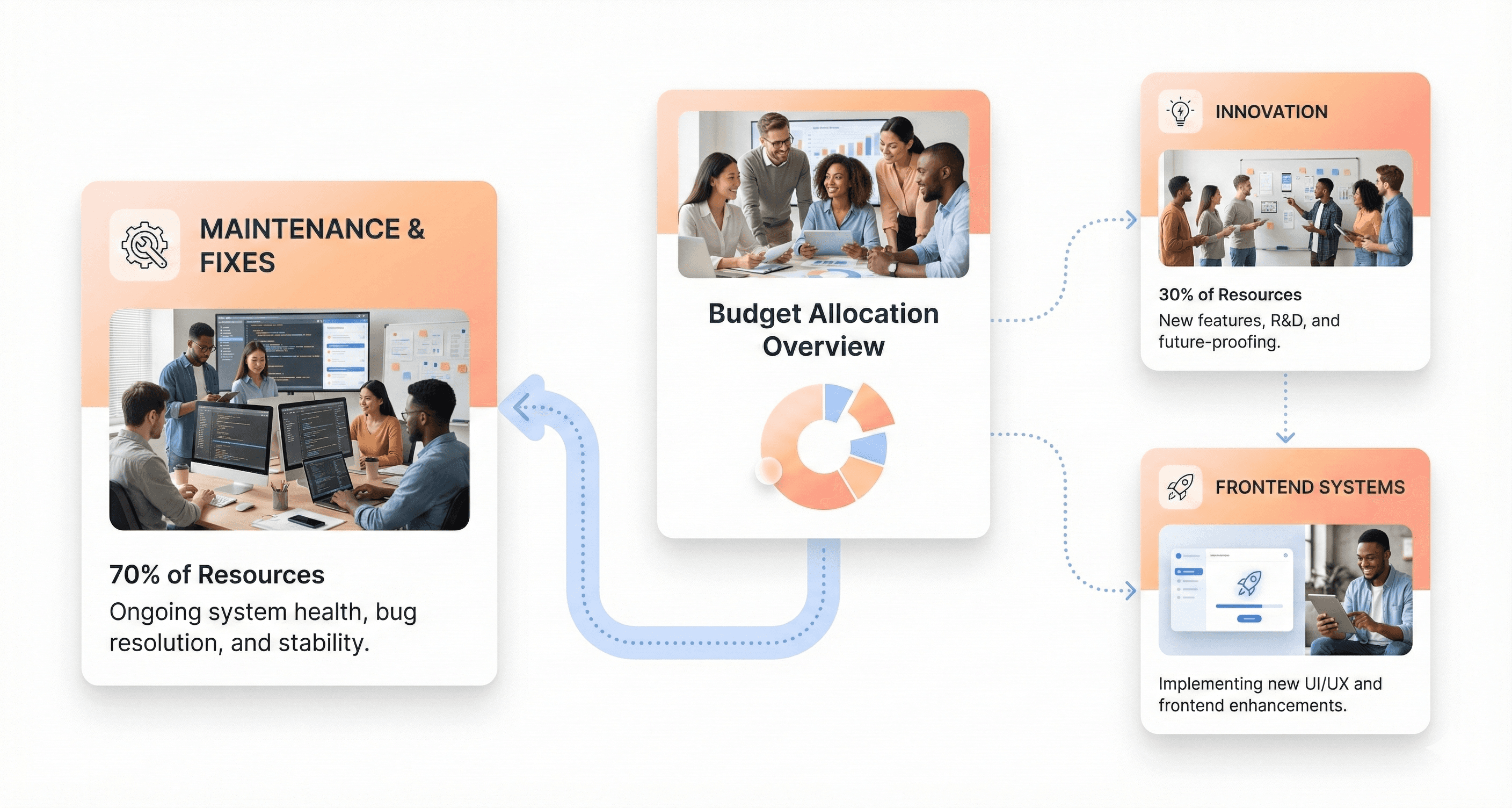
Infrastructure burden from poorly designed features
When your frontend features are poorly designed, they create significant infrastructure burdens that drain your resources continuously. Your legacy HTML CSS frontend architecture becomes increasingly difficult to scale or modify, forcing your IT team to spend countless hours on connectivity initiatives, patching, and adding customizations that can amount to a full-time job.
Your infrastructure costs rise when poorly designed components over-fetch data, re-render too often or ship large bundles, pushing extra work onto servers, CDNs and users' devices. These inefficiencies in your frontend architecture cascade through your entire system, affecting not just your development team but also accounting and business partners who rely on smooth operations.
The infrastructure burden extends beyond just technical costs. Your team must dedicate substantial time to addressing inefficiencies that result from manual steps, duplication, and constant remediation efforts. The hours your employees spend remediating outages and maintaining suboptimal systems represent a hidden drain on your organization's productivity and bottom line.
The opportunity cost of ignoring inefficiencies
The largest cost of technical debt is the work you cannot do. Every sprint spent on maintenance, firefighting and root cause analysis is a sprint not spent on the features customers asked for. SaaS customers notice lag, outages and glitches, particularly during busy periods.
When debt affects performance, scaling up or adding features becomes harder, and competitors who ship faster gain ground. Customers rarely complain about code quality. They complain about slow dashboards, broken workflows and inconsistent screens, and some quietly leave at renewal.
This is especially critical for MarTech and AdTech platforms where Martech AdTech UI UX services ensure high-performance campaign dashboards, marketing automation interfaces, and real-time analytics tools operate without latency or UX friction.
For some products, the best next investment is not another feature but reducing the debt that makes every future feature slower.
Why Frontend Technical Debt Persists
If the costs are real, why does debt keep growing? Three reasons come up in almost every SaaS team.
It is hard to see: technical debt does not appear on financial statements or project dashboards. Without numbers on how it slows delivery or causes defects, engineers cannot make a case that budget holders will accept
Velocity pressure wins: visible features beat invisible refactoring in planning meetings, so debt work is pushed to future sprints that never arrive. Delivery then slows anyway, as developers spend more time working around fragile code
No shared way to weigh cost against value: without a framework that compares the cost of debt with the value of new features, prioritisation is inconsistent and "fix what isn't broken" loses every time
The measurement signals and prioritisation approach in the first section close all three gaps: they make debt visible, express it in business terms and give it a protected place in the plan.
Hidden Operational Costs That Drain Resources
Increased support and maintenance requirements
When technical debt accumulates in your frontend applications, you'll find yourself dedicating significantly more resources to support and maintenance activities.
Your development team will spend increasing amounts of time on bug fixes, conflict resolution, and navigating complex codebases rather than building new features. This shift in focus directly impacts your operational costs, as developers who could be creating value-added functionality are instead remedying issues stemming from suboptimal system architecture.
You'll notice that your IT team spends considerable time on connectivity initiatives, outages, patching, and adding customizations, work that can amount to a full-time job. These remediation hours represent hidden costs that drain your resources while providing no forward momentum for your business objectives. The time your employees spend addressing inefficiencies from manual steps, duplication, and system fixes compounds over time, creating an ever-growing operational burden.
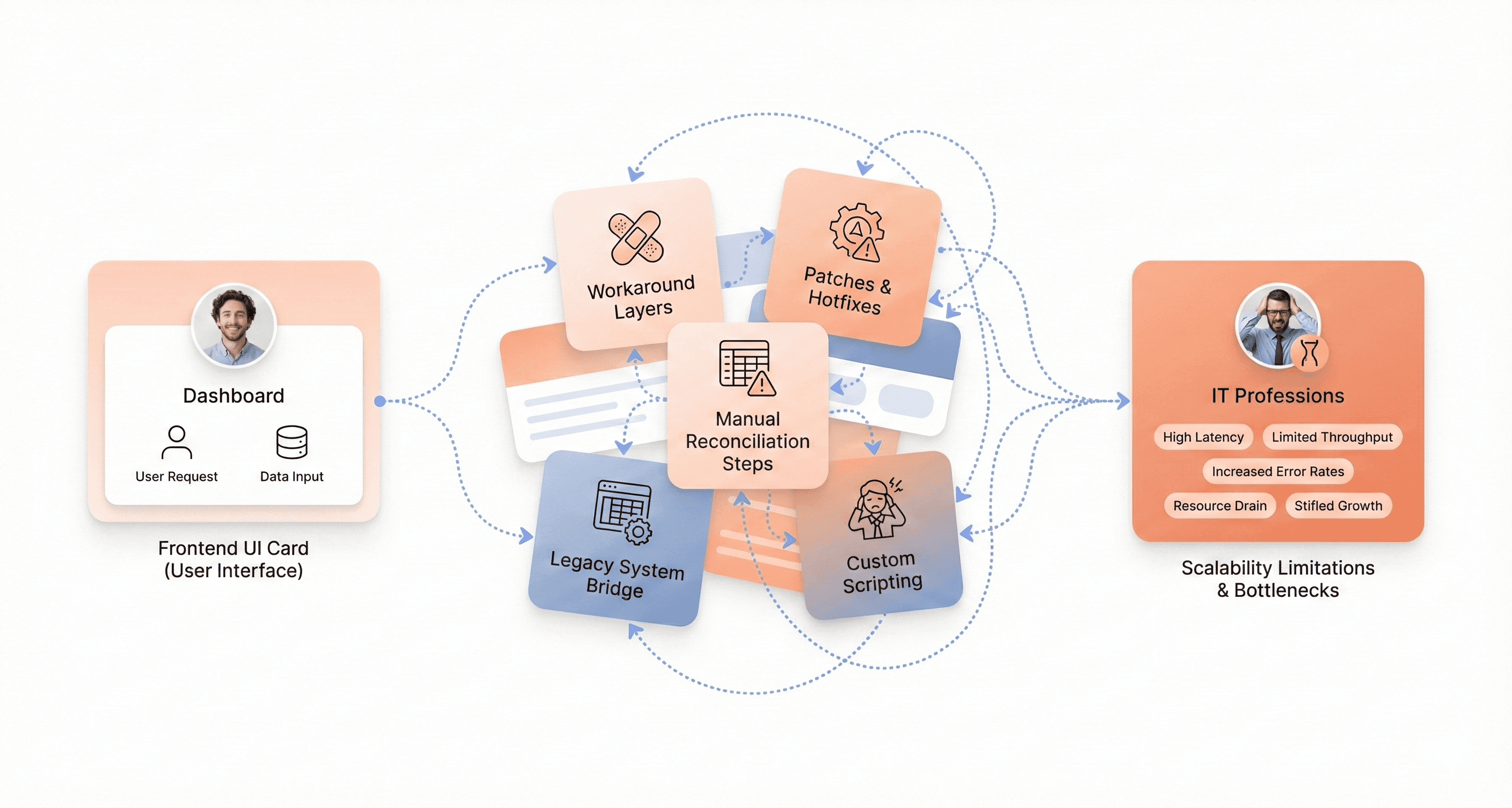
Slower development cycles for future features
Technical debt significantly hampers your development cycles, creating a cascading effect on your ability to deliver new features and respond to market demands. As your codebase becomes more complex due to accumulated debt, your developers must navigate increasingly intricate systems, which naturally extends development timelines.
Your team will find themselves spending more time understanding existing code, working around legacy implementations, and ensuring new features don't break existing functionality. This extended development time means you're slower to respond to shifting market conditions, a critical disadvantage in today's fast-paced business environment. The strategic concern extends beyond tight IT budgets, technical debt is directly affecting your ability to create new business opportunities and maintain competitive advantage.
Scalability limitations that require expensive workarounds
Your frontend applications with accumulated technical debt will inevitably face scalability challenges that demand costly solutions. When you've built platforms with human interactions in mind, adapting them for modern requirements becomes problematic and expensive. You'll discover that suboptimal integration strategies implemented earlier now require significant investment to overcome.
These scalability limitations force you to implement expensive workarounds rather than elegant solutions. Your systems may lack the architecture needed to handle both current user demands and emerging technologies, leading to performance issues and the need for costly infrastructure modifications. Over time, the cost of carrying these workarounds can exceed the cost of fixing the underlying design properly.
Transforming Development Culture to Prevent Technical Debt
Shifting acceptance criteria from functionality to efficiency
Preventing new technical debt requires a fundamental shift in how you define project success. Instead of accepting code that merely works, you need to establish acceptance criteria that prioritize long-term efficiency alongside immediate functionality.
Your teams must move beyond the traditional mindset of "getting the MVP out there" without considering the downstream costs. When you factor technical debt into your development cycle from the beginning, you create accountability for sustainable code practices. This means documenting and detailing any new technical debt introduction, then tracking it through your organization's ticketing system so teams can report on and analyze its impact.
Consider implementing a structured approach that evaluates code against five key operational principles: simplicity, flexibility, continuity, security, and transparency. When your acceptance criteria incorporate these elements, you create visibility into technical debt across your entire organization, ensuring that quality becomes as important as speed in your development process.
Rejecting inefficient code before it reaches production
The next step is establishing robust governance processes that prevent poor-quality code from reaching production. This becomes increasingly important as AI-generated code proliferates throughout development workflows, where teams can "crank out code rapidly" but often lack the expertise to properly review and refine it.
Your governance program should set clear requirements for testing and quality assurance while specifying when human review is necessary instead of relying solely on automated decisions. Without proper oversight, you risk creating "code bloat" that leads to more technical debt and legacy issues down the road.
To effectively reject inefficient code, you need governance that balances innovation speed with quality standards. This means establishing processes and tools, including AI-enabled ones, that ensure unacceptable amounts of poor-quality code don't slip through your development pipeline. Your governance framework must evolve to keep pace with modern development practices while maintaining rigorous standards for code that enters your production environment.
Building efficiency principles into development processes
Your organization should also embed efficiency principles directly into your development workflows. You can't treat technical debt management as a one-off project. It requires integration into your ongoing demand management strategy, handling both new work requirements and legacy system maintenance.
Your development culture should embrace the reality that "just because a project is delivered, it's not done." This journey-oriented mindset ensures continuous attention to code quality and system health. Implement practices where your teams identify new technical debt and determine appropriate remediation timelines as part of their regular sprint activities.
Building accountability into your culture means treating technical debt items with the same priority as other work in your sprint backlogs. Your teams should understand that erring on the side of "speed and innovation" without proper quality assurance creates expensive issues downstream. By establishing a culture that values long-term code quality over short-term speed, you help teams make better architectural decisions from the start.
Regular peer reviews, automated testing, and proper planning become non-negotiable components of your development process. When efficiency principles are woven throughout your workflows, you create sustainable development practices that prevent technical debt accumulation rather than merely managing it after the fact.
Strategic Approaches for Technical Debt Remediation
Dedicating Sprint Time to High-Impact Debt Reduction
Debt reduction only happens reliably when it is planned. Left to spare time, it never gets done, so make it a scheduled activity in every development cycle.
You should implement a unified backlog approach that merges new features and technical debt tasks into a single prioritization framework. This ensures that debt reduction receives the same consideration as feature development during sprint planning. Reserve a fixed portion of each development cycle for frontend debt, agree its size with product based on how severe the debt is, and protect it when deadlines tighten.
Consider incorporating stabilization sprints that focus solely on technical debt and bug fixes to ensure system stability. During these dedicated periods, your team can tackle numerous problems without adding new debt, leading to higher-quality products over time. This approach is particularly effective for addressing legacy UI/UX components that may be hindering your SaaS application's performance.
You'll find that planned debt repayment periods allow you to implement refactoring into your process systematically. Refactoring means restructuring code without changing what it does, for example replacing copy-pasted list markup with one reusable, tested component. Regular refactoring naturally reduces technical debt and should result in shortened development cycle times.
Communicating Long-Term Business Value to Stakeholders
You also need to communicate the impact of technical debt to stakeholders who may not understand the technical implications. Your success in securing resources for debt reduction depends on presenting technical debt impacts in a data-driven manner that resonates with business priorities.
You should employ specific metrics to demonstrate the business consequences of accumulated debt. Track indicators such as new bugs versus closed bugs: if new bugs outpace closed bugs, you have clear evidence that technical debt management requires immediate attention. Development cycle time serves as another powerful metric, measuring how long your team takes to make changes to existing code. Extended cycle times indicate clunky code structure that represents its own form of technical debt.
When presenting to stakeholders, frame technical debt in financial terms they understand. Explain how technical debt, like financial debt, accumulates interest over time. A temporary solution implemented to meet a deadline might seem minor initially, but if left unaddressed for six months, the "interest" compounds significantly, requiring much more time and resources to resolve.
You need to emphasize that technical debt directly impacts time-to-market for new features. As your frontend applications become more complex due to unaddressed debt, adding new features becomes increasingly time-consuming and error-prone. This slower development cycle translates to delayed product releases and reduced competitive advantage, concerns that resonate strongly with business stakeholders.
Creating Executive Sponsorship for Sustainability Initiatives
Executive sponsorship is crucial because sustainable technical debt management requires organizational commitment beyond the development team.
You should position technical debt reduction as a strategic initiative that enables faster innovation and reduces operational risk. Present executives with concrete data showing how technical debt reduction correlates with improved development velocity and reduced bug frequency. When executives understand that investing in code quality today prevents more expensive problems tomorrow, they're more likely to support sustainability initiatives.
Create a compelling business case by highlighting the cost of inaction, using your own figures for unplanned work and defect resolution from the signals described above. This reactive approach not only slows feature development but also increases the risk of system failures that could impact customer experience and revenue.
You need to advocate for cross-team collaboration to break down silos between development, operations, and quality assurance. Executive sponsorship enables this organizational alignment, ensuring everyone works toward the same goals regarding code quality and system sustainability. When executives champion these initiatives, it signals to the entire organization that technical debt management is a business priority, not just a developer concern.
Secure executive commitment to regular technology upgrades and infrastructure investments. Outdated technologies make the entire development process slower, forcing developers to cut corners to meet deadlines. Executive-sponsored modernization initiatives enable your team to work more efficiently while naturally reducing technical debt accumulation in your frontend applications.
Measuring and Prioritizing Technical Debt for Maximum Impact
Identifying Mission-Critical Inefficiencies
When measuring technical debt in your frontend applications, you need to start by pinpointing the inefficiencies that pose the greatest threat to your business operations. Your mission-critical systems, those that directly impact user experience, revenue generation, or core business functions, should receive immediate attention in your debt assessment process.
Focus on identifying security vulnerabilities that have accumulated in your frontend codebase. In traditional development cycles, security testing often occurs at the end of the process, leading to vulnerabilities that become too costly or complex to address before release. These security-related debts frequently slip into production, creating an endless cycle of patching and significantly higher end-to-end development costs for your team.
Your assessment should also examine weak access management and governance within your frontend applications. Despite the clear need for strong access controls, many organizations implement minimal safeguards to reduce friction for users. This approach can lead to privilege escalation and grant unauthorized access to sensitive systems, requiring considerable time to remediate and potentially causing irreversible brand damage.
Another critical area to evaluate is the complexity level of your frontend architecture. When your technical teams adopt multiple technologies, languages, and strategies, complexity keeps growing. This becomes particularly dangerous during mergers or acquisitions when your team inherits another company's systems and tools, adding their technical debt to yours.
Calculating Total Cost of Ownership Over Time
Once you know where the critical inefficiencies are, quantify their financial impact with a total cost of ownership view. An estimate in time and money, even a rough one, is what moves technical debt from a developer complaint into budget conversations.
Your calculation should begin with the Technical Debt Ratio (TDR), which quantifies the ratio of remediation effort to development effort. It compares the estimated effort to fix known issues with the effort it took to build the code, and is usually produced by static analysis tools. Track the trend rather than chasing a universal target: a ratio that rises release after release means debt is growing faster than you repay it.
To calculate your total cost of ownership, you must account for both the "principal" and "interest" components of your technical debt. The principal represents the cost of fixing the original code, dependencies, and frameworks to function in today's technology environment. The interest encompasses the ongoing maintenance costs that compound over time, including the challenge of keeping aging and inflexible legacy applications running as they become increasingly incompatible with rapidly changing modern infrastructure.
Your cost calculations should factor in the cascading effects beyond increased maintenance costs. Technical debt reduces deployment frequency, increases change failure rates, and extends mean time to recovery when issues occur. These impacts translate directly to lost revenue opportunities and increased operational expenses that compound quarterly.
Establishing Frameworks for Ongoing Debt Assessment
Next, implement systematic frameworks for continuous monitoring and assessment. Your framework should incorporate automated tracking of key technical debt metrics over time, including Technical Debt Ratio, lead time, change failure rate, and defect ratio.
Consider implementing monthly or quarterly debt reviews that align cross-functional stakeholders to reassess priorities, adjust remediation plans, and celebrate progress. These regular assessments help prevent debt from accumulating gradually without clear visibility into its growing impact on development velocity.
Your framework should integrate debt remediation tasks into sprint backlogs, giving developers dedicated time to perform additional testing and remediate issues. By prioritizing technical debt reduction within your regular development cycles, you can prevent problems from occurring later and save time while reducing headaches for your team members.
Automation plays a crucial role in your ongoing assessment framework. Automated tools can continuously scan for code smells, security gaps, and architectural issues, generating dashboards that highlight debt hot spots and measure reduction over time. This approach allows you to maintain consistency in your assessment process while providing real-time visibility into debt accumulation patterns.
Your assessment framework should also establish clear metrics or scores to quantify the impact of technical debt, enabling your teams to prioritize effectively, track reductions over time, and maintain a healthier codebase. Remember that measuring technical debt is an ongoing process, and translating discovery into action requires systematic approaches that embed debt management into your everyday development workflows.
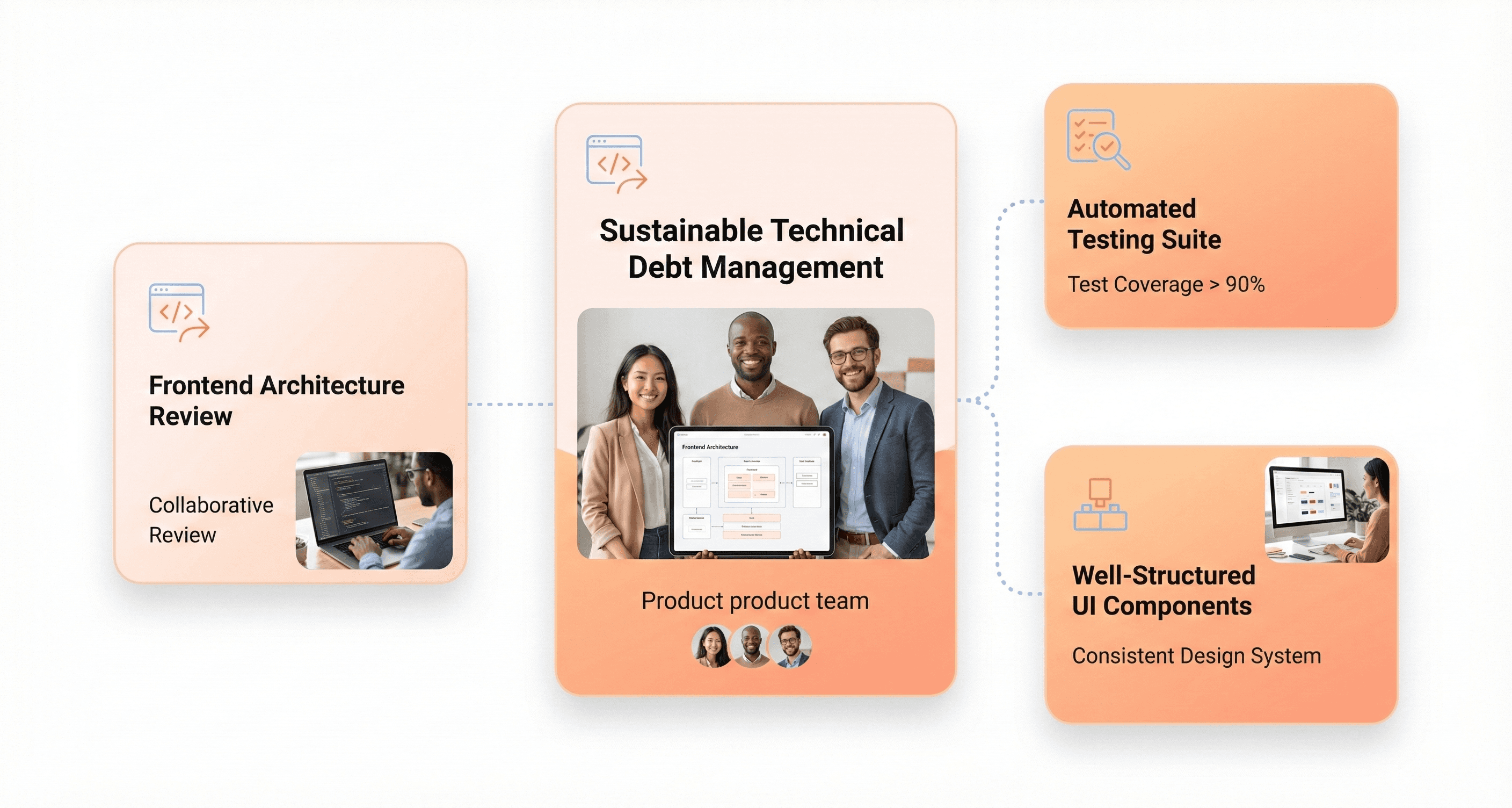
Conclusion
Frontend technical debt is a business problem, not just a developer problem. Its costs build up quietly, in slower releases, heavier support and infrastructure load, inconsistent UX and lower team morale, and they grow as the application scales.
Modern frontend practice gives you the tools to manage it: measure a handful of signals, prioritise by business impact, protect a share of every sprint, and pay the debt down incrementally with a design system, automated tests, regular upgrades and, for legacy apps, the strangler fig pattern. For hands-on help, see our frontend development services.
Want a second opinion on where frontend debt is costing you most? Talk to Hashbyt's frontend engineering team.




About the author
I’m the founder of Hashbyt, an AI-first frontend and UI/UX SaaS partner helping 200+ SaaS companies scale faster through intelligent, growth-driven design. My work focuses on building modern frontend systems, design frameworks, and product modernization strategies that boost revenue, improve user adoption, and help SaaS founders turn their UI into a true growth engine.
Is a clunky UI holding back your growth?
Is a clunky UI holding back your growth?
▶︎
Transform slow, frustrating dashboards into intuitive interfaces that ensure effortless user adoption.
▶︎
Transform slow, frustrating dashboards into intuitive interfaces that ensure effortless user adoption.
