

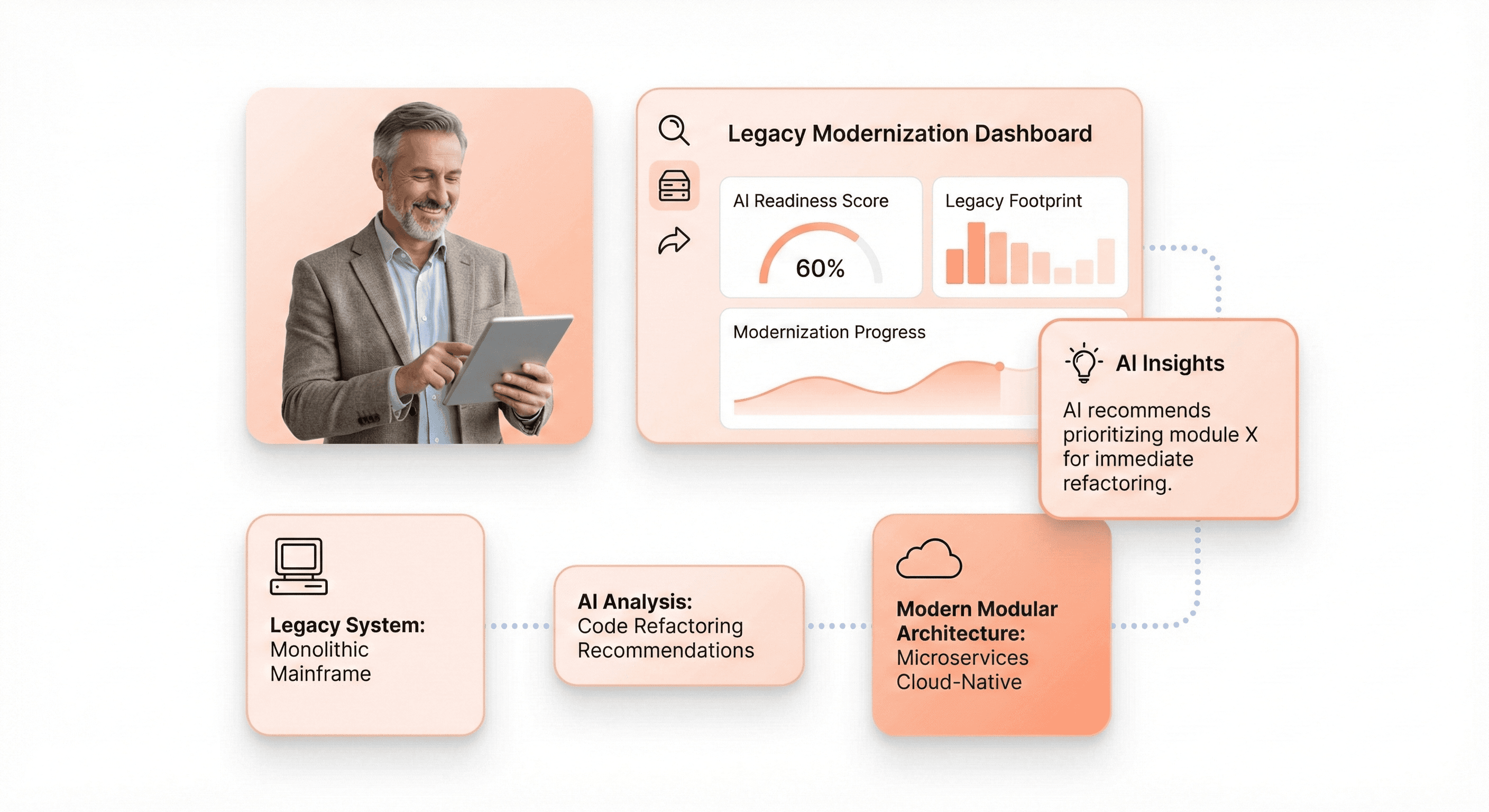
Enterprise leaders across industries face mounting pressure to transform aging systems that limit growth and block AI initiatives. Legacy applications that once powered expansion now create bottlenecks, drain IT budgets, and prevent organizations from scaling innovative technologies. This is where legacy modernization services play a critical role in enabling organizations to rebuild, replatform, and scale with confidence.
AI-powered legacy modernization has emerged as the solution for 2026, combining artificial intelligence with proven modernization frameworks to accelerate transformation while reducing risk. This comprehensive guide serves CTOs, CIOs, and IT directors planning strategic modernization initiatives that need to deliver results fast.
We'll explore how generative AI legacy systems assessment tools can map complex architectures in weeks instead of months. You'll discover proven modernization architecture patterns that balance speed with stability, from modular monoliths to selective microservices strategies. Finally, we'll show you how leading organizations use AI-assisted modernization processes to cut technical debt while building platforms ready for future innovation.
Understanding AI-Powered Legacy Modernization in 2026
Defining AI-powered legacy system modernization and its core components
AI-powered legacy system modernization represents a fundamental shift from traditional manual transformation approaches to intelligent, automated modernization strategies. This approach leverages generative AI, multi-agent AI platforms, and machine learning capabilities to analyze, document, and transform legacy systems with unprecedented speed and precision.
The core components of AI-powered legacy modernization include:
Intelligent Code Analysis: AI systems can analyze massive legacy codebases quickly, identifying dependencies, risks, and architectural patterns that would take human teams months to uncover. This automated analysis provides a comprehensive understanding of system complexity and interdependencies.
Automated Refactoring and Migration: Generative AI enables the automatic conversion of legacy code into modern languages and architectures. This includes generating production-ready code, creating documentation, and producing test cases that maintain business logic integrity while modernizing the underlying technology stack.
AI-Driven Testing and Validation: Advanced AI models assist with comprehensive testing automation, ensuring that modernized applications maintain functional parity with legacy systems while improving performance and security.
Human-in-the-Loop Precision: While AI accelerates analysis and generation, expert engineers provide validation, quality assurance, and business continuity oversight, creating a balanced approach that combines automation speed with human expertise.
Why legacy systems have become a strategic business constraint
Legacy systems have evolved from being operational foundations to becoming significant strategic barriers that constrain enterprise agility and innovation capacity. In 2026, these aging platforms struggle to meet modern demands for scalability, security, and speed, creating a compounding liability that affects every aspect of business operations.
The primary constraints imposed by legacy systems include:
Limited Scalability: Traditional monolithic architectures cannot efficiently scale to handle modern data volumes and user demands. Every component is tightly coupled, meaning that adding new capabilities increases the risk of breaking core system functionality.
Security Vulnerabilities: Older systems often lack modern security frameworks and compliance capabilities, exposing organizations to increasing cybersecurity risks and regulatory compliance failures.
Integration Challenges: Legacy systems typically operate in isolation, making it difficult to create the API-driven connections necessary for modern AI agent deployment and cross-system automation.
Innovation Bottlenecks: The rigid structure of legacy applications prevents organizations from rapidly adopting new technologies, particularly AI initiatives that require flexible, modular architectures to function effectively.
According to research insights, over 80% of large enterprises will use AI-assisted tools to modernize legacy systems by 2026, recognizing that traditional approaches no longer provide the agility required for digital-first competition.
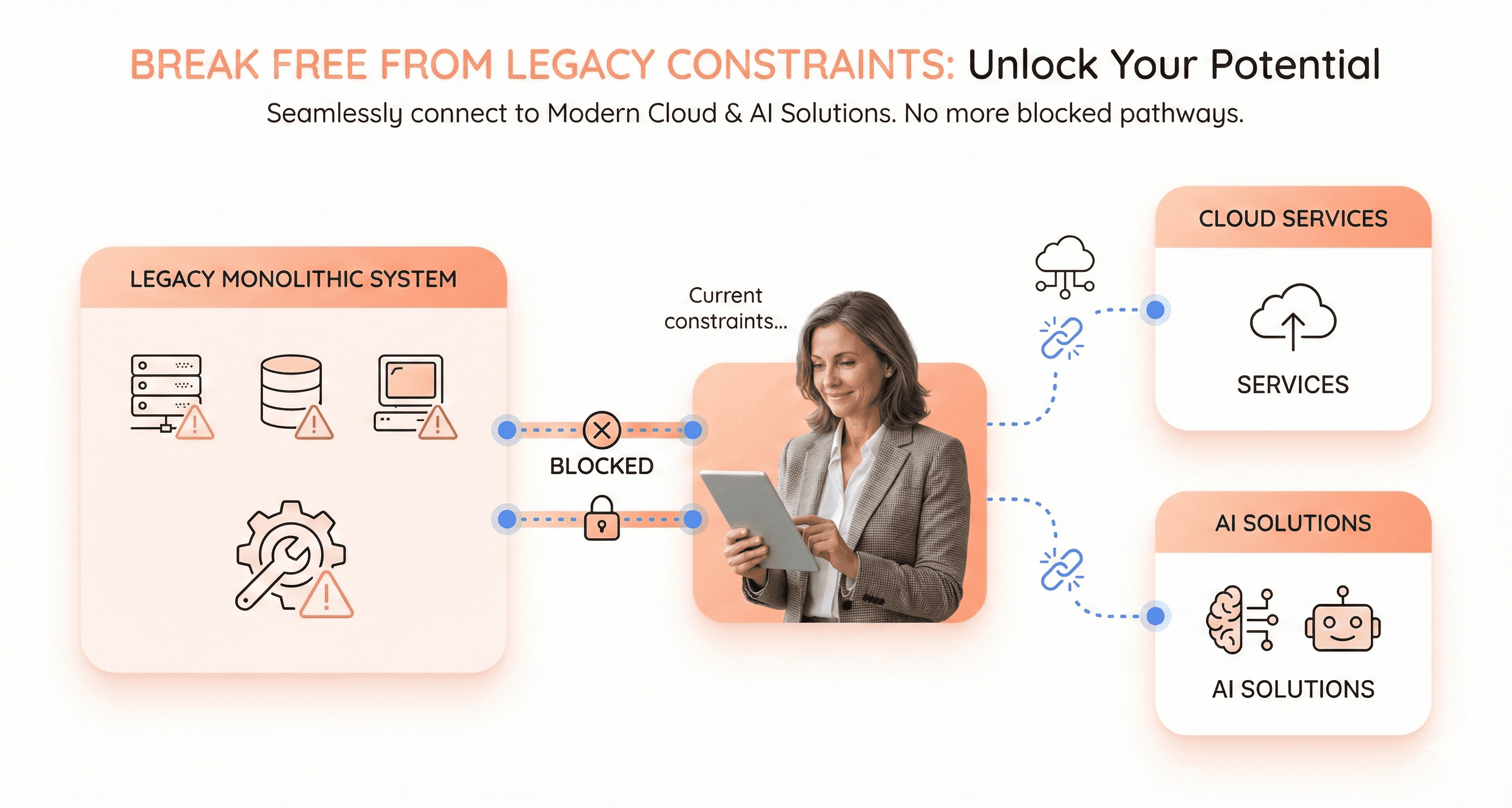
The financial impact of technical debt on enterprise operations
Technical debt has transformed from an IT concern into a strategic business liability that directly impacts enterprise profitability and growth potential. Research by McKinsey indicates that a significant majority of CIOs see their technical debt increasing, with many organizations forced to spend over 20% of their project budgets simply managing existing complexity rather than driving innovation.
Budget Allocation Impact: The financial burden of technical debt creates a vicious cycle where maintenance costs consume resources originally intended for innovation and growth initiatives. This misallocation of capital prevents organizations from investing in transformative technologies like AI that could drive competitive advantage.
Operational Efficiency Losses: Poor data categorization and system fragmentation can increase AI implementation costs by up to 40%, according to Gartner research. When mission-critical information remains trapped in isolated systems, organizations cannot leverage their data assets for intelligent decision-making and automation.
Competitive Disadvantage: Organizations carrying significant technical debt find themselves increasingly unable to respond quickly to market changes or customer demands. The hidden friction in most AI initiatives stems not from the technology itself, but from the accumulated weight of legacy systems that act as digital anchors.
Scalability Limitations: Technical debt compounds over time, creating architectural constraints that limit an organization's ability to scale operations efficiently. This becomes particularly critical as businesses attempt to implement enterprise-wide AI automation, where legacy bottlenecks can prevent successful scaling of intelligent systems across the organization.
Strategic Framework for Legacy System Assessment
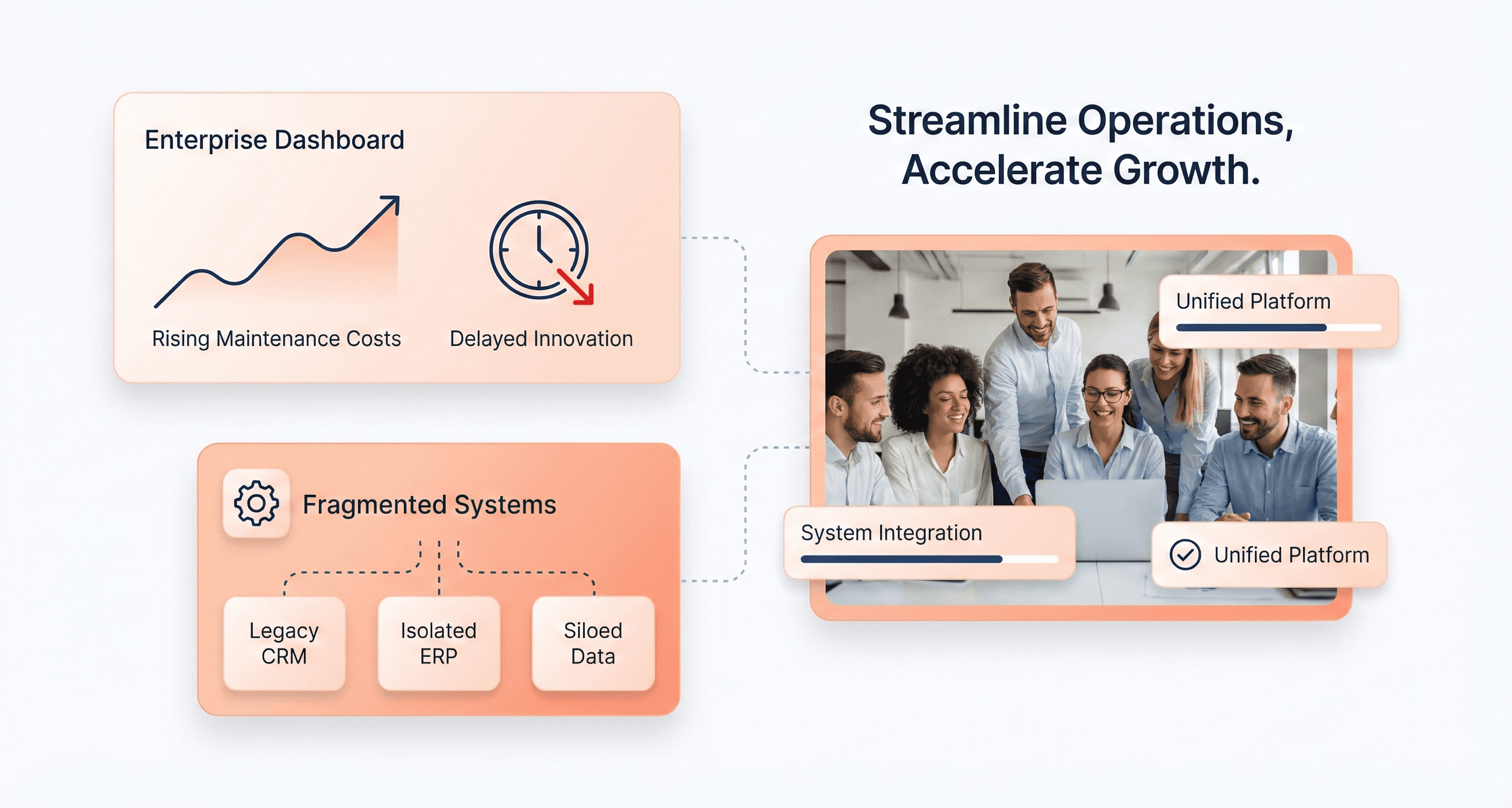
Building comprehensive system maps using AI-powered discovery tools
Modern legacy system assessment frameworks require sophisticated mapping capabilities to understand the full scope of enterprise applications and their interdependencies. The government's Legacy IT Risk Assessment Framework demonstrates how systematic discovery can identify critical systems across complex organizational structures, providing a standardized mechanism to gauge technical health and enable strategic resource allocation.
AI-powered discovery tools excel at automatically cataloging system components, including operating systems, databases, applications, and infrastructure elements that may have been customized and integrated over time. These tools can identify legacy application transformation candidates by recognizing indicators such as software out of support, expired vendor contracts, insufficient skilled personnel, inability to meet current business needs, unsuitable hardware, known security vulnerabilities, and recent operational issues.
The framework establishes clear criteria for comprehensive system mapping through seven likelihood dimensions (L1-L7) that assess the propensity of system issues. This includes evaluating end-of-life status, vendor contract expiration, knowledge and skills gaps, business needs alignment, physical environment suitability, security vulnerability exposure, and historical issue patterns. Each criterion uses a six-point scale from "Very Low" to "Certain," enabling precise risk quantification.
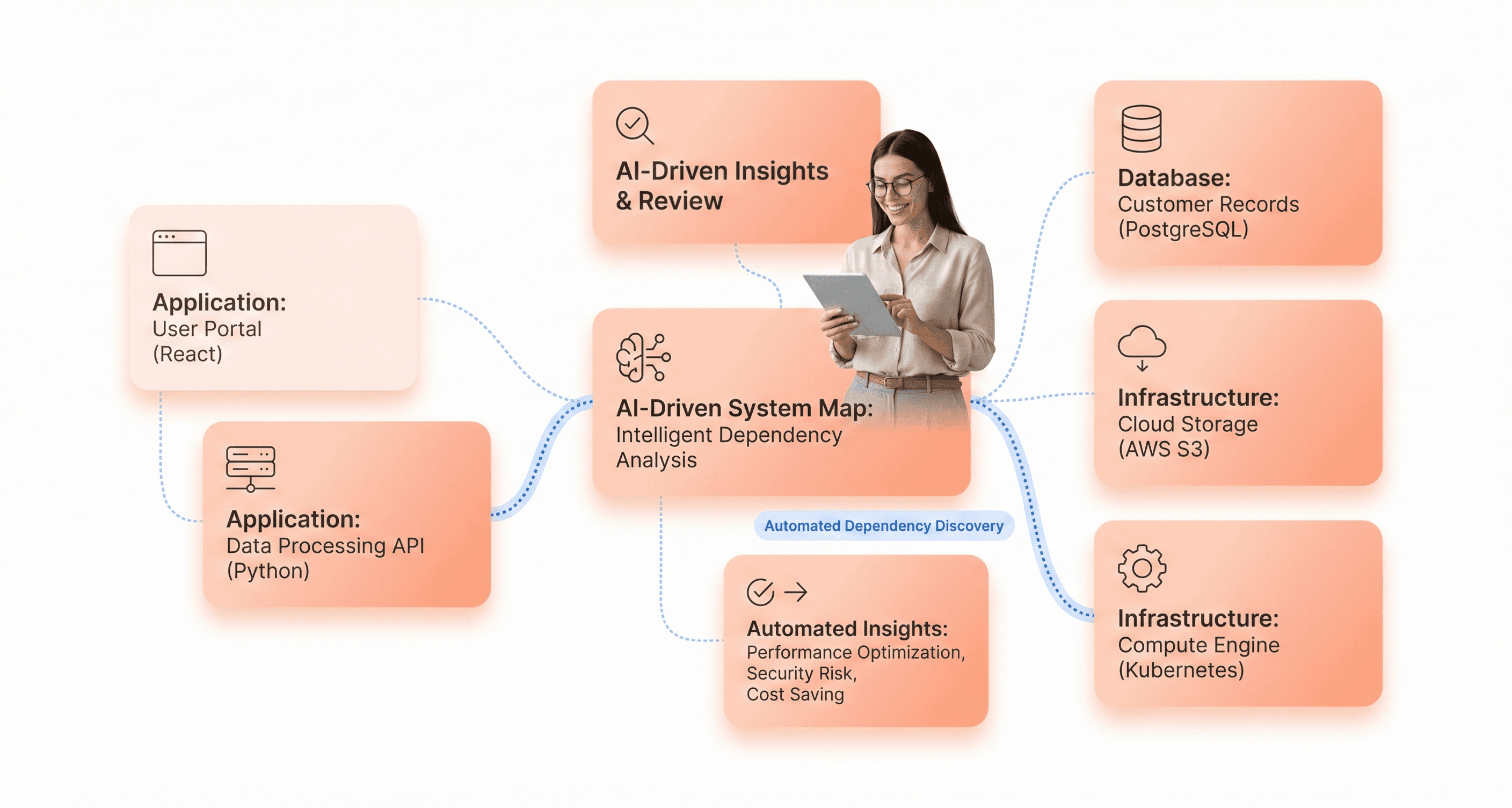
Quantifying the real cost of legacy maintenance and missed opportunities
The enterprise modernization strategy must include detailed financial impact assessment using structured criteria that capture both direct and indirect costs. The government framework's impact assessment covers six critical dimensions (C1-C6) that quantify consequences ranging from national security implications to operational resource losses.
Direct financial impact assessment considers regulatory costs, litigation expenses, citizen redress payments, exit costs, and break-clause penalties. The framework categorizes financial impact on a five-point scale, with "Very High" representing impacts exceeding 10% of departmental budget or £50 million, "High" covering 8-10% or £21-50 million, and "Medium" spanning 5-7% or £11-20 million ranges.
Operational impact quantification measures resource hours lost or additional workload required following system outages. The framework scales from "Very Low" impact (less than 100 resource hours) to "Very High" impact (exceeding 500,000 resource hours), providing concrete metrics for calculating true operational costs.
Technical barrier costs emerge from system codependencies that increase build costs and project durations. The framework assesses how legacy systems create barriers to innovation, with highly integrated systems significantly impacting other modernization initiatives. This comprehensive approach ensures organizations capture the full economic impact of maintaining outdated systems.
Identifying critical modernization priorities based on business impact
The AI modernization roadmap requires systematic prioritization based on comprehensive risk scoring that combines likelihood and impact assessments. Systems achieving an overall risk score of 16 or above are classified as "red-rated," indicating critical risk levels requiring immediate attention and remediation plans.
Risk calculation methodology aggregates likelihood and impact scores by finding the average between the mean score and maximum score across all criteria. For example, a fictional system with likelihood scores of 5-6 across criteria (mean: 5.43, max: 6) yields a total likelihood score of 5.71. Combined with impact scores averaging 4.67, the overall risk score reaches 26.67, clearly identifying it as a priority system.
The framework enables cross-organizational comparison and identification of commonalities across departments, supporting shared technology solutions and supplier strategies. This standardized approach allows central oversight bodies to create comprehensive risk matrices plotting multiple legacy systems against likelihood and impact dimensions.
Priority systems exhibiting "red-rated" status require immediate modernization, updates, or replacement, while lower-risk systems can be addressed in subsequent phases. Regular reviews account for changes in technology, business needs, and security threats, ensuring assessment accuracy. The framework mandates annual updates to maintain current risk profiles and support ongoing monitoring across the enterprise modernization portfolio.
Choosing the Right Modernization Architecture
When to modernize to a well-structured monolith versus microservices
The architectural decision between modernizing legacy systems to a well-structured monolith or microservices depends on carefully evaluating several critical forces that shape your organization's context. Based on established modernization architecture patterns, this decision requires balancing what are known as "dark energy" and "dark matter" forces.
Dark energy forces favor distributed architectures and include:
Simple components - Services with fewer subdomains are easier to understand and maintain
Team autonomy - Teams need independent development, testing, and deployment capabilities
Fast deployment pipeline - Smaller components enable faster builds and testing cycles
Multiple technology stacks - Different services can use varied technologies and upgrade independently
Segregate by characteristics - Separate services can optimize for different scalability, availability, and security requirements
Dark matter forces favor monolithic architectures and include:
Simple interactions - Local operations are easier to understand than distributed ones
Efficient interactions - Avoiding network overhead and data transfer inefficiencies
ACID over BASE - Traditional transactions are simpler than eventually consistent sagas
Minimize runtime coupling - Reduce availability and latency risks from distributed calls
Minimize design time coupling - Avoid lockstep changes between services
Choose microservices when your organization has mature DevOps practices, cross-functional teams, and can handle distributed system complexity. Large-scale applications like Netflix, Amazon, and eBay successfully evolved from monoliths to microservices to handle massive scale and rapid feature delivery.
Opt for a well-structured monolith when your team lacks distributed systems expertise, when most operations are naturally cohesive, or when the application domain doesn't justify the operational overhead of managing multiple services.
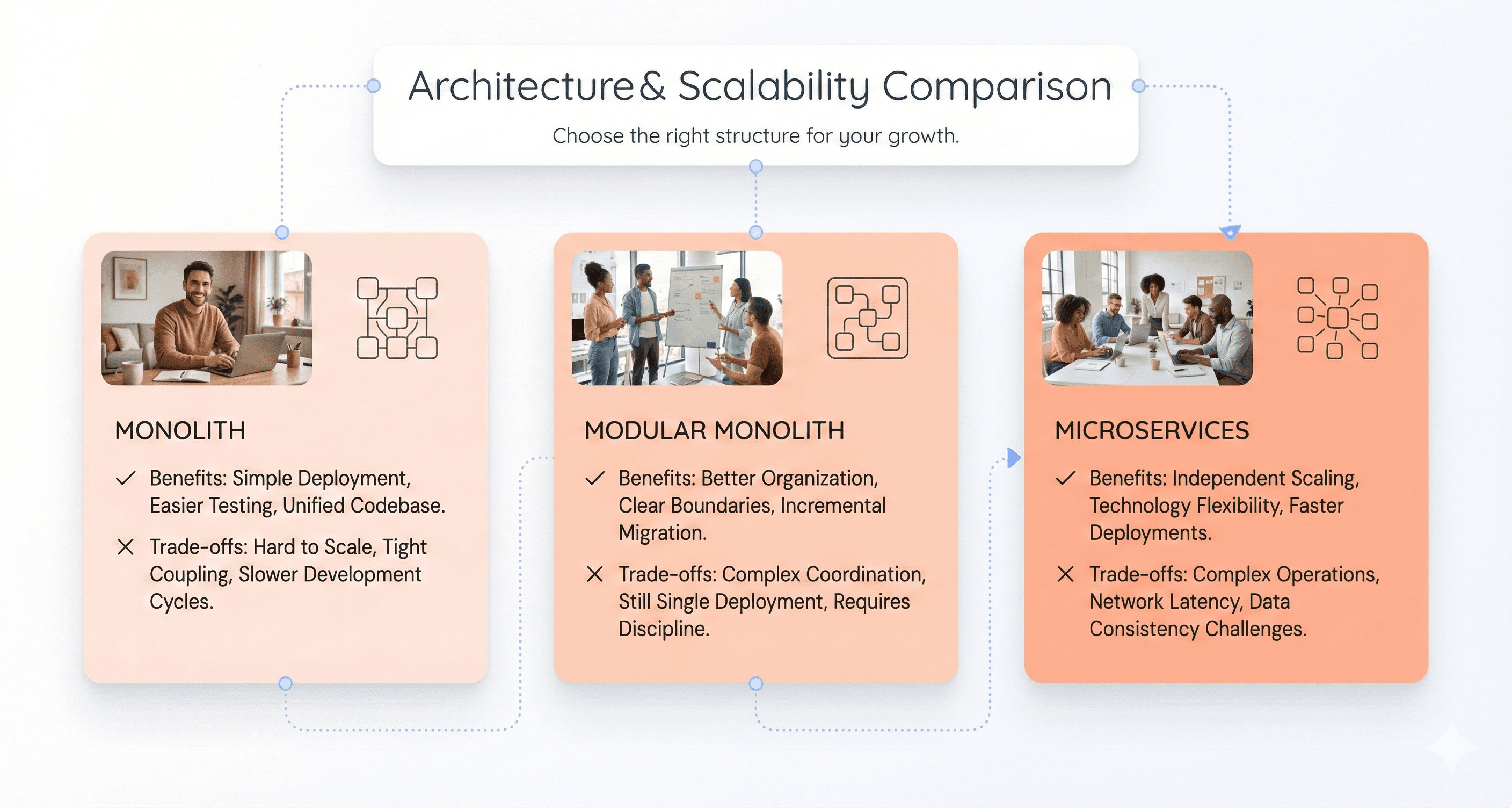
Understanding modular monoliths as the optimal middle ground
Modular monoliths represent the architectural sweet spot for many enterprise modernization scenarios, offering the structural benefits of microservices while maintaining the operational simplicity of monolithic deployment. This approach organizes subdomains into well-defined modules within a single deployable unit, providing clear boundaries without distributed system complexity.
In a modular monolith architecture, each subdomain consists of business logic with business entities (DDD aggregates) implementing business rules, and adapters for external communication. These modules are organized into packages that compile into a single deployable artifact, yet maintain logical separation comparable to microservices.
Key advantages of modular monoliths include:
Aspect | Benefit |
|---|---|
Deployment Simplicity | Single deployment unit reduces operational complexity |
Transaction Management | ACID transactions across modules without distributed coordination |
Performance | No network latency between modules |
Refactoring | Easier to restructure boundaries before committing to service boundaries |
Team Transition | Allows teams to learn domain boundaries before distributed operations |
The modular monolith serves as an excellent stepping stone in the AI-assisted modernization process, allowing organizations to establish proper domain boundaries and team responsibilities. Once these boundaries stabilize and teams develop the necessary operational maturity, individual modules can be extracted into separate microservices using patterns like the strangler pattern.
This approach is particularly effective for legacy system modernization where business domains are still being discovered and team topologies are evolving. Organizations can implement database-per-module patterns within the monolith, preparing for future microservices extraction while avoiding premature distribution.
Matching architectural decisions to team topology and operational maturity
Successful modernization architecture patterns must align with your organization's team structure and operational capabilities, following principles outlined in Team Topologies. The relationship between architecture and team organization is bidirectional - architecture influences team communication patterns, while team capabilities constrain viable architectural choices.
Team Topology Considerations:
Stream-aligned teams working on specific business capabilities naturally align with microservices ownership models. Each team should own one or more subdomains, with clear boundaries matching their expertise and responsibilities. However, if teams lack experience with distributed systems, starting with modular monoliths allows them to develop domain expertise before taking on operational complexity.
Platform teams provide essential foundation services for microservices architectures, including deployment pipelines, monitoring, and service mesh capabilities. Without mature platform teams, organizations struggle with the operational overhead of distributed systems, making well-structured monoliths more appropriate.
Operational Maturity Assessment Framework:
Maturity Level | Recommended Architecture | Key Indicators |
|---|---|---|
Basic | Well-structured Monolith | Manual deployments, shared databases, limited monitoring |
Intermediate | Modular Monolith | Automated CI/CD, some containerization, basic observability |
Advanced | Microservices | DevOps practices, container orchestration, distributed tracing |
Critical operational capabilities required for microservices include:
Automated deployment pipelines for independent service releases
Comprehensive observability including distributed tracing and log aggregation
Circuit breaker patterns and failure isolation mechanisms
Service mesh or API gateway capabilities for inter-service communication
Database per service implementation with eventual consistency management
Organizations should honestly assess their current capabilities against these requirements. Attempting microservices without adequate operational maturity often results in a "distributed monolith" - the worst of both architectural approaches, combining distributed system complexity with monolithic coupling constraints.
The modernization journey should evolve architecture in lockstep with growing team maturity, using patterns like database per service and saga patterns as teams develop the expertise to manage distributed transactions and eventual consistency models.
How Generative AI Accelerates Legacy Transformation
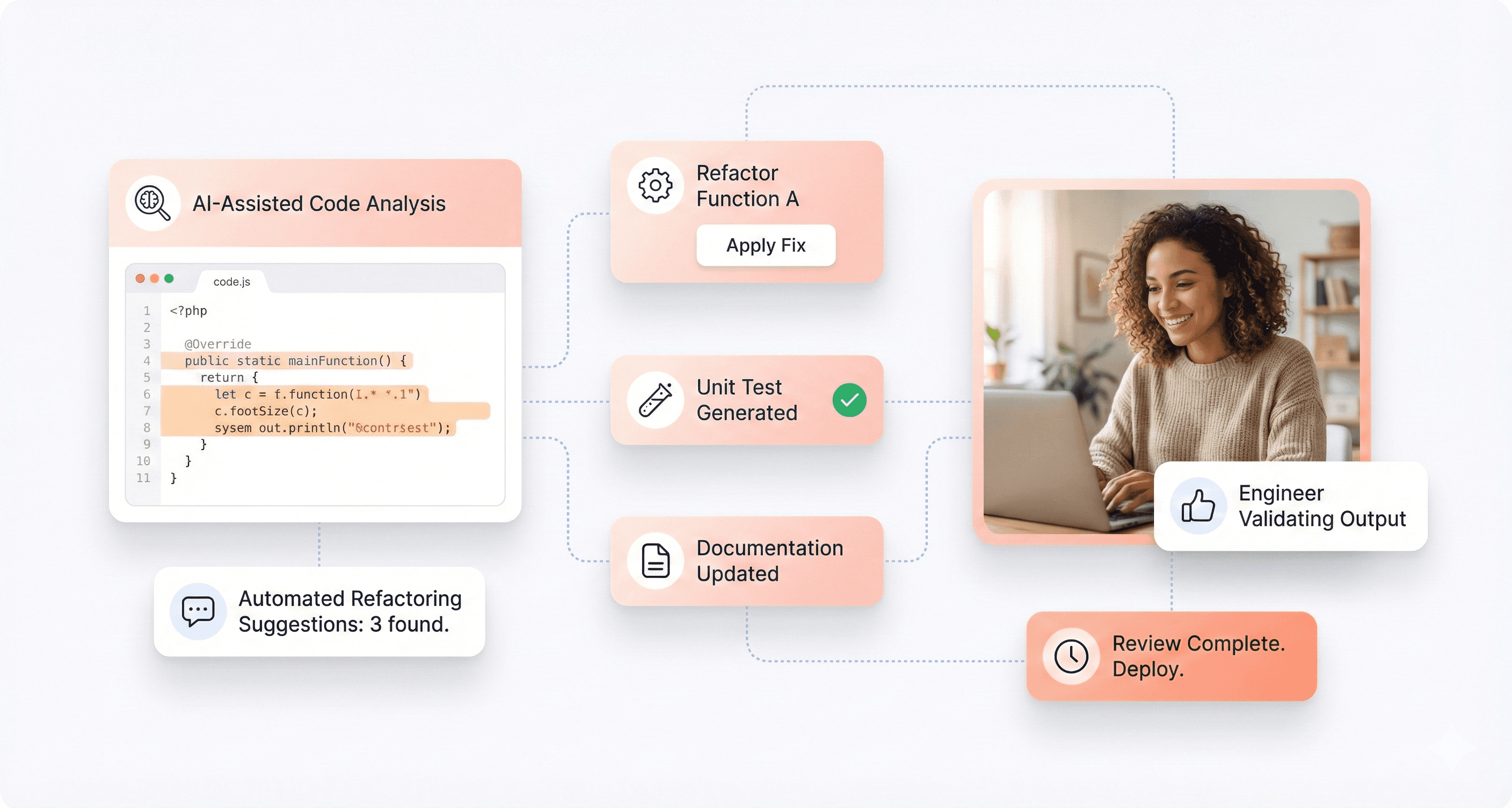
AI-assisted code analysis and dependency mapping capabilities
Modern generative AI systems excel at understanding complex legacy codebases through sophisticated code analysis and dependency mapping. AI-powered legacy modernization leverages large language models trained on vast amounts of code to identify implementation details, design patterns, and system architecture without requiring human domain experts.
GenAI addresses critical challenges that traditionally made legacy modernization time and cost-prohibitive. These systems can automatically understand existing implementation details, gather comprehensive knowledge about system design, and extract domains, subdomains, and capabilities from complex codebases. The technology proves particularly valuable when dealing with mainframe systems - some of the most significant legacy systems in terms of size and complexity.
AI models demonstrate remarkable capability in recognizing code patterns, identifying functions, understanding relationships between components, and inferring the intent behind specific implementations. This analysis extends beyond simple syntax recognition to provide deep insights into business logic and system behavior.
For enterprise application modernization in 2026, AI-assisted dependency mapping becomes crucial when functionality spans multiple files across different application layers. Advanced models can process interconnected components including controllers, services, repositories, domain models, and front-end components to understand complete feature implementations rather than isolated code segments.
Automated refactoring and test generation for safer migrations
Generative AI accelerates legacy transformation through automated refactoring capabilities that minimize modernization risks. The technology addresses one of the most challenging aspects of legacy system updates: maintaining system behavior while upgrading underlying architecture and code patterns.
AI-powered modernization tools can automatically improve and add automated tests as safety nets during the transformation process. This capability proves essential for enterprises seeking to modernize legacy applications without compromising existing functionality or introducing new defects.
The hybrid approach to AI-assisted modernization combines requirements extraction with current code analysis, preserving essential business logic while implementing modern patterns and practices. This method allows organizations to update outdated implementation details without risking functionality changes that might break user expectations.
Advanced AI systems can perform idiomatic code translation at scale to desired technology stacks while maintaining core business logic integrity. The technology handles complex scenarios including inconsistent error handling, legacy patterns, and technical debt preservation when necessary for system stability.
AI-assisted test generation creates comprehensive safety nets that clearly identify differences between old and new system behaviors, ensuring that changes remain intentional rather than accidental. This approach enables smoother cut-overs and reduces the headaches typically associated with legacy system migrations.
Real-world results showing 50-75% reduction in modernization timelines
Organizations implementing AI-powered legacy modernization report significant acceleration in transformation timelines. The evolutionary approach to legacy displacement, enhanced by generative AI capabilities, makes modernization both safer and more effective at achieving value goals compared to traditional "Big Bang" cutover methods.
GenAI transforms the cost/time/value equation for modernizing large systems that were previously prohibitive to update. Real-world implementations demonstrate that AI-assisted approaches can dramatically reduce the time required for legacy system analysis, code translation, and testing phases of modernization projects.
The technology enables organizations to generate value early in the modernization process while incorporating frequent feedback through gradual software releases. This iterative approach, accelerated by AI automation, reduces risks associated with modernizing critical business systems while maintaining operational continuity.
Enterprise modernization solution providers report consistent results showing 50-75% reduction in overall modernization timelines when leveraging AI-powered tools and methodologies. These improvements stem from automated code analysis, intelligent refactoring suggestions, and comprehensive dependency mapping that would traditionally require months of manual effort.
The democratization of GenAI through development frameworks and tools allows modernization teams to run quick experiments and proof-of-concepts without requiring specialized AI expertise. However, successful implementation requires careful attention to framework selection and avoiding convenience traps that could compromise long-term modernization objectives.
The Five-Stage AI-Assisted Modernization Process
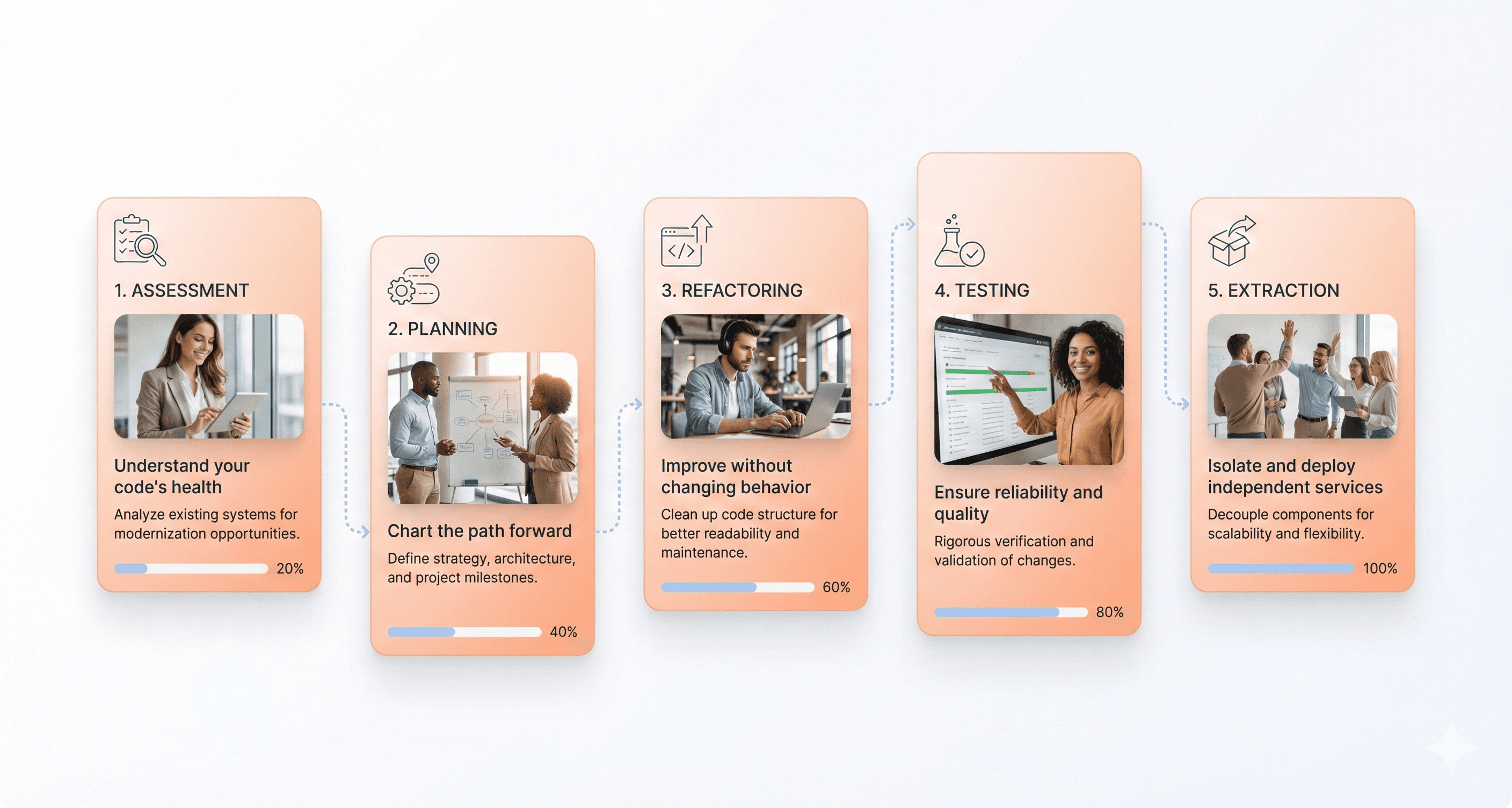
Assessment and intelligent system mapping phase
Drawing from established AI implementation frameworks, the assessment phase leverages AI-powered tools to conduct comprehensive analysis of existing legacy systems. This initial stage focuses on establishing a solid data foundation through intelligent discovery and automated inventory processes. AI-driven analysis tools can map system dependencies, identify integration points, and catalog technical components with unprecedented accuracy and speed.
During this phase, product managers, engineering leaders, and subject matter experts collaborate to map the entire application landscape rather than examining isolated components. The intelligent mapping process uses automated discovery tools to analyze codebases, database schemas, and integration patterns. This comprehensive approach ensures teams capture both explicit system relationships and hidden dependencies that traditional manual assessments often miss.
Key activities include automated code analysis, dependency mapping, and risk assessment scoring. AI tools can process large volumes of legacy code to identify architectural patterns, security vulnerabilities, and performance bottlenecks that would require weeks of manual review. The outcome is a detailed system map that serves as the foundation for all subsequent modernization decisions.
Architectural target selection and planning stage
With system mapping complete, teams enter the prioritization phase where AI-assisted analysis helps evaluate modernization options based on feasibility, business impact, and resource requirements. This stage involves weighing technical viability against potential value delivery, considering factors like latency requirements, cost implications, and integration complexity.
AI-powered planning tools can simulate different architectural scenarios, comparing microservices approaches against monolithic modernization strategies. The planning process includes evaluating cloud-native patterns, containerization opportunities, and API-first designs. Teams must consider whether modernization efforts can be reused across multiple system components, maximizing return on investment.
The architectural selection process benefits from AI-driven recommendation engines that analyze similar modernization projects and suggest optimal patterns based on system characteristics, business requirements, and organizational constraints. This data-driven approach reduces guesswork and improves decision-making accuracy during the critical planning phase.
AI-powered refactoring and modularization execution
The execution phase represents where AI truly accelerates legacy transformation through automated refactoring and intelligent modularization. Generative AI tools can analyze monolithic applications and suggest microservice boundaries based on business capability patterns and data flow analysis. These AI systems can automatically generate boilerplate code, API contracts, and database migration scripts.
During this phase, AI-powered refactoring tools handle routine transformation tasks while human developers focus on complex business logic and architectural decisions. The technology enables rapid iteration and experimentation with different modularization approaches, allowing teams to test architectural changes before committing to full implementation.
Machine learning models trained on successful modernization patterns can identify optimal service boundaries, suggest database splitting strategies, and recommend communication patterns between newly created microservices. This AI-assisted approach significantly reduces the time and effort required for manual code transformation while maintaining code quality and system reliability.
Automated test scaffolding and safety net creation
Before deploying modernized components, comprehensive testing becomes critical to ensure system reliability and performance. AI-powered testing frameworks can automatically generate test cases based on existing system behavior, creating comprehensive regression test suites that mirror real-world usage patterns. This automated approach addresses one of the biggest challenges in legacy modernization: ensuring new systems maintain existing functionality.
The evaluation phase incorporates multiple testing strategies including real-world data validation, automated performance testing, and security vulnerability scanning. AI tools can create test datasets that mirror production inputs, enabling thorough validation before deployment. Automated guardrails and inline evaluations provide continuous monitoring capabilities, catching potential issues in real-time during the modernization process.
Testing automation extends beyond functional verification to include performance benchmarking, security scanning, and compatibility validation. AI-powered testing tools can simulate various load conditions, identify potential bottlenecks, and recommend optimization strategies before systems reach production environments.
Selective service extraction and system hardening
The final stage focuses on selective extraction of modernized services while maintaining system stability and operational continuity. This phase requires careful lifecycle management to ensure extracted services remain robust, reliable, and effectively integrated with remaining legacy components. AI monitoring tools provide continuous oversight of system performance during the transition period.
System hardening involves implementing automated monitoring, setting up performance alerts, and establishing feedback loops for continuous improvement. AI-powered monitoring solutions can detect anomalies, predict potential failures, and recommend proactive maintenance actions. Version control systems enable rollback capabilities when issues arise during service extraction.
The continuous improvement aspect ensures modernized systems evolve with changing business needs. AI analytics can identify usage patterns, performance trends, and optimization opportunities, enabling iterative enhancements that maintain system effectiveness over time. This ongoing optimization approach ensures modernization investments continue delivering value long after initial implementation.
Leading AI-Powered Modernization Solution Providers
Opteamix's Comprehensive AI-First Modernization Platform
Now that we have covered the strategic frameworks and architectural approaches, let's examine the leading modernization solution providers shaping the enterprise landscape. Stride 100x emerges as a distinctive AI-powered legacy modernization platform specifically engineered for high-stakes enterprise environments. This platform combines proprietary GenerativeAI tools with expert engineering oversight to deliver unprecedented clarity, speed, and safety in legacy system modernization projects.
The platform's unique approach centers on human-led AI supported services, ensuring that while AI handles the complex mapping and analysis tasks, human experts maintain control over critical decision-making processes. This methodology proves particularly valuable for regulated industries where compliance and risk management are paramount concerns.
Stride 100x offers comprehensive capabilities including deep code and database tracing, visualization of legacy code for auditing purposes, recovery of requirements directly from existing code, and enriched epic and backlog generation. The platform demonstrates exceptional proficiency with Microsoft .NET environments, capable of modernizing C# or Visual Basic .NET code regardless of age, while also addressing challenges with overused SQL stored procedures and monolithic system architectures.
Performance metrics indicate that Stride 100x delivers up to 87% faster modernization compared to traditional approaches, while maintaining a highly tailored process that works closely with in-house development teams. The modernization process leverages comprehensive code and database context analysis, ensuring that transformations are both technically sound and business-aligned.
Enterprise-Scale Providers Including IBM, Accenture, and TCS
The enterprise modernization strategy landscape features several established global providers that bring massive scale and comprehensive capabilities to AI-powered legacy modernization initiatives. Cognizant stands as one of the legacy consulting heavyweights, delivering GenAI-powered frameworks specifically engineered for Fortune 100 demands. Their approach balances compliance requirements, transformation objectives, and multi-region rollouts, though engagement costs remain premium and delivery primarily occurs through offshore teams.
Infosys maintains its position as a transformation titan, integrating GenAI tooling with agile frameworks to drive structured change across complex, global organizations. Their modernization approach excels in high-complexity environments where compliance coordination across multiple time zones becomes critical. The platform offers agile-led replatforming, application reengineering, and cloud-native infrastructure rollouts, supported by broad industry experience and AI-driven process insights.
These enterprise application modernization 2026 providers typically require longer onboarding periods and higher initial investments but deliver comprehensive transformation capabilities suitable for multinational corporations planning large-scale system overhauls. Their offerings encompass end-to-end modernization services, from initial assessment through full deployment and ongoing support.
Specialized Capabilities Across Different Industry Verticals
Previously, we've seen how different industries require specialized approaches to legacy application transformation. OpenLegacy demonstrates particular strength in financial services and telecommunications, offering practical modernization approaches that bridge legacy core systems with modern architectures through automated API generation and visual system mapping. Their platform excels in enabling gradual, low-disruption transitions while maintaining business continuity through hybrid coexistence capabilities.
For organizations seeking speed-focused solutions, Rhino.ai represents a new generation of modernization platforms utilizing agentic AI and automation. This modular approach aims to simplify legacy-to-cloud transitions with minimal human input, making it particularly suitable for tech-forward startups and mid-size companies comfortable with rapid transformation timelines.
Devox Software and Hashbyt bring architectural rigor to mid-market modernization, focusing on system analysis, refactoring, and code-level transformation with minimal disruption to live systems. Their AI-powered tooling uncovers bottlenecks, tracks dependencies, and restructures systems effectively for organizations seeking foundational improvements before cloud-native transitions.
Industry-specific providers like Appinventiv focus on rapid delivery for mobile and customer-facing modernization needs, while XenonStack specializes in building modular, real-time systems using microservices and AI-powered automation for event-driven architectures. These specialized capabilities ensure that modernization solution providers can address unique industry requirements while leveraging AI to accelerate transformation timelines and reduce associated risks.
Building a Practical Modernization Roadmap for 2026
Creating shared organizational understanding of modernization value
Now that we have explored the technical aspects of AI-powered modernization, establishing organizational alignment becomes critical for roadmap success. Creating shared understanding requires translating technical complexity into clear business value propositions that resonate across different stakeholder groups.
The foundation of organizational alignment lies in developing a comprehensive baseline that everyone can understand. Legacy systems often suffer from undocumented business logic and hidden dependencies that create resistance to change. By leveraging AI-powered analysis tools, organizations can automatically map inter-program, job, and data dependencies while surfacing hidden coupling and risk hotspots. This creates a visual baseline of applications, programs, files, databases, and their relationships that stakeholders can actually comprehend.
Effective value communication requires connecting technical insights to business priorities. Modern modernization platforms provide structured environments for defining and organizing initiatives across complex legacy estates, producing actionable insights that tie technical landscapes directly to business outcomes. This approach transforms abstract technical debt discussions into concrete business impact scenarios.
Cross-functional collaboration becomes essential when architects, product owners, analysts, and engineering teams work from a single source of truth. Role-based access control ensures appropriate stakeholders can contribute their expertise while maintaining governance and accountability through audit trails and plan history for compliance requirements.
Selecting pilot domains for controlled modernization experiments
Previously, we've established the importance of organizational alignment, and with this foundation in place, the next critical step involves strategic pilot domain selection for AI-assisted modernization experiments. The selection process requires careful consideration of both technical complexity and business value to ensure early wins that build confidence across the organization.
Effective pilot domain selection begins with comprehensive legacy landscape visualization. Modern AI-powered tools can automatically ingest metadata from mainframe, IBM i, and other legacy repositories including COBOL, RPG, JCL, and DB2 systems. This creates interactive dependency graphs with filters by domain, technology, or business function, enabling teams to identify optimal candidates for initial modernization waves.
The most successful pilot domains typically exhibit specific characteristics that balance risk and reward. These include well-defined business boundaries, moderate technical complexity, and clear success metrics. For example, a core banking system might isolate customer and account management modules, while an insurance platform could focus on specific claims processing workflows rather than attempting enterprise-wide transformation.
Risk-aware pilot selection supports micro-decoupling and phased execution approaches, allowing organizations to modernize in safe, testable steps instead of high-risk "big bang" cutovers. This methodology enables teams to validate AI-assisted modernization capabilities while building organizational confidence and expertise.
The pilot domain approach also facilitates scenario modeling and impact analysis, allowing teams to compare alternative strategies such as refactor versus rehost before committing resources. This analytical approach ensures pilot selection aligns with broader enterprise modernization strategy while providing valuable learning opportunities.
Institutionalizing AI-assisted modernization as ongoing capability
Now that successful pilot domains have demonstrated value, organizations must establish AI-assisted modernization as a sustained organizational capability rather than a one-time project initiative. This transformation requires embedding modernization practices into standard development workflows and governance structures.
The institutionalization process begins with establishing structured workflows that guide teams from understanding legacy landscapes to executing controlled modernization tasks. This includes importing and baselining metadata from various legacy repositories, automatically mapping dependencies, and defining comprehensive modernization plans with clear strategies for each component.
Version-controlled modernization plans become essential infrastructure for ongoing capability development. These plans must include clear scope definition, strategy assignment (rehost, refactor, wrap, decommission), and structured task lists tied to actual system components and dependencies. The planning infrastructure should support phasing, prioritization, and milestone tracking for large programs while maintaining traceability from original analysis through execution.
Automation integration proves critical for sustainable modernization capability. API-first design with REST and MCP exposure enables scripting, automation, and integration into existing toolchains. Connectors for DevOps and project management tools keep execution and reporting synchronized while reducing manual coordination overhead.
The most successful organizations establish continuous feedback loops that connect legacy analysis, strategic planning, and transformation execution. This creates an analyze-plan-execute-deliver lifecycle that reduces handoffs, tool fragmentation, and modernization risk while building institutional knowledge and expertise across teams.
Collaboration infrastructure must support ongoing capability development through shared workspaces that enable architects, business owners, and engineering teams to align on priorities and timelines. This collaborative approach ensures modernization becomes an organizational competency rather than depending on individual expertise or external consultants.
Reducing Technical Debt to Enable AI Scaling
Preparing legacy systems for successful AI integration
Previously established modernization strategies must now evolve to accommodate AI-powered legacy modernization requirements. Technical debt has become the primary barrier preventing organizations from successfully integrating AI solutions into their existing enterprise applications. The stark reality is that with AI poised to penetrate every business function, all technical debt is becoming AI technical debt.
Legacy systems carrying significant technical debt create unstable foundations that prevent effective AI deployment. Outdated infrastructure and applications aren't just slowing companies down—they actively prevent organizations from deploying AI solutions that could reshape how they compete. Companies well-positioned for AI integration typically maintain a reinvention-ready "digital core" consisting of key components such as cloud infrastructure, data, and AI capabilities that can be easily updated.
Successful preparation requires establishing clear guidelines and standards for AI integration, including standards for code quality, documentation, and testing. Organizations must invest in continuous education and training to ensure development teams are equipped with the knowledge and tools needed to effectively integrate AI-generated code into their modernization workflows.
Creating stable interfaces and acceptable data quality standards
Now that we understand the foundation requirements, creating stable interfaces becomes critical for AI-enabled legacy transformation. Software intelligence technology plays an immensely helpful role in understanding and managing technical debt during AI-powered modernization initiatives. By mapping automatically generated insights about the inner workings of applications with qualitative information across the software landscape, organizations can understand their exposure to technical debt across an application portfolio based on facts.
Establishing acceptable data quality standards requires applying software intelligence for continuous oversight. This involves leveraging software mapping and intelligence technologies to accurately understand the quality and potential technical debt of both AI-generated and manually written code. For example, software intelligence platforms can identify within a Java application's code if too many literal numbers are being used—while not necessarily problematic within a small AI-generated code snippet, when integrated into the broader application codebase, it can make the application overly cumbersome to maintain and update over time.
These insights enable organizations to evaluate and compare technical debt trends across applications that use AI-generated code versus those that do not, allowing leaders to make informed decisions about AI adoption and management in their development processes.
Establishing the modernization-AI adoption feedback loop
With stable interfaces and data quality standards in place, establishing an effective feedback loop becomes essential for sustainable AI-assisted modernization. The key to harnessing AI-generated code potential while mitigating technical debt risks lies in a balanced approach that combines AI strengths with human developer discernment and expertise.
Companies well-positioned for change typically set aside around 15% of their IT budgets for tech debt remediation. The research shows that addressing technical debt reduction AI initiatives is not about eliminating debt entirely but managing it strategically. The key lies in knowing what the debt is, what to fix, what to keep, and how to recognize the tech debt that is boosting innovation capacity.
Software intelligence platforms enable organizations to prioritize and address critical areas of technical debt, ensuring teams focus efforts on making impactful improvements and allocating resources efficiently. This proactive management approach equips leaders with knowledge to take proactive steps in mitigating risks and optimizing development strategies.
By capturing contextual information such as business impact of each application across a portfolio and mapping it against technical insights from code, organizations can create comprehensive feedback loops that inform both modernization priorities and AI adoption strategies. This approach prevents technical debt build-up while identifying optimal paths for addressing existing debt.
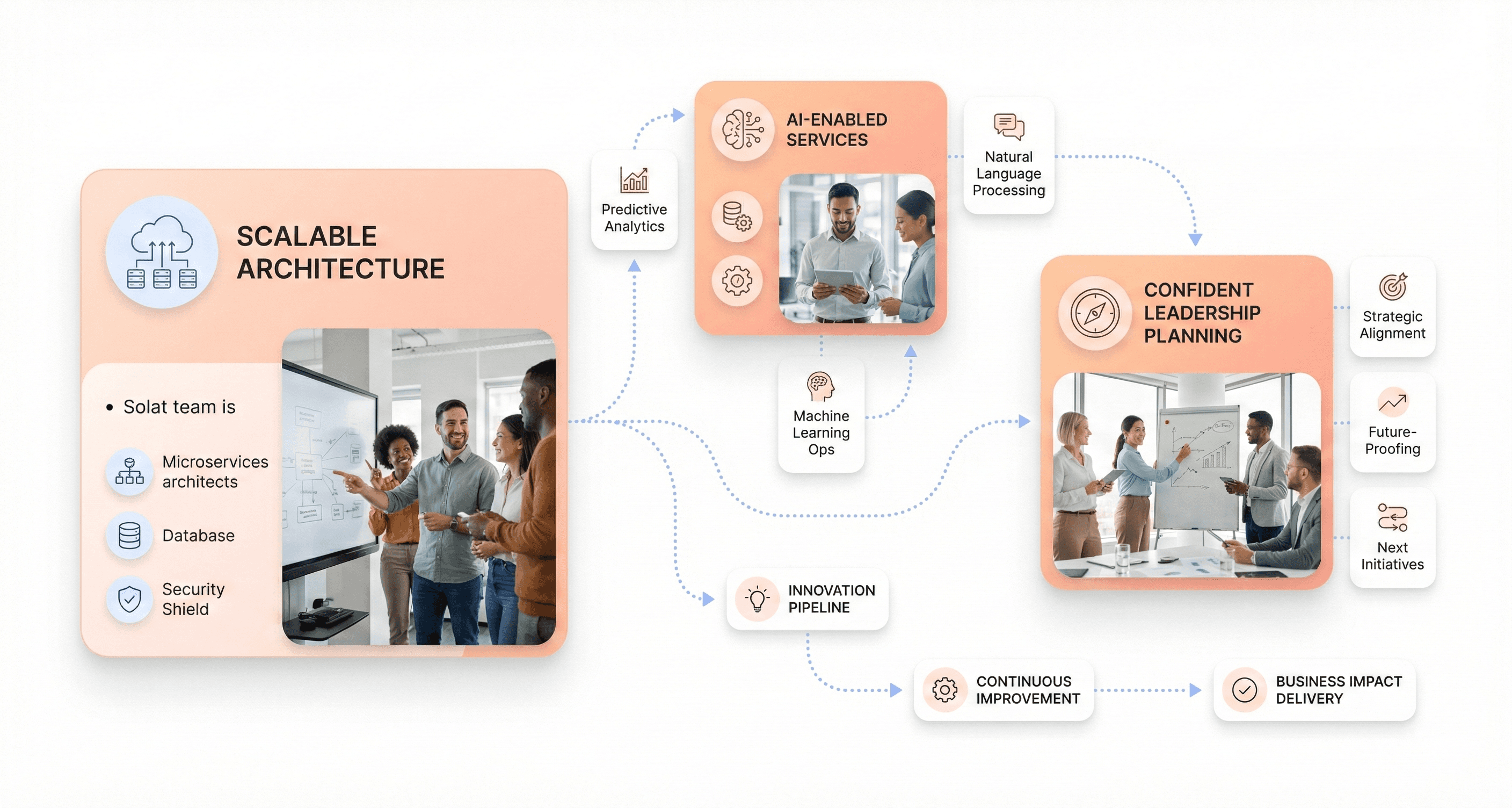
Conclusion
The convergence of AI and legacy modernization represents a fundamental shift in how enterprises approach digital transformation. Organizations that embrace AI-powered modernization frameworks can reduce technical debt by up to 50%, accelerate project timelines, and build platforms capable of supporting next-generation AI initiatives. The five-stage AI-assisted modernization process—from assessment and mapping through selective extraction—provides a proven roadmap for transforming legacy systems into scalable, modern architectures without compromising business continuity.
As we move into 2026, the question is no longer whether to modernize legacy systems, but how quickly and effectively you can execute this transformation. The enterprises that treat modernization as a strategic imperative—combining generative AI tools with expert architectural guidance—will find their legacy platforms evolving from operational constraints into competitive launchpads. Those who delay will increasingly find their growth potential dictated by systems they no longer fully control. The time to act is now, turning your technology ceiling into the foundation for future innovation.




About the author
I’m the founder of Hashbyt, an AI-first frontend and UI/UX SaaS partner helping 200+ SaaS companies scale faster through intelligent, growth-driven design. My work focuses on building modern frontend systems, design frameworks, and product modernization strategies that boost revenue, improve user adoption, and help SaaS founders turn their UI into a true growth engine.
Is a clunky UI holding back your growth?
Is a clunky UI holding back your growth?
▶︎
Transform slow, frustrating dashboards into intuitive interfaces that ensure effortless user adoption.
▶︎
Transform slow, frustrating dashboards into intuitive interfaces that ensure effortless user adoption.
