
Understanding Legacy Modernization Terms for Founders
Posted on
Saas Growth
Saas Growth
Posted at
Jan 6, 2026
Jan 6, 2026
Min read
10

I hope you found this post valuable. If you’re looking for proven frontend and design expertise to elevate your product, feel free to reach out.


Founders of growing companies face a critical challenge: outdated software systems that can't keep pace with business demands. Legacy modernization terms flood your conversations with CTOs, consultants, and vendors, but the jargon often clouds the real decisions you need to make.
This guide breaks down the essential legacy modernization terminology every founder should know. We'll walk through key concepts that impact your bottom line, explain strategic approaches that fit different business stages, and decode the technology stack options powering modern applications today.
You'll discover what terms like "replatforming" and "microservices architecture" actually mean for your company's growth trajectory, plus learn how to evaluate modernization costs against potential returns on investment.
Understanding Legacy Systems and Why They Need Modernization
What Legacy Systems Are and Common Examples Across Industries
Legacy systems refer to old technology or computer systems that continue to be used by organizations despite the availability of newer alternatives. These systems often support critical business processes but are based on outdated hardware or software, which makes maintenance challenging and costly. Legacy systems can be deeply integrated into a company's core operations, representing significant infrastructure investments that organizations have accumulated over years of operation.
These aging systems are characterized by their use of obsolete programming languages, outdated architectures, and technologies that may no longer receive vendor support or security updates. Despite their limitations, legacy systems frequently handle mission-critical functions that businesses depend on for daily operations, making them difficult to replace without careful planning and substantial investment.
Why Companies Still Rely on Outdated Technology
The reliance on aged technologies persists mainly due to the investment in their infrastructure and the potential risk and disruption associated with migrating to new systems. Organizations often defer upgrading or replacing legacy systems due to concerns about business continuity and the complex dependencies these systems have developed within their operational framework.
Legacy systems become deeply embedded within an organization's operations over time, creating intricate architectures with numerous dependencies on other systems and processes. This complexity means that upgrading or replacing one component can have unforeseen impacts across the entire IT landscape. Many of these systems have accumulated a tangled web of customizations over the years, making modernization efforts increasingly complex.
Additionally, as technology evolves, expertise in older systems becomes scarce, with fewer IT professionals proficient in outdated programming languages and architectures. This scarcity of skilled personnel makes it challenging and costly to find individuals capable of maintaining, troubleshooting, and upgrading legacy applications, further encouraging organizations to retain their existing systems rather than face the difficulties of finding qualified experts.
The Hidden Costs of Maintaining Legacy Infrastructure
Maintaining legacy systems typically requires significant financial investment that extends far beyond the initial implementation costs. These systems demand constant patches, fixes, and workarounds to keep them functional, creating an ongoing drain on IT resources and budgets. The expense of supporting outdated technology often exceeds the cost of modern alternatives when calculated over time.
Legacy systems are expensive to maintain due to their need for specialized hardware, custom software solutions, and skilled professionals who understand outdated technologies. As these systems age, finding replacement parts for obsolete hardware becomes increasingly difficult and costly. Organizations must often maintain inventory of spare components or pay premium prices for discontinued equipment when failures occur.
The operational inefficiencies of legacy systems also contribute to hidden costs through reduced productivity and slower response times. Modern systems typically require less maintenance and fewer resources to operate efficiently, which translates into reduced operational costs over time. Despite the initial investment required for modernizing legacy systems, the long-term savings can be significant when compared to the escalating costs of maintaining outdated infrastructure.
Security Risks and Compliance Challenges of Aging Systems
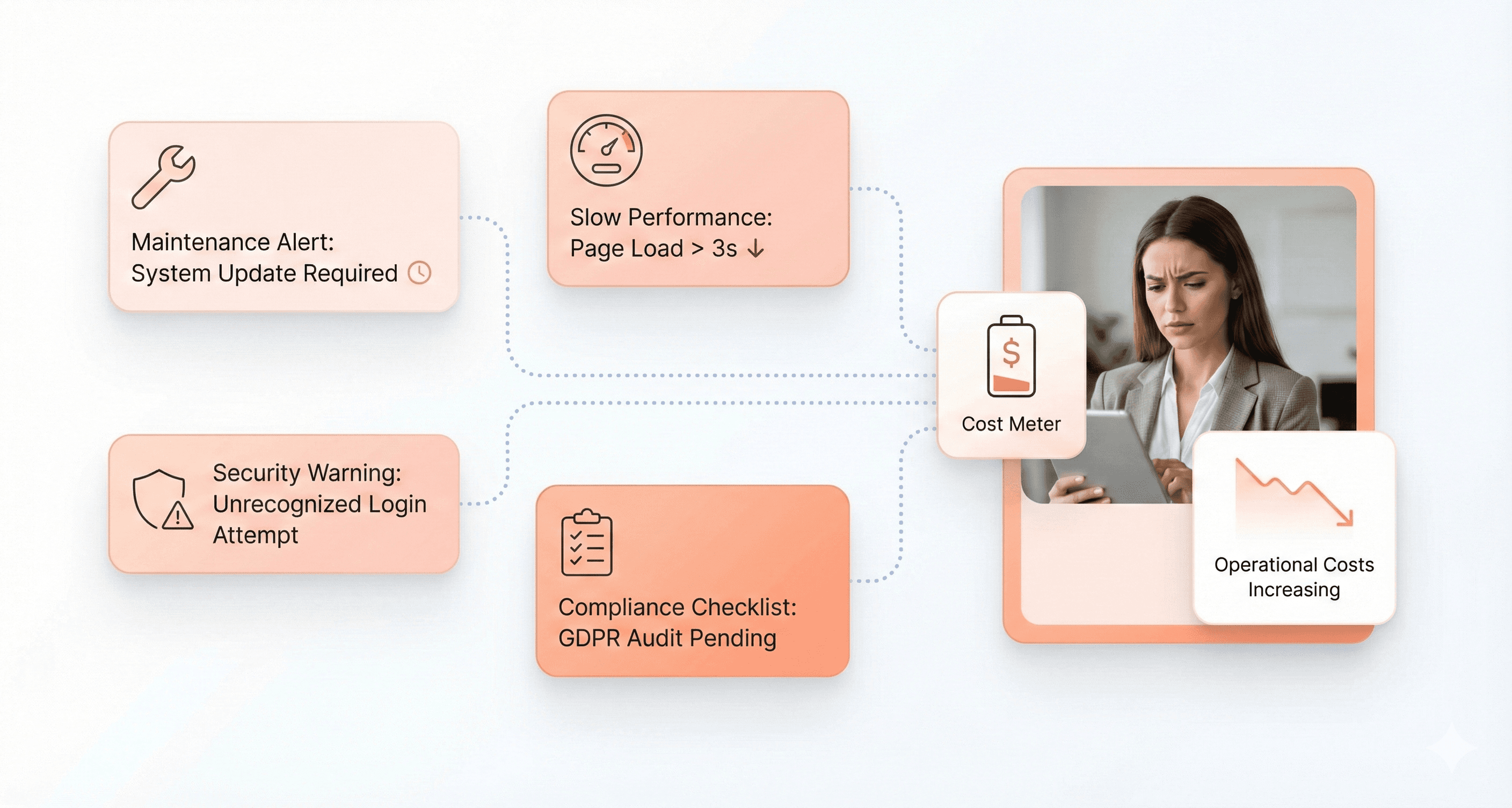
Legacy systems often pose significant security vulnerabilities and compliance challenges that can expose organizations to substantial risks. Older systems frequently lack support and updates from their original vendors, leaving them susceptible to cyber-attacks and security breaches. These systems may not receive critical security patches, making them attractive targets for malicious actors seeking to exploit known vulnerabilities.
The security risks associated with legacy systems extend beyond technical vulnerabilities to include compliance issues with evolving industry regulations and standards. Many legacy systems were designed before current security frameworks and compliance requirements were established, making it difficult to meet modern regulatory standards without substantial modifications or replacements.
Organizations maintaining legacy systems face increasing pressure to demonstrate compliance with data protection regulations, industry standards, and security requirements. The inability to implement modern security measures or provide adequate audit trails can result in regulatory violations, financial penalties, and reputational damage. Enhanced security and compliance capabilities become crucial for protecting sensitive data and avoiding potential breaches that could have devastating consequences for business operations and customer trust.
Essential Legacy Modernization Terminology for Business Leaders
Legacy Modernization vs Legacy Transformation vs Legacy Migration
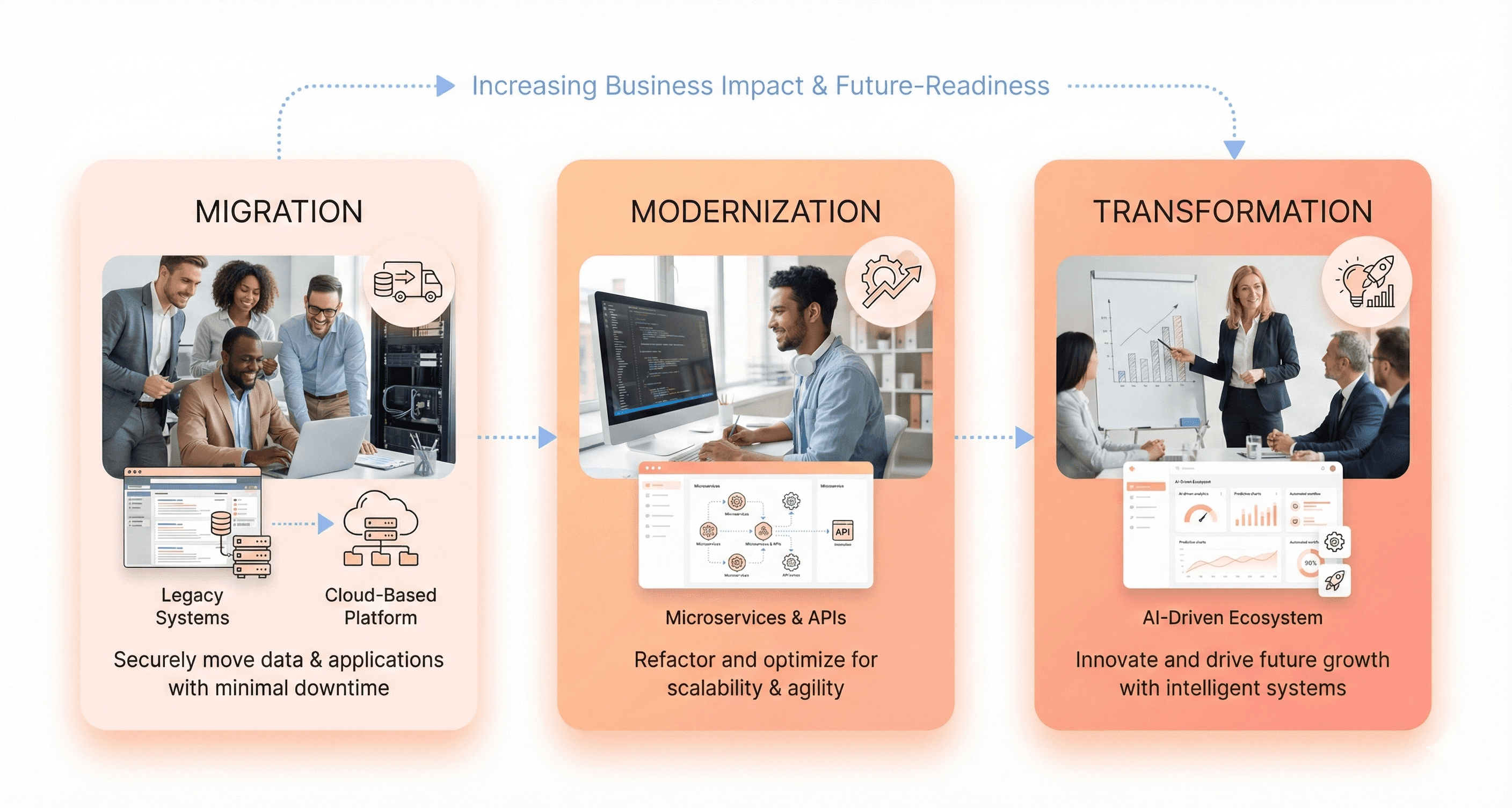
While these terms are often used interchangeably, understanding their distinct meanings is crucial for founders making strategic technology decisions. Legacy modernization represents the broadest approach, encompassing a range of strategies to revitalize outdated systems to align with current industry standards and evolving business needs. This process doesn't necessarily mean complete replacement but rather involves improving performance, scalability, security, and maintainability while leveraging existing investments.
Legacy transformation typically refers to more comprehensive changes that fundamentally alter how systems operate, often involving rearchitecting or rebuilding applications with modern design patterns and technologies. This approach usually results in significant improvements in agility and innovation capabilities but requires more substantial investment and risk management.
Legacy migration, in contrast, focuses primarily on moving systems from one environment to another, such as from on-premises infrastructure to cloud platforms—with minimal changes to the underlying code and functionality. This "lift and shift" approach, also known as rehosting, can provide immediate benefits like improved infrastructure and scalability while maintaining familiar system behavior.
Technical Debt and Its Impact on Business Operations
Technical debt represents one of the most significant challenges in legacy modernization. This metaphor refers to the consequences of choosing quick solutions over comprehensive approaches, creating a trade-off between short-term gains and long-term costs. Like financial debt, technical debt accumulates interest over time, making systems increasingly difficult and expensive to maintain.
Technical debt occurs when development teams make deliberate or unintentional decisions to take shortcuts or compromise code quality to meet immediate development goals or deadlines. These shortcuts result in poor code quality, workarounds that don't address root causes, and systems that become increasingly rigid and difficult to modify.
The business impact of technical debt is substantial. Legacy applications often suffer from knowledge silos, where critical system understanding is concentrated among a few individuals. When these employees leave, their successors may struggle to understand poorly written and annotated legacy code, blocking progress on necessary changes. This creates operational bottlenecks and increases the risk of system failures.
Organizations can address technical debt through several strategies: prioritizing reduction by restructuring and refactoring legacy code to make it more maintainable, transitioning to cloud-native systems to enhance scalability and cost-effectiveness, and embracing DevOps methodology to automate and integrate development and operations efforts. This systematic approach to debt reduction creates a foundation for more agile and responsive business operations.
Cloud-Native Architecture and Infrastructure Concepts
Cloud-native architecture offers more than just modern hosting—it provides architectural capabilities that enable specific modernization patterns impossible with traditional infrastructure. These platforms deliver three key modernization capabilities that directly support legacy transformation initiatives.
First, cloud-native systems enable incremental data synchronization through patterns like event sourcing and change data capture. This allows organizations to maintain legacy systems while building modern consumers of their data, creating a bridge between old and new architectures without disrupting ongoing operations.
Second, service mesh integration facilitates gradual traffic migration between legacy and modernized systems while maintaining unified observability across the entire infrastructure. This capability is crucial for organizations implementing the strangler fig pattern, where new functionality gradually replaces legacy components without system-wide disruption.
Third, cloud-native platforms support stateful workload migration through storage abstraction and session state externalization. This enables organizations to move complex, data-dependent applications to modern infrastructure while preserving critical business state and user sessions.
The shift to cloud and hybrid infrastructure also supports microservices architecture, where large, monolithic applications are decomposed into smaller, independent components or services. This modular approach enhances maintainability, scalability, and development velocity while enabling teams to update individual services without affecting the entire system.
Application vs Platform vs Data Modernization Distinctions
Understanding the distinctions between these three modernization approaches is essential for developing a comprehensive modernization strategy. Each addresses different layers of the technology stack and requires specific expertise and planning considerations.
Application modernization focuses on updating software applications themselves, involving strategies like refactoring existing code, rearchitecting system design, or completely rebuilding applications with modern frameworks and programming languages. This approach primarily addresses business logic, user interfaces, and application-specific functionality. The goal is to improve application performance, maintainability, and user experience while preserving critical business functionality.
Platform modernization encompasses the underlying infrastructure and runtime environments that support applications. This includes updating hardware infrastructure from bare-metal servers to cloud environments, modernizing runtime components like web servers and application servers, and upgrading development frameworks for web applications, business logic, and database connectivity. Platform modernization often enables application modernization by providing more flexible, scalable, and secure foundation layers.
Data modernization addresses how organizations store, process, and access their information assets. Legacy systems often store data in silos, making it difficult to extract meaningful insights or ensure consistency across systems. Data modernization involves migrating from outdated database technologies to modern data platforms, implementing data integration strategies to break down silos, and establishing data governance frameworks to ensure accuracy, security, and compliance.
These three approaches are interconnected and often require coordinated implementation. For example, modernizing applications may necessitate platform upgrades to support new technologies, while data modernization enables applications to deliver enhanced analytics and business intelligence capabilities. Successful modernization initiatives typically address all three dimensions through a carefully orchestrated strategy that considers dependencies and business priorities.
Strategic Approaches to Legacy System Transformation
The Seven R's Framework for Modernization Planning
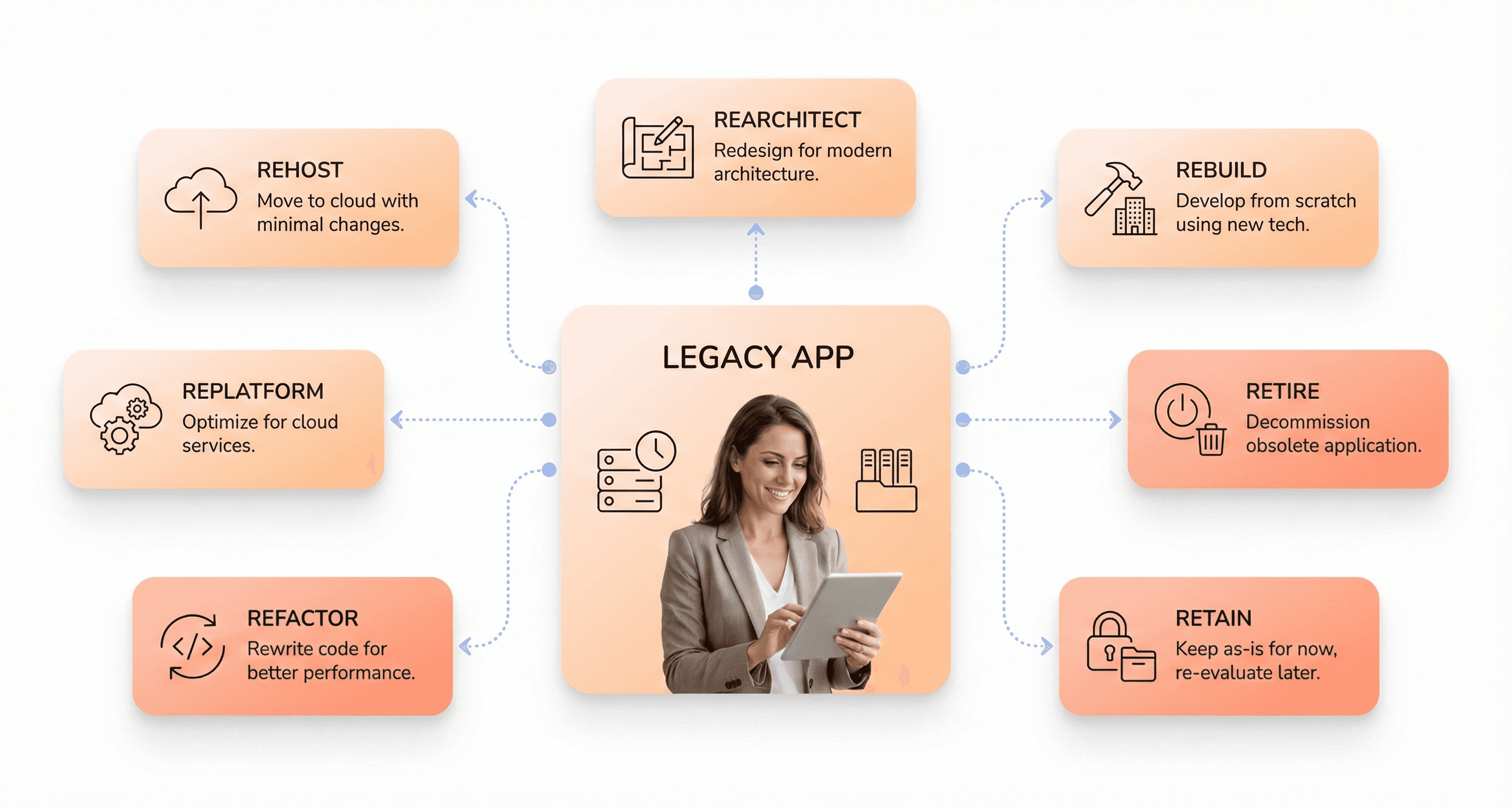
The Seven R's framework provides a comprehensive approach to legacy modernization, offering multiple pathways for transforming outdated systems. This strategic framework encompasses seven distinct approaches: rehost, refactor, replatform, re-architect, rebuild, retire, and retain. Each approach presents unique benefits and challenges that organizations must carefully evaluate based on their specific circumstances.
Rehosting involves redeploying applications to new infrastructures without altering their code, offering quick implementation and cost savings. However, this approach may not address underlying issues within the application itself. Refactoring focuses on restructuring existing code to enhance performance and maintainability while preserving external behavior, effectively reducing technical debt. Studies reveal that engineers spend about 33% of their time addressing technical debt, underscoring the necessity for effective refactoring strategies.
Rebuilding entails rethinking and rewriting applications from scratch, allowing organizations to leverage modern technology stacks and development practices. While this approach can yield significant long-term benefits, it also comes with higher costs and risks. Organizations must assess their legacy systems considering key factors such as cost, complexity, and business impact to identify the most appropriate upgrade strategy. Expert opinions emphasize that a strategic, phased approach to updating can minimize disruptions and provide consistent business value.
Replatforming for Quick Cloud Migration Benefits
Replatforming represents a strategic approach that involves taking legacy applications and moving them to a newer platform, typically the cloud, without making major code changes. This methodology delivers improved scalability, cuts infrastructure costs, and boosts performance significantly. Many businesses choose this path when they want to get their legacy apps cloud-ready while keeping existing functionality intact.
The cloud migration trend underscores the importance of this approach, with statistics showing that 83% of mid-sized businesses have moved over half of their workloads to the cloud. Google Cloud offers a comprehensive suite of tools and services tailored for modernization through cloud technologies, empowering organizations to achieve enhanced scalability, flexibility, and cost efficiency.
With Google Cloud's robust infrastructure, businesses can gradually transition their traditional setups, adopting a hybrid model that integrates both on-premises and cloud solutions. Platforms like Google Kubernetes Engine facilitate legacy modernization by enabling the containerization of legacy applications, thereby boosting their agility and manageability. This cloud-first strategy not only facilitates legacy modernization by revitalizing outdated frameworks but also enables organizations to harness cutting-edge technologies such as AI and machine learning.
However, meticulous planning prior to migration is essential for ensuring a seamless transition. The global cloud market projected to reach $732 billion by the end of 2025 highlights the critical importance of strategic replatforming initiatives.
Re-architecting for Long-term Scalability and Performance
Re-architecting becomes the optimal strategy when legacy application architecture is so outdated that it cannot work effectively with modern frameworks. This comprehensive approach involves restructuring applications to embrace cloud-native architectures, microservices, or containerization, resulting in faster development cycles and smoother integration with contemporary tools.
This transformation approach focuses on fundamental changes to system architecture rather than surface-level modifications. Organizations pursuing re-architecting can leverage advanced technologies and modern development practices that weren't available when their original systems were built. The process enables businesses to break away from monolithic structures and adopt more flexible, scalable architectures.
Re-architecting supports the implementation of cloud-native designs, allowing organizations to build modular, container-based applications that scale dynamically, integrate seamlessly with modern services, and adapt easily to changing business requirements. This approach positions companies to capitalize on emerging technologies like AI-driven automation and advanced analytics capabilities.
While re-architecting demands more time and investment compared to other approaches like replatforming, the long-term benefits include enhanced system performance, improved scalability, and greater flexibility to accommodate future business needs. Organizations must carefully evaluate their current system limitations and future growth plans to determine if re-architecting aligns with their strategic objectives.
Refactoring Code Without Changing Business Logic
Legacy code modernization through refactoring focuses on cleaning up and restructuring existing code without changing what it actually does. This precision approach works particularly well for applications that function properly but have performance issues or are difficult to maintain. Refactoring differs significantly from rewriting legacy applications, which involves starting completely from scratch while keeping the business logic intact.
The refactoring process involves improving code structure, readability, and maintainability while preserving the application's external behavior and functionality. This approach proves especially valuable when organizations need to address technical debt without disrupting critical business operations. The structured methodology ensures that essential business processes remain intact throughout the modernization process.
Refactoring enables organizations to enhance system performance and reduce maintenance complexity without the risks associated with complete system rewrites. This approach allows development teams to improve code quality incrementally, making applications more maintainable and easier to extend with new features.
Organizations implementing refactoring strategies can benefit from improved system reliability, reduced maintenance costs, and enhanced developer productivity. The approach supports better integration capabilities with modern tools and frameworks while maintaining the valuable business logic that has been refined over years of operation. Any refactoring effort should be closely aligned with business objectives to support business growth and ensure that improvements deliver measurable value to the organization.
Technology Stack Powering Modern Application Development
Cloud Platforms and Infrastructure as a Service Benefits
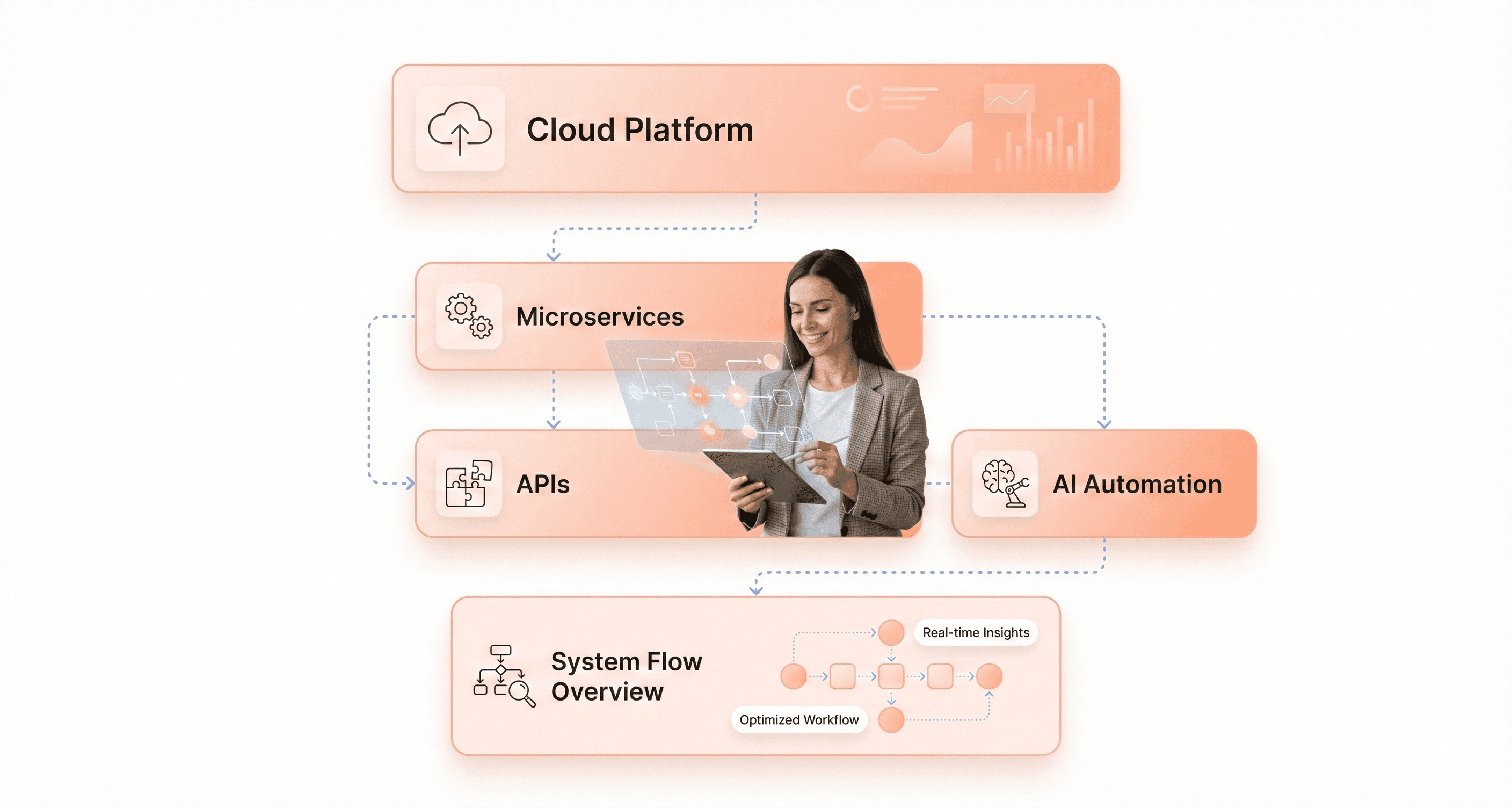
Cloud computing provides the foundational infrastructure that powers modern application development, offering organizations a scalable and flexible platform to host applications and services. The major cloud service providers—Amazon Web Services (AWS), Microsoft Azure, and Google Cloud Platform (GCP)—deliver comprehensive Infrastructure as a Service (IaaS) capabilities that eliminate the need for complex on-premises infrastructure management.
Fully managed, cloud-based databases represent one of the most significant advantages of cloud platforms. These services provide limitless scale, low-latency access to rich data, and advanced data protection, all built in, regardless of programming languages or frameworks. Organizations can choose the data models, APIs, storage structures, and deployment options that best fit their application patterns without handling complex database infrastructure and security management.
Cloud-native architecture enables organizations to act on new ideas more often, respond to changing needs faster, and run resilient and scalable applications more easily. The elastic and always-on nature of cloud databases supports business continuity and improves responsiveness to changing environments while helping operations comply with consistent availability and latency goals. This approach significantly reduces the total cost of ownership by eliminating the heavy lifting tasks of traditional database management.
Microservices Architecture for Improved Flexibility
Previously, legacy applications were built using monolithic architectures that made changes difficult and risky. Microservices architecture represents a fundamental shift in how modern applications are designed, emphasizing the breakdown of applications into small, independent services that can be developed, deployed, and scaled independently.
By packaging application code and dependencies in containers and deploying them as microservices, organizations increase architectural portability to deploy applications across environments with little or no modification. This approach allows changes to be made to individual components with lower risk to the whole application, dramatically improving development agility and system reliability.
Kubernetes helps manage containers at scale, providing the orchestration layer needed for microservices deployments. Organizations can increase release velocity and operational scalability by using DevOps processes and tools to automate build, test, and delivery of microservices. This containerized approach makes applications more resilient to failures, as issues in one microservice don't necessarily affect the entire application ecosystem.
The microservices architecture also enables teams to work more independently, as different services can be developed using different technologies and programming languages, allowing organizations to choose the best tools for specific tasks rather than being locked into a single technology stack.
API Integration and Data Accessibility Solutions
Now that we have covered the infrastructure and architectural foundations, let's examine how modern applications achieve seamless integration and data accessibility. Modern integrations using out-of-the-box connectors and APIs help organizations become more productive, access data easily, and keep disparate systems up to date in real time.
Connectors are ready-made integrations that make it easier to connect apps with software as a service, systems, and data anywhere—whether on-premises or in the cloud. These pre-built solutions eliminate the need for custom integration development, significantly reducing implementation time and complexity.
Lightweight APIs enable integration with protocols like REST and OAuth, simplifying data retrieval and sharing between services without requiring heavier message bus architectures. Organizations can tap into APIs that already exist within their enterprise and expose them securely through a gateway with hybrid capabilities to access APIs at the edge, on-premises, or in other clouds.
This API-first approach creates a more connected ecosystem where different applications and services can communicate seamlessly, enabling real-time data synchronization and improved business process automation. The result is a more agile IT environment that can adapt quickly to changing business requirements.
AI-Assisted Development and Automation Tools
With the foundation of cloud infrastructure, microservices, and API integration in place, AI-powered capabilities represent the next frontier in modern application development. AI can be infused into both the user interface and business logic application layers to enhance user experiences and deepen business insights.
For user interfaces, organizations can engage audiences globally by adding translation, chatbots, and voice capabilities for AI-enabled interactions. On the business logic side, AI enhances applications with capabilities for search, personalization, document processing, image analytics, anomaly detection, and speech analytics.
Modern application development platforms enable developers of all skill levels to easily add AI capabilities to their applications using prebuilt and customizable AI models for speech, vision, language, and decision-making. This democratization of AI technology means that organizations don't need specialized AI expertise to incorporate intelligent features into their applications.
Maximizing automation in operations becomes crucial as environments grow increasingly complex. Automated logging, scaling, and high availability features help improve operational efficiency and identify issues before they affect the customer experience. Rich telemetry, actionable alerting, and full visibility into applications and underlying systems are key components of this AI-assisted approach to modern application development, enabling organizations to respond to incidents with minimal downtime and data loss.
Planning Your Legacy Modernization Project Successfully
Assessment and Discovery Phase Best Practices
The foundation of any successful modernization project begins with comprehensive analysis and architectural observability. Organizations must start with dependency discovery and technical debt assessment to understand their existing systems before making architectural decisions. While static code analysis reveals architectural debt, runtime analysis shows how systems actually behave in production.
A thorough assessment should evaluate the software system's key components: hardware infrastructure (bare-metal servers, on-premise virtualization, cloud, or hybrid setups), runtime environment (web servers, application servers, and database servers), development frameworks, and business logic implementation. This evaluation helps identify dead code, understand traffic patterns, and map all external dependencies along with their potential failure modes.
Modern automated analysis tools can accelerate this discovery process by analyzing codebases to reveal hidden dependencies and structural patterns that would take months to document manually. These platforms provide comprehensive dependency mapping and technical debt identification across both monolithic and distributed applications, dramatically reducing the time and expertise required for manual assessment.
Organizations should also focus on mapping their process landscape before modernizing any code. This involves identifying which systems are authoritative for specific business capabilities, documenting system integrations, and understanding failure scenarios. Legacy systems often create "process debt" where business logic becomes tightly coupled with workflows, making modernization far more complex than simple code updates.
Defining Clear Business Goals and Success Metrics
Before selecting a modernization strategy, organizations must establish clear vision and objectives that align with their competitive landscape needs. The decision to modernize should be driven by specific business drivers: when legacy applications fail to meet today's business requirements, act as impediments to success, drive up total cost of ownership, or introduce undue risk.
Success metrics should encompass multiple dimensions of improvement. Operational efficiency gains can be measured through reduced deployment times, faster response times, and decreased error rates. Cost metrics should track maintenance expenses, infrastructure costs, and resource utilization improvements. Security improvements can be quantified through reduced vulnerabilities, compliance adherence, and incident response times.
Organizations should also define metrics for enhanced agility and innovation capabilities. This includes measuring time-to-market for new features, system scalability improvements, and integration capabilities with modern technologies. Customer experience metrics such as user satisfaction scores, service delivery speed, and omnichannel experience quality provide additional success indicators.
The modernization goals should address specific pain points identified during the assessment phase while considering budget constraints, timeline requirements, and risk tolerance. Success metrics must be realistic, measurable, and tied to business outcomes rather than purely technical achievements.
Choosing Between Gradual Migration and Complete Overhaul
Organizations can choose between gradual modernization approaches and more comprehensive transformation strategies, each with varying degrees of complexity and invasiveness. The selection depends on the legacy system's age and complexity, organizational budgetary constraints, timeline requirements, risk tolerance, and desired transformation level.
Gradual approaches offer lower risk and continuous progress. Encapsulation creates interfaces or APIs around legacy systems, allowing interaction with modern applications without significant changes to existing code. This relatively low-risk strategy provides quick integration wins. Organizations can also implement the strangler fig pattern using API gateways as integration points, gradually replacing legacy functionality while maintaining existing interfaces.
Rehosting or "lift and shift" strategies migrate applications to newer platforms like cloud infrastructure while keeping legacy code largely intact. Replatforming involves similar migration but with code adjustments to leverage new platform capabilities. These approaches offer immediate infrastructure and scalability benefits with moderate complexity.
More comprehensive strategies include refactoring (restructuring existing code without changing external behavior), rearchitecting (redesigning system architecture to leverage modern technologies), and complete rebuilding or replacement. While these approaches are more expensive and time-consuming, they offer greater flexibility and innovation potential.
Many organizations adopt hybrid approaches, combining different strategies to address specific system aspects. This might involve encapsulating some components, rehosting others, and refactoring critical modules based on their individual requirements and business value.
Risk Mitigation Strategies for Business Continuity
Legacy modernization projects require careful risk management to ensure business continuity throughout the transformation process. Organizations must address complexity risks inherent in poorly documented, intertwined legacy systems by visualizing functional domains, interdependencies, and potential failure points.
A phased approach reduces risk by breaking modernization projects into smaller, manageable phases that ensure continuous progress. Risk-based prioritization helps organizations plot components against business criticality and technical risk. Components scoring high in both areas should be encapsulated first rather than rewritten, as the risk of introducing new problems often outweighs clean code benefits.
Data migration presents significant risks requiring thorough planning, validation, and testing. Organizations must ensure data accuracy, consistency, and security during transitions while planning seamless integration with existing systems. Database changes are particularly risky because they're complex to reverse and limit iteration opportunities.
Change management strategies address resistance from employees accustomed to legacy systems. Effective communication, training, and stakeholder engagement help overcome resistance and ensure user adoption. Technical risk mitigation includes establishing continuous architectural observability to monitor dependency drift, performance regressions, and security boundary violations.
Organizations should also consider regulatory and compliance requirements, particularly in industries like finance and healthcare with strict data management, security, and privacy regulations. Modernization projects must maintain compliance to avoid legal and financial repercussions while achieving transformation objectives.
Cost Considerations and ROI Expectations for Modernization
Initial Investment vs Long-term Operational Savings
The upfront costs of legacy modernization can appear daunting, but understanding the long-term operational savings reveals the true value proposition. Direct modernization investments typically include system upgrade or migration costs, application replatforming or refactoring expenses, hardware or cloud migration costs, licensing fees for new software, and external vendor or consulting services. Additionally, indirect costs encompass staff training, documentation development, temporary productivity dips during transition, and data migration efforts.
However, these initial expenses must be weighed against substantial operational savings. Organizations commonly see 50-90% reduction in annual operating expenses (OPEX) when moving from mainframes to cloud environments. For example, a company spending $270,000 annually on maintenance, downtime, and productivity losses can achieve $180,000 in yearly savings post-modernization, leading to clear net value within 3-4 years.
The cost structure shifts dramatically after modernization. Mainframe MIPS (million instructions per second) pricing, which can average $1,600 per installed MIPS annually, gets replaced by more predictable cloud consumption models. An 11,000 MIPS machine costing approximately $17.6 million annually can see 50-90% cost reductions through strategic modernization approaches.
Hidden Costs of Legacy System Maintenance
Legacy systems harbor numerous hidden costs that organizations often underestimate until conducting thorough analysis. The most significant hidden cost driver is the escalating expense of specialized skills. Legacy skill sets such as COBOL and PL/I programming are becoming increasingly rare and expensive, with businesses spending up to 100% more on average for obsolete licensing, maintenance, and narrow-expertise hiring costs.
Integration barriers represent another substantial hidden cost. Legacy systems were never built for cloud environments, APIs, AI/ML pipelines, or modern DevOps practices, creating bottlenecks that slow innovation and increase operational complexity. These systems demand more maintenance over time, struggle with scalability requirements, and become risk magnets for security vulnerabilities and compliance issues.
The cost of inaction often exceeds modernization investment. Organizations continuing to operate legacy systems face rising technical debt, employee frustration due to outdated tools, compliance exposure in regulated industries, and brittle infrastructure that becomes increasingly difficult to maintain. Downtime-related costs, vendor dependency issues, and loss of competitive advantage compound these hidden expenses, making the true cost of maintaining legacy systems far higher than initial assessments suggest.
Measuring Success Through Performance and Efficiency Gains
Tracking meaningful metrics is essential for validating modernization ROI and ensuring alignment between targets and execution. Key performance indicators fall into several critical categories that demonstrate tangible value creation.
Productivity improvement metrics include faster development cycles, shorter onboarding periods for engineers, and faster resolution of technical issues. Organizations typically see significant gains in developer productivity as modern platforms eliminate many of the constraints and inefficiencies associated with legacy systems.
Downtime reduction represents one of the most measurable benefits. Tracking outage hours per month, SLA consistency, and reduced business disruption provides clear evidence of improved system reliability. Many organizations report dramatic improvements in system uptime after modernization, directly translating to reduced revenue loss and improved customer satisfaction.
Maintenance cost reduction manifests through lower vendor fees, reduced internal support time requirements, and infrastructure optimization. Cloud-native automation features like automated patching, auto-scaling, and auto-healing reduce operational overhead and manual intervention needs, leading to predictable and lower support expenses over time.
Customer satisfaction improvements can be measured through Net Promoter Score (NPS) enhancements, faster response times, and reduced transaction errors. These metrics help demonstrate how technical improvements translate into business value and competitive advantage.
Timeline Expectations for Different Modernization Approaches
The timeline for seeing ROI varies significantly based on the chosen modernization approach, with each strategy offering different risk-reward profiles and investment horizons.
Rehosting (Lift-and-Shift) offers the fastest path to initial cost savings, typically showing ROI within 12-24 months. This approach transfers existing mainframe applications to cloud-hosted environments without architectural changes, providing immediate relief from escalating mainframe costs while minimizing downtime risk. However, while rehosting delivers quick wins, it may limit long-term agility gains.
Replatforming requires a moderate timeline, typically 18-36 months to full ROI realization. This approach involves moving applications to modern runtime environments while making selective code modifications to support new databases, operating systems, and compilers. The balanced approach between risk and benefit makes replatforming attractive for organizations seeking improved performance and integration capabilities without complete architectural overhaul.
Refactoring and Re-architecting demands the longest investment horizon, often 24-48 months for full ROI materialization, but offers the highest potential returns. This comprehensive approach involves converting legacy code to modern languages, adopting microservices architectures, and implementing cloud-native features. While requiring significant initial investment, refactoring provides maximum agility, scalability, and innovation capacity for long-term competitive advantage.
Most organizations begin seeing operational improvements within the first year regardless of approach, but sustainable ROI typically emerges after teams adapt to new tools and processes, making change management and training critical success factors for any timeline.
Selecting the Right Modernization Partner and Services
Key Capabilities to Look for in Service Providers
When evaluating legacy modernization partners, organizations must assess critical capabilities that distinguish successful providers from generalists. The most effective modernization companies demonstrate proficiency across multiple transformation approaches, encapsulation, rehosting, replatforming, refactoring, and rebuilding—allowing them to recommend the optimal strategy for your specific systems.
AI-Powered Automation Tools represent a fundamental differentiator. Leading providers leverage advanced platforms that accelerate analysis, migration, and testing phases significantly. Look for demonstrations of AI-based code analyzers, migration dashboards, and automated test suites, as mature tooling can compress migration timelines and reduce defect rates substantially.
Comprehensive Change Management capabilities extend beyond technical execution. Successful modernization requires providers who offer training programs, communications planning, and key performance indicator frameworks that connect technical outputs to measurable business outcomes. This holistic approach ensures sustained user adoption and organizational transformation.
Phased Value Delivery methodology demonstrates a provider's understanding that modernization isn't a one-time event. Insist on partners who can deliver incremental benefits—cost reduction, performance gains, or new digital capabilities—each quarter, maintaining executive support while mitigating project risks throughout the transformation journey.
Industry-Specific Expertise and Compliance Requirements
Now that we understand core capabilities, industry specialization becomes crucial for regulated environments and complex business domains. Providers with deep vertical knowledge can navigate sector-specific challenges that generic modernization approaches often overlook.
Regulated Industries require partners who understand compliance frameworks and can maintain regulatory adherence throughout transformation. Healthcare, financial services, and government sectors demand providers experienced with HIPAA, SOX, PCI-DSS, and other regulatory requirements. These partners ensure that modernized systems meet or exceed current compliance standards while improving operational efficiency.
Domain-Specific Accelerators distinguish industry specialists from general service providers. Leading companies develop vertical-specific frameworks, pre-built integrations, and proven methodologies tailored to particular business models. For example, retail banks require different modernization approaches than manufacturing companies or healthcare systems.
High-Availability Environments present unique challenges that demand specialized expertise. Providers working in mission-critical sectors must demonstrate experience with zero-downtime migrations, parallel system operations, and rollback procedures that protect business continuity throughout the modernization process.
Regional Considerations for Global Modernization Projects
With industry expertise established, global enterprises must evaluate how regional factors impact modernization success. Data sovereignty, local regulations, and cultural considerations significantly influence provider selection and project execution strategies.
Data Residency Requirements vary significantly across jurisdictions, affecting cloud migration strategies and system architecture decisions. European GDPR compliance, Chinese data localization laws, and similar regulations require providers with regional expertise who can design solutions that maintain compliance while achieving modernization objectives.
Time Zone Alignment impacts collaboration effectiveness and project velocity. Consider providers who offer regional delivery centers or have established nearshore partnerships that enable real-time collaboration during critical project phases. This becomes particularly important for organizations requiring frequent stakeholder involvement or rapid issue resolution.
Cultural and Communication Factors influence project success rates significantly. Providers with strong regional presence understand local business practices, communication styles, and organizational dynamics that can accelerate adoption and reduce change resistance within global teams.
Evaluating Vendor Track Records and Case Studies
Previously, we've covered capabilities and regional factors, but proven results provide the most reliable indicator of modernization success. Thorough evaluation of vendor track records reveals actual performance against promises and helps predict likely outcomes for your transformation initiative.
Quantifiable Success Metrics should feature prominently in case studies. Look for specific achievements like processing speed improvements, cost reduction percentages, and timeline adherence rates. For instance, successful providers demonstrate results such as 30% faster processing, 25% cost savings, or 40% reduction in data errors across similar modernization projects.
Complexity Alignment ensures the provider can handle your specific challenges. Evaluate case studies that match your system complexity, data volume, and integration requirements. Providers who have successfully modernized similar architectures or handled comparable transaction volumes offer higher probability of success for your initiative.
Client Reference Accessibility indicates provider confidence and client satisfaction levels. Request direct conversations with reference clients who have completed similar modernization projects. These discussions reveal practical insights about communication quality, problem-solving approaches, and post-implementation support that case studies cannot fully capture.
Long-term Partnership Evidence demonstrates commitment beyond project completion. Evaluate whether providers maintain ongoing relationships with modernized clients, offering continuous optimization services that ensure sustained value delivery and system evolution as business requirements change.
Conclusion
Legacy modernization represents more than just a technical upgrade, it's a comprehensive business transformation that positions your organization for long-term success. Throughout this guide, we've explored the essential terminology, strategic approaches, and key considerations that founders need to understand when embarking on their modernization journey. From understanding the differences between replatforming, re-architecting, and refactoring to navigating cost considerations and selecting the right technology stack, these foundational concepts provide the framework for making informed decisions about your legacy systems.
The modernization landscape continues evolving rapidly, with AI-assisted development, automation-driven migration, and cloud-native architectures reshaping how businesses approach transformation. Whether you choose a lift-and-shift strategy for quick cloud migration or pursue a complete rebuild for maximum flexibility, success depends on aligning your chosen approach with your business goals, budget, and timeline. Remember that legacy modernization isn't a one-time event, it's an ongoing journey that requires careful planning, the right partnerships, and a commitment to continuous improvement. By investing in modernization today, you're not just solving current technical challenges; you're building the foundation for future innovation, enhanced security, and sustainable growth in an increasingly digital world.
Founders of growing companies face a critical challenge: outdated software systems that can't keep pace with business demands. Legacy modernization terms flood your conversations with CTOs, consultants, and vendors, but the jargon often clouds the real decisions you need to make.
This guide breaks down the essential legacy modernization terminology every founder should know. We'll walk through key concepts that impact your bottom line, explain strategic approaches that fit different business stages, and decode the technology stack options powering modern applications today.
You'll discover what terms like "replatforming" and "microservices architecture" actually mean for your company's growth trajectory, plus learn how to evaluate modernization costs against potential returns on investment.
Understanding Legacy Systems and Why They Need Modernization
What Legacy Systems Are and Common Examples Across Industries
Legacy systems refer to old technology or computer systems that continue to be used by organizations despite the availability of newer alternatives. These systems often support critical business processes but are based on outdated hardware or software, which makes maintenance challenging and costly. Legacy systems can be deeply integrated into a company's core operations, representing significant infrastructure investments that organizations have accumulated over years of operation.
These aging systems are characterized by their use of obsolete programming languages, outdated architectures, and technologies that may no longer receive vendor support or security updates. Despite their limitations, legacy systems frequently handle mission-critical functions that businesses depend on for daily operations, making them difficult to replace without careful planning and substantial investment.
Why Companies Still Rely on Outdated Technology
The reliance on aged technologies persists mainly due to the investment in their infrastructure and the potential risk and disruption associated with migrating to new systems. Organizations often defer upgrading or replacing legacy systems due to concerns about business continuity and the complex dependencies these systems have developed within their operational framework.
Legacy systems become deeply embedded within an organization's operations over time, creating intricate architectures with numerous dependencies on other systems and processes. This complexity means that upgrading or replacing one component can have unforeseen impacts across the entire IT landscape. Many of these systems have accumulated a tangled web of customizations over the years, making modernization efforts increasingly complex.
Additionally, as technology evolves, expertise in older systems becomes scarce, with fewer IT professionals proficient in outdated programming languages and architectures. This scarcity of skilled personnel makes it challenging and costly to find individuals capable of maintaining, troubleshooting, and upgrading legacy applications, further encouraging organizations to retain their existing systems rather than face the difficulties of finding qualified experts.
The Hidden Costs of Maintaining Legacy Infrastructure
Maintaining legacy systems typically requires significant financial investment that extends far beyond the initial implementation costs. These systems demand constant patches, fixes, and workarounds to keep them functional, creating an ongoing drain on IT resources and budgets. The expense of supporting outdated technology often exceeds the cost of modern alternatives when calculated over time.
Legacy systems are expensive to maintain due to their need for specialized hardware, custom software solutions, and skilled professionals who understand outdated technologies. As these systems age, finding replacement parts for obsolete hardware becomes increasingly difficult and costly. Organizations must often maintain inventory of spare components or pay premium prices for discontinued equipment when failures occur.
The operational inefficiencies of legacy systems also contribute to hidden costs through reduced productivity and slower response times. Modern systems typically require less maintenance and fewer resources to operate efficiently, which translates into reduced operational costs over time. Despite the initial investment required for modernizing legacy systems, the long-term savings can be significant when compared to the escalating costs of maintaining outdated infrastructure.

Security Risks and Compliance Challenges of Aging Systems
Legacy systems often pose significant security vulnerabilities and compliance challenges that can expose organizations to substantial risks. Older systems frequently lack support and updates from their original vendors, leaving them susceptible to cyber-attacks and security breaches. These systems may not receive critical security patches, making them attractive targets for malicious actors seeking to exploit known vulnerabilities.
The security risks associated with legacy systems extend beyond technical vulnerabilities to include compliance issues with evolving industry regulations and standards. Many legacy systems were designed before current security frameworks and compliance requirements were established, making it difficult to meet modern regulatory standards without substantial modifications or replacements.
Organizations maintaining legacy systems face increasing pressure to demonstrate compliance with data protection regulations, industry standards, and security requirements. The inability to implement modern security measures or provide adequate audit trails can result in regulatory violations, financial penalties, and reputational damage. Enhanced security and compliance capabilities become crucial for protecting sensitive data and avoiding potential breaches that could have devastating consequences for business operations and customer trust.
Essential Legacy Modernization Terminology for Business Leaders
Legacy Modernization vs Legacy Transformation vs Legacy Migration
While these terms are often used interchangeably, understanding their distinct meanings is crucial for founders making strategic technology decisions. Legacy modernization represents the broadest approach, encompassing a range of strategies to revitalize outdated systems to align with current industry standards and evolving business needs. This process doesn't necessarily mean complete replacement but rather involves improving performance, scalability, security, and maintainability while leveraging existing investments.
Legacy transformation typically refers to more comprehensive changes that fundamentally alter how systems operate, often involving rearchitecting or rebuilding applications with modern design patterns and technologies. This approach usually results in significant improvements in agility and innovation capabilities but requires more substantial investment and risk management.
Legacy migration, in contrast, focuses primarily on moving systems from one environment to another, such as from on-premises infrastructure to cloud platforms—with minimal changes to the underlying code and functionality. This "lift and shift" approach, also known as rehosting, can provide immediate benefits like improved infrastructure and scalability while maintaining familiar system behavior.

Technical Debt and Its Impact on Business Operations
Technical debt represents one of the most significant challenges in legacy modernization. This metaphor refers to the consequences of choosing quick solutions over comprehensive approaches, creating a trade-off between short-term gains and long-term costs. Like financial debt, technical debt accumulates interest over time, making systems increasingly difficult and expensive to maintain.
Technical debt occurs when development teams make deliberate or unintentional decisions to take shortcuts or compromise code quality to meet immediate development goals or deadlines. These shortcuts result in poor code quality, workarounds that don't address root causes, and systems that become increasingly rigid and difficult to modify.
The business impact of technical debt is substantial. Legacy applications often suffer from knowledge silos, where critical system understanding is concentrated among a few individuals. When these employees leave, their successors may struggle to understand poorly written and annotated legacy code, blocking progress on necessary changes. This creates operational bottlenecks and increases the risk of system failures.
Organizations can address technical debt through several strategies: prioritizing reduction by restructuring and refactoring legacy code to make it more maintainable, transitioning to cloud-native systems to enhance scalability and cost-effectiveness, and embracing DevOps methodology to automate and integrate development and operations efforts. This systematic approach to debt reduction creates a foundation for more agile and responsive business operations.
Cloud-Native Architecture and Infrastructure Concepts
Cloud-native architecture offers more than just modern hosting—it provides architectural capabilities that enable specific modernization patterns impossible with traditional infrastructure. These platforms deliver three key modernization capabilities that directly support legacy transformation initiatives.
First, cloud-native systems enable incremental data synchronization through patterns like event sourcing and change data capture. This allows organizations to maintain legacy systems while building modern consumers of their data, creating a bridge between old and new architectures without disrupting ongoing operations.
Second, service mesh integration facilitates gradual traffic migration between legacy and modernized systems while maintaining unified observability across the entire infrastructure. This capability is crucial for organizations implementing the strangler fig pattern, where new functionality gradually replaces legacy components without system-wide disruption.
Third, cloud-native platforms support stateful workload migration through storage abstraction and session state externalization. This enables organizations to move complex, data-dependent applications to modern infrastructure while preserving critical business state and user sessions.
The shift to cloud and hybrid infrastructure also supports microservices architecture, where large, monolithic applications are decomposed into smaller, independent components or services. This modular approach enhances maintainability, scalability, and development velocity while enabling teams to update individual services without affecting the entire system.
Application vs Platform vs Data Modernization Distinctions
Understanding the distinctions between these three modernization approaches is essential for developing a comprehensive modernization strategy. Each addresses different layers of the technology stack and requires specific expertise and planning considerations.
Application modernization focuses on updating software applications themselves, involving strategies like refactoring existing code, rearchitecting system design, or completely rebuilding applications with modern frameworks and programming languages. This approach primarily addresses business logic, user interfaces, and application-specific functionality. The goal is to improve application performance, maintainability, and user experience while preserving critical business functionality.
Platform modernization encompasses the underlying infrastructure and runtime environments that support applications. This includes updating hardware infrastructure from bare-metal servers to cloud environments, modernizing runtime components like web servers and application servers, and upgrading development frameworks for web applications, business logic, and database connectivity. Platform modernization often enables application modernization by providing more flexible, scalable, and secure foundation layers.
Data modernization addresses how organizations store, process, and access their information assets. Legacy systems often store data in silos, making it difficult to extract meaningful insights or ensure consistency across systems. Data modernization involves migrating from outdated database technologies to modern data platforms, implementing data integration strategies to break down silos, and establishing data governance frameworks to ensure accuracy, security, and compliance.
These three approaches are interconnected and often require coordinated implementation. For example, modernizing applications may necessitate platform upgrades to support new technologies, while data modernization enables applications to deliver enhanced analytics and business intelligence capabilities. Successful modernization initiatives typically address all three dimensions through a carefully orchestrated strategy that considers dependencies and business priorities.
Strategic Approaches to Legacy System Transformation
The Seven R's Framework for Modernization Planning
The Seven R's framework provides a comprehensive approach to legacy modernization, offering multiple pathways for transforming outdated systems. This strategic framework encompasses seven distinct approaches: rehost, refactor, replatform, re-architect, rebuild, retire, and retain. Each approach presents unique benefits and challenges that organizations must carefully evaluate based on their specific circumstances.
Rehosting involves redeploying applications to new infrastructures without altering their code, offering quick implementation and cost savings. However, this approach may not address underlying issues within the application itself. Refactoring focuses on restructuring existing code to enhance performance and maintainability while preserving external behavior, effectively reducing technical debt. Studies reveal that engineers spend about 33% of their time addressing technical debt, underscoring the necessity for effective refactoring strategies.
Rebuilding entails rethinking and rewriting applications from scratch, allowing organizations to leverage modern technology stacks and development practices. While this approach can yield significant long-term benefits, it also comes with higher costs and risks. Organizations must assess their legacy systems considering key factors such as cost, complexity, and business impact to identify the most appropriate upgrade strategy. Expert opinions emphasize that a strategic, phased approach to updating can minimize disruptions and provide consistent business value.

Replatforming for Quick Cloud Migration Benefits
Replatforming represents a strategic approach that involves taking legacy applications and moving them to a newer platform, typically the cloud, without making major code changes. This methodology delivers improved scalability, cuts infrastructure costs, and boosts performance significantly. Many businesses choose this path when they want to get their legacy apps cloud-ready while keeping existing functionality intact.
The cloud migration trend underscores the importance of this approach, with statistics showing that 83% of mid-sized businesses have moved over half of their workloads to the cloud. Google Cloud offers a comprehensive suite of tools and services tailored for modernization through cloud technologies, empowering organizations to achieve enhanced scalability, flexibility, and cost efficiency.
With Google Cloud's robust infrastructure, businesses can gradually transition their traditional setups, adopting a hybrid model that integrates both on-premises and cloud solutions. Platforms like Google Kubernetes Engine facilitate legacy modernization by enabling the containerization of legacy applications, thereby boosting their agility and manageability. This cloud-first strategy not only facilitates legacy modernization by revitalizing outdated frameworks but also enables organizations to harness cutting-edge technologies such as AI and machine learning.
However, meticulous planning prior to migration is essential for ensuring a seamless transition. The global cloud market projected to reach $732 billion by the end of 2025 highlights the critical importance of strategic replatforming initiatives.
Re-architecting for Long-term Scalability and Performance
Re-architecting becomes the optimal strategy when legacy application architecture is so outdated that it cannot work effectively with modern frameworks. This comprehensive approach involves restructuring applications to embrace cloud-native architectures, microservices, or containerization, resulting in faster development cycles and smoother integration with contemporary tools.
This transformation approach focuses on fundamental changes to system architecture rather than surface-level modifications. Organizations pursuing re-architecting can leverage advanced technologies and modern development practices that weren't available when their original systems were built. The process enables businesses to break away from monolithic structures and adopt more flexible, scalable architectures.
Re-architecting supports the implementation of cloud-native designs, allowing organizations to build modular, container-based applications that scale dynamically, integrate seamlessly with modern services, and adapt easily to changing business requirements. This approach positions companies to capitalize on emerging technologies like AI-driven automation and advanced analytics capabilities.
While re-architecting demands more time and investment compared to other approaches like replatforming, the long-term benefits include enhanced system performance, improved scalability, and greater flexibility to accommodate future business needs. Organizations must carefully evaluate their current system limitations and future growth plans to determine if re-architecting aligns with their strategic objectives.
Refactoring Code Without Changing Business Logic
Legacy code modernization through refactoring focuses on cleaning up and restructuring existing code without changing what it actually does. This precision approach works particularly well for applications that function properly but have performance issues or are difficult to maintain. Refactoring differs significantly from rewriting legacy applications, which involves starting completely from scratch while keeping the business logic intact.
The refactoring process involves improving code structure, readability, and maintainability while preserving the application's external behavior and functionality. This approach proves especially valuable when organizations need to address technical debt without disrupting critical business operations. The structured methodology ensures that essential business processes remain intact throughout the modernization process.
Refactoring enables organizations to enhance system performance and reduce maintenance complexity without the risks associated with complete system rewrites. This approach allows development teams to improve code quality incrementally, making applications more maintainable and easier to extend with new features.
Organizations implementing refactoring strategies can benefit from improved system reliability, reduced maintenance costs, and enhanced developer productivity. The approach supports better integration capabilities with modern tools and frameworks while maintaining the valuable business logic that has been refined over years of operation. Any refactoring effort should be closely aligned with business objectives to support business growth and ensure that improvements deliver measurable value to the organization.
Technology Stack Powering Modern Application Development

Cloud Platforms and Infrastructure as a Service Benefits
Cloud computing provides the foundational infrastructure that powers modern application development, offering organizations a scalable and flexible platform to host applications and services. The major cloud service providers—Amazon Web Services (AWS), Microsoft Azure, and Google Cloud Platform (GCP)—deliver comprehensive Infrastructure as a Service (IaaS) capabilities that eliminate the need for complex on-premises infrastructure management.
Fully managed, cloud-based databases represent one of the most significant advantages of cloud platforms. These services provide limitless scale, low-latency access to rich data, and advanced data protection, all built in, regardless of programming languages or frameworks. Organizations can choose the data models, APIs, storage structures, and deployment options that best fit their application patterns without handling complex database infrastructure and security management.
Cloud-native architecture enables organizations to act on new ideas more often, respond to changing needs faster, and run resilient and scalable applications more easily. The elastic and always-on nature of cloud databases supports business continuity and improves responsiveness to changing environments while helping operations comply with consistent availability and latency goals. This approach significantly reduces the total cost of ownership by eliminating the heavy lifting tasks of traditional database management.
Microservices Architecture for Improved Flexibility
Previously, legacy applications were built using monolithic architectures that made changes difficult and risky. Microservices architecture represents a fundamental shift in how modern applications are designed, emphasizing the breakdown of applications into small, independent services that can be developed, deployed, and scaled independently.
By packaging application code and dependencies in containers and deploying them as microservices, organizations increase architectural portability to deploy applications across environments with little or no modification. This approach allows changes to be made to individual components with lower risk to the whole application, dramatically improving development agility and system reliability.
Kubernetes helps manage containers at scale, providing the orchestration layer needed for microservices deployments. Organizations can increase release velocity and operational scalability by using DevOps processes and tools to automate build, test, and delivery of microservices. This containerized approach makes applications more resilient to failures, as issues in one microservice don't necessarily affect the entire application ecosystem.
The microservices architecture also enables teams to work more independently, as different services can be developed using different technologies and programming languages, allowing organizations to choose the best tools for specific tasks rather than being locked into a single technology stack.
API Integration and Data Accessibility Solutions
Now that we have covered the infrastructure and architectural foundations, let's examine how modern applications achieve seamless integration and data accessibility. Modern integrations using out-of-the-box connectors and APIs help organizations become more productive, access data easily, and keep disparate systems up to date in real time.
Connectors are ready-made integrations that make it easier to connect apps with software as a service, systems, and data anywhere—whether on-premises or in the cloud. These pre-built solutions eliminate the need for custom integration development, significantly reducing implementation time and complexity.
Lightweight APIs enable integration with protocols like REST and OAuth, simplifying data retrieval and sharing between services without requiring heavier message bus architectures. Organizations can tap into APIs that already exist within their enterprise and expose them securely through a gateway with hybrid capabilities to access APIs at the edge, on-premises, or in other clouds.
This API-first approach creates a more connected ecosystem where different applications and services can communicate seamlessly, enabling real-time data synchronization and improved business process automation. The result is a more agile IT environment that can adapt quickly to changing business requirements.
AI-Assisted Development and Automation Tools
With the foundation of cloud infrastructure, microservices, and API integration in place, AI-powered capabilities represent the next frontier in modern application development. AI can be infused into both the user interface and business logic application layers to enhance user experiences and deepen business insights.
For user interfaces, organizations can engage audiences globally by adding translation, chatbots, and voice capabilities for AI-enabled interactions. On the business logic side, AI enhances applications with capabilities for search, personalization, document processing, image analytics, anomaly detection, and speech analytics.
Modern application development platforms enable developers of all skill levels to easily add AI capabilities to their applications using prebuilt and customizable AI models for speech, vision, language, and decision-making. This democratization of AI technology means that organizations don't need specialized AI expertise to incorporate intelligent features into their applications.
Maximizing automation in operations becomes crucial as environments grow increasingly complex. Automated logging, scaling, and high availability features help improve operational efficiency and identify issues before they affect the customer experience. Rich telemetry, actionable alerting, and full visibility into applications and underlying systems are key components of this AI-assisted approach to modern application development, enabling organizations to respond to incidents with minimal downtime and data loss.
Planning Your Legacy Modernization Project Successfully
Assessment and Discovery Phase Best Practices
The foundation of any successful modernization project begins with comprehensive analysis and architectural observability. Organizations must start with dependency discovery and technical debt assessment to understand their existing systems before making architectural decisions. While static code analysis reveals architectural debt, runtime analysis shows how systems actually behave in production.
A thorough assessment should evaluate the software system's key components: hardware infrastructure (bare-metal servers, on-premise virtualization, cloud, or hybrid setups), runtime environment (web servers, application servers, and database servers), development frameworks, and business logic implementation. This evaluation helps identify dead code, understand traffic patterns, and map all external dependencies along with their potential failure modes.
Modern automated analysis tools can accelerate this discovery process by analyzing codebases to reveal hidden dependencies and structural patterns that would take months to document manually. These platforms provide comprehensive dependency mapping and technical debt identification across both monolithic and distributed applications, dramatically reducing the time and expertise required for manual assessment.
Organizations should also focus on mapping their process landscape before modernizing any code. This involves identifying which systems are authoritative for specific business capabilities, documenting system integrations, and understanding failure scenarios. Legacy systems often create "process debt" where business logic becomes tightly coupled with workflows, making modernization far more complex than simple code updates.
Defining Clear Business Goals and Success Metrics
Before selecting a modernization strategy, organizations must establish clear vision and objectives that align with their competitive landscape needs. The decision to modernize should be driven by specific business drivers: when legacy applications fail to meet today's business requirements, act as impediments to success, drive up total cost of ownership, or introduce undue risk.
Success metrics should encompass multiple dimensions of improvement. Operational efficiency gains can be measured through reduced deployment times, faster response times, and decreased error rates. Cost metrics should track maintenance expenses, infrastructure costs, and resource utilization improvements. Security improvements can be quantified through reduced vulnerabilities, compliance adherence, and incident response times.
Organizations should also define metrics for enhanced agility and innovation capabilities. This includes measuring time-to-market for new features, system scalability improvements, and integration capabilities with modern technologies. Customer experience metrics such as user satisfaction scores, service delivery speed, and omnichannel experience quality provide additional success indicators.
The modernization goals should address specific pain points identified during the assessment phase while considering budget constraints, timeline requirements, and risk tolerance. Success metrics must be realistic, measurable, and tied to business outcomes rather than purely technical achievements.
Choosing Between Gradual Migration and Complete Overhaul
Organizations can choose between gradual modernization approaches and more comprehensive transformation strategies, each with varying degrees of complexity and invasiveness. The selection depends on the legacy system's age and complexity, organizational budgetary constraints, timeline requirements, risk tolerance, and desired transformation level.
Gradual approaches offer lower risk and continuous progress. Encapsulation creates interfaces or APIs around legacy systems, allowing interaction with modern applications without significant changes to existing code. This relatively low-risk strategy provides quick integration wins. Organizations can also implement the strangler fig pattern using API gateways as integration points, gradually replacing legacy functionality while maintaining existing interfaces.
Rehosting or "lift and shift" strategies migrate applications to newer platforms like cloud infrastructure while keeping legacy code largely intact. Replatforming involves similar migration but with code adjustments to leverage new platform capabilities. These approaches offer immediate infrastructure and scalability benefits with moderate complexity.
More comprehensive strategies include refactoring (restructuring existing code without changing external behavior), rearchitecting (redesigning system architecture to leverage modern technologies), and complete rebuilding or replacement. While these approaches are more expensive and time-consuming, they offer greater flexibility and innovation potential.
Many organizations adopt hybrid approaches, combining different strategies to address specific system aspects. This might involve encapsulating some components, rehosting others, and refactoring critical modules based on their individual requirements and business value.
Risk Mitigation Strategies for Business Continuity
Legacy modernization projects require careful risk management to ensure business continuity throughout the transformation process. Organizations must address complexity risks inherent in poorly documented, intertwined legacy systems by visualizing functional domains, interdependencies, and potential failure points.
A phased approach reduces risk by breaking modernization projects into smaller, manageable phases that ensure continuous progress. Risk-based prioritization helps organizations plot components against business criticality and technical risk. Components scoring high in both areas should be encapsulated first rather than rewritten, as the risk of introducing new problems often outweighs clean code benefits.
Data migration presents significant risks requiring thorough planning, validation, and testing. Organizations must ensure data accuracy, consistency, and security during transitions while planning seamless integration with existing systems. Database changes are particularly risky because they're complex to reverse and limit iteration opportunities.
Change management strategies address resistance from employees accustomed to legacy systems. Effective communication, training, and stakeholder engagement help overcome resistance and ensure user adoption. Technical risk mitigation includes establishing continuous architectural observability to monitor dependency drift, performance regressions, and security boundary violations.
Organizations should also consider regulatory and compliance requirements, particularly in industries like finance and healthcare with strict data management, security, and privacy regulations. Modernization projects must maintain compliance to avoid legal and financial repercussions while achieving transformation objectives.
Cost Considerations and ROI Expectations for Modernization
Initial Investment vs Long-term Operational Savings
The upfront costs of legacy modernization can appear daunting, but understanding the long-term operational savings reveals the true value proposition. Direct modernization investments typically include system upgrade or migration costs, application replatforming or refactoring expenses, hardware or cloud migration costs, licensing fees for new software, and external vendor or consulting services. Additionally, indirect costs encompass staff training, documentation development, temporary productivity dips during transition, and data migration efforts.
However, these initial expenses must be weighed against substantial operational savings. Organizations commonly see 50-90% reduction in annual operating expenses (OPEX) when moving from mainframes to cloud environments. For example, a company spending $270,000 annually on maintenance, downtime, and productivity losses can achieve $180,000 in yearly savings post-modernization, leading to clear net value within 3-4 years.
The cost structure shifts dramatically after modernization. Mainframe MIPS (million instructions per second) pricing, which can average $1,600 per installed MIPS annually, gets replaced by more predictable cloud consumption models. An 11,000 MIPS machine costing approximately $17.6 million annually can see 50-90% cost reductions through strategic modernization approaches.
Hidden Costs of Legacy System Maintenance
Legacy systems harbor numerous hidden costs that organizations often underestimate until conducting thorough analysis. The most significant hidden cost driver is the escalating expense of specialized skills. Legacy skill sets such as COBOL and PL/I programming are becoming increasingly rare and expensive, with businesses spending up to 100% more on average for obsolete licensing, maintenance, and narrow-expertise hiring costs.
Integration barriers represent another substantial hidden cost. Legacy systems were never built for cloud environments, APIs, AI/ML pipelines, or modern DevOps practices, creating bottlenecks that slow innovation and increase operational complexity. These systems demand more maintenance over time, struggle with scalability requirements, and become risk magnets for security vulnerabilities and compliance issues.
The cost of inaction often exceeds modernization investment. Organizations continuing to operate legacy systems face rising technical debt, employee frustration due to outdated tools, compliance exposure in regulated industries, and brittle infrastructure that becomes increasingly difficult to maintain. Downtime-related costs, vendor dependency issues, and loss of competitive advantage compound these hidden expenses, making the true cost of maintaining legacy systems far higher than initial assessments suggest.
Measuring Success Through Performance and Efficiency Gains
Tracking meaningful metrics is essential for validating modernization ROI and ensuring alignment between targets and execution. Key performance indicators fall into several critical categories that demonstrate tangible value creation.
Productivity improvement metrics include faster development cycles, shorter onboarding periods for engineers, and faster resolution of technical issues. Organizations typically see significant gains in developer productivity as modern platforms eliminate many of the constraints and inefficiencies associated with legacy systems.
Downtime reduction represents one of the most measurable benefits. Tracking outage hours per month, SLA consistency, and reduced business disruption provides clear evidence of improved system reliability. Many organizations report dramatic improvements in system uptime after modernization, directly translating to reduced revenue loss and improved customer satisfaction.
Maintenance cost reduction manifests through lower vendor fees, reduced internal support time requirements, and infrastructure optimization. Cloud-native automation features like automated patching, auto-scaling, and auto-healing reduce operational overhead and manual intervention needs, leading to predictable and lower support expenses over time.
Customer satisfaction improvements can be measured through Net Promoter Score (NPS) enhancements, faster response times, and reduced transaction errors. These metrics help demonstrate how technical improvements translate into business value and competitive advantage.
Timeline Expectations for Different Modernization Approaches
The timeline for seeing ROI varies significantly based on the chosen modernization approach, with each strategy offering different risk-reward profiles and investment horizons.
Rehosting (Lift-and-Shift) offers the fastest path to initial cost savings, typically showing ROI within 12-24 months. This approach transfers existing mainframe applications to cloud-hosted environments without architectural changes, providing immediate relief from escalating mainframe costs while minimizing downtime risk. However, while rehosting delivers quick wins, it may limit long-term agility gains.
Replatforming requires a moderate timeline, typically 18-36 months to full ROI realization. This approach involves moving applications to modern runtime environments while making selective code modifications to support new databases, operating systems, and compilers. The balanced approach between risk and benefit makes replatforming attractive for organizations seeking improved performance and integration capabilities without complete architectural overhaul.
Refactoring and Re-architecting demands the longest investment horizon, often 24-48 months for full ROI materialization, but offers the highest potential returns. This comprehensive approach involves converting legacy code to modern languages, adopting microservices architectures, and implementing cloud-native features. While requiring significant initial investment, refactoring provides maximum agility, scalability, and innovation capacity for long-term competitive advantage.
Most organizations begin seeing operational improvements within the first year regardless of approach, but sustainable ROI typically emerges after teams adapt to new tools and processes, making change management and training critical success factors for any timeline.
Selecting the Right Modernization Partner and Services
Key Capabilities to Look for in Service Providers
When evaluating legacy modernization partners, organizations must assess critical capabilities that distinguish successful providers from generalists. The most effective modernization companies demonstrate proficiency across multiple transformation approaches, encapsulation, rehosting, replatforming, refactoring, and rebuilding—allowing them to recommend the optimal strategy for your specific systems.
AI-Powered Automation Tools represent a fundamental differentiator. Leading providers leverage advanced platforms that accelerate analysis, migration, and testing phases significantly. Look for demonstrations of AI-based code analyzers, migration dashboards, and automated test suites, as mature tooling can compress migration timelines and reduce defect rates substantially.
Comprehensive Change Management capabilities extend beyond technical execution. Successful modernization requires providers who offer training programs, communications planning, and key performance indicator frameworks that connect technical outputs to measurable business outcomes. This holistic approach ensures sustained user adoption and organizational transformation.
Phased Value Delivery methodology demonstrates a provider's understanding that modernization isn't a one-time event. Insist on partners who can deliver incremental benefits—cost reduction, performance gains, or new digital capabilities—each quarter, maintaining executive support while mitigating project risks throughout the transformation journey.
Industry-Specific Expertise and Compliance Requirements
Now that we understand core capabilities, industry specialization becomes crucial for regulated environments and complex business domains. Providers with deep vertical knowledge can navigate sector-specific challenges that generic modernization approaches often overlook.
Regulated Industries require partners who understand compliance frameworks and can maintain regulatory adherence throughout transformation. Healthcare, financial services, and government sectors demand providers experienced with HIPAA, SOX, PCI-DSS, and other regulatory requirements. These partners ensure that modernized systems meet or exceed current compliance standards while improving operational efficiency.
Domain-Specific Accelerators distinguish industry specialists from general service providers. Leading companies develop vertical-specific frameworks, pre-built integrations, and proven methodologies tailored to particular business models. For example, retail banks require different modernization approaches than manufacturing companies or healthcare systems.
High-Availability Environments present unique challenges that demand specialized expertise. Providers working in mission-critical sectors must demonstrate experience with zero-downtime migrations, parallel system operations, and rollback procedures that protect business continuity throughout the modernization process.
Regional Considerations for Global Modernization Projects
With industry expertise established, global enterprises must evaluate how regional factors impact modernization success. Data sovereignty, local regulations, and cultural considerations significantly influence provider selection and project execution strategies.
Data Residency Requirements vary significantly across jurisdictions, affecting cloud migration strategies and system architecture decisions. European GDPR compliance, Chinese data localization laws, and similar regulations require providers with regional expertise who can design solutions that maintain compliance while achieving modernization objectives.
Time Zone Alignment impacts collaboration effectiveness and project velocity. Consider providers who offer regional delivery centers or have established nearshore partnerships that enable real-time collaboration during critical project phases. This becomes particularly important for organizations requiring frequent stakeholder involvement or rapid issue resolution.
Cultural and Communication Factors influence project success rates significantly. Providers with strong regional presence understand local business practices, communication styles, and organizational dynamics that can accelerate adoption and reduce change resistance within global teams.
Evaluating Vendor Track Records and Case Studies
Previously, we've covered capabilities and regional factors, but proven results provide the most reliable indicator of modernization success. Thorough evaluation of vendor track records reveals actual performance against promises and helps predict likely outcomes for your transformation initiative.
Quantifiable Success Metrics should feature prominently in case studies. Look for specific achievements like processing speed improvements, cost reduction percentages, and timeline adherence rates. For instance, successful providers demonstrate results such as 30% faster processing, 25% cost savings, or 40% reduction in data errors across similar modernization projects.
Complexity Alignment ensures the provider can handle your specific challenges. Evaluate case studies that match your system complexity, data volume, and integration requirements. Providers who have successfully modernized similar architectures or handled comparable transaction volumes offer higher probability of success for your initiative.
Client Reference Accessibility indicates provider confidence and client satisfaction levels. Request direct conversations with reference clients who have completed similar modernization projects. These discussions reveal practical insights about communication quality, problem-solving approaches, and post-implementation support that case studies cannot fully capture.
Long-term Partnership Evidence demonstrates commitment beyond project completion. Evaluate whether providers maintain ongoing relationships with modernized clients, offering continuous optimization services that ensure sustained value delivery and system evolution as business requirements change.

Conclusion
Legacy modernization represents more than just a technical upgrade, it's a comprehensive business transformation that positions your organization for long-term success. Throughout this guide, we've explored the essential terminology, strategic approaches, and key considerations that founders need to understand when embarking on their modernization journey. From understanding the differences between replatforming, re-architecting, and refactoring to navigating cost considerations and selecting the right technology stack, these foundational concepts provide the framework for making informed decisions about your legacy systems.
The modernization landscape continues evolving rapidly, with AI-assisted development, automation-driven migration, and cloud-native architectures reshaping how businesses approach transformation. Whether you choose a lift-and-shift strategy for quick cloud migration or pursue a complete rebuild for maximum flexibility, success depends on aligning your chosen approach with your business goals, budget, and timeline. Remember that legacy modernization isn't a one-time event, it's an ongoing journey that requires careful planning, the right partnerships, and a commitment to continuous improvement. By investing in modernization today, you're not just solving current technical challenges; you're building the foundation for future innovation, enhanced security, and sustainable growth in an increasingly digital world.


Stuck with slow releases and high IT costs?
▶︎
Launch 2.5x faster with our AI-driven frontend workflows, specialized for SaaS.
▶︎
Cut IT costs by up to 50% and boost user adoption by 2x with our proprietary frameworks.

Stuck with slow releases and high IT costs?
▶︎
Launch 2.5x faster with our AI-driven frontend workflows, specialized for SaaS.
▶︎
Cut IT costs by up to 50% and boost user adoption by 2x with our proprietary frameworks.

Stuck with slow releases and high IT costs?
▶︎
Launch 2.5x faster with our AI-driven frontend workflows, specialized for SaaS.
▶︎
Cut IT costs by up to 50% and boost user adoption by 2x with our proprietary frameworks.
Frequently Asked Questions
We're ready to answer your questions
Slow releases, clunky dashboards, and frustrated users? You've got questions about how to fix them. We have the Frontend-First answers that unlock growth. Let's talk solutions.
Answer
Question
Answer
Question
Answer
Question
Answer
Question
Answer
Question
Frequently Asked Questions
We're ready to answer your questions
Slow releases, clunky dashboards, and frustrated users? You've got questions about how to fix them. We have the Frontend-First answers that unlock growth. Let's talk solutions.
Answer
Question
Answer
Question
Answer
Question
Answer
Question
Answer
Question
Frequently Asked Questions
We're ready to answer your questions
Slow releases, clunky dashboards, and frustrated users? You've got questions about how to fix them. We have the Frontend-First answers that unlock growth. Let's talk solutions.
Answer
Question
Answer
Question
Answer
Question
Answer
Question
Answer
Question

About the author
Author Name:
Parth G
|
Founder of
Hashbyt
I’m the founder of Hashbyt, an AI-first frontend and UI/UX SaaS partner helping 200+ SaaS companies scale faster through intelligent, growth-driven design. My work focuses on building modern frontend systems, design frameworks, and product modernization strategies that boost revenue, improve user adoption, and help SaaS founders turn their UI into a true growth engine.
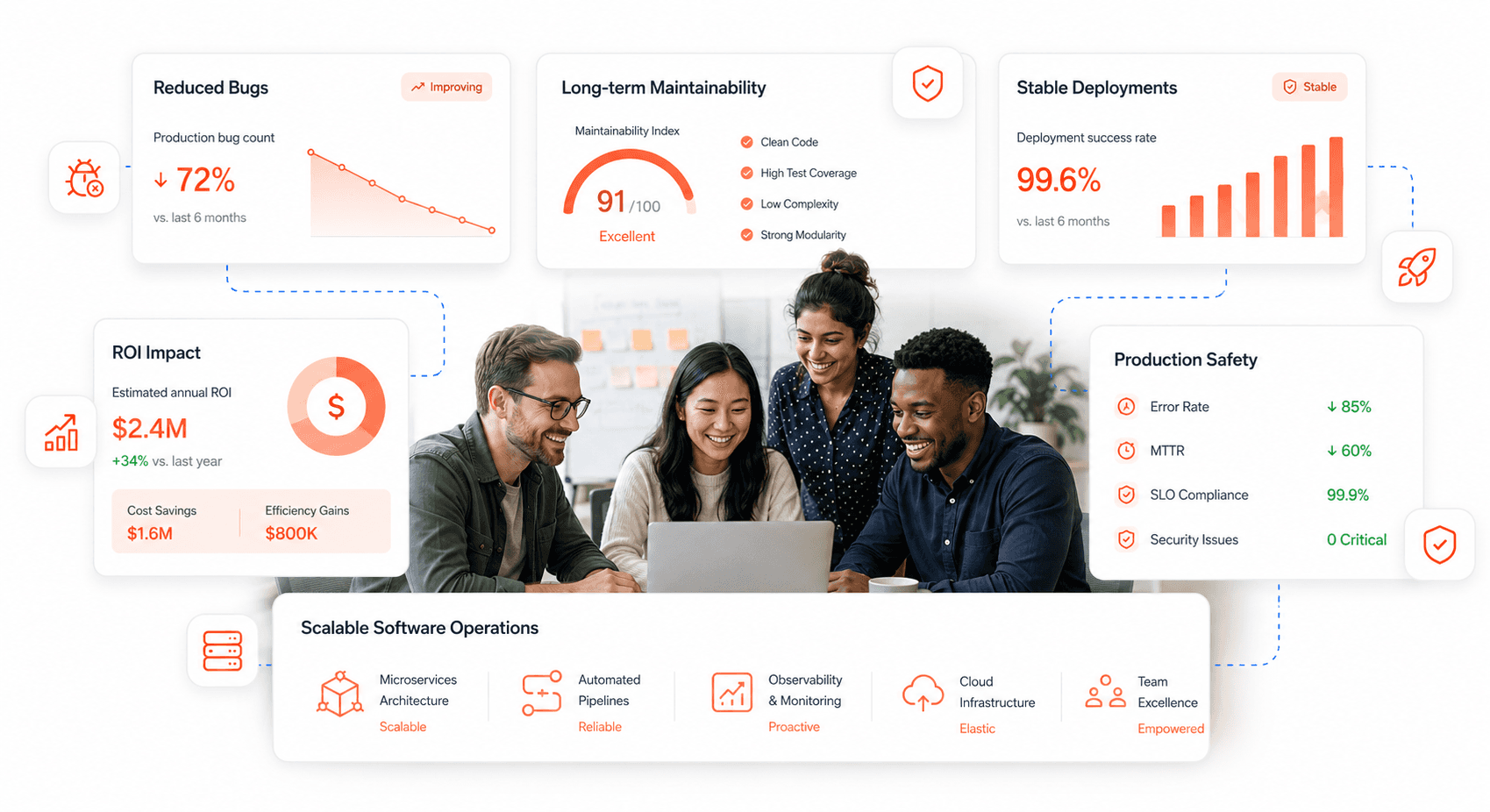
Related Blogs
Related Blogs
Is a clunky UI holding back your growth?
▶︎
Transform slow, frustrating dashboards into intuitive interfaces that ensure effortless user adoption.
▶︎
Transform slow, frustrating dashboards into intuitive interfaces that ensure effortless user adoption.
Is a clunky UI holding back your growth?
▶︎
Transform slow, frustrating dashboards into intuitive interfaces that ensure effortless user adoption.
▶︎
Transform slow, frustrating dashboards into intuitive interfaces that ensure effortless user adoption.
Is a clunky UI holding back your growth?
▶︎
Transform slow, frustrating dashboards into intuitive interfaces that ensure effortless user adoption.
▶︎
Transform slow, frustrating dashboards into intuitive interfaces that ensure effortless user adoption.