

Frontend First vs Backend First Modernization: Your Complete Decision Guide
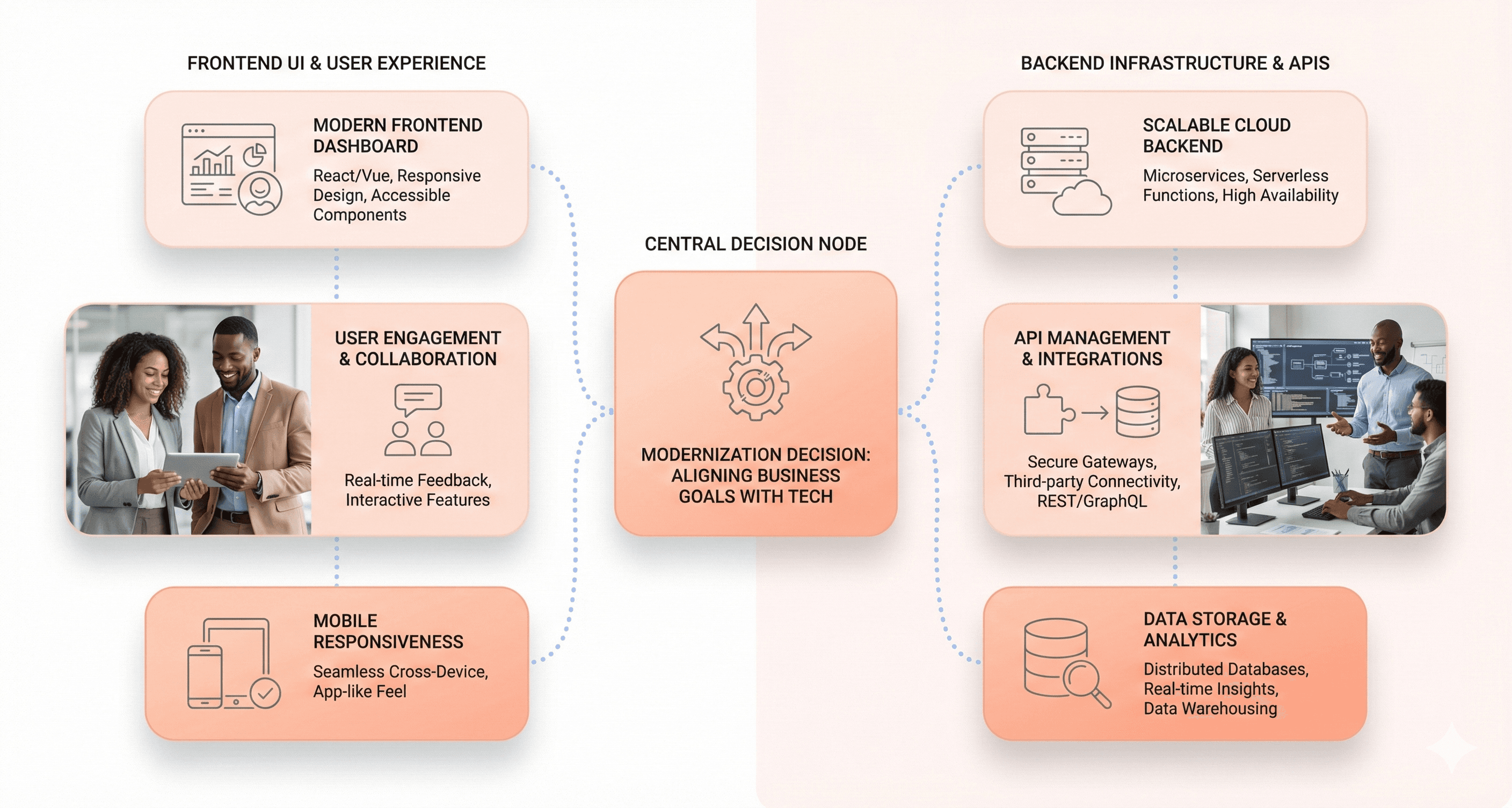
Enterprise leaders and IT decision-makers face a critical choice when planning their application modernization journey. Should you start with a frontend modernization strategy or take a backend modernization approach first? Choosing the right approach often depends on your broader strategy and the legacy modernization services you adopt to support long-term scalability.
This comprehensive guide breaks down both paths to help you make the right system modernization decision for your organization. We will walk through the key differences between frontend vs backend modernization, compare the real costs and resource needs of each approach, and show you how to assess technical risks before committing your budget.
You will discover when a frontend-first strategy makes sense for improving user experience quickly, and when starting with backend infrastructure delivers better long-term value. We will also cover practical frameworks for aligning your business modernization strategy with the right legacy modernization services based on your company’s specific goals and constraints.
By the end, you will have a clear roadmap for your enterprise application modernization project and the confidence to choose the approach that delivers the best ROI for your situation.
Frontend First Modernization Strategy Explained
Transforming User Experience to Drive Business Value
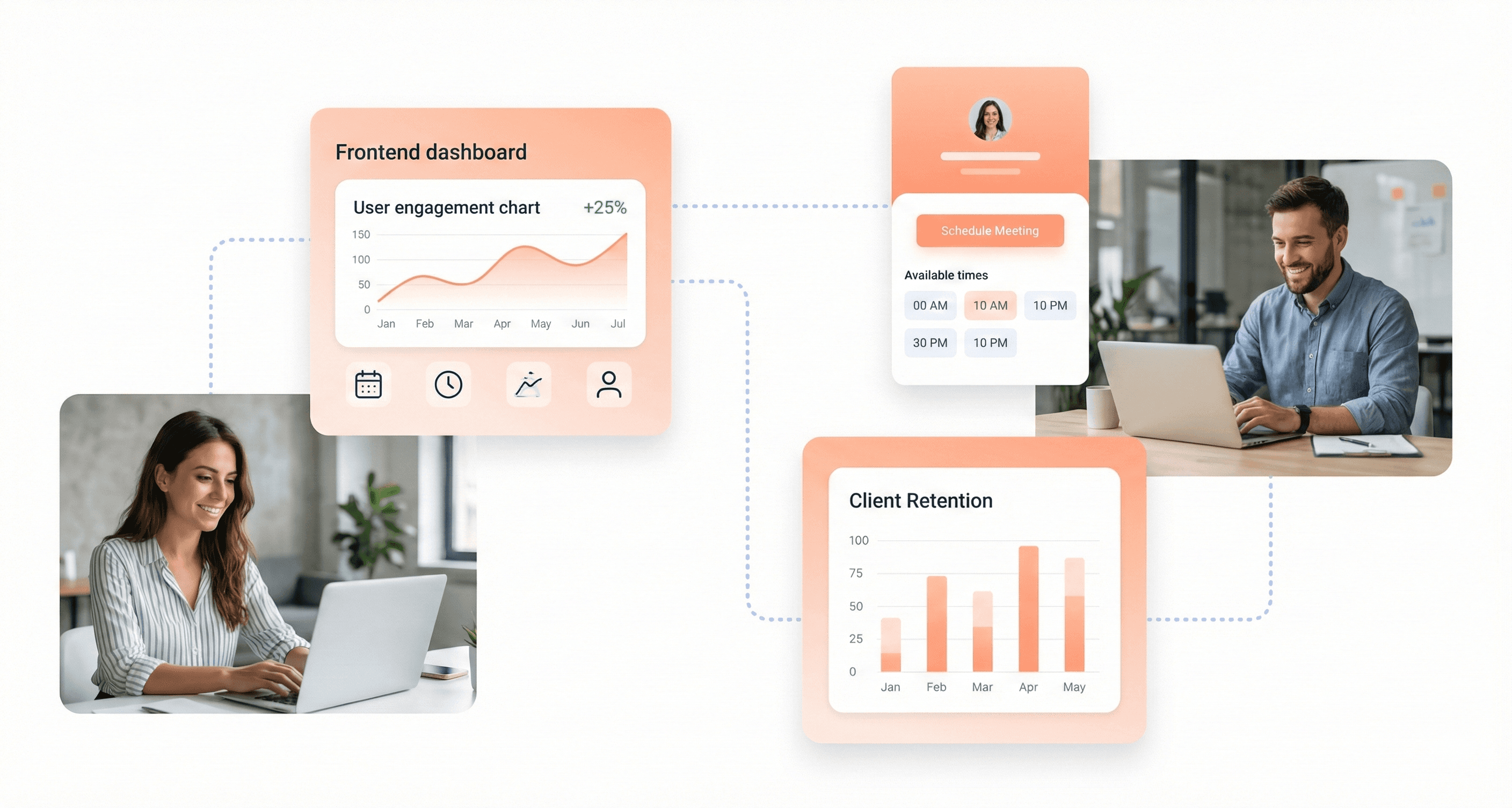
Frontend first modernization strategy puts user experience at the center of transformation efforts. When organizations prioritize the user interface, they immediately create visible impact that resonates with customers and stakeholders alike. This approach recognizes that users interact primarily with the frontend, making it the most critical touchpoint for business success.
Modern users expect fast, responsive, and modern intuitive interfaces for SaaS products regardless of what happens behind the scenes. By addressing frontend challenges first, companies can boost user satisfaction, increase engagement rates, and drive revenue growth while legacy backend systems continue operating. This strategy works particularly well for customer-facing applications where user experience directly affects business metrics.
The visual transformation creates immediate buy-in from executives and end-users who can see tangible improvements. Marketing teams can showcase enhanced interfaces to attract new customers, while support teams benefit from reduced user confusion and complaints. This positive feedback loop builds momentum for ongoing modernization efforts across the organization.
Leveraging Modern UI Technologies for Competitive Advantage
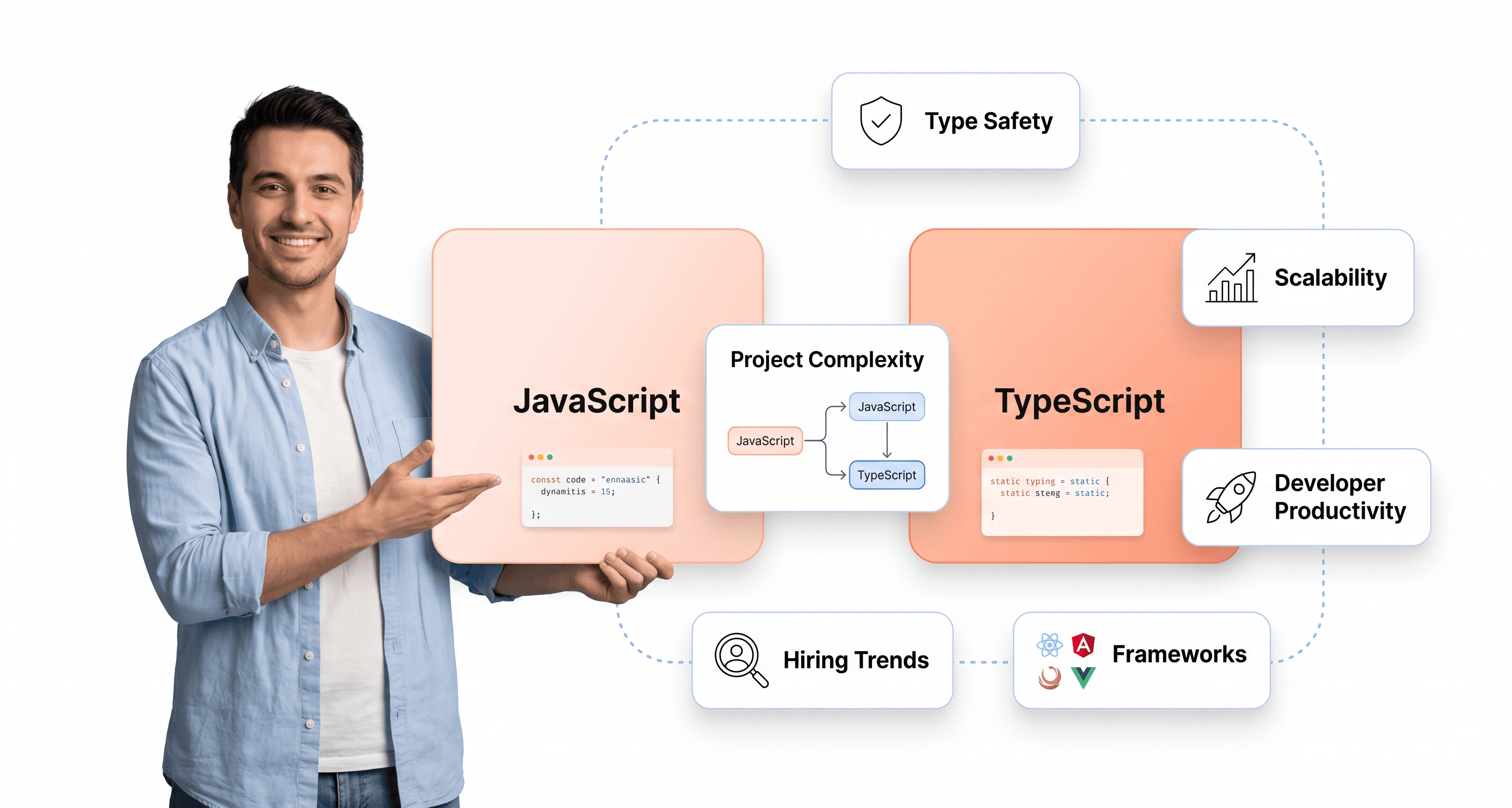
Contemporary frontend modernization strategy embraces cutting-edge UI technologies that set organizations apart from competitors still relying on outdated interfaces. React, Vue.js, and Angular frameworks enable developers to build dynamic, single-page applications that feel more like native mobile apps than traditional web pages.
These modern frameworks offer component reusability, improved performance, and better developer productivity compared to legacy UI technologies. Organizations can implement progressive web apps (PWAs) that work seamlessly across devices, providing native app experiences without requiring app store distribution.
Technology | Key Benefits | Use Cases |
|---|---|---|
React | Component reusability, large ecosystem | Complex interactive applications |
Vue.js | Gentle learning curve, flexible architecture | Gradual modernization projects |
Angular | Enterprise-grade structure, TypeScript support | Large-scale applications |
PWAs | Cross-platform compatibility, offline capabilities | Mobile-first experiences |
Advanced UI features like real-time updates, drag-and-drop functionality, and responsive design become standard rather than premium offerings. Companies gain competitive advantages by delivering superior user experiences that competitors with legacy frontends cannot match.
Reducing Development Complexity Through Component-Based Architecture
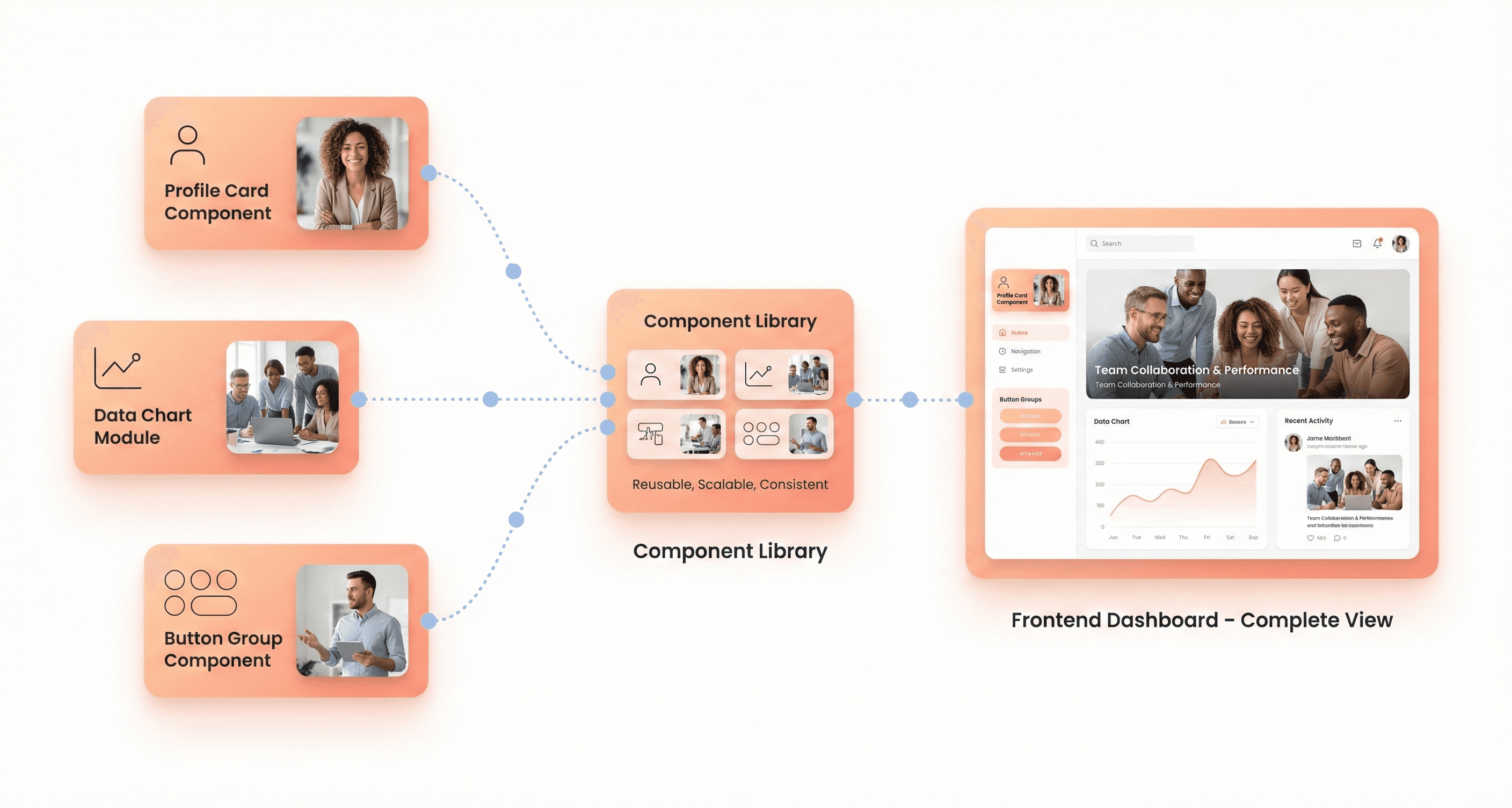
Component-based architecture transforms how development teams approach frontend modernization strategy. Instead of monolithic user interfaces that require extensive modifications for simple changes, modern frameworks promote modular components that can be developed, tested, and maintained independently.
This architectural shift reduces complexity by breaking down complex interfaces into manageable pieces. Developers can work on specific components without affecting other parts of the application, leading to fewer conflicts and faster development cycles. Teams can also reuse components across different sections of the application or even different projects.
The component approach simplifies testing since each piece can be validated individually before integration. Quality assurance becomes more predictable and thorough, reducing bugs that reach production environments. Code maintainability improves dramatically as developers can locate and modify specific functionality without navigating through interconnected legacy code.
Design systems built around best React UI component libraries consistency across the entire application while allowing flexibility for unique requirements. This balance between standardization and customization accelerates development while maintaining brand coherence and user experience quality.
Accelerating Time-to-Market with Rapid Prototyping
Frontend first modernization enables rapid prototyping that dramatically reduces time-to-market for new features and products. Modern development tools and frameworks support quick iteration cycles where teams can build, test, and refine user interfaces within days rather than weeks or months.
Prototyping tools integrate seamlessly with modern frontend frameworks, allowing designers and developers to collaborate more effectively. Interactive prototypes help stakeholders visualize final products early in the development process, reducing miscommunication and scope changes that typically delay projects.
The decoupled nature of frontend-first approaches helps teams modernize legacy frontend without breaking workflows, enabling UI improvements to be deployed independently of backend changes. This parallel development capability accelerates overall project timelines while reducing dependencies that often create bottlenecks in traditional modernization approaches.
Mock data and API simulation tools enable frontend teams to continue development even when backend systems are unavailable or under development. This flexibility keeps projects moving forward and helps organizations capitalize on market opportunities faster than competitors following more traditional sequential development approaches.
Backend First Modernization Approach Explained
Building Robust Infrastructure for Scalable Growth
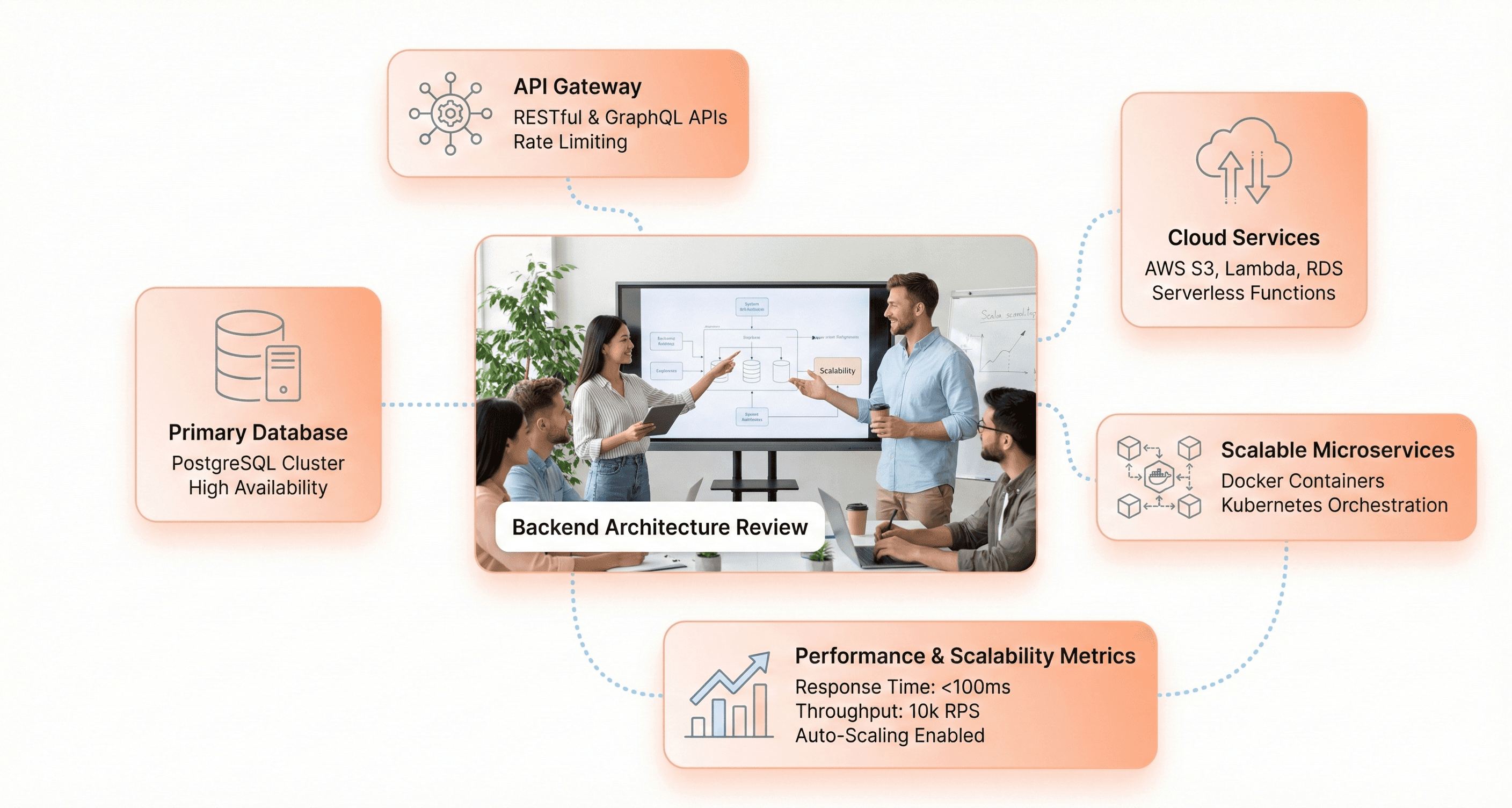
Starting with a backend modernization approach creates the foundation your business needs to handle future growth without breaking a sweat. When you prioritize modernizing your core systems first, you're essentially building a strong house from the ground up - the pretty facade can come later.
This strategy shines when your existing infrastructure can't keep up with demand. Symptoms such as slow databases and fragile APIs often indicate the need for legacy to cloud native modernization enterprise instead of cosmetic frontend fixes. By modernizing these core components first, you create a system that can handle 10x your current load without missing a beat.
The beauty of backend-first modernization lies in its ability to unlock capabilities you didn't know you needed. Modern cloud-native architectures support auto-scaling, meaning your system automatically adjusts resources based on demand.
Microservices architecture allows different teams to work on separate components without stepping on each other's toes. These improvements directly translate to better user experiences, even if the frontend remains unchanged initially.
Companies often discover that backend modernization reveals opportunities for new features and services they couldn't offer before. Real-time analytics, personalization engines, and advanced integrations become possible when your infrastructure can actually support them.
This approach particularly benefits organizations planning significant expansion or those in rapidly growing industries where scalability isn't optional - it's survival.
Ensuring Data Security and Compliance from the Ground Up
Backend-first modernization puts security and compliance at the heart of your digital transformation journey. When you start with the backend, you can implement enterprise-grade security measures before sensitive data ever reaches new systems or user interfaces.
Modern backend architectures support requirements similar to medical device UX safety and compliance, offering security features that legacy systems simply can't match. Zero-trust security models, end-to-end encryption, and advanced identity management systems become standard components rather than afterthoughts.
This is especially critical for industries dealing with sensitive data - healthcare, finance, and government organizations can't afford security gaps during modernization.
Compliance becomes much more manageable when you build it into your infrastructure from day one. GDPR, HIPAA, SOX, and other regulatory requirements demand specific data handling, storage, and audit capabilities. Legacy systems often struggle to meet these standards, forcing organizations into expensive workarounds or compliance violations.
Key security benefits of backend-first modernization include:
Advanced encryption at rest and in transit
Automated security monitoring and threat detection
Granular access controls with role-based permissions
Comprehensive audit trails for compliance reporting
Regular security updates without system-wide disruptions
The peace of mind that comes from knowing your data is secure can't be overstated. While frontend improvements might impress users, backend security protects your entire business. This approach lets you modernize user-facing components later without worrying about exposing vulnerabilities or violating compliance requirements.
Optimizing Performance Through Strategic Database Modernization
Database modernization often delivers the biggest performance gains in any modernization project. When your application runs faster, users notice immediately - even with the same old interface. This makes database upgrades a smart starting point for organizations where performance issues are killing productivity or customer satisfaction.
Legacy databases create bottlenecks that no amount of frontend polish can fix. Outdated query optimization, limited concurrent user support, and poor integration capabilities drag down entire applications. Modern database solutions offer dramatic improvements in speed, reliability, and functionality that transform how users experience your applications.
Cloud-native databases bring capabilities that were unimaginable just a few years ago. Auto-scaling ensures your database performance scales with demand. Advanced caching reduces response times from seconds to milliseconds. Real-time analytics let you spot and fix performance issues before they impact users. These improvements often deliver 3-5x performance gains without changing a single line of frontend code.
Strategic database modernization also opens doors for advanced features like:
Real-time data processing for instant insights
Global data replication for worldwide performance
Advanced backup and recovery with point-in-time restoration
Integration capabilities with modern analytics and AI tools
Cost optimization through efficient resource management
Performance degradation during migration often exposes the frontend technical debt hidden costs that accumulate when infrastructure is ignored. Users work faster, reports generate quicker, and integration with other systems becomes seamless. This foundation makes subsequent frontend improvements much more impactful since they're built on a system that can actually deliver the performance users expect.
Comparing Cost Implications and Resource Requirements
Analyzing Initial Investment Differences Between Approaches
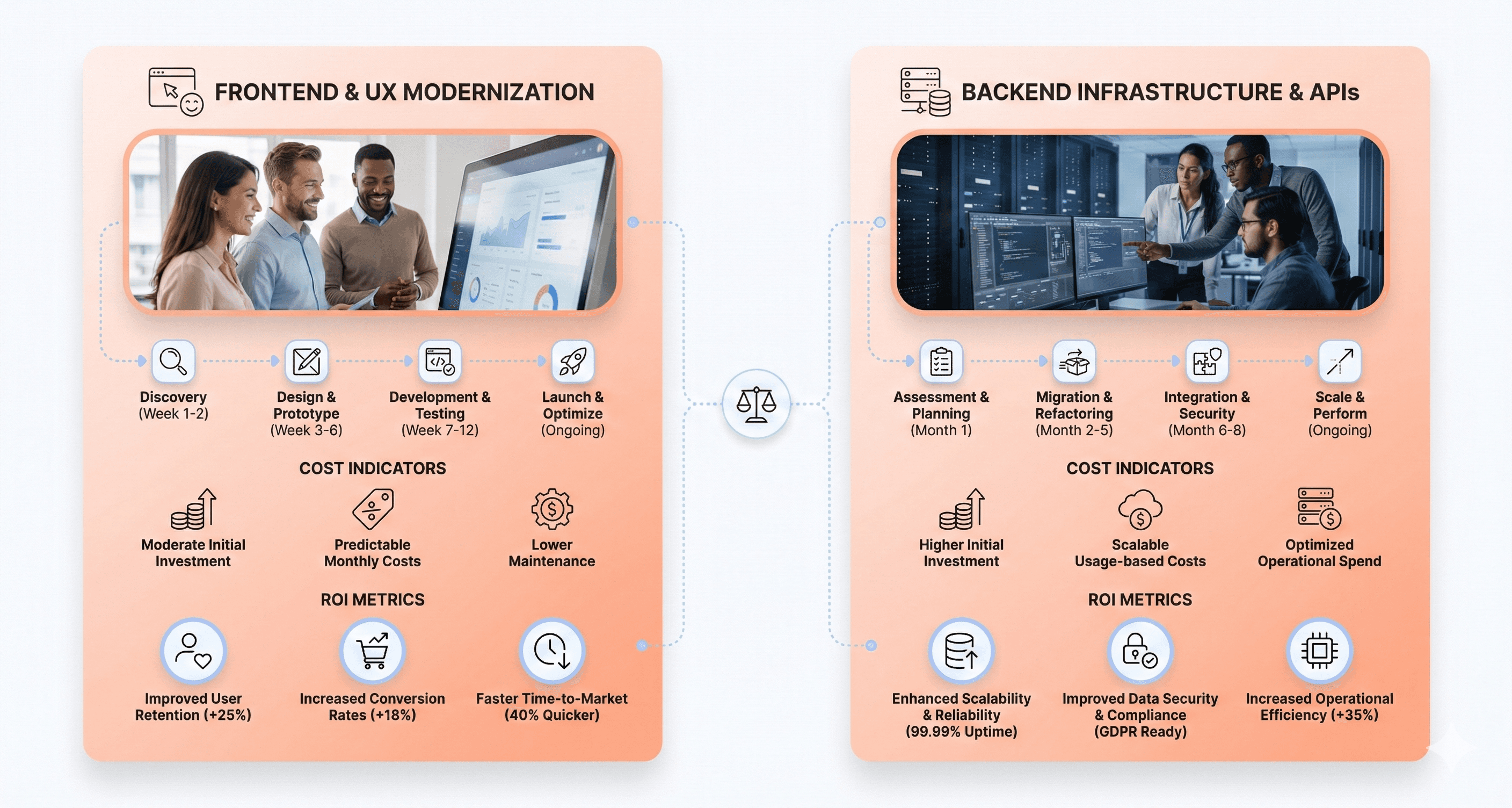
Frontend first modernization strategy typically requires smaller upfront investments compared to backend transformations. Organizations can expect initial costs ranging from $50,000 to $200,000 for moderate-scale projects, focusing primarily on user interface redesigns, responsive frameworks, and modern JavaScript libraries. The beauty of this approach lies in its incremental nature, you can modernize one component at a time without disrupting core business operations.
Backend modernization approach demands significantly higher initial capital, often starting at $200,000 and scaling up to millions for enterprise applications. This investment covers database migrations, API restructuring, cloud infrastructure setup, and potential third-party licensing fees. The complexity increases exponentially when dealing with legacy databases and interconnected systems that require careful orchestration during migration.
Approach | Initial Investment Range | Primary Cost Drivers |
|---|---|---|
Frontend First | $50K - $200K | UI/UX design, JavaScript frameworks, responsive development |
Backend First | $200K - $2M+ | Infrastructure, data migration, API development, licensing |
The resource allocation differs dramatically between approaches. Frontend projects typically need 3-5 developers for 6-12 months, while backend initiatives often require 8-15 specialists including database administrators, cloud architects, and DevOps engineers working for 12-24 months.
Calculating Long-term Maintenance and Support Costs
Frontend-focused modernization creates ongoing maintenance costs of approximately 15-20% of initial development expenses annually. These costs primarily stem from browser compatibility updates, security patches for client-side frameworks, and periodic design refreshes to maintain user engagement. The rapid evolution of frontend technologies means teams must regularly update dependencies and adapt to new standards.
Backend maintenance expenses typically consume 20-30% of the original investment each year. These higher percentages reflect the complexity of maintaining databases, ensuring security compliance, managing cloud infrastructure costs, and supporting integrations with multiple systems. Legacy system modernization through backend changes often introduces hidden maintenance burdens as organizations must support both old and new systems during transition periods.
Modern cloud-native backends can reduce long-term costs through:
Automated scaling that optimizes resource usage
Managed services that eliminate infrastructure maintenance overhead
DevOps automation that reduces manual intervention requirements
However, frontend modernization offers more predictable maintenance patterns since user interface changes typically don't impact core business logic or data integrity requirements.
Evaluating Team Skills and Training Requirements
Application modernization success heavily depends on available talent and skill gaps within existing teams. Frontend modernization typically requires JavaScript proficiency, modern framework knowledge (React, Vue, Angular), and responsive design expertise. Most developers can transition to modern frontend technologies within 2-3 months of focused training, making skill acquisition relatively straightforward.
Backend transformations demand deeper technical expertise spanning multiple domains:
Cloud architecture and DevOps practices
Database design and migration strategies
API development and microservices architecture
Security implementation and compliance standards
Performance optimization and monitoring
Training timelines for backend skills often extend 6-12 months, with organizations frequently needing to hire specialized consultants or senior engineers to bridge knowledge gaps. The learning curve proves steeper because backend changes affect system reliability, data integrity, and business continuity.
Companies pursuing frontend first strategies often discover their existing teams can adapt quickly, reducing external hiring needs and associated recruitment costs. Backend modernization typically requires significant team expansion or extensive contractor relationships, adding complexity to project management and knowledge transfer processes.
Measuring Return on Investment Timelines
Frontend modernization delivers measurable ROI within 3-6 months through improved user engagement, reduced bounce rates, and enhanced conversion metrics. Organizations typically see immediate benefits including faster page load times, better mobile experiences, and increased customer satisfaction scores. These improvements directly translate to revenue growth and reduced customer acquisition costs.
Backend ROI materializes over longer periods, usually 12-18 months, but delivers more substantial operational benefits. Modernization cost comparison studies show backend investments eventually provide higher returns through:
Reduced infrastructure costs (30-50% savings with cloud migration)
Improved system reliability and reduced downtime
Enhanced developer productivity through modern tooling
Better scalability supporting business growth
The ROI timeline also depends on business priorities. E-commerce companies prioritizing customer experience often see faster returns from frontend improvements, while data-intensive enterprises benefit more from backend infrastructure investments that enable advanced analytics and reporting capabilities.
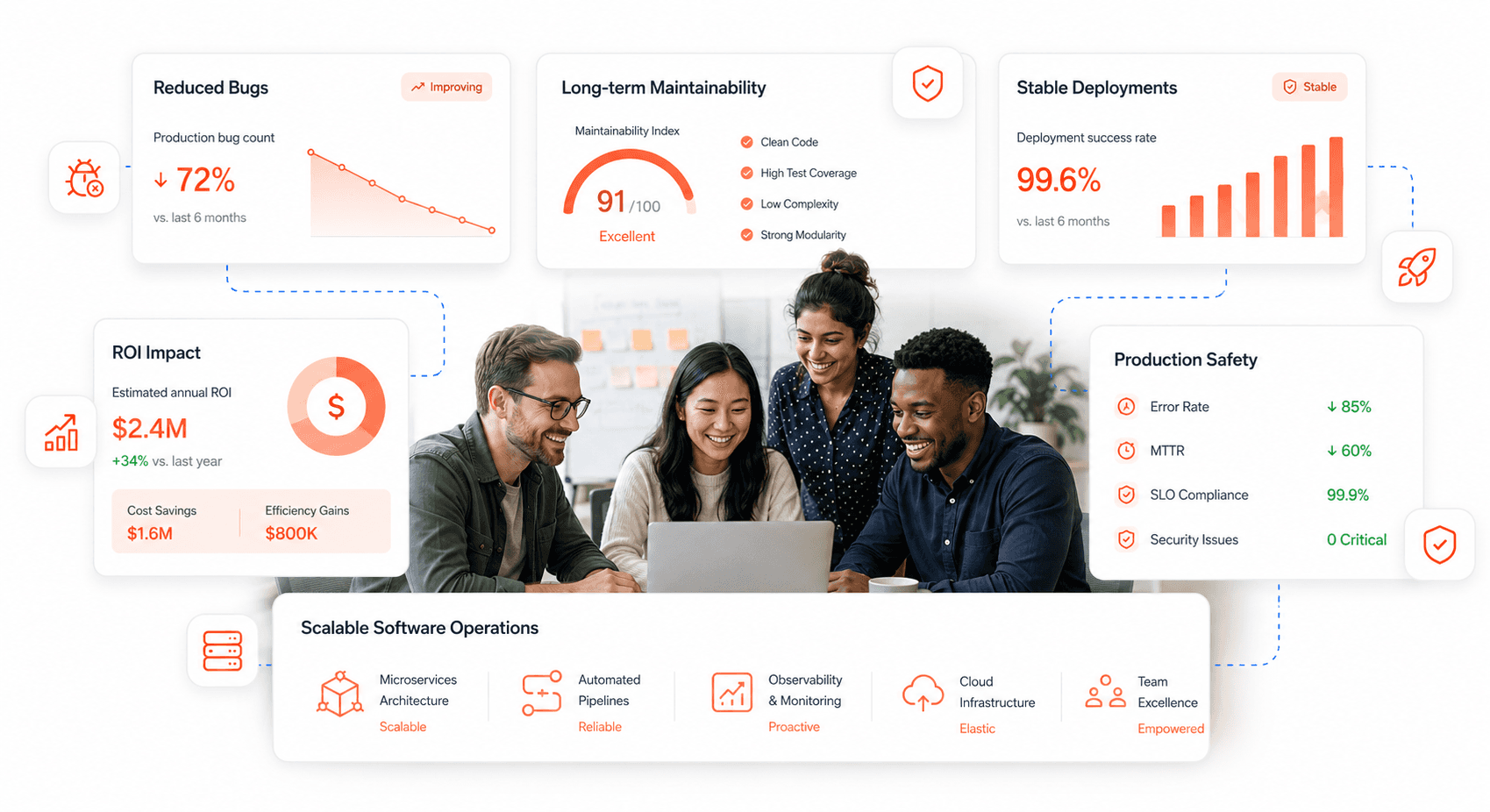
Smart organizations often adopt a phased approach, starting with frontend modernization to generate quick wins and fund subsequent backend transformations. This strategy balances immediate business value with long-term technical debt reduction, creating a sustainable modernization roadmap that aligns with available resources and business objectives.
Assessing Technical Risks and Mitigation Strategies
Identifying Integration Challenges in Frontend First Approach
When organizations pursue a frontend modernization strategy, they often encounter complex integration hurdles that can derail project timelines. The biggest challenge stems from connecting modern frontend frameworks with legacy backend systems that weren't designed for contemporary web architectures.
API compatibility issues frequently arise when new frontend applications attempt to communicate with older backend services. Legacy systems typically use outdated protocols, inconsistent data formats, or lack proper REST/GraphQL endpoints. This mismatch forces development teams to build extensive middleware layers or custom adapters, adding significant complexity to the modernization effort.
Cross-platform compatibility becomes another major concern. Modern frontends need to work seamlessly across various devices and browsers while interfacing with backend systems that may have browser-specific dependencies or limited mobile support. Teams must invest considerable time testing and debugging compatibility issues across different environments.
Data synchronization problems also emerge when new frontend interfaces display real-time information that legacy backends can't provide efficiently. Organizations often discover that their existing databases lack the performance capabilities needed to support modern user expectations for instant updates and responsive interactions.
To mitigate these risks, successful application modernization projects implement incremental integration strategies. Teams can create API gateways that standardize communication protocols, develop comprehensive testing frameworks for cross-platform validation, and establish data caching mechanisms to bridge performance gaps between modern frontends and legacy backends.
Managing Data Migration Risks in Backend First Strategy
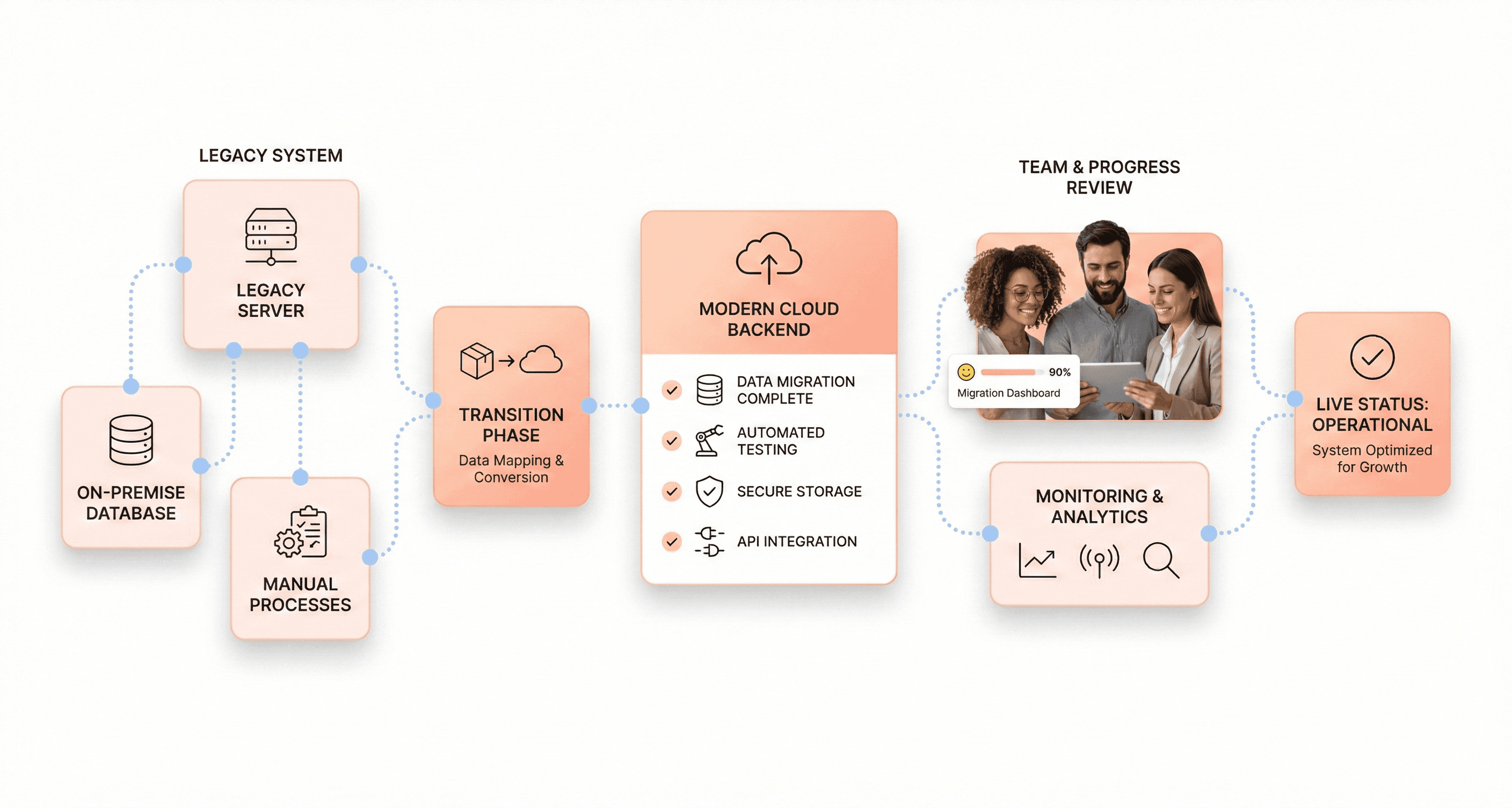
Backend modernization approach projects face substantial data migration challenges that can threaten business operations if not properly managed. The primary risk involves potential data loss or corruption during the transition from legacy databases to modern systems.
Schema incompatibility represents a critical concern when migrating from older database structures to contemporary platforms. Legacy systems often contain denormalized data, custom field types, or business logic embedded within database procedures that don't translate directly to modern architectures. Teams must carefully map existing data structures to new schemas while preserving data integrity and business rules.
Performance degradation during migration poses another significant threat. Large-scale data transfers can overwhelm network resources and impact system availability, especially when organizations attempt to migrate terabytes of historical data without proper planning. Real-time applications may experience unacceptable latency spikes that affect user experience and business operations.
Rollback complexity adds another layer of risk to legacy system modernization efforts. If migration issues arise, reverting to previous systems becomes challenging when data has been transformed or restructured for new backend architectures. Organizations must maintain parallel systems and synchronization mechanisms to enable safe rollback procedures.
Effective mitigation strategies include implementing phased migration approaches that move data in smaller, manageable chunks. Teams should establish comprehensive backup procedures, create detailed rollback plans, and use data validation tools to verify migration accuracy. Running parallel systems during transition periods allows for gradual cutover while maintaining business continuity and data integrity throughout the modernization process.
Planning for System Downtime and Business Continuity
System availability concerns represent one of the most critical aspects of technical risk assessment in modernization projects. Both frontend and backend modernization strategies carry downtime risks that can impact revenue, customer satisfaction, and operational efficiency.
Planned maintenance windows often prove insufficient for complex modernization tasks. Organizations frequently underestimate the time required for system cutover, data validation, and performance testing. What begins as scheduled weekend maintenance can extend into business hours, creating unexpected operational disruptions.
Dependency mapping becomes crucial for understanding the full scope of potential downtime impacts. Modern applications rely on numerous interconnected services, third-party APIs, and external systems that may not be immediately obvious. A seemingly isolated backend update might affect multiple frontend applications or downstream business processes.
Rolling deployment strategies offer effective solutions for minimizing downtime risks. Blue-green deployments allow teams to maintain parallel production environments, enabling instant rollback if issues arise. Canary releases gradually introduce changes to small user segments, helping identify problems before full deployment.
Strategy | Downtime Risk | Implementation Complexity | Rollback Speed |
|---|---|---|---|
Blue-Green Deployment | Minimal | High | Instant |
Canary Release | Low | Medium | Fast |
Rolling Update | Medium | Low | Moderate |
Big Bang Migration | High | Low | Slow |
Load balancing and redundancy planning help maintain service availability during modernization activities. Organizations should establish monitoring systems that provide real-time visibility into system performance and user experience metrics. Automated alerting mechanisms can trigger immediate response procedures when performance thresholds are exceeded or service degradation is detected.
Making the Strategic Decision Based on Business Goals
Aligning Modernization Strategy with Customer Experience Priorities
Your customers don't care about your backend architecture, they care about how fast pages load, how intuitive the interface feels, and whether they can complete tasks without frustration. This reality should heavily influence your modernization approach.
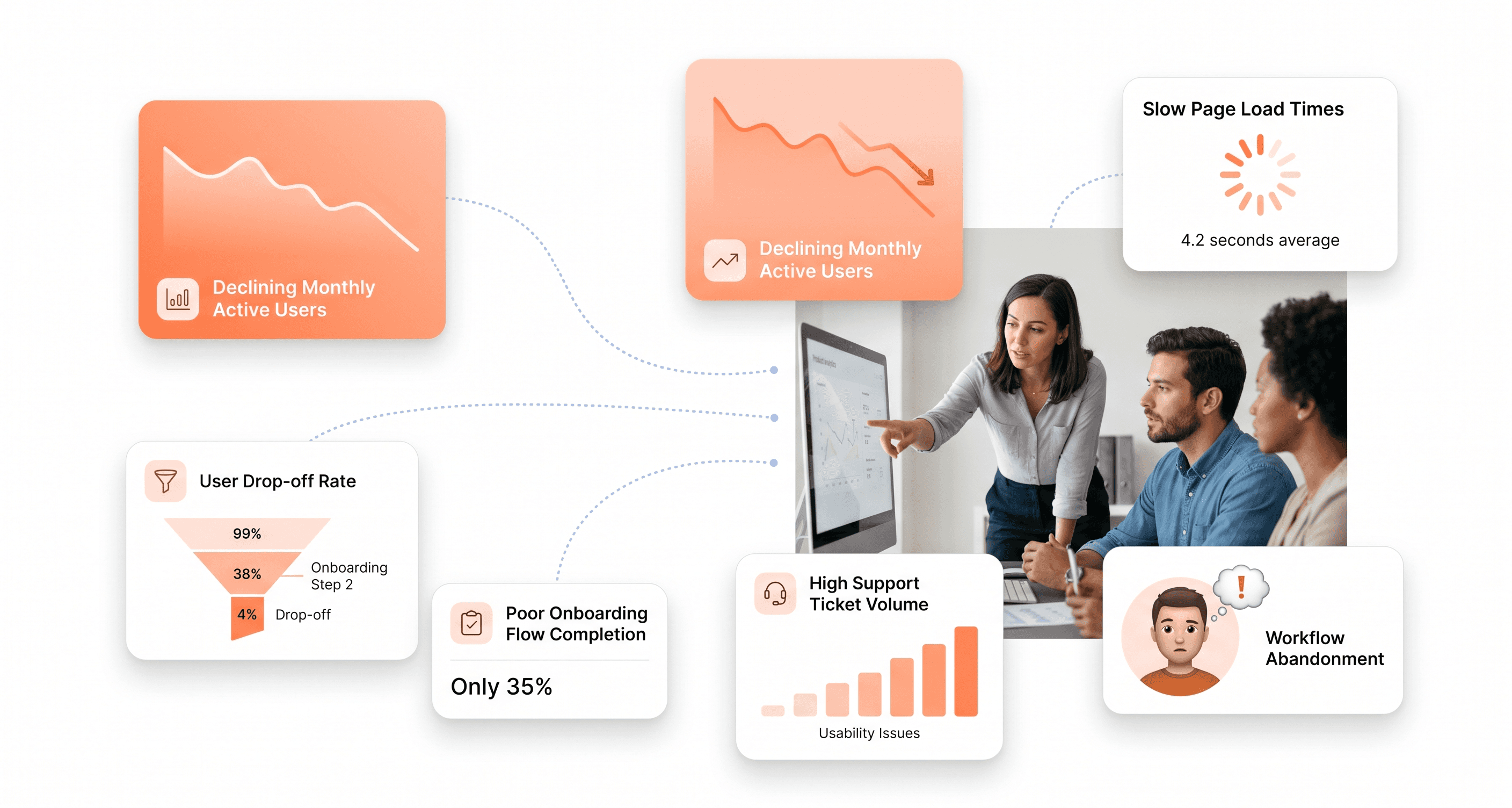
When customer satisfaction scores are dropping or user engagement metrics show declining trends, a frontend modernization strategy often delivers immediate wins. Modern JavaScript frameworks can transform sluggish interfaces into responsive, interactive experiences that keep users engaged. Companies in e-commerce, media, and consumer services frequently prioritize frontend updates because visual improvements directly correlate with conversion rates and revenue.
However, if your customer complaints center around system reliability, data inconsistencies, or slow transaction processing, backend issues are likely the root cause. Financial institutions and healthcare organizations often discover that customer frustration stems from outdated databases and integration problems rather than interface design. A backend modernization approach addresses these foundational issues that no amount of frontend polish can fix.
Consider creating a customer journey map that identifies specific pain points. Are users abandoning shopping carts due to confusing navigation or because checkout processes time out? Do they struggle with finding information or accessing it? This analysis reveals whether your business modernization strategy should focus on user-facing improvements or underlying system performance.
Matching Approach to Organizational Change Capacity
Your team's current skills and organizational structure play a crucial role in determining which application modernization path makes sense. Frontend modernization typically requires different expertise than backend transformation, and forcing your organization down the wrong path can create expensive bottlenecks.
Teams with strong UX designers, frontend developers familiar with React or Angular, and experience with modern deployment pipelines are naturally positioned for frontend-first approaches. These organizations can move quickly on interface improvements while gradually building backend capabilities.
Conversely, organizations with deep infrastructure expertise, database administrators, and architects experienced with microservices patterns might find backend modernization approach more manageable. These teams understand the complexity of data migration, API design, and system integration challenges that backend modernization entails.
Change management capacity matters just as much as technical skills. Frontend changes are highly visible and can create user resistance if not properly managed. Backend changes, while less visible, often require extensive coordination across departments and can disrupt established workflows. Assess honestly whether your organization can handle the communication, training, and adjustment periods each approach demands.
Consider starting with pilot projects that test your team's capacity in the chosen direction. A small frontend redesign or limited backend service migration can reveal organizational strengths and weaknesses before committing to a full-scale modernization effort.
Considering Industry Requirements and Compliance Needs
Regulatory environments and industry standards significantly influence modernization priorities. Healthcare organizations dealing with HIPAA requirements, financial institutions navigating SOX compliance, or government contractors managing security clearances often find that backend systems require immediate attention to meet evolving compliance standards.
Industries with strict data governance requirements typically benefit from backend modernization approach first. Modern data architectures provide better audit trails, encryption capabilities, and access controls that compliance frameworks demand. Trying to add these features through frontend-only changes often results in security gaps and regulatory violations.
However, industries facing customer experience disruption - retail, hospitality, or media - might prioritize frontend improvements even within compliance constraints. The key is understanding which compliance requirements can be met through interface changes versus those requiring infrastructure modifications.
Industry Sector | Typical Priority | Compliance Driver |
|---|---|---|
Financial Services | Backend First | Data security, audit trails |
Healthcare | Backend First | Patient privacy, data integrity |
Retail/E-commerce | Frontend First | Customer experience, conversion |
Manufacturing | Backend First | Supply chain integration |
Media/Entertainment | Frontend First | User engagement, content delivery |
Remember that compliance isn't just about following rules, it's about building trust with customers and partners. Choose the modernization approach that best positions your organization to meet both current requirements and anticipated regulatory changes.
Evaluating Timeline Constraints and Market Pressures
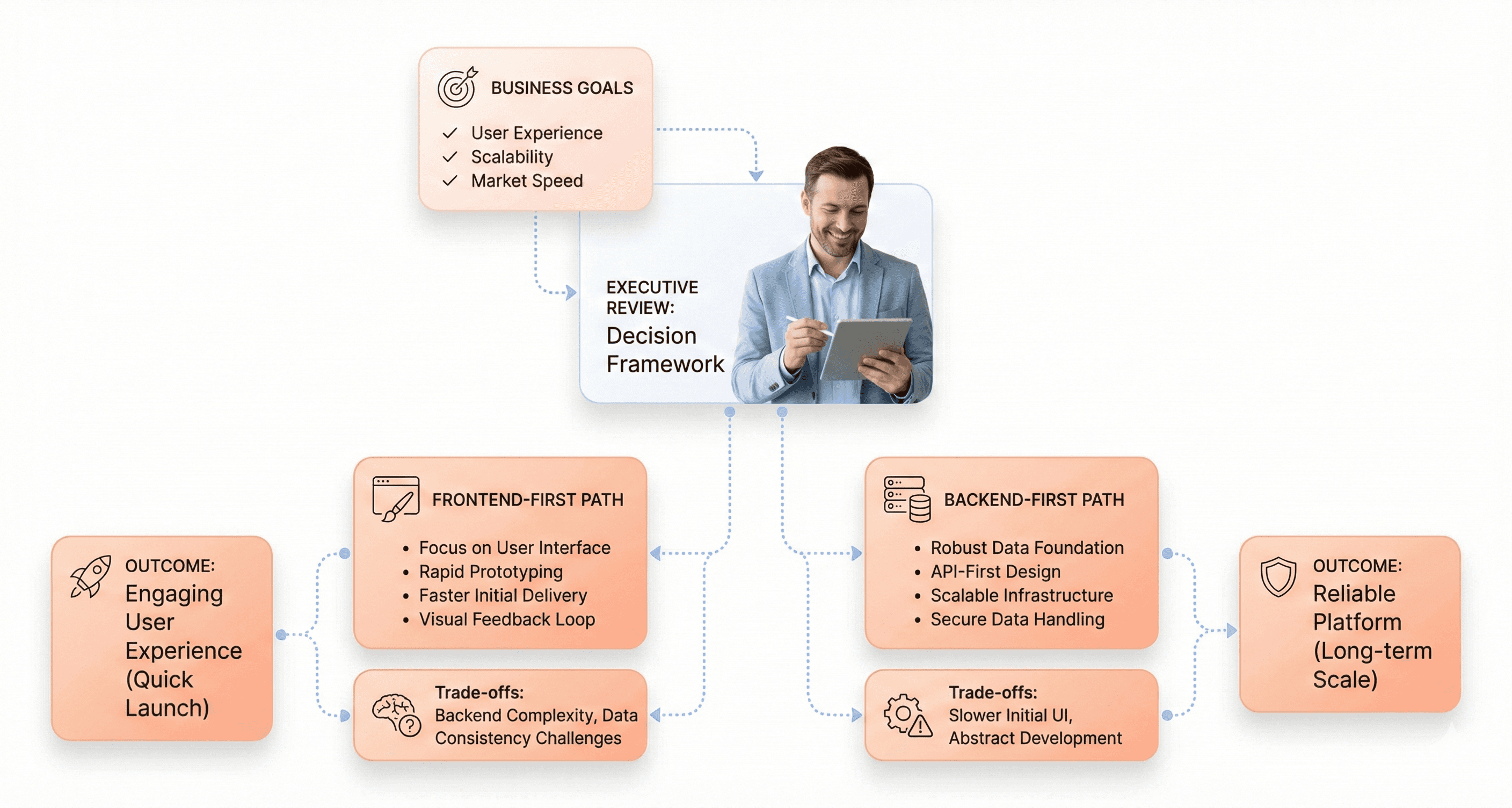
Market timing can make or break modernization decisions. Competitive pressure, seasonal business cycles, and investor expectations create urgency that influences which modernization cost comparison makes strategic sense.
Startups facing funding rounds or established companies launching new products often need visible progress quickly. Frontend modernization delivers demonstrable results faster than backend overhauls. Investors and stakeholders can see improved interfaces, faster page loads, and enhanced user experiences within months rather than years.
However, companies experiencing system stability issues or scalability limitations can't afford to delay backend improvements. If your current infrastructure struggles with existing load, adding a modern frontend without addressing underlying capacity issues creates bigger problems. Technical debt in backend systems compounds rapidly and becomes exponentially more expensive to fix over time.
Consider your competitive landscape carefully. Are competitors gaining market share through superior user experiences or superior functionality? User experience advantages typically require frontend focus, while functional superiority often depends on robust backend capabilities.
Timeline considerations for each approach:
Frontend First: 3-6 months for visible improvements, 12-18 months for complete transformation
Backend First: 6-12 months before user-facing benefits, 18-36 months for comprehensive modernization
Market windows don't always align with ideal technical approaches. Sometimes you need to choose the strategy that keeps you competitive today while planning for long-term technical excellence tomorrow. The best system modernization decision balances immediate market needs with sustainable technical architecture.
Conclusion
Both frontend-first and backend-first modernization strategies have their place, but the right choice depends on your specific business needs and current challenges. If your users are struggling with outdated interfaces and your backend systems are relatively stable, starting with the frontend makes perfect sense.
You'll see faster user satisfaction improvements and can build momentum for future changes. On the other hand, if your backend infrastructure is creating bottlenecks, security concerns, or scalability issues, tackling that foundation first will pay off in the long run.
The key is being honest about where your biggest pain points lie and what your organization can realistically handle. Don't just follow what worked for another company, look at your team's skills, budget constraints, and how much disruption your business can absorb.
Start by auditing your current systems, talking to your users, and identifying which approach aligns best with your immediate goals and long-term vision. Remember, modernization isn't a race, and the strategy that gets you moving forward steadily will always beat the one that sounds impressive but overwhelms your resources.




About the author
I’m the founder of Hashbyt, an AI-first frontend and UI/UX SaaS partner helping 200+ SaaS companies scale faster through intelligent, growth-driven design. My work focuses on building modern frontend systems, design frameworks, and product modernization strategies that boost revenue, improve user adoption, and help SaaS founders turn their UI into a true growth engine.
Is a clunky UI holding back your growth?
Is a clunky UI holding back your growth?
▶︎
Transform slow, frustrating dashboards into intuitive interfaces that ensure effortless user adoption.
▶︎
Transform slow, frustrating dashboards into intuitive interfaces that ensure effortless user adoption.
