
Share

Share

How React Improves SaaS Performance, UX, and Feature Velocity?

How React Improves SaaS Performance, UX, and Feature Velocity?

Posted on

Frontend Development

Frontend Development

Posted at

Jan 2, 2026

Jan 2, 2026

Min read

10

I hope you found this post valuable. If you’re looking for proven frontend and design expertise to elevate your product, feel free to reach out.

I hope you found this post valuable. If you’re looking for proven frontend and design expertise to elevate your product, feel free to reach out.

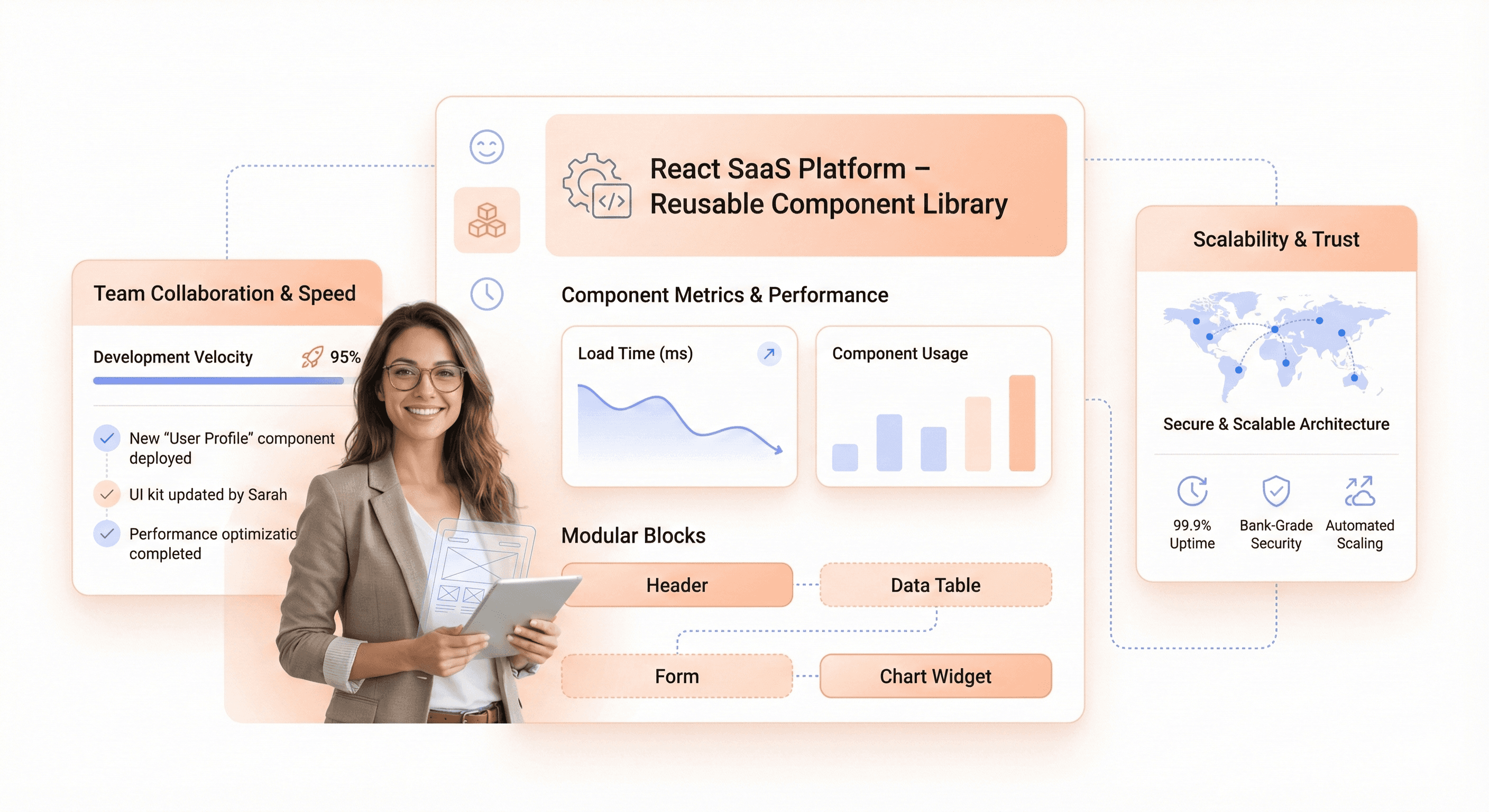
React-powered SaaS dashboard showing reusable UI components, performance metrics, and modular frontend architecture for scalable applications

React has become the go-to frontend framework for SaaS companies looking to build fast, scalable applications that actually retain users. If you're a startup founder racing to launch your MVP, a CTO scaling your tech stack, or a product manager pushing for better user experience, choosing React can make the difference between rapid growth and frustrating churn.

This framework doesn't just help you ship features faster - it transforms how your entire team builds and maintains software. We'll explore how React's component-based architecture accelerates your development speed, letting you build once and reuse everywhere. You'll also discover how React scales your SaaS performance without breaking under user load, and why it delivers the smooth, responsive user experience that keeps customers coming back for more.

Accelerate Development Speed with Component-Based Architecture

Build Reusable UI Components for Faster Feature Development
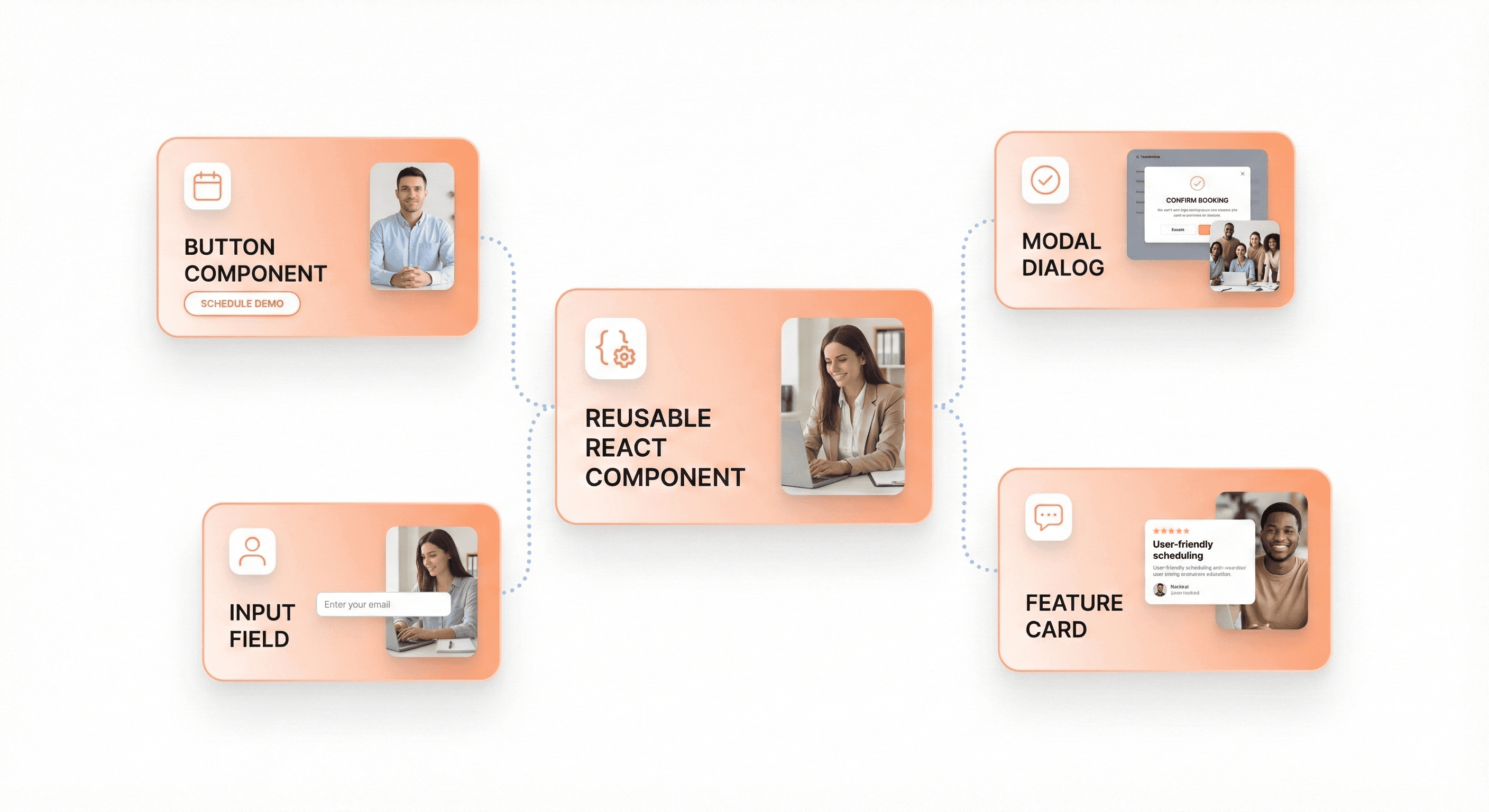
Reusable React UI components like buttons, modals, and cards connected through a shared component system to accelerate SaaS feature development

React's component-based architecture allows developers to write once and use it multiple times, dramatically reducing redundancy and improving maintainability. Reusable components are self-contained UI elements that can be used multiple times within an application without modifying their core logic. Examples include buttons, modals, input fields, and cards that can all be designed as reusable components.

The benefits of this approach are substantial:

  • Improved Code Maintainability: Instead of writing the same code multiple times, you create a single, well-tested component and reuse it, reducing code duplication and making future modifications easier

  • Better Scalability: When working on large applications, reusable components help maintain consistent UI and reduce development time

  • Enhanced Performance: Since reusable components are optimized and reused, they enhance React app performance by reducing unnecessary re-renders

  • Faster Development: Developers can focus on functionality rather than rebuilding UI elements

To maximize effectiveness, components should follow the Single Responsibility Principle, use props efficiently for dynamic customization, and avoid hardcoded data. A centralized component library stored in dedicated folders like /components or /shared ensures easy management and accessibility across development teams.

Enable Rapid MVP Development and Market Validation
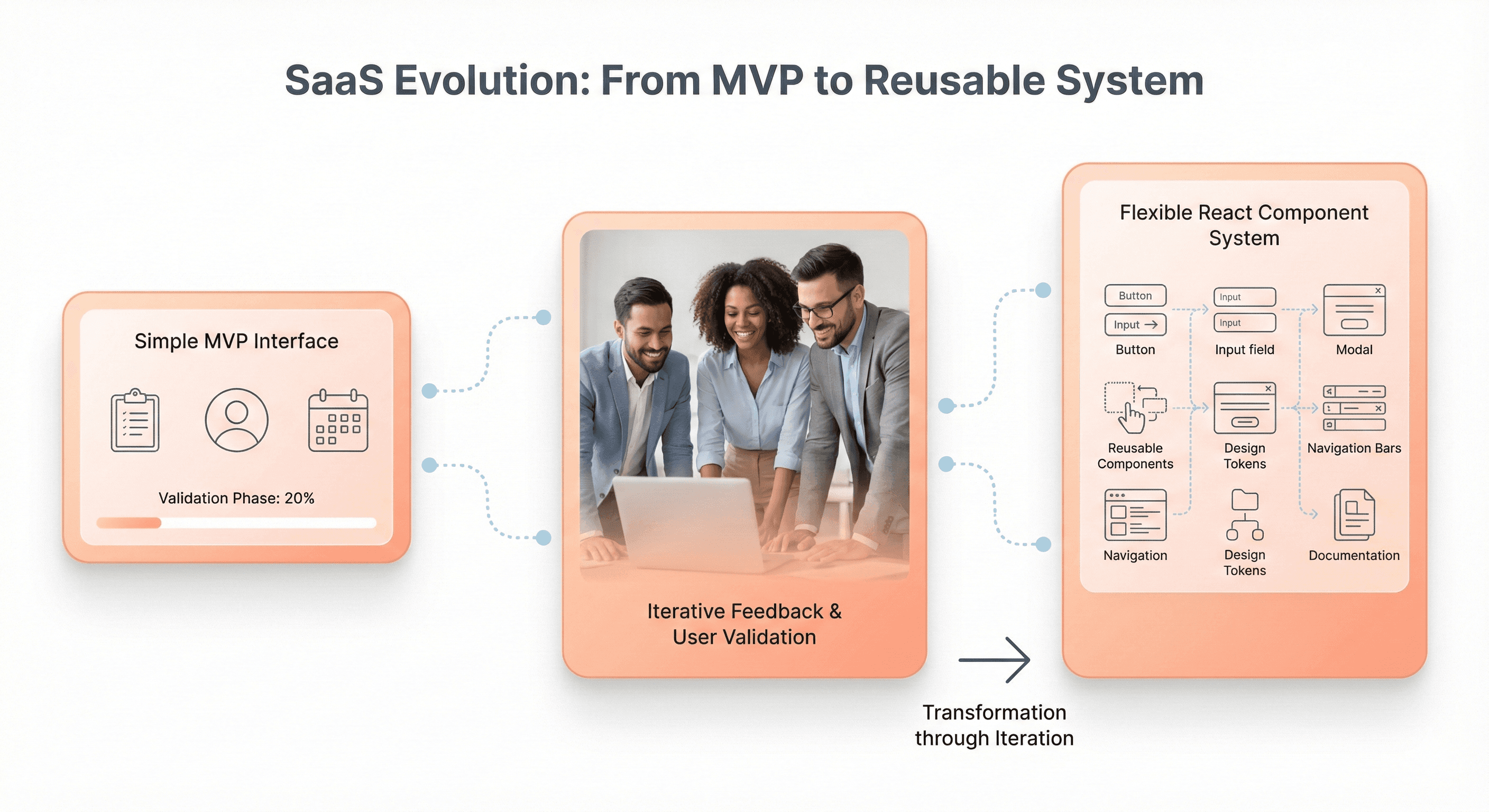
Early-stage SaaS MVP interface evolving into reusable React components for faster iteration and market validation

Component reusability becomes particularly powerful during MVP development phases. When building new features, developers should initially create components to fit minimum customization requirements. For instance, a search button that asks the server for information when clicked doesn't need extensive configuration initially.

However, when the application requires similar functionality elsewhere - such as searching for different entities - this becomes the optimal time to create a generic, reusable component. The button can then receive the function it should call and display text through props, transforming into a truly generic component only when the application demonstrates the same behavior in multiple places.

This approach prevents the trap of building reusable components too far in advance. Software projects constantly change, and today's requirements may make features similar enough to use the same component, but implementation realities might favor building separate one-off components instead of one complicated but reusable solution.

Achieve Guaranteed UX Consistency Across All Product Areas

Reusable components serve as the foundation for maintaining consistent user interfaces across large applications. By establishing a standardized component library, development teams ensure that UI elements behave and appear identically throughout the entire product ecosystem.

Different types of reusable components address various consistency needs:

  • UI Components: Buttons, input fields, dropdowns, and modals

  • Form Components: Custom input fields, text areas, and validation components

  • Navigation Components: Navigation bars, breadcrumbs, and side menus

  • Layout Components: Grid systems, card components, and flex containers

  • Data Display Components: Tables, lists, charts, and graphs

This systematic approach eliminates visual and functional inconsistencies that can confuse users and degrade the overall experience. When a button component is updated or improved, those changes automatically propagate across all instances throughout the application.

Facilitate Rapid Feature Iteration in Hours Instead of Days

The true power of React's component-based architecture emerges during feature iteration cycles. With a well-established component library, developers can rapidly prototype and deploy new features by assembling existing, battle-tested components rather than building everything from scratch.

To maximize iteration speed, components should minimize the amount of state they draw from outside themselves. A search button shouldn't import search terms directly from other components - these should be passed through props instead. Similarly, modals should make independent decisions about display content rather than relying on global state management.

This self-contained approach allows applications to reuse components without importing extra state and creating dependencies. When component logic becomes complicated, it often indicates the need to break functionality into different, more focused components rather than creating increasingly complex reusable ones.

The result is development cycles where new features can be assembled and deployed within hours rather than days, enabling rapid market response and continuous product improvement that keeps SaaS platforms competitive and responsive to user needs.

Scale Your SaaS Performance Without Breaking

Handle Growth from 100 to 100,000 Users Seamlessly
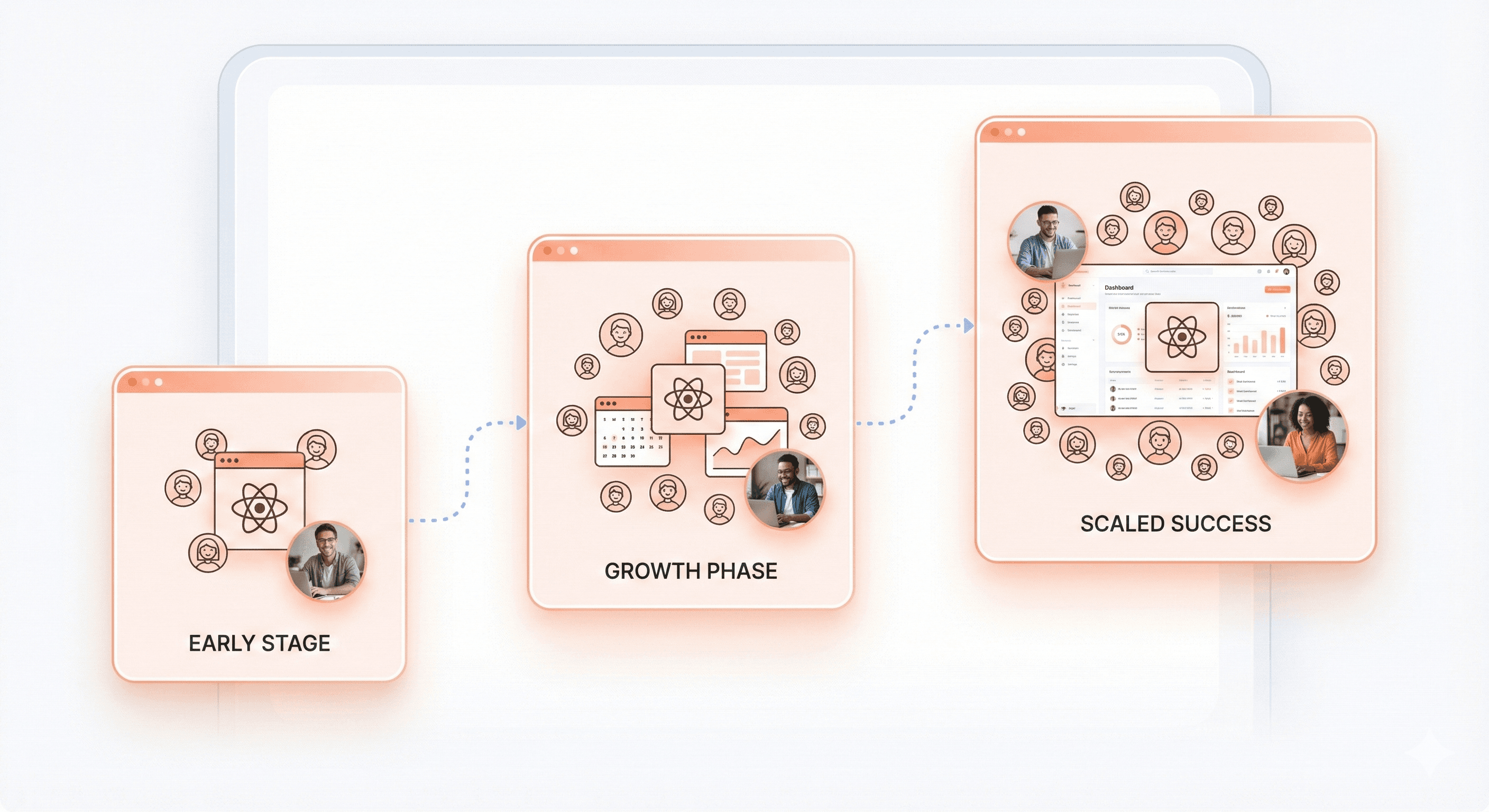
React-based SaaS interface handling increasing user load while maintaining stable frontend architecture and performance

React's component-based architecture naturally accommodates user base expansion without requiring fundamental restructuring. As your SaaS application grows from a small user base to enterprise-scale, React's modular design enables you to add new features and components incrementally. Each component operates independently, allowing development teams to scale specific functionalities based on user demand without affecting the entire application.

The library's efficient state management solutions, including Redux and built-in React hooks, centralize application state handling regardless of user volume. This centralized approach prevents performance bottlenecks that typically emerge as user interactions increase. Additionally, React's support for micro frontends allows you to develop, deploy, and scale different UI segments independently, enabling targeted scaling for high-traffic features while maintaining optimal performance across the platform.

Leverage Virtual DOM for Faster Rendering Under Heavy Load
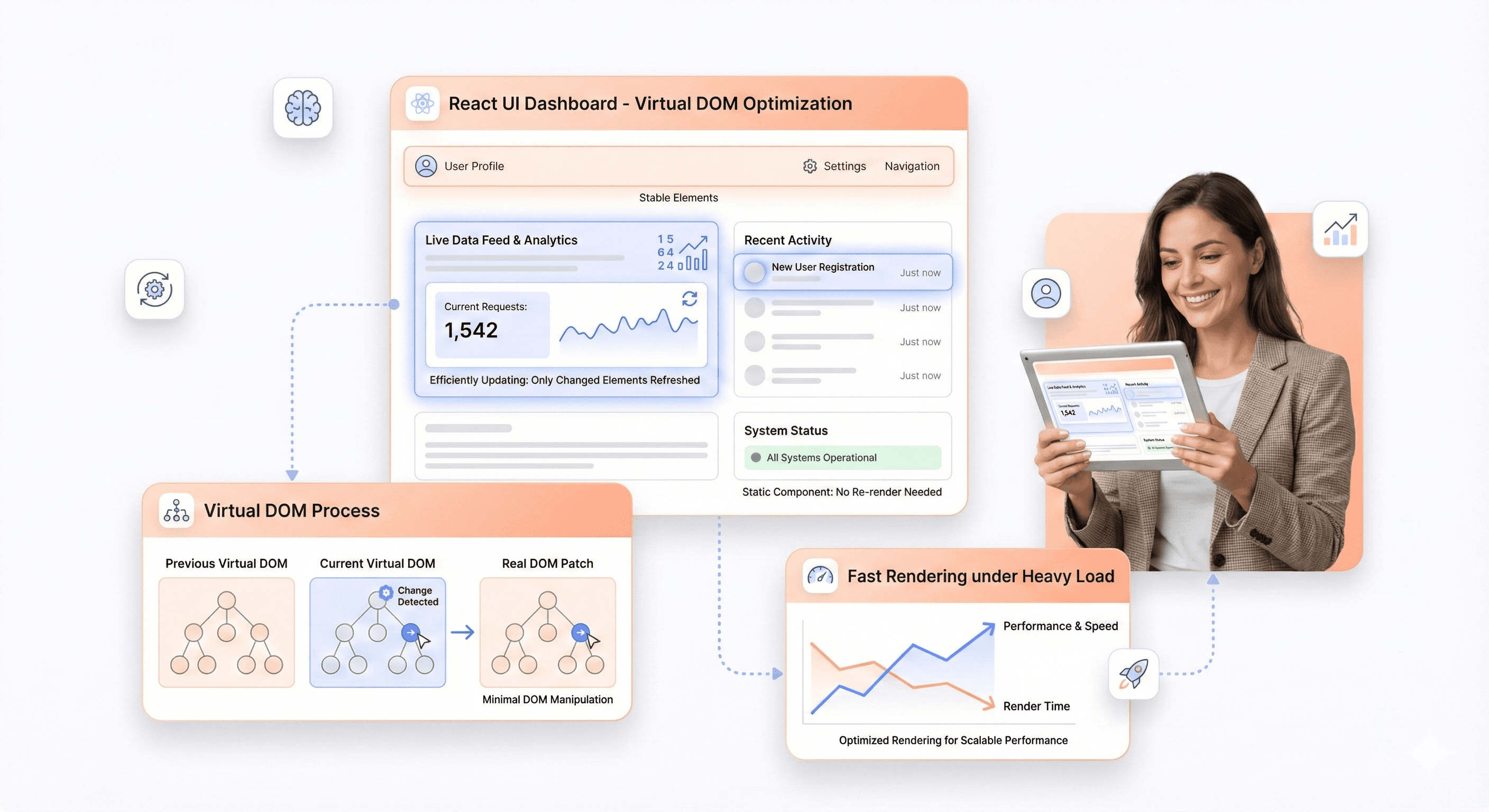
Selective UI updates in a React dashboard demonstrating Virtual DOM performance optimization under heavy user load

React's Virtual DOM implementation provides significant performance advantages during peak usage periods by updating only the changed parts of the actual DOM. This selective rendering approach keeps user interfaces responsive even when handling complex applications with thousands of simultaneous users. Instead of re-rendering entire page sections, React calculates the most efficient way to update the UI, dramatically reducing computational overhead.

When combined with React's memoization capabilities through React.memo and PureComponent, unnecessary re-renders are prevented entirely. This optimization becomes crucial as your SaaS handles increased traffic, ensuring that UI responsiveness remains consistent regardless of user load. The Virtual DOM's efficiency particularly shines in data-heavy dashboards and real-time applications where frequent updates could otherwise degrade performance.

Organize Large Apps into Manageable, Testable Modules

Establishing a feature-first project structure proves essential for maintaining large-scale React applications. Rather than organizing files by type, grouping components, containers, and utilities by feature (such as /UserProfile or /Dashboard) creates logical boundaries that simplify development and testing. This modular approach enables multiple developers to work simultaneously on different features without conflicts.

Code splitting with React.lazy and Suspense further enhances modularity by loading components dynamically, resulting in faster initial page loads. Testing frameworks like Jest and React Testing Library integrate seamlessly with this modular structure, allowing comprehensive testing of individual features without dependencies on the entire application. This separation of concerns makes onboarding new developers faster and reduces the complexity of maintaining large codebases.

Avoid Costly "Big Rewrite" Scenarios as You Grow

React's incremental adoption capabilities and extensive ecosystem support help prevent the need for complete application rewrites as requirements evolve. The library's flexibility allows gradual integration of new technologies and patterns without disrupting existing functionality. TypeScript can be introduced progressively for enhanced type safety, while performance optimization techniques like virtualization and debouncing can be implemented selectively where needed.

The framework's support for backend integrations and microservices architecture ensures that your application can adapt to changing technical requirements without fundamental restructuring. React's clear separation of concerns and extensive tooling ecosystem provide multiple upgrade paths, allowing you to modernize components individually rather than undertaking risky, expensive complete rewrites that could disrupt business operations.

Deliver Superior User Experience That Drives Retention

Provide Fast and Fluid Interactions Without Page Reloads

React's architecture enables applications to deliver lightning-fast user interactions through its virtual DOM and component-based design. Unlike traditional web applications that require full page reloads for each user action, React updates only the specific parts of the interface that have changed. This approach creates a seamless experience where users can interact with buttons, forms, and navigation elements without experiencing the jarring interruption of page refreshes.

The virtual DOM acts as an intelligent intermediary that calculates the most efficient way to update the actual DOM, resulting in smooth animations and instant feedback for user actions. When users click buttons, submit forms, or navigate between sections, they receive immediate visual confirmation that their actions have been registered and processed.

Implement Instant Navigation with Client-Side Routing
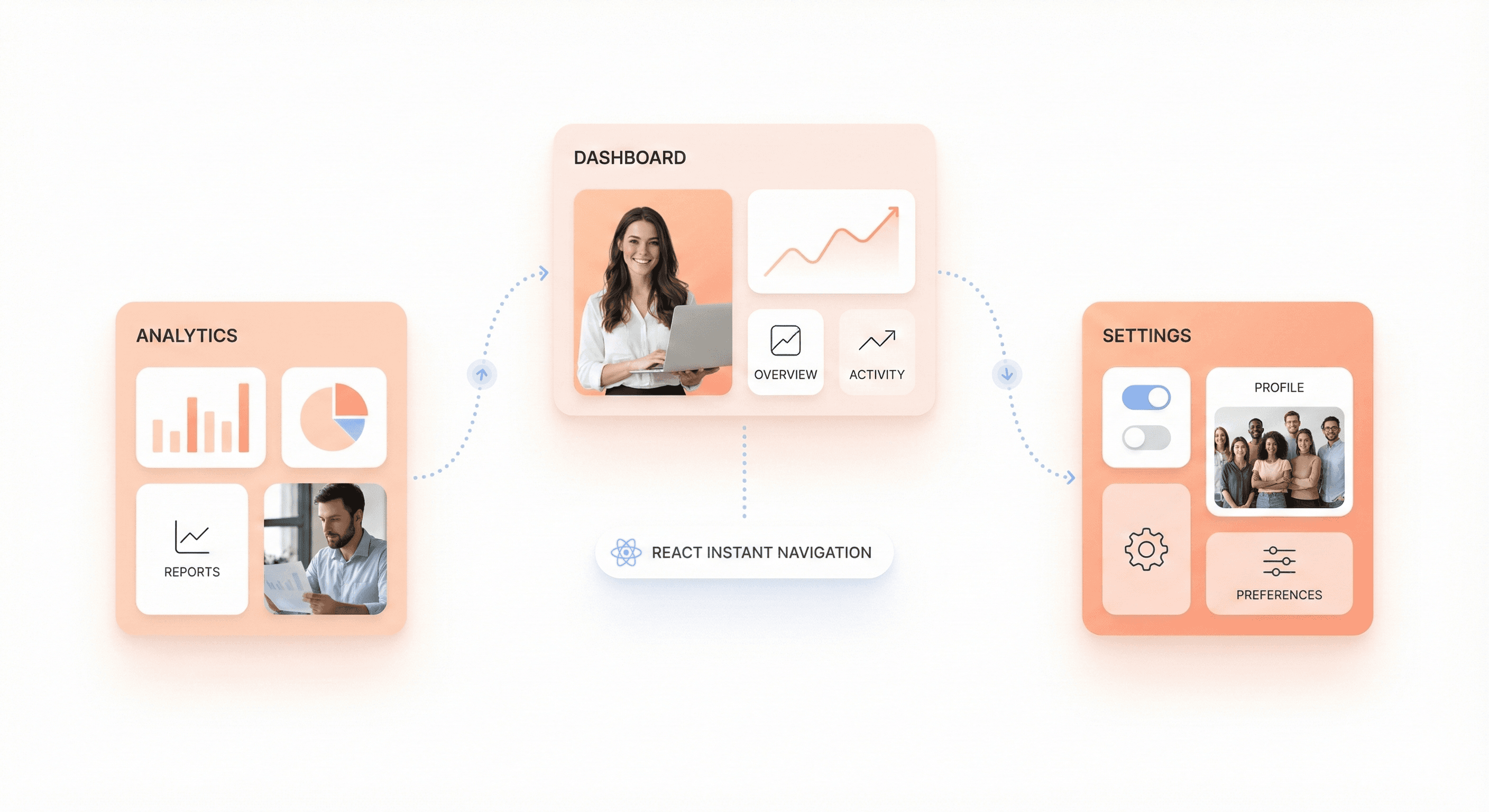
Client-side navigation between SaaS dashboards and settings screens without page reloads using React routing

React's client-side routing capabilities transform how users move through SaaS applications by eliminating the traditional wait times associated with server requests. With React Router and similar libraries, navigation between different sections of your application happens instantaneously, as all the necessary code is already loaded in the browser.

This instant navigation creates a native app-like experience within web browsers, where clicking on menu items or links provides immediate response. Users can seamlessly move between dashboards, settings pages, and data views without experiencing loading delays that might cause them to abandon their tasks or lose their workflow momentum.

Prioritize Critical Updates with Concurrent Features

React's concurrent features allow applications to prioritize user interactions and maintain responsiveness even during heavy computational tasks. This capability ensures that critical user interface updates, such as responding to button clicks or form inputs, take precedence over background processes like data synchronization or complex calculations.

The framework intelligently manages rendering priorities, ensuring that user-facing elements remain interactive while less critical updates are processed in the background. This approach prevents the application from becoming unresponsive during intensive operations, maintaining the smooth user experience that modern SaaS users expect.

Build Professional Perception and User Trust

The fluid, responsive interactions enabled by React contribute significantly to users' perception of your application's professionalism and reliability. When interfaces respond instantly to user input and navigation feels seamless, users develop confidence in the application's stability and performance.

This professional perception directly impacts user retention, as applications that feel polished and responsive encourage continued engagement. Users are more likely to invest time in learning and utilizing features when they trust that the application will perform consistently. The psychological impact of smooth interactions cannot be understated – they create a sense of quality and attention to detail that users associate with premium software solutions.

Modern users have been conditioned by native mobile applications and high-quality web experiences to expect immediate feedback and fluid interactions. React's ability to deliver on these expectations helps establish credibility and encourages users to view your SaaS solution as a professional tool worthy of their time and potential financial investment.

Leverage Massive Ecosystem for Faster Development

Access Battle-Tested Solutions for Every Challenge

The React ecosystem provides battle-tested solutions for virtually every development challenge SaaS teams face. For server state management and caching, TanStack Query (formerly React Query) handles data fetching, caching, and synchronization with automatic background updates, often eliminating the need for complex global state management. As developers note, "TanstackQuery is fantastic for dealing with server data. It will likely get rid of the vast majority of your global state since you don't need to store server data globally to avoid prop drilling anymore."

For client-side state management, Zustand offers a lightweight alternative to Redux with minimal boilerplate, while Jotai provides atomic state management that prevents unnecessary re-renders without requiring memoization. Form handling becomes effortless with React Hook Form, which creates performant forms with built-in validation and minimal re-renders - particularly valuable for complex SaaS application forms.

Authentication and API communication are streamlined through Axios, which provides interceptors for JWT tokens, request/response transformation, and centralized error handling. For TypeScript-based SaaS applications, Zod delivers both compile-time types and runtime validation, catching invalid API responses and form inputs before they cause bugs.

Reduce Custom Development Time with Pre-Built Tools

Pre-built tools in the React ecosystem dramatically reduce custom development time for SaaS applications. UI component libraries eliminate weeks of development work - Material UI provides a comprehensive framework implementing Google's Material Design, while Shadcn/ui offers fully customizable, accessible components with complete control over styling and behavior.

For specialized SaaS needs, SVAR React DataGrid and SVAR React Gantt provide enterprise-ready components for building dashboards, admin panels, and project management tools without starting from scratch. The DataGrid supports sorting, paging, in-cell editing, and virtualization, while the Gantt component offers interactive timeline management for tasks and dependencies.

React Router handles declarative routing for single-page applications, simplifying navigation and view transitions. Testing infrastructure becomes standardized with React Testing Library for unit testing and Playwright for end-to-end testing, providing reliable cross-browser automation and user workflow testing.

Minimize Maintenance Costs with Well-Documented Libraries

Well-documented React ecosystem libraries significantly reduce long-term maintenance costs for SaaS applications. Popular libraries like React Query with 38.7k GitHub stars, React Hook Form with 38.9k stars, and Redux with 60.3k stars benefit from extensive community support and comprehensive documentation.

Vitest, a modern testing framework built on Vite, offers instant watch mode and native ESM support, making it 3-4 times faster than Jest while maintaining excellent documentation. As developers report, "We moved to vitest a while back and never looked back, we use it in any project even if it doesn't use vite."

The extensive documentation and community resources around these libraries mean reduced onboarding time for new team members and faster troubleshooting when issues arise. Libraries like Framer Motion for animations and React Email for email components come with detailed guides and examples, enabling teams to implement complex features without extensive research or trial-and-error development.

Future-Proof Your Technology Stack Investment

The React ecosystem's maturity and continuous evolution ensure SaaS applications remain technologically relevant. Libraries like Next.js with 119k GitHub stars and Remix with 26.7k stars represent full-stack frameworks that evolve with modern web standards while maintaining backward compatibility.

The ecosystem's commitment to web fundamentals means investments in React-based solutions align with platform standards rather than proprietary approaches. Docusaurus for documentation, React Use with its extensive hook library (39.8k stars), and frameworks like Next.js demonstrate the ecosystem's ability to adapt to changing requirements while preserving existing investments.

The large community support behind these libraries ensures continued development and security updates. When libraries like Redux maintain their relevance over years while new solutions like Zustand and Jotai emerge to address specific needs, it demonstrates the ecosystem's ability to evolve without forcing complete rewrites, protecting long-term technology investments.

Integrate Seamlessly with Any Backend Technology

Connect with REST, GraphQL, and WebSocket APIs Effortlessly

React's flexible architecture enables seamless integration with any API type, making it a powerful choice for SaaS applications that need to work with diverse backend technologies. Whether your backend uses traditional REST APIs, modern GraphQL endpoints, or real-time WebSocket connections, React provides robust solutions for each approach.

For REST API integration, React works seamlessly with HTTP clients like Axios and the native Fetch API. You can structure your API calls using service layers that encapsulate all backend communication logic:


GraphQL integration offers even more flexibility for SaaS applications. Apollo Client and Relay provide powerful solutions for GraphQL consumption in React. Apollo Client is particularly developer-friendly and works seamlessly with React out of the box, offering built-in caching and flexible state management that can even replace Redux in some scenarios.


Leverage Existing System Investments Without Replacement

One of React's greatest strengths for SaaS development is its ability to work with existing backend infrastructure without requiring complete system overhauls. This compatibility ensures that organizations can modernize their frontend while preserving valuable backend investments.

React's API layer approach allows you to abstract backend complexities while maintaining compatibility with legacy systems. You can integrate with existing REST endpoints, enterprise databases, and third-party services without modification. The framework's flexible HTTP client support means you can work with any backend that speaks HTTP, regardless of the underlying technology stack.

For authentication and authorization, React easily integrates with existing enterprise security systems. Whether your organization uses JWT tokens, OAuth providers, or session-based authentication, React can accommodate these systems:


This flexibility means you can gradually modernize your frontend while keeping proven backend systems in place, reducing risk and maximizing return on existing technology investments.

Enable Independent Frontend and Backend Development Teams

React's API-first approach creates clear boundaries between frontend and backend responsibilities, enabling development teams to work independently and efficiently. This separation is crucial for SaaS organizations that need to scale their development efforts across multiple teams.

The API layer serves as a contract between frontend and backend teams. Once the API interface is defined, both teams can work in parallel - frontend developers can build UI components and user experiences while backend developers focus on data processing, business logic, and server-side operations.

This independence offers several advantages for SaaS development:

  • Parallel Development: Teams can work simultaneously without blocking each other, significantly reducing development time

  • Specialized Focus: Frontend developers can concentrate on creating engaging user experiences while backend teams optimize data management and business logic

  • Technology Choice Flexibility: Each team can choose the most appropriate tools and technologies for their domain without affecting the other team's work

React's Context API and state management solutions like Redux enable frontend teams to manage API data effectively while maintaining clean separation from backend concerns:

// ApiContext.js
import React, { createContext, useState, useEffect } from 'react';
import { fetchData } from './apiService';

export const ApiContext = createContext();

export const ApiProvider = ({ children }) => {
  const [data, setData] = useState(null);
  const [loading, setLoading] = useState(true);
  const [error, setError]

Accelerate New Feature Rollouts with API-First Design

An API-first approach with React dramatically accelerates feature development and deployment cycles for SaaS applications. By designing APIs before implementing frontend features, teams can ensure consistent data handling and create reusable backend services that support multiple frontend use cases.

React's component-based architecture complements API-first design perfectly. You can create reusable components that consume specific API endpoints, making it easy to add new features by combining existing components with new API integrations. This modular approach significantly reduces development time for new features.

Performance optimization techniques like caching, debouncing, and throttling help ensure new features perform well at scale. Libraries like SWR provide automatic caching and revalidation:

import useSWR from 'swr';
import { fetchData } from './apiService';

const DataComponent = () => {
  const { data, error } = useSWR('/endpoint', fetchData);

  if (error) return <div>Error loading data</div>;
  if (!data) return <div>Loading...</div>;

  return <div>Data: {JSON.stringify(data)}</div>

For user input scenarios, debouncing reduces API calls and improves performance, especially important for SaaS applications with large user bases:

import React, { useState, useEffect } from 'react';
import { fetchData } from './apiService';
import debounce from 'lodash.debounce';

const SearchComponent = () => {
  const [query, setQuery] = useState('');
  const [results, setResults] = useState([]);
  
  const fetchResults = debounce(async (searchTerm) => {
    const data = await fetchData(`/search?query=${searchTerm}`);
    setResults(data);
  }, 300);
  
  useEffect(() => {
    if (query) {
      fetchResults(query);
    }
  }, [query]

This API-first approach with React enables rapid feature iteration, consistent user experiences, and scalable architecture that grows with your SaaS platform's needs.

Build Powerful Dashboards and Admin Panels

Create Interactive Data Visualizations with Real-Time Updates

React's component-based architecture makes it exceptionally powerful for building interactive dashboards with real-time data visualizations. The framework's efficient rendering system handles complex charts, graphs, and data grids seamlessly, enabling SaaS applications to display large chunks of data with optimal performance.

The ecosystem provides numerous charting libraries specifically designed for React, allowing developers to integrate everything from simple line charts to complex gauges and interactive maps. These components can be easily updated with real-time data streams, providing users with instant insights into their business metrics without page refreshes or performance degradation.

Implement Complex User Interactions Like Drag-and-Drop

Modern SaaS dashboards require sophisticated user interactions to enhance productivity and user experience. React's event handling system excels at implementing complex features like drag-and-drop interfaces, making it simple to create intuitive admin panels where users can reorganize elements, move data between sections, or customize their workspace layout.

The framework's state management capabilities ensure that these interactions remain smooth and responsive, even when handling multiple simultaneous user actions. This level of interactivity transforms static admin interfaces into dynamic, user-friendly tools that significantly improve workflow efficiency.

Deliver Compelling User Analytics That Drive Engagement

React templates come equipped with comprehensive analytics components that help SaaS businesses track user behavior and engagement metrics. Popular dashboard templates like Devias Kit and react-admin provide ready-to-use components for user lists, profile pages, and detailed analytics views that can be customized to match specific business requirements.

These pre-built components save development time while ensuring professional-quality interfaces that present complex data in digestible formats. The templates feature everything from simple user tables to sophisticated data visualization tools that help businesses understand their customer base and make data-driven decisions.

Boost Internal Team Productivity with Feature-Rich Tools

React's extensive ecosystem offers powerful admin panel solutions that streamline internal operations. Templates like react-admin provide Do It Yourself frameworks that can be built on top of existing APIs, enabling teams to quickly visualize and interact with business data without extensive custom development.

These feature-rich tools include essential admin functionalities such as user management, content editing, form handling, and notification systems. With over 100 individual components available in popular templates like Creative Tim's offerings, teams can create comprehensive internal tools that include dashboards, calendars, tables, charts, and error handling - all with consistent design and functionality that enhances team productivity and operational efficiency.

Maintain and Update Your SaaS with Minimal Effort

Apply Painless Major Updates with Careful Framework Evolution

React's commitment to backward compatibility makes framework updates remarkably smooth for SaaS applications. Unlike other frameworks that introduce breaking changes frequently, React's evolution follows a careful, methodical approach that prioritizes developer experience and application stability. When new React versions are released, experienced development teams conduct systematic upgrade processes that optimize application performance while ensuring compatibility with the latest features.

The framework's gradual deprecation strategy gives developers ample time to adapt their codebases. Rather than forcing immediate changes, React provides clear migration paths and maintains support for older patterns during transition periods. This approach allows SaaS teams to plan updates strategically, minimizing business disruption while staying current with the latest improvements.

Implement Safe Feature Rollouts with Feature Flags

Modern React applications excel at implementing feature flags, enabling SaaS teams to deploy new functionality gradually and safely. This capability allows developers to introduce features to specific user segments or gradually increase exposure based on performance metrics and user feedback.

Feature flag implementation in React applications provides several advantages for SaaS platforms. Development teams can push code to production while keeping features hidden until they're fully tested and ready for release. This separation of deployment from feature activation reduces risk and enables rapid iteration based on real user data.

The component-based architecture of React makes feature flagging particularly effective, as entire components or specific functionality can be conditionally rendered based on flag status. This granular control ensures that new features can be tested thoroughly in production environments without affecting the broader user base.

Scale Development Teams Rapidly with Built-In Documentation

React's comprehensive documentation ecosystem significantly accelerates team onboarding and knowledge transfer within SaaS organizations. The framework's extensive official documentation, combined with industry-standard practices, creates a foundation that new developers can quickly understand and contribute to.

Maintaining clear and up-to-date documentation for React applications becomes streamlined through established patterns and community conventions. Development teams can leverage React's built-in development tools and extensive ecosystem to create self-documenting code that reduces the learning curve for new team members.

The component-based nature of React applications naturally encourages modular, well-documented code structures. Each component can be documented independently, making it easier for developers to understand specific functionality without needing to grasp the entire application architecture immediately.

Integrate New Technologies Without Architectural Rewrites

React's flexible architecture enables seamless integration of new technologies and third-party tools without requiring complete system overhauls. SaaS applications built with React can adapt to changing technology landscapes by incrementally adopting new solutions while maintaining existing functionality.

The framework's unopinionated approach to state management, routing, and data fetching allows teams to experiment with new libraries and patterns without disrupting core application logic. Whether integrating advanced security scanning tools, performance monitoring solutions, or new API technologies, React applications can accommodate these additions through established integration patterns.

This adaptability proves particularly valuable for SaaS platforms that need to respond quickly to market demands or regulatory requirements. Instead of planning major architectural changes, development teams can implement new capabilities incrementally, reducing both risk and development time while maintaining application stability and performance.

Conclusion
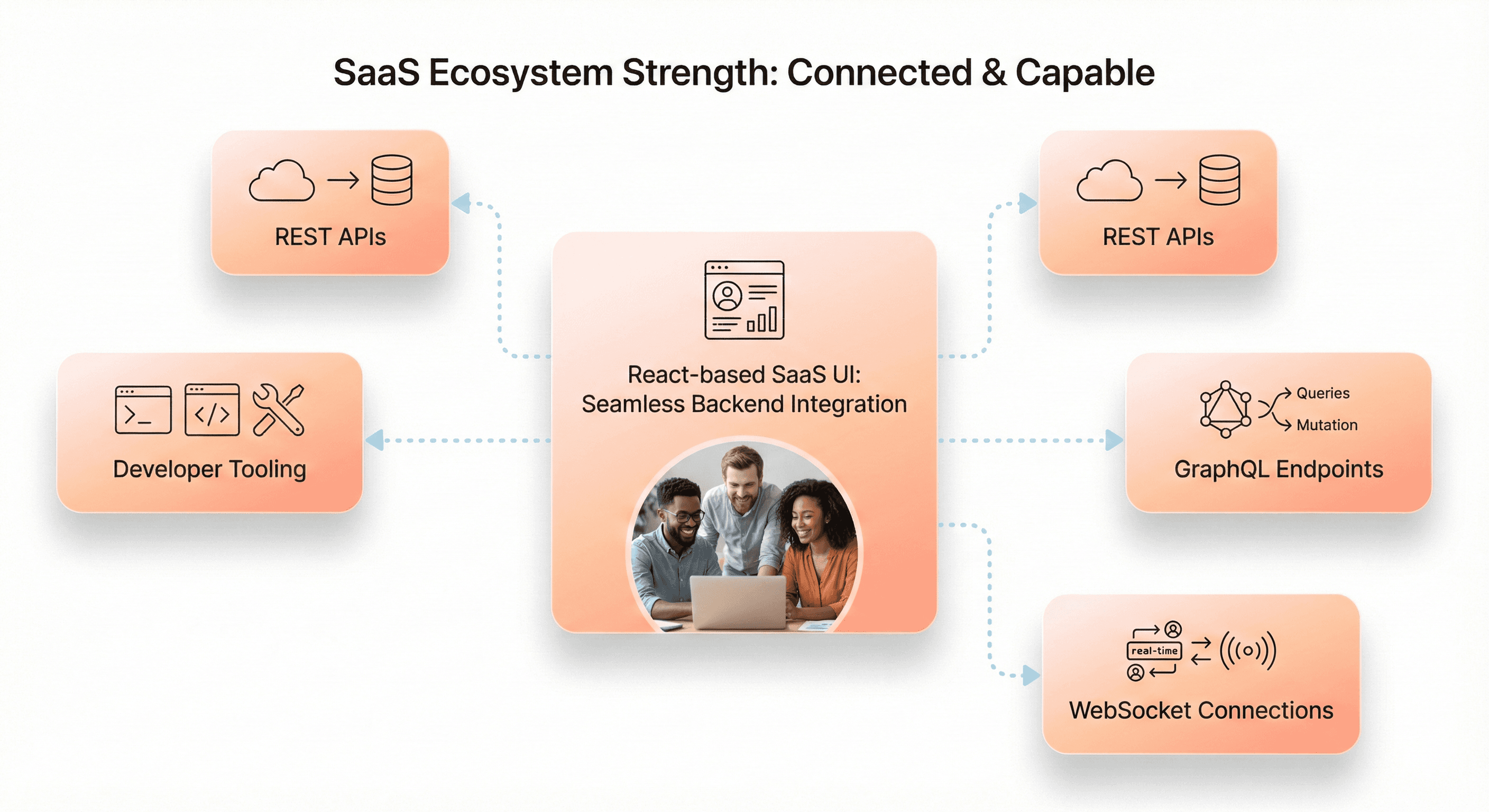
React SaaS frontend connected to REST APIs, GraphQL services, WebSockets, and developer tooling for flexible backend integration

React has consistently proven itself as the strategic backbone for SaaS applications, delivering on every critical business metric that matters. From component-based architecture that accelerates development speed to virtual DOM optimization that ensures scalable performance, React provides the foundation for building applications that grow with your business. The framework's massive ecosystem, seamless backend integration capabilities, and powerful dashboard-building features create a development environment where innovation thrives and time-to-market shrinks dramatically.

The evidence is clear: companies choosing React for their SaaS development gain a significant competitive advantage through faster feature delivery, superior user experiences, and reduced maintenance overhead. When every click impacts churn and every delay costs revenue, React's proven infrastructure ensures your application performs flawlessly while your team focuses on what matters most – delivering value to your users. Ready to transform your SaaS vision into a resilient, high-velocity reality? The path forward is clear, and React is your proven partner for sustainable growth and success.


React has become the go-to frontend framework for SaaS companies looking to build fast, scalable applications that actually retain users. If you're a startup founder racing to launch your MVP, a CTO scaling your tech stack, or a product manager pushing for better user experience, choosing React can make the difference between rapid growth and frustrating churn.

This framework doesn't just help you ship features faster - it transforms how your entire team builds and maintains software. We'll explore how React's component-based architecture accelerates your development speed, letting you build once and reuse everywhere. You'll also discover how React scales your SaaS performance without breaking under user load, and why it delivers the smooth, responsive user experience that keeps customers coming back for more.

Accelerate Development Speed with Component-Based Architecture

Build Reusable UI Components for Faster Feature Development

Reusable React UI components like buttons, modals, and cards connected through a shared component system to accelerate SaaS feature development

React's component-based architecture allows developers to write once and use it multiple times, dramatically reducing redundancy and improving maintainability. Reusable components are self-contained UI elements that can be used multiple times within an application without modifying their core logic. Examples include buttons, modals, input fields, and cards that can all be designed as reusable components.

The benefits of this approach are substantial:

  • Improved Code Maintainability: Instead of writing the same code multiple times, you create a single, well-tested component and reuse it, reducing code duplication and making future modifications easier

  • Better Scalability: When working on large applications, reusable components help maintain consistent UI and reduce development time

  • Enhanced Performance: Since reusable components are optimized and reused, they enhance React app performance by reducing unnecessary re-renders

  • Faster Development: Developers can focus on functionality rather than rebuilding UI elements

To maximize effectiveness, components should follow the Single Responsibility Principle, use props efficiently for dynamic customization, and avoid hardcoded data. A centralized component library stored in dedicated folders like /components or /shared ensures easy management and accessibility across development teams.

Enable Rapid MVP Development and Market Validation

Early-stage SaaS MVP interface evolving into reusable React components for faster iteration and market validation

Component reusability becomes particularly powerful during MVP development phases. When building new features, developers should initially create components to fit minimum customization requirements. For instance, a search button that asks the server for information when clicked doesn't need extensive configuration initially.

However, when the application requires similar functionality elsewhere - such as searching for different entities - this becomes the optimal time to create a generic, reusable component. The button can then receive the function it should call and display text through props, transforming into a truly generic component only when the application demonstrates the same behavior in multiple places.

This approach prevents the trap of building reusable components too far in advance. Software projects constantly change, and today's requirements may make features similar enough to use the same component, but implementation realities might favor building separate one-off components instead of one complicated but reusable solution.

Achieve Guaranteed UX Consistency Across All Product Areas

Reusable components serve as the foundation for maintaining consistent user interfaces across large applications. By establishing a standardized component library, development teams ensure that UI elements behave and appear identically throughout the entire product ecosystem.

Different types of reusable components address various consistency needs:

  • UI Components: Buttons, input fields, dropdowns, and modals

  • Form Components: Custom input fields, text areas, and validation components

  • Navigation Components: Navigation bars, breadcrumbs, and side menus

  • Layout Components: Grid systems, card components, and flex containers

  • Data Display Components: Tables, lists, charts, and graphs

This systematic approach eliminates visual and functional inconsistencies that can confuse users and degrade the overall experience. When a button component is updated or improved, those changes automatically propagate across all instances throughout the application.

Facilitate Rapid Feature Iteration in Hours Instead of Days

The true power of React's component-based architecture emerges during feature iteration cycles. With a well-established component library, developers can rapidly prototype and deploy new features by assembling existing, battle-tested components rather than building everything from scratch.

To maximize iteration speed, components should minimize the amount of state they draw from outside themselves. A search button shouldn't import search terms directly from other components - these should be passed through props instead. Similarly, modals should make independent decisions about display content rather than relying on global state management.

This self-contained approach allows applications to reuse components without importing extra state and creating dependencies. When component logic becomes complicated, it often indicates the need to break functionality into different, more focused components rather than creating increasingly complex reusable ones.

The result is development cycles where new features can be assembled and deployed within hours rather than days, enabling rapid market response and continuous product improvement that keeps SaaS platforms competitive and responsive to user needs.

Scale Your SaaS Performance Without Breaking

Handle Growth from 100 to 100,000 Users Seamlessly

React-based SaaS interface handling increasing user load while maintaining stable frontend architecture and performance

React's component-based architecture naturally accommodates user base expansion without requiring fundamental restructuring. As your SaaS application grows from a small user base to enterprise-scale, React's modular design enables you to add new features and components incrementally. Each component operates independently, allowing development teams to scale specific functionalities based on user demand without affecting the entire application.

The library's efficient state management solutions, including Redux and built-in React hooks, centralize application state handling regardless of user volume. This centralized approach prevents performance bottlenecks that typically emerge as user interactions increase. Additionally, React's support for micro frontends allows you to develop, deploy, and scale different UI segments independently, enabling targeted scaling for high-traffic features while maintaining optimal performance across the platform.

Leverage Virtual DOM for Faster Rendering Under Heavy Load

Selective UI updates in a React dashboard demonstrating Virtual DOM performance optimization under heavy user load

React's Virtual DOM implementation provides significant performance advantages during peak usage periods by updating only the changed parts of the actual DOM. This selective rendering approach keeps user interfaces responsive even when handling complex applications with thousands of simultaneous users. Instead of re-rendering entire page sections, React calculates the most efficient way to update the UI, dramatically reducing computational overhead.

When combined with React's memoization capabilities through React.memo and PureComponent, unnecessary re-renders are prevented entirely. This optimization becomes crucial as your SaaS handles increased traffic, ensuring that UI responsiveness remains consistent regardless of user load. The Virtual DOM's efficiency particularly shines in data-heavy dashboards and real-time applications where frequent updates could otherwise degrade performance.

Organize Large Apps into Manageable, Testable Modules

Establishing a feature-first project structure proves essential for maintaining large-scale React applications. Rather than organizing files by type, grouping components, containers, and utilities by feature (such as /UserProfile or /Dashboard) creates logical boundaries that simplify development and testing. This modular approach enables multiple developers to work simultaneously on different features without conflicts.

Code splitting with React.lazy and Suspense further enhances modularity by loading components dynamically, resulting in faster initial page loads. Testing frameworks like Jest and React Testing Library integrate seamlessly with this modular structure, allowing comprehensive testing of individual features without dependencies on the entire application. This separation of concerns makes onboarding new developers faster and reduces the complexity of maintaining large codebases.

Avoid Costly "Big Rewrite" Scenarios as You Grow

React's incremental adoption capabilities and extensive ecosystem support help prevent the need for complete application rewrites as requirements evolve. The library's flexibility allows gradual integration of new technologies and patterns without disrupting existing functionality. TypeScript can be introduced progressively for enhanced type safety, while performance optimization techniques like virtualization and debouncing can be implemented selectively where needed.

The framework's support for backend integrations and microservices architecture ensures that your application can adapt to changing technical requirements without fundamental restructuring. React's clear separation of concerns and extensive tooling ecosystem provide multiple upgrade paths, allowing you to modernize components individually rather than undertaking risky, expensive complete rewrites that could disrupt business operations.

Deliver Superior User Experience That Drives Retention

Provide Fast and Fluid Interactions Without Page Reloads

React's architecture enables applications to deliver lightning-fast user interactions through its virtual DOM and component-based design. Unlike traditional web applications that require full page reloads for each user action, React updates only the specific parts of the interface that have changed. This approach creates a seamless experience where users can interact with buttons, forms, and navigation elements without experiencing the jarring interruption of page refreshes.

The virtual DOM acts as an intelligent intermediary that calculates the most efficient way to update the actual DOM, resulting in smooth animations and instant feedback for user actions. When users click buttons, submit forms, or navigate between sections, they receive immediate visual confirmation that their actions have been registered and processed.

Implement Instant Navigation with Client-Side Routing

Client-side navigation between SaaS dashboards and settings screens without page reloads using React routing

React's client-side routing capabilities transform how users move through SaaS applications by eliminating the traditional wait times associated with server requests. With React Router and similar libraries, navigation between different sections of your application happens instantaneously, as all the necessary code is already loaded in the browser.

This instant navigation creates a native app-like experience within web browsers, where clicking on menu items or links provides immediate response. Users can seamlessly move between dashboards, settings pages, and data views without experiencing loading delays that might cause them to abandon their tasks or lose their workflow momentum.

Prioritize Critical Updates with Concurrent Features

React's concurrent features allow applications to prioritize user interactions and maintain responsiveness even during heavy computational tasks. This capability ensures that critical user interface updates, such as responding to button clicks or form inputs, take precedence over background processes like data synchronization or complex calculations.

The framework intelligently manages rendering priorities, ensuring that user-facing elements remain interactive while less critical updates are processed in the background. This approach prevents the application from becoming unresponsive during intensive operations, maintaining the smooth user experience that modern SaaS users expect.

Build Professional Perception and User Trust

The fluid, responsive interactions enabled by React contribute significantly to users' perception of your application's professionalism and reliability. When interfaces respond instantly to user input and navigation feels seamless, users develop confidence in the application's stability and performance.

This professional perception directly impacts user retention, as applications that feel polished and responsive encourage continued engagement. Users are more likely to invest time in learning and utilizing features when they trust that the application will perform consistently. The psychological impact of smooth interactions cannot be understated – they create a sense of quality and attention to detail that users associate with premium software solutions.

Modern users have been conditioned by native mobile applications and high-quality web experiences to expect immediate feedback and fluid interactions. React's ability to deliver on these expectations helps establish credibility and encourages users to view your SaaS solution as a professional tool worthy of their time and potential financial investment.

Leverage Massive Ecosystem for Faster Development

Access Battle-Tested Solutions for Every Challenge

The React ecosystem provides battle-tested solutions for virtually every development challenge SaaS teams face. For server state management and caching, TanStack Query (formerly React Query) handles data fetching, caching, and synchronization with automatic background updates, often eliminating the need for complex global state management. As developers note, "TanstackQuery is fantastic for dealing with server data. It will likely get rid of the vast majority of your global state since you don't need to store server data globally to avoid prop drilling anymore."

For client-side state management, Zustand offers a lightweight alternative to Redux with minimal boilerplate, while Jotai provides atomic state management that prevents unnecessary re-renders without requiring memoization. Form handling becomes effortless with React Hook Form, which creates performant forms with built-in validation and minimal re-renders - particularly valuable for complex SaaS application forms.

Authentication and API communication are streamlined through Axios, which provides interceptors for JWT tokens, request/response transformation, and centralized error handling. For TypeScript-based SaaS applications, Zod delivers both compile-time types and runtime validation, catching invalid API responses and form inputs before they cause bugs.

Reduce Custom Development Time with Pre-Built Tools

Pre-built tools in the React ecosystem dramatically reduce custom development time for SaaS applications. UI component libraries eliminate weeks of development work - Material UI provides a comprehensive framework implementing Google's Material Design, while Shadcn/ui offers fully customizable, accessible components with complete control over styling and behavior.

For specialized SaaS needs, SVAR React DataGrid and SVAR React Gantt provide enterprise-ready components for building dashboards, admin panels, and project management tools without starting from scratch. The DataGrid supports sorting, paging, in-cell editing, and virtualization, while the Gantt component offers interactive timeline management for tasks and dependencies.

React Router handles declarative routing for single-page applications, simplifying navigation and view transitions. Testing infrastructure becomes standardized with React Testing Library for unit testing and Playwright for end-to-end testing, providing reliable cross-browser automation and user workflow testing.

Minimize Maintenance Costs with Well-Documented Libraries

Well-documented React ecosystem libraries significantly reduce long-term maintenance costs for SaaS applications. Popular libraries like React Query with 38.7k GitHub stars, React Hook Form with 38.9k stars, and Redux with 60.3k stars benefit from extensive community support and comprehensive documentation.

Vitest, a modern testing framework built on Vite, offers instant watch mode and native ESM support, making it 3-4 times faster than Jest while maintaining excellent documentation. As developers report, "We moved to vitest a while back and never looked back, we use it in any project even if it doesn't use vite."

The extensive documentation and community resources around these libraries mean reduced onboarding time for new team members and faster troubleshooting when issues arise. Libraries like Framer Motion for animations and React Email for email components come with detailed guides and examples, enabling teams to implement complex features without extensive research or trial-and-error development.

Future-Proof Your Technology Stack Investment

The React ecosystem's maturity and continuous evolution ensure SaaS applications remain technologically relevant. Libraries like Next.js with 119k GitHub stars and Remix with 26.7k stars represent full-stack frameworks that evolve with modern web standards while maintaining backward compatibility.

The ecosystem's commitment to web fundamentals means investments in React-based solutions align with platform standards rather than proprietary approaches. Docusaurus for documentation, React Use with its extensive hook library (39.8k stars), and frameworks like Next.js demonstrate the ecosystem's ability to adapt to changing requirements while preserving existing investments.

The large community support behind these libraries ensures continued development and security updates. When libraries like Redux maintain their relevance over years while new solutions like Zustand and Jotai emerge to address specific needs, it demonstrates the ecosystem's ability to evolve without forcing complete rewrites, protecting long-term technology investments.

Integrate Seamlessly with Any Backend Technology

Connect with REST, GraphQL, and WebSocket APIs Effortlessly

React's flexible architecture enables seamless integration with any API type, making it a powerful choice for SaaS applications that need to work with diverse backend technologies. Whether your backend uses traditional REST APIs, modern GraphQL endpoints, or real-time WebSocket connections, React provides robust solutions for each approach.

For REST API integration, React works seamlessly with HTTP clients like Axios and the native Fetch API. You can structure your API calls using service layers that encapsulate all backend communication logic:


GraphQL integration offers even more flexibility for SaaS applications. Apollo Client and Relay provide powerful solutions for GraphQL consumption in React. Apollo Client is particularly developer-friendly and works seamlessly with React out of the box, offering built-in caching and flexible state management that can even replace Redux in some scenarios.


Leverage Existing System Investments Without Replacement

One of React's greatest strengths for SaaS development is its ability to work with existing backend infrastructure without requiring complete system overhauls. This compatibility ensures that organizations can modernize their frontend while preserving valuable backend investments.

React's API layer approach allows you to abstract backend complexities while maintaining compatibility with legacy systems. You can integrate with existing REST endpoints, enterprise databases, and third-party services without modification. The framework's flexible HTTP client support means you can work with any backend that speaks HTTP, regardless of the underlying technology stack.

For authentication and authorization, React easily integrates with existing enterprise security systems. Whether your organization uses JWT tokens, OAuth providers, or session-based authentication, React can accommodate these systems:


This flexibility means you can gradually modernize your frontend while keeping proven backend systems in place, reducing risk and maximizing return on existing technology investments.

Enable Independent Frontend and Backend Development Teams

React's API-first approach creates clear boundaries between frontend and backend responsibilities, enabling development teams to work independently and efficiently. This separation is crucial for SaaS organizations that need to scale their development efforts across multiple teams.

The API layer serves as a contract between frontend and backend teams. Once the API interface is defined, both teams can work in parallel - frontend developers can build UI components and user experiences while backend developers focus on data processing, business logic, and server-side operations.

This independence offers several advantages for SaaS development:

  • Parallel Development: Teams can work simultaneously without blocking each other, significantly reducing development time

  • Specialized Focus: Frontend developers can concentrate on creating engaging user experiences while backend teams optimize data management and business logic

  • Technology Choice Flexibility: Each team can choose the most appropriate tools and technologies for their domain without affecting the other team's work

React's Context API and state management solutions like Redux enable frontend teams to manage API data effectively while maintaining clean separation from backend concerns:

// ApiContext.js
import React, { createContext, useState, useEffect } from 'react';
import { fetchData } from './apiService';

export const ApiContext = createContext();

export const ApiProvider = ({ children }) => {
  const [data, setData] = useState(null);
  const [loading, setLoading] = useState(true);
  const [error, setError]

Accelerate New Feature Rollouts with API-First Design

An API-first approach with React dramatically accelerates feature development and deployment cycles for SaaS applications. By designing APIs before implementing frontend features, teams can ensure consistent data handling and create reusable backend services that support multiple frontend use cases.

React's component-based architecture complements API-first design perfectly. You can create reusable components that consume specific API endpoints, making it easy to add new features by combining existing components with new API integrations. This modular approach significantly reduces development time for new features.

Performance optimization techniques like caching, debouncing, and throttling help ensure new features perform well at scale. Libraries like SWR provide automatic caching and revalidation:

import useSWR from 'swr';
import { fetchData } from './apiService';

const DataComponent = () => {
  const { data, error } = useSWR('/endpoint', fetchData);

  if (error) return <div>Error loading data</div>;
  if (!data) return <div>Loading...</div>;

  return <div>Data: {JSON.stringify(data)}</div>

For user input scenarios, debouncing reduces API calls and improves performance, especially important for SaaS applications with large user bases:

import React, { useState, useEffect } from 'react';
import { fetchData } from './apiService';
import debounce from 'lodash.debounce';

const SearchComponent = () => {
  const [query, setQuery] = useState('');
  const [results, setResults] = useState([]);
  
  const fetchResults = debounce(async (searchTerm) => {
    const data = await fetchData(`/search?query=${searchTerm}`);
    setResults(data);
  }, 300);
  
  useEffect(() => {
    if (query) {
      fetchResults(query);
    }
  }, [query]

This API-first approach with React enables rapid feature iteration, consistent user experiences, and scalable architecture that grows with your SaaS platform's needs.

Build Powerful Dashboards and Admin Panels

Create Interactive Data Visualizations with Real-Time Updates

React's component-based architecture makes it exceptionally powerful for building interactive dashboards with real-time data visualizations. The framework's efficient rendering system handles complex charts, graphs, and data grids seamlessly, enabling SaaS applications to display large chunks of data with optimal performance.

The ecosystem provides numerous charting libraries specifically designed for React, allowing developers to integrate everything from simple line charts to complex gauges and interactive maps. These components can be easily updated with real-time data streams, providing users with instant insights into their business metrics without page refreshes or performance degradation.

Implement Complex User Interactions Like Drag-and-Drop

Modern SaaS dashboards require sophisticated user interactions to enhance productivity and user experience. React's event handling system excels at implementing complex features like drag-and-drop interfaces, making it simple to create intuitive admin panels where users can reorganize elements, move data between sections, or customize their workspace layout.

The framework's state management capabilities ensure that these interactions remain smooth and responsive, even when handling multiple simultaneous user actions. This level of interactivity transforms static admin interfaces into dynamic, user-friendly tools that significantly improve workflow efficiency.

Deliver Compelling User Analytics That Drive Engagement

React templates come equipped with comprehensive analytics components that help SaaS businesses track user behavior and engagement metrics. Popular dashboard templates like Devias Kit and react-admin provide ready-to-use components for user lists, profile pages, and detailed analytics views that can be customized to match specific business requirements.

These pre-built components save development time while ensuring professional-quality interfaces that present complex data in digestible formats. The templates feature everything from simple user tables to sophisticated data visualization tools that help businesses understand their customer base and make data-driven decisions.

Boost Internal Team Productivity with Feature-Rich Tools

React's extensive ecosystem offers powerful admin panel solutions that streamline internal operations. Templates like react-admin provide Do It Yourself frameworks that can be built on top of existing APIs, enabling teams to quickly visualize and interact with business data without extensive custom development.

These feature-rich tools include essential admin functionalities such as user management, content editing, form handling, and notification systems. With over 100 individual components available in popular templates like Creative Tim's offerings, teams can create comprehensive internal tools that include dashboards, calendars, tables, charts, and error handling - all with consistent design and functionality that enhances team productivity and operational efficiency.

Maintain and Update Your SaaS with Minimal Effort

Apply Painless Major Updates with Careful Framework Evolution

React's commitment to backward compatibility makes framework updates remarkably smooth for SaaS applications. Unlike other frameworks that introduce breaking changes frequently, React's evolution follows a careful, methodical approach that prioritizes developer experience and application stability. When new React versions are released, experienced development teams conduct systematic upgrade processes that optimize application performance while ensuring compatibility with the latest features.

The framework's gradual deprecation strategy gives developers ample time to adapt their codebases. Rather than forcing immediate changes, React provides clear migration paths and maintains support for older patterns during transition periods. This approach allows SaaS teams to plan updates strategically, minimizing business disruption while staying current with the latest improvements.

Implement Safe Feature Rollouts with Feature Flags

Modern React applications excel at implementing feature flags, enabling SaaS teams to deploy new functionality gradually and safely. This capability allows developers to introduce features to specific user segments or gradually increase exposure based on performance metrics and user feedback.

Feature flag implementation in React applications provides several advantages for SaaS platforms. Development teams can push code to production while keeping features hidden until they're fully tested and ready for release. This separation of deployment from feature activation reduces risk and enables rapid iteration based on real user data.

The component-based architecture of React makes feature flagging particularly effective, as entire components or specific functionality can be conditionally rendered based on flag status. This granular control ensures that new features can be tested thoroughly in production environments without affecting the broader user base.

Scale Development Teams Rapidly with Built-In Documentation

React's comprehensive documentation ecosystem significantly accelerates team onboarding and knowledge transfer within SaaS organizations. The framework's extensive official documentation, combined with industry-standard practices, creates a foundation that new developers can quickly understand and contribute to.

Maintaining clear and up-to-date documentation for React applications becomes streamlined through established patterns and community conventions. Development teams can leverage React's built-in development tools and extensive ecosystem to create self-documenting code that reduces the learning curve for new team members.

The component-based nature of React applications naturally encourages modular, well-documented code structures. Each component can be documented independently, making it easier for developers to understand specific functionality without needing to grasp the entire application architecture immediately.

Integrate New Technologies Without Architectural Rewrites

React's flexible architecture enables seamless integration of new technologies and third-party tools without requiring complete system overhauls. SaaS applications built with React can adapt to changing technology landscapes by incrementally adopting new solutions while maintaining existing functionality.

The framework's unopinionated approach to state management, routing, and data fetching allows teams to experiment with new libraries and patterns without disrupting core application logic. Whether integrating advanced security scanning tools, performance monitoring solutions, or new API technologies, React applications can accommodate these additions through established integration patterns.

This adaptability proves particularly valuable for SaaS platforms that need to respond quickly to market demands or regulatory requirements. Instead of planning major architectural changes, development teams can implement new capabilities incrementally, reducing both risk and development time while maintaining application stability and performance.

Conclusion

React SaaS frontend connected to REST APIs, GraphQL services, WebSockets, and developer tooling for flexible backend integration

React has consistently proven itself as the strategic backbone for SaaS applications, delivering on every critical business metric that matters. From component-based architecture that accelerates development speed to virtual DOM optimization that ensures scalable performance, React provides the foundation for building applications that grow with your business. The framework's massive ecosystem, seamless backend integration capabilities, and powerful dashboard-building features create a development environment where innovation thrives and time-to-market shrinks dramatically.

The evidence is clear: companies choosing React for their SaaS development gain a significant competitive advantage through faster feature delivery, superior user experiences, and reduced maintenance overhead. When every click impacts churn and every delay costs revenue, React's proven infrastructure ensures your application performs flawlessly while your team focuses on what matters most – delivering value to your users. Ready to transform your SaaS vision into a resilient, high-velocity reality? The path forward is clear, and React is your proven partner for sustainable growth and success.
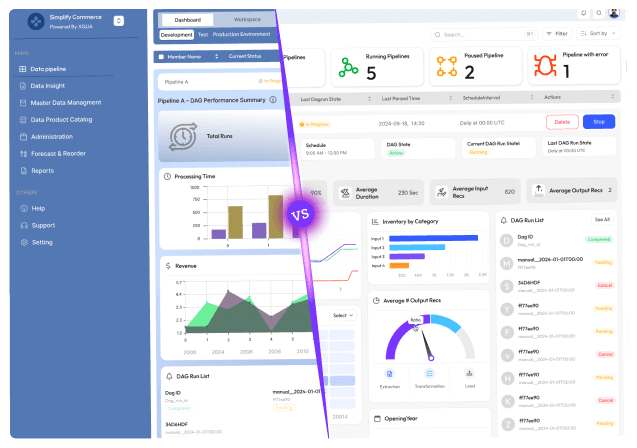
Stuck with slow releases and high IT costs?

▶︎

Launch 2.5x faster with our AI-driven frontend workflows, specialized for SaaS.

▶︎

Cut IT costs by up to 50% and boost user adoption by 2x with our proprietary frameworks.

Stuck with slow releases and high IT costs?

▶︎

Launch 2.5x faster with our AI-driven frontend workflows, specialized for SaaS.

▶︎

Cut IT costs by up to 50% and boost user adoption by 2x with our proprietary frameworks.

Stuck with slow releases and high IT costs?

▶︎

Launch 2.5x faster with our AI-driven frontend workflows, specialized for SaaS.

▶︎

Cut IT costs by up to 50% and boost user adoption by 2x with our proprietary frameworks.

Frequently Asked Questions

We're ready to answer your questions

Slow releases, clunky dashboards, and frustrated users? You've got questions about how to fix them. We have the Frontend-First answers that unlock growth. Let's talk solutions.

React is well-suited for SaaS products because it enables faster development, scalable performance, and a smooth user experience. Its component-based architecture allows teams to build reusable UI elements, while its efficient rendering model keeps applications responsive as they grow. This combination helps SaaS teams ship features faster without sacrificing stability or UX.

Answer

Why is React a good choice for SaaS applications?

Question

React allows developers to break the interface into independent, reusable components. This reduces duplicated code, simplifies maintenance, and makes it easier to add or modify features as the product evolves. As a SaaS application grows, teams can scale specific features without restructuring the entire frontend.

Answer

How does React help SaaS teams build and scale faster?

Question

React uses a Virtual DOM to update only the parts of the interface that change, instead of re-rendering entire pages. This selective rendering reduces unnecessary work in the browser, keeping the application fast and responsive even under heavy user load or in data-intensive dashboards.

Answer

How does React improve performance in large or growing SaaS products?

Question

Yes. React enables fast, fluid interactions without full page reloads, creating a smooth and app-like experience. Instant navigation, responsive UI updates, and consistent interface behavior across the product help users complete tasks faster and build trust in the software, which directly supports retention.

Answer

Does React improve user experience and retention in SaaS products?

Question

React is designed to work with a wide range of backend technologies. It can connect seamlessly with REST APIs, GraphQL services, and real-time data sources without requiring backend changes. This makes it easier for SaaS companies to modernize their frontend while continuing to use existing infrastructure.

Answer

Can React integrate with existing backend systems in a SaaS setup?

Question

Frequently Asked Questions

We're ready to answer your questions

Slow releases, clunky dashboards, and frustrated users? You've got questions about how to fix them. We have the Frontend-First answers that unlock growth. Let's talk solutions.

React is well-suited for SaaS products because it enables faster development, scalable performance, and a smooth user experience. Its component-based architecture allows teams to build reusable UI elements, while its efficient rendering model keeps applications responsive as they grow. This combination helps SaaS teams ship features faster without sacrificing stability or UX.

Answer

Why is React a good choice for SaaS applications?

Question

React allows developers to break the interface into independent, reusable components. This reduces duplicated code, simplifies maintenance, and makes it easier to add or modify features as the product evolves. As a SaaS application grows, teams can scale specific features without restructuring the entire frontend.

Answer

How does React help SaaS teams build and scale faster?

Question

React uses a Virtual DOM to update only the parts of the interface that change, instead of re-rendering entire pages. This selective rendering reduces unnecessary work in the browser, keeping the application fast and responsive even under heavy user load or in data-intensive dashboards.

Answer

How does React improve performance in large or growing SaaS products?

Question

Yes. React enables fast, fluid interactions without full page reloads, creating a smooth and app-like experience. Instant navigation, responsive UI updates, and consistent interface behavior across the product help users complete tasks faster and build trust in the software, which directly supports retention.

Answer

Does React improve user experience and retention in SaaS products?

Question

React is designed to work with a wide range of backend technologies. It can connect seamlessly with REST APIs, GraphQL services, and real-time data sources without requiring backend changes. This makes it easier for SaaS companies to modernize their frontend while continuing to use existing infrastructure.

Answer

Can React integrate with existing backend systems in a SaaS setup?

Question

Frequently Asked Questions

We're ready to answer your questions

Slow releases, clunky dashboards, and frustrated users? You've got questions about how to fix them. We have the Frontend-First answers that unlock growth. Let's talk solutions.

React is well-suited for SaaS products because it enables faster development, scalable performance, and a smooth user experience. Its component-based architecture allows teams to build reusable UI elements, while its efficient rendering model keeps applications responsive as they grow. This combination helps SaaS teams ship features faster without sacrificing stability or UX.

Answer

Why is React a good choice for SaaS applications?

Question

React allows developers to break the interface into independent, reusable components. This reduces duplicated code, simplifies maintenance, and makes it easier to add or modify features as the product evolves. As a SaaS application grows, teams can scale specific features without restructuring the entire frontend.

Answer

How does React help SaaS teams build and scale faster?

Question

React uses a Virtual DOM to update only the parts of the interface that change, instead of re-rendering entire pages. This selective rendering reduces unnecessary work in the browser, keeping the application fast and responsive even under heavy user load or in data-intensive dashboards.

Answer

How does React improve performance in large or growing SaaS products?

Question

Yes. React enables fast, fluid interactions without full page reloads, creating a smooth and app-like experience. Instant navigation, responsive UI updates, and consistent interface behavior across the product help users complete tasks faster and build trust in the software, which directly supports retention.

Answer

Does React improve user experience and retention in SaaS products?

Question

React is designed to work with a wide range of backend technologies. It can connect seamlessly with REST APIs, GraphQL services, and real-time data sources without requiring backend changes. This makes it easier for SaaS companies to modernize their frontend while continuing to use existing infrastructure.

Answer

Can React integrate with existing backend systems in a SaaS setup?

Question

About the author

Author Name:

Parth G

|


Founder of

Hashbyt

I’m the founder of Hashbyt, an AI-first frontend and UI/UX SaaS partner helping 200+ SaaS companies scale faster through intelligent, growth-driven design. My work focuses on building modern frontend systems, design frameworks, and product modernization strategies that boost revenue, improve user adoption, and help SaaS founders turn their UI into a true growth engine.
Follow the expert:

Related Blogs

Related Blogs

Is a clunky UI holding back your growth?

Is a clunky UI holding back your growth?

▶︎

Transform slow, frustrating dashboards into intuitive interfaces that ensure effortless user adoption.

▶︎

Transform slow, frustrating dashboards into intuitive interfaces that ensure effortless user adoption.

Is a clunky UI holding back your growth?

Is a clunky UI holding back your growth?

▶︎

Transform slow, frustrating dashboards into intuitive interfaces that ensure effortless user adoption.

▶︎

Transform slow, frustrating dashboards into intuitive interfaces that ensure effortless user adoption.

Is a clunky UI holding back your growth?

Is a clunky UI holding back your growth?

▶︎

Transform slow, frustrating dashboards into intuitive interfaces that ensure effortless user adoption.

▶︎

Transform slow, frustrating dashboards into intuitive interfaces that ensure effortless user adoption.