
How to Hire React Developers for Scalable SaaS Products
Posted on
Fronend Development
Guide
Posted at
Jan 7, 2026
Jan 7, 2026
Min read
10

I hope you found this post valuable. If you’re looking for proven frontend and design expertise to elevate your product, feel free to reach out.


Building scalable SaaS products requires React developers who can handle more than just basic component creation. These professionals need to architect front-end systems that grow with your user base, integrate seamlessly with backend APIs, and deliver lightning-fast performance under heavy load.
This guide is for CTOs, engineering managers, and startup founders who want to build reliable React teams without the typical hiring headaches. You need developers who understand both the technical complexities of React and the business realities of SaaS development.
We'll walk through the essential skills that separate good React developers from great ones, including experience with Next.js, TypeScript, and performance optimization. You'll also learn about different engagement models - from dedicated teams to project-based contracts - so you can choose what works best for your timeline and budget. Finally, we'll cover proven vetting strategies that help you identify developers who can actually deliver production-ready code, not just pass coding interviews.
Understanding React's Role in Modern SaaS Architecture
Why React Powers Leading SaaS Platforms
React has become the go-to frontend framework for SaaS companies looking to build fast, scalable applications that actually retain users. Leading SaaS platforms choose React because it doesn't just help ship features faster - it transforms how entire teams build and maintain software. The framework's widespread adoption by industry leaders demonstrates its proven capability to handle the complex demands of modern SaaS applications.
The technology enables accelerated development through its component-based architecture, where developers write once and use multiple times, dramatically reducing redundancy and improving maintainability. This approach proves particularly valuable during MVP phases, where rapid market validation is crucial. Companies can build core app flows including signup, dashboard, and settings more efficiently as reusable components stack together seamlessly.
React's dominance stems from its ability to deliver superior user experience while maintaining development efficiency. The framework enables lightning-fast interactions without page reloads by updating only changed UI parts, creating smooth animations and instant feedback that modern users demand.
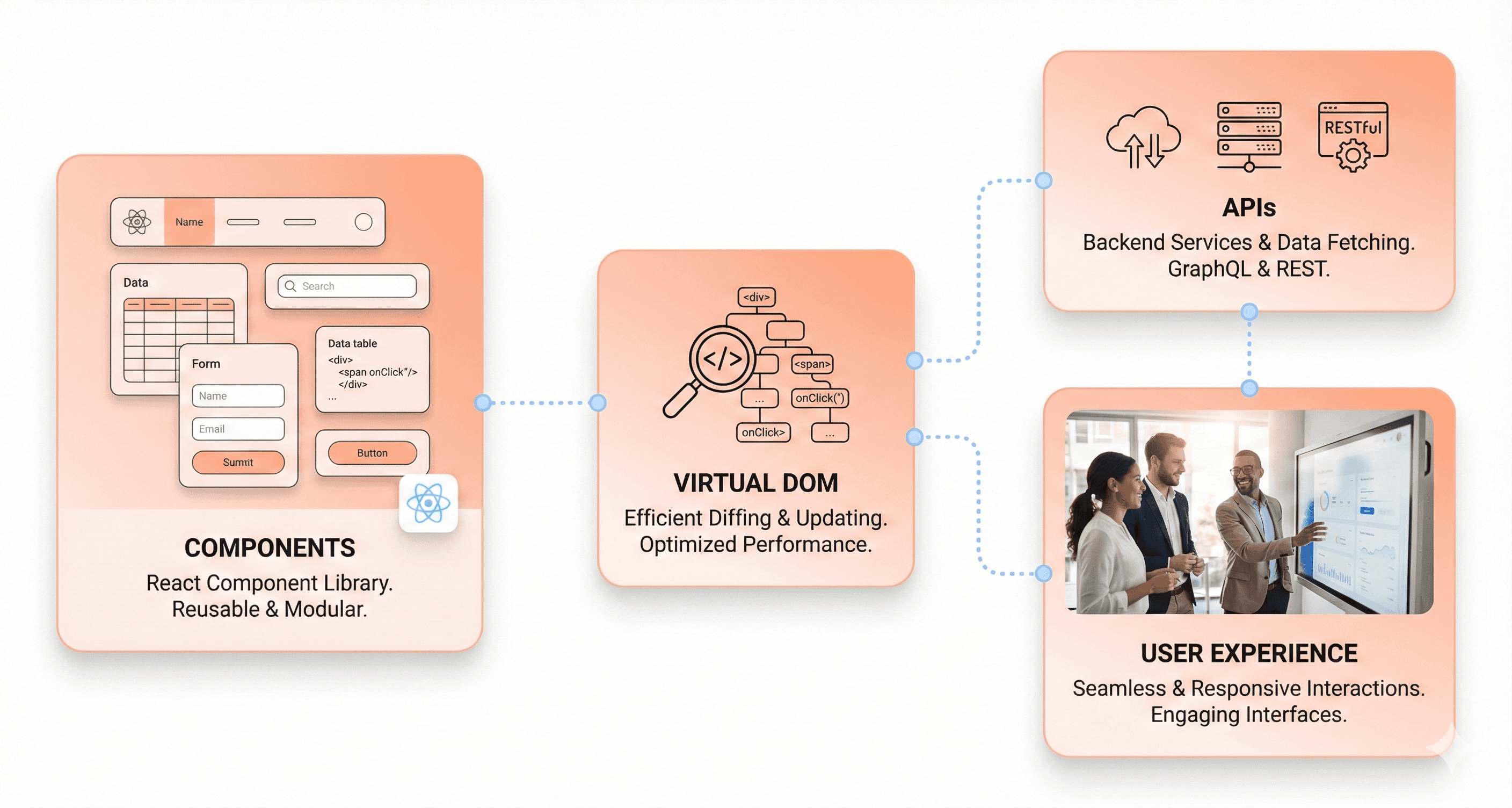
Component-Based Architecture Benefits for Scalability
React's foundational strength lies in its component-based architecture, which serves as the cornerstone for building scalable SaaS applications. This architectural approach allows development teams to create self-contained UI elements that can be used multiple times within an application without modifying their core logic. Examples include buttons, modals, input fields, and cards that maintain consistent functionality across different contexts.
The scalability benefits of this approach are multifaceted:
Improved Code Maintainability: Instead of writing the same code multiple times, developers create a single, well-tested component and reuse it, reducing code duplication and making future modifications significantly easier. This centralized approach means updates to a component propagate automatically, maintaining visual and functional consistency throughout the product.
Enhanced Development Speed: Developers can focus on functionality rather than rebuilding UI elements from scratch. With a robust component library, new features can be rapidly prototyped by assembling existing components, allowing deployment within hours rather than days.
Better Long-term Scalability: Reusable components help maintain consistent UI and reduce development time on large applications. React's modular design supports growth from 100 to 100,000+ users without requiring fundamental restructuring. Each component operates independently, allowing incremental scaling based on demand.
To maximize effectiveness, components should follow the Single Responsibility Principle, use props efficiently for dynamic customization, and avoid hardcoded data. A centralized component library stored in dedicated folders like /components or /shared ensures easy management and accessibility across teams.
The component-based approach proves especially powerful for SaaS dashboards and admin panels, where complex data must be transformed into interactive experiences. State management and component reusability ensure smooth rendering and instant updates, even with thousands of data points.
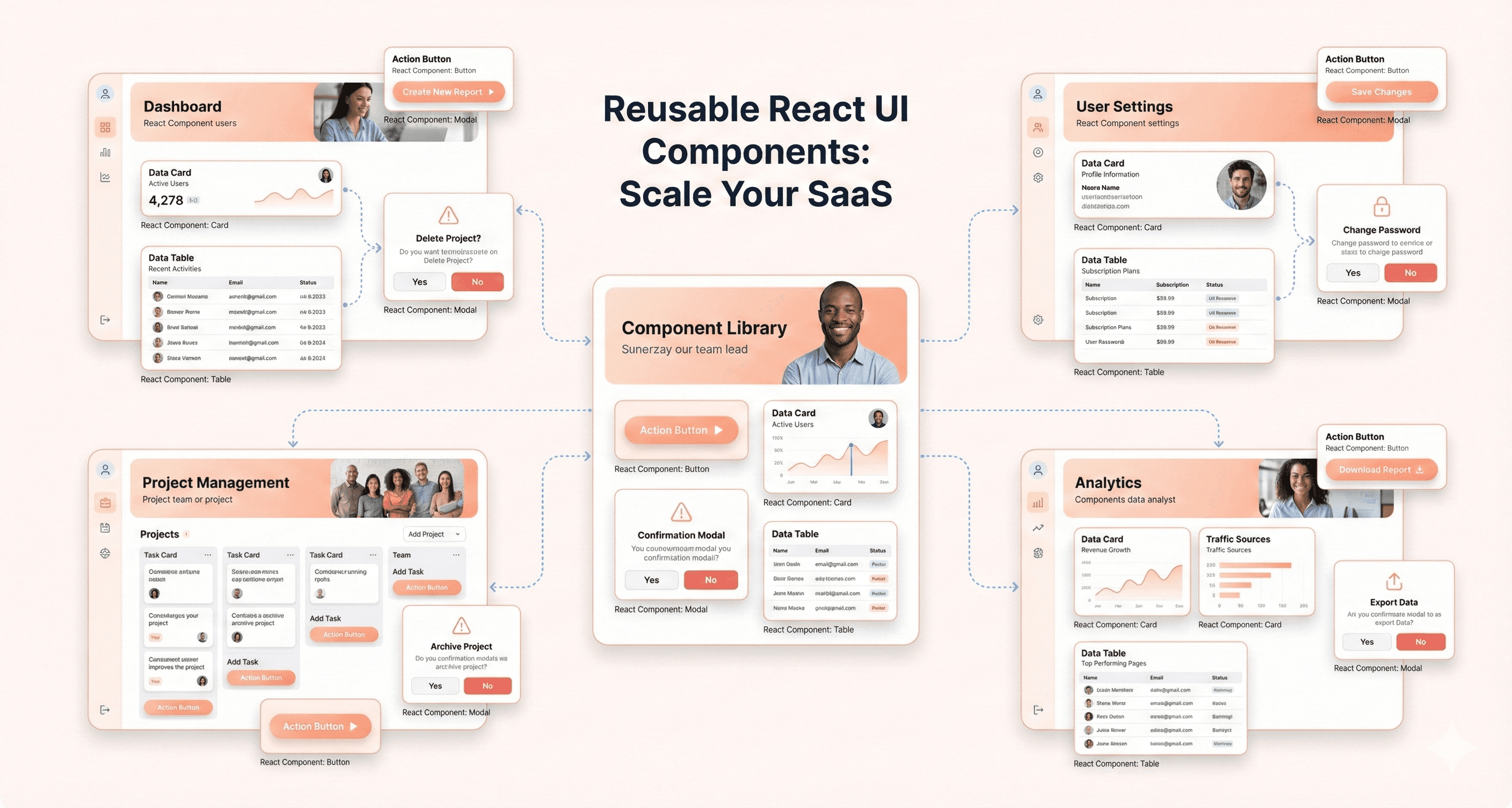
Performance Advantages with Virtual DOM Technology
React's Virtual DOM technology represents a revolutionary approach to UI rendering that delivers significant performance advantages for SaaS applications. The Virtual DOM maintains a lightweight "virtual" representation of the UI in memory, and when data changes, React calculates the minimal set of actual DOM updates needed through a process called diffing.
This technology becomes particularly effective in applications with frequent, dynamic updates such as real-time dashboards, collaborative tools, and complex data grids. Instead of re-rendering entire sections of the interface, the Virtual DOM updates only the changed parts, keeping the UI responsive even under heavy load.
The performance benefits manifest in several key areas:
Faster Rendering Under Load: For apps handling complex interactions and frequent updates, Virtual DOM ensures significantly faster rendering and smoother user experience. This is crucial for SaaS platforms where performance directly impacts user retention and engagement.
Optimized Re-rendering: When combined with React.memo and PureComponent, the Virtual DOM prevents unnecessary re-renders, further enhancing performance. This optimization proves particularly valuable in dashboards and real-time applications where data updates constantly.
Scalable Performance: The Virtual DOM enables SaaS applications to handle growth gracefully, maintaining UI responsiveness whether serving 100 users or 100,000+ users. This scalability prevents performance from becoming a bottleneck as the user base expands.
Concurrent Features Support: React's concurrent features work alongside Virtual DOM to prioritize critical updates, ensuring apps remain responsive even during heavy computation. This means typing feedback and user interactions maintain priority over less critical background rendering tasks.
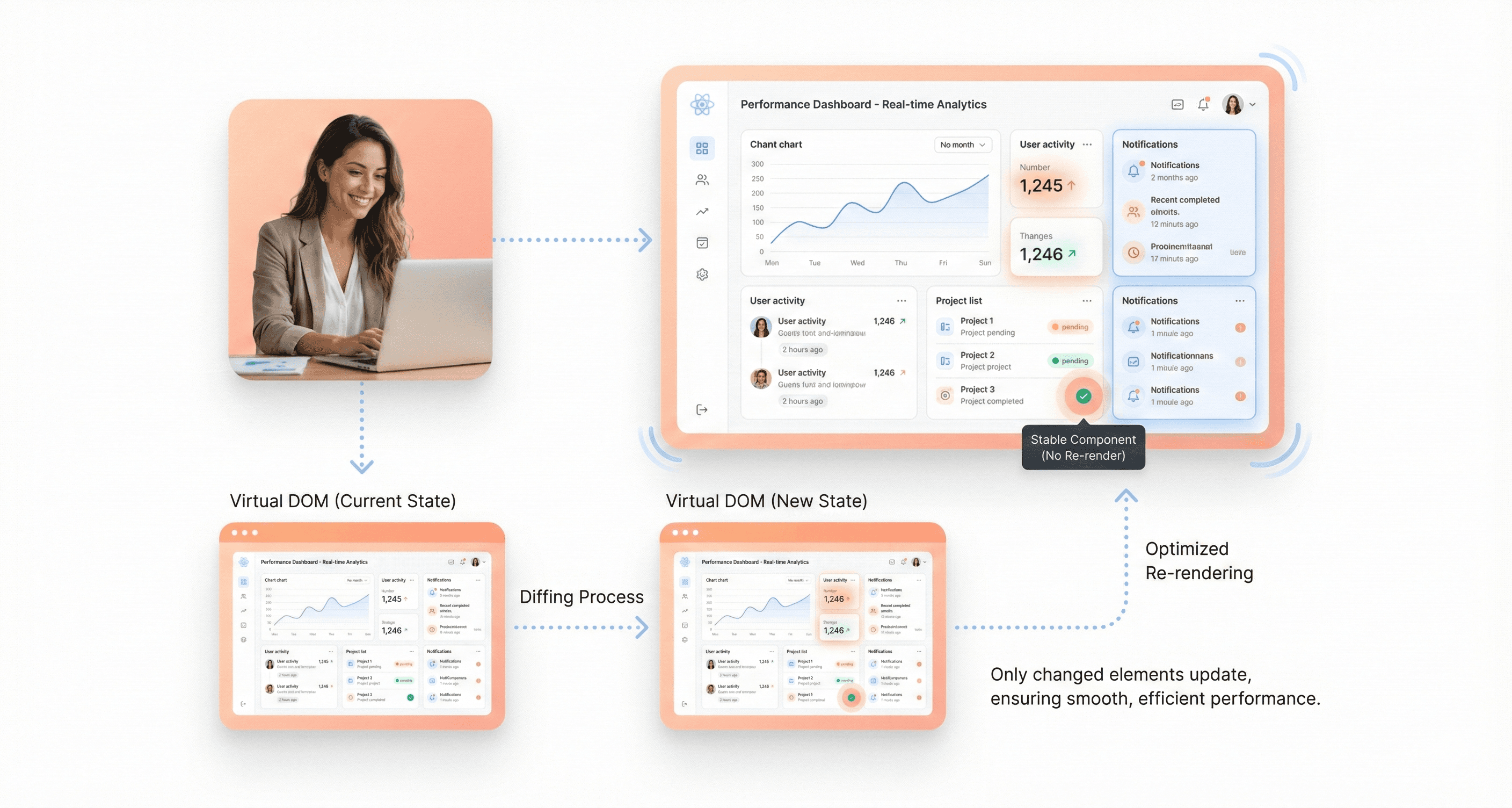
Integration Capabilities with Modern Tech Stacks
React's backend-agnostic design enables seamless integration with virtually any technology powering business logic, data storage, or microservices architecture. This flexibility proves essential for SaaS companies that need to adapt quickly to changing requirements and integrate with diverse technology ecosystems.
API-First Integration: React components naturally consume data via APIs, supporting multiple communication protocols including REST, GraphQL, WebSockets for real-time updates, and gRPC. Libraries like Axios, Apollo Client, and React Query streamline these integrations, providing battle-tested solutions for common SaaS needs.
Backend Technology Compatibility: React maintains compatibility with existing backend systems, enabling gradual modernization without costly "rip-and-replace" scenarios. Whether working with legacy systems or modern microservices, React's integration capabilities allow phased app modernization while delivering a modern frontend experience.
Authentication and Security Integration: The framework easily integrates with JWT, OAuth, and session-based authentication systems, preserving existing security investments while enabling modern frontend experiences. This compatibility ensures security implementations remain robust while user interfaces evolve.
Independent Development Workflows: Clear API boundaries enable parallel development where frontend teams focus on UI while backend teams concentrate on data and business logic. Context API and state management solutions like Redux facilitate data handling separately from backend concerns, improving development efficiency.
Ecosystem Integration: React's extensive ecosystem includes solutions for every common SaaS challenge. TanStack Query handles data fetching and caching, Zustand and Jotai provide state management, React Hook Form manages form handling, and libraries like Material UI and Shadcn/ui accelerate UI development. This comprehensive toolkit reduces custom development time and maintenance costs.
The framework's integration capabilities extend to testing and development tools, with React Testing Library and Playwright enhancing reliability, while well-documented libraries ensure ongoing maintainability and reduced technical debt.
Essential Skills to Look for in React Developers
Core React 18+ Competencies and Advanced Features
Modern React developers must demonstrate mastery of React 18's latest capabilities and architectural patterns. Strong JavaScript fundamentals form the foundation, requiring deep understanding of ES6+ features including let/const declarations, arrow functions, destructuring, promises, async/await, and closures. Developers should be fluent with array methods like map, filter, and reduce, which are essential for data manipulation in React applications.
JSX proficiency goes beyond basic syntax understanding. Developers must grasp JSX as an abstraction over React.createElement(), enabling scalable application development without the complexity of raw React APIs. This knowledge directly impacts development speed and code maintainability in SaaS products.
React Hooks expertise is non-negotiable for modern development. Developers must demonstrate proper usage of useState, useEffect, useContext, and useRef while avoiding common pitfalls like infinite loops and unnecessary re-renders. The ability to create reusable custom hooks shows advanced understanding of React's composition model, crucial for building modular SaaS components.
Component lifecycle understanding remains critical, particularly the shift from class components to functional components with Hooks. Developers should understand controlled versus uncontrolled components, props versus state management, and how React's rendering behavior affects performance in large-scale applications.
TypeScript Integration for Enterprise-Grade Applications
TypeScript integration has become essential for enterprise SaaS development, providing type safety and improved developer experience. While not explicitly detailed in core React skills, TypeScript knowledge complements JavaScript mastery by adding static type checking, interface definitions, and enhanced IDE support.
Developers should understand how TypeScript enhances React development through prop type definitions, component interfaces, and generic components. This integration reduces runtime errors and improves code documentation, making it particularly valuable for scalable SaaS products where multiple developers collaborate on complex codebases.
The combination of React with TypeScript enables better refactoring capabilities, catching errors at compile time rather than runtime, and provides superior autocomplete and navigation features that accelerate development velocity in enterprise environments.
State Management Expertise with Redux and Modern Alternatives
State management expertise separates professional React developers from beginners. Developers must understand when and why to implement state management libraries, avoiding over-engineering simple applications while recognizing when complexity demands robust solutions.
Redux fundamentals include understanding the store, actions, and reducers pattern. Modern Redux development requires familiarity with Redux Toolkit and best practices for middleware implementation using Thunk or Saga. However, skilled developers don't default to Redux for every project, they evaluate application complexity and choose appropriate tools.
Alternative state management solutions deserve equal attention. The Context API serves well for simpler applications, while modern alternatives like Zustand and Recoil offer different approaches to global state management. Understanding these options allows developers to select the optimal solution based on specific SaaS requirements rather than following trends blindly.
Next.js and Meta-Framework Proficiency for Full-Stack Development
While not explicitly covered in the reference material, Next.js proficiency has become increasingly important for full-stack React development. This meta-framework extends React's capabilities with server-side rendering, static site generation, and API routes, making it particularly valuable for SaaS applications requiring SEO optimization and performance.
Full-stack development capabilities enable React developers to build complete features independently, reducing dependencies on backend teams and accelerating development cycles. This versatility proves especially valuable in startup environments and small development teams.
Testing and Quality Assurance Capabilities
Testing knowledge distinguishes professional React developers from amateur practitioners. Essential testing skills include writing unit tests with Jest and component testing using React Testing Library. Developers must understand mocking strategies, snapshot testing, and testing asynchronous behavior including API calls.
Testing capabilities directly impact product quality, deployment velocity, and long-term maintainability. Developers who prioritize testing help reduce bugs, improve code stability, and enable confident refactoring in evolving SaaS products. This skill becomes increasingly critical as applications scale and team sizes grow.
Understanding test-driven development practices and the ability to write meaningful test cases that cover both happy paths and edge cases demonstrates professional-level React development capabilities.
AI-Native Development and Modern Tooling Skills
Modern React developers must adapt to AI-assisted development workflows and contemporary tooling ecosystems. While traditional skills remain fundamental, the ability to leverage AI tools for code generation, debugging assistance, and documentation creation has become increasingly valuable.
Version control proficiency with Git remains essential, including branching strategies, merge conflict resolution, and collaborative workflows through platforms like GitHub or GitLab. These skills ensure smooth collaboration with distributed teams and effective code review processes.
Node.js and npm ecosystem understanding enables developers to navigate the JavaScript package management landscape effectively. Knowledge of package managers like npm and Yarn, dependency management, and build tool integration supports the broader development workflow required for professional SaaS development.
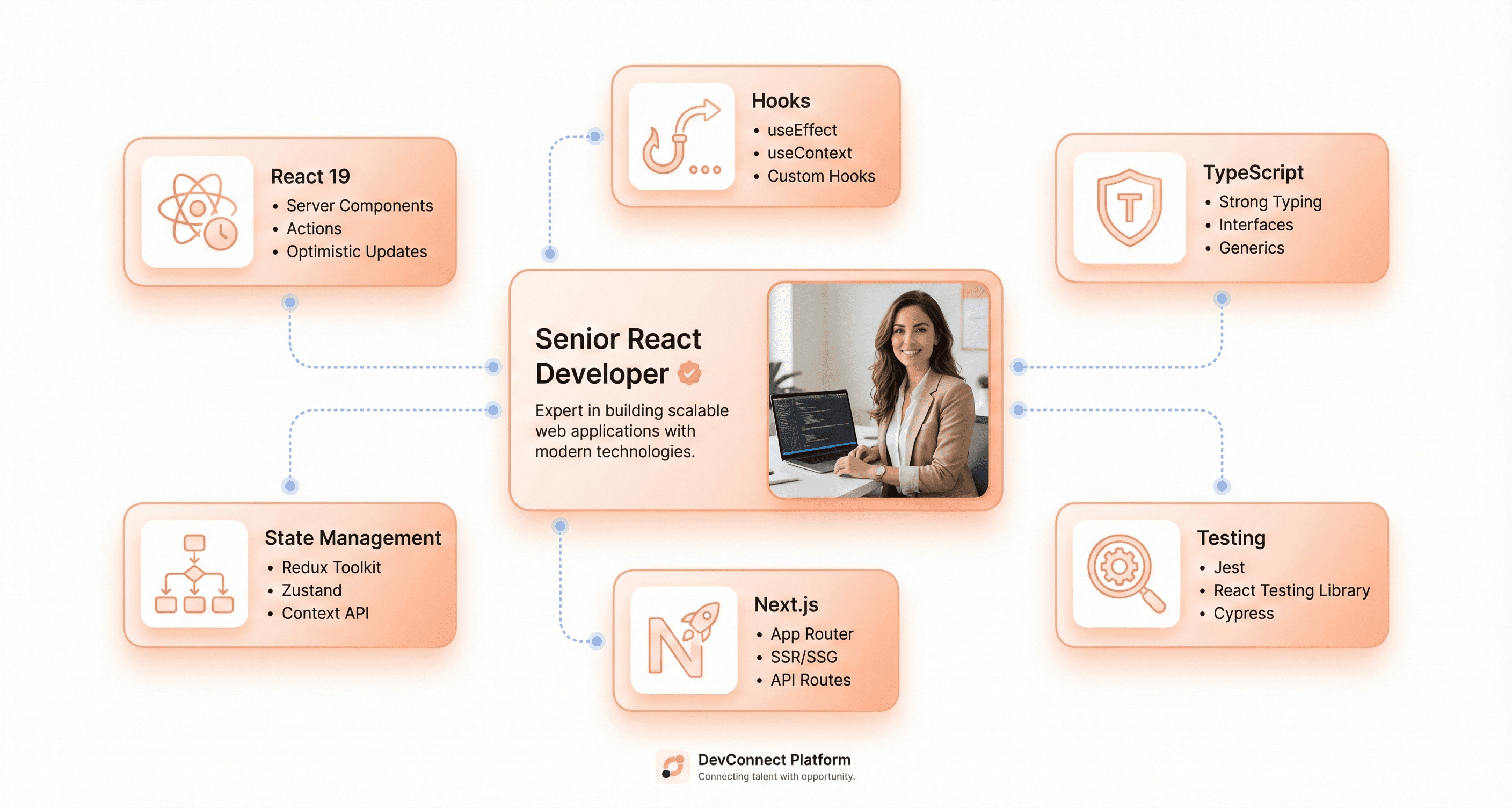
Different Engagement Models for Hiring React Talent
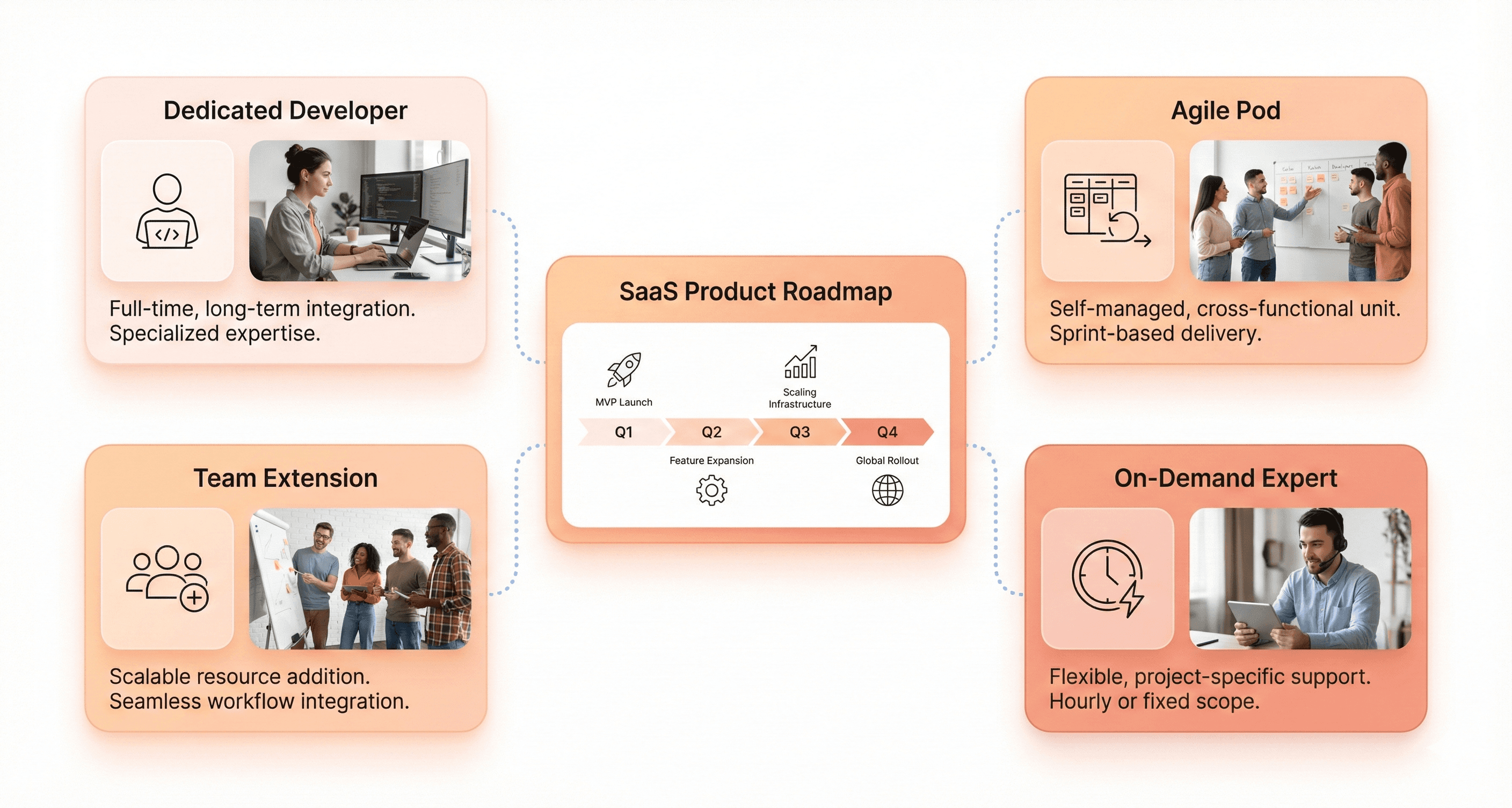
Dedicated Full-Time Developers for Long-Term Projects
For businesses developing comprehensive SaaS platforms that require sustained development efforts, dedicated full-time React developers represent the most strategic hiring approach. These developers typically commit 8 hours per day with a minimum engagement period of 30 days, though most successful SaaS projects extend this relationship for multiple years.
The full-time model proves particularly effective when you need developers who can deeply understand your business domain, maintain consistency in code architecture, and evolve with your product roadmap. With dedicated developers, you gain team members who become integral to your organization's culture and long-term vision, ensuring seamless knowledge transfer and reduced onboarding overhead for new features.
Part-Time and Contract-Based Arrangements
When your SaaS development needs are more targeted or budget constraints require optimization, part-time React developers offer an excellent middle ground. The typical part-time model involves 4 hours per day with a minimum 30-day commitment, making it ideal for maintaining existing applications, implementing specific feature sets, or supporting ongoing maintenance tasks.
Contract-based arrangements provide additional flexibility, allowing you to engage developers for predetermined project phases or deliverables. This model works exceptionally well for SaaS companies that experience seasonal fluctuations in development needs or require specialized React expertise for particular modules without committing to full-time resources.
Team Extension for Scaling Existing Development Teams
Now that we've covered individual hiring models, team extension represents a hybrid approach where external React developers integrate seamlessly with your existing internal development team. This model addresses the common challenge of scaling development capacity without the lengthy process of traditional hiring.
Team extension works particularly well for SaaS companies that have established development practices and need to augment their capabilities rapidly. The external developers adopt your existing workflows, coding standards, and project management tools, essentially functioning as remote team members rather than separate contractors.
Agile Team Pods with Cross-Functional Expertise
Previously, we've discussed individual developer models, but agile team pods represent a more comprehensive approach where you hire small, self-contained units of React developers with complementary skills. These pods typically include a senior React developer, a UI/UX specialist familiar with React components, and a developer experienced in backend integration.
This model proves invaluable for SaaS products requiring rapid feature development and iterative releases. The pod structure ensures knowledge sharing, peer review, and collective ownership of deliverables, reducing the risk associated with single-developer dependencies.
On-Demand Talent for Short-Term Specialized Projects
With this in mind, next, we'll explore the on-demand model designed for specific, time-bound requirements. This approach typically follows an hourly engagement structure with a minimum of 80 hours, making it perfect for specialized tasks like performance optimization, third-party integrations, or React version migrations.
On-demand React developers excel in scenarios where you need expert-level intervention for particular challenges without long-term commitment. Whether you're troubleshooting complex state management issues, implementing advanced React patterns, or conducting code reviews, this model provides access to specialized expertise precisely when needed, ensuring cost-effective resource utilization for your SaaS development initiatives.
Geographic Hiring Strategies and Cost Optimization
Onshore Options for Direct Collaboration and Compliance
Onshore hiring provides the advantage of working within the same legal and regulatory environment, which is particularly essential for projects involving sensitive data or intellectual property. This approach ensures complete alignment with local compliance requirements and eliminates potential legal complexities that may arise with international partnerships.
The primary benefit of onshore React developers lies in seamless communication and real-time collaboration. Working within the same time zones eliminates delays associated with asynchronous communication, enabling faster decision-making and immediate problem resolution. Cultural similarities also facilitate building productive working relationships and effective collaboration between teams.
While onshore options typically command higher hourly rates compared to offshore alternatives, they offer unparalleled control over project management and quality assurance. Companies can maintain direct oversight of development processes and ensure adherence to specific business practices and methodologies.
Nearshore Development in Latin America for Time Zone Alignment
Latin America has emerged as a premier nearshore outsourcing destination, offering the optimal combination of technical skill, cultural alignment, and time zone overlap for ReactJS development. Countries like Brazil, Argentina, and Mexico have become go-to hiring destinations for talented ReactJS developers.
Brazilian developers are particularly notable for their tech-savvy talent pool, with many professionals fluent in English, making communication seamless for US businesses. The favorable time zones enable real-time collaboration, significantly reducing project coordination challenges. Similarly, Argentina serves as another LatAm powerhouse known for exceptional software developers who emphasize agile development methodologies and maintain high English proficiency levels.
Mexico stands out as an ideal nearshore destination due to its proximity, which fosters seamless collaboration and enables short travel times when face-to-face meetings are necessary. Mexican developers possess a deep understanding of US business practices, and competitive rates paired with strong infrastructure make this country a prime choice for businesses seeking skilled ReactJS talent.
The time zone alignment advantage allows for better communication with fewer misunderstandings, as teams can work during overlapping business hours. This synchronization eliminates the delays and extra costs typically associated with working across vastly different time zones.
Offshore Talent in India and Eastern Europe for Cost Efficiency
India remains a leading outsourcing destination due to its vast network of highly skilled developers. ReactJS developers in India are not only experienced but also adaptable to various project development needs. The country's education system emphasizes engineering and technology, creating a consistent supply of qualified tech professionals.
The cost-effectiveness of offshore development is particularly compelling, as developers from regions with lower costs of living can provide the same level of expertise while offering significant cost-efficiency. This allows companies to allocate resources more effectively across their business operations without sacrificing quality.
Eastern Europe, particularly Ukraine and Poland, has established itself as a renowned technology hub. Ukrainian developers are recognized for their technical skills and proficiency in modern development frameworks, with many possessing strong English command and extensive experience working with US clients. The Polish IT outsourcing industry is regarded as one of Europe's best, with developers well-versed in advanced technologies like ReactJS and known for excellent problem-solving skills.
Offshore teams provide the advantage of round-the-clock development capabilities, enabling projects to progress continuously across different time zones. This 24/7 productivity model can significantly reduce project timelines while maintaining high-quality standards.
Hybrid Models Combining Multiple Geographic Locations
Hybrid models offer the flexibility to combine advantages from different geographic regions, allowing companies to optimize their development strategy based on specific project requirements. This approach enables businesses to leverage onshore teams for critical decision-making and compliance oversight while utilizing nearshore and offshore talent for development execution.
Companies can establish core teams onshore for strategic priorities and client-facing activities while delegating technical development tasks to offshore ReactJS developers. This hybrid structure allows organizations to maintain control over essential business functions while benefiting from cost-effective offshore expertise.
The hybrid approach also provides access to diverse talent pools with varying specializations. For instance, companies might utilize Latin American developers for their time zone alignment and cultural compatibility for ongoing maintenance and support, while leveraging Eastern European talent for complex technical implementations requiring specialized skills.
Flexible engagement models within hybrid structures allow businesses to scale up or down based on project requirements. Whether needing dedicated teams, part-time assistance, or project-based support, this adaptability ensures companies are never over- or under-resourced. The model can seamlessly integrate different geographic teams to create a cohesive development ecosystem that maximizes both efficiency and cost-effectiveness.
Comprehensive Vetting Process for Quality Assurance
Deep Technical Skill Assessment Beyond Basic Knowledge
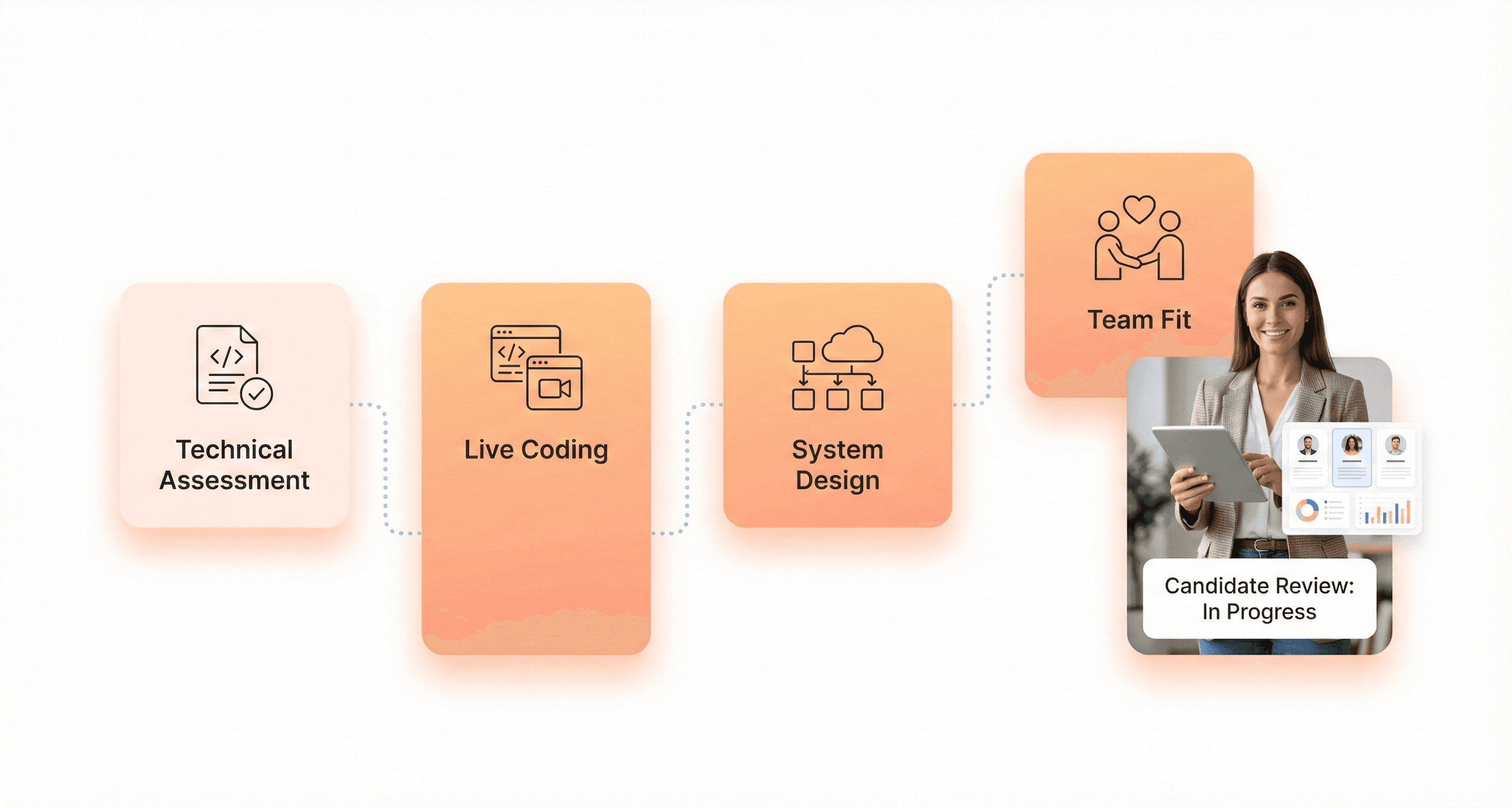
Now that we have established the fundamental requirements for React developers, let's delve into creating a comprehensive assessment process that goes beyond surface-level knowledge. A strategically designed React technical assessment should evaluate multiple layers of expertise, starting with fundamental understanding of React's lifecycle, principles, tools, structures, and core concepts.
The assessment must test candidates' proficiency in React frameworks, Java algorithms, Redux, Material Kit React, and React Router. Equally important is evaluating their familiarity with building reusable components and their ability to read, analyze, and troubleshoot existing code. Developers should demonstrate competence in handling events and real-world challenges within React environments, along with proven ability to manage state using Redux or hooks.
To ensure quality assessment, incorporate practical tasks that mirror your actual project requirements. This approach provides insight into how well developers can handle real-world, highly related challenges. The assessment should also evaluate their ability to work under pressure, their problem-solving approach, and their capacity to produce clean, efficient code that meets production standards.
System Design and Scalability Evaluation
With technical foundations assessed, the next critical phase focuses on evaluating candidates' understanding of system design and scalability considerations. This evaluation should explore their knowledge of React's role within broader application architecture and their ability to design solutions that can grow with your SaaS product.
Candidates should demonstrate understanding of how React fits into the MVC architecture and their knowledge of React's virtual DOM implementation for performance optimization. Assess their experience with unidirectional data flow components and their practical understanding of how these concepts apply to building scalable applications.
The evaluation should include discussions about performance optimization strategies, testing methodologies, and debugging approaches in React. Candidates should articulate their experience with UX/UI design principles and how they balance user experience with technical performance requirements.
Communication and Cultural Fit Testing
Previously, we've focused on technical capabilities, but successful React developers must also excel in communication and collaboration. The assessment process should evaluate candidates' ability to articulate complex technical concepts clearly and their capacity to work effectively within team environments.
During screening phases, assess communication skills through phone or video interviews, evaluating how clearly candidates can explain their experiences and technical approaches. Explore their preferred working style, values, thought processes, passion projects, and commitment to continuous learning to determine cultural alignment with your organization.
The evaluation should examine their ability to collaborate with both front-end and back-end developers, as React developers frequently engage in discussions about component interactions and system integration. Strong communication skills enhance knowledge transfer and facilitate better team dynamics throughout the development process.
Live Coding Sessions and Real-World Problem Solving
With this comprehensive foundation established, live coding sessions represent the culmination of the technical assessment process. These sessions provide invaluable insight into candidates' real-time problem-solving abilities, coding practices, and their approach to handling unexpected challenges.
Structure live coding sessions to include practical scenarios that reflect actual development challenges your team faces. Observe not only the final solution but also the candidate's thought process, their ability to break down complex problems, and their approach to debugging when encountering obstacles.
The session should evaluate their openness to feedback and constructive criticism, demonstrating their willingness to learn new methodologies, technologies, and concepts. Pay attention to their ability to analyze, tackle, and solve complex problems that may arise during actual development work, as this directly translates to their potential contribution to your SaaS product development.
Technology Stack Combinations for SaaS Success
React with Python for Data-Driven Platforms
React combined with Python creates a powerful stack for SaaS applications that require sophisticated data processing and analytics capabilities. Python's extensive ecosystem, particularly with Django or FastAPI, provides robust backend solutions that excel at handling complex business logic and data operations.
FastAPI emerges as the preferred choice for modern SaaS applications due to its performance and developer experience. Here's how a typical FastAPI backend integrates with React:
from fastapi import FastAPI, Depends, HTTPException
from sqlalchemy.orm import Session
from typing import List
app = FastAPI()
class UserService:
def __init__
Django offers built-in admin panels and authentication systems that can significantly accelerate development timelines for data-heavy SaaS products. The framework's ORM provides excellent database abstraction, making it easier to handle complex queries and relationships that are common in enterprise SaaS applications.
However, performance considerations become critical as your user base grows. Python's performance characteristics may require additional optimization strategies, including caching layers and database query optimization, compared to other backend technologies.
React with Node.js for Full-Stack JavaScript Solutions
The React-Node.js combination represents one of the most streamlined approaches to SaaS development, enabling teams to work with a single language across the entire technology stack. This unified approach significantly reduces context switching and allows for code sharing between frontend and backend components.
Node.js excels at handling concurrent requests, which is crucial for SaaS applications serving multiple tenants simultaneously. The JavaScript ecosystem's vast library collection means developers can quickly implement features without building components from scratch:
const express = require('express');
const { authenticateToken } = require('./middleware/auth');
const { validateTenant } = require('./middleware/tenant');
const app = express();
// Multi-tenant middleware
app.use(validateTenant);
// Protected routes
app.get('/api/users', authenticateToken, async (req, res) => {
try {
const users = await User.findAll({
where: { tenantId: req.tenantId },
include: ['subscription', 'permissions']
});
res.json(users);
} catch (error) {
res.status(500).json({ error: 'Failed to fetch users' });
}
});
// Subscription management
app.post('/api/subscriptions', authenticateToken, async (req, res) => {
try {
const subscription = await stripe.subscriptions.create({
customer: req.user.stripeCustomerId,
items: [{ price: req.body.priceId }]
This stack proves particularly effective for rapid MVP development and teams looking to minimize their technology learning curve. The ability to share utilities, types, and even components between frontend and backend reduces duplication and maintains consistency across the application.
React with GraphQL for Optimized Data Fetching
GraphQL integration with React transforms how SaaS applications handle data fetching, particularly beneficial for complex dashboards and analytics interfaces where different components require varying data subsets. This combination eliminates over-fetching issues common in traditional REST APIs.
The typed nature of GraphQL aligns perfectly with TypeScript-based React applications, providing compile-time safety and excellent developer experience. Schema-first development ensures that frontend and backend teams can work in parallel while maintaining consistency in data contracts.
For SaaS applications with complex user permissions and multi-tenant architectures, GraphQL's field-level authorization capabilities provide granular control over data access. This proves essential when different subscription tiers require access to different data sets or when implementing role-based access controls.
React Query or Apollo Client can be leveraged alongside GraphQL to implement sophisticated caching strategies, reducing server load and improving user experience through optimistic updates and background synchronization.
React with Cloud Services for Global Scalability
Modern SaaS applications require global reach and automatic scaling capabilities that cloud services provide. React applications deployed through services like Vercel or AWS CloudFront benefit from edge caching and global content distribution networks.
Serverless architectures complement React applications particularly well, allowing backends to scale automatically based on demand. This approach proves cost-effective for SaaS products with variable usage patterns, as you only pay for actual compute time used.
Database services like Supabase provide PostgreSQL databases with built-in real-time capabilities, authentication, and row-level security features that are essential for multi-tenant SaaS applications. The combination of Supabase with React enables rapid development of sophisticated applications with enterprise-grade security.
File upload and storage requirements common in SaaS products can be efficiently handled through S3-compatible services, with presigned URLs providing secure, direct client-to-storage uploads without burdening your application servers.
Monitoring and observability become crucial at scale, with services like Sentry for error tracking and DataDog for performance monitoring providing the visibility needed to maintain reliable SaaS operations across global user bases.
Pricing Models and Budget Planning
Understanding Cost Structures Across Different Skill Levels
The cost to hire React developers varies dramatically based on experience level, with rate differentials of 40-65% between junior and senior developers. Junior React developers (0-2 years) typically command $15-70 per hour globally, while senior developers (5+ years) earn $40-150 per hour depending on their location and specialization.
Junior React Developers represent the most budget-friendly option but come with inherent limitations. While they understand React fundamentals and can handle straightforward component development, they require significant oversight and often produce code that may need refactoring. Their lack of architectural experience means they're best suited for well-defined tasks rather than complex system design.
Mid-level developers (3-5 years) occupy the sweet spot for most SaaS projects, offering independence and problem-solving capabilities without premium pricing. They can work autonomously on feature development and understand state management patterns, making them ideal workhorses for scaling applications.
Senior developers justify their premium rates through architectural expertise and the ability to prevent costly technical debt. They don't just code—they design systems that scale efficiently and mentor junior team members, ultimately reducing long-term development costs despite higher hourly rates.
Transparent Pricing Without Hidden Fees
Beyond hourly rates, successful React hiring requires understanding the full cost structure. Hidden costs can inflate your total investment by 50-100% if not properly planned for during budget allocation.
Recruitment and onboarding costs represent significant expenses often overlooked in initial budgets. In-house hiring typically involves recruiter fees of 15-25% of the first-year salary, plus the opportunity cost of technical leadership time spent interviewing candidates instead of developing products.
Training and continuous learning expenses add substantial overhead for in-house teams. React's rapid evolution requires ongoing education through conferences, courses, and certification programs. When partnering with agencies, these training costs are absorbed by the service provider rather than your budget.
Infrastructure and tooling costs include development environments, software licenses, and cloud services. Each developer requires laptop hardware, IDE licenses, collaboration tools like Jira and Slack, plus cloud server access for development and testing environments.
Communication and management overhead often becomes the silent budget killer. Poorly communicating developers can consume 20+ hours weekly of management time, effectively doubling their true cost when you factor in leadership opportunity costs.
Risk Management and Replacement Guarantees
Smart hiring strategies incorporate risk mitigation through structured replacement policies and performance guarantees. The risk of developer unavailability or underperformance can derail project timelines and budgets without proper safeguards.
Freelancer risks include sudden unavailability, project abandonment, and lack of accountability. When hiring individual contractors, there's no backup support if they become unavailable or fail to deliver quality work. This single point of failure can halt development progress entirely.
Agency partnerships typically offer built-in risk mitigation through developer replacement guarantees and team redundancy. Reputable agencies maintain bench strength to immediately replace underperforming or unavailable developers without project delays.
Quality assurance protocols should include code review processes, automated testing requirements, and performance benchmarks. Senior React developers typically produce 40-60% fewer bugs than junior developers, reducing QA costs and rework expenses.
Contract terms should specify deliverable standards, communication expectations, and replacement procedures. Risk-free trial periods of 30 days allow evaluation of developer fit before long-term commitments.
ROI Considerations for Different Engagement Types
Calculating return on investment requires analyzing total project cost versus delivered value rather than simply comparing hourly rates. Different engagement models offer varying ROI profiles depending on project requirements and business stage.
Freelancer engagements offer the lowest overhead costs but require significant management investment. They're most cost-effective for small, well-defined tasks where management overhead remains minimal relative to development work.
Staff augmentation through agencies provides better ROI for complex projects by including project management, QA processes, and team scalability. While hourly rates may appear 30-50% higher than freelancers, the total cost often decreases when factoring in reduced management overhead and faster delivery timelines.
In-house teams deliver maximum long-term ROI for stable, ongoing development needs but require substantial upfront investment. Full-time salaries converted to hourly rates often exceed contractor rates by 20-30% when benefits and overhead are included.
Feature velocity metrics demonstrate that senior developers completing 4-6 story points daily with higher code quality often deliver better ROI than junior developers at 2-4 points daily, despite higher hourly rates. When calculated per feature delivered, senior talent frequently costs less than junior alternatives.
Geographic arbitrage offers significant ROI improvements by accessing high-quality talent in cost-effective regions. Eastern European developers at $35-65 per hour can deliver equivalent quality to North American developers at $80-120 per hour, providing 40-50% cost savings without quality compromise.
Streamlined Hiring Process and Timeline Management
Requirements Definition and Project Scoping
Previously, I've discussed the essential skills and engagement models for hiring React developers. With this in mind, the next critical step is establishing clear requirements and project scope before beginning your search.
Define your technical requirements with precision rather than asking for a developer who can handle everything. Be specific about which React features matter most for your projects—whether you need expertise in server-side rendering, complex state management, or performance optimization. According to experienced recruiters, the most successful hiring processes start with clients who can clearly articulate what type of work the developer will do most: building new features, optimizing existing code, or handling data-heavy interfaces.
This clarity helps you match candidates with the right strengths rather than seeking generic "React experience." Consider whether you need someone focused on building React components, handling entire front-end architecture, or bridging front-end and backend systems. Hire for depth in your most critical areas rather than trying to find a "front-end unicorn."
When writing job descriptions, go beyond listing requirements—sell the opportunity and filter for genuine interest. Include specific details about the React projects they'll work on, the team they'll collaborate with, and the impact their work will have on users or business goals. Avoid vague requirements like "3+ years React experience" in favor of specific examples: "Experience building responsive dashboards that handle real-time data updates" or "Comfortable optimizing React applications for mobile performance."
Don't impose rigid degree requirements, as this might rule out excellent developers who've learned through alternative paths. Skills-based hiring approaches expand candidate pools by 6.1x globally, making it beneficial to focus on relevant capabilities rather than diplomas.
Candidate Matching and Interview Coordination
Now that we have covered requirement definition, the next phase involves efficiently matching candidates to your specific needs and coordinating interviews. This stage requires systematic evaluation that goes beyond technical skills assessment.
Use practical assessments over theoretical questions when evaluating candidates. Rather than asking candidates to recite React concepts, provide them with small, real-world coding challenges that reflect the actual work they'll perform. This could involve building a simple component, debugging existing code, or implementing a specific feature. Research shows that 54% of organizations now use pre-employment technical assessments, with 78% reporting improved hire quality.
Focus on communication and collaboration skills during the interview process. Technical skills are just the starting point—the best React developers can explain their architectural decisions, walk through their code with non-technical stakeholders, and collaborate effectively across teams. Pay attention to how candidates explain their past projects. Can they describe what they built without getting lost in technical details? Do they mention collaborating with designers, product managers, or backend developers? These signals indicate someone who can work well in a team environment.
Structure your interview process to include both technical and behavioral components. Ask candidates to walk through recent React projects they built from scratch, discussing challenges faced and solutions implemented. This reveals practical experience, problem-solving approach, and communication skills. Look for candidates who can explain not just what they built, but why they made specific architectural decisions and how they handled roadblocks.
Rapid Onboarding and Integration Strategies
With candidates selected, the focus shifts to rapid onboarding and seamless integration into your existing team structure. Top React developers often have multiple opportunities, especially in today's competitive market, so moving quickly with compelling offers is crucial.
Once you've identified the right candidate, move fast with a competitive offer that includes growth opportunities and clear expectations. One common mistake companies make is having lengthy processes or multiple technical assessments. Candidates don't want to spend weeks going through extensive evaluation procedures, especially when they have other options available.
Focus on total compensation and growth potential when making offers. While salary is important, developers also value learning opportunities, work-life balance, flexible hours, and ownership of their work. Be prepared to discuss career growth paths, interesting technical challenges, and how their work will impact the business.
When competing for top talent, emphasize what makes your opportunity unique: the chance to work with cutting-edge technology, solve interesting problems, or make meaningful impact on users or the business. Provide specific details about the React projects they'll work on, team collaboration opportunities, and professional development resources available.
Ongoing Support and Team Management
After successful onboarding, maintaining ongoing support and effective team management becomes essential for long-term success. React development often involves evolving requirements and shifting priorities, so establishing clear communication channels and support systems is crucial.
Great React developers need strong communication, ownership mindset, and strategic thinking to build applications that scale with your business. The best developers take full responsibility for their code from development through production, proactively identifying potential issues, suggesting improvements, and following through on commitments without micromanagement.
Ensure your React developers have access to the tools and resources they need for continuous learning. The React ecosystem evolves rapidly, with new features, changing browser standards, and evolving user expectations requiring developers to learn continuously and adapt their approaches based on project needs.
Establish regular feedback mechanisms and performance evaluation processes. Great developers welcome feedback and can incorporate it constructively while maintaining their technical judgment. Look for team members who demonstrate adaptability when working with unclear or changing requirements, asking clarifying questions and communicating proactively about the impacts of changes while finding ways to deliver value even when requirements aren't perfectly defined.
Conclusion
Building scalable SaaS products with React requires more than just technical expertise—it demands strategic thinking, architectural foresight, and the right team dynamics. Throughout this guide, we've explored the essential elements of hiring React developers, from understanding their role in modern SaaS architecture to implementing comprehensive vetting processes and choosing optimal engagement models. The key lies in balancing technical proficiency with communication skills, geographic considerations with cost optimization, and immediate needs with long-term scalability goals.
Success in hiring React developers ultimately comes down to clarity of requirements, thorough evaluation processes, and selecting partners who understand both the technical and business aspects of SaaS development. Whether you choose dedicated teams, fractional talent, or AI-augmented developers, the investment in quality React expertise will determine your product's ability to scale, perform, and evolve with market demands. Take the time to define your specific needs, implement rigorous vetting standards, and establish clear collaboration frameworks—your SaaS product's future depends on these foundational decisions.
Building scalable SaaS products requires React developers who can handle more than just basic component creation. These professionals need to architect front-end systems that grow with your user base, integrate seamlessly with backend APIs, and deliver lightning-fast performance under heavy load.
This guide is for CTOs, engineering managers, and startup founders who want to build reliable React teams without the typical hiring headaches. You need developers who understand both the technical complexities of React and the business realities of SaaS development.
We'll walk through the essential skills that separate good React developers from great ones, including experience with Next.js, TypeScript, and performance optimization. You'll also learn about different engagement models - from dedicated teams to project-based contracts - so you can choose what works best for your timeline and budget. Finally, we'll cover proven vetting strategies that help you identify developers who can actually deliver production-ready code, not just pass coding interviews.
Understanding React's Role in Modern SaaS Architecture
Why React Powers Leading SaaS Platforms
React has become the go-to frontend framework for SaaS companies looking to build fast, scalable applications that actually retain users. Leading SaaS platforms choose React because it doesn't just help ship features faster - it transforms how entire teams build and maintain software. The framework's widespread adoption by industry leaders demonstrates its proven capability to handle the complex demands of modern SaaS applications.
The technology enables accelerated development through its component-based architecture, where developers write once and use multiple times, dramatically reducing redundancy and improving maintainability. This approach proves particularly valuable during MVP phases, where rapid market validation is crucial. Companies can build core app flows including signup, dashboard, and settings more efficiently as reusable components stack together seamlessly.
React's dominance stems from its ability to deliver superior user experience while maintaining development efficiency. The framework enables lightning-fast interactions without page reloads by updating only changed UI parts, creating smooth animations and instant feedback that modern users demand.

Component-Based Architecture Benefits for Scalability
React's foundational strength lies in its component-based architecture, which serves as the cornerstone for building scalable SaaS applications. This architectural approach allows development teams to create self-contained UI elements that can be used multiple times within an application without modifying their core logic. Examples include buttons, modals, input fields, and cards that maintain consistent functionality across different contexts.
The scalability benefits of this approach are multifaceted:
Improved Code Maintainability: Instead of writing the same code multiple times, developers create a single, well-tested component and reuse it, reducing code duplication and making future modifications significantly easier. This centralized approach means updates to a component propagate automatically, maintaining visual and functional consistency throughout the product.
Enhanced Development Speed: Developers can focus on functionality rather than rebuilding UI elements from scratch. With a robust component library, new features can be rapidly prototyped by assembling existing components, allowing deployment within hours rather than days.
Better Long-term Scalability: Reusable components help maintain consistent UI and reduce development time on large applications. React's modular design supports growth from 100 to 100,000+ users without requiring fundamental restructuring. Each component operates independently, allowing incremental scaling based on demand.
To maximize effectiveness, components should follow the Single Responsibility Principle, use props efficiently for dynamic customization, and avoid hardcoded data. A centralized component library stored in dedicated folders like /components or /shared ensures easy management and accessibility across teams.
The component-based approach proves especially powerful for SaaS dashboards and admin panels, where complex data must be transformed into interactive experiences. State management and component reusability ensure smooth rendering and instant updates, even with thousands of data points.

Performance Advantages with Virtual DOM Technology
React's Virtual DOM technology represents a revolutionary approach to UI rendering that delivers significant performance advantages for SaaS applications. The Virtual DOM maintains a lightweight "virtual" representation of the UI in memory, and when data changes, React calculates the minimal set of actual DOM updates needed through a process called diffing.
This technology becomes particularly effective in applications with frequent, dynamic updates such as real-time dashboards, collaborative tools, and complex data grids. Instead of re-rendering entire sections of the interface, the Virtual DOM updates only the changed parts, keeping the UI responsive even under heavy load.
The performance benefits manifest in several key areas:
Faster Rendering Under Load: For apps handling complex interactions and frequent updates, Virtual DOM ensures significantly faster rendering and smoother user experience. This is crucial for SaaS platforms where performance directly impacts user retention and engagement.
Optimized Re-rendering: When combined with React.memo and PureComponent, the Virtual DOM prevents unnecessary re-renders, further enhancing performance. This optimization proves particularly valuable in dashboards and real-time applications where data updates constantly.
Scalable Performance: The Virtual DOM enables SaaS applications to handle growth gracefully, maintaining UI responsiveness whether serving 100 users or 100,000+ users. This scalability prevents performance from becoming a bottleneck as the user base expands.
Concurrent Features Support: React's concurrent features work alongside Virtual DOM to prioritize critical updates, ensuring apps remain responsive even during heavy computation. This means typing feedback and user interactions maintain priority over less critical background rendering tasks.

Integration Capabilities with Modern Tech Stacks
React's backend-agnostic design enables seamless integration with virtually any technology powering business logic, data storage, or microservices architecture. This flexibility proves essential for SaaS companies that need to adapt quickly to changing requirements and integrate with diverse technology ecosystems.
API-First Integration: React components naturally consume data via APIs, supporting multiple communication protocols including REST, GraphQL, WebSockets for real-time updates, and gRPC. Libraries like Axios, Apollo Client, and React Query streamline these integrations, providing battle-tested solutions for common SaaS needs.
Backend Technology Compatibility: React maintains compatibility with existing backend systems, enabling gradual modernization without costly "rip-and-replace" scenarios. Whether working with legacy systems or modern microservices, React's integration capabilities allow phased app modernization while delivering a modern frontend experience.
Authentication and Security Integration: The framework easily integrates with JWT, OAuth, and session-based authentication systems, preserving existing security investments while enabling modern frontend experiences. This compatibility ensures security implementations remain robust while user interfaces evolve.
Independent Development Workflows: Clear API boundaries enable parallel development where frontend teams focus on UI while backend teams concentrate on data and business logic. Context API and state management solutions like Redux facilitate data handling separately from backend concerns, improving development efficiency.
Ecosystem Integration: React's extensive ecosystem includes solutions for every common SaaS challenge. TanStack Query handles data fetching and caching, Zustand and Jotai provide state management, React Hook Form manages form handling, and libraries like Material UI and Shadcn/ui accelerate UI development. This comprehensive toolkit reduces custom development time and maintenance costs.
The framework's integration capabilities extend to testing and development tools, with React Testing Library and Playwright enhancing reliability, while well-documented libraries ensure ongoing maintainability and reduced technical debt.
Essential Skills to Look for in React Developers
Core React 18+ Competencies and Advanced Features
Modern React developers must demonstrate mastery of React 18's latest capabilities and architectural patterns. Strong JavaScript fundamentals form the foundation, requiring deep understanding of ES6+ features including let/const declarations, arrow functions, destructuring, promises, async/await, and closures. Developers should be fluent with array methods like map, filter, and reduce, which are essential for data manipulation in React applications.
JSX proficiency goes beyond basic syntax understanding. Developers must grasp JSX as an abstraction over React.createElement(), enabling scalable application development without the complexity of raw React APIs. This knowledge directly impacts development speed and code maintainability in SaaS products.
React Hooks expertise is non-negotiable for modern development. Developers must demonstrate proper usage of useState, useEffect, useContext, and useRef while avoiding common pitfalls like infinite loops and unnecessary re-renders. The ability to create reusable custom hooks shows advanced understanding of React's composition model, crucial for building modular SaaS components.
Component lifecycle understanding remains critical, particularly the shift from class components to functional components with Hooks. Developers should understand controlled versus uncontrolled components, props versus state management, and how React's rendering behavior affects performance in large-scale applications.
TypeScript Integration for Enterprise-Grade Applications
TypeScript integration has become essential for enterprise SaaS development, providing type safety and improved developer experience. While not explicitly detailed in core React skills, TypeScript knowledge complements JavaScript mastery by adding static type checking, interface definitions, and enhanced IDE support.
Developers should understand how TypeScript enhances React development through prop type definitions, component interfaces, and generic components. This integration reduces runtime errors and improves code documentation, making it particularly valuable for scalable SaaS products where multiple developers collaborate on complex codebases.
The combination of React with TypeScript enables better refactoring capabilities, catching errors at compile time rather than runtime, and provides superior autocomplete and navigation features that accelerate development velocity in enterprise environments.
State Management Expertise with Redux and Modern Alternatives
State management expertise separates professional React developers from beginners. Developers must understand when and why to implement state management libraries, avoiding over-engineering simple applications while recognizing when complexity demands robust solutions.
Redux fundamentals include understanding the store, actions, and reducers pattern. Modern Redux development requires familiarity with Redux Toolkit and best practices for middleware implementation using Thunk or Saga. However, skilled developers don't default to Redux for every project, they evaluate application complexity and choose appropriate tools.
Alternative state management solutions deserve equal attention. The Context API serves well for simpler applications, while modern alternatives like Zustand and Recoil offer different approaches to global state management. Understanding these options allows developers to select the optimal solution based on specific SaaS requirements rather than following trends blindly.
Next.js and Meta-Framework Proficiency for Full-Stack Development
While not explicitly covered in the reference material, Next.js proficiency has become increasingly important for full-stack React development. This meta-framework extends React's capabilities with server-side rendering, static site generation, and API routes, making it particularly valuable for SaaS applications requiring SEO optimization and performance.
Full-stack development capabilities enable React developers to build complete features independently, reducing dependencies on backend teams and accelerating development cycles. This versatility proves especially valuable in startup environments and small development teams.
Testing and Quality Assurance Capabilities
Testing knowledge distinguishes professional React developers from amateur practitioners. Essential testing skills include writing unit tests with Jest and component testing using React Testing Library. Developers must understand mocking strategies, snapshot testing, and testing asynchronous behavior including API calls.
Testing capabilities directly impact product quality, deployment velocity, and long-term maintainability. Developers who prioritize testing help reduce bugs, improve code stability, and enable confident refactoring in evolving SaaS products. This skill becomes increasingly critical as applications scale and team sizes grow.
Understanding test-driven development practices and the ability to write meaningful test cases that cover both happy paths and edge cases demonstrates professional-level React development capabilities.
AI-Native Development and Modern Tooling Skills
Modern React developers must adapt to AI-assisted development workflows and contemporary tooling ecosystems. While traditional skills remain fundamental, the ability to leverage AI tools for code generation, debugging assistance, and documentation creation has become increasingly valuable.
Version control proficiency with Git remains essential, including branching strategies, merge conflict resolution, and collaborative workflows through platforms like GitHub or GitLab. These skills ensure smooth collaboration with distributed teams and effective code review processes.
Node.js and npm ecosystem understanding enables developers to navigate the JavaScript package management landscape effectively. Knowledge of package managers like npm and Yarn, dependency management, and build tool integration supports the broader development workflow required for professional SaaS development.

Different Engagement Models for Hiring React Talent
Dedicated Full-Time Developers for Long-Term Projects
For businesses developing comprehensive SaaS platforms that require sustained development efforts, dedicated full-time React developers represent the most strategic hiring approach. These developers typically commit 8 hours per day with a minimum engagement period of 30 days, though most successful SaaS projects extend this relationship for multiple years.
The full-time model proves particularly effective when you need developers who can deeply understand your business domain, maintain consistency in code architecture, and evolve with your product roadmap. With dedicated developers, you gain team members who become integral to your organization's culture and long-term vision, ensuring seamless knowledge transfer and reduced onboarding overhead for new features.
Part-Time and Contract-Based Arrangements
When your SaaS development needs are more targeted or budget constraints require optimization, part-time React developers offer an excellent middle ground. The typical part-time model involves 4 hours per day with a minimum 30-day commitment, making it ideal for maintaining existing applications, implementing specific feature sets, or supporting ongoing maintenance tasks.
Contract-based arrangements provide additional flexibility, allowing you to engage developers for predetermined project phases or deliverables. This model works exceptionally well for SaaS companies that experience seasonal fluctuations in development needs or require specialized React expertise for particular modules without committing to full-time resources.
Team Extension for Scaling Existing Development Teams
Now that we've covered individual hiring models, team extension represents a hybrid approach where external React developers integrate seamlessly with your existing internal development team. This model addresses the common challenge of scaling development capacity without the lengthy process of traditional hiring.
Team extension works particularly well for SaaS companies that have established development practices and need to augment their capabilities rapidly. The external developers adopt your existing workflows, coding standards, and project management tools, essentially functioning as remote team members rather than separate contractors.
Agile Team Pods with Cross-Functional Expertise
Previously, we've discussed individual developer models, but agile team pods represent a more comprehensive approach where you hire small, self-contained units of React developers with complementary skills. These pods typically include a senior React developer, a UI/UX specialist familiar with React components, and a developer experienced in backend integration.
This model proves invaluable for SaaS products requiring rapid feature development and iterative releases. The pod structure ensures knowledge sharing, peer review, and collective ownership of deliverables, reducing the risk associated with single-developer dependencies.
On-Demand Talent for Short-Term Specialized Projects
With this in mind, next, we'll explore the on-demand model designed for specific, time-bound requirements. This approach typically follows an hourly engagement structure with a minimum of 80 hours, making it perfect for specialized tasks like performance optimization, third-party integrations, or React version migrations.
On-demand React developers excel in scenarios where you need expert-level intervention for particular challenges without long-term commitment. Whether you're troubleshooting complex state management issues, implementing advanced React patterns, or conducting code reviews, this model provides access to specialized expertise precisely when needed, ensuring cost-effective resource utilization for your SaaS development initiatives.

Geographic Hiring Strategies and Cost Optimization
Onshore Options for Direct Collaboration and Compliance
Onshore hiring provides the advantage of working within the same legal and regulatory environment, which is particularly essential for projects involving sensitive data or intellectual property. This approach ensures complete alignment with local compliance requirements and eliminates potential legal complexities that may arise with international partnerships.
The primary benefit of onshore React developers lies in seamless communication and real-time collaboration. Working within the same time zones eliminates delays associated with asynchronous communication, enabling faster decision-making and immediate problem resolution. Cultural similarities also facilitate building productive working relationships and effective collaboration between teams.
While onshore options typically command higher hourly rates compared to offshore alternatives, they offer unparalleled control over project management and quality assurance. Companies can maintain direct oversight of development processes and ensure adherence to specific business practices and methodologies.
Nearshore Development in Latin America for Time Zone Alignment
Latin America has emerged as a premier nearshore outsourcing destination, offering the optimal combination of technical skill, cultural alignment, and time zone overlap for ReactJS development. Countries like Brazil, Argentina, and Mexico have become go-to hiring destinations for talented ReactJS developers.
Brazilian developers are particularly notable for their tech-savvy talent pool, with many professionals fluent in English, making communication seamless for US businesses. The favorable time zones enable real-time collaboration, significantly reducing project coordination challenges. Similarly, Argentina serves as another LatAm powerhouse known for exceptional software developers who emphasize agile development methodologies and maintain high English proficiency levels.
Mexico stands out as an ideal nearshore destination due to its proximity, which fosters seamless collaboration and enables short travel times when face-to-face meetings are necessary. Mexican developers possess a deep understanding of US business practices, and competitive rates paired with strong infrastructure make this country a prime choice for businesses seeking skilled ReactJS talent.
The time zone alignment advantage allows for better communication with fewer misunderstandings, as teams can work during overlapping business hours. This synchronization eliminates the delays and extra costs typically associated with working across vastly different time zones.
Offshore Talent in India and Eastern Europe for Cost Efficiency
India remains a leading outsourcing destination due to its vast network of highly skilled developers. ReactJS developers in India are not only experienced but also adaptable to various project development needs. The country's education system emphasizes engineering and technology, creating a consistent supply of qualified tech professionals.
The cost-effectiveness of offshore development is particularly compelling, as developers from regions with lower costs of living can provide the same level of expertise while offering significant cost-efficiency. This allows companies to allocate resources more effectively across their business operations without sacrificing quality.
Eastern Europe, particularly Ukraine and Poland, has established itself as a renowned technology hub. Ukrainian developers are recognized for their technical skills and proficiency in modern development frameworks, with many possessing strong English command and extensive experience working with US clients. The Polish IT outsourcing industry is regarded as one of Europe's best, with developers well-versed in advanced technologies like ReactJS and known for excellent problem-solving skills.
Offshore teams provide the advantage of round-the-clock development capabilities, enabling projects to progress continuously across different time zones. This 24/7 productivity model can significantly reduce project timelines while maintaining high-quality standards.
Hybrid Models Combining Multiple Geographic Locations
Hybrid models offer the flexibility to combine advantages from different geographic regions, allowing companies to optimize their development strategy based on specific project requirements. This approach enables businesses to leverage onshore teams for critical decision-making and compliance oversight while utilizing nearshore and offshore talent for development execution.
Companies can establish core teams onshore for strategic priorities and client-facing activities while delegating technical development tasks to offshore ReactJS developers. This hybrid structure allows organizations to maintain control over essential business functions while benefiting from cost-effective offshore expertise.
The hybrid approach also provides access to diverse talent pools with varying specializations. For instance, companies might utilize Latin American developers for their time zone alignment and cultural compatibility for ongoing maintenance and support, while leveraging Eastern European talent for complex technical implementations requiring specialized skills.
Flexible engagement models within hybrid structures allow businesses to scale up or down based on project requirements. Whether needing dedicated teams, part-time assistance, or project-based support, this adaptability ensures companies are never over- or under-resourced. The model can seamlessly integrate different geographic teams to create a cohesive development ecosystem that maximizes both efficiency and cost-effectiveness.
Comprehensive Vetting Process for Quality Assurance
Deep Technical Skill Assessment Beyond Basic Knowledge
Now that we have established the fundamental requirements for React developers, let's delve into creating a comprehensive assessment process that goes beyond surface-level knowledge. A strategically designed React technical assessment should evaluate multiple layers of expertise, starting with fundamental understanding of React's lifecycle, principles, tools, structures, and core concepts.
The assessment must test candidates' proficiency in React frameworks, Java algorithms, Redux, Material Kit React, and React Router. Equally important is evaluating their familiarity with building reusable components and their ability to read, analyze, and troubleshoot existing code. Developers should demonstrate competence in handling events and real-world challenges within React environments, along with proven ability to manage state using Redux or hooks.
To ensure quality assessment, incorporate practical tasks that mirror your actual project requirements. This approach provides insight into how well developers can handle real-world, highly related challenges. The assessment should also evaluate their ability to work under pressure, their problem-solving approach, and their capacity to produce clean, efficient code that meets production standards.
System Design and Scalability Evaluation
With technical foundations assessed, the next critical phase focuses on evaluating candidates' understanding of system design and scalability considerations. This evaluation should explore their knowledge of React's role within broader application architecture and their ability to design solutions that can grow with your SaaS product.
Candidates should demonstrate understanding of how React fits into the MVC architecture and their knowledge of React's virtual DOM implementation for performance optimization. Assess their experience with unidirectional data flow components and their practical understanding of how these concepts apply to building scalable applications.
The evaluation should include discussions about performance optimization strategies, testing methodologies, and debugging approaches in React. Candidates should articulate their experience with UX/UI design principles and how they balance user experience with technical performance requirements.
Communication and Cultural Fit Testing
Previously, we've focused on technical capabilities, but successful React developers must also excel in communication and collaboration. The assessment process should evaluate candidates' ability to articulate complex technical concepts clearly and their capacity to work effectively within team environments.
During screening phases, assess communication skills through phone or video interviews, evaluating how clearly candidates can explain their experiences and technical approaches. Explore their preferred working style, values, thought processes, passion projects, and commitment to continuous learning to determine cultural alignment with your organization.
The evaluation should examine their ability to collaborate with both front-end and back-end developers, as React developers frequently engage in discussions about component interactions and system integration. Strong communication skills enhance knowledge transfer and facilitate better team dynamics throughout the development process.
Live Coding Sessions and Real-World Problem Solving
With this comprehensive foundation established, live coding sessions represent the culmination of the technical assessment process. These sessions provide invaluable insight into candidates' real-time problem-solving abilities, coding practices, and their approach to handling unexpected challenges.
Structure live coding sessions to include practical scenarios that reflect actual development challenges your team faces. Observe not only the final solution but also the candidate's thought process, their ability to break down complex problems, and their approach to debugging when encountering obstacles.
The session should evaluate their openness to feedback and constructive criticism, demonstrating their willingness to learn new methodologies, technologies, and concepts. Pay attention to their ability to analyze, tackle, and solve complex problems that may arise during actual development work, as this directly translates to their potential contribution to your SaaS product development.
Technology Stack Combinations for SaaS Success
React with Python for Data-Driven Platforms
React combined with Python creates a powerful stack for SaaS applications that require sophisticated data processing and analytics capabilities. Python's extensive ecosystem, particularly with Django or FastAPI, provides robust backend solutions that excel at handling complex business logic and data operations.
FastAPI emerges as the preferred choice for modern SaaS applications due to its performance and developer experience. Here's how a typical FastAPI backend integrates with React:
from fastapi import FastAPI, Depends, HTTPException
from sqlalchemy.orm import Session
from typing import List
app = FastAPI()
class UserService:
def __init__
Django offers built-in admin panels and authentication systems that can significantly accelerate development timelines for data-heavy SaaS products. The framework's ORM provides excellent database abstraction, making it easier to handle complex queries and relationships that are common in enterprise SaaS applications.
However, performance considerations become critical as your user base grows. Python's performance characteristics may require additional optimization strategies, including caching layers and database query optimization, compared to other backend technologies.
React with Node.js for Full-Stack JavaScript Solutions
The React-Node.js combination represents one of the most streamlined approaches to SaaS development, enabling teams to work with a single language across the entire technology stack. This unified approach significantly reduces context switching and allows for code sharing between frontend and backend components.
Node.js excels at handling concurrent requests, which is crucial for SaaS applications serving multiple tenants simultaneously. The JavaScript ecosystem's vast library collection means developers can quickly implement features without building components from scratch:
const express = require('express');
const { authenticateToken } = require('./middleware/auth');
const { validateTenant } = require('./middleware/tenant');
const app = express();
// Multi-tenant middleware
app.use(validateTenant);
// Protected routes
app.get('/api/users', authenticateToken, async (req, res) => {
try {
const users = await User.findAll({
where: { tenantId: req.tenantId },
include: ['subscription', 'permissions']
});
res.json(users);
} catch (error) {
res.status(500).json({ error: 'Failed to fetch users' });
}
});
// Subscription management
app.post('/api/subscriptions', authenticateToken, async (req, res) => {
try {
const subscription = await stripe.subscriptions.create({
customer: req.user.stripeCustomerId,
items: [{ price: req.body.priceId }]
This stack proves particularly effective for rapid MVP development and teams looking to minimize their technology learning curve. The ability to share utilities, types, and even components between frontend and backend reduces duplication and maintains consistency across the application.
React with GraphQL for Optimized Data Fetching
GraphQL integration with React transforms how SaaS applications handle data fetching, particularly beneficial for complex dashboards and analytics interfaces where different components require varying data subsets. This combination eliminates over-fetching issues common in traditional REST APIs.
The typed nature of GraphQL aligns perfectly with TypeScript-based React applications, providing compile-time safety and excellent developer experience. Schema-first development ensures that frontend and backend teams can work in parallel while maintaining consistency in data contracts.
For SaaS applications with complex user permissions and multi-tenant architectures, GraphQL's field-level authorization capabilities provide granular control over data access. This proves essential when different subscription tiers require access to different data sets or when implementing role-based access controls.
React Query or Apollo Client can be leveraged alongside GraphQL to implement sophisticated caching strategies, reducing server load and improving user experience through optimistic updates and background synchronization.
React with Cloud Services for Global Scalability
Modern SaaS applications require global reach and automatic scaling capabilities that cloud services provide. React applications deployed through services like Vercel or AWS CloudFront benefit from edge caching and global content distribution networks.
Serverless architectures complement React applications particularly well, allowing backends to scale automatically based on demand. This approach proves cost-effective for SaaS products with variable usage patterns, as you only pay for actual compute time used.
Database services like Supabase provide PostgreSQL databases with built-in real-time capabilities, authentication, and row-level security features that are essential for multi-tenant SaaS applications. The combination of Supabase with React enables rapid development of sophisticated applications with enterprise-grade security.
File upload and storage requirements common in SaaS products can be efficiently handled through S3-compatible services, with presigned URLs providing secure, direct client-to-storage uploads without burdening your application servers.
Monitoring and observability become crucial at scale, with services like Sentry for error tracking and DataDog for performance monitoring providing the visibility needed to maintain reliable SaaS operations across global user bases.
Pricing Models and Budget Planning
Understanding Cost Structures Across Different Skill Levels
The cost to hire React developers varies dramatically based on experience level, with rate differentials of 40-65% between junior and senior developers. Junior React developers (0-2 years) typically command $15-70 per hour globally, while senior developers (5+ years) earn $40-150 per hour depending on their location and specialization.
Junior React Developers represent the most budget-friendly option but come with inherent limitations. While they understand React fundamentals and can handle straightforward component development, they require significant oversight and often produce code that may need refactoring. Their lack of architectural experience means they're best suited for well-defined tasks rather than complex system design.
Mid-level developers (3-5 years) occupy the sweet spot for most SaaS projects, offering independence and problem-solving capabilities without premium pricing. They can work autonomously on feature development and understand state management patterns, making them ideal workhorses for scaling applications.
Senior developers justify their premium rates through architectural expertise and the ability to prevent costly technical debt. They don't just code—they design systems that scale efficiently and mentor junior team members, ultimately reducing long-term development costs despite higher hourly rates.
Transparent Pricing Without Hidden Fees
Beyond hourly rates, successful React hiring requires understanding the full cost structure. Hidden costs can inflate your total investment by 50-100% if not properly planned for during budget allocation.
Recruitment and onboarding costs represent significant expenses often overlooked in initial budgets. In-house hiring typically involves recruiter fees of 15-25% of the first-year salary, plus the opportunity cost of technical leadership time spent interviewing candidates instead of developing products.
Training and continuous learning expenses add substantial overhead for in-house teams. React's rapid evolution requires ongoing education through conferences, courses, and certification programs. When partnering with agencies, these training costs are absorbed by the service provider rather than your budget.
Infrastructure and tooling costs include development environments, software licenses, and cloud services. Each developer requires laptop hardware, IDE licenses, collaboration tools like Jira and Slack, plus cloud server access for development and testing environments.
Communication and management overhead often becomes the silent budget killer. Poorly communicating developers can consume 20+ hours weekly of management time, effectively doubling their true cost when you factor in leadership opportunity costs.
Risk Management and Replacement Guarantees
Smart hiring strategies incorporate risk mitigation through structured replacement policies and performance guarantees. The risk of developer unavailability or underperformance can derail project timelines and budgets without proper safeguards.
Freelancer risks include sudden unavailability, project abandonment, and lack of accountability. When hiring individual contractors, there's no backup support if they become unavailable or fail to deliver quality work. This single point of failure can halt development progress entirely.
Agency partnerships typically offer built-in risk mitigation through developer replacement guarantees and team redundancy. Reputable agencies maintain bench strength to immediately replace underperforming or unavailable developers without project delays.
Quality assurance protocols should include code review processes, automated testing requirements, and performance benchmarks. Senior React developers typically produce 40-60% fewer bugs than junior developers, reducing QA costs and rework expenses.
Contract terms should specify deliverable standards, communication expectations, and replacement procedures. Risk-free trial periods of 30 days allow evaluation of developer fit before long-term commitments.
ROI Considerations for Different Engagement Types
Calculating return on investment requires analyzing total project cost versus delivered value rather than simply comparing hourly rates. Different engagement models offer varying ROI profiles depending on project requirements and business stage.
Freelancer engagements offer the lowest overhead costs but require significant management investment. They're most cost-effective for small, well-defined tasks where management overhead remains minimal relative to development work.
Staff augmentation through agencies provides better ROI for complex projects by including project management, QA processes, and team scalability. While hourly rates may appear 30-50% higher than freelancers, the total cost often decreases when factoring in reduced management overhead and faster delivery timelines.
In-house teams deliver maximum long-term ROI for stable, ongoing development needs but require substantial upfront investment. Full-time salaries converted to hourly rates often exceed contractor rates by 20-30% when benefits and overhead are included.
Feature velocity metrics demonstrate that senior developers completing 4-6 story points daily with higher code quality often deliver better ROI than junior developers at 2-4 points daily, despite higher hourly rates. When calculated per feature delivered, senior talent frequently costs less than junior alternatives.
Geographic arbitrage offers significant ROI improvements by accessing high-quality talent in cost-effective regions. Eastern European developers at $35-65 per hour can deliver equivalent quality to North American developers at $80-120 per hour, providing 40-50% cost savings without quality compromise.
Streamlined Hiring Process and Timeline Management
Requirements Definition and Project Scoping
Previously, I've discussed the essential skills and engagement models for hiring React developers. With this in mind, the next critical step is establishing clear requirements and project scope before beginning your search.
Define your technical requirements with precision rather than asking for a developer who can handle everything. Be specific about which React features matter most for your projects—whether you need expertise in server-side rendering, complex state management, or performance optimization. According to experienced recruiters, the most successful hiring processes start with clients who can clearly articulate what type of work the developer will do most: building new features, optimizing existing code, or handling data-heavy interfaces.
This clarity helps you match candidates with the right strengths rather than seeking generic "React experience." Consider whether you need someone focused on building React components, handling entire front-end architecture, or bridging front-end and backend systems. Hire for depth in your most critical areas rather than trying to find a "front-end unicorn."
When writing job descriptions, go beyond listing requirements—sell the opportunity and filter for genuine interest. Include specific details about the React projects they'll work on, the team they'll collaborate with, and the impact their work will have on users or business goals. Avoid vague requirements like "3+ years React experience" in favor of specific examples: "Experience building responsive dashboards that handle real-time data updates" or "Comfortable optimizing React applications for mobile performance."
Don't impose rigid degree requirements, as this might rule out excellent developers who've learned through alternative paths. Skills-based hiring approaches expand candidate pools by 6.1x globally, making it beneficial to focus on relevant capabilities rather than diplomas.
Candidate Matching and Interview Coordination
Now that we have covered requirement definition, the next phase involves efficiently matching candidates to your specific needs and coordinating interviews. This stage requires systematic evaluation that goes beyond technical skills assessment.
Use practical assessments over theoretical questions when evaluating candidates. Rather than asking candidates to recite React concepts, provide them with small, real-world coding challenges that reflect the actual work they'll perform. This could involve building a simple component, debugging existing code, or implementing a specific feature. Research shows that 54% of organizations now use pre-employment technical assessments, with 78% reporting improved hire quality.
Focus on communication and collaboration skills during the interview process. Technical skills are just the starting point—the best React developers can explain their architectural decisions, walk through their code with non-technical stakeholders, and collaborate effectively across teams. Pay attention to how candidates explain their past projects. Can they describe what they built without getting lost in technical details? Do they mention collaborating with designers, product managers, or backend developers? These signals indicate someone who can work well in a team environment.
Structure your interview process to include both technical and behavioral components. Ask candidates to walk through recent React projects they built from scratch, discussing challenges faced and solutions implemented. This reveals practical experience, problem-solving approach, and communication skills. Look for candidates who can explain not just what they built, but why they made specific architectural decisions and how they handled roadblocks.
Rapid Onboarding and Integration Strategies
With candidates selected, the focus shifts to rapid onboarding and seamless integration into your existing team structure. Top React developers often have multiple opportunities, especially in today's competitive market, so moving quickly with compelling offers is crucial.
Once you've identified the right candidate, move fast with a competitive offer that includes growth opportunities and clear expectations. One common mistake companies make is having lengthy processes or multiple technical assessments. Candidates don't want to spend weeks going through extensive evaluation procedures, especially when they have other options available.
Focus on total compensation and growth potential when making offers. While salary is important, developers also value learning opportunities, work-life balance, flexible hours, and ownership of their work. Be prepared to discuss career growth paths, interesting technical challenges, and how their work will impact the business.
When competing for top talent, emphasize what makes your opportunity unique: the chance to work with cutting-edge technology, solve interesting problems, or make meaningful impact on users or the business. Provide specific details about the React projects they'll work on, team collaboration opportunities, and professional development resources available.
Ongoing Support and Team Management
After successful onboarding, maintaining ongoing support and effective team management becomes essential for long-term success. React development often involves evolving requirements and shifting priorities, so establishing clear communication channels and support systems is crucial.
Great React developers need strong communication, ownership mindset, and strategic thinking to build applications that scale with your business. The best developers take full responsibility for their code from development through production, proactively identifying potential issues, suggesting improvements, and following through on commitments without micromanagement.
Ensure your React developers have access to the tools and resources they need for continuous learning. The React ecosystem evolves rapidly, with new features, changing browser standards, and evolving user expectations requiring developers to learn continuously and adapt their approaches based on project needs.
Establish regular feedback mechanisms and performance evaluation processes. Great developers welcome feedback and can incorporate it constructively while maintaining their technical judgment. Look for team members who demonstrate adaptability when working with unclear or changing requirements, asking clarifying questions and communicating proactively about the impacts of changes while finding ways to deliver value even when requirements aren't perfectly defined.

Conclusion
Building scalable SaaS products with React requires more than just technical expertise—it demands strategic thinking, architectural foresight, and the right team dynamics. Throughout this guide, we've explored the essential elements of hiring React developers, from understanding their role in modern SaaS architecture to implementing comprehensive vetting processes and choosing optimal engagement models. The key lies in balancing technical proficiency with communication skills, geographic considerations with cost optimization, and immediate needs with long-term scalability goals.
Success in hiring React developers ultimately comes down to clarity of requirements, thorough evaluation processes, and selecting partners who understand both the technical and business aspects of SaaS development. Whether you choose dedicated teams, fractional talent, or AI-augmented developers, the investment in quality React expertise will determine your product's ability to scale, perform, and evolve with market demands. Take the time to define your specific needs, implement rigorous vetting standards, and establish clear collaboration frameworks—your SaaS product's future depends on these foundational decisions.


Stuck with slow releases and high IT costs?
▶︎
Launch 2.5x faster with our AI-driven frontend workflows, specialized for SaaS.
▶︎
Cut IT costs by up to 50% and boost user adoption by 2x with our proprietary frameworks.

Stuck with slow releases and high IT costs?
▶︎
Launch 2.5x faster with our AI-driven frontend workflows, specialized for SaaS.
▶︎
Cut IT costs by up to 50% and boost user adoption by 2x with our proprietary frameworks.

Stuck with slow releases and high IT costs?
▶︎
Launch 2.5x faster with our AI-driven frontend workflows, specialized for SaaS.
▶︎
Cut IT costs by up to 50% and boost user adoption by 2x with our proprietary frameworks.
Frequently Asked Questions
We're ready to answer your questions
Slow releases, clunky dashboards, and frustrated users? You've got questions about how to fix them. We have the Frontend-First answers that unlock growth. Let's talk solutions.
React is well suited for scalable SaaS products because of its component-based architecture. Reusable components improve maintainability, speed up development, and allow applications to grow without requiring major frontend restructuring.
Answer
Why is React a good choice for building scalable SaaS products?
Question
React components are self-contained and reusable, which reduces code duplication and keeps the UI consistent. This modular approach makes it easier to add new features, manage large codebases, and scale SaaS applications over time.
Answer
How does React’s component-based architecture support long-term scalability?
Question
React’s Virtual DOM updates only the parts of the interface that change instead of re-rendering the entire page. This results in faster rendering and smoother user experiences, especially in data-heavy dashboards and real-time SaaS applications.
Answer
How does React’s Virtual DOM improve performance in SaaS applications?
Question
React 18 introduces concurrent rendering, which prioritizes critical user interactions over background updates. This helps SaaS applications remain responsive and stable even as complexity and user load increase.
Answer
What advantages does React 18 offer for large SaaS applications?
Question
React developers should understand modern React features such as Hooks, component composition, and performance optimization. Experience with TypeScript, Next.js, and real-world testing practices is also important for building maintainable, production-ready SaaS applications.
Answer
What skills should React developers have to build scalable SaaS products?
Question
Frequently Asked Questions
We're ready to answer your questions
Slow releases, clunky dashboards, and frustrated users? You've got questions about how to fix them. We have the Frontend-First answers that unlock growth. Let's talk solutions.
React is well suited for scalable SaaS products because of its component-based architecture. Reusable components improve maintainability, speed up development, and allow applications to grow without requiring major frontend restructuring.
Answer
Why is React a good choice for building scalable SaaS products?
Question
React components are self-contained and reusable, which reduces code duplication and keeps the UI consistent. This modular approach makes it easier to add new features, manage large codebases, and scale SaaS applications over time.
Answer
How does React’s component-based architecture support long-term scalability?
Question
React’s Virtual DOM updates only the parts of the interface that change instead of re-rendering the entire page. This results in faster rendering and smoother user experiences, especially in data-heavy dashboards and real-time SaaS applications.
Answer
How does React’s Virtual DOM improve performance in SaaS applications?
Question
React 18 introduces concurrent rendering, which prioritizes critical user interactions over background updates. This helps SaaS applications remain responsive and stable even as complexity and user load increase.
Answer
What advantages does React 18 offer for large SaaS applications?
Question
React developers should understand modern React features such as Hooks, component composition, and performance optimization. Experience with TypeScript, Next.js, and real-world testing practices is also important for building maintainable, production-ready SaaS applications.
Answer
What skills should React developers have to build scalable SaaS products?
Question
Frequently Asked Questions
We're ready to answer your questions
Slow releases, clunky dashboards, and frustrated users? You've got questions about how to fix them. We have the Frontend-First answers that unlock growth. Let's talk solutions.
React is well suited for scalable SaaS products because of its component-based architecture. Reusable components improve maintainability, speed up development, and allow applications to grow without requiring major frontend restructuring.
Answer
Why is React a good choice for building scalable SaaS products?
Question
React components are self-contained and reusable, which reduces code duplication and keeps the UI consistent. This modular approach makes it easier to add new features, manage large codebases, and scale SaaS applications over time.
Answer
How does React’s component-based architecture support long-term scalability?
Question
React’s Virtual DOM updates only the parts of the interface that change instead of re-rendering the entire page. This results in faster rendering and smoother user experiences, especially in data-heavy dashboards and real-time SaaS applications.
Answer
How does React’s Virtual DOM improve performance in SaaS applications?
Question
React 18 introduces concurrent rendering, which prioritizes critical user interactions over background updates. This helps SaaS applications remain responsive and stable even as complexity and user load increase.
Answer
What advantages does React 18 offer for large SaaS applications?
Question
React developers should understand modern React features such as Hooks, component composition, and performance optimization. Experience with TypeScript, Next.js, and real-world testing practices is also important for building maintainable, production-ready SaaS applications.
Answer
What skills should React developers have to build scalable SaaS products?
Question

About the author
Author Name:
Parth G
|
Founder of
Hashbyt
I’m the founder of Hashbyt, an AI-first frontend and UI/UX SaaS partner helping 200+ SaaS companies scale faster through intelligent, growth-driven design. My work focuses on building modern frontend systems, design frameworks, and product modernization strategies that boost revenue, improve user adoption, and help SaaS founders turn their UI into a true growth engine.
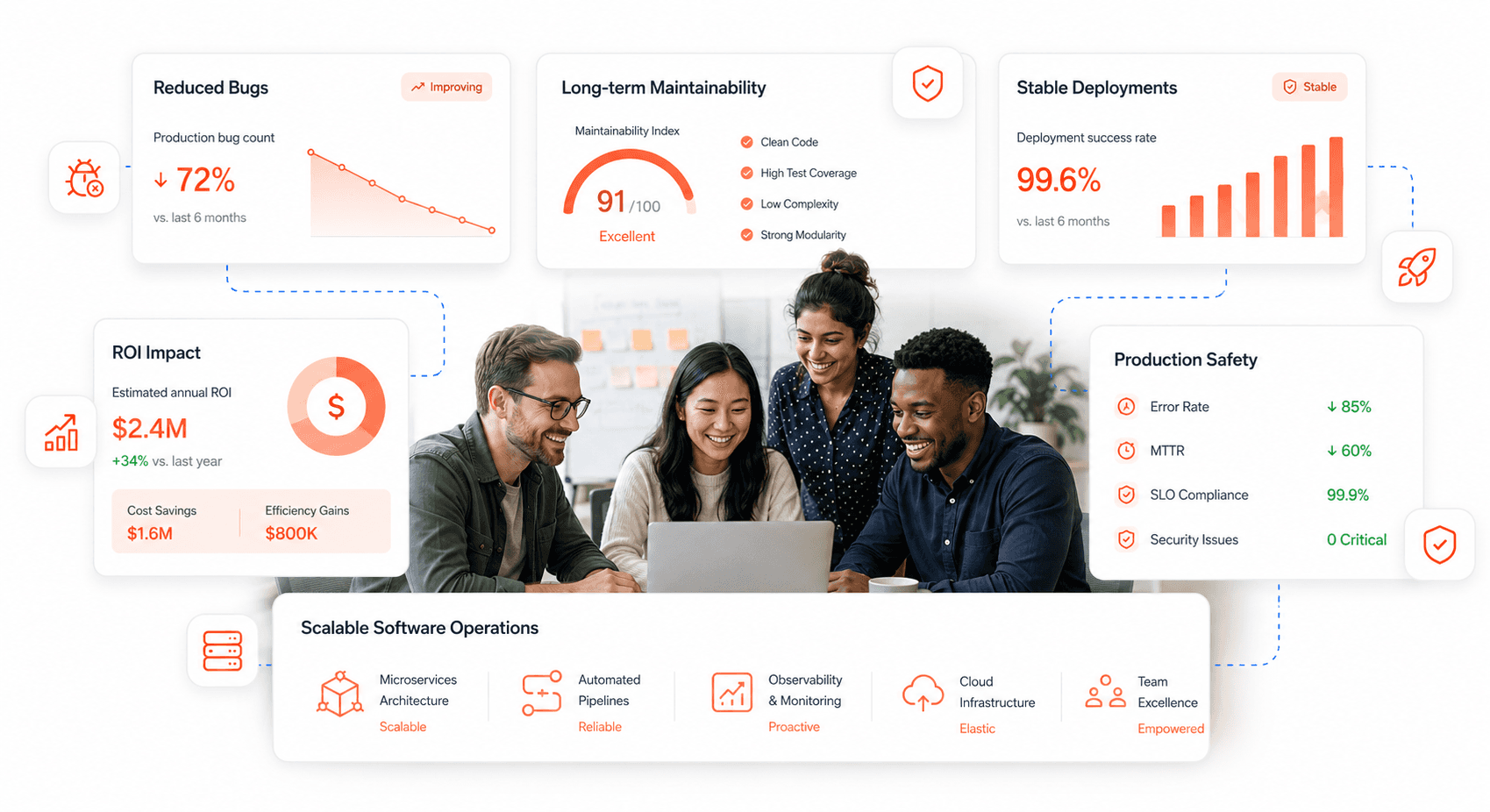
Related Blogs
Related Blogs
Is a clunky UI holding back your growth?
▶︎
Transform slow, frustrating dashboards into intuitive interfaces that ensure effortless user adoption.
▶︎
Transform slow, frustrating dashboards into intuitive interfaces that ensure effortless user adoption.
Is a clunky UI holding back your growth?
▶︎
Transform slow, frustrating dashboards into intuitive interfaces that ensure effortless user adoption.
▶︎
Transform slow, frustrating dashboards into intuitive interfaces that ensure effortless user adoption.
Is a clunky UI holding back your growth?
▶︎
Transform slow, frustrating dashboards into intuitive interfaces that ensure effortless user adoption.
▶︎
Transform slow, frustrating dashboards into intuitive interfaces that ensure effortless user adoption.