

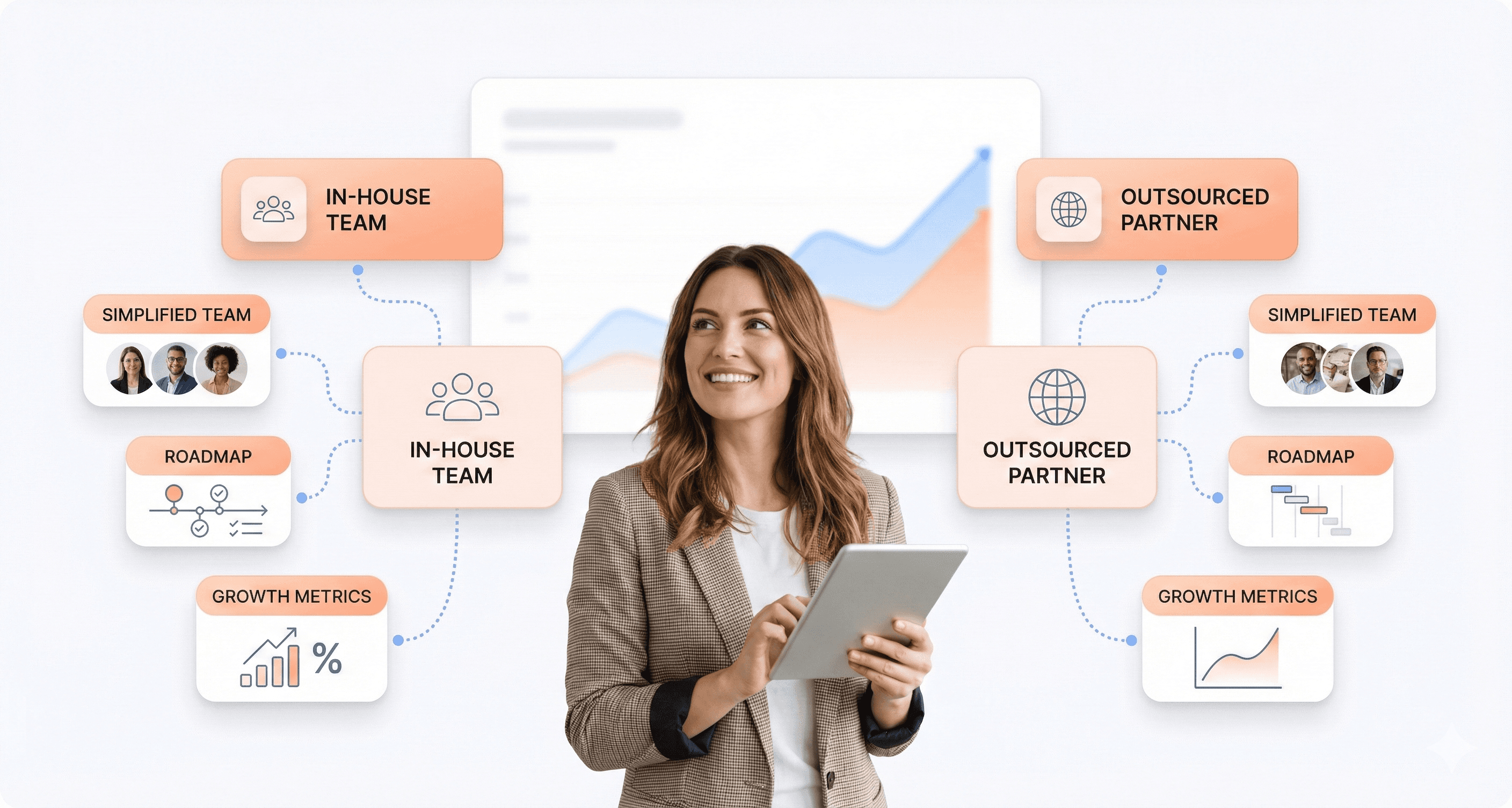
Choosing how to build your product is no longer just an operational decision — it is a strategic growth choice that directly affects revenue, speed, and competitive advantage. Founders and product leaders today must think beyond features and engineering capacity. The real question is how your development model shapes customer adoption, retention, and long-term business impact.
This comprehensive guide to in-house vs outsourced product development is designed for founders, CTOs, product leaders, and business executives who want to align engineering with growth. Whether you're launching a new product, scaling after product-market fit, or restructuring your current team, understanding the strategic implications of each model helps you avoid costly missteps.
We’ll break down how internal teams create deep alignment and long-term ownership, how outsourcing provides speed and flexibility, and when hybrid structures deliver the best of both worlds. You’ll learn how cost structure, scalability, governance, and product criticality influence your decision — and how to match your development approach to your business stage.
This is not a debate about which model is universally better. It’s a strategic framework to help you build the right structure for your goals. Because in modern product companies, development isn’t just about writing code — it’s about building a growth engine that powers your business forward.
The Shift from Feature Building to Growth Building
In recent years, product development has fundamentally changed. What used to be about delivery speed and feature checklists is now about customer engagement, adoption, and measurable business impact. Product teams are expected to generate revenue, not just complete tickets. This shift makes the question of how you build products a strategic decision rather than an operational one. Leaders who still treat development purely as a technical function risk stagnation because competitors who connect development with strategy move faster and win customers.
Why Product Development Is a Strategic Business Decision
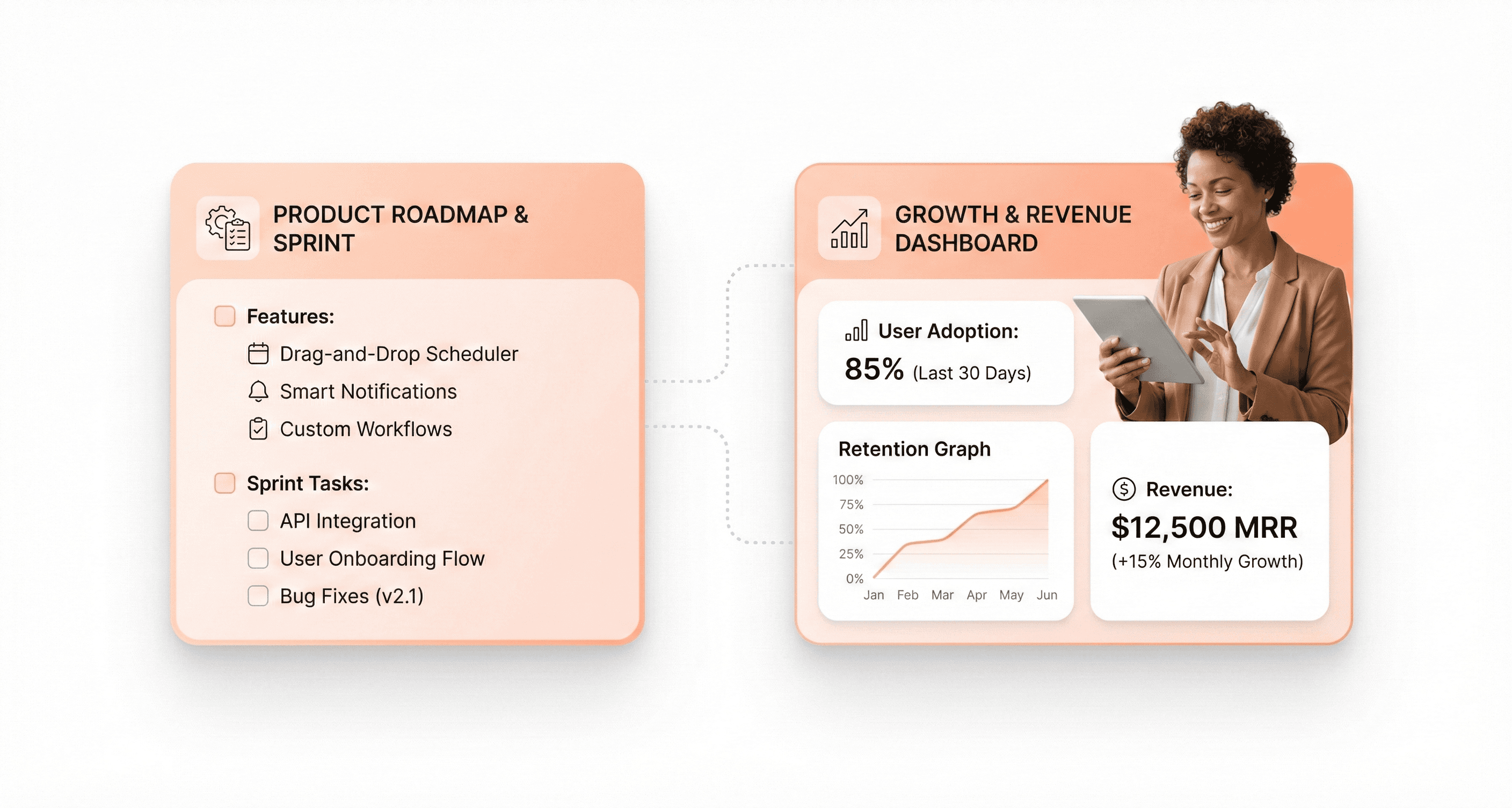
When product strategy is disconnected from business goals, the team ends up optimizing the wrong outcomes. For example, measuring success in story points instead of customer retention leads to high feature output but low market impact. The choice between in-house and outsourced development directly influences business outcomes because it determines how the team collaborates, priorities are set, and how quickly the product learns from the market. This is why founders and product leaders must approach development choices with a business-first mindset.
The Risk of Treating Engineering as a Cost Center
Many organizations still view engineering as a support cost rather than a growth engine. This frames development decisions around budgets and headcounts instead of outcomes and differentiation. When product leaders see development only through cost lenses, the team becomes transactional. Features get built, but they fail to deliver a competitive advantage because decisions are reactive rather than strategic. Intentional decisions about where work happens and who does it can transform development from a cost center into a growth driver.
How Development Models Influence Revenue and Adoption
Whether your engineers sit inside your org or outside as partners affects speed alignment and ultimately customer satisfaction. In-house teams offer deep alignment with product vision but come with higher fixed costs. Outsourced teams bring flexibility and specialized skills but require careful coordination. Both models influence how quickly features reach users and how reliably those features solve real problems. Leaders must understand these tradeoffs in order to choose the path that best supports product goals.
Who Should Read This Guide
This article is designed for founders product leaders CTOs and business executives who need to rethink how their product teams operate. If you are facing slow releases misalignments between business and engineering rising costs or inconsistent product outcomes, this guide gives you a fact-based framework to decide whether building internally outsourcing externally or combining both makes strategic sense.
Product Development as a Strategic Growth Lever
Product Development as a Competitive Advantage
Product development today determines how effectively a company competes. Markets reward organizations that can release improvements quickly and respond to user feedback with precision. Development models influence this ability directly. An internal team can provide tight alignment with strategy, while an external partner can bring speed and specialized capability. Leaders must view development structure as a lever that shapes competitive position rather than a simple staffing choice.
Bridging the Gap Between Engineering and Business Goals
A frequent problem inside companies is the gap between what engineering delivers and what the business actually needs. Teams may focus on technical elegance, while revenue teams need faster market validation. This disconnect appears when product success is measured only by output instead of customer impact. Choosing the right development model helps close this gap by aligning incentives, communication, and accountability with commercial objectives.
Measuring Product Success Beyond Development Velocity
Traditional metrics such as velocity or number of features shipped do not guarantee growth. True success is reflected in adoption, retention and revenue contribution. Development approaches must therefore be evaluated by how well they support these outcomes. Outsourced teams may accelerate delivery, while in-house teams may provide deeper understanding of users. The strategic context requires leaders to connect these characteristics with the metrics that matter most to the organization.
Leadership’s Role in Product Development Strategy
No model succeeds without clear leadership. Whether work happens internally or through partners, executives must define priorities, guard product vision, and ensure communication discipline. Outsourcing especially demands structured governance and documented expectations. In-house teams require equal attention to talent development and cross functional collaboration. Leadership quality, therefore, becomes the decisive factor that converts any model into business value.
Common Mistakes Founders Make When Choosing a Development Model
Founders often select a model based on short-term cost or personal preference instead of strategic fit. Some build large internal teams before validating market demand. Others outsource critical knowledge without planning for transfer. Both paths create risk. A balanced assessment of budget, timeline, expertise, and product maturity prevents these errors and leads to more resilient decisions.
Understanding Internal Product Development
What Is In-House Product Development
In house product development refers to building digital products using your organization’s own team members. Developers, designers, product managers and quality engineers are employed directly and work within the company structure instead of through external vendors. This model centralizes product work inside your organization and aligns it with your internal culture, goals and priorities.
How Internal Product Teams Are Structured
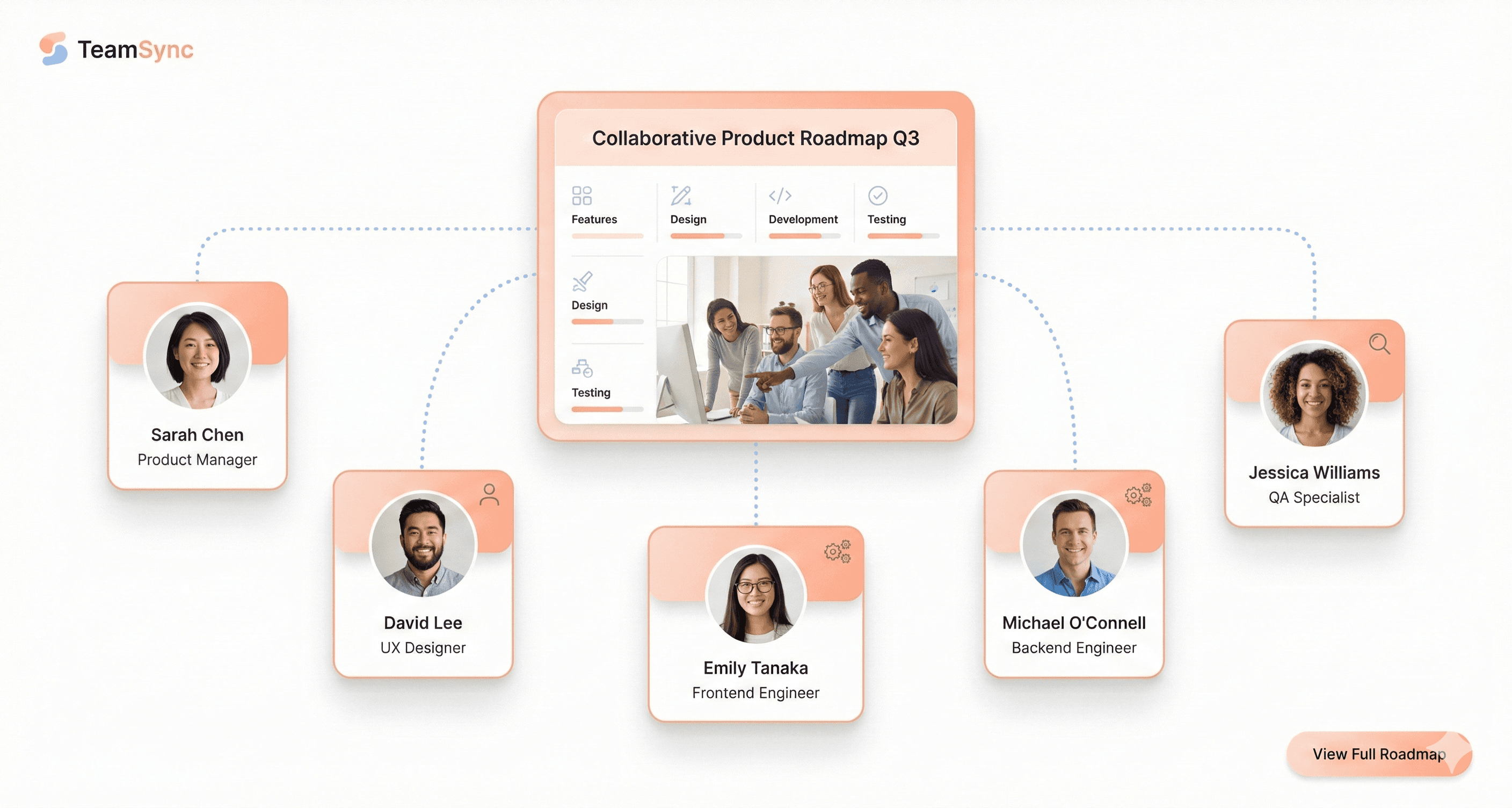
An internal product team typically includes core roles such as product manager, UX designer, frontend and backend engineers, testing and deployment specialists. These team members report into the company and follow internal leadership. Because they share the same organizational incentives they can collaborate closely on product strategy, technical decisions and iterative improvements.
An effective internal product team typically includes:
A product manager responsible for roadmap and business alignment
UX/UI designers focused on customer experience
Frontend and backend engineers for core development
QA specialists ensuring product reliability
DevOps or deployment experts managing infrastructure
Ownership and Accountability in In-House Teams
With in house teams ownership and accountability are concentrated within your organization. Product decisions are made directly by internal leadership without needing to coordinate through formal contracts. This enhances alignment between product outcomes and business strategy. Internal teams often feel a stronger sense of responsibility for long term success because they are part of the company’s mission and culture.
Stakeholder Collaboration in Internal Development
Internal teams benefit from real time collaboration with marketing, sales, customer support and operations teams. Face to face communication or shared virtual workspaces help remove barriers that slow decision making. Because everyone is operating in the same environment internal teams can adjust priorities quickly based on user feedback or shifts in strategy.
When In-House Development Makes Strategic Sense
In house development typically makes sense when the product is core to the business and expected to evolve for many years. Companies building complex platforms that require deep domain understanding benefit from the continuity that internal teams provide. Organizations with sufficient budget for hiring and training will find this model strengthens long term product quality and organizational alignment.
Exploring External Product Development Partnerships
Understanding the Outsourcing Model
Outsourced product development means transferring part or all of the product building responsibility to an external organization. Instead of hiring employees directly, the company partners with a specialized vendor that provides developers, designers and product experts under a contract. The business retains ownership of the product vision while execution is handled by professionals outside the company structure.
Types of Software Development Outsourcing Models
Outsourcing can take several forms depending on business needs. Some companies delegate the entire product lifecycle to an external partner. Others outsource only specific components such as user interface design or quality assurance. This flexibility allows leaders to choose the level of involvement that matches their internal capability and risk tolerance.
Project-Based vs Dedicated Development Teams
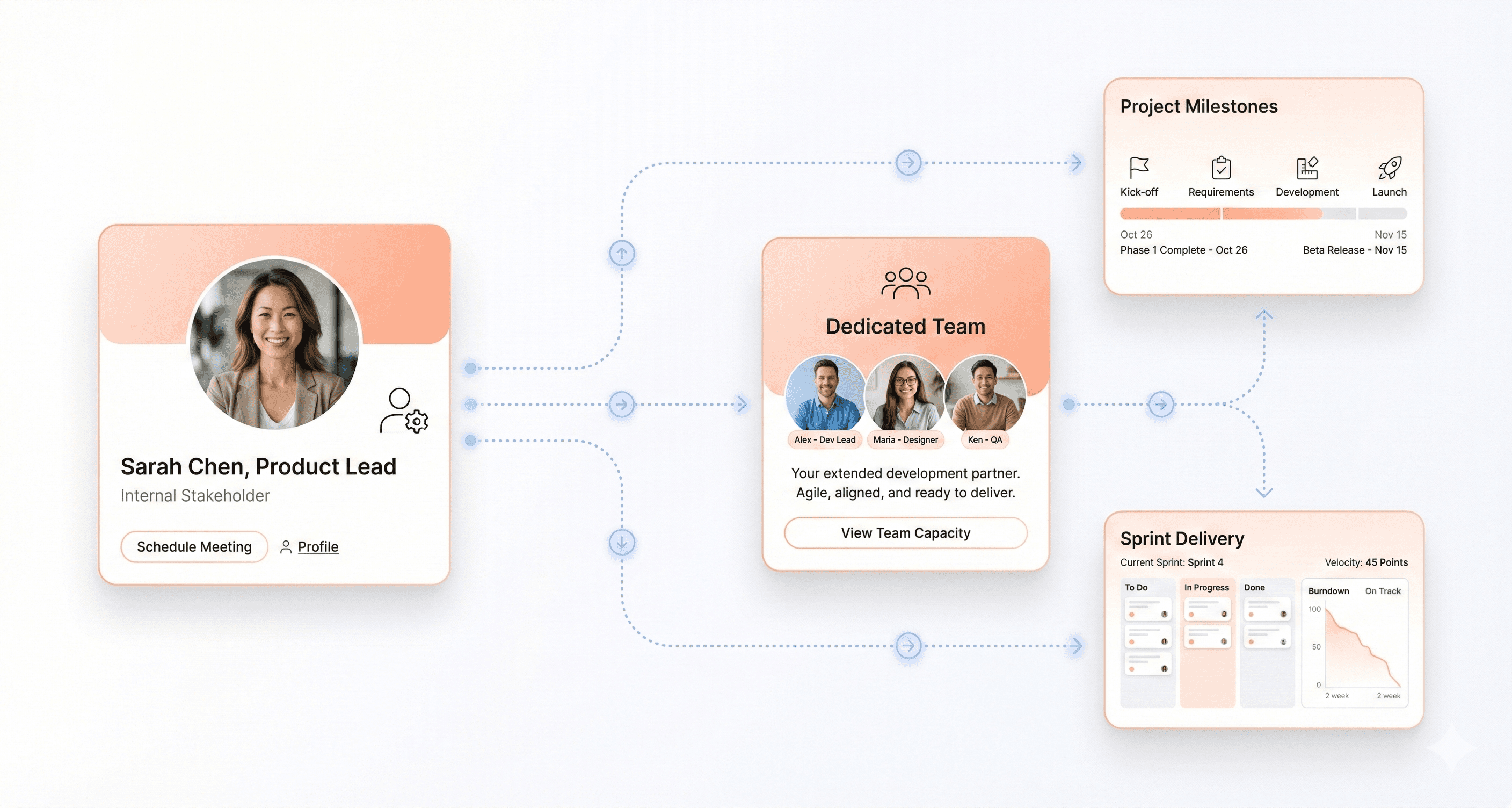
Two common engagement styles dominate outsourced development. Project based contracts focus on fixed scope and defined deliverables. Dedicated team models provide a group of specialists who work as an extension of the client organization for a longer period. Each approach offers different levels of control and adaptability.
Accessing Global Talent Through Outsourcing
One of the strongest reasons companies outsource is access to global expertise. External vendors often employ specialists in emerging technologies that are difficult to recruit locally. This allows businesses to use advanced skills without long hiring cycles or permanent salary commitments.
When to Choose an External Product Development Partner
Organizations typically choose outsourcing when they need rapid scaling, cost flexibility or knowledge in unfamiliar domains. Startups launching a minimum viable product and enterprises exploring new digital initiatives frequently rely on partners to accelerate progress while internal teams focus on core operations.
Advantages of Building an Internal Product Team
Deep Alignment with Company Vision
In house product teams work on strategic goals that are tightly connected to the organisation’s long term mission. Because internal teams participate in company meetings and are part of the cultural fabric, they understand not just what needs to be built but why it matters. This alignment improves product decisions and ensures every feature supports broader business objectives.
Stronger Control Over Roadmap
With internal teams you have direct oversight of the product roadmap. You control priorities, timelines and resource allocation without negotiating scope changes through contracts. This control makes it easier to pivot when market feedback requires quick adjustments and helps you retain strategic flexibility.
Faster Internal Communication
When developers, designers and product managers are part of the same organisation communication happens continuously rather than in scheduled checkpoints. Informal discussions, sprint reviews and real time collaboration eliminate barriers that often slow decision making. The result is improved clarity and faster resolution of issues.
Knowledge Retention Within the Business
Internal teams retain domain knowledge that becomes a competitive advantage. As products evolve, history and context stay with the organisation rather than disappearing when a contract ends. This accumulated knowledge increases development quality and reduces redundant work over time.
Over time, internal development creates strategic advantages such as:
Accumulated domain expertise that improves decision quality
Faster iteration based on direct user feedback
Stronger cultural alignment with company mission
Greater architectural consistency across releases
Reduced reliance on external coordination
Long Term Quality Advantages
While outsourced teams can deliver quality work, internal teams build deep product expertise that raises standards over time. They understand customer behaviour, internal processes and long term strategic direction better than a temporary partner. For products expected to evolve for years internal development often results in higher sustained quality.
Limitations of Internal Product Development
High Recruitment and Retention Costs
Building an internal product team requires significant financial commitment. Companies must compete for skilled developers, designers and product managers in a market where demand often exceeds supply. Salaries, benefits and recruitment expenses create a heavy fixed cost before a single feature is released. For young companies this investment can consume a large portion of operating budget.
Infrastructure and Training Burden
In house development demands continuous investment in tools, licenses and technical infrastructure. Teams need modern hardware, testing environments and security systems to remain productive. Technology changes rapidly, which means organizations must also fund regular training so employees stay current with new frameworks and practices. Without these investments productivity and morale decline.
The core operational challenges include:
High fixed monthly payroll commitments
Ongoing investment in tools, licenses and hardware
Continuous training to stay updated with evolving technologies
Long recruitment cycles for niche expertise
Risk of internal dependency on key individuals
Limited Access to Niche Skills
Internal teams are usually built around a specific technology stack. When a product requires new capabilities such as advanced analytics or specialized design, the company may not have the right people available. Recruiting experts takes time and may still leave gaps in knowledge. This limitation can slow innovation and restrict the product vision.
Slower Scaling During Growth
When business demand suddenly increases, in house teams cannot expand overnight. Hiring and onboarding new members often takes months. During this period release schedules may slip and competitors can capture market opportunities. Internal structures that work well at small scale sometimes struggle when the product grows rapidly.
Risk of Internal Bottlenecks
Product progress can become dependent on a few key employees. Vacations, resignations or burnout create bottlenecks that affect the entire roadmap. Because knowledge is concentrated internally, replacing these people is difficult and expensive. Leaders must plan carefully to avoid single points of failure inside their own organization.
Strategic Benefits of Outsourcing Product Development
Access to Global Expertise
Outsourced development opens the door to a worldwide network of specialists. Companies are no longer limited to the talent available in their local market. External partners often employ engineers and designers who focus on specific technologies such as cloud architecture, data engineering or advanced user experience. This access allows businesses to use high level expertise without building large internal departments.
Outsourcing delivers measurable operational advantages including:
Immediate access to specialized technical skills
Reduced hiring and onboarding delays
Flexible engagement models based on project scope
Faster product validation cycles
Lower fixed operational overhead
Flexible Cost Structure
One of the strongest advantages of outsourcing is financial flexibility. Instead of permanent salaries and benefits, organizations pay for the exact capacity they need. Contracts can be adjusted according to project stage and available budget. This model converts fixed expenses into variable costs and protects cash flow during uncertain periods.
Accelerated Time to Market
External development teams usually operate with established processes and ready infrastructure. They can begin work immediately without the long hiring and onboarding cycles required for internal teams. This readiness shortens delivery timelines and helps companies test ideas in the market faster. Speed becomes a critical advantage when competition is intense.
Ability to Scale on Demand
Outsourcing enables rapid scaling when product demand increases. Additional developers or specialists can be added to the project within weeks instead of months. When priorities change, the team size can be reduced just as easily. This elasticity allows businesses to respond to market opportunities without long term commitments.
Learning from Cross Industry Experience
External partners bring knowledge gathered from many different products and sectors. They understand common mistakes and proven patterns because they have implemented similar solutions before. This perspective often improves design decisions and helps internal stakeholders avoid costly experiments.
Risks and Challenges in Outsourced Development
Communication and Coordination Issues
Working with external teams often introduces communication complexity. Team members may operate from different locations and time zones, which reduces opportunities for spontaneous discussion. Requirements that appear clear to internal stakeholders can be interpreted differently by remote developers. Without structured communication routines, small misunderstandings gradually become major delivery problems.
Cultural and Process Differences
Every organization follows its own professional habits and work culture. When two companies collaborate, these habits do not always align. Differences in decision making style, documentation standards or feedback processes can slow collaboration. External partners may also prioritize tasks based on contract terms rather than long term product thinking, which creates friction with business stakeholders.
Quality and Accountability Risks
Outsourcing transfers execution outside direct managerial control. If performance expectations are not clearly defined, the delivered product may not meet business needs. Vendors focus on agreed deliverables, yet real success depends on user satisfaction and revenue impact. Achieving this alignment requires strong governance and continuous review from the client side.
Data Security Concerns
Sharing sensitive product information with third parties increases security exposure. Intellectual property, customer data and internal processes move beyond company boundaries. Organizations must establish strict confidentiality agreements, access controls and secure collaboration tools before any development begins. Without these safeguards outsourcing can create legal and compliance challenges.
Dependency on External Knowledge
When critical system knowledge remains with the vendor, the client becomes dependent on that relationship. If the partnership ends unexpectedly, the internal team may struggle to maintain or extend the product. Continuous documentation and planned knowledge transfer are essential to reduce this dependency and preserve long term control.
Comparing In-House and Outsourced Development Models
Factor | In-House Development | Outsourced Development |
Cost Structure | Fixed salaries, benefits, infrastructure | Variable, contract-based costs |
Speed to Start | Slower due to hiring and onboarding | Faster due to ready teams |
Control Level | High direct control | Requires structured governance |
Product Knowledge | Deep internal domain expertise | Knowledge depends on documentation transfer |
Scalability | Slower hiring cycle | Rapid team scaling possible |
Access to Skills | Limited to hired expertise | Access to global specialists |
Communication | Real-time, easier alignment | Time-zone and coordination challenges |
Long-Term Ownership | Fully retained internally | May require structured knowledge transfer |
Cost Structure Differences
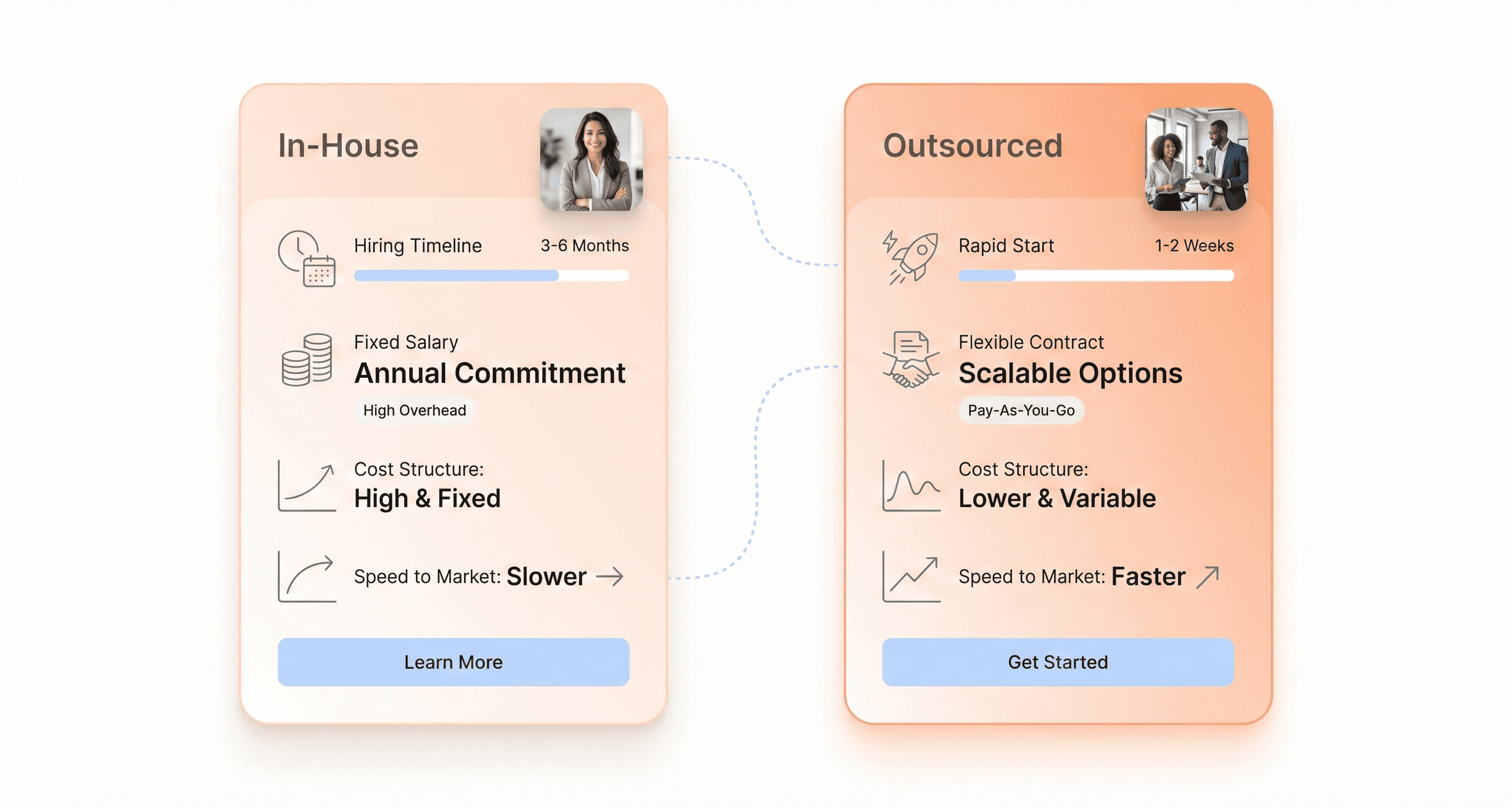
Comparing in house teams with outsourced partners begins with financial structure. Internal teams require ongoing salaries, benefits, hiring costs and infrastructure investment. These costs are predictable but fixed, which can be a burden if product priorities change or market conditions tighten. Outsourced models convert much of this expense into variable costs. You pay for what you need when you need it, which protects cash flow and reduces long term obligations.
Speed and Delivery Timelines
Speed to market is essential for competitive advantage. Outsourced development often accelerates delivery because external teams already have processes, tools and onboarding rhythms established. They can start work immediately with minimal ramp up. In house teams require time for recruiting, onboarding and establishing workflow norms before achieving peak velocity. This difference often determines who wins early market tests and validation cycles.
Control and Governance
Internal teams provide deeper control over development decisions. Product leadership can make real time changes without renegotiating contracts or waiting for external approvals. This level of control reduces friction when priorities shift quickly. Outsourced teams require clear scope definitions and governance mechanisms to preserve alignment. Without strong leadership this can lead to friction between business intent and execution activity.
Expertise and Innovation
Expertise availability shapes innovation outcomes. In house teams excel when deep understanding of product context and business model matter most. However internal skill sets may be narrower compared with a vendor that serves multiple industries and technology stacks. Outsourced teams bring fresh perspectives and cross industry experience. Choosing which type of expertise matters depends on the product’s life cycle and strategic ambition.
Impact on Final Product Quality
Final product quality is influenced by both alignment and execution discipline. Internal teams understand customer behavior and long term vision making them strong custodians of quality. Outsourced partners may deliver high quality work but require clear standards and frequent reviews to match business expectations. The best outcomes arise when quality is measured by customer impact rather than adherence to internal code conventions alone.
A Practical Framework for Selecting the Right Model
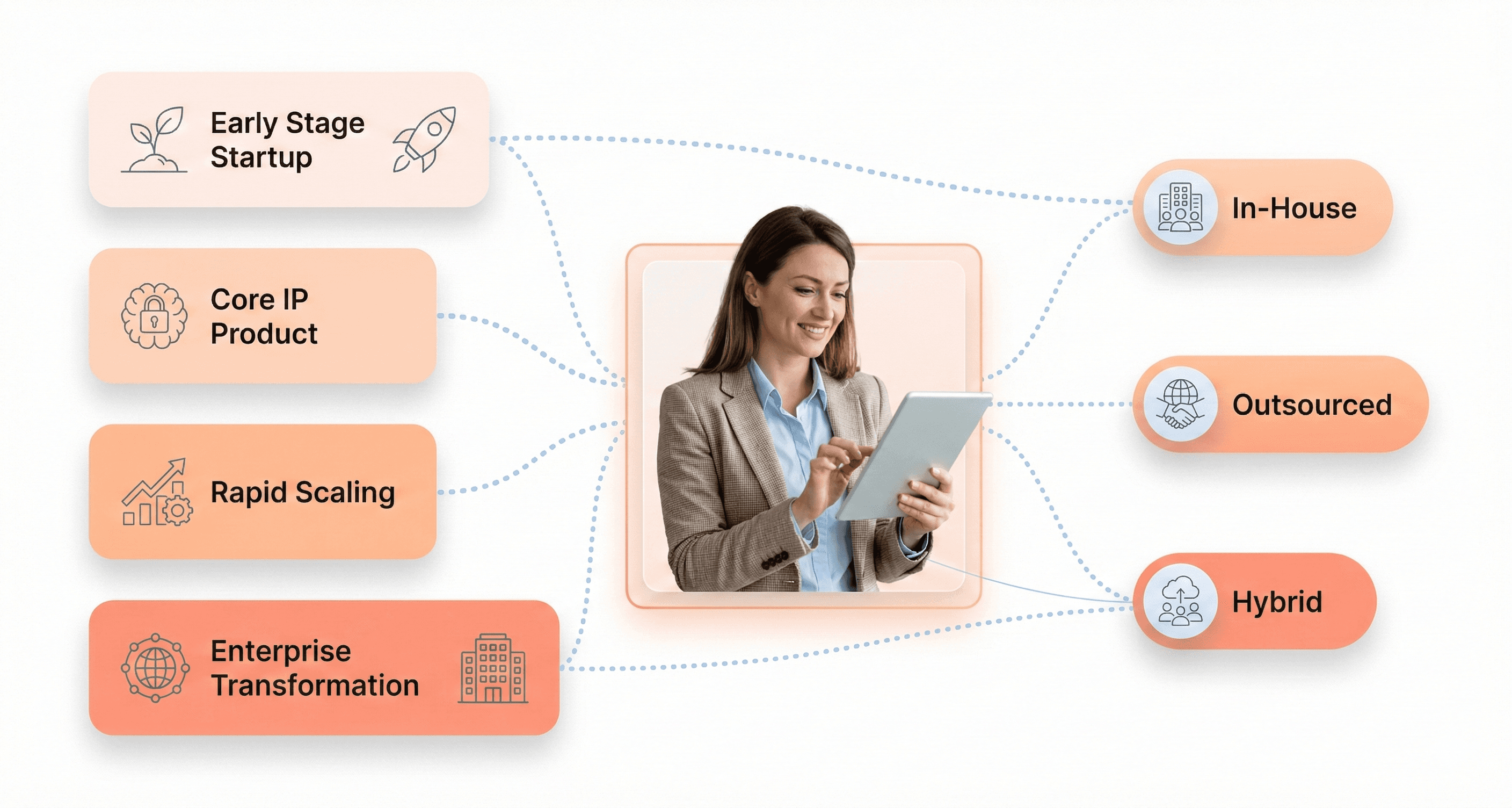
Business Scenario | Recommended Model | Why |
Early-stage startup validating idea | Outsourced or Hybrid | Faster MVP launch with lower upfront cost |
Core IP product with long-term roadmap | In-House | Strong control and knowledge retention |
Rapid scaling after product-market fit | Hybrid | Maintain control while scaling capacity |
Limited budget with urgent timeline | Outsourced | Cost flexibility and speed |
Enterprise digital transformation | Hybrid | Balance strategic ownership with external expertise |
Highly regulated or sensitive data product | In-House | Better data control and compliance management |
Evaluating Product Criticality
The first question leaders must ask is how critical the product is to the core identity of the business. When the product represents unique intellectual property or long term differentiation, keeping development in house usually protects strategic control. If the product is supportive rather than central, outsourcing can deliver results without heavy internal investment. Understanding this distinction prevents companies from overbuilding internal teams for work that does not define competitive advantage.
Budget and Return Considerations
Financial reality shapes every development decision. Internal teams require stable monthly spending regardless of immediate revenue. Outsourced models align costs more closely with project milestones and cash flow. Leaders must compare expected return from the product with the total cost of ownership under each model. A disciplined financial view often reveals that the cheapest option on paper is not the most profitable in the long run.
Speed Versus Stability Tradeoffs
Every product faces tension between rapid experimentation and long term stability. Outsourcing favors speed because experienced vendors can mobilize quickly. In house development favors stability and deeper architectural consistency. The right choice depends on whether the business is validating ideas or scaling a proven platform. Leaders should match the model to the stage of the product journey rather than applying a single rule forever.
Leadership and Management Readiness
Outsourcing does not remove the need for strong internal leadership. It actually increases the requirement for clear product ownership, documentation and decision discipline. Companies without mature product management often struggle with external vendors. In house teams also require capable leadership but benefit from informal collaboration channels. Assessing managerial readiness helps determine which model the organization can realistically govern.
Matching Model to Business Stage
Startups, growing companies and established enterprises need different approaches. Early stage businesses may prioritize outsourced speed to test market fit. Scaling companies often build hybrid structures to balance control and capacity. Mature organizations with complex ecosystems lean toward in house ownership. Recognizing the stage of the business prevents leaders from copying decisions that worked for companies in completely different circumstances.
Leveraging Hybrid Product Development Structures
Blending Internal and External Strengths
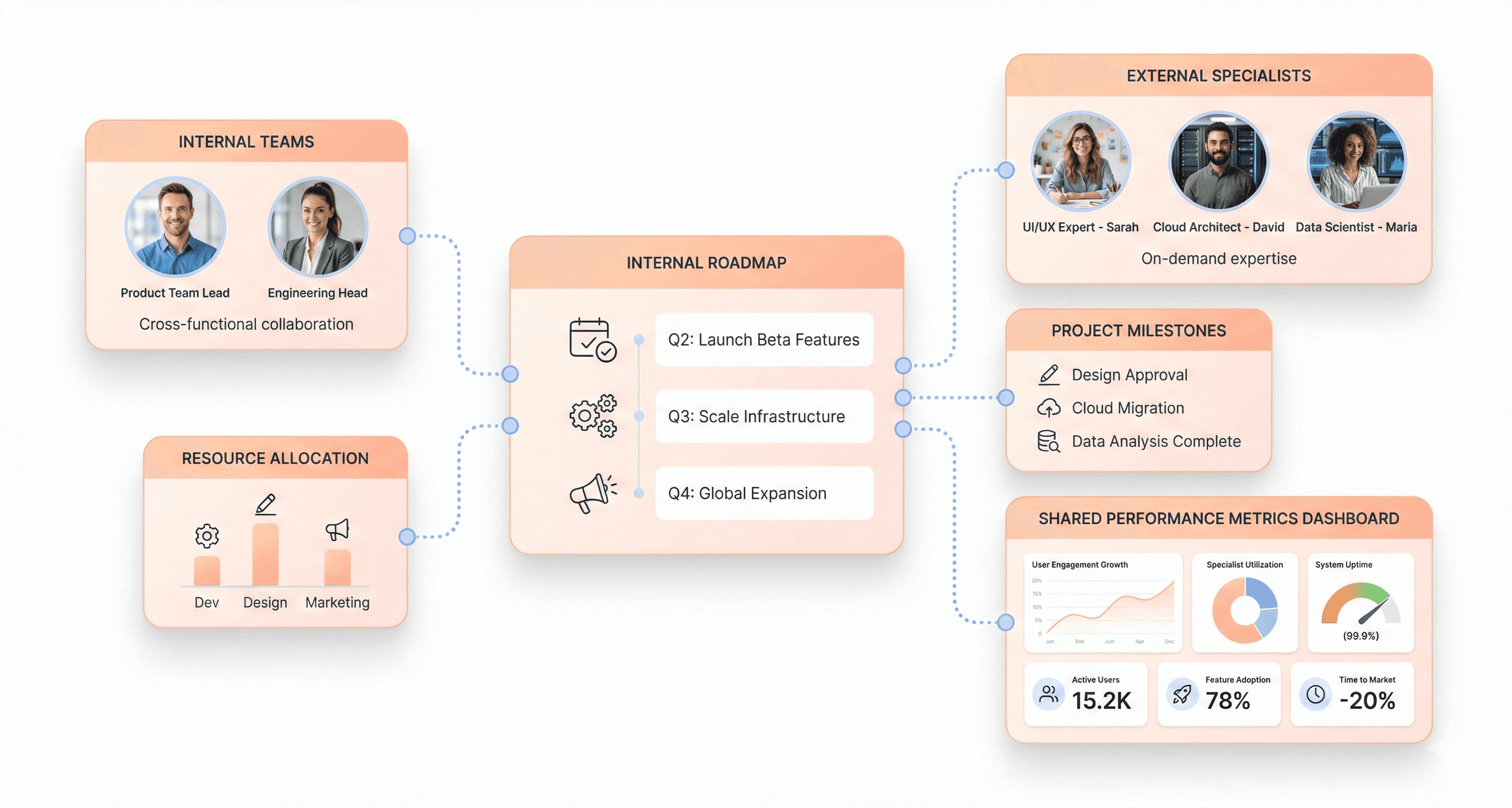
A hybrid model combines the best elements of in house and outsourced development. Companies keep core strategic work internal while leveraging external expertise for modules that require specialized skills or additional capacity. This hybrid approach reduces pressure on internal teams and distributes risk more effectively. It also ensures that core IP remains within the organization while benefiting from outside talent where appropriate.
A successful hybrid model often includes:
Internal ownership of product vision and roadmap
External specialists for niche technical execution
Shared tools and documentation systems
Clearly defined performance metrics for all contributors
Structured knowledge transfer between teams
Keeping Core Strategy In House
When the product roadmap involves vision-setting, long term architectural decisions and ownership of customer relationships, these tasks are best handled internally. Core strategy influences every aspect of product experience and functions as the foundation for future innovations. Keeping this work in house improves alignment and reduces the risk of strategic drift.
Using Partners for Specialized Work
One of the clearest benefits of hybrid models is the ability to engage external partners for specialized tasks such as UI/UX design, performance optimization or machine learning integration. These areas often require niche skills that internal teams may not have or might take too long to recruit for. Using partners strategically accelerates delivery without overstretching internal resources.
Governance in Hybrid Teams
To succeed with a hybrid model companies must establish clear governance practices. Goals, success metrics and communication standards should be defined upfront for both internal and external contributors. Consistent documentation ensures that all parties understand expectations and deliverables. Shared performance indicators help align the work of outsourced teams with internal team priorities.
Building an Extended Product Organization
A distributed product organization treats internal and external talent as a unified team rather than separate silos. Tools, processes and workflows are standardized so everyone works toward the same outcomes. This approach demands strong product leadership but creates an adaptable structure that can absorb market changes and scale without compromising quality or strategy.
Shifting the Conversation from Tactics to Strategy
Moving Beyond Old Assumptions
The discussion about in house versus outsourced development is often shaped by outdated beliefs. Many leaders assume internal teams are always higher quality or that outsourcing is only about saving money. These assumptions ignore how modern product markets operate. Development structure should be judged by how well it supports customer value and business growth rather than by tradition or comfort.
Connecting Development to Revenue
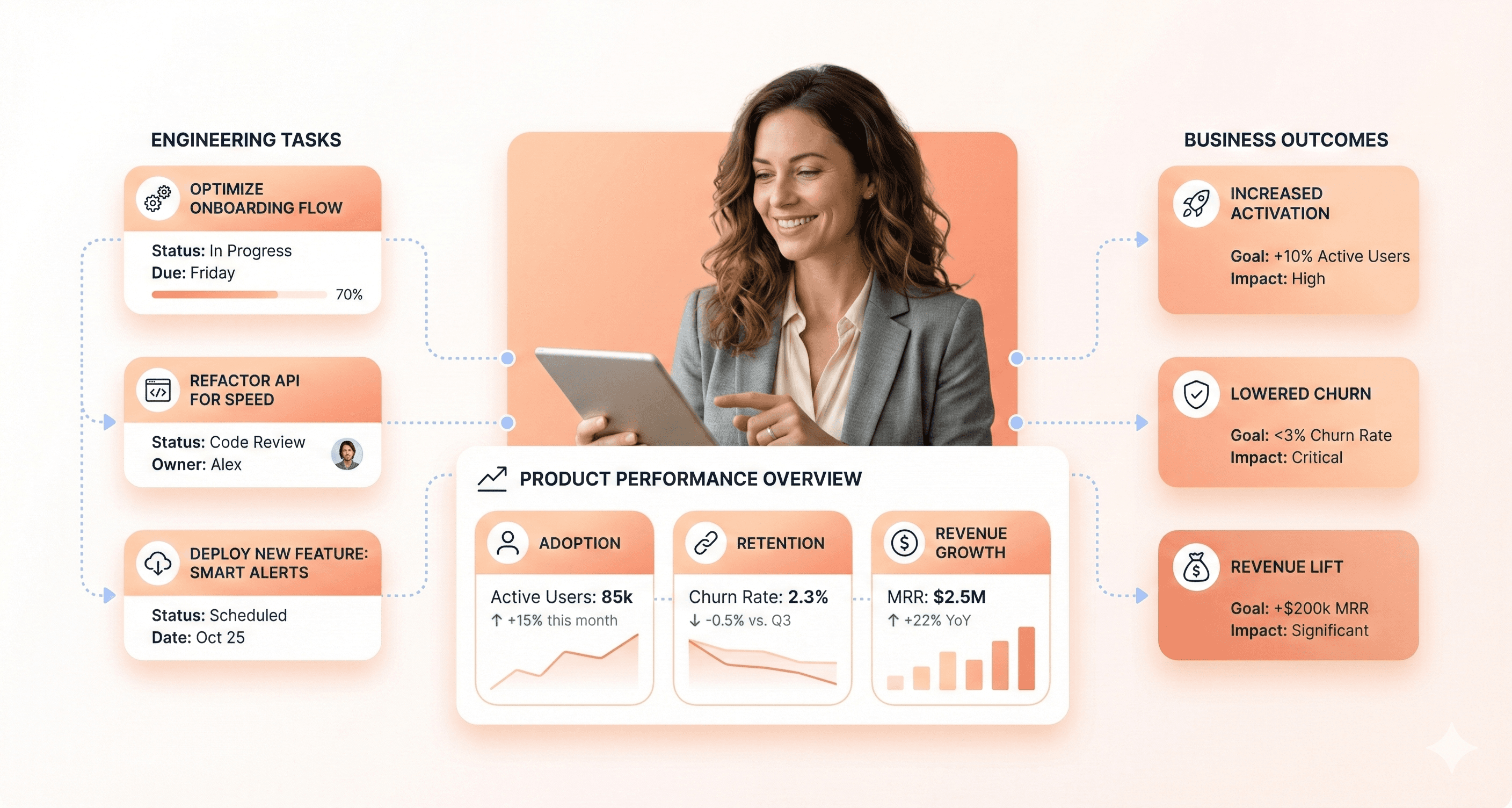
Every line of code must ultimately serve revenue and retention. When companies treat development as a separate technical activity, they lose this connection. The better question is not where the team sits but how the model influences commercial outcomes. Both internal and external teams can generate revenue impact when leadership defines clear product goals and measures success by market results.
A strategy-driven development approach focuses on:
Aligning engineering priorities with revenue impact
Measuring success through adoption and retention metrics
Prioritizing customer outcomes over feature volume
Adapting team structure as the product lifecycle evolves
Treating development as a growth engine rather than a cost center
Flexibility Across Product Stages
Products move through stages from early validation to maturity. A model that works during experimentation may fail during scale. Outsourcing can accelerate early learning while in house ownership may become more important once the product stabilizes. Strategic companies allow their development approach to evolve with the product lifecycle instead of locking themselves into a single path.
Choosing Impact Over Effort
Organizations frequently reward effort instead of impact. Large internal teams can create the illusion of progress while real customer problems remain unsolved. Outsourced teams can also deliver many features without moving business metrics. Leaders must judge both models by outcomes such as adoption, revenue growth and customer satisfaction rather than hours spent or tickets closed.
Building a Future Ready Approach
The most successful companies design development structures that can adapt to new technology and market shifts. They combine internal ownership with external expertise when necessary. This pragmatic mindset transforms the debate from ideological choice into strategic design. Development becomes a system for learning and growth instead of a fixed organizational chart.
Taking the Next Step Toward Smarter Product Execution
Think Like a Product Investor
Every founder and product leader must see development as an investment portfolio. Money, time and talent are allocated with the expectation of measurable return. The question is not whether in house or outsourced development is cheaper today. The real question is which structure will create stronger products, happier customers and predictable revenue tomorrow.
Evaluate Your Current Model
Take an honest look at how your product is built right now. Ask whether release speed supports market opportunities. Examine whether engineering priorities reflect business goals. Identify where delays, rework or communication gaps reduce customer impact. These signals reveal whether your current structure is helping growth or quietly blocking it.
Align Engineering with Growth
Product development must be connected to adoption and retention. Teams should be measured by how well they improve user outcomes rather than by technical activity alone. Whether work is done internally or through partners, alignment with growth metrics is essential. This mindset turns development from a cost into a strategic advantage.
Start a Strategic Assessment
The best next step is a structured assessment of your roadmap, budget and delivery capacity. Map which parts of the product require deep internal ownership and which parts could benefit from external expertise. Compare timelines under different models and estimate the impact on revenue milestones. A clear assessment replaces opinion with evidence.
Build Development for Business Impact
Choose a development approach that serves the future of the company rather than habits of the past. The right model will accelerate learning, protect strategic knowledge and deliver value to customers consistently. When product leaders make this decision with discipline, development becomes the strongest engine of business growth.
Conclusion: In-House vs Outsourced Product Development
Choosing between in-house and outsourced product development is a strategic business decision that directly impacts speed, scalability, cost structure, and long-term growth. In-house teams offer deeper alignment, stronger control, and long-term knowledge retention — making them ideal for core products and proprietary innovation. Outsourced development provides flexibility, faster execution, and access to global expertise, which is especially valuable for startups, rapid scaling, or specialized technical needs.
For many businesses, a hybrid product development model delivers the best balance — keeping strategy and ownership internal while leveraging external talent for speed and niche skills.
The right choice depends on your product stage, budget, growth goals, and leadership readiness. When aligned with business objectives, your development model becomes more than a delivery function — it becomes a powerful engine for sustainable revenue and competitive advantage.




About the author
I’m the founder of Hashbyt, an AI-first frontend and UI/UX SaaS partner helping 200+ SaaS companies scale faster through intelligent, growth-driven design. My work focuses on building modern frontend systems, design frameworks, and product modernization strategies that boost revenue, improve user adoption, and help SaaS founders turn their UI into a true growth engine.
Is a clunky UI holding back your growth?
Is a clunky UI holding back your growth?
▶︎
Transform slow, frustrating dashboards into intuitive interfaces that ensure effortless user adoption.
▶︎
Transform slow, frustrating dashboards into intuitive interfaces that ensure effortless user adoption.
