
Product Development Readiness Checklist for SaaS Founders

Product Development Readiness Checklist for SaaS Founders

Posted on

Checklist

Frontend

Posted at

Feb 10, 2026

Feb 10, 2026

Min read

10

I hope you found this post valuable. If you’re looking for proven frontend and design expertise to elevate your product, feel free to reach out.

I hope you found this post valuable. If you’re looking for proven frontend and design expertise to elevate your product, feel free to reach out.

Share

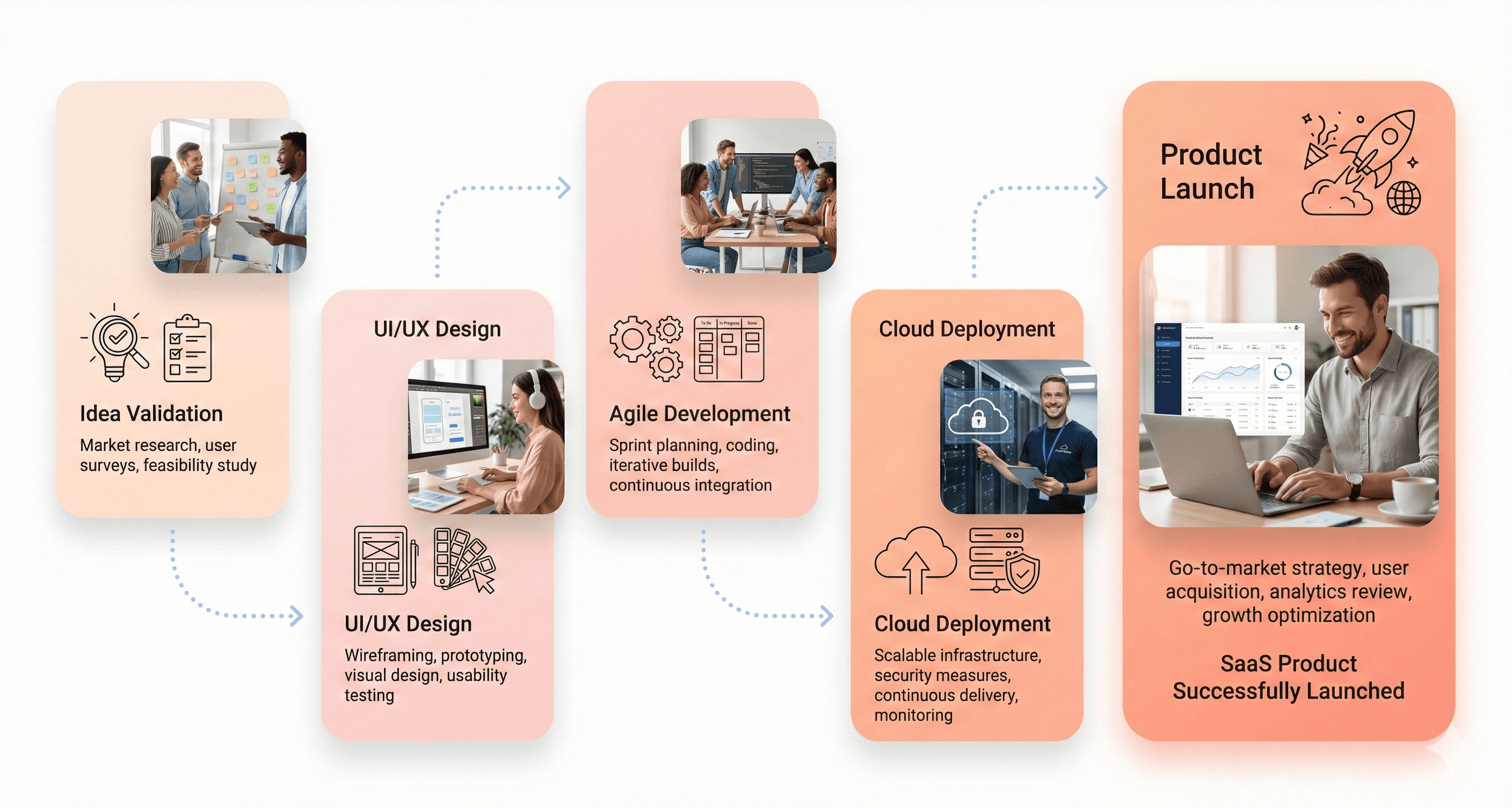
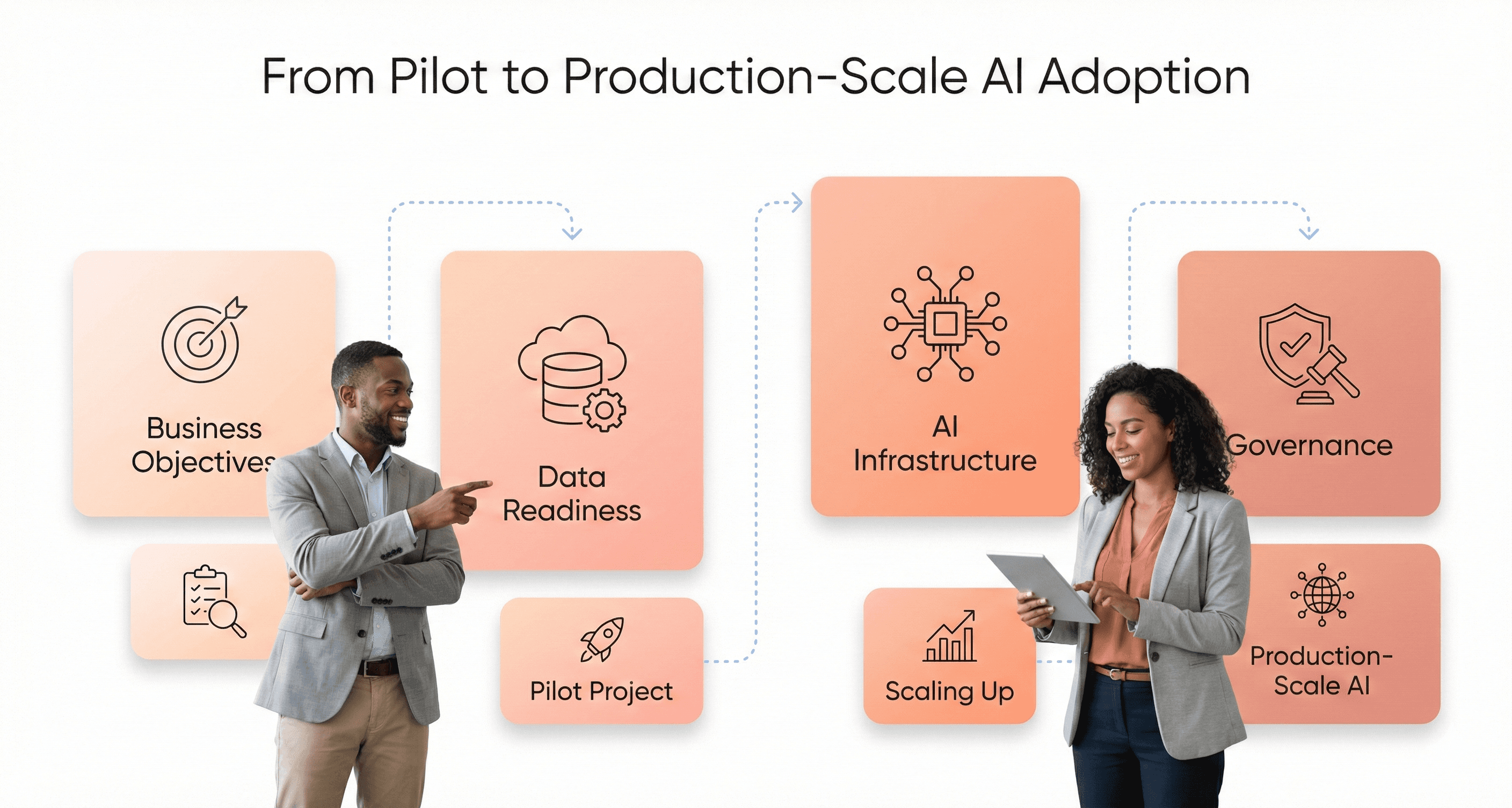
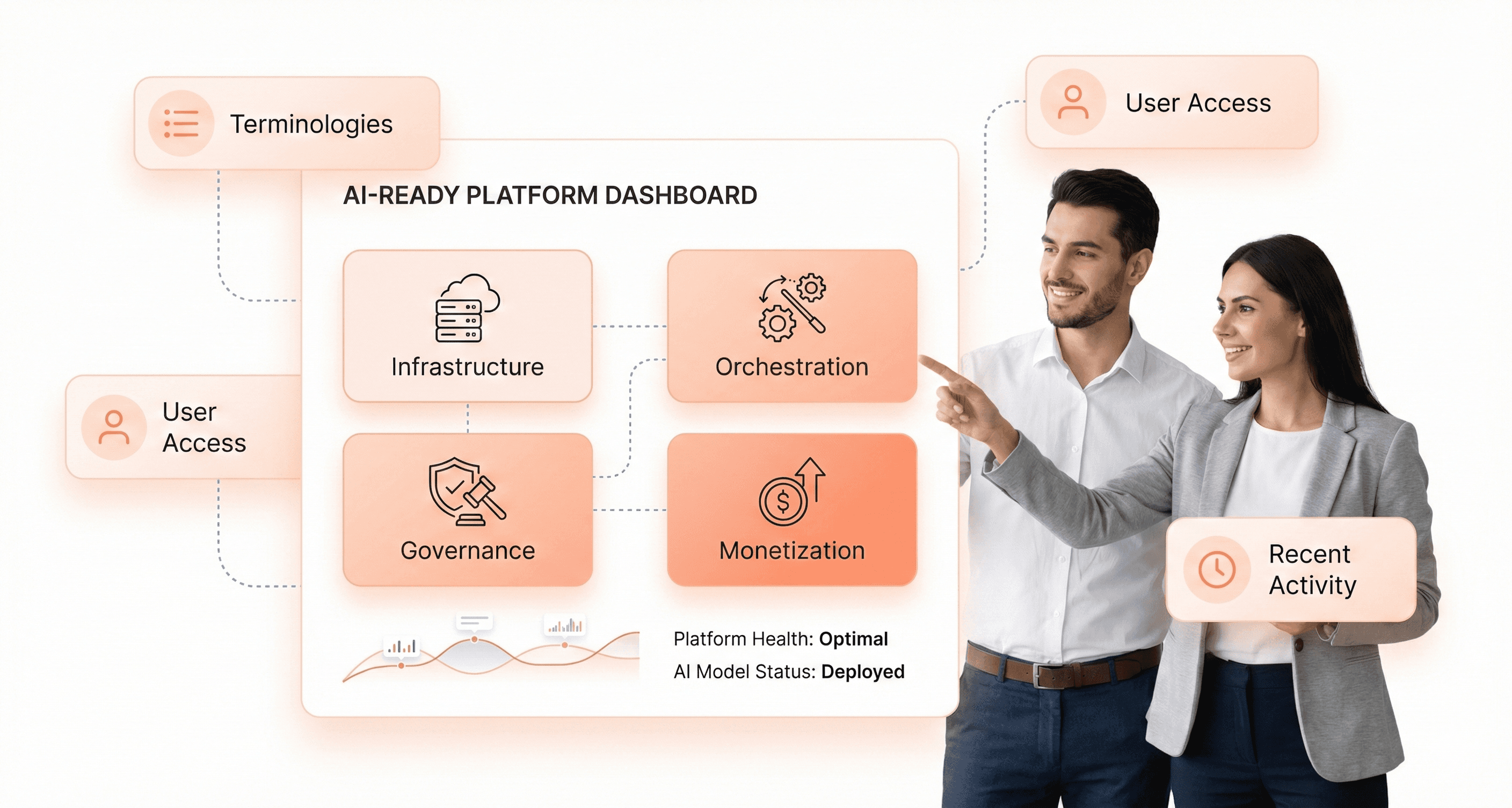
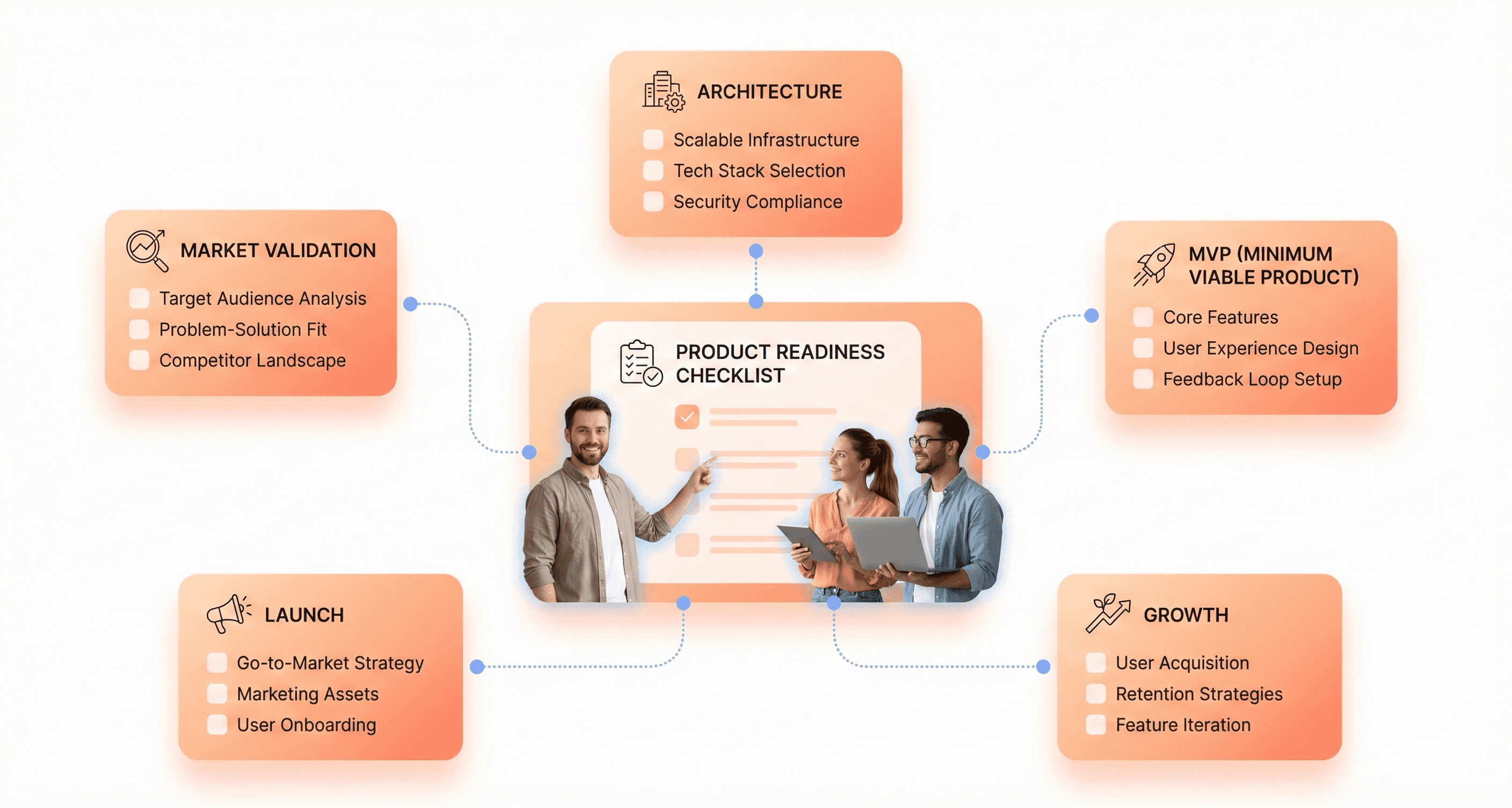
Visual roadmap showing a complete SaaS product development checklist from idea validation to launch and growth.

Summary

A successful SaaS product is built by following a structured SaaS product development roadmap that starts with market research and validation. Founders must clearly define the problem statement, validate user pain points through interviews, and analyze competitors before development begins. The next step is creating detailed user personas, a strong value proposition, and a focused MVP development strategy that prioritizes core features only. Scalable cloud infrastructure, clean application architecture, efficient databases, and API-driven systems are essential to avoid technical debt. Security, compliance, and data privacy must be implemented early to build trust. After MVP launch, continuous testing, user feedback, pricing optimization, marketing execution, and customer support systems drive sustainable growth. This systematic product development checklist for SaaS reduces risk, improves product-market fit, and supports long-term scalability.

Building Security Tools SOC Analysts Can

Navigate Under Pressure?

Summary

A successful SaaS product is built by following a structured SaaS product development roadmap that starts with market research and validation. Founders must clearly define the problem statement, validate user pain points through interviews, and analyze competitors before development begins. The next step is creating detailed user personas, a strong value proposition, and a focused MVP development strategy that prioritizes core features only. Scalable cloud infrastructure, clean application architecture, efficient databases, and API-driven systems are essential to avoid technical debt. Security, compliance, and data privacy must be implemented early to build trust. After MVP launch, continuous testing, user feedback, pricing optimization, marketing execution, and customer support systems drive sustainable growth. This systematic product development checklist for SaaS reduces risk, improves product-market fit, and supports long-term scalability.

Building Security Tools SOC Analysts Can Navigate Under Pressure?

Summary

A successful SaaS product is built by following a structured SaaS product development roadmap that starts with market research and validation. Founders must clearly define the problem statement, validate user pain points through interviews, and analyze competitors before development begins. The next step is creating detailed user personas, a strong value proposition, and a focused MVP development strategy that prioritizes core features only. Scalable cloud infrastructure, clean application architecture, efficient databases, and API-driven systems are essential to avoid technical debt. Security, compliance, and data privacy must be implemented early to build trust. After MVP launch, continuous testing, user feedback, pricing optimization, marketing execution, and customer support systems drive sustainable growth. This systematic product development checklist for SaaS reduces risk, improves product-market fit, and supports long-term scalability.

Building Security Tools SOC Analysts Can

Navigate Under Pressure?

Building a successful SaaS product demands more than just coding skills and brilliant ideas. SaaS founders need a systematic approach that covers every critical aspect of product development, from initial market validation to post-launch optimization.

This product development checklist for saas is designed specifically for SaaS entrepreneurs, first-time founders, and technical co-founders who want to transform their vision into a market-ready product. Whether you're bootstrapping your first startup or scaling your existing platform, having a comprehensive saas product readiness checklist prevents costly mistakes and ensures you don't miss essential steps.

We'll walk you through the foundational elements of market research and validation, helping you confirm there's real demand for your solution before you invest months in development. You'll also discover how to build a technical architecture and infrastructure planning framework that scales with your growth, avoiding the technical debt that kills many promising SaaS companies.

Finally, we'll cover your MVP development and testing strategy, showing you how to launch lean while gathering the user feedback that guides your product roadmap. This isn't about building perfect software, it's about building the right software that solves real problems for people willing to pay for your solution.

Market Research and Validation Foundation

Define Problem Statement and User Pain Points

Establishing a clear problem statement forms the cornerstone of your saas product development roadmap. Before rushing into validation, ensure your market research is thorough and addresses specific customer pain points that your SaaS solution can solve effectively. Your problem statement should be precise, focusing on genuine challenges faced by your target audience rather than assumed needs.

When defining user pain points, conduct comprehensive customer interviews to gather direct insights into their current challenges and frustrations. Prepare structured questions that uncover specific problems within their workflows, processes, or existing tools. For example, if developing a project management tool, interview potential users about their current project management struggles, bottlenecks in team collaboration, and inefficiencies in their existing solutions.

The validation process for your saas startup product development should include early feedback from trusted advisors and potential users. If initial feedback suggests your problem statement needs refinement, take time to adjust before proceeding further. A well-defined SaaS idea should address specific problems with clear, cost-effective solutions that demonstrate genuine value to users.

Conduct Comprehensive Market Analysis and Competitor Research

Market analysis serves as the foundation for your product development framework saas strategy. Understanding market size, competitive landscape, and industry trends helps shape realistic expectations and identify opportunities for differentiation. Your market research should examine both direct and indirect competitors to understand what works and what gaps exist in the current market.

Study your competitors systematically by analyzing their strengths, weaknesses, pricing models, and customer feedback. This competitor analysis reveals opportunities where your SaaS product can fill unmet needs or improve upon existing solutions. For instance, if developing a customer support tool, examine leading solutions like established platforms to identify integration gaps with CRM systems or unique features that could set your product apart.

Industry-specific forums and online communities provide valuable insights into market needs and competitor performance. Participate actively in these communities to discuss your concept and gather unfiltered feedback from potential users. This engagement helps validate market demand while building relationships with your target audience before launch.
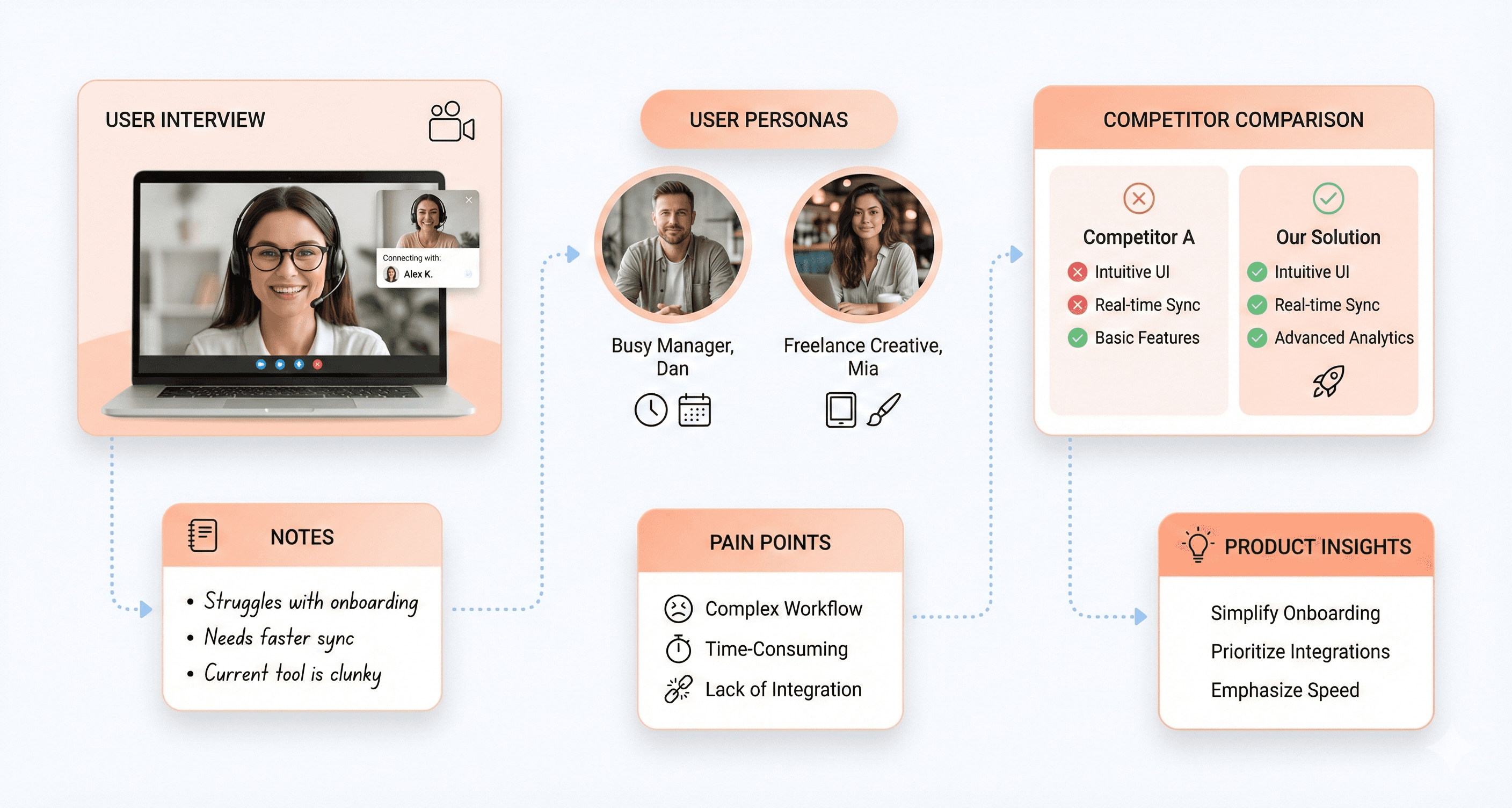
SaaS market research process showing user interviews, pain points, personas, and competitor analysis.

Identify Target User Base and Create Detailed User Personas

Creating detailed user personas ensures your mvp development strategy saas targets the right audience with relevant solutions. Your user personas should be based on actual research data rather than assumptions, incorporating demographics, pain points, goals, and behavioral patterns of your ideal customers.

Leverage online surveys to gather quantitative data about your target market's preferences, challenges, and willingness to pay for solutions. Use tools like survey platforms to reach broader audiences and collect statistically relevant data. Focus your surveys on understanding specific use cases, feature preferences, and budget considerations that will inform your product roadmap.

Email list building serves as an effective method for identifying and engaging with potential customers early in your development process. Create valuable content related to your target market's challenges and offer it in exchange for email subscriptions. Monitor sign-up rates and engagement levels to gauge genuine interest in your proposed solution and refine your user personas accordingly.

Develop Unique Value Proposition and Product Roadmap

Your unique value proposition distinguishes your SaaS solution from existing alternatives and communicates clear benefits to potential customers. This proposition should directly address the validated pain points and demonstrate how your solution provides superior value compared to current options in the market.

Develop your saas product validation process by testing different value propositions through landing pages and A/B testing. Create simple landing pages describing your SaaS product benefits and experiment with different headlines, calls-to-action, and feature highlights. Measure conversion rates and user engagement to determine which value propositions resonate most strongly with your target audience.

Your product roadmap should prioritize core functionalities that address the most critical pain points identified through your research. Focus on essential features that provide immediate value while planning future enhancements based on user feedback and market evolution. This roadmap becomes your guide for MVP development, ensuring you build features that truly matter to your target users rather than nice-to-have additions that dilute your core value proposition.

Technical Architecture and Infrastructure Planning

Design Scalable Cloud-Based Infrastructure with Auto-Scaling

Building a robust SaaS product development roadmap requires establishing cloud infrastructure that can grow with your business demands. Modern cloud platforms like AWS, Azure, and Google Cloud offer distinct advantages for SaaS startups. AWS provides the broadest range of services with pay-as-you-go pricing and reserved instance options for cost control. Azure integrates seamlessly with Microsoft's ecosystem, making it ideal for hybrid cloud setups, while Google Cloud excels in AI/ML tools and analytics with competitive pricing for startups.

Auto-scaling represents a critical component of your SaaS product development framework. This mechanism monitors key metrics like CPU usage, memory consumption, and request queues, automatically adjusting resources to match current demands. When your marketing campaign brings a surge of new users, additional servers spin up automatically. During off-hours when activity drops, excess resources scale down to save costs, maintaining optimal performance without requiring constant manual adjustments.

Smart load balancing ensures your platform stays responsive regardless of user volume. It distributes incoming traffic across multiple servers, preventing any single server from becoming overwhelmed. Proper load balancers monitor server health, redirect users to the closest geographical server, and automatically remove problematic servers from rotation.

A multi-cloud strategy distributes your platform across multiple providers, reducing vulnerability to outages and expanding geographical reach. This approach gives you leverage in negotiations and allows you to take advantage of each provider's strengths while maintaining consistency in deployment and management.

Implement Robust Application Architecture and API Design

With scalable infrastructure established, implementing the right application architecture becomes crucial for your SaaS product readiness checklist. Modern SaaS platforms benefit from breaking functionality into smaller, independent services rather than building one massive application. Each service handles specific tasks like user authentication, payment processing, and data analytics, allowing for independent updates and scaling.

This microservices approach offers significant advantages for SaaS development best practices. When your payment service needs an upgrade or analytics functionality gets busy during end-of-month reporting, you can address that specific issue without touching the rest of the platform. Different teams can work on different services simultaneously, speeding up development and reducing conflicts.

API design forms the backbone of your SaaS product development roadmap, enabling seamless integrations with third-party services and custom functionality. Well-designed APIs ensure your platform can easily connect with other services and adapt to future needs. The modular nature of proper architecture makes it easier to evolve your product over time, with new features developed and tested in isolation before integration into the main system.

Companies like Figma successfully evolved from a simple design tool to a full collaboration platform because their architecture allowed them to add real-time collaboration, plugins, and team libraries gradually without disrupting existing users. Similarly, Notion expanded from note-taking to wikis, databases, and project management through strategic architectural decisions.
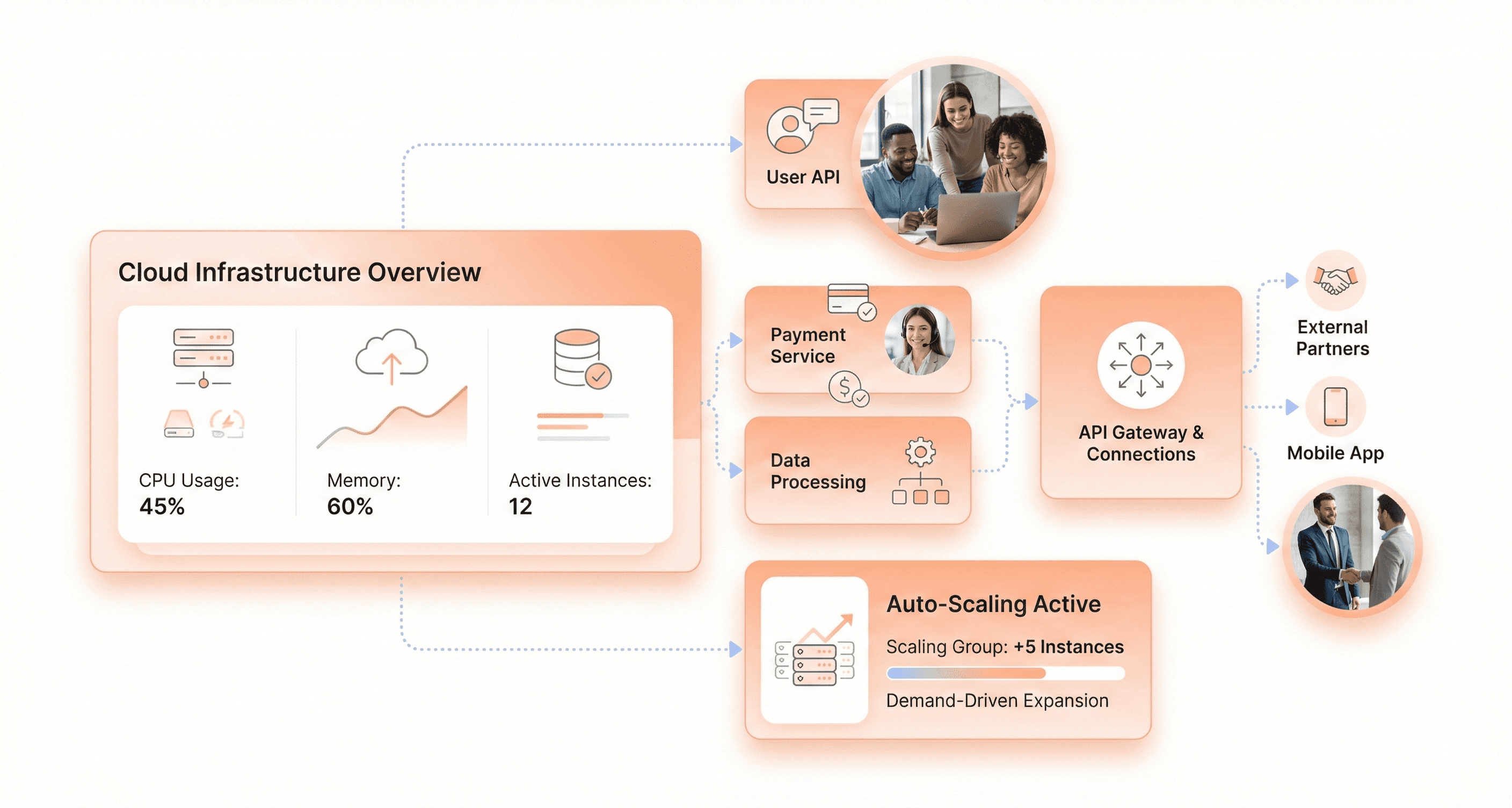
Scalable SaaS architecture with cloud infrastructure, microservices, APIs, and auto-scaling systems.

Optimize Database Design and Performance Systems

Database architecture represents a fundamental element of your SaaS startup product development strategy. Effective data architecture design requires mapping out how your platform will handle data, focusing on multi-tenancy, data isolation, and scalability. This determines how efficiently your SaaS will grow and adapt to increasing user demands.

Multi-tenancy emerges as the critical architectural principle distinguishing SaaS from traditional software deployment models. This approach allows a single software instance to serve multiple customer organizations while maintaining strict data segregation and personalized experiences. Advanced data partitioning strategies ensure each customer's information remains secure and isolated while optimizing performance across the entire platform.

Performance optimization involves implementing sophisticated database management systems that can handle dynamic resource allocation. This includes establishing systems for real-time performance tracking, user analytics, and automated backup systems for data protection. Modern SaaS applications require databases that can scale both vertically and horizontally to accommodate growth without compromising response times.

Data security and compliance must be built into the database architecture from the start. This involves implementing encryption at rest and in transit, maintaining strict access controls, and regularly auditing security measures. Clear audit trails for all data access help meet regulatory requirements like GDPR and HIPAA while maintaining operational integrity.

Establish Version Control and Continuous Integration Processes

Now that we have covered the foundational infrastructure and architecture components, establishing robust development processes becomes essential for your SaaS product launch preparation. Version control systems form the backbone of collaborative development, allowing teams to track changes, manage code versions, and coordinate work across multiple developers and features.

Continuous integration processes ensure that code changes are automatically tested and validated before deployment. This systematic approach prevents conflicts and maintains code quality throughout the development lifecycle. Automated testing frameworks should be integrated into your CI pipeline to catch issues early and maintain platform reliability.

The implementation of proper version control enables faster development and easier updates since changes to one service don't impact others. This approach supports the modular architecture principles discussed earlier, where teams can work independently on different components while maintaining overall system integrity.

Deployment strategies should include automated systems that can handle rolling updates without service interruptions. Modern SaaS platforms require the ability to deploy new features gradually, test them with limited user groups, and roll back changes if issues arise. This flexibility extends to third-party integrations, allowing you to adopt new technologies without major restructuring.

Monitoring and alerting systems should be established to track everything from system performance to deployment success rates. Real-time monitoring helps identify potential issues before they impact users and provides valuable data for optimizing both infrastructure and development processes.

Security and Compliance Framework

mplement Access Control and Secure Infrastructure

Building a robust security foundation requires implementing comprehensive access controls and secure infrastructure from the ground up. Effective access management involves regularly reviewing and reducing excessive permissions to limit data exposure while ensuring access levels comply with frameworks like SOC 2, HIPAA, ISO, and NIST.

Start by establishing multi-factor authentication (MFA) across all systems, as this security measure is essential for meeting most compliance standards. Implement granular access controls that follow the principle of least privilege, ensuring users only have access to the resources necessary for their specific roles.

Your secure infrastructure should include firewalls, encryption protocols, and network segmentation to protect against unauthorized access. For SaaS founders, this means selecting cloud providers that offer robust security features and maintaining control over configuration settings. Consider implementing identity and access management (IAM) solutions that can scale with your product development roadmap.

Ensure Data Privacy and Protection Measures

Data privacy and protection form the cornerstone of any successful SaaS product development checklist. Your organization must implement data encryption both at rest and in transit, ensuring sensitive information remains protected throughout its lifecycle.

Establish clear data minimization practices by collecting only the data necessary for your service to function. This approach aligns with privacy regulations and reduces your overall risk exposure. Implement comprehensive data processing requirements that define how personal information is collected, used, stored, and deleted.

Create robust incident response plans that outline procedures for handling potential data breaches. These plans should include notification protocols, containment strategies, and recovery procedures. Regular security audits help identify vulnerabilities before they become critical issues, supporting your SaaS development best practices.
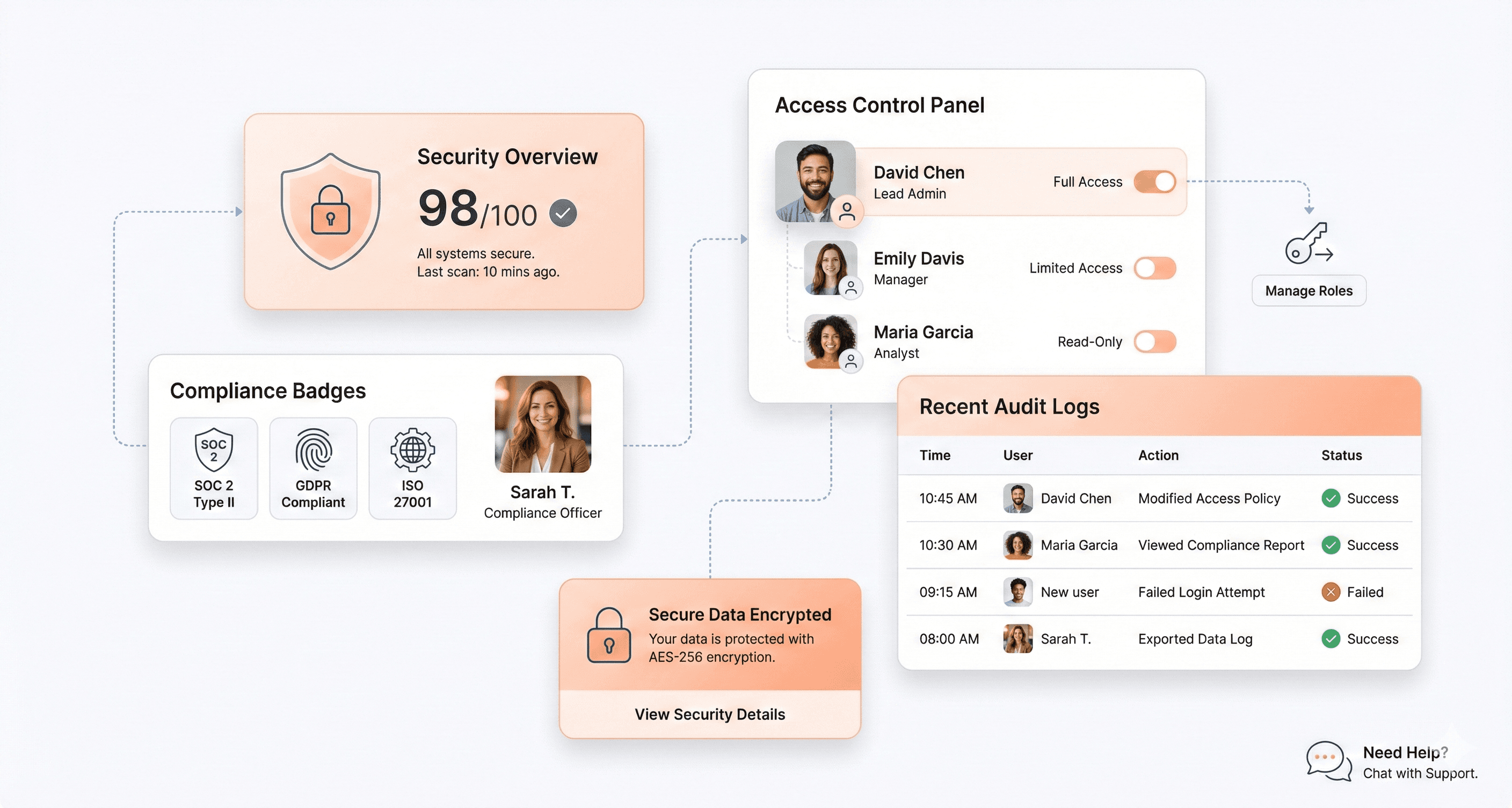
SaaS security and compliance framework showing data protection, access control, and regulatory standards.

Achieve Regulatory Compliance (GDPR, CCPA, HIPAA)

Understanding and implementing regulatory compliance requirements is crucial for SaaS founders planning their product launch preparation. Different regulations apply based on your target market and the type of data you handle.

GDPR compliance is mandatory if you process EU personal data, regardless of your company's location. Key requirements include obtaining proper consent, ensuring data transparency, implementing data minimization practices, and providing users with rights to access and erasure. Non-compliance can result in fines up to €20 million or 4% of global annual revenue.

CCPA governs California residents' personal data, requiring businesses to disclose data practices and offer opt-out mechanisms. This regulation grants consumers significant control over their personal information and requires clear privacy notices.

For healthcare-related SaaS products, HIPAA compliance is essential when handling protected health information (PHI). This requires implementing strong access controls, encryption, security audits, risk assessments, and comprehensive incident response plans.

Regulation

Scope

Key Requirements

GDPR

EU personal data

Consent, data minimization, right to erasure

CCPA

California residents

Data practice disclosure, opt-out options

HIPAA

Healthcare data (PHI)

Access controls, encryption, risk assessments

Conduct Regular Security Audits and Testing

Establishing a systematic approach to security audits and testing ensures your SaaS product maintains its security posture throughout development and post-launch phases. Regular audits provide independent validation and strengthen your overall security framework.

Implement continuous monitoring systems that detect suspicious activities in real-time. This ongoing surveillance helps identify potential security incidents before they escalate into major breaches. Your monitoring should cover all critical systems, applications, and data flows.

Risk assessments should be conducted regularly to identify new vulnerabilities and assess the effectiveness of existing security controls. These assessments help prioritize security investments and ensure resources are allocated to address the most critical risks.

Consider pursuing security certifications like SOC 2, which evaluates how service organizations manage customer data based on five trust principles: security, availability, processing integrity, confidentiality, and privacy. SOC 2 Type II reports evaluate the effectiveness of controls over a period (typically 3-12 months), providing valuable validation for enterprise customers.

Maintain comprehensive logs across all systems to streamline future audits and demonstrate adherence to compliance standards. These logs should be regularly reviewed and analyzed to identify patterns that might indicate security issues or compliance gaps.

External security audits conducted by third-party professionals provide objective assessments of your security posture and help identify blind spots that internal teams might miss. Schedule these audits at regular intervals and after significant system changes to ensure continuous compliance with your chosen security frameworks.

User Experience and Design Excellence

Conduct User Research and Information Architecture Planning

Building upon your technical foundation, successful SaaS product development requires a deep understanding of your users and how they'll navigate your application. User research forms the cornerstone of effective information architecture, ensuring that your SaaS product development roadmap aligns with actual user needs rather than assumptions.

Start by conducting focus group testing if you're developing from scratch, or implement beta testing for existing platforms. Focus groups allow you to observe how users interact with your design mockups, while beta testing enables real-world validation with a smaller user base before full rollout. Both quantitative and qualitative data collection are essential during this phase.

Your information architecture should follow the principle of familiarity, organizing content and features in logical, intuitive ways that users already understand. Consider how users will move through your software from onboarding through task completion with minimal effort. Map out user flows that feel natural and reduce cognitive load.

Progressive disclosure becomes crucial here - layer features by presenting core, frequently-used tools prominently while tucking advanced functions into sub-menus or collapsible sections. This approach allows users to gradually learn your product's full functionality without feeling overwhelmed during initial interactions.

Create Responsive Visual Design and Navigation Systems

With your user research complete, the next step in your SaaS development framework involves crafting the visual interface and navigation structure. Your user interface encompasses the visual layout, buttons, and interactions that users will see and touch throughout their journey.

Responsive design ensures your SaaS application functions seamlessly across devices, from desktop dashboards to mobile interfaces. Focus on creating clean, intuitive layouts that prioritize performance and usability. Your dashboard should run smoothly and remain simple to use, as speed and responsiveness directly impact user satisfaction and retention.

Navigation systems must support your information architecture while maintaining visual consistency. Implement familiar design patterns that users recognize from other applications, as effective UX often builds upon what users already know. Avoid unnecessary creativity in core navigation elements - users are most comfortable with familiar structures.

Consider implementing micro-interactions throughout your interface. These subtle design elements, such as button color changes, loading indicators, or hover effects, provide immediate feedback and guide users through your product without being intrusive. Status indicators, hints, and call-to-action reinforcement through small animations help users navigate confidently.
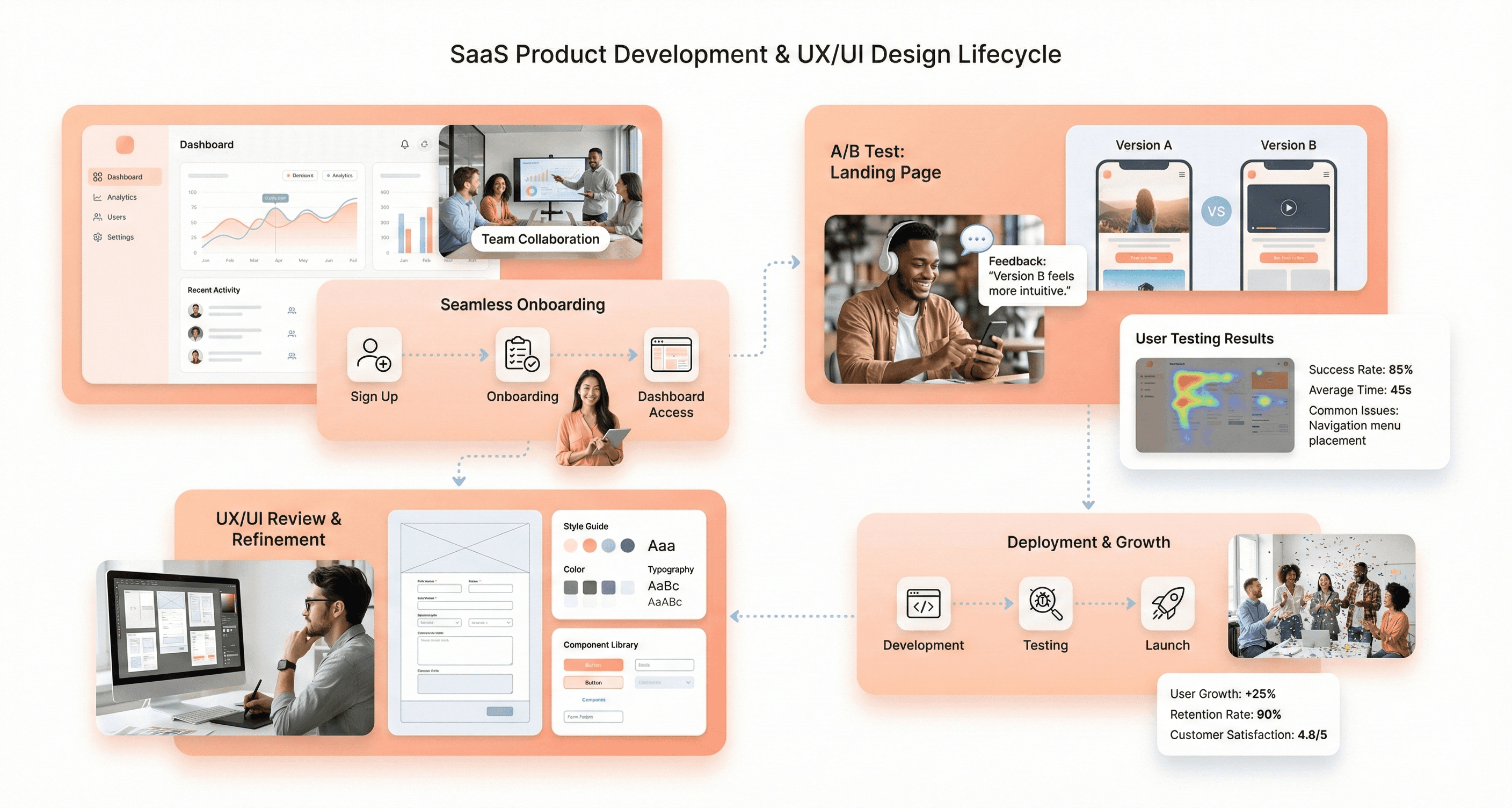
SaaS user experience design with intuitive navigation, usability testing, and clean interface layouts.

Perform Usability Testing and User Feedback Collection

Now that your visual design is established, rigorous testing becomes essential to validate your SaaS product readiness. Usability testing should combine both quantitative metrics tracking and qualitative feedback collection to provide comprehensive insights into user behavior.

Track key metrics like friction events in your workflows to identify where users encounter difficulties. Monitor completion rates from workflow start to finish, helping you understand if your UX design is intuitive enough for your target audience. Build conversion funnels for critical workflows, examining each step to pinpoint areas needing improvement.

Session replays prove invaluable for understanding user frustration points. Watch recordings of users who abandoned workflows or encountered high-friction areas, looking for moments of confusion or difficulty. Trigger feedback surveys during key frustration points - such as rage clicks or website errors - to capture user reactions in real-time.

Implement both scheduled feedback collection and on-demand tooltips that allow users to discover your product at their own pace. These tooltips can be triggered by user behavior, providing contextual help exactly when needed without cluttering the interface.

Optimize Conversion Paths and User Journey Flow

The final component of your UX excellence framework focuses on streamlining the paths users take to complete valuable actions within your SaaS application. Conversion path optimization requires analyzing user behavior data to identify and eliminate barriers to task completion.

Map out your primary user journeys, from initial onboarding through core feature adoption and ongoing engagement. Each step should feel natural and necessary, with clear value propositions guiding users forward. Remove unnecessary steps that don't contribute to user success or business objectives.

Personalization plays a crucial role in optimizing user journeys. Use data collected during onboarding to tailor experiences based on user goals, industry, or team size. Ask strategic questions about their current tools or workflows to customize your product's presentation and reduce learning curves for new users.

Consider implementing AI-powered workflows where appropriate, as these can significantly enhance user experience by providing intelligent assistance and automation. Even simple chatbot integrations can help users navigate complex features or get quick answers to common questions.

Monitor your optimized conversion paths continuously, using experience analytics to track how users respond to changes. Implement A/B testing for significant UX modifications, ensuring that improvements actually enhance rather than hinder user experience before rolling them out to your entire user base.

MVP Development and Testing Strategy

Choose Technology Stack and Technical Implementation

When building a successful MVP development strategy for SaaS, selecting the right technology stack requires balancing functionality, development speed, and future scalability. Over-engineering at this level can be costly and time-consuming, so choose tools and frameworks appropriate for your project's goals and long-term ambitions.

Programming Languages and Frameworks

The programming language you choose determines the flexibility and efficiency of your MVP. JavaScript excels at creating dynamic user interfaces, while Python's simplicity makes it an excellent choice for rapid development. Java provides reliability and scalability for large-scale applications, while Ruby offers a developer-friendly environment.

For front-end development, React offers a component-based framework for modular development, Angular provides comprehensive tools for large projects, and Vue.js stands out for its simplicity and ease of use. Back-end frameworks like Node.js deliver performance and handle multiple simultaneous requests, while Django offers a fully-featured framework for rapid development.

Database and Infrastructure Considerations

PostgreSQL excels at handling complex queries and reliability, MongoDB offers flexibility and scalability for unstructured data, and MySQL provides fast, efficient management of large datasets. Cloud platforms like AWS provide global reach with innovative services, Google Cloud Platform offers superior analytics and machine learning capabilities, and Microsoft Azure ensures seamless integration with Microsoft products.

Key Factors for Technology Selection

Consider development speed - how quickly you can build and iterate using these technologies. Evaluate your team's familiarity with the chosen stack and assess community support and documentation availability. Factor in licensing, hosting, and resource costs while considering future scalability without creating severe bottlenecks.
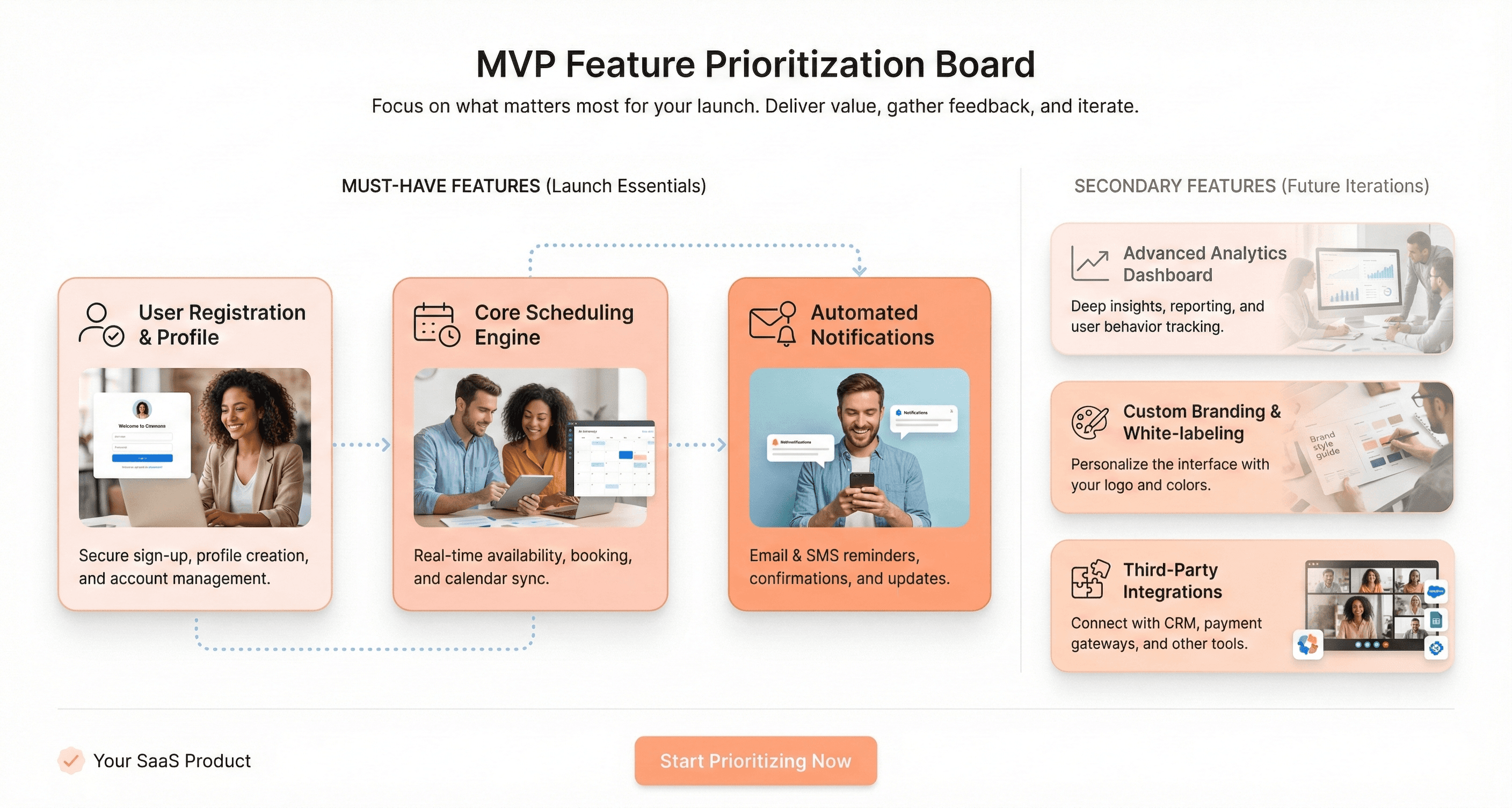
SaaS MVP development strategy highlighting core feature prioritization and lean product building.

Develop Minimum Viable Product with Core Features

Previously, having established your technology foundation, the next critical phase involves developing your SaaS MVP with laser focus on core functionality. A SaaS minimum viable product represents the most basic version of your software, designed to test your core concept and gather valuable customer insights.

Defining Core Features

Resist the urge for feature overload and prioritize essential features that directly address your core value proposition. Think Minimum Viable Product, not Maximum Viable Product - focus on functionalities that validate your concept and gather user feedback. Utilize techniques like the MoSCoW method (Must-have, Should-have, Could-have, Won't-have) to categorize features based on criticality.

The MVP focuses on delivering vital features that solve critical problems for your target audience, allowing you to assess market demand and adjust your product strategy without significant upfront investment. This approach saves time and resources on features that may not appeal to users.

Development Process and Best Practices

Create user-friendly UI and UX through prototyping and continuous feedback collection. Interactive prototyping allows experimentation with different navigation options, button placements, and overall layouts, ensuring smooth user experiences. Gather feedback throughout development from potential users, stakeholders, and usability testing to identify improvement areas.

Implement straightforward navigation with intuitive menus and clear user paths. Use compelling calls-to-action with strategically placed, visually distinctive buttons. Design visually appealing, clean layouts that enhance usability while remaining uncluttered.

Conduct Comprehensive Testing and Quality Assurance

With your MVP development underway, comprehensive testing becomes essential for ensuring product reliability and user satisfaction. A successful SaaS product launch requires strategic planning and continuous development through robust testing frameworks.

Pre-Launch Testing Preparations

Before launch, develop robust analytics and tracking systems that provide essential insights into user behavior, engagement, and overall product performance. These systems allow you to understand how users interact with your MVP and identify areas for improvement.

Implement essential analytics tools like Google Analytics for analyzing website traffic, user demographics, and conversion rates. Utilize Mixpanel for user behavior analysis to examine specific actions within your app and understand user journeys. Consider Amplitude for detailed insights into user behavior and product usage trends.

Quality Assurance Framework

Establish comprehensive testing protocols covering functionality, performance, security, and user experience. Conduct usability testing throughout the development process to identify potential issues with user interface and user experience. Implement automated testing where possible to ensure consistent quality and rapid iteration cycles.

Test core features extensively to ensure they solve critical problems for your target audience effectively. Validate that your MVP delivers on its core value proposition and provides the foundation for gathering meaningful user feedback.
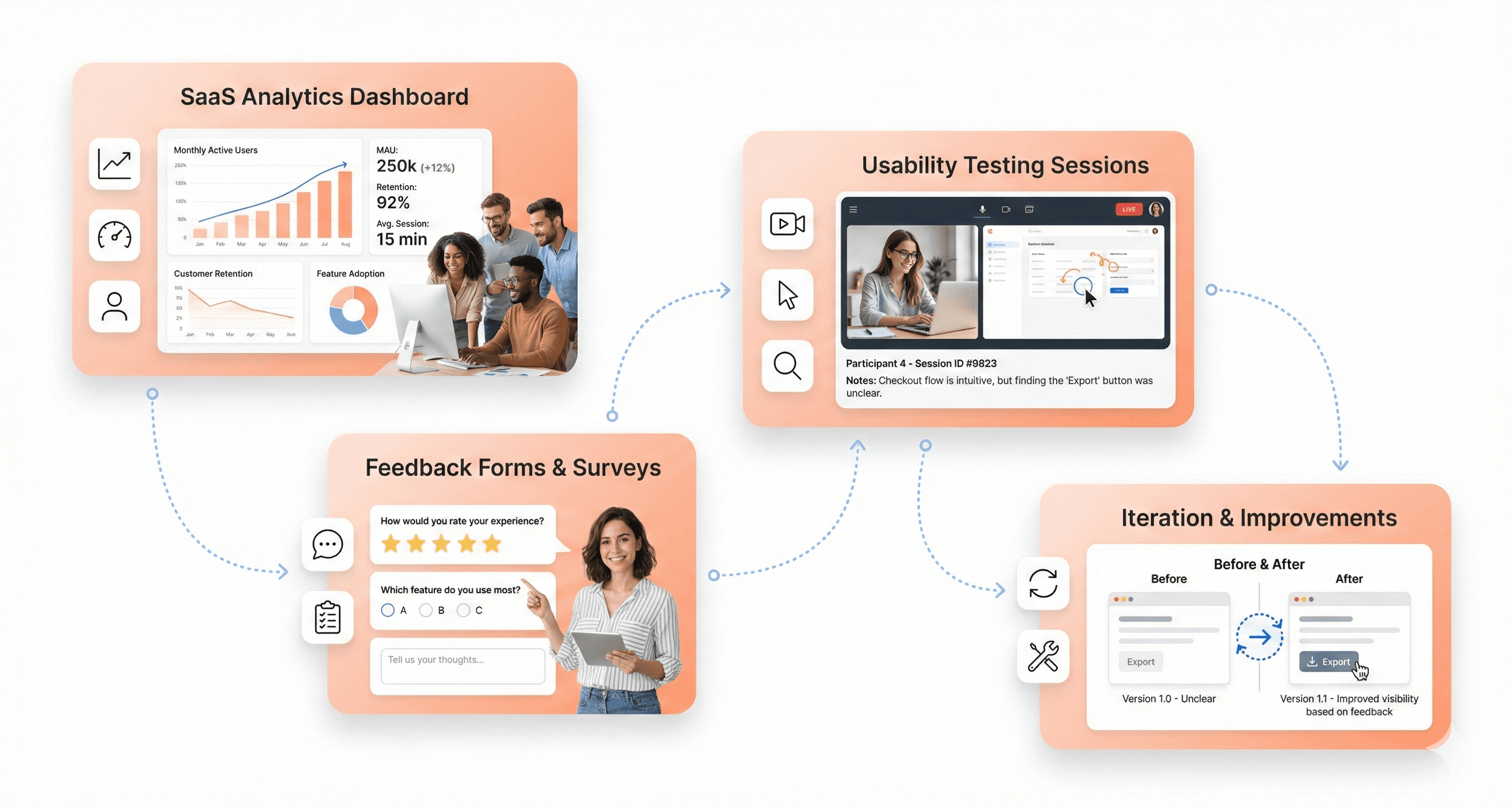
SaaS product testing and feedback loop with analytics dashboards and user insights.

Gather User Feedback and Iterate Based on Insights

Now that your SaaS MVP is live, focusing on gathering feedback from early users becomes critical for understanding user needs, preferences, and pain points. This feedback loop is central to the MVP methodology and lays the foundation for developing a successful SaaS solution.

Feedback Collection Strategies

Use in-app messaging through surveys or feedback messages to gather real-time insights on user experience. Provide targeted feedback forms on your website or within the app where users can offer specific suggestions and ideas. Conduct targeted surveys to gather quantitative data on user satisfaction, feature usage, and overall experience.

Monitor social media channels actively for product mentions and engage with users to gather feedback and resolve issues. This multifaceted approach ensures you capture comprehensive insights about your product's performance and user satisfaction.

Measuring Success and Key Metrics

Track essential KPIs to evaluate your MVP's effectiveness. Monitor Customer Acquisition Cost (CAC) to understand new customer acquisition expenses. Measure Monthly Recurring Revenue (MRR) for predictable revenue tracking. Calculate churn rate to determine subscription cancellation percentages and Customer Lifetime Value (CLTV) for total revenue estimates per customer relationship.

Focus on user engagement metrics including Daily and Monthly Active Users (DAU/MAU), average session duration, feature usage patterns, and user retention rates. Analyze conversion rates at each customer journey stage, from website visits to sign-ups, trial initiations, and paid subscription conversions.

By actively soliciting and evaluating user feedback, you can identify development areas, prioritize improvements, and fine-tune your SaaS MVP to match market demand. This iterative process ensures continuous product evolution based on real-world data and user insights.

Pricing and Monetization Strategy

Determine Pricing Model and Plan Tiers

Now that you've established your technical foundation and user experience framework, developing a strategic pricing model becomes crucial for your SaaS product development roadmap. The right pricing structure directly impacts your ability to acquire customers, generate revenue, and scale sustainably.

Start by selecting a pricing model that aligns with your product's value proposition and customer usage patterns. Tiered pricing remains the most popular approach for SaaS businesses, offering multiple pricing plans at different price points designed for specific customer segments. This model allows you to serve small businesses with basic needs while providing enterprise-grade features for larger organizations.

Consider usage-based pricing if your product's value scales with consumption, such as API calls, storage, or transactions. This model aligns costs with customer value and can improve adoption by removing upfront friction. Alternatively, per-user pricing works well for collaboration tools where value increases as more team members join.

For products targeting diverse customer segments, feature-based pricing allows you to charge based on access to specific tools or modules. This approach works particularly well when your SaaS product serves customers with varying complexity requirements.

When structuring your tiers, ensure each plan reflects real customer value and creates clear upgrade paths. Avoid creating too many options that confuse potential customers, but provide enough flexibility to accommodate different buyer personas and budget constraints.
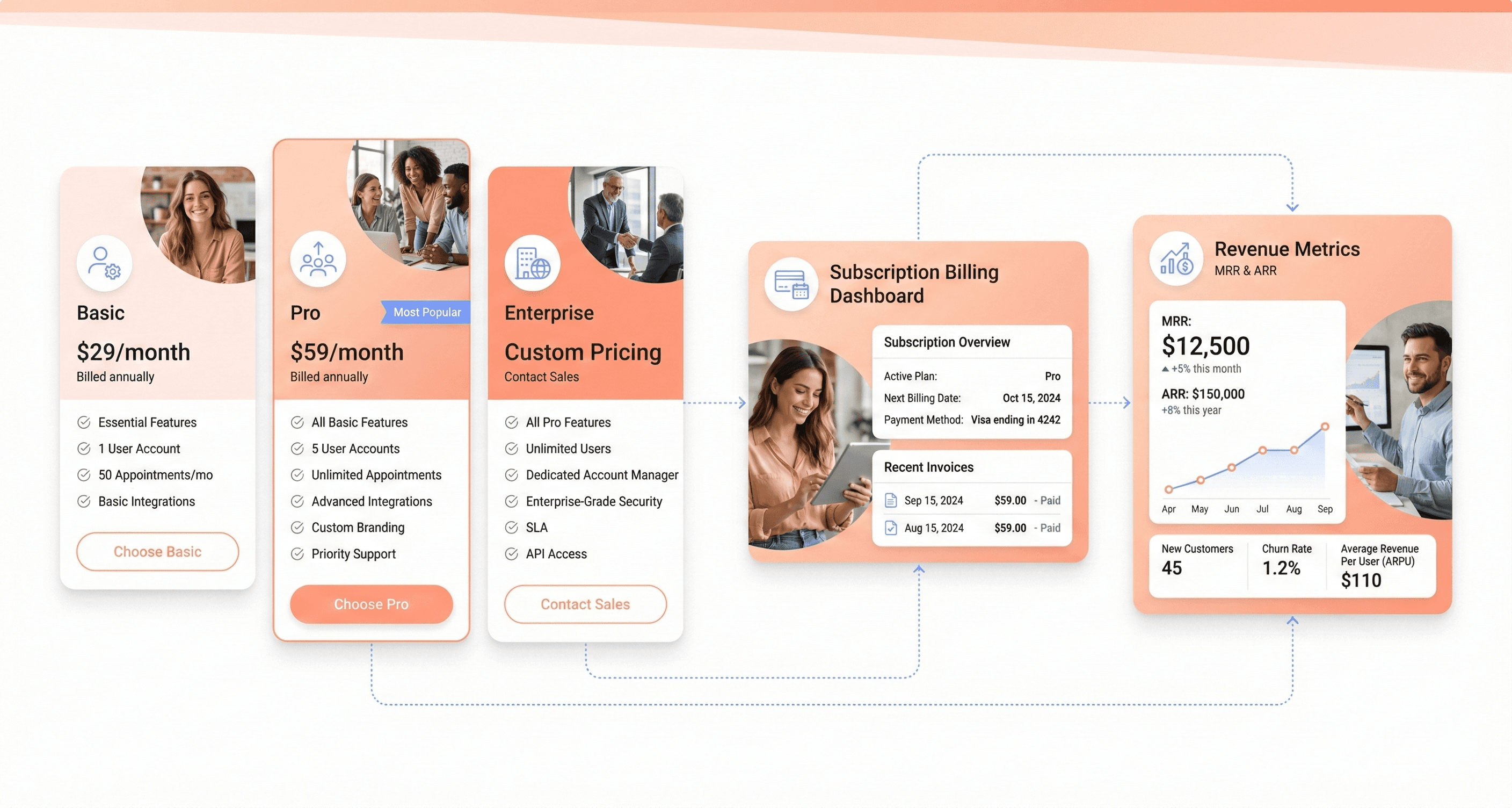
SaaS pricing and monetization model with subscription plans, billing, and revenue metrics.

Integrate Payment Gateway and Billing Systems

With your pricing model defined, implementing robust payment infrastructure becomes essential for your SaaS product launch preparation. Selecting the right payment gateway and billing system directly impacts customer experience and revenue collection efficiency.

Choose a payment gateway that supports multiple payment methods and currencies if you plan to serve international markets. Your billing system should handle the complexity of subscription payments, including recurring charges, proration, and automated retries for failed payments.

Ensure your billing infrastructure can support various pricing models from day one. Whether you're implementing flat-rate pricing, tiered subscriptions, or usage-based billing, your system needs the flexibility to accommodate changes as your business evolves.

Focus on creating a frictionless checkout experience that reduces payment friction. Complex payment flows can derail customer acquisition before it starts, making simplicity a key priority in your product development framework.

Implement Subscription Management and Usage-Based Billing

Modern SaaS businesses require sophisticated subscription management capabilities that go beyond simple recurring billing. Your system must handle subscription lifecycle events including upgrades, downgrades, pauses, and cancellations seamlessly.

For usage-based billing scenarios, implement accurate usage tracking and real-time billing calculations. Customers should have visibility into their consumption patterns and associated costs to build trust and prevent billing surprises.

Design your subscription management system to support proration calculations when customers change plans mid-cycle. This feature ensures fair billing practices and improves customer satisfaction during plan transitions.

Include automated dunning management to handle failed payments gracefully. Your system should automatically retry failed charges, send appropriate notifications, and provide customers with easy payment update mechanisms to minimize involuntary churn.

Set Up Revenue Reporting and Financial Forecasting

Establishing comprehensive revenue reporting capabilities is fundamental to your SaaS development best practices. Implement tracking for key metrics including monthly recurring revenue (MRR), annual recurring revenue (ARR), and customer lifetime value (CLTV).

Create dashboards that provide real-time visibility into revenue performance across different pricing tiers and customer segments. This data becomes invaluable for making informed pricing adjustments and identifying expansion revenue opportunities.

Build forecasting models that account for subscription growth patterns, churn rates, and seasonal variations. Accurate financial projections help secure funding, plan resource allocation, and make strategic business decisions.

Track plan upgrades, downgrades, and expansion revenue to understand customer behavior patterns. This information guides future pricing optimization and product development priorities, ensuring your pricing strategy evolves with market demands and customer needs.

Marketing and Go-to-Market Preparation

Develop Brand Identity and Messaging Strategy

With your product development and technical infrastructure in place, the next critical step involves establishing a strong brand identity and messaging strategy that resonates with your target audience. A clear value proposition and strong brand identity can set you apart in a crowded market, serving as the foundation for all your marketing efforts.

Start by developing value-based messaging that clearly highlights how your SaaS product solves specific problems and improves workflows. Your messaging serves as the bridge between your product and your target audience, conveying the value of your solution and articulating how you address customers' pain points. The best value propositions communicate what makes your SaaS product unique and why it's valuable to your specific market segment.

Focus on creating messaging that resonates with your audience and persuades them to consider your solution over competitors. This involves understanding your target market's industry, company size, location, and individual roles within organizations. Use these research insights to inform your messaging strategy, ensuring it speaks directly to decision makers, influencers, and end users in your target segments.
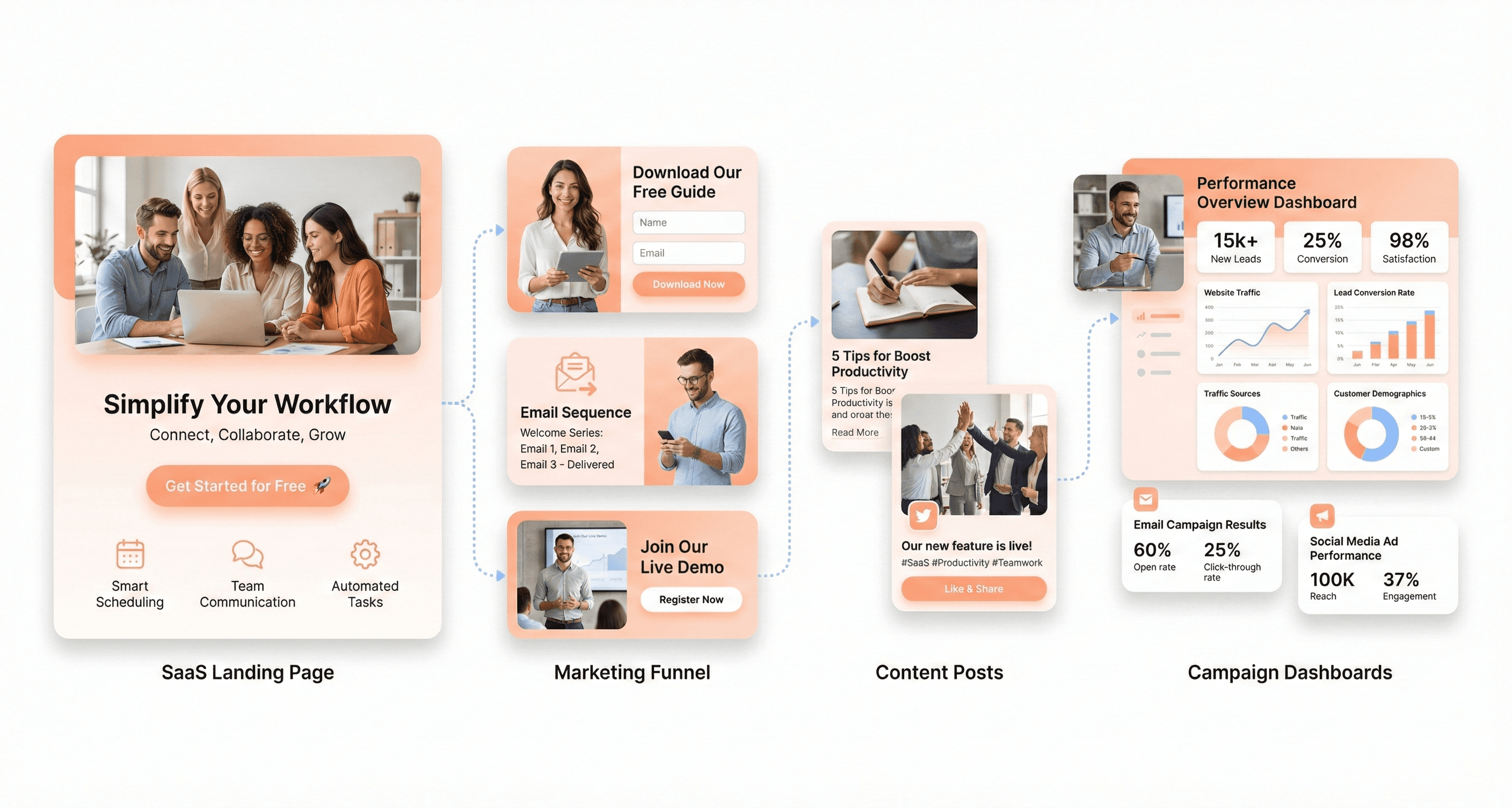
SaaS go-to-market strategy showing landing pages, content marketing, and demand generation.

Create Website, Landing Pages and SEO Optimization

Now that you have established your brand messaging, it's time to create digital assets that effectively communicate your value proposition. Your website and landing pages serve as the primary touchpoints where potential customers will evaluate your SaaS solution, making their design and optimization crucial for conversion success.

Develop dedicated landing pages that align with your messaging strategy and target specific customer segments or use cases. These pages should clearly articulate your unique value proposition while addressing the specific pain points of your target audience. Focus on creating content that demonstrates how your product solves real customer problems and improves their workflows.

Implement SEO optimization strategies to ensure your target audience can discover your solution organically. This involves incorporating relevant keywords naturally into your content while maintaining readability and value. Your SEO efforts should align with the search behavior of your target market, considering the terms and phrases they use when looking for solutions like yours.

Build Social Media Presence and Content Marketing Strategy

With your website foundation established, developing a comprehensive content marketing strategy becomes essential for reaching your target audience across multiple channels. Content marketing forms a critical component of your go-to-market approach, helping you generate awareness and interest in your product while establishing thought leadership in your industry.

Create high-quality content that showcases how to address customer pain points while demonstrating your product's capabilities. This includes blog posts, educational resources, and industry-specific content that provides genuine value to your target audience. Focus on content that helps potential customers understand their challenges while positioning your solution as the ideal remedy.

Leverage social media platforms to engage with your target community and amplify your content reach. Consider platforms where your target audience is most active, whether that's LinkedIn for B2B audiences or other channels relevant to your specific market. Use these platforms to share valuable insights, engage in industry conversations, and build relationships with potential customers.

Launch Email Campaigns and Paid Advertising Initiatives

Building on your content marketing foundation, implementing targeted email campaigns and paid advertising initiatives will help you reach and nurture potential customers more effectively. These channels work together to guide prospects through the buyer's journey, from initial awareness to conversion.

Develop email marketing campaigns that nurture leads through automated sequences, providing valuable content and demonstrating your product's capabilities. Use these campaigns to educate potential customers about their challenges while showcasing how your solution addresses their specific needs. Focus on creating email content that builds trust and credibility with your audience.

Consider paid advertising initiatives across relevant channels to amplify your reach and target specific customer segments. This might include LinkedIn advertisements, retargeting campaigns, or other platforms where your target audience is active. Ensure your paid advertising aligns with your overall messaging strategy and drives traffic to optimized landing pages that convert visitors into leads.

Remember that your marketing and distribution strategy should align with your potential customers' preferences and your product's complexity. A more advanced SaaS product might benefit from a dedicated sales approach, while simpler solutions could leverage self-service signup options effectively.

Customer Support and Success Infrastructure

Implement Multi-Channel Support Systems and Knowledge Base

Modern SaaS customer support requires an omnichannel approach that meets users where they are. Your support infrastructure should consolidate messages from email, live chat, Slack, in-app widgets, and other channels into a unified inbox. This eliminates the context switching and siloed communication that slows down response times and frustrates both agents and customers.

When implementing multi-channel support systems, prioritize platforms that provide a single view of all customer interactions across touchpoints. Support agents need to see the complete conversation history regardless of whether a customer started on email and switched to chat, or moved from Slack to a support ticket. This unified visibility enables faster, more informed responses and prevents customers from repeating their issues.

Your knowledge base should be deeply integrated with your support channels, not treated as a separate resource. Modern support platforms allow agents to surface relevant articles in real-time during conversations and embed documentation directly within chat widgets or email responses. This immediate access to information helps resolve tickets faster and empowers customers to find answers independently.

Self-service capabilities are crucial for scaling your support operation. Create searchable documentation, FAQ pages, and troubleshooting guides that customers can access 24/7. Your knowledge base should include comprehensive product education, hands-on tutorials, and solutions for common technical issues. Well-structured self-service resources can deflect a significant percentage of basic tickets, allowing your human agents to focus on complex problems that require personalized attention.
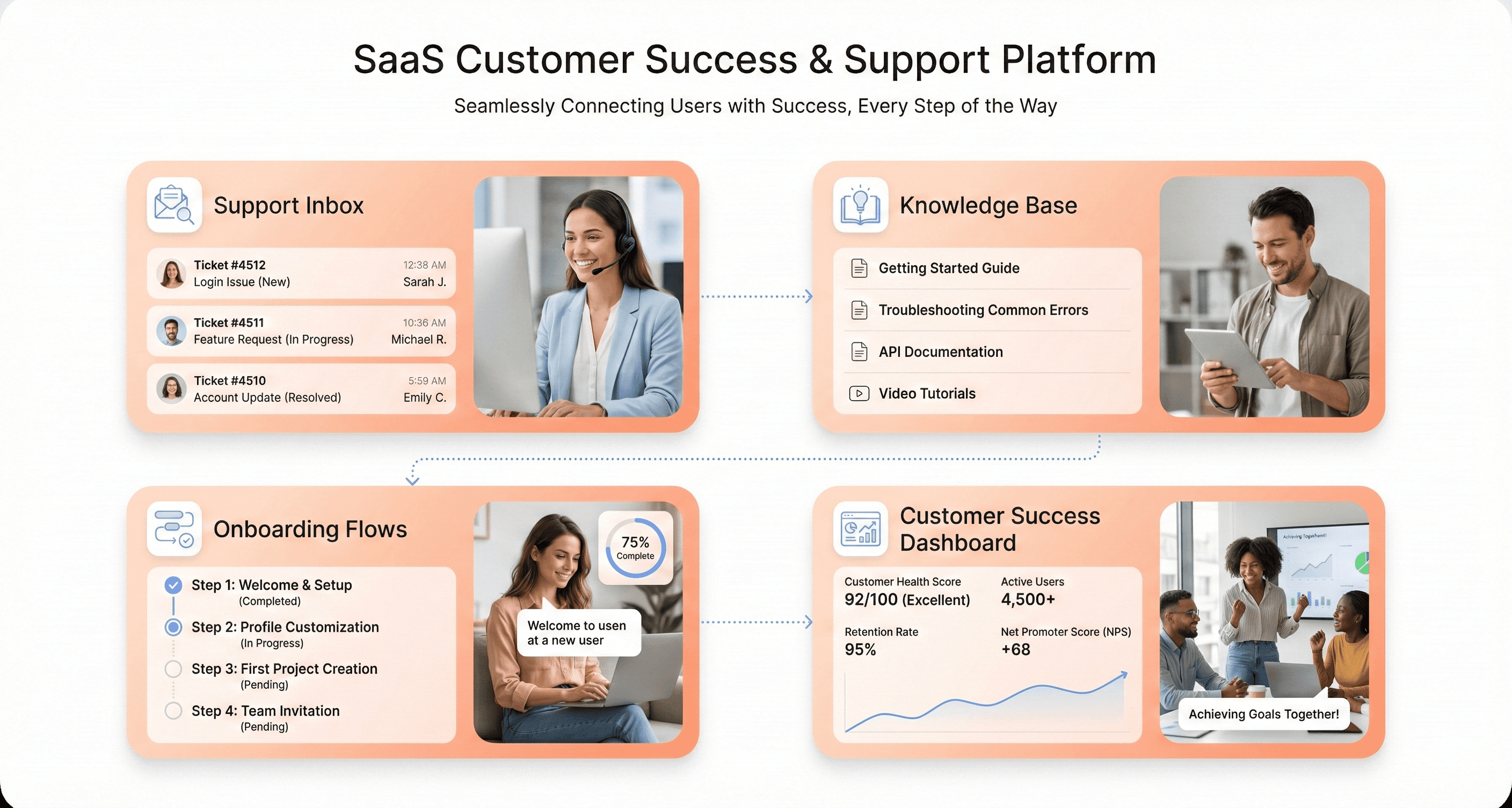
SaaS customer support and success system with onboarding, helpdesk, and knowledge base.

Create Training Materials and User Onboarding Programs

Effective onboarding is critical for SaaS product adoption and long-term customer success. Your training materials should guide users through initial setup, core feature discovery, and advanced functionality in a structured progression. This proactive approach helps customers realize value quickly and reduces the volume of support tickets during their first 30-90 days.

Develop personalized onboarding workflows that adapt to different user types, company sizes, and use cases. Your training program should include in-app tutorials, guided walkthroughs, and scheduled check-ins during crucial adoption milestones. Monitor product usage data to identify when users hit common roadblocks and proactively reach out with targeted assistance before issues escalate.

Training materials should extend beyond initial onboarding to include ongoing education about new features, best practices, and advanced use cases. Create role-specific content that addresses the needs of different user personas within your customer organizations. This comprehensive approach ensures users continue to discover value as your product evolves and their needs become more sophisticated.

Your support team requires equally thorough training on product functionality, common customer scenarios, and internal escalation procedures. Invest in deep product education that includes hands-on experience with all features, understanding of technical architecture, and familiarity with integration capabilities. Regular training updates ensure agents stay current with new releases and can confidently guide customers through complex implementations.

Establish Support Metrics and Analytics Tracking

Data-driven support operations require comprehensive metrics tracking across all customer touchpoints. Implement systems to monitor Customer Satisfaction (CSAT) scores, Net Promoter Score (NPS), first response times, and resolution times. These core metrics provide insight into both operational efficiency and customer perception of your support quality.

Track First Contact Resolution (FCR) rates to measure how effectively your team resolves issues during initial interactions. High FCR indicates well-trained agents, effective tools, and comprehensive documentation. Monitor Customer Effort Score (CES) to understand how easy customers find it to get help, as reducing friction directly impacts retention and satisfaction.

Advanced analytics should connect support metrics to broader business outcomes like customer retention and churn rates. Analyze ticket trends to identify common product issues, documentation gaps, and training needs. Use tagging systems to categorize tickets by product area, customer segment, and issue type, enabling deeper analysis of support patterns and resource allocation needs.

Implement real-time dashboards that provide visibility into queue depth, response time performance, and SLA adherence. These operational metrics help managers make immediate staffing decisions and identify when additional resources or process improvements are needed. Regular reporting should include trends over time, comparative analysis across channels, and correlation with product releases or marketing campaigns.

Build User Community and Feedback Collection Systems

Creating vibrant user communities amplifies your support efforts by enabling peer-to-peer assistance and creating scalable knowledge sharing. Establish forums, user groups, or Slack communities where customers can ask questions, share best practices, and provide feedback on product development priorities. Active communities reduce support ticket volume while building stronger relationships between your company and customers.

Implement systematic feedback collection across all support interactions to capture voice-of-customer insights. Every support ticket provides valuable data about product gaps, usability issues, and customer needs that should inform product roadmap decisions. Create structured processes for escalating bug reports to engineering teams and feature requests to product management.

Your feedback collection should extend beyond reactive support to include proactive surveys, user interviews, and regular check-ins with key accounts. Use this information to identify common pain points, validate product improvements, and prioritize development efforts that address real customer challenges. Comprehensive feedback systems transform support from a cost center into a strategic source of product intelligence.

Collaboration between support, product, and engineering teams ensures customer insights drive meaningful improvements. Establish clear escalation paths for technical issues, regular meetings to review support trends, and shared tools that maintain visibility into customer feedback across departments. This alignment helps create a customer-centric culture where support insights directly influence product development and business strategy.

Launch Execution and Post-Launch Optimization

Execute Pre-Launch Marketing Activities and Database Building

With your SaaS product readiness checklist complete, now it's time to execute a coordinated pre-launch marketing strategy that builds anticipation and creates a robust customer database. Your go-to-market execution should focus on generating buzz through multiple channels while establishing meaningful connections with your target audience.

Create a comprehensive launch announcement that is compelling, concise, and shareable across all platforms. This coordinated effort should leverage traditional PR, social media, your company blog, relevant online communities, live webinars, podcasts, and in-person events. Rather than treating these as isolated activities, build a core message around your launch and distribute it strategically across all channels to reach your ideal customer profile in multiple touchpoints.

Social media platforms like LinkedIn and Reddit offer powerful opportunities for reaching your target audience directly. Share engaging content tailored to each platform, including teaser videos, posts requesting product feedback, and countdown announcements to your launch date. Consider running targeted ads to amplify your reach and drive qualified traffic to your landing page.

Implement email marketing campaigns to nurture leads and build your customer database. Craft personalized email sequences that guide potential customers through the buyer's journey, using attention-grabbing subject lines and strong calls-to-action. Segment your email lists based on user personas to deliver relevant content that resonates with different audience segments.

Industry-specific outreach plays a crucial role in pre-launch success. Connect with influencers, bloggers, and media outlets who can amplify your message and add credibility to your brand. Offer exclusive previews or invite them to pre-launch demos to generate authentic endorsements from trusted voices in your niche.

Coordinate Technical Launch and Security Monitoring

Technical launch coordination requires meticulous planning and real-time monitoring to ensure a smooth product debut. Establish clear communication channels and dedicated coordination systems, such as Slack channels or project management tools, to keep all team members synchronized and address any technical issues that arise immediately.

Implement comprehensive monitoring systems to track your product's technical performance from the moment of launch. Pay special attention to load times, scalability, and responsiveness, particularly during high-traffic periods following your launch announcement. Server capacity and performance optimization become critical as user adoption accelerates, requiring continuous testing and addressing of functionality concerns to maintain a polished user experience.

Security monitoring must be your top priority during launch execution. Implement robust security measures and continuous monitoring protocols to protect both your platform and users' sensitive data. Data breaches can severely damage your reputation and erode customer trust, while security vulnerabilities can disrupt service availability and lead to costly downtime. Ensure compliance with data protection regulations to avoid legal repercussions and maintain customer confidence.

Establish contingency plans for unexpected technical challenges that may arise during launch. Anticipate potential issues and develop solutions in advance, create clear escalation processes for critical problems, and maintain transparent communication with customers and stakeholders about any changes or delays. Flexibility and adaptability in your launch strategy allow you to pivot quickly when technical issues emerge.

Customer support readiness becomes essential as technical issues inevitably surface during launch. Prepare your support team for a surge in inquiries and ensure they have the resources and knowledge to address technical problems promptly. Fast response times and proactive problem-solving approaches significantly impact customer satisfaction during these critical early interactions.
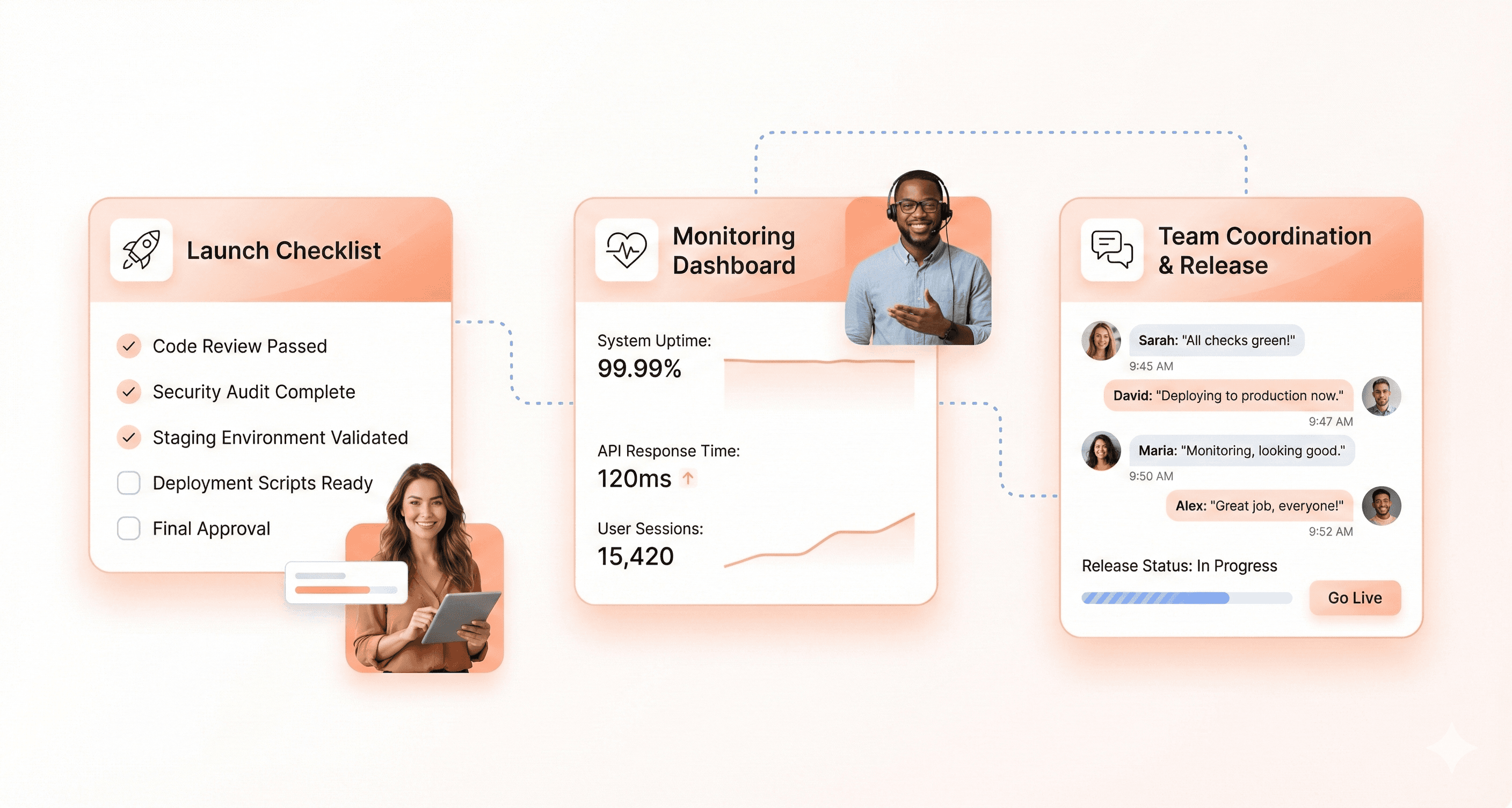
SaaS product launch execution with release checklist, monitoring tools, and team coordination.

Implement Continuous Maintenance and Feature Updates

Post-launch maintenance and feature development form the foundation of long-term SaaS success. Establish a systematic approach to collecting and analyzing user feedback through multiple channels, including in-app surveys, user interviews, social media monitoring, and customer support interactions. This feedback becomes your most valuable resource for identifying pain points and uncovering opportunities to enhance the user experience.

Create a structured product roadmap that incorporates user suggestions while aligning with your long-term business goals. Focus on delivering updates and new features that address critical user needs and improve overall functionality. However, competing priorities will emerge after launch, making it essential that your engineering and product teams maintain clear alignment on high-priority features, modules, and integrations to ensure you're building solutions that truly benefit end-users.

Implement continuous iteration cycles that allow for rapid response to market demands and user feedback. Map out development sprints that balance new feature development with maintenance and optimization tasks. This approach ensures your product remains competitive while maintaining stability and performance standards that users expect from professional SaaS solutions.

Version control and rollback procedures become critical during continuous updates. Establish testing protocols that prevent bugs from reaching production environments while maintaining the ability to quickly address issues that do emerge. Beta testing with select user groups can help validate new features before broader releases.

Documentation and change management processes ensure that updates enhance rather than disrupt the user experience. Maintain clear communication with users about upcoming changes and provide training resources to help them adapt to new features and improvements.

Monitor Performance Metrics and Customer Success Indicators

Comprehensive performance monitoring encompasses both technical metrics and customer success indicators that drive sustainable growth. Track key performance indicators including user acquisition metrics like sign-ups, cost per acquisition, and conversion rates, alongside engagement metrics such as daily and monthly active users, session duration, and feature adoption rates.

Revenue metrics require particular attention for SaaS products, including average revenue per user (ARPU), customer lifetime value (CLV), and churn rates. These indicators provide insights into the financial health of your product and help identify trends that require strategic adjustments. Break down these metrics into actionable milestones with realistic, time-bound goals that guide your team's efforts and maintain organizational alignment.

Customer success indicators extend beyond basic usage metrics to include customer satisfaction scores, support ticket resolution times, and user onboarding completion rates. Monitor user analytics to identify specific points in your workflow where users experience difficulties or abandon the platform, then investigate and implement improvements to optimize these critical touchpoints.

Implement automated dashboards and reporting systems that provide real-time visibility into performance trends. Rather than building reports manually, automated systems enable data-driven decision-making by providing always up-to-date billing, subscription, and customer behavior information. Segment performance data by customer types and usage patterns to identify opportunities for targeted improvements.
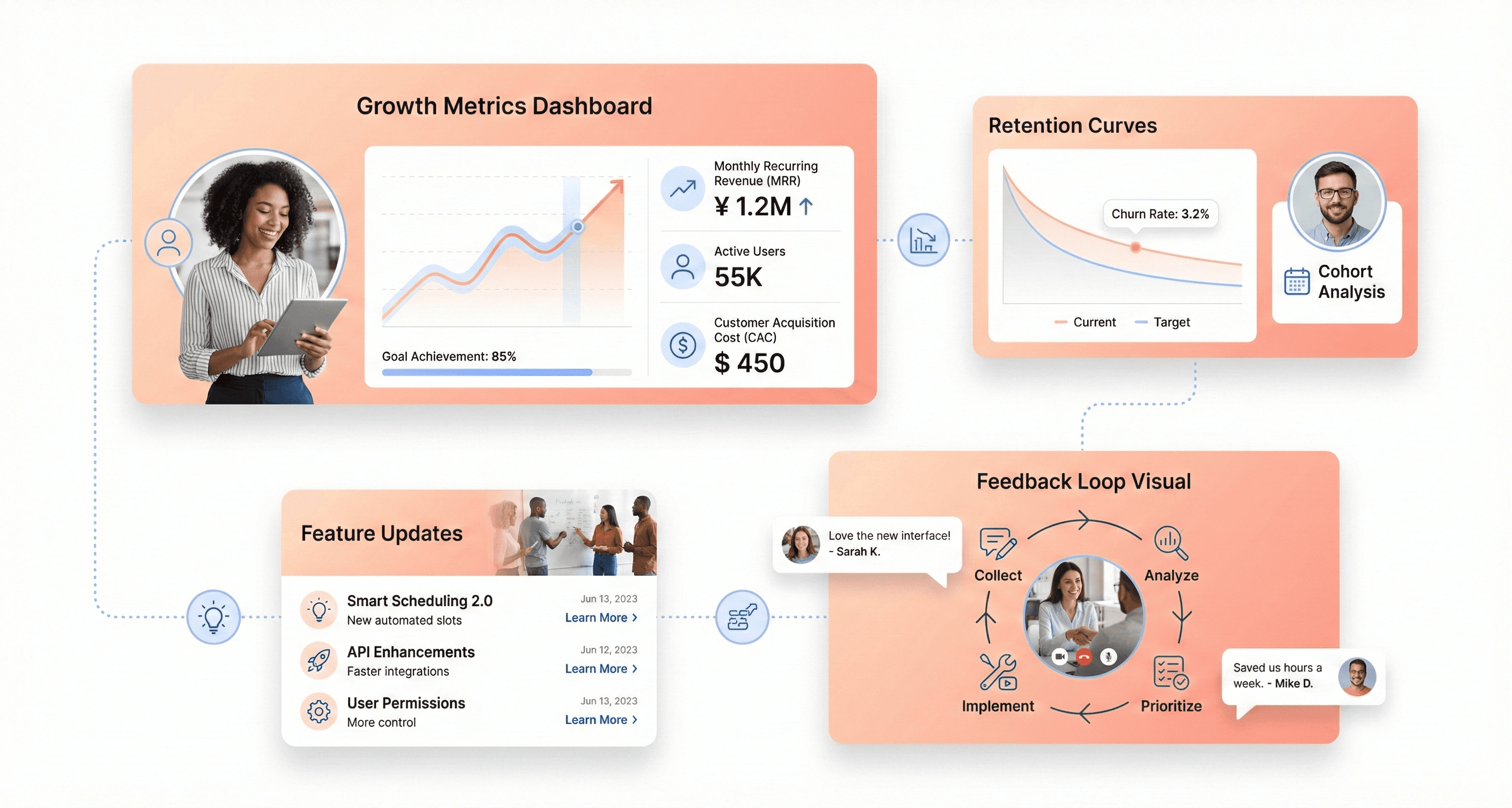
SaaS post-launch optimization showing growth metrics, retention tracking, and continuous improvement.

Regular analysis of performance metrics should inform continuous optimization efforts across all aspects of your SaaS product. Use insights from customer success indicators to refine your onboarding process, improve feature adoption, and reduce churn rates while identifying opportunities for expansion revenue from existing customers.

Conclusion

Building a successful SaaS product requires meticulous planning across multiple dimensions, from market validation and technical architecture to user experience and go-to-market execution. This comprehensive checklist addresses the critical areas that can make or break your product launch. Remember that 35% of startups fail due to lack of market need, while 38% fail from insufficient funding, both preventable outcomes with proper preparation and execution of these readiness components.

Your SaaS journey doesn't end at launch, it's an ongoing process of refinement, scaling, and optimization. The thoroughness of your preparation directly impacts your ability to navigate challenges and pivot when necessary. Use this checklist as your roadmap, but remember that adaptability and continuous learning from user feedback will ultimately determine your product's long-term success in the competitive SaaS landscape.

Building a successful SaaS product demands more than just coding skills and brilliant ideas. SaaS founders need a systematic approach that covers every critical aspect of product development, from initial market validation to post-launch optimization.

This product development checklist for saas is designed specifically for SaaS entrepreneurs, first-time founders, and technical co-founders who want to transform their vision into a market-ready product. Whether you're bootstrapping your first startup or scaling your existing platform, having a comprehensive saas product readiness checklist prevents costly mistakes and ensures you don't miss essential steps.

We'll walk you through the foundational elements of market research and validation, helping you confirm there's real demand for your solution before you invest months in development. You'll also discover how to build a technical architecture and infrastructure planning framework that scales with your growth, avoiding the technical debt that kills many promising SaaS companies.

Finally, we'll cover your MVP development and testing strategy, showing you how to launch lean while gathering the user feedback that guides your product roadmap. This isn't about building perfect software, it's about building the right software that solves real problems for people willing to pay for your solution.

Market Research and Validation Foundation

Define Problem Statement and User Pain Points

Establishing a clear problem statement forms the cornerstone of your saas product development roadmap. Before rushing into validation, ensure your market research is thorough and addresses specific customer pain points that your SaaS solution can solve effectively. Your problem statement should be precise, focusing on genuine challenges faced by your target audience rather than assumed needs.

When defining user pain points, conduct comprehensive customer interviews to gather direct insights into their current challenges and frustrations. Prepare structured questions that uncover specific problems within their workflows, processes, or existing tools. For example, if developing a project management tool, interview potential users about their current project management struggles, bottlenecks in team collaboration, and inefficiencies in their existing solutions.

The validation process for your saas startup product development should include early feedback from trusted advisors and potential users. If initial feedback suggests your problem statement needs refinement, take time to adjust before proceeding further. A well-defined SaaS idea should address specific problems with clear, cost-effective solutions that demonstrate genuine value to users.

Conduct Comprehensive Market Analysis and Competitor Research

Market analysis serves as the foundation for your product development framework saas strategy. Understanding market size, competitive landscape, and industry trends helps shape realistic expectations and identify opportunities for differentiation. Your market research should examine both direct and indirect competitors to understand what works and what gaps exist in the current market.

Study your competitors systematically by analyzing their strengths, weaknesses, pricing models, and customer feedback. This competitor analysis reveals opportunities where your SaaS product can fill unmet needs or improve upon existing solutions. For instance, if developing a customer support tool, examine leading solutions like established platforms to identify integration gaps with CRM systems or unique features that could set your product apart.

Industry-specific forums and online communities provide valuable insights into market needs and competitor performance. Participate actively in these communities to discuss your concept and gather unfiltered feedback from potential users. This engagement helps validate market demand while building relationships with your target audience before launch.

SaaS market research process showing user interviews, pain points, personas, and competitor analysis.

Identify Target User Base and Create Detailed User Personas

Creating detailed user personas ensures your mvp development strategy saas targets the right audience with relevant solutions. Your user personas should be based on actual research data rather than assumptions, incorporating demographics, pain points, goals, and behavioral patterns of your ideal customers.

Leverage online surveys to gather quantitative data about your target market's preferences, challenges, and willingness to pay for solutions. Use tools like survey platforms to reach broader audiences and collect statistically relevant data. Focus your surveys on understanding specific use cases, feature preferences, and budget considerations that will inform your product roadmap.

Email list building serves as an effective method for identifying and engaging with potential customers early in your development process. Create valuable content related to your target market's challenges and offer it in exchange for email subscriptions. Monitor sign-up rates and engagement levels to gauge genuine interest in your proposed solution and refine your user personas accordingly.

Develop Unique Value Proposition and Product Roadmap

Your unique value proposition distinguishes your SaaS solution from existing alternatives and communicates clear benefits to potential customers. This proposition should directly address the validated pain points and demonstrate how your solution provides superior value compared to current options in the market.

Develop your saas product validation process by testing different value propositions through landing pages and A/B testing. Create simple landing pages describing your SaaS product benefits and experiment with different headlines, calls-to-action, and feature highlights. Measure conversion rates and user engagement to determine which value propositions resonate most strongly with your target audience.

Your product roadmap should prioritize core functionalities that address the most critical pain points identified through your research. Focus on essential features that provide immediate value while planning future enhancements based on user feedback and market evolution. This roadmap becomes your guide for MVP development, ensuring you build features that truly matter to your target users rather than nice-to-have additions that dilute your core value proposition.

Technical Architecture and Infrastructure Planning

Design Scalable Cloud-Based Infrastructure with Auto-Scaling

Building a robust SaaS product development roadmap requires establishing cloud infrastructure that can grow with your business demands. Modern cloud platforms like AWS, Azure, and Google Cloud offer distinct advantages for SaaS startups. AWS provides the broadest range of services with pay-as-you-go pricing and reserved instance options for cost control. Azure integrates seamlessly with Microsoft's ecosystem, making it ideal for hybrid cloud setups, while Google Cloud excels in AI/ML tools and analytics with competitive pricing for startups.

Auto-scaling represents a critical component of your SaaS product development framework. This mechanism monitors key metrics like CPU usage, memory consumption, and request queues, automatically adjusting resources to match current demands. When your marketing campaign brings a surge of new users, additional servers spin up automatically. During off-hours when activity drops, excess resources scale down to save costs, maintaining optimal performance without requiring constant manual adjustments.

Smart load balancing ensures your platform stays responsive regardless of user volume. It distributes incoming traffic across multiple servers, preventing any single server from becoming overwhelmed. Proper load balancers monitor server health, redirect users to the closest geographical server, and automatically remove problematic servers from rotation.

A multi-cloud strategy distributes your platform across multiple providers, reducing vulnerability to outages and expanding geographical reach. This approach gives you leverage in negotiations and allows you to take advantage of each provider's strengths while maintaining consistency in deployment and management.

Implement Robust Application Architecture and API Design

With scalable infrastructure established, implementing the right application architecture becomes crucial for your SaaS product readiness checklist. Modern SaaS platforms benefit from breaking functionality into smaller, independent services rather than building one massive application. Each service handles specific tasks like user authentication, payment processing, and data analytics, allowing for independent updates and scaling.

This microservices approach offers significant advantages for SaaS development best practices. When your payment service needs an upgrade or analytics functionality gets busy during end-of-month reporting, you can address that specific issue without touching the rest of the platform. Different teams can work on different services simultaneously, speeding up development and reducing conflicts.

API design forms the backbone of your SaaS product development roadmap, enabling seamless integrations with third-party services and custom functionality. Well-designed APIs ensure your platform can easily connect with other services and adapt to future needs. The modular nature of proper architecture makes it easier to evolve your product over time, with new features developed and tested in isolation before integration into the main system.

Companies like Figma successfully evolved from a simple design tool to a full collaboration platform because their architecture allowed them to add real-time collaboration, plugins, and team libraries gradually without disrupting existing users. Similarly, Notion expanded from note-taking to wikis, databases, and project management through strategic architectural decisions.

Scalable SaaS architecture with cloud infrastructure, microservices, APIs, and auto-scaling systems.

Optimize Database Design and Performance Systems

Database architecture represents a fundamental element of your SaaS startup product development strategy. Effective data architecture design requires mapping out how your platform will handle data, focusing on multi-tenancy, data isolation, and scalability. This determines how efficiently your SaaS will grow and adapt to increasing user demands.

Multi-tenancy emerges as the critical architectural principle distinguishing SaaS from traditional software deployment models. This approach allows a single software instance to serve multiple customer organizations while maintaining strict data segregation and personalized experiences. Advanced data partitioning strategies ensure each customer's information remains secure and isolated while optimizing performance across the entire platform.

Performance optimization involves implementing sophisticated database management systems that can handle dynamic resource allocation. This includes establishing systems for real-time performance tracking, user analytics, and automated backup systems for data protection. Modern SaaS applications require databases that can scale both vertically and horizontally to accommodate growth without compromising response times.

Data security and compliance must be built into the database architecture from the start. This involves implementing encryption at rest and in transit, maintaining strict access controls, and regularly auditing security measures. Clear audit trails for all data access help meet regulatory requirements like GDPR and HIPAA while maintaining operational integrity.

Establish Version Control and Continuous Integration Processes

Now that we have covered the foundational infrastructure and architecture components, establishing robust development processes becomes essential for your SaaS product launch preparation. Version control systems form the backbone of collaborative development, allowing teams to track changes, manage code versions, and coordinate work across multiple developers and features.

Continuous integration processes ensure that code changes are automatically tested and validated before deployment. This systematic approach prevents conflicts and maintains code quality throughout the development lifecycle. Automated testing frameworks should be integrated into your CI pipeline to catch issues early and maintain platform reliability.

The implementation of proper version control enables faster development and easier updates since changes to one service don't impact others. This approach supports the modular architecture principles discussed earlier, where teams can work independently on different components while maintaining overall system integrity.

Deployment strategies should include automated systems that can handle rolling updates without service interruptions. Modern SaaS platforms require the ability to deploy new features gradually, test them with limited user groups, and roll back changes if issues arise. This flexibility extends to third-party integrations, allowing you to adopt new technologies without major restructuring.

Monitoring and alerting systems should be established to track everything from system performance to deployment success rates. Real-time monitoring helps identify potential issues before they impact users and provides valuable data for optimizing both infrastructure and development processes.

Security and Compliance Framework

mplement Access Control and Secure Infrastructure

Building a robust security foundation requires implementing comprehensive access controls and secure infrastructure from the ground up. Effective access management involves regularly reviewing and reducing excessive permissions to limit data exposure while ensuring access levels comply with frameworks like SOC 2, HIPAA, ISO, and NIST.

Start by establishing multi-factor authentication (MFA) across all systems, as this security measure is essential for meeting most compliance standards. Implement granular access controls that follow the principle of least privilege, ensuring users only have access to the resources necessary for their specific roles.

Your secure infrastructure should include firewalls, encryption protocols, and network segmentation to protect against unauthorized access. For SaaS founders, this means selecting cloud providers that offer robust security features and maintaining control over configuration settings. Consider implementing identity and access management (IAM) solutions that can scale with your product development roadmap.

Ensure Data Privacy and Protection Measures

Data privacy and protection form the cornerstone of any successful SaaS product development checklist. Your organization must implement data encryption both at rest and in transit, ensuring sensitive information remains protected throughout its lifecycle.

Establish clear data minimization practices by collecting only the data necessary for your service to function. This approach aligns with privacy regulations and reduces your overall risk exposure. Implement comprehensive data processing requirements that define how personal information is collected, used, stored, and deleted.

Create robust incident response plans that outline procedures for handling potential data breaches. These plans should include notification protocols, containment strategies, and recovery procedures. Regular security audits help identify vulnerabilities before they become critical issues, supporting your SaaS development best practices.

SaaS security and compliance framework showing data protection, access control, and regulatory standards.

Achieve Regulatory Compliance (GDPR, CCPA, HIPAA)

Understanding and implementing regulatory compliance requirements is crucial for SaaS founders planning their product launch preparation. Different regulations apply based on your target market and the type of data you handle.

GDPR compliance is mandatory if you process EU personal data, regardless of your company's location. Key requirements include obtaining proper consent, ensuring data transparency, implementing data minimization practices, and providing users with rights to access and erasure. Non-compliance can result in fines up to €20 million or 4% of global annual revenue.

CCPA governs California residents' personal data, requiring businesses to disclose data practices and offer opt-out mechanisms. This regulation grants consumers significant control over their personal information and requires clear privacy notices.

For healthcare-related SaaS products, HIPAA compliance is essential when handling protected health information (PHI). This requires implementing strong access controls, encryption, security audits, risk assessments, and comprehensive incident response plans.

Regulation

Scope

Key Requirements

GDPR

EU personal data

Consent, data minimization, right to erasure

CCPA

California residents

Data practice disclosure, opt-out options

HIPAA

Healthcare data (PHI)

Access controls, encryption, risk assessments

Conduct Regular Security Audits and Testing

Establishing a systematic approach to security audits and testing ensures your SaaS product maintains its security posture throughout development and post-launch phases. Regular audits provide independent validation and strengthen your overall security framework.

Implement continuous monitoring systems that detect suspicious activities in real-time. This ongoing surveillance helps identify potential security incidents before they escalate into major breaches. Your monitoring should cover all critical systems, applications, and data flows.

Risk assessments should be conducted regularly to identify new vulnerabilities and assess the effectiveness of existing security controls. These assessments help prioritize security investments and ensure resources are allocated to address the most critical risks.

Consider pursuing security certifications like SOC 2, which evaluates how service organizations manage customer data based on five trust principles: security, availability, processing integrity, confidentiality, and privacy. SOC 2 Type II reports evaluate the effectiveness of controls over a period (typically 3-12 months), providing valuable validation for enterprise customers.

Maintain comprehensive logs across all systems to streamline future audits and demonstrate adherence to compliance standards. These logs should be regularly reviewed and analyzed to identify patterns that might indicate security issues or compliance gaps.

External security audits conducted by third-party professionals provide objective assessments of your security posture and help identify blind spots that internal teams might miss. Schedule these audits at regular intervals and after significant system changes to ensure continuous compliance with your chosen security frameworks.

User Experience and Design Excellence

Conduct User Research and Information Architecture Planning

Building upon your technical foundation, successful SaaS product development requires a deep understanding of your users and how they'll navigate your application. User research forms the cornerstone of effective information architecture, ensuring that your SaaS product development roadmap aligns with actual user needs rather than assumptions.

Start by conducting focus group testing if you're developing from scratch, or implement beta testing for existing platforms. Focus groups allow you to observe how users interact with your design mockups, while beta testing enables real-world validation with a smaller user base before full rollout. Both quantitative and qualitative data collection are essential during this phase.

Your information architecture should follow the principle of familiarity, organizing content and features in logical, intuitive ways that users already understand. Consider how users will move through your software from onboarding through task completion with minimal effort. Map out user flows that feel natural and reduce cognitive load.

Progressive disclosure becomes crucial here - layer features by presenting core, frequently-used tools prominently while tucking advanced functions into sub-menus or collapsible sections. This approach allows users to gradually learn your product's full functionality without feeling overwhelmed during initial interactions.

Create Responsive Visual Design and Navigation Systems

With your user research complete, the next step in your SaaS development framework involves crafting the visual interface and navigation structure. Your user interface encompasses the visual layout, buttons, and interactions that users will see and touch throughout their journey.

Responsive design ensures your SaaS application functions seamlessly across devices, from desktop dashboards to mobile interfaces. Focus on creating clean, intuitive layouts that prioritize performance and usability. Your dashboard should run smoothly and remain simple to use, as speed and responsiveness directly impact user satisfaction and retention.

Navigation systems must support your information architecture while maintaining visual consistency. Implement familiar design patterns that users recognize from other applications, as effective UX often builds upon what users already know. Avoid unnecessary creativity in core navigation elements - users are most comfortable with familiar structures.

Consider implementing micro-interactions throughout your interface. These subtle design elements, such as button color changes, loading indicators, or hover effects, provide immediate feedback and guide users through your product without being intrusive. Status indicators, hints, and call-to-action reinforcement through small animations help users navigate confidently.

SaaS user experience design with intuitive navigation, usability testing, and clean interface layouts.

Perform Usability Testing and User Feedback Collection

Now that your visual design is established, rigorous testing becomes essential to validate your SaaS product readiness. Usability testing should combine both quantitative metrics tracking and qualitative feedback collection to provide comprehensive insights into user behavior.

Track key metrics like friction events in your workflows to identify where users encounter difficulties. Monitor completion rates from workflow start to finish, helping you understand if your UX design is intuitive enough for your target audience. Build conversion funnels for critical workflows, examining each step to pinpoint areas needing improvement.

Session replays prove invaluable for understanding user frustration points. Watch recordings of users who abandoned workflows or encountered high-friction areas, looking for moments of confusion or difficulty. Trigger feedback surveys during key frustration points - such as rage clicks or website errors - to capture user reactions in real-time.

Implement both scheduled feedback collection and on-demand tooltips that allow users to discover your product at their own pace. These tooltips can be triggered by user behavior, providing contextual help exactly when needed without cluttering the interface.

Optimize Conversion Paths and User Journey Flow

The final component of your UX excellence framework focuses on streamlining the paths users take to complete valuable actions within your SaaS application. Conversion path optimization requires analyzing user behavior data to identify and eliminate barriers to task completion.

Map out your primary user journeys, from initial onboarding through core feature adoption and ongoing engagement. Each step should feel natural and necessary, with clear value propositions guiding users forward. Remove unnecessary steps that don't contribute to user success or business objectives.

Personalization plays a crucial role in optimizing user journeys. Use data collected during onboarding to tailor experiences based on user goals, industry, or team size. Ask strategic questions about their current tools or workflows to customize your product's presentation and reduce learning curves for new users.

Consider implementing AI-powered workflows where appropriate, as these can significantly enhance user experience by providing intelligent assistance and automation. Even simple chatbot integrations can help users navigate complex features or get quick answers to common questions.

Monitor your optimized conversion paths continuously, using experience analytics to track how users respond to changes. Implement A/B testing for significant UX modifications, ensuring that improvements actually enhance rather than hinder user experience before rolling them out to your entire user base.

MVP Development and Testing Strategy

Choose Technology Stack and Technical Implementation

When building a successful MVP development strategy for SaaS, selecting the right technology stack requires balancing functionality, development speed, and future scalability. Over-engineering at this level can be costly and time-consuming, so choose tools and frameworks appropriate for your project's goals and long-term ambitions.

Programming Languages and Frameworks

The programming language you choose determines the flexibility and efficiency of your MVP. JavaScript excels at creating dynamic user interfaces, while Python's simplicity makes it an excellent choice for rapid development. Java provides reliability and scalability for large-scale applications, while Ruby offers a developer-friendly environment.

For front-end development, React offers a component-based framework for modular development, Angular provides comprehensive tools for large projects, and Vue.js stands out for its simplicity and ease of use. Back-end frameworks like Node.js deliver performance and handle multiple simultaneous requests, while Django offers a fully-featured framework for rapid development.

Database and Infrastructure Considerations

PostgreSQL excels at handling complex queries and reliability, MongoDB offers flexibility and scalability for unstructured data, and MySQL provides fast, efficient management of large datasets. Cloud platforms like AWS provide global reach with innovative services, Google Cloud Platform offers superior analytics and machine learning capabilities, and Microsoft Azure ensures seamless integration with Microsoft products.

Key Factors for Technology Selection

Consider development speed - how quickly you can build and iterate using these technologies. Evaluate your team's familiarity with the chosen stack and assess community support and documentation availability. Factor in licensing, hosting, and resource costs while considering future scalability without creating severe bottlenecks.

SaaS MVP development strategy highlighting core feature prioritization and lean product building.

Develop Minimum Viable Product with Core Features

Previously, having established your technology foundation, the next critical phase involves developing your SaaS MVP with laser focus on core functionality. A SaaS minimum viable product represents the most basic version of your software, designed to test your core concept and gather valuable customer insights.

Defining Core Features

Resist the urge for feature overload and prioritize essential features that directly address your core value proposition. Think Minimum Viable Product, not Maximum Viable Product - focus on functionalities that validate your concept and gather user feedback. Utilize techniques like the MoSCoW method (Must-have, Should-have, Could-have, Won't-have) to categorize features based on criticality.

The MVP focuses on delivering vital features that solve critical problems for your target audience, allowing you to assess market demand and adjust your product strategy without significant upfront investment. This approach saves time and resources on features that may not appeal to users.

Development Process and Best Practices

Create user-friendly UI and UX through prototyping and continuous feedback collection. Interactive prototyping allows experimentation with different navigation options, button placements, and overall layouts, ensuring smooth user experiences. Gather feedback throughout development from potential users, stakeholders, and usability testing to identify improvement areas.

Implement straightforward navigation with intuitive menus and clear user paths. Use compelling calls-to-action with strategically placed, visually distinctive buttons. Design visually appealing, clean layouts that enhance usability while remaining uncluttered.

Conduct Comprehensive Testing and Quality Assurance

With your MVP development underway, comprehensive testing becomes essential for ensuring product reliability and user satisfaction. A successful SaaS product launch requires strategic planning and continuous development through robust testing frameworks.

Pre-Launch Testing Preparations

Before launch, develop robust analytics and tracking systems that provide essential insights into user behavior, engagement, and overall product performance. These systems allow you to understand how users interact with your MVP and identify areas for improvement.

Implement essential analytics tools like Google Analytics for analyzing website traffic, user demographics, and conversion rates. Utilize Mixpanel for user behavior analysis to examine specific actions within your app and understand user journeys. Consider Amplitude for detailed insights into user behavior and product usage trends.

Quality Assurance Framework

Establish comprehensive testing protocols covering functionality, performance, security, and user experience. Conduct usability testing throughout the development process to identify potential issues with user interface and user experience. Implement automated testing where possible to ensure consistent quality and rapid iteration cycles.

Test core features extensively to ensure they solve critical problems for your target audience effectively. Validate that your MVP delivers on its core value proposition and provides the foundation for gathering meaningful user feedback.

SaaS product testing and feedback loop with analytics dashboards and user insights.

Gather User Feedback and Iterate Based on Insights

Now that your SaaS MVP is live, focusing on gathering feedback from early users becomes critical for understanding user needs, preferences, and pain points. This feedback loop is central to the MVP methodology and lays the foundation for developing a successful SaaS solution.

Feedback Collection Strategies

Use in-app messaging through surveys or feedback messages to gather real-time insights on user experience. Provide targeted feedback forms on your website or within the app where users can offer specific suggestions and ideas. Conduct targeted surveys to gather quantitative data on user satisfaction, feature usage, and overall experience.

Monitor social media channels actively for product mentions and engage with users to gather feedback and resolve issues. This multifaceted approach ensures you capture comprehensive insights about your product's performance and user satisfaction.

Measuring Success and Key Metrics

Track essential KPIs to evaluate your MVP's effectiveness. Monitor Customer Acquisition Cost (CAC) to understand new customer acquisition expenses. Measure Monthly Recurring Revenue (MRR) for predictable revenue tracking. Calculate churn rate to determine subscription cancellation percentages and Customer Lifetime Value (CLTV) for total revenue estimates per customer relationship.

Focus on user engagement metrics including Daily and Monthly Active Users (DAU/MAU), average session duration, feature usage patterns, and user retention rates. Analyze conversion rates at each customer journey stage, from website visits to sign-ups, trial initiations, and paid subscription conversions.

By actively soliciting and evaluating user feedback, you can identify development areas, prioritize improvements, and fine-tune your SaaS MVP to match market demand. This iterative process ensures continuous product evolution based on real-world data and user insights.

Pricing and Monetization Strategy

Determine Pricing Model and Plan Tiers

Now that you've established your technical foundation and user experience framework, developing a strategic pricing model becomes crucial for your SaaS product development roadmap. The right pricing structure directly impacts your ability to acquire customers, generate revenue, and scale sustainably.

Start by selecting a pricing model that aligns with your product's value proposition and customer usage patterns. Tiered pricing remains the most popular approach for SaaS businesses, offering multiple pricing plans at different price points designed for specific customer segments. This model allows you to serve small businesses with basic needs while providing enterprise-grade features for larger organizations.

Consider usage-based pricing if your product's value scales with consumption, such as API calls, storage, or transactions. This model aligns costs with customer value and can improve adoption by removing upfront friction. Alternatively, per-user pricing works well for collaboration tools where value increases as more team members join.

For products targeting diverse customer segments, feature-based pricing allows you to charge based on access to specific tools or modules. This approach works particularly well when your SaaS product serves customers with varying complexity requirements.

When structuring your tiers, ensure each plan reflects real customer value and creates clear upgrade paths. Avoid creating too many options that confuse potential customers, but provide enough flexibility to accommodate different buyer personas and budget constraints.

SaaS pricing and monetization model with subscription plans, billing, and revenue metrics.

Integrate Payment Gateway and Billing Systems

With your pricing model defined, implementing robust payment infrastructure becomes essential for your SaaS product launch preparation. Selecting the right payment gateway and billing system directly impacts customer experience and revenue collection efficiency.

Choose a payment gateway that supports multiple payment methods and currencies if you plan to serve international markets. Your billing system should handle the complexity of subscription payments, including recurring charges, proration, and automated retries for failed payments.

Ensure your billing infrastructure can support various pricing models from day one. Whether you're implementing flat-rate pricing, tiered subscriptions, or usage-based billing, your system needs the flexibility to accommodate changes as your business evolves.

Focus on creating a frictionless checkout experience that reduces payment friction. Complex payment flows can derail customer acquisition before it starts, making simplicity a key priority in your product development framework.

Implement Subscription Management and Usage-Based Billing

Modern SaaS businesses require sophisticated subscription management capabilities that go beyond simple recurring billing. Your system must handle subscription lifecycle events including upgrades, downgrades, pauses, and cancellations seamlessly.

For usage-based billing scenarios, implement accurate usage tracking and real-time billing calculations. Customers should have visibility into their consumption patterns and associated costs to build trust and prevent billing surprises.

Design your subscription management system to support proration calculations when customers change plans mid-cycle. This feature ensures fair billing practices and improves customer satisfaction during plan transitions.

Include automated dunning management to handle failed payments gracefully. Your system should automatically retry failed charges, send appropriate notifications, and provide customers with easy payment update mechanisms to minimize involuntary churn.

Set Up Revenue Reporting and Financial Forecasting

Establishing comprehensive revenue reporting capabilities is fundamental to your SaaS development best practices. Implement tracking for key metrics including monthly recurring revenue (MRR), annual recurring revenue (ARR), and customer lifetime value (CLTV).

Create dashboards that provide real-time visibility into revenue performance across different pricing tiers and customer segments. This data becomes invaluable for making informed pricing adjustments and identifying expansion revenue opportunities.

Build forecasting models that account for subscription growth patterns, churn rates, and seasonal variations. Accurate financial projections help secure funding, plan resource allocation, and make strategic business decisions.

Track plan upgrades, downgrades, and expansion revenue to understand customer behavior patterns. This information guides future pricing optimization and product development priorities, ensuring your pricing strategy evolves with market demands and customer needs.

Marketing and Go-to-Market Preparation

Develop Brand Identity and Messaging Strategy

With your product development and technical infrastructure in place, the next critical step involves establishing a strong brand identity and messaging strategy that resonates with your target audience. A clear value proposition and strong brand identity can set you apart in a crowded market, serving as the foundation for all your marketing efforts.

Start by developing value-based messaging that clearly highlights how your SaaS product solves specific problems and improves workflows. Your messaging serves as the bridge between your product and your target audience, conveying the value of your solution and articulating how you address customers' pain points. The best value propositions communicate what makes your SaaS product unique and why it's valuable to your specific market segment.

Focus on creating messaging that resonates with your audience and persuades them to consider your solution over competitors. This involves understanding your target market's industry, company size, location, and individual roles within organizations. Use these research insights to inform your messaging strategy, ensuring it speaks directly to decision makers, influencers, and end users in your target segments.

SaaS go-to-market strategy showing landing pages, content marketing, and demand generation.

Create Website, Landing Pages and SEO Optimization

Now that you have established your brand messaging, it's time to create digital assets that effectively communicate your value proposition. Your website and landing pages serve as the primary touchpoints where potential customers will evaluate your SaaS solution, making their design and optimization crucial for conversion success.

Develop dedicated landing pages that align with your messaging strategy and target specific customer segments or use cases. These pages should clearly articulate your unique value proposition while addressing the specific pain points of your target audience. Focus on creating content that demonstrates how your product solves real customer problems and improves their workflows.

Implement SEO optimization strategies to ensure your target audience can discover your solution organically. This involves incorporating relevant keywords naturally into your content while maintaining readability and value. Your SEO efforts should align with the search behavior of your target market, considering the terms and phrases they use when looking for solutions like yours.

Build Social Media Presence and Content Marketing Strategy

With your website foundation established, developing a comprehensive content marketing strategy becomes essential for reaching your target audience across multiple channels. Content marketing forms a critical component of your go-to-market approach, helping you generate awareness and interest in your product while establishing thought leadership in your industry.

Create high-quality content that showcases how to address customer pain points while demonstrating your product's capabilities. This includes blog posts, educational resources, and industry-specific content that provides genuine value to your target audience. Focus on content that helps potential customers understand their challenges while positioning your solution as the ideal remedy.

Leverage social media platforms to engage with your target community and amplify your content reach. Consider platforms where your target audience is most active, whether that's LinkedIn for B2B audiences or other channels relevant to your specific market. Use these platforms to share valuable insights, engage in industry conversations, and build relationships with potential customers.

Launch Email Campaigns and Paid Advertising Initiatives

Building on your content marketing foundation, implementing targeted email campaigns and paid advertising initiatives will help you reach and nurture potential customers more effectively. These channels work together to guide prospects through the buyer's journey, from initial awareness to conversion.

Develop email marketing campaigns that nurture leads through automated sequences, providing valuable content and demonstrating your product's capabilities. Use these campaigns to educate potential customers about their challenges while showcasing how your solution addresses their specific needs. Focus on creating email content that builds trust and credibility with your audience.

Consider paid advertising initiatives across relevant channels to amplify your reach and target specific customer segments. This might include LinkedIn advertisements, retargeting campaigns, or other platforms where your target audience is active. Ensure your paid advertising aligns with your overall messaging strategy and drives traffic to optimized landing pages that convert visitors into leads.

Remember that your marketing and distribution strategy should align with your potential customers' preferences and your product's complexity. A more advanced SaaS product might benefit from a dedicated sales approach, while simpler solutions could leverage self-service signup options effectively.

Customer Support and Success Infrastructure

Implement Multi-Channel Support Systems and Knowledge Base

Modern SaaS customer support requires an omnichannel approach that meets users where they are. Your support infrastructure should consolidate messages from email, live chat, Slack, in-app widgets, and other channels into a unified inbox. This eliminates the context switching and siloed communication that slows down response times and frustrates both agents and customers.

When implementing multi-channel support systems, prioritize platforms that provide a single view of all customer interactions across touchpoints. Support agents need to see the complete conversation history regardless of whether a customer started on email and switched to chat, or moved from Slack to a support ticket. This unified visibility enables faster, more informed responses and prevents customers from repeating their issues.

Your knowledge base should be deeply integrated with your support channels, not treated as a separate resource. Modern support platforms allow agents to surface relevant articles in real-time during conversations and embed documentation directly within chat widgets or email responses. This immediate access to information helps resolve tickets faster and empowers customers to find answers independently.

Self-service capabilities are crucial for scaling your support operation. Create searchable documentation, FAQ pages, and troubleshooting guides that customers can access 24/7. Your knowledge base should include comprehensive product education, hands-on tutorials, and solutions for common technical issues. Well-structured self-service resources can deflect a significant percentage of basic tickets, allowing your human agents to focus on complex problems that require personalized attention.

SaaS customer support and success system with onboarding, helpdesk, and knowledge base.

Create Training Materials and User Onboarding Programs

Effective onboarding is critical for SaaS product adoption and long-term customer success. Your training materials should guide users through initial setup, core feature discovery, and advanced functionality in a structured progression. This proactive approach helps customers realize value quickly and reduces the volume of support tickets during their first 30-90 days.

Develop personalized onboarding workflows that adapt to different user types, company sizes, and use cases. Your training program should include in-app tutorials, guided walkthroughs, and scheduled check-ins during crucial adoption milestones. Monitor product usage data to identify when users hit common roadblocks and proactively reach out with targeted assistance before issues escalate.

Training materials should extend beyond initial onboarding to include ongoing education about new features, best practices, and advanced use cases. Create role-specific content that addresses the needs of different user personas within your customer organizations. This comprehensive approach ensures users continue to discover value as your product evolves and their needs become more sophisticated.

Your support team requires equally thorough training on product functionality, common customer scenarios, and internal escalation procedures. Invest in deep product education that includes hands-on experience with all features, understanding of technical architecture, and familiarity with integration capabilities. Regular training updates ensure agents stay current with new releases and can confidently guide customers through complex implementations.

Establish Support Metrics and Analytics Tracking

Data-driven support operations require comprehensive metrics tracking across all customer touchpoints. Implement systems to monitor Customer Satisfaction (CSAT) scores, Net Promoter Score (NPS), first response times, and resolution times. These core metrics provide insight into both operational efficiency and customer perception of your support quality.

Track First Contact Resolution (FCR) rates to measure how effectively your team resolves issues during initial interactions. High FCR indicates well-trained agents, effective tools, and comprehensive documentation. Monitor Customer Effort Score (CES) to understand how easy customers find it to get help, as reducing friction directly impacts retention and satisfaction.

Advanced analytics should connect support metrics to broader business outcomes like customer retention and churn rates. Analyze ticket trends to identify common product issues, documentation gaps, and training needs. Use tagging systems to categorize tickets by product area, customer segment, and issue type, enabling deeper analysis of support patterns and resource allocation needs.

Implement real-time dashboards that provide visibility into queue depth, response time performance, and SLA adherence. These operational metrics help managers make immediate staffing decisions and identify when additional resources or process improvements are needed. Regular reporting should include trends over time, comparative analysis across channels, and correlation with product releases or marketing campaigns.

Build User Community and Feedback Collection Systems

Creating vibrant user communities amplifies your support efforts by enabling peer-to-peer assistance and creating scalable knowledge sharing. Establish forums, user groups, or Slack communities where customers can ask questions, share best practices, and provide feedback on product development priorities. Active communities reduce support ticket volume while building stronger relationships between your company and customers.

Implement systematic feedback collection across all support interactions to capture voice-of-customer insights. Every support ticket provides valuable data about product gaps, usability issues, and customer needs that should inform product roadmap decisions. Create structured processes for escalating bug reports to engineering teams and feature requests to product management.

Your feedback collection should extend beyond reactive support to include proactive surveys, user interviews, and regular check-ins with key accounts. Use this information to identify common pain points, validate product improvements, and prioritize development efforts that address real customer challenges. Comprehensive feedback systems transform support from a cost center into a strategic source of product intelligence.

Collaboration between support, product, and engineering teams ensures customer insights drive meaningful improvements. Establish clear escalation paths for technical issues, regular meetings to review support trends, and shared tools that maintain visibility into customer feedback across departments. This alignment helps create a customer-centric culture where support insights directly influence product development and business strategy.

Launch Execution and Post-Launch Optimization

Execute Pre-Launch Marketing Activities and Database Building

With your SaaS product readiness checklist complete, now it's time to execute a coordinated pre-launch marketing strategy that builds anticipation and creates a robust customer database. Your go-to-market execution should focus on generating buzz through multiple channels while establishing meaningful connections with your target audience.

Create a comprehensive launch announcement that is compelling, concise, and shareable across all platforms. This coordinated effort should leverage traditional PR, social media, your company blog, relevant online communities, live webinars, podcasts, and in-person events. Rather than treating these as isolated activities, build a core message around your launch and distribute it strategically across all channels to reach your ideal customer profile in multiple touchpoints.

Social media platforms like LinkedIn and Reddit offer powerful opportunities for reaching your target audience directly. Share engaging content tailored to each platform, including teaser videos, posts requesting product feedback, and countdown announcements to your launch date. Consider running targeted ads to amplify your reach and drive qualified traffic to your landing page.

Implement email marketing campaigns to nurture leads and build your customer database. Craft personalized email sequences that guide potential customers through the buyer's journey, using attention-grabbing subject lines and strong calls-to-action. Segment your email lists based on user personas to deliver relevant content that resonates with different audience segments.

Industry-specific outreach plays a crucial role in pre-launch success. Connect with influencers, bloggers, and media outlets who can amplify your message and add credibility to your brand. Offer exclusive previews or invite them to pre-launch demos to generate authentic endorsements from trusted voices in your niche.

Coordinate Technical Launch and Security Monitoring

Technical launch coordination requires meticulous planning and real-time monitoring to ensure a smooth product debut. Establish clear communication channels and dedicated coordination systems, such as Slack channels or project management tools, to keep all team members synchronized and address any technical issues that arise immediately.

Implement comprehensive monitoring systems to track your product's technical performance from the moment of launch. Pay special attention to load times, scalability, and responsiveness, particularly during high-traffic periods following your launch announcement. Server capacity and performance optimization become critical as user adoption accelerates, requiring continuous testing and addressing of functionality concerns to maintain a polished user experience.

Security monitoring must be your top priority during launch execution. Implement robust security measures and continuous monitoring protocols to protect both your platform and users' sensitive data. Data breaches can severely damage your reputation and erode customer trust, while security vulnerabilities can disrupt service availability and lead to costly downtime. Ensure compliance with data protection regulations to avoid legal repercussions and maintain customer confidence.

Establish contingency plans for unexpected technical challenges that may arise during launch. Anticipate potential issues and develop solutions in advance, create clear escalation processes for critical problems, and maintain transparent communication with customers and stakeholders about any changes or delays. Flexibility and adaptability in your launch strategy allow you to pivot quickly when technical issues emerge.

Customer support readiness becomes essential as technical issues inevitably surface during launch. Prepare your support team for a surge in inquiries and ensure they have the resources and knowledge to address technical problems promptly. Fast response times and proactive problem-solving approaches significantly impact customer satisfaction during these critical early interactions.

SaaS product launch execution with release checklist, monitoring tools, and team coordination.

Implement Continuous Maintenance and Feature Updates

Post-launch maintenance and feature development form the foundation of long-term SaaS success. Establish a systematic approach to collecting and analyzing user feedback through multiple channels, including in-app surveys, user interviews, social media monitoring, and customer support interactions. This feedback becomes your most valuable resource for identifying pain points and uncovering opportunities to enhance the user experience.

Create a structured product roadmap that incorporates user suggestions while aligning with your long-term business goals. Focus on delivering updates and new features that address critical user needs and improve overall functionality. However, competing priorities will emerge after launch, making it essential that your engineering and product teams maintain clear alignment on high-priority features, modules, and integrations to ensure you're building solutions that truly benefit end-users.

Implement continuous iteration cycles that allow for rapid response to market demands and user feedback. Map out development sprints that balance new feature development with maintenance and optimization tasks. This approach ensures your product remains competitive while maintaining stability and performance standards that users expect from professional SaaS solutions.

Version control and rollback procedures become critical during continuous updates. Establish testing protocols that prevent bugs from reaching production environments while maintaining the ability to quickly address issues that do emerge. Beta testing with select user groups can help validate new features before broader releases.

Documentation and change management processes ensure that updates enhance rather than disrupt the user experience. Maintain clear communication with users about upcoming changes and provide training resources to help them adapt to new features and improvements.

Monitor Performance Metrics and Customer Success Indicators

Comprehensive performance monitoring encompasses both technical metrics and customer success indicators that drive sustainable growth. Track key performance indicators including user acquisition metrics like sign-ups, cost per acquisition, and conversion rates, alongside engagement metrics such as daily and monthly active users, session duration, and feature adoption rates.

Revenue metrics require particular attention for SaaS products, including average revenue per user (ARPU), customer lifetime value (CLV), and churn rates. These indicators provide insights into the financial health of your product and help identify trends that require strategic adjustments. Break down these metrics into actionable milestones with realistic, time-bound goals that guide your team's efforts and maintain organizational alignment.

Customer success indicators extend beyond basic usage metrics to include customer satisfaction scores, support ticket resolution times, and user onboarding completion rates. Monitor user analytics to identify specific points in your workflow where users experience difficulties or abandon the platform, then investigate and implement improvements to optimize these critical touchpoints.

Implement automated dashboards and reporting systems that provide real-time visibility into performance trends. Rather than building reports manually, automated systems enable data-driven decision-making by providing always up-to-date billing, subscription, and customer behavior information. Segment performance data by customer types and usage patterns to identify opportunities for targeted improvements.

SaaS post-launch optimization showing growth metrics, retention tracking, and continuous improvement.

Regular analysis of performance metrics should inform continuous optimization efforts across all aspects of your SaaS product. Use insights from customer success indicators to refine your onboarding process, improve feature adoption, and reduce churn rates while identifying opportunities for expansion revenue from existing customers.

Conclusion

Building a successful SaaS product requires meticulous planning across multiple dimensions, from market validation and technical architecture to user experience and go-to-market execution. This comprehensive checklist addresses the critical areas that can make or break your product launch. Remember that 35% of startups fail due to lack of market need, while 38% fail from insufficient funding, both preventable outcomes with proper preparation and execution of these readiness components.

Your SaaS journey doesn't end at launch, it's an ongoing process of refinement, scaling, and optimization. The thoroughness of your preparation directly impacts your ability to navigate challenges and pivot when necessary. Use this checklist as your roadmap, but remember that adaptability and continuous learning from user feedback will ultimately determine your product's long-term success in the competitive SaaS landscape.

Stuck with slow releases and high IT costs?

▶︎

Launch 2.5x faster with our AI-driven frontend workflows, specialized for SaaS.

▶︎

Cut IT costs by up to 50% and boost user adoption by 2x with our proprietary frameworks.

Stuck with slow releases and high IT costs?

▶︎

Launch 2.5x faster with our AI-driven frontend workflows, specialized for SaaS.

▶︎

Cut IT costs by up to 50% and boost user adoption by 2x with our proprietary frameworks.

Stuck with slow releases and high IT costs?

▶︎

Launch 2.5x faster with our AI-driven frontend workflows, specialized for SaaS.

▶︎

Cut IT costs by up to 50% and boost user adoption by 2x with our proprietary frameworks.

Frequently Asked Questions

We're ready to answer your questions

Slow releases, clunky dashboards, and frustrated users? You've got questions about how to fix them. We have the Frontend-First answers that unlock growth. Let's talk solutions.

An MVP (Minimum Viable Product) is the simplest version of a SaaS product that includes only core features needed for early customers to use and provide feedback, helping validate assumptions about user needs and market demand. By focusing on essential functionality, an MVP reduces risk and accelerates learning without over investing in full product development.

Answer

What is an MVP in SaaS product development?

Question

Market validation ensures your SaaS idea solves a real problem and that customers are willing to pay for it, preventing wasted development time and resources. Testing pricing, gathering early feedback, and confirming demand helps you refine the concept before committing to full development, making the SaaS product launch preparation more reliable.

Answer

Why is market validation important before building a SaaS product?

Question

User research provides deep insights into user pain points, needs, and behaviors, enabling you to build features that truly matter and improve user experience. Continuous research throughout development and testing helps refine your product and ensures it stays aligned with real user expectations.

Answer

What role does user research play in SaaS product readiness?

Question

Iterative development allows teams to release small improvements frequently, respond to user feedback, and adapt to market changes faster. This Agile-style approach reduces risk, improves product quality, and accelerates time-to-market by continuously refining the SaaS product based on real data.

Answer

How does iterative development benefit SaaS products?

Question

Scalable architecture ensures a SaaS product can handle growing user demand without performance issues, maintaining reliability as the product expands. Designing with scalability helps avoid costly rework later and supports long-term growth by enabling seamless scaling of infrastructure and services.

Answer

Why is scalable architecture critical for SaaS product success?

Question

Frequently Asked Questions

We're ready to answer your questions

Slow releases, clunky dashboards, and frustrated users? You've got questions about how to fix them. We have the Frontend-First answers that unlock growth. Let's talk solutions.

An MVP (Minimum Viable Product) is the simplest version of a SaaS product that includes only core features needed for early customers to use and provide feedback, helping validate assumptions about user needs and market demand. By focusing on essential functionality, an MVP reduces risk and accelerates learning without over investing in full product development.

Answer

What is an MVP in SaaS product development?

Question

Market validation ensures your SaaS idea solves a real problem and that customers are willing to pay for it, preventing wasted development time and resources. Testing pricing, gathering early feedback, and confirming demand helps you refine the concept before committing to full development, making the SaaS product launch preparation more reliable.

Answer

Why is market validation important before building a SaaS product?

Question

User research provides deep insights into user pain points, needs, and behaviors, enabling you to build features that truly matter and improve user experience. Continuous research throughout development and testing helps refine your product and ensures it stays aligned with real user expectations.

Answer

What role does user research play in SaaS product readiness?

Question

Iterative development allows teams to release small improvements frequently, respond to user feedback, and adapt to market changes faster. This Agile-style approach reduces risk, improves product quality, and accelerates time-to-market by continuously refining the SaaS product based on real data.

Answer

How does iterative development benefit SaaS products?

Question

Scalable architecture ensures a SaaS product can handle growing user demand without performance issues, maintaining reliability as the product expands. Designing with scalability helps avoid costly rework later and supports long-term growth by enabling seamless scaling of infrastructure and services.

Answer

Why is scalable architecture critical for SaaS product success?

Question

Frequently Asked Questions

We're ready to answer your questions

Slow releases, clunky dashboards, and frustrated users? You've got questions about how to fix them. We have the Frontend-First answers that unlock growth. Let's talk solutions.

An MVP (Minimum Viable Product) is the simplest version of a SaaS product that includes only core features needed for early customers to use and provide feedback, helping validate assumptions about user needs and market demand. By focusing on essential functionality, an MVP reduces risk and accelerates learning without over investing in full product development.

Answer

What is an MVP in SaaS product development?

Question

Market validation ensures your SaaS idea solves a real problem and that customers are willing to pay for it, preventing wasted development time and resources. Testing pricing, gathering early feedback, and confirming demand helps you refine the concept before committing to full development, making the SaaS product launch preparation more reliable.

Answer

Why is market validation important before building a SaaS product?

Question

User research provides deep insights into user pain points, needs, and behaviors, enabling you to build features that truly matter and improve user experience. Continuous research throughout development and testing helps refine your product and ensures it stays aligned with real user expectations.

Answer

What role does user research play in SaaS product readiness?

Question

Iterative development allows teams to release small improvements frequently, respond to user feedback, and adapt to market changes faster. This Agile-style approach reduces risk, improves product quality, and accelerates time-to-market by continuously refining the SaaS product based on real data.

Answer

How does iterative development benefit SaaS products?

Question

Scalable architecture ensures a SaaS product can handle growing user demand without performance issues, maintaining reliability as the product expands. Designing with scalability helps avoid costly rework later and supports long-term growth by enabling seamless scaling of infrastructure and services.

Answer

Why is scalable architecture critical for SaaS product success?

Question

About the author

Author Name:

Parth G

|


Founder of

Hashbyt

I’m the founder of Hashbyt, an AI-first frontend and UI/UX SaaS partner helping 200+ SaaS companies scale faster through intelligent, growth-driven design. My work focuses on building modern frontend systems, design frameworks, and product modernization strategies that boost revenue, improve user adoption, and help SaaS founders turn their UI into a true growth engine.

Follow the expert:

Related Blogs

Related Blogs

Is a clunky UI holding back your growth?

Is a clunky UI holding back your growth?

▶︎

Transform slow, frustrating dashboards into intuitive interfaces that ensure effortless user adoption.

▶︎

Transform slow, frustrating dashboards into intuitive interfaces that ensure effortless user adoption.

Is a clunky UI holding back your growth?

Is a clunky UI holding back your growth?

▶︎

Transform slow, frustrating dashboards into intuitive interfaces that ensure effortless user adoption.

▶︎

Transform slow, frustrating dashboards into intuitive interfaces that ensure effortless user adoption.

Is a clunky UI holding back your growth?

Is a clunky UI holding back your growth?

▶︎

Transform slow, frustrating dashboards into intuitive interfaces that ensure effortless user adoption.

▶︎

Transform slow, frustrating dashboards into intuitive interfaces that ensure effortless user adoption.