

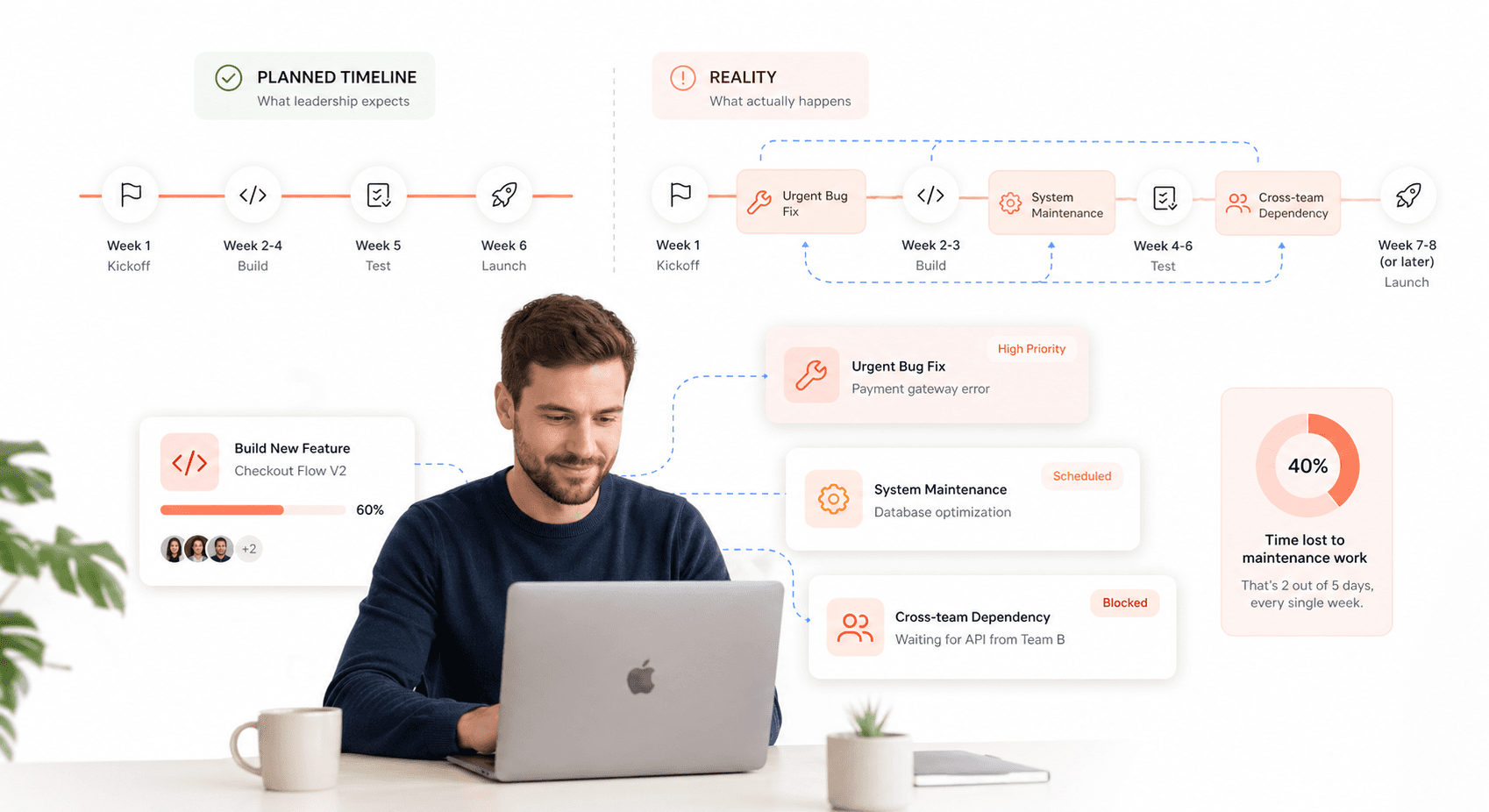
You've been wondering why that "simple" feature your team promised three weeks ago is still sitting in development. You're not alone. Feature delivery timeline issues plague software teams everywhere, turning straightforward updates into months-long projects that frustrate stakeholders and exhaust developers.
This guide is for product managers, engineering leaders, and business stakeholders who need to understand the real reasons behind software development delays and how to address them. You'll discover why even experienced teams struggle with accurate estimates and learn practical strategies to improve your development cycle optimization.
We'll explore how "run the business" work quietly consumes your team's capacity, examine why product maturity dramatically affects development speed, and uncover the estimation challenges that derail feature timelines. You'll also learn about the hidden costs that extend beyond initial development and discover proven methods for managing cross-team dependencies software challenges that create bottlenecks across your organization.
Understanding Run the Business Work and Its Impact on Feature Delivery
Defining maintenance work that supports existing functionality
When you're planning your next sprint, you're likely focused on exciting new features that will delight users and drive business growth. However, there's an entire category of work happening behind the scenes that directly impacts your feature delivery timeline - Run the Business (RTB) work. This encompasses everything required to support your existing functionality, including updating libraries, fixing bugs, addressing security issues, improving reliability and scaling, modernization efforts, and handling technical vendor updates.
You might not immediately recognize how much RTB work your team actually performs because it often gets mixed in with feature development or handled reactively. Unlike greenfield development where you're building something entirely new, RTB work ensures that what you've already built continues to function properly, remains secure, and performs at acceptable levels as your user base grows.
How unplanned technical debt creates development bottlenecks
If you don't properly account for RTB work in your planning processes, it becomes a primary source of technical debt and unplanned work that significantly impacts your software development delays. When maintenance tasks are deferred or ignored, they don't simply disappear - they compound over time, creating an accumulation of bugs and increasingly costly upgrades that demand immediate attention.
This creates a vicious cycle where your team becomes reactive rather than proactive. Instead of dedicating planned time to maintenance, you find yourself constantly firefighting issues that could have been prevented. These technical debt impact delivery scenarios force you to pull developers away from planned feature work to address urgent problems, creating unpredictable delays in your development cycle.
Why teams fail to account for ongoing maintenance in sprint planning
The root cause of many feature shipping bottlenecks lies in how you approach sprint planning. Most teams fail to differentiate or properly account for RTB work when estimating capacity and timelines. Instead of treating maintenance as a predictable, necessary component of development work, it gets handled as unplanned, firefighting work that disrupts your carefully laid plans.
This oversight creates unrealistic expectations about what your team can actually deliver within a given timeframe. When RTB work inevitably surfaces during a sprint, it competes directly with new feature development, forcing you to make difficult trade-offs that impact both timeline commitments and code quality. Without proper planning for maintenance work, your product development challenges multiply as technical debt accumulates and your development velocity decreases over time.
Product Maturity Stages and Their Effect on Development Speed
Early Stage Development Velocity Versus Mature Product Constraints
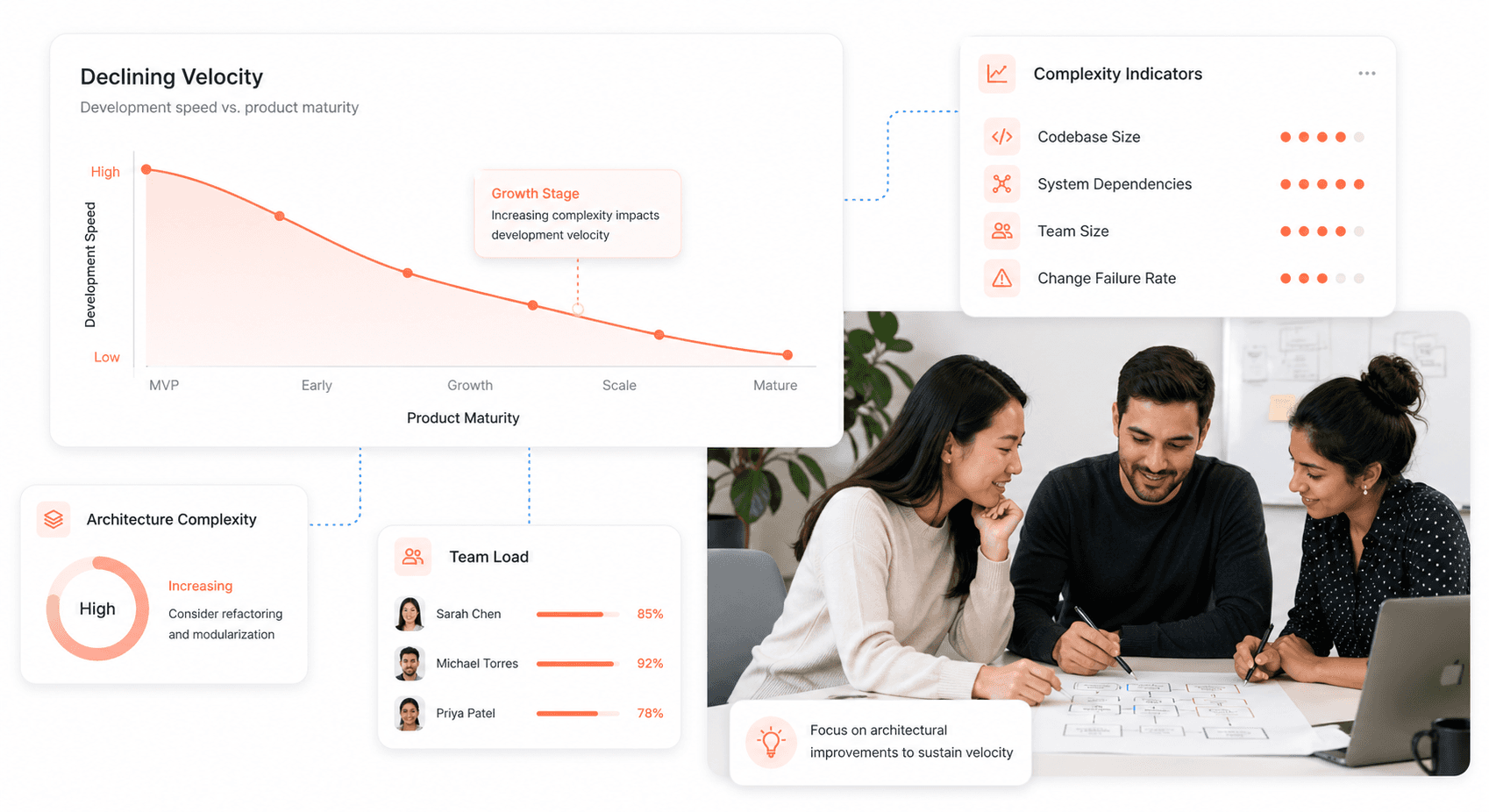
When you're building a new product, your development velocity starts remarkably high during the beginning phase. Your team can rapidly prototype, experiment, and ship features because your codebase is clean, your architecture is simple, and you have minimal legacy constraints to work around. However, as your product enters the 'Scaling & Iterating' phase, you'll notice that new features take significantly longer to deliver.
This slowdown isn't a sign of declining team performance, it's the natural consequence of product maturity. Your growing codebase introduces complexity, integration points multiply, and the risk of breaking existing functionality increases with every change. Without properly adjusting your Run the Business (RTB) work allocation during this transition, your feature delivery timeline will suffer dramatically.
The key insight here is that maintaining the same work allocation strategy from your early days will create development bottlenecks as your product matures. Your team needs more time for testing, regression prevention, and careful integration work that simply wasn't necessary when your product was in its infancy.
Adjusting Maintenance Work Allocation Based on Product Lifecycle
Your maintenance work allocation strategy must evolve with your product's maturity stage. Teams working on early-stage products can dedicate most of their time to new feature development, but this approach becomes unsustainable as your product grows in complexity and user base.
As your product matures, you need to allocate significantly more time to RTB work compared to teams working on early-stage products. This shift isn't optional, it's essential for maintaining development speed and product quality. Mature products require more extensive testing, careful deployment procedures, performance monitoring, and bug fixes that accumulate from a larger, more complex codebase.
Your resource allocation decisions during this transition period will determine whether your team maintains reasonable development velocity or gets bogged down in an endless cycle of technical debt and maintenance work.
Preventing Technical Debt Accumulation Through Proactive Planning
Proactively balancing your functional investments can dramatically reduce your RTB costs and prevent the excessive accumulation of technical debt. Without this strategic approach, you risk reaching a point where 40% of your team's time is consumed by RTB work, severely hampering your ability to deliver new features.
The solution lies in making conscious decisions about technical quality investments throughout your product's evolution. By allocating appropriate resources to code refactoring, architecture improvements, and technical infrastructure before problems become critical, you can avoid the productivity killer of overwhelming technical debt.
This proactive approach to technical debt management directly impacts your feature delivery timeline. When you invest in technical quality early and consistently, your team avoids the later penalty of spending nearly half their time on maintenance work instead of building new capabilities that drive business value.
Estimation Challenges That Derail Feature Timelines
Overcoming Pressure to Provide Overly Optimistic Time Estimates
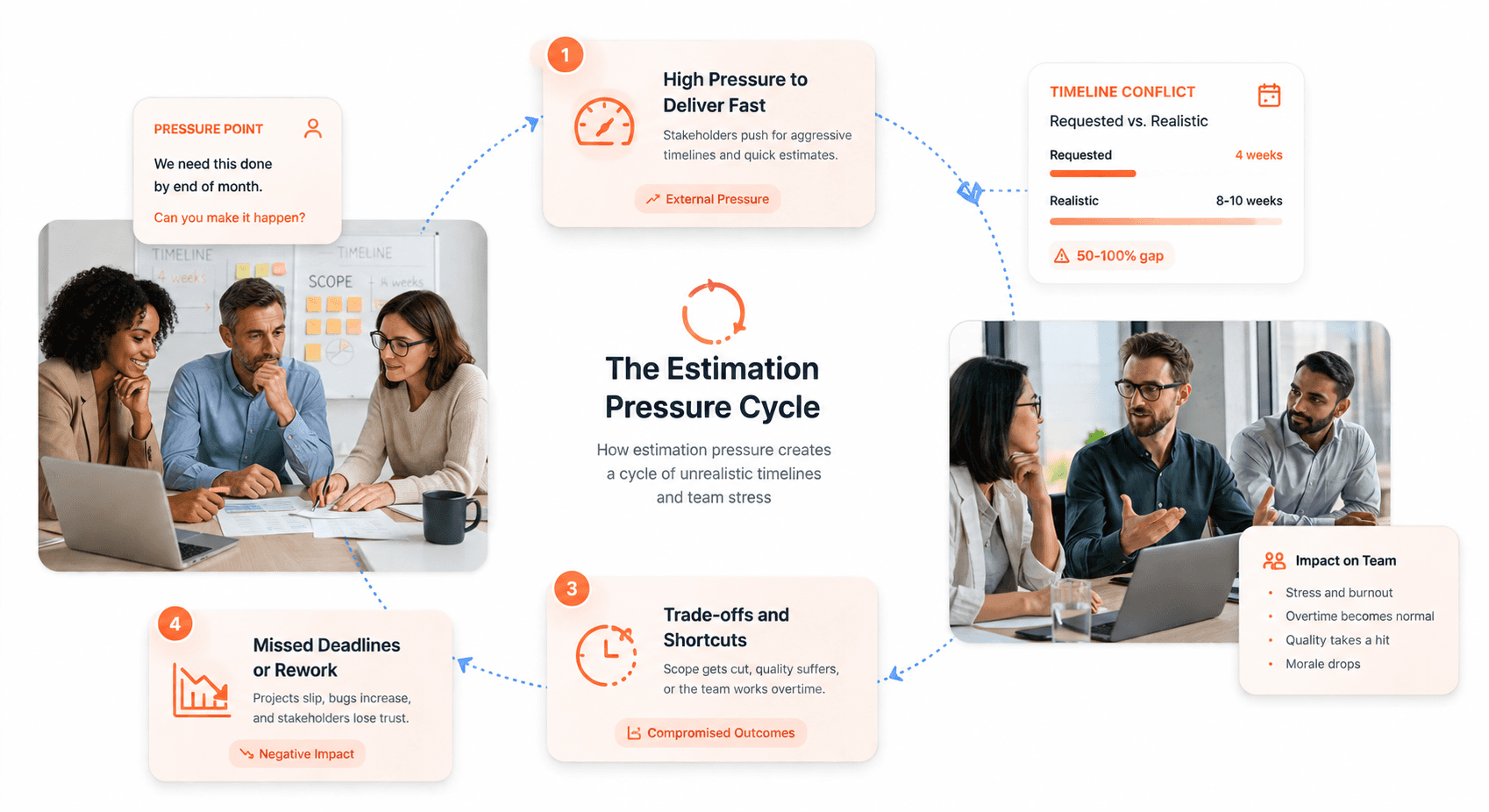
You've likely experienced the uncomfortable position of being pressured to give overly optimistic estimates to satisfy stakeholders who want to hear shorter timelines. This pressure creates a dangerous cycle where your initial estimates become unrealistic expectations, and the true complexity of development work gets overlooked entirely. When you succumb to this pressure, you're essentially setting up your entire project for failure from the start.
The root of this problem lies in stakeholder expectations that don't align with technical reality. Your stakeholders often view software estimation problems through a business lens, wanting quick wins and rapid feature delivery timelines without understanding the underlying technical challenges. This disconnect forces you to either stand firm on realistic estimates or cave to pressure and promise what you know you can't deliver.
To break this cycle, you need to establish clear communication protocols that educate stakeholders about the estimation process. Document the reasoning behind your estimates and explain the specific technical complexities that drive longer timelines. This transparency helps build trust and reduces the pressure to provide unrealistic commitments.
Balancing Realistic Buffers Without Excessive Timeline Padding
You might find yourself overcompensating for past estimation failures by adding excessive buffers to your development timelines. While this approach helps you avoid disappointing stakeholders, it creates its own set of development cycle optimization problems. These oversized buffers slow your overall progress and limit your team's capacity to tackle bigger, more impactful challenges.
The key is finding the sweet spot between realistic protection and timeline efficiency. Your buffers should account for known unknowns – the typical complications that arise during feature development – without becoming so large that they hamper your team's ability to deliver value quickly. Consider implementing graduated buffers based on the complexity and risk level of different features.
You should also track your estimation accuracy over time to calibrate your buffer strategy. If you consistently finish early, you're likely padding too much. If you're constantly running over, your buffers may be insufficient or your base estimates need adjustment.
Avoiding Top-Down Deadline Setting Without Technical Input
Perhaps the most dangerous scenario you can encounter is when stakeholders set deadlines without consulting your engineering team first. This top-down approach creates significant risks because it operates without any understanding of technical complexity, leading your team toward quick fixes that damage your software's long-term health.
When deadlines are imposed without technical input, you're forced to make compromises that prioritize speed over quality. These feature shipping bottlenecks often result in technical debt that will slow future development and create more estimation problems down the line. The pressure to meet unrealistic deadlines pushes you toward shortcuts that seem beneficial in the short term but prove costly over time.
To prevent this situation, you need to establish a collaborative planning process where technical input is required before any deadlines are set. Insist on being part of the initial scoping conversations, and provide stakeholders with multiple timeline scenarios that show the trade-offs between speed and quality. This proactive approach helps you avoid the crisis mode that comes with impossible deadlines.
Hidden Costs Beyond Initial Feature Development
Accounting for Design, Testing, and Deployment in Project Timelines
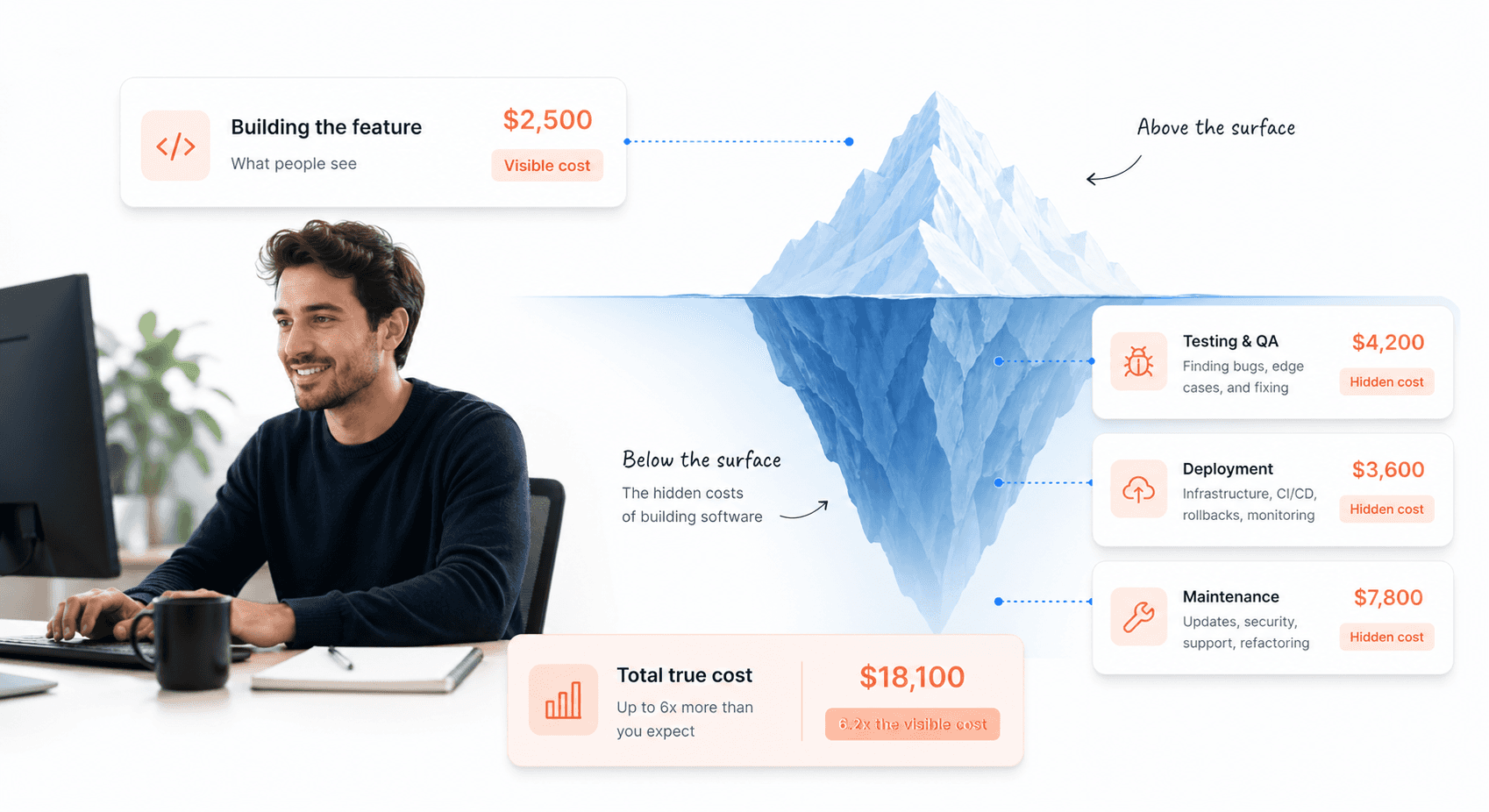
When you're planning your feature delivery timeline, you need to recognize that launching a feature involves more than just coding. The engineering workflow encompasses multiple critical phases that significantly impact your overall development schedule. Design work must be completed before developers can begin implementation, requiring coordination between design and engineering teams. Your testing phase includes unit testing, integration testing, user acceptance testing, and often multiple rounds of bug fixes and retesting.
Deployment activities add another layer of complexity to your timeline. You'll need to coordinate deployment windows, handle database migrations, configure monitoring systems, and manage potential rollback scenarios. These operational considerations can extend your feature shipping timeline considerably, especially when dealing with complex systems or multiple environments.
Your project estimates should account for handling operational issues that inevitably arise during and after deployment. These unexpected challenges can derail even the most carefully planned feature delivery timeline, creating software development delays that cascade through your entire roadmap.
Planning for Ongoing Maintenance Over Feature Lifetime
Your feature development challenges extend far beyond the initial launch date. When estimating the cost of a new feature, you must factor in ongoing maintenance costs over its entire lifetime, not just the initial development phase. This long-term perspective is crucial for accurate project planning and resource allocation.
Maintenance work includes bug fixes, performance optimizations, security updates, and feature enhancements based on user feedback. Your team will also need to update documentation, provide user support, and ensure compatibility with system updates and third-party integrations. These ongoing responsibilities create persistent demands on your development resources that can impact your ability to ship new features.
Applying the Five-to-One Maintenance Effort Rule
A practical rule of thumb suggests spending five times as much effort on maintenance over the lifetime of a feature as you spend on building it initially. This ratio helps you understand the true cost implications of feature development and creates more realistic expectations for your product development lifecycle.
If your team spends one month developing a feature, you should expect to invest approximately five months of cumulative effort maintaining that feature throughout its operational lifetime. This maintenance effort includes addressing technical debt, implementing improvements, and ensuring the feature continues to meet user needs as your product evolves. Understanding this ratio helps you make more informed decisions about feature prioritization and resource allocation, ultimately reducing software development delays in your future planning cycles.
Managing Cross-Team Dependencies and External Bottlenecks
Identifying Complex Team and Software Architecture Misalignments
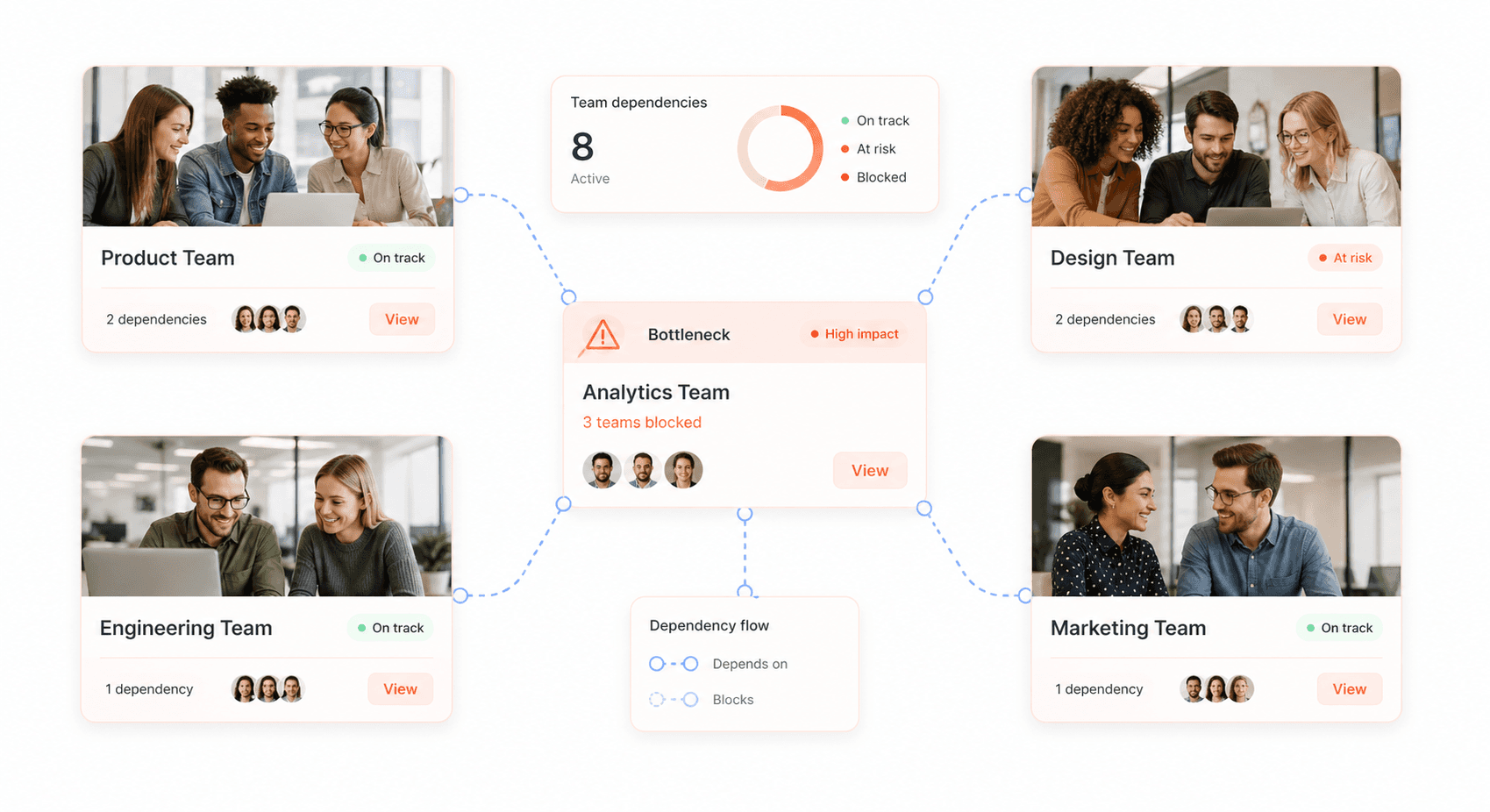
Your feature delivery timeline often suffers when your team structure doesn't mirror your software architecture. These misalignments create hidden friction points that multiply delays across your development cycle. When your teams are organized around business functions while your software is structured around technical layers, you'll find yourself caught in a web of cross-team dependencies for even simple feature requests.
Weak processes compound these architectural mismatches, turning what should be straightforward handoffs into prolonged negotiations. Your teams end up spending more time coordinating than actually building, as each feature requires multiple teams to align their priorities and timelines. This mismatch forces you to navigate complex approval chains and communication overhead that weren't accounted for in your original estimates.
Preventing Cascading Delays from Vendor and Platform Dependencies
Your software development delays intensify when cascading dependencies create domino effects throughout your project timeline. You might discover that your team's progress hinges on another team's completion, which in turn depends on an external vendor or platform update. These layered dependencies cause your timelines to collapse because you underestimate the complexity of coordinating multiple moving parts.
External dependencies introduce variables beyond your control, making it nearly impossible to maintain predictable feature delivery timelines. When your vendor experiences their own delays or when platform changes don't arrive as scheduled, these disruptions ripple through your entire development pipeline. Your initial estimates become meaningless as each dependency adds uncertainty to your delivery schedule.
Maintaining Urgency Across Multiple Team Handoffs
Your feature's priority diminishes with each handoff between teams, creating a natural decay in urgency that stalls progress. What begins as a critical initiative for your originating team transforms into just another backlog item for subsequent teams. This loss of urgency occurs because context and business reasoning don't transfer effectively during handoffs, leaving downstream teams without the motivation to prioritize your feature.
Each team views your feature through their own workload lens rather than understanding its strategic importance. Your carefully crafted urgency gets lost in translation as teams focus on their immediate priorities. This stagnation in backlogs means your feature sits waiting while teams address what they perceive as more pressing tasks, extending your software development delays far beyond original projections.
Eliminating Productivity Killers Through Better Work Management
Focusing on finishing features instead of starting multiple priorities
When you're under pressure to deliver, your instinct might be to tackle multiple high-priority items simultaneously. However, this approach actually works against you and significantly increases your feature delivery timeline. Working on too many features in parallel keeps everything perpetually "In Progress" and creates a bottleneck that dramatically extends lead times.
You'll find that prioritizing finishing features over starting new ones is crucial for maintaining momentum. When your team spreads their attention across multiple initiatives, each feature moves more slowly through the development pipeline. Instead of having three features at 30% completion, you'd benefit more from having one feature completely finished and ready to ship.
This finishing-first approach reduces the cognitive overhead of managing multiple workstreams and allows your team to see tangible progress more frequently. The psychological benefit of completed work also boosts morale and maintains focus on delivery rather than just activity.
Minimizing context switching and interruption costs
Your productivity takes a significant hit every time you or your team members switch between different tasks or get interrupted during focused work. Research demonstrates that it takes 23 minutes to regain your mental state after being interrupted during deep work. These context switching costs compound throughout the day, creating substantial delays in your software development process.
Even short interruptions that seem harmless - a quick Slack message, a brief meeting check-in, or a colleague's question - carry hidden costs that impact your feature shipping bottlenecks. When you multiply these interruptions across your entire development team, the cumulative effect on your development cycle optimization becomes substantial.
You can minimize these costs by establishing clear communication protocols, batching similar activities together, and creating dedicated time blocks for different types of work. Consider implementing "no interruption" hours or using status indicators that signal when team members are in deep focus mode.
Protecting deep work time for complex engineering tasks
Complex engineering tasks require sustained concentration and mental clarity to execute effectively. When you allow constant interruptions, small distractions, and numerous meetings to fragment your team's day, you're not just reducing productivity - you're also increasing the likelihood of mistakes that will require additional time to fix.
Your engineering team needs protected blocks of time to tackle challenging technical problems, work through complex algorithms, or architect new system components. These tasks demand the kind of deep thinking that can only happen when your mind isn't constantly shifting gears or preparing for the next interruption.
You should actively guard these deep work periods by scheduling meetings strategically, encouraging asynchronous communication for non-urgent matters, and creating physical or digital environments that support sustained concentration. The quality of work produced during these protected periods will be higher, reducing the need for revisions and accelerating your overall feature delivery timeline.
Balancing Technical Quality with Business Pressure
Understanding the True Cost of Shortcuts and Quick Fixes
When you're under pressure to deliver features quickly, shortcuts and quick fixes might seem like the obvious solution. However, these seemingly harmless decisions become a ticking time bomb whose true cost you'll pay later often at a much higher price. What starts as a simple workaround resurfaces as technical debt that significantly impacts your feature delivery timeline.
Every shortcut you take today creates compound interest on future development work. Your team will spend exponentially more time working around these quick fixes, debugging unexpected issues, and eventually rewriting the problematic code. This cycle directly contributes to software development delays that make future feature shipping bottlenecks even more severe.
Advocating for Modernization and System Upgrades
Your modernization efforts, including IT migrations, re-architecting, and system upgrades, are absolutely necessary for maintaining development velocity. Yet you'll often encounter resistance due to the significant investment required and the lack of immediate visible benefits for business leaders.
You must help stakeholders understand that postponing these upgrades creates a compounding effect on your product development challenges. Legacy systems become increasingly difficult to modify, making even simple feature additions time-consuming. When you advocate for modernization, you're investing in your team's ability to deliver features faster and more reliably in the future.
The key is demonstrating how current technical limitations directly impact your development cycle optimization and create unnecessary cross-team dependencies in software projects.

Creating Shared Responsibility Across All Stakeholders
Addressing the root causes of why software features take long requires shared accountability across your entire organization. You can't solve technical debt impact on delivery through engineering efforts alone, it demands collaborative commitment from all stakeholders.
Your leadership team must provide realistic priorities that account for necessary technical improvements alongside feature development. Product managers need to understand the complexities involved in feature delivery and incorporate technical debt reduction into their roadmaps. Meanwhile, your engineering teams should actively advocate for better practices and clearly communicate the long-term consequences of technical shortcuts.
This shared responsibility model ensures that decisions about feature development consider both immediate business needs and long-term technical sustainability, ultimately improving your overall software development process.
Conclusion
The reasons why features take months instead of weeks to ship aren't mysterious they're the result of predictable, systemic challenges that most organizations face. From underestimating "run the business" work that can consume 30-40% of your team's time, to navigating complex dependencies between teams and managing the hidden costs of technical debt, these factors compound to create significant delays. When you add estimation challenges, productivity killers like constant context switching, and the pressure to choose quick fixes over sustainable solutions, it becomes clear why even "simple" features can derail timelines.
The solution isn't about working harder or hiring more developers, it's about acknowledging these realities and building them into your planning process. Start by accounting for the true maturity stage of your product and allocating appropriate time for maintenance work. Address cross-team dependencies early, resist the urge to juggle multiple priorities simultaneously, and protect your team's deep work time. Most importantly, recognize that this isn't just an engineering problem, it requires collaboration across leadership, stakeholders, product managers, and engineers to create sustainable practices that support both speed and quality in your feature delivery.




About the author
I’m the founder of Hashbyt, an AI-first frontend and UI/UX SaaS partner helping 200+ SaaS companies scale faster through intelligent, growth-driven design. My work focuses on building modern frontend systems, design frameworks, and product modernization strategies that boost revenue, improve user adoption, and help SaaS founders turn their UI into a true growth engine.
Is a clunky UI holding back your growth?
Is a clunky UI holding back your growth?
▶︎
Transform slow, frustrating dashboards into intuitive interfaces that ensure effortless user adoption.
▶︎
Transform slow, frustrating dashboards into intuitive interfaces that ensure effortless user adoption.
