

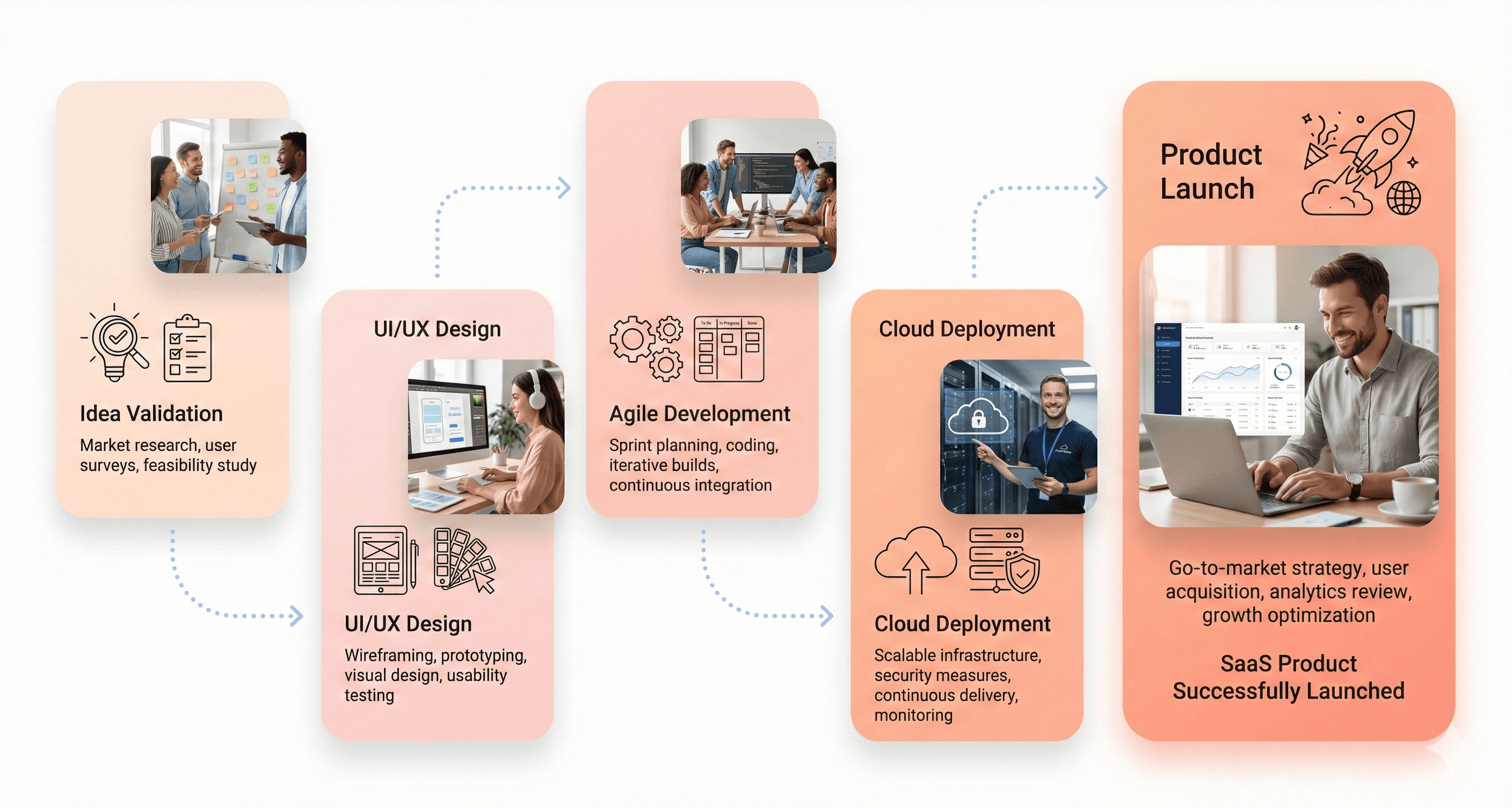
Quick answer: Custom SaaS product development moves through six stages: discovery and validation, requirements and architecture, UX/UI design and prototyping, MVP build, testing and beta, then launch and continuous iteration. Design and engineering should overlap rather than hand over once. Decide the tenancy model, integration approach and compliance scope before the MVP build, because they are the most expensive things to change later.
This guide is for SaaS founders, product managers and engineering leads planning a new product or a rebuild. It covers each stage with its deliverables and typical duration, how to choose a design team with SaaS and industry-vertical experience, how to build integrations that scale, and the architecture, security and pricing decisions that shape the product.
Understanding Product Design and Development for SaaS Companies
Defining Product Design vs Product Development
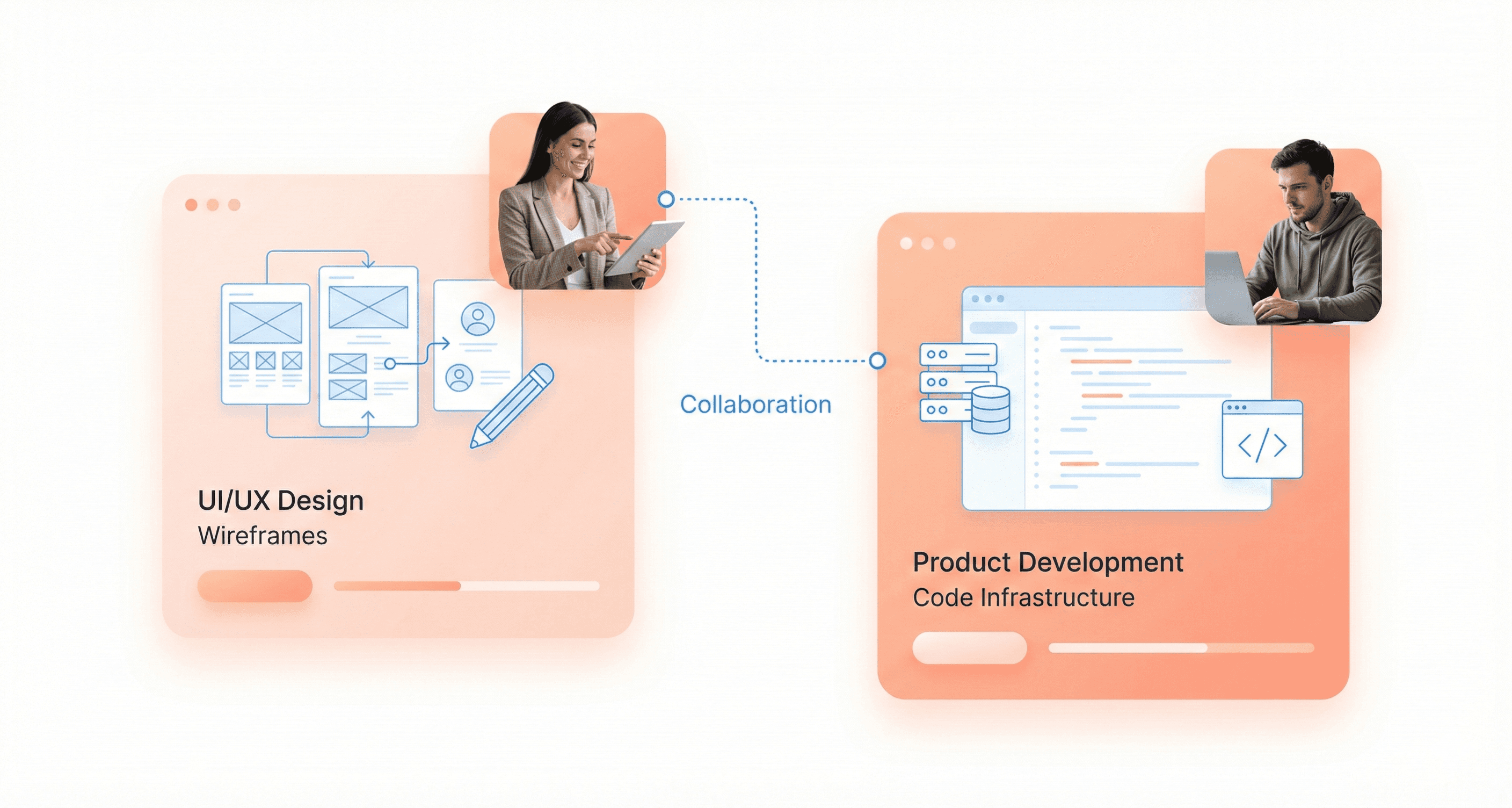
In SaaS product development, it helps to separate two kinds of work that run side by side: product design and product development. Product design encompasses the strategic conceptualization and user experience planning phase, focusing on how users will interact with your SaaS application. This includes market research to define target customers, understand their pain points, assess competitors, and identify unique selling points that determine product viability.
Product design involves creating user-friendly and visually appealing interfaces, prioritizing user experience (UX) by making products intuitive and easy to use. The design phase requires investment in UI design aligned with modern principles and conducting usability testing to address any issues before development begins.
Product development, on the other hand, represents the technical implementation and coding phase where the conceptual design transforms into a functional SaaS application. This phase leverages agile development methodologies to build products incrementally, iteratively incorporating user feedback to ensure seamless experiences. Development teams focus on establishing scalable and secure infrastructure using cloud services like Amazon Web Services (AWS) or Microsoft Azure to handle scalability, reliability, and data security requirements.
The development process encompasses comprehensive testing to identify and resolve bugs, usability issues, and security vulnerabilities, followed by quality assurance checks to maintain the highest standards throughout the product lifecycle.
The Multi-Stage Development Lifecycle Process
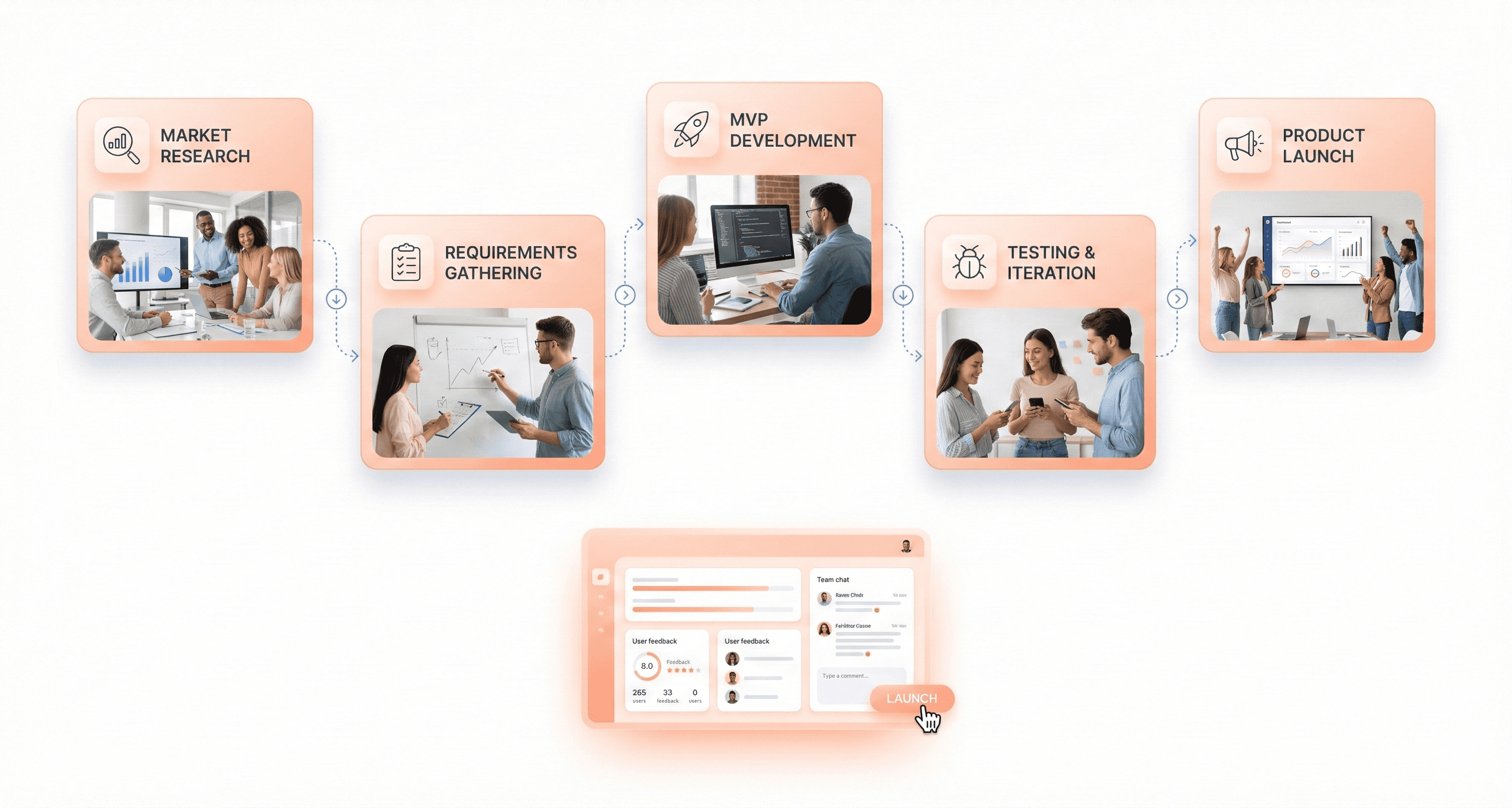
The SaaS development process follows a structured, multi-stage approach that ensures systematic progression from concept to market-ready product. This comprehensive SaaS development process begins with conducting thorough market analysis, where product teams shift focus from what they're developing to the users they're developing it for, identifying end users' key challenges and analyzing whether competition is meeting those challenges.
Following market research, teams gather fundamental requirements, considering privacy protection, security audits, customization options, and scalability planning. The budget estimation stage provides stakeholders with realistic views of development costs, including design, coding, business analysis, customer support, maintenance, and marketing expenses.
The technology stack definition phase determines which combination of frontend frameworks (Vue.js, Angular, React), backend technologies (Django, Node.js), servers (AWS, Azure), and databases (NoSQL, PostgreSQL, MySQL) best serves the project requirements. Subsequently, teams develop a Minimum Viable Product (MVP): a simple but functional version that solves significant user problems while reducing development costs and accelerating market release.
The iterative testing phase involves early adopters providing feedback to improve subsequent product iterations. This approach helps development teams correct course early, testing product viability before devoting excessive budget resources. The final stages include quality assurance testing against established criteria, product release preparation for distribution channels, and ongoing support and maintenance involving continued iteration based on user feedback and market demands.
Key Benefits of Custom SaaS Solutions Over Off-the-Shelf Products
Custom SaaS development means building your own cloud product, or a platform your business runs on, instead of configuring an existing tool. It is not automatically better. Buy off-the-shelf software when a mature product already covers the workflow and the workflow is not what makes you different. Build custom when one of these is true:
The workflow is your product or your advantage, so a generic tool would make you look and work like everyone else
Industry rules shape the interface, for example approvals, audit trails and permission-aware views in fintech, or patient-data handling in healthtech
You need to sell it to many customers, which means multi-tenancy, subscription billing and self-service onboarding that you control
Integration or data needs outgrow what off-the-shelf tools allow, such as deep links into customers' own systems
The trade-off is ownership. A custom product needs a team to design, build, secure and maintain it for years, so budget for iteration after launch, not only for the first release.
SaaS Product Design and Development Process at a Glance
The table summarises each stage of the process. The sections below explain them in more detail.
Stage | Main deliverables | Typical duration |
|---|---|---|
1. Discovery and validation | User interviews, competitor review, riskiest assumptions and how to test them, success metrics | 2 to 4 weeks |
2. Requirements and architecture | Prioritised backlog, tenancy model, integration map, compliance scope, stack choice | 1 to 3 weeks |
3. UX/UI design and prototyping | User flows, wireframes, clickable prototype tested with users, design system foundations | 3 to 8 weeks |
4. MVP build | Working product with sign-up, roles, the core workflow, billing and a CI/CD pipeline | 2 to 4 months |
5. Testing and beta | Automated and manual QA, security and accessibility checks, beta feedback | 2 to 6 weeks, overlapping the build |
6. Launch and iteration | Production monitoring, product analytics, regular releases driven by usage data | Ongoing |
Durations are typical ranges for a focused B2B SaaS MVP, not quotes. Complex integrations, regulated data or a large existing product can extend any stage.
How to Choose a Design Team With SaaS and Industry-Vertical Expertise
Short answer: choose a team that has shipped live SaaS products in your industry, can explain the rules that shape your users' workflows, and designs with engineering constraints in mind. General UI skill is not enough. In vertical SaaS, the hard design problems come from regulation, data sensitivity and complex roles.
When you assess a SaaS design team, check for:
Live products, not only mock-ups: ask for production SaaS products they designed and what changed after launch
Domain vocabulary: they should ask about your compliance obligations, approval chains and user roles in the first conversation
Measured outcomes: accessibility level reached, support ticket or onboarding changes, with a named client where possible
Multi-tenant and permission design: how the interface behaves when different tenants and roles see different data
Design systems and handover: components that engineers can build and maintain, not only static screens
Here is an example from our own work. When Hashbyt redesigned Silver Oak Wealth Advisors' wealth management platform, the hard part was simplifying compliance-driven workflows without losing the approvals, audit trails and permission-aware multi-tenant views that regulation requires. The platform reached WCAG 2.1 AA, and UI-related support tickets fell by 65%. You can see the sectors we design for on our industries page, and how we run SaaS design projects on our SaaS product design services page.
Research and Market Analysis for Product Vision
Building a successful SaaS product design begins with thorough market research and validation. The conceptualization phase requires all stakeholders to participate, including software architects, investors, developers, product managers, cloud consultants, sales representatives, and marketers. This collaborative approach ensures comprehensive understanding of market opportunities.
The research process involves several critical steps:
Generating and validating the SaaS application idea through systematic market evaluation
Conducting thorough market analysis to identify target audiences and competitive landscapes
Identifying business opportunities and requirements that align with market demands
Deciding short, medium, and long-term business strategies for sustainable growth
Assessing cloud architecture requirements for scalability and performance
Engaging in negotiations with potential investors and collaborators
Market research is essential for gaining insights into your target market and discerning the fundamental characteristics needed for creating effective application features. This phase helps establish product-market fit. Building features nobody asked for is one of the most expensive mistakes a SaaS team can make, and validation is the cheapest place to catch it.
The planning phase also involves outlining specific requirements for your SaaS product development services, including multi-tenancy architecture, self-service provisioning, security measures, and user activity monitoring capabilities.
User-Centric Design and Prototyping Strategies
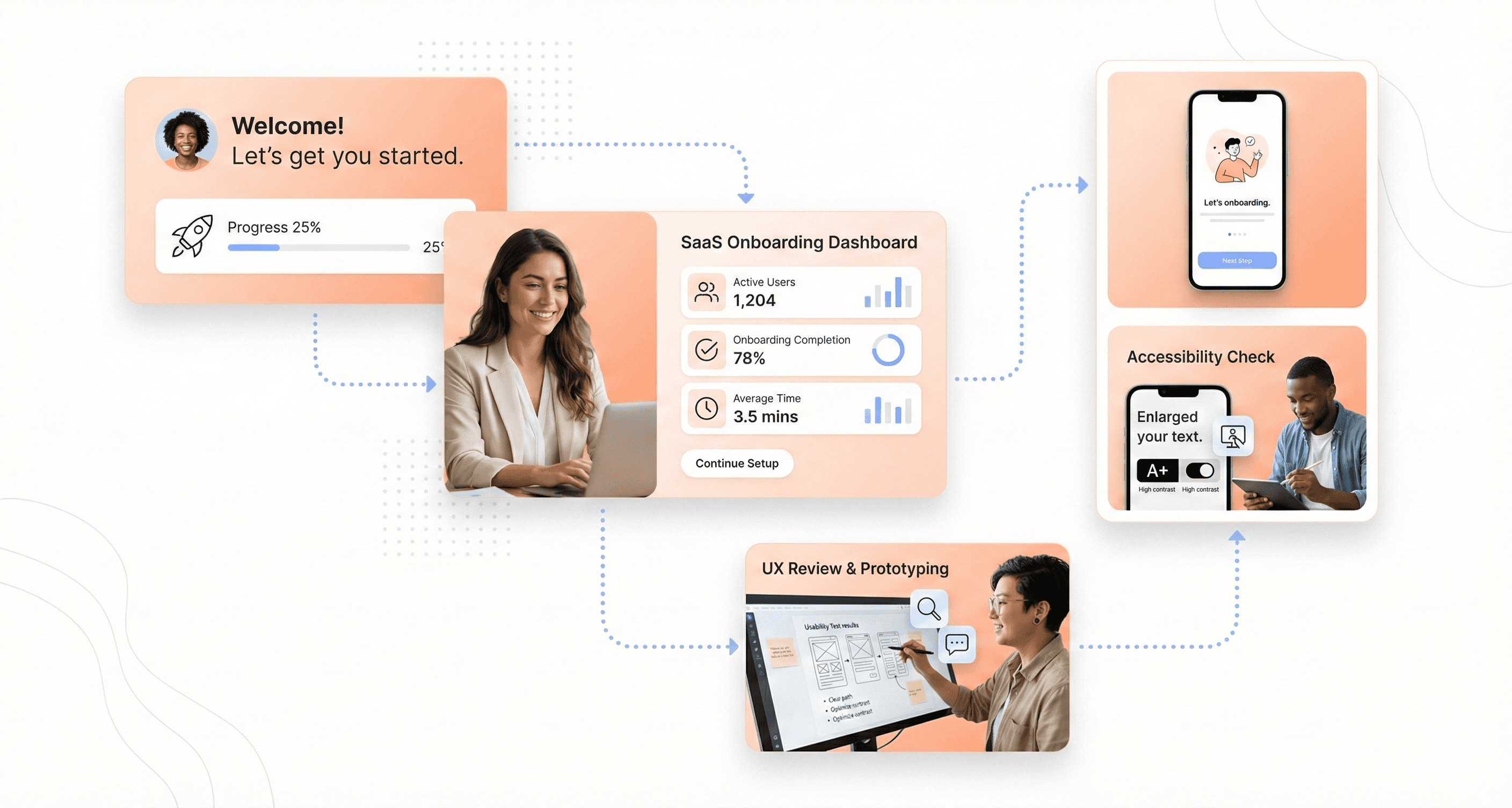
Once market research solidifies the product concept, the design stage focuses on creating both visual and architectural elements of the SaaS application. For SaaS products, success isn't solely determined by functionality. User experience (UX) is equally important for sustained engagement and retention.
The longevity of SaaS platforms relies on sustained user engagement through user-centric design principles that ensure each user interaction holds significance, fostering loyalty and retention. UI/UX designers collaborate on prototypes and wireframes to ensure user-friendly designs that resonate with target audiences.
Design Tools and Technologies
Design tools matter less than the process, but most SaaS teams now work in:
Figma for collaborative interface design, prototyping and shared design systems, and the default choice for most SaaS teams
Sketch for vector-based design and prototyping on macOS
FigJam, Miro or similar whiteboards for journey mapping and workshops
Adobe XD is no longer a sensible choice for new projects. Adobe stopped selling it as a standalone product in 2023 and has said it will not invest further in it.
A well-designed SaaS application can significantly improve user experience, reduce friction, and enhance overall usability. System architects work alongside designers to outline the software's overall structure and define interactions between components.
User Journey Mapping
The design process includes comprehensive user journey mapping that covers:
Onboarding workflows for seamless user introduction
Dashboard interfaces for intuitive navigation
Mobile responsiveness for cross-device accessibility
Accessibility compliance against WCAG 2.2, the current W3C Recommendation (enterprise buyers often ask for level AA)
This becomes especially important in HR SaaS platforms where HRTech UI UX services help teams design onboarding dashboards, analytics panels, and employee workflows that are easy to navigate across devices.
Agile Development and Testing Methodologies
The development stage represents the most important and time-consuming phase in the SaaS development process. Various methodologies influence the pace and approach to development, requiring careful selection based on project needs.
Popular Development Methodologies
Agile methodology is widely used for its flexibility, allowing for iterations, changes, and continuous improvements. It operates on sprint-based development, making it suitable for remote teams and developers while enabling adaptation to evolving SaaS technology stack requirements.
Scrum, a subset of Agile, emphasizes sprint cycles and retrospectives, focusing on achieving incremental progress through structured team collaboration.
Waterfall follows a sequential approach where each phase must be completed before moving to the next, offering consistency but potentially lacking adaptability.
Spiral model involves iterative cycles, with each phase influencing the next through continuous evaluation and refinement.
MVP Development and Testing
The first step in creating a SaaS product involves building the minimum viable product (MVP), which serves as the initial version for testing ideas, gathering user feedback, and validating monetization strategies. This approach provides a cost-effective way to validate concepts before full-scale development.
Once the MVP is complete, testing with early adopters or beta testers allows stakeholders to gather valuable feedback and refine the product before official launch. This iterative approach enables teams to add features, improve user experience, and deliver more refined versions based on real user input.
Cloud Deployment and Continuous Integration Practices
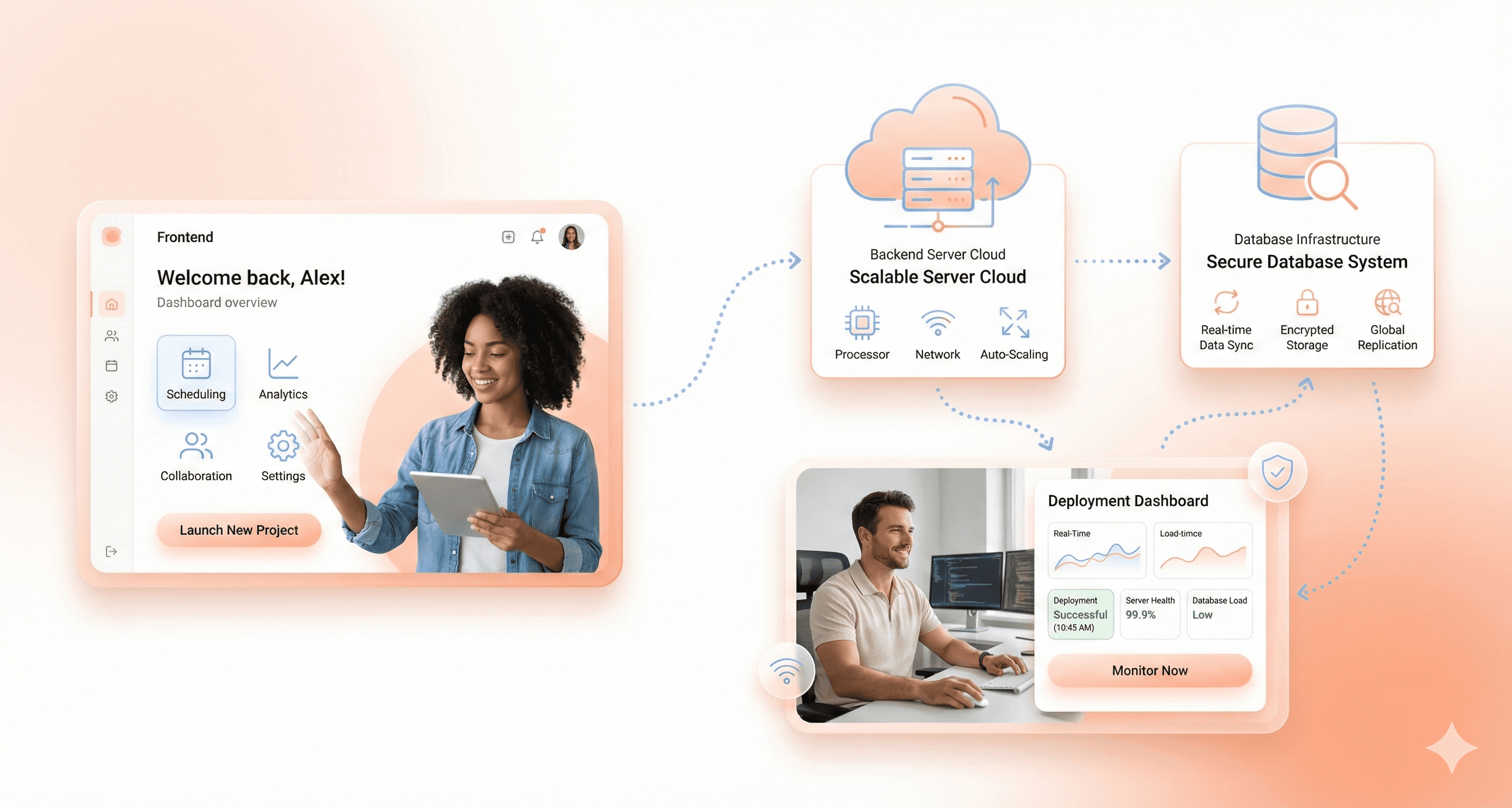
The deployment stage involves decisions that shape the rest of the SaaS lifecycle, especially cloud infrastructure and release strategy.
Cloud Provider Selection
Choosing a cloud provider determines where your SaaS product will be hosted and significantly impacts scalability, accessibility, and cost-effectiveness. The evaluation process should consider:
Technical architecture requirements for your specific SaaS application
Platform capabilities and architectural adjustments offered
Scalability options for growing user bases
Support and reliability metrics
Cost-effectiveness across different usage scenarios
Major cloud providers like Amazon AWS, Google Cloud, and Microsoft Azure offer various options suitable for different SaaS architecture needs.
Technology Stack Decisions
Selecting the appropriate technology stack determines the development environment's ease and efficiency of your software as a service design. This involves:
Structuring class diagrams for system architecture
Selecting front-end and back-end technologies for optimal performance
Choosing databases that support multi-tenancy requirements
Adding AI features only where they solve a real user problem, with clear data and cost boundaries
Continuous Integration and Deployment
The launch and maintenance stage involves deploying the product to users and implementing ongoing support systems. This includes:
Production server configuration with comprehensive monitoring tools
Automated deployment pipelines for consistent releases
Performance monitoring to ensure optimal user experience
Security patching and version management processes
Continuous improvement cycles based on user feedback and analytics
Post-launch operations require continuous monitoring, updates, and improvements including bug fixes, feature additions, and compatibility maintenance with evolving technologies and user needs.
Technical Architecture and Technology Stack Considerations
Choosing Programming Languages and Development Frameworks
Selecting the right programming languages and development frameworks forms the foundation of your SaaS technology stack. For frontend development, React remains the safest choice for most SaaS projects due to its extensive ecosystem and component reusability. React's large community ensures you'll find libraries for essential SaaS features like authentication, charts, forms, and file uploads without building from scratch.
Vue.js offers an excellent alternative for smaller teams seeking something easier to learn, though its ecosystem is smaller than React's. Angular provides enterprise-grade capabilities but comes with a steep learning curve that can slow development for most SaaS products. While Svelte shows promise with excellent performance, its growing ecosystem makes it less suitable for products requiring reliable, proven solutions.
For backend development, Node.js handles many concurrent requests well, which suits multi-user SaaS applications. The JavaScript ecosystem's massive size allows code sharing between frontend and backend, accelerating development. Node.js particularly shines in event-driven, real-time applications where user interactions need immediate responses.
Python with Django or FastAPI presents another strong option, especially if your team has Python expertise. Django includes built-in admin panels and authentication systems that can significantly speed up development. FastAPI offers excellent performance for API-heavy SaaS products while maintaining Python's developer-friendly syntax.
Go delivers exceptional performance and scalability but comes with a smaller ecosystem, requiring more time to build basic features. Java with Spring Boot provides enterprise-grade capabilities but demands a larger team with Java experience and involves a steeper learning curve.
Cloud Provider Selection and Infrastructure Planning
Cloud provider selection significantly impacts your SaaS development stack's scalability, performance, and long-term costs. AWS, Azure, and Google Cloud Platform offer comprehensive managed services that reduce infrastructure maintenance overhead while providing the foundation for reliable SaaS operations.
For startups and MVPs, serverless architecture can help teams focus more on code development rather than infrastructure management. This approach works particularly well for products with inconsistent workloads or traffic spikes, allowing automatic scaling without manual intervention. However, high-performance applications requiring tight runtime control may encounter limitations with cold starts and vendor-specific constraints.
Infrastructure planning should consider both current needs and future growth patterns. Starting with simple hosting solutions like Vercel for frontends and Railway or Render for backends can provide cost-effective deployment for early-stage products. As load, compliance needs or team size grow, moving to a major cloud provider's managed services usually gives better control and scaling options.
Container orchestration using Docker and Kubernetes becomes valuable when implementing microservices architecture or managing complex deployment pipelines. These tools enable horizontal scaling where individual services can scale independently based on demand, rather than scaling the entire application together.
Multi-region deployment considerations become critical for SaaS products serving global audiences, requiring careful planning of data replication, latency optimization, and compliance with regional data protection regulations.
Database Design for Scalability and Performance
Database selection directly impacts your SaaS application's ability to handle complex queries, user growth, and data relationships. PostgreSQL emerges as the top recommendation for most SaaS products due to its superior handling of complex queries essential for analytics and reporting features common in SaaS applications.
PostgreSQL's robust JSON data support proves invaluable for storing flexible user preferences, settings, and configuration data that SaaS products frequently require. Its advanced indexing capabilities and row-level security features make it particularly well-suited for multi-tenant SaaS architectures where data isolation between customers is critical.
For multi-tenant SaaS applications, implementing proper database schema design ensures both security and performance. Row-level security policies can automatically filter data based on tenant context, while strategic indexing on tenant IDs and frequently queried fields maintains query performance as data volumes grow.
MySQL offers simpler setup and management but presents limitations as SaaS applications grow in complexity. The performance differences become significant with the complex analytical queries that subscription-based software commonly requires.
NoSQL solutions like MongoDB work well for rapid prototyping but typically prove less suitable for SaaS products where user data, subscriptions, and billing information follow inherently relational patterns. Redis serves excellently as a caching layer to improve performance for frequently accessed data.
How to Build Scalable SaaS Integrations
Short answer: treat every integration as an unreliable, asynchronous dependency. Put it behind your own service layer, make every write safe to retry, process webhooks through a queue, and give each integration its own monitoring and versioning. Integrations that assume the other side is always up and always fast are what break first when a SaaS product grows.
In practice, that means:
Contract first: describe your own API with an OpenAPI document (the specification is at version 3.2) and version it, so partners and your frontend build against a stable contract
Idempotent writes: send an idempotency key with create and update calls so a retry after a timeout cannot charge or create twice. Stripe's API, for example, saves the result of the first request for each key and returns it for repeats
Webhooks through a queue: verify the signature, return a 2xx response quickly, then process the event asynchronously. Providers retry failed deliveries (Stripe retries for up to three days in live mode) and do not guarantee order, so store processed event IDs and ignore duplicates
Retries with backoff and rate-limit awareness: respect 429 responses and Retry-After headers, and use exponential backoff so one slow partner cannot exhaust your workers
Tenant-aware credentials: store each customer's tokens separately and encrypted, scoped per tenant, with OAuth 2.0 where the provider supports it
Observability per integration: log failures, latency and backlog per connector, with error tracking such as Sentry and performance monitoring such as Datadog
Payment, authentication and messaging are the usual first integrations. Services such as Stripe for billing, and Auth0 or Supabase for authentication, save months of work. Your backend still owns the subscription state, webhook handling and permission checks.
Professional Services and Strategic Advantages
Benefits of Partnering with Specialized Development Teams
Partnering with a specialised SaaS development team can make sense when you need SaaS experience your in-house team does not have yet. Specialized teams bring deep expertise in SaaS product design and cloud software architecture, enabling companies to leverage proven methodologies and industry best practices from day one.
The primary benefit lies in accessing concentrated knowledge pools where developers have extensive experience with SaaS technology stack decisions, scalability challenges, and software as a service design principles. These teams understand the nuances of multi-tenant architectures, subscription billing integrations, and the unique requirements of cloud-based applications that generalist developers might overlook.
Cost efficiency represents another significant advantage, as specialized teams eliminate the learning curve associated with SaaS-specific challenges. Rather than investing months in trial-and-error approaches, companies can accelerate their product development services timeline by leveraging teams that have already navigated common pitfalls in SaaS application development.
Streamlining Workflows Through Expert Consultation
Good consultants also improve how the work runs, not only what gets built. Specialized consultants bring structured approaches to the SaaS development process, implementing proven frameworks that reduce development cycles while maintaining high quality standards.
These experts establish clear communication channels between stakeholders, ensuring that product requirements align with technical capabilities and market demands. They introduce agile methodologies specifically adapted for SaaS product design, incorporating continuous feedback loops that are essential for cloud-based applications where user expectations evolve rapidly.
Workflow optimization extends to resource allocation, where consultants help prioritize features based on their impact on user acquisition and retention. This strategic approach ensures that development efforts focus on components that drive actual business value rather than pursuing technically interesting but commercially irrelevant features.
Quality Assurance and Risk Mitigation Strategies
Quality assurance in SaaS has to cover risks that single-customer software does not have. Specialized development teams implement comprehensive testing strategies that encompass security vulnerabilities, performance under varying load conditions, and data integrity across multi-tenant architectures.
Risk mitigation in SaaS development involves proactive identification of potential failure points, from third-party API dependencies to database scaling limitations. Expert teams establish monitoring systems and automated testing protocols that catch issues before they impact end users, protecting both company reputation and customer relationships.
These quality assurance strategies extend to compliance considerations, where specialized teams ensure that applications meet industry-specific requirements such as SOC 2, HIPAA, or GDPR standards from the initial development phases rather than attempting to retrofit compliance later in the software development lifecycle.
Security and Compliance Best Practices
Data Encryption and Protection Standards
Implementing robust data encryption forms the foundation of any secure SaaS product design and development process. Data must be protected both at rest and in transit to meet modern compliance requirements. For data at rest, this involves encrypting information stored in production databases, backup systems, and file storage platforms. Most cloud providers offer encryption by default, but SaaS development teams must verify it's properly enabled and configured according to industry standards.
Data in transit protection requires implementing encryption protocols between the SaaS application and users, as well as between internal system components. This includes securing API communications, database connections, and all data transfers across the software architecture. Transport Layer Security (TLS) protocols should be implemented consistently across all endpoints to prevent unauthorized data interception.
Access controls complement encryption by ensuring only authorized personnel can decrypt and access sensitive information. Role-based access control (RBAC) should be implemented throughout the SaaS technology stack, mapping user permissions based on job functions and principle of least privilege. Regular access reviews help maintain security hygiene as teams scale.
Comprehensive logging and monitoring systems must track all data access patterns, failed authentication attempts, and permission changes. These audit trails provide essential evidence for compliance frameworks and enable rapid detection of suspicious activities that could compromise data protection standards.
Multi-Tenancy Architecture and Logical Isolation
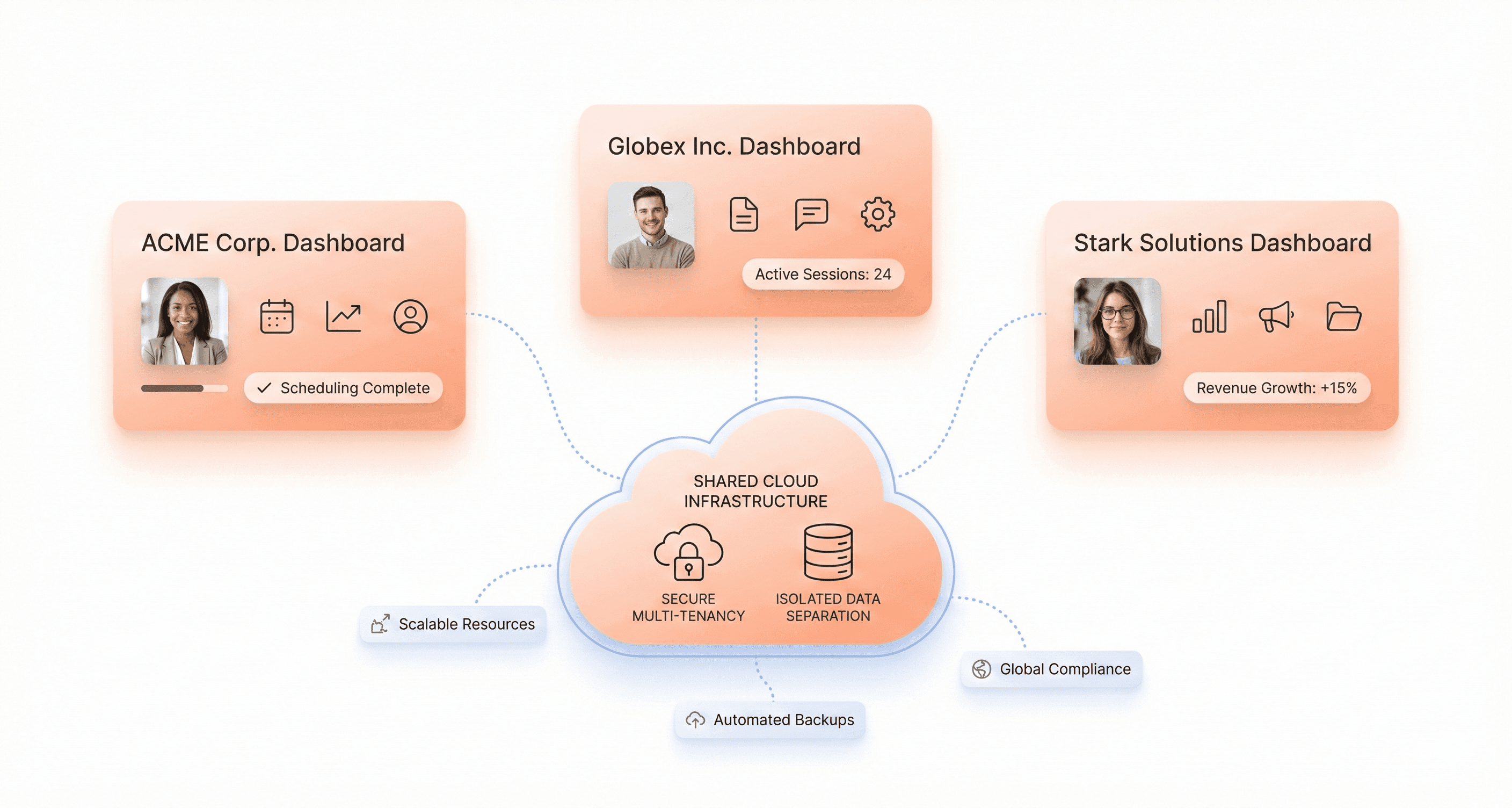
Multi-tenancy architecture presents unique security challenges that require careful consideration during the SaaS development process. Logical isolation ensures that customer data remains completely separated even when stored on shared infrastructure. This architectural approach allows SaaS companies to achieve cost efficiency while maintaining strict data boundaries between tenants.
Effective multi-tenant security begins with database design that implements tenant-specific data partitioning. Each customer's information must be logically isolated through schema separation, row-level security policies, or dedicated database instances depending on the security requirements. The software development lifecycle should include thorough testing of isolation controls to prevent data leakage between tenants.
Application-level isolation extends beyond the database to include user interfaces, APIs, and background processing systems. Each tenant should operate within completely separate execution contexts, with no possibility of accessing another tenant's data or functionality. This requires implementing tenant-aware authentication, authorization, and session management throughout the cloud software architecture.
Network segmentation adds another layer of protection by isolating tenant traffic and preventing lateral movement in case of security breaches. Virtual private clouds, subnets, and security groups should be configured to enforce strict network boundaries between different customer environments while maintaining the shared infrastructure benefits of multi-tenancy.
Regulatory Compliance Requirements and Implementation
Regulatory compliance means aligning SaaS product design with specific legal frameworks based on customer locations and data types. The General Data Protection Regulation (GDPR) applies to any SaaS application processing personal data of EU residents, regardless of where the company is located. GDPR implementation requires explicit user consent mechanisms, data minimization practices, and the ability to fulfill user rights including data access and deletion requests.
For SaaS platforms handling protected health information, HIPAA compliance becomes mandatory through administrative, physical, and technical safeguards. This includes implementing Business Associate Agreements (BAAs), conducting regular risk assessments, and maintaining detailed audit logs of all PHI access. The software as a service design must incorporate privacy controls from the initial development stages rather than as an afterthought.
SOC 2 is an attestation report, not a certification. An independent CPA firm reports on your controls against the AICPA Trust Services Criteria: security, availability, processing integrity, confidentiality and privacy. A Type II report tests whether those controls worked over an observation period of several months, so plan for it well before enterprise deals depend on it. This framework is particularly important for B2B SaaS companies as enterprise customers often require SOC 2 reports before signing contracts.
Payment Card Industry Data Security Standard (PCI DSS) applies when SaaS applications store, process, or transmit credit card information. Implementation requires specific network security controls, access management protocols, and regular security testing procedures. The compliance framework demands secure coding practices throughout the SaaS application development lifecycle.
ISO 27001 provides an international standard for information security management systems, requiring systematic approaches to managing sensitive data. This certification often appeals to European customers and large enterprises globally, making it valuable for SaaS companies planning international expansion.
Continuous monitoring and automated compliance checking help maintain these regulatory standards as the product evolves. Compliance platforms can provide real-time visibility into control effectiveness and generate audit-ready documentation, reducing the manual overhead of maintaining multiple compliance frameworks simultaneously.
Commercialization and Revenue Generation Strategies
Subscription-Based vs Pay-As-You-Go Pricing Models
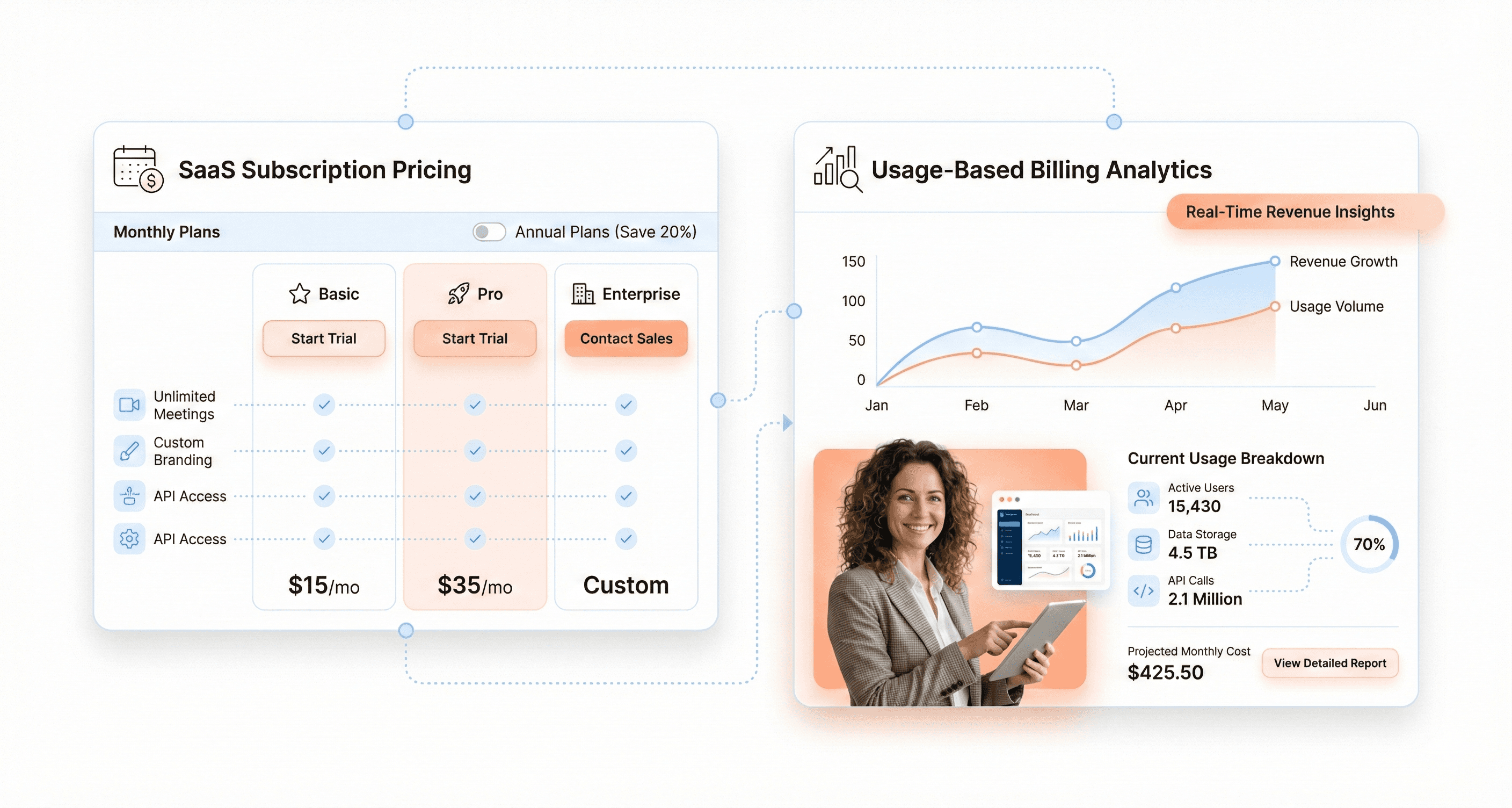
SaaS companies must strategically choose between subscription-based and pay-as-you-go (usage-based) pricing models to optimize revenue generation and customer acquisition. Each approach offers distinct advantages and challenges that directly impact commercialization success.
Subscription-based pricing provides predictable revenue streams through fixed monthly or annual fees. This model works exceptionally well for application software where the number of users remains relatively stable. Salesforce is the classic example of per-user (seat-based) subscription pricing with tiered upgrade paths.
Pay-as-you-go or usage-based pricing aligns costs directly with customer value consumption. API and infrastructure products such as Twilio are well-known examples. Usage-based models create natural expansion, because customers pay more as they get more value.
The choice between these models depends on several critical factors:
Customer preference for predictability: Enterprise buyers typically demand cost certainty for annual budgeting, favoring subscription models
Value delivery mechanism: If your software saves time through automation, usage-based pricing connects directly to value creation
Market positioning: Premium positioning often requires subscription models with clear feature differentiation across tiers
Hybrid approaches are increasingly popular, combining base platform fees with usage overages. This two-part tariff structure provides revenue predictability while enabling natural expansion as customers grow their usage.
Key Performance Metrics for SaaS Success
Effective commercialization requires monitoring specific metrics that indicate pricing model effectiveness and revenue health. These key performance indicators directly influence strategic decisions about pricing optimization and customer acquisition strategies.
Customer Acquisition Cost (CAC) and Customer Lifetime Value (LTV) form the foundation of SaaS unit economics. CAC payback period, which is CAC divided by the monthly gross-margin revenue a new customer brings in, shows how many months it takes to earn back what you spent to win that customer. Pricing changes move this number directly, so review pricing as seriously as features.
Net Dollar Retention (NDR) measures revenue expansion from existing customers, indicating whether your pricing model encourages natural growth. NDR above 100% means expansion from existing customers outweighs churn and downgrades.
Monthly Recurring Revenue (MRR) and Annual Recurring Revenue (ARR) provide predictability indicators, particularly crucial for subscription-based models. These metrics help evaluate whether your pricing strategy supports sustainable growth patterns.
Churn rates vary significantly between pricing models. Usage-based pricing can complicate churn measurement when customers use products intermittently, requiring adjusted calculation methods to accurately assess customer retention.
Sales cycle length directly correlates with pricing complexity. Usage-based pricing can lengthen enterprise sales cycles, because buyers need help forecasting their spend. Offer spend estimates, caps or committed-use tiers to reduce that friction.
Digital Marketing and Customer Acquisition Tactics
Digital marketing strategies must align with your chosen pricing model to maximize customer acquisition effectiveness. The approach differs significantly between subscription-based and usage-based models, requiring tailored tactics for optimal conversion rates.
Product-led growth (PLG) strategies work exceptionally well with usage-based pricing models. Companies can offer generous free tiers or low-cost entry points, allowing prospects to experience value before committing to larger contracts. Usage data feeds lead scoring systems, enabling account executives to identify high-potential prospects for outbound campaigns.
Freemium models serve as powerful lead generation strategies, particularly effective for subscription-based products. Companies like Dropbox and LinkedIn built massive user bases through freemium before converting users to paid plans. The key challenge involves balancing generous free tiers that attract users against conversion rates that sustain business growth.
Value-based messaging becomes critical for higher-priced subscription models. Marketing teams must clearly communicate ROI through case studies, testimonials, and quantified benefits. Enterprise buyers need ammunition to defend software spend internally, requiring detailed ROI calculations and clear value propositions.
Content marketing strategies should address different stages of the buyer journey. For usage-based models, focus on demonstrating scalability and flexibility. For subscription models, emphasize predictable outcomes and comprehensive feature sets that justify fixed costs.
Conversion optimization requires different approaches based on pricing complexity. Simple flat-rate pricing reduces friction but may leave money on the table. Tiered pricing provides upgrade paths but requires clear differentiation between tiers to avoid confusion that kills conversion rates.
The most successful SaaS companies align their digital marketing tactics with their pricing model's inherent strengths while addressing its specific challenges through targeted messaging and strategic positioning.
Common Challenges and Effective Solutions
Managing Complex Third-Party Integrations
Modern SaaS applications require seamless connectivity with various external systems, from payment gateways and cloud storage services to social media APIs and enterprise software. The complexity of integrating third-party services presents significant challenges for SaaS development teams, particularly when dealing with compatibility issues, skill gaps within development teams, and varying technical requirements across different service providers.
The fix is to design for integration from the start: expose a documented, versioned API, choose partners with well-documented and versioned APIs, and use middleware or an integration platform where a direct connection is not practical. The section on how to build scalable SaaS integrations above covers the patterns (idempotency, queued webhooks, retries and per-tenant credentials) in detail.
If you are replacing an ageing product rather than starting fresh, avoid a big-bang rewrite. Hashbyt's legacy app modernisation work replaces the frontend incrementally with micro-frontends and the strangler fig pattern, so existing integrations and customers keep working while modules move across.
Ensuring Data Security and Privacy Compliance
Security risks represent one of the most critical challenges in SaaS development, as these applications handle sensitive user data ranging from personal information to payment details. Without robust security measures, data breaches can severely damage brand reputation and compromise user trust, making comprehensive security implementation essential for successful SaaS product design.
A multi-layered security approach forms the foundation of effective SaaS security strategy. Data encryption serves as the first line of defense, requiring encryption of data both in transit and at rest using industry-standard algorithms like AES-256. This ensures that sensitive information remains secure even if unauthorized access occurs to your database systems.
Authentication and authorization mechanisms provide additional security layers through multi-factor authentication (MFA) for user logins. OAuth 2.0 has emerged as a popular authentication protocol that enables secure authorization without exposing user credentials, making it an ideal choice for SaaS applications requiring robust access controls.
Regular security audits and penetration testing are essential components of maintaining security compliance. Engaging third-party security experts to conduct rigorous testing helps identify vulnerabilities before attackers can exploit them. Additionally, implementing automatic backup and disaster recovery plans ensures rapid service restoration without significant downtime in case of data loss or security incidents.
Configuration mistakes, such as public storage buckets, over-broad permissions or disabled logging, are a common cause of SaaS security incidents. SaaS Security Posture Management (SSPM) tools can help rapidly identify and rectify configuration errors, minimizing the risk of security breaches through automated monitoring and correction capabilities.
Scaling Multi-Tenant Architecture Efficiently
Multi-tenant architecture complexity represents a fundamental challenge in SaaS development, requiring systems that can manage multiple tenants simultaneously while maintaining data isolation, resource sharing, and optimal performance. As user bases grow, the demand on system resources grows with them, making scalable architecture design crucial for long-term success.
Building for horizontal scaling provides the most effective approach to handling growing user demands. Instead of upgrading single servers to handle increased traffic, horizontal scaling involves deploying additional servers or instances to distribute load across multiple resources. Cloud infrastructure providers such as AWS, Google Cloud, and Microsoft Azure enable easy resource scaling as applications grow, supporting dynamic resource allocation based on demand.
Containerization technologies like Docker, combined with orchestration tools such as Kubernetes, are critical for managing the scaling process effectively. These technologies enable efficient resource utilization while maintaining system stability across multiple tenant environments. Adopting a microservices architecture further enhances scalability by allowing different application components to scale independently, making it easier to allocate resources to areas experiencing the highest demand.
Implementing time-proven approaches such as separate database schemas, tenant-specific customizations, and containerization for process isolation ensures seamless operation and productivity across multi-tenant environments. These strategies help maintain data isolation between tenants while optimizing resource utilization and system performance as the SaaS application scales to accommodate growing user bases.
Future Trends and Emerging Technologies
Artificial Intelligence and Machine Learning Integration
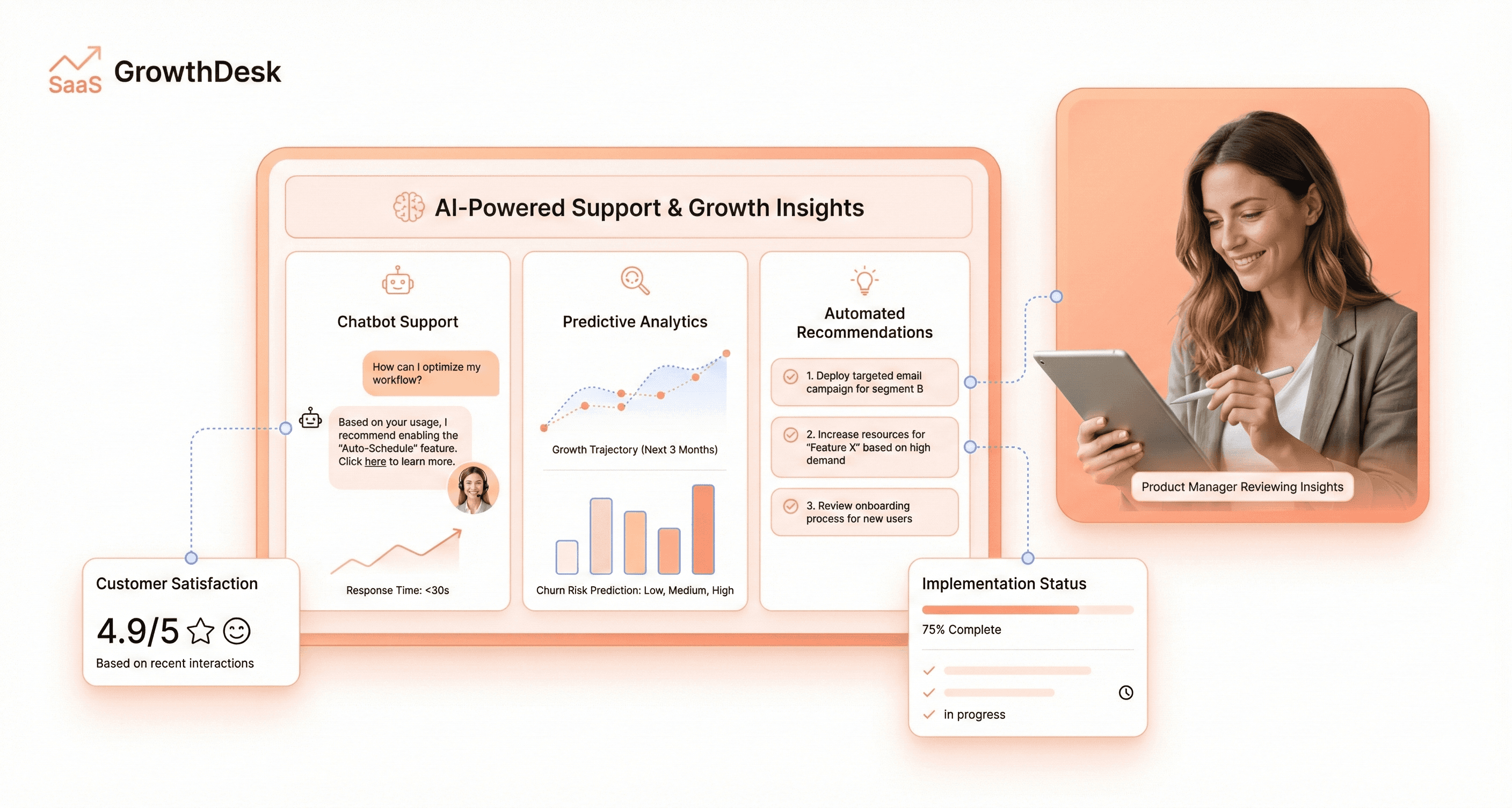
AI features are now an expected part of many products in the SaaS development process. The useful question is no longer whether to add AI, but where it removes real work for users. In SaaS product design, that usually means drafting, summarising, searching or automating repetitive steps inside an existing workflow.
Generative AI has changed SaaS application development in two ways. Inside products, assistants and copilots now appear in design, CRM and productivity tools. In delivery, AI coding and design tools speed up prototyping. Both need the same discipline: clear data boundaries per tenant, cost limits per customer, human review for consequential actions, and interfaces that show users what the AI did and why.
Classic machine learning still matters as well: anomaly detection and automated alerts that notify users when goals are met or something unexpected happens are often more valuable than a chatbot.
AI serves as an additional team member, particularly valuable for handling strenuous and mundane tasks. Chatbots enable 24/7 customer support without requiring additional staffing, allowing existing teams to focus on tasks requiring more attention. Predictive analytics uses past user interactions to improve future experiences, streamlining the customer journey while minimizing required effort.
Low-Code and No-Code Development Platforms
The emergence of low-code and no-code platforms represents a significant shift in SaaS development services, democratizing software creation and accelerating product design for startups. These platforms enable organizations to build sophisticated applications without extensive coding expertise, fundamentally changing the software development lifecycle approach.
For SaaS teams, low-code tools are most useful for internal admin panels, prototypes and back-office workflows. The core product, where differentiation, performance and multi-tenant security matter, is usually still custom code.
Microservices and API-First Architecture Approaches
Integrated API connections have revolutionized SaaS technology stack design by eliminating the need for multiple vendors and applications for single tasks. Modern cloud-based systems are more connected than ever, with APIs allowing platforms to handle data from various sources seamlessly.
The API-first architecture approach enables smooth user experiences by connecting disparate systems. PayPal's integration with e-commerce websites exemplifies this trend, allowing users to make payments without leaving shopping applications. Depending on specific business requirements, different API integrations become necessary, driving demand for custom SaaS platforms.
This architectural approach supports the growing trend toward vertical SaaS solutions, which are customized for specific industries like healthcare, finance, and retail. Smaller institutions can subscribe to precisely what they need rather than paying for full-featured platforms they won't fully utilize. The microservices architecture enables this granular approach, allowing organizations to scale individual components based on demand.
Microservices add operational cost, so most early-stage SaaS products start as a well-structured modular monolith with an API-first design, and split out services only where scaling or team boundaries require it.
Selecting the Right Development Partner
Evaluating Portfolio and Industry Expertise
When selecting a SaaS development partner, portfolio assessment requires more than reviewing case studies. You need to examine live, production SaaS applications handling real users. Ask for actual URLs of SaaS products they've built and deployed, not just impressive presentations. Partners with genuine SaaS product design experience will provide specific examples of multi-tenant systems they've architected and maintained over time.
Industry experience reveals itself through similar business models and challenges. Partners who have built subscription billing systems, usage-based pricing models, or freemium platforms with feature gates understand the unique requirements of SaaS application development. They should demonstrate knowledge of SaaS economics beyond just coding, such as how customer acquisition costs affect feature decisions and how churn rates influence development priorities.
Look for partners who can explain their approach to multi-tenant architecture in detail, and who have worked in your sector: our fintech software development work, for example, starts from compliance and audit requirements rather than screens. They should discuss how they isolate tenant data, handle shared resources, and prevent one customer's activities from affecting another's performance. Vague answers about "best practices" often signal limited hands-on experience with real SaaS deployments.
Production deployments matter more than portfolio breadth. A partner with five successfully scaled SaaS products provides more value than one claiming dozens of projects across various industries. Focus on partners who understand subscription business models and can challenge your assumptions with product thinking alongside technical execution.
Cloud Provider Experience and Technical Capabilities
Cloud platform expertise requires depth over breadth. A partner expert in AWS provides more value than one claiming equal proficiency across AWS, Azure, and Google Cloud Platform. They should demonstrate specific knowledge of managed services, understanding when to use Lambda versus ECS, how to structure VPCs properly, and database optimization strategies for their chosen platform.
DevOps capabilities separate reliable partners from those who create deployment nightmares. Professional SaaS development services must include CI/CD pipelines, automated testing, and infrastructure as code. Partners should explain their approach to continuous delivery: how they ship updates without downtime and catch bugs before customers encounter them.
Microservices and API expertise enable product scalability and integration capabilities. Your SaaS technology stack must support third-party integrations, independent feature scaling, and extensibility without breaking existing functionality. Partners should demonstrate experience building API-first architectures that support long-term product evolution.
Scalability planning requires specific strategies, not generic promises. Ask partners to explain what happens at 10x current load, where bottlenecks typically occur, and their approach to performance monitoring. Experienced partners discuss database sharding, read replicas, CDN configuration, and auto-scaling rules based on real implementation experience.
Post-Launch Support and Maintenance Services
Launch day represents the beginning of your partnership, not its conclusion. SaaS products require ongoing updates, performance optimization, and rapid bug resolution to remain competitive. Define support terms, response times, and availability commitments before development begins to avoid gaps in critical maintenance when issues arise.
Ongoing maintenance covers more than bug fixes. It includes feature scaling as your user base grows, security updates, and infrastructure evolution. What works for 100 users often fails at 10,000 users, requiring continuous architectural optimization from partners who understand your system deeply.
Support models vary from retainer-based agreements to per-incident pricing. Establish clear expectations for response times, availability windows, and what services cost extra. Partners offering SLAs demonstrate operational maturity and confidence in their infrastructure capabilities.
Long-term scalability support becomes crucial as your product evolves. The partner who built your foundation can optimize it efficiently as you grow, avoiding the knowledge transfer delays and architectural misunderstandings that occur when switching providers mid-journey.
Feature development continues throughout your product's lifecycle, driven by user feedback and market demands. Partners should provide strategic guidance on prioritization, helping you focus on features that drive retention over those that merely look impressive in demonstrations.
Conclusion: Getting Custom SaaS Product Development Right
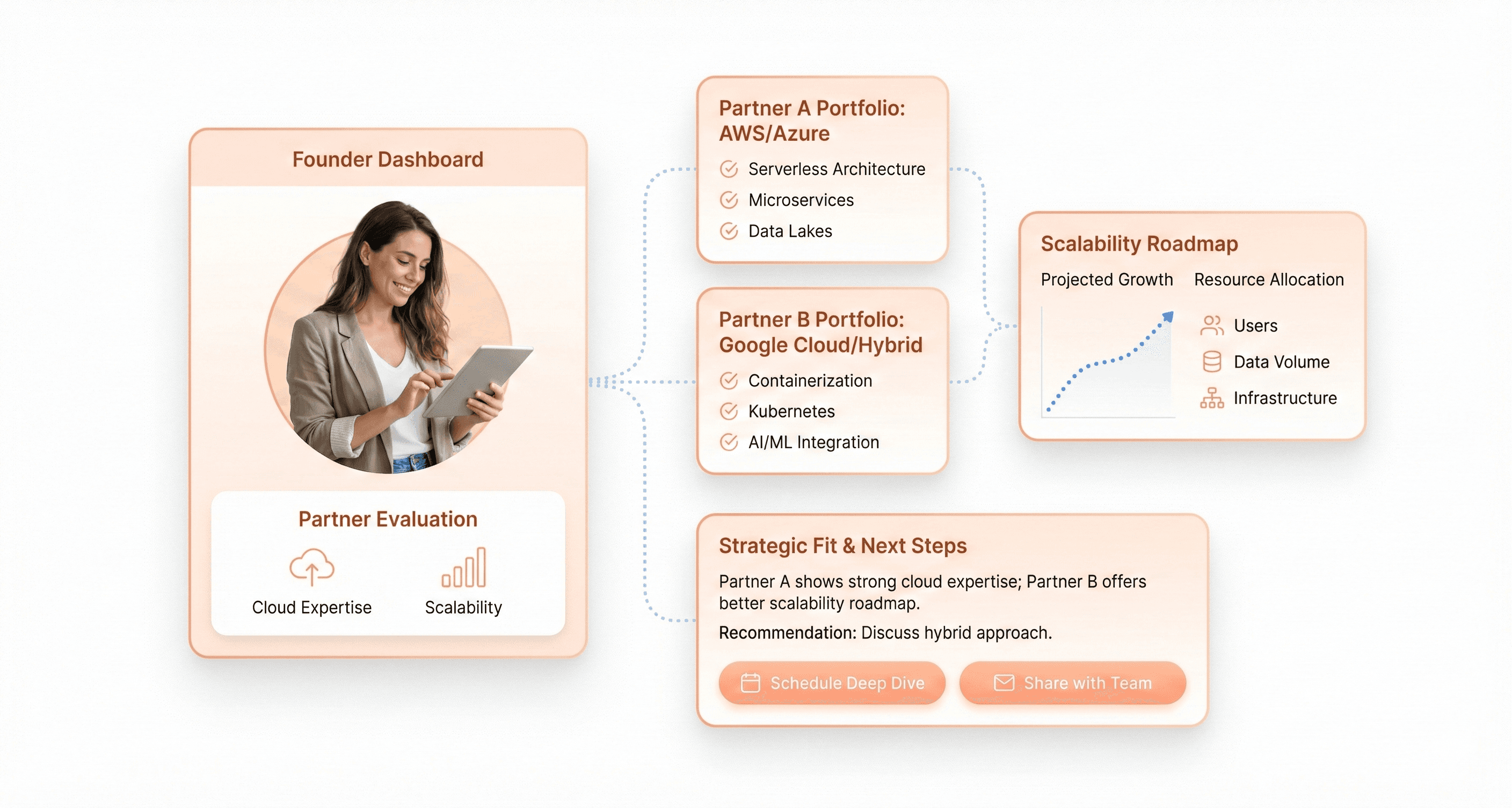
Custom SaaS product development works best when validation, design and engineering run together rather than in sequence. Validate the problem before you build. Settle tenancy, integrations and compliance scope before the MVP. Design the core workflow with real users. Then treat launch as the start of iteration, not the finish.
The partner you choose matters most in vertical SaaS, where regulation and complex roles shape every screen. Look for live products, measured outcomes and a team that asks about your users' rules before it shows you designs.
If you are planning a new SaaS product or rebuilding one, talk to Hashbyt's SaaS design and engineering team. Or see how we approach UI/UX design for SaaS companies.




About the author
I’m the founder of Hashbyt, an AI-first frontend and UI/UX SaaS partner helping 200+ SaaS companies scale faster through intelligent, growth-driven design. My work focuses on building modern frontend systems, design frameworks, and product modernization strategies that boost revenue, improve user adoption, and help SaaS founders turn their UI into a true growth engine.
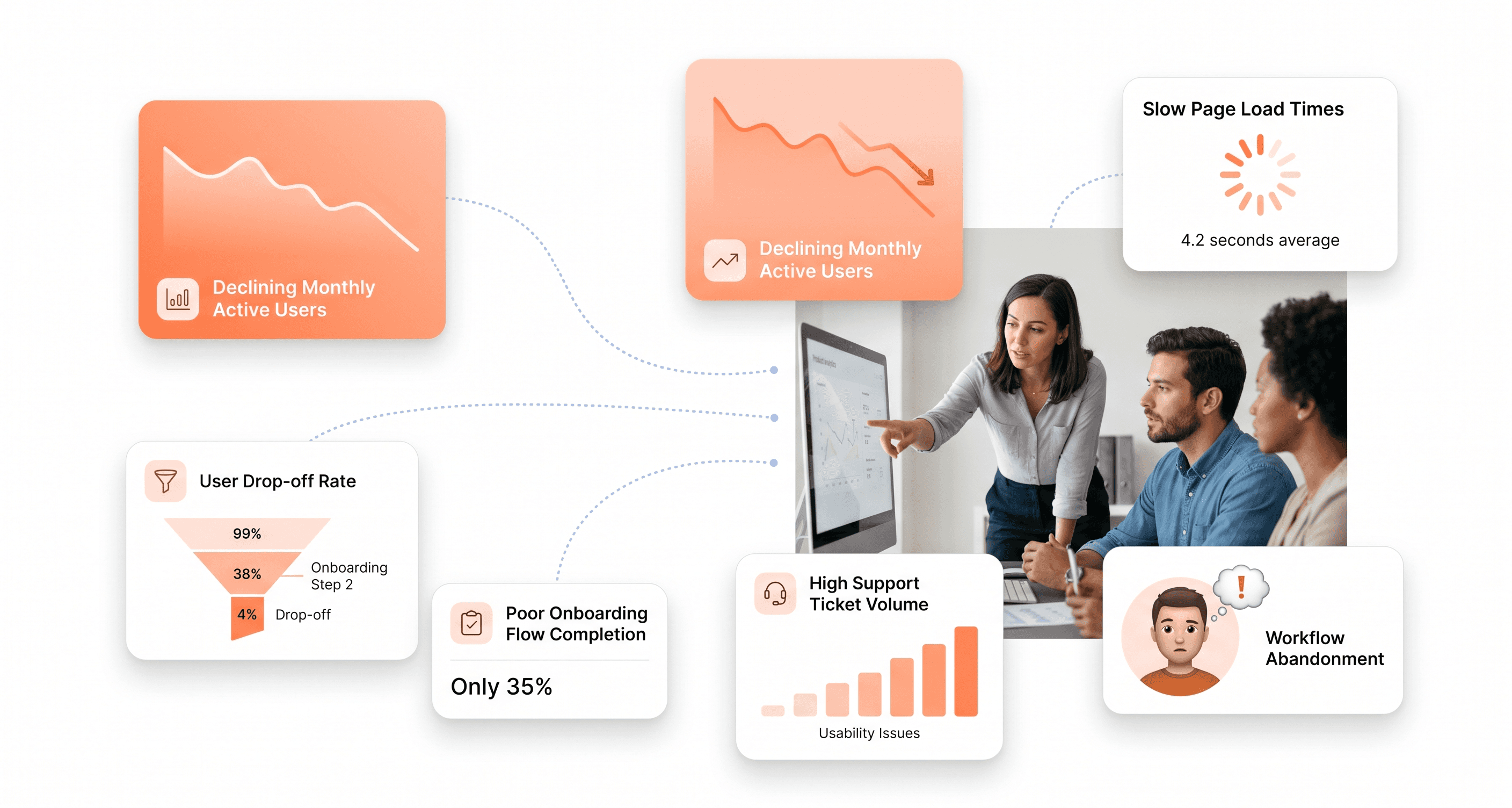
Is a clunky UI holding back your growth?
Is a clunky UI holding back your growth?
▶︎
Transform slow, frustrating dashboards into intuitive interfaces that ensure effortless user adoption.
▶︎
Transform slow, frustrating dashboards into intuitive interfaces that ensure effortless user adoption.
