
SaaS Product Development Trends 2026
Posted on
News / Trend Article
Frontend
Posted at
Feb 10, 2026
Feb 10, 2026
Min read
10

I hope you found this post valuable. If you’re looking for proven frontend and design expertise to elevate your product, feel free to reach out.


Summary
Building Security Tools SOC Analysts Can
Navigate Under Pressure?
Summary
Building Security Tools SOC Analysts Can Navigate Under Pressure?
Summary
Building Security Tools SOC Analysts Can
Navigate Under Pressure?
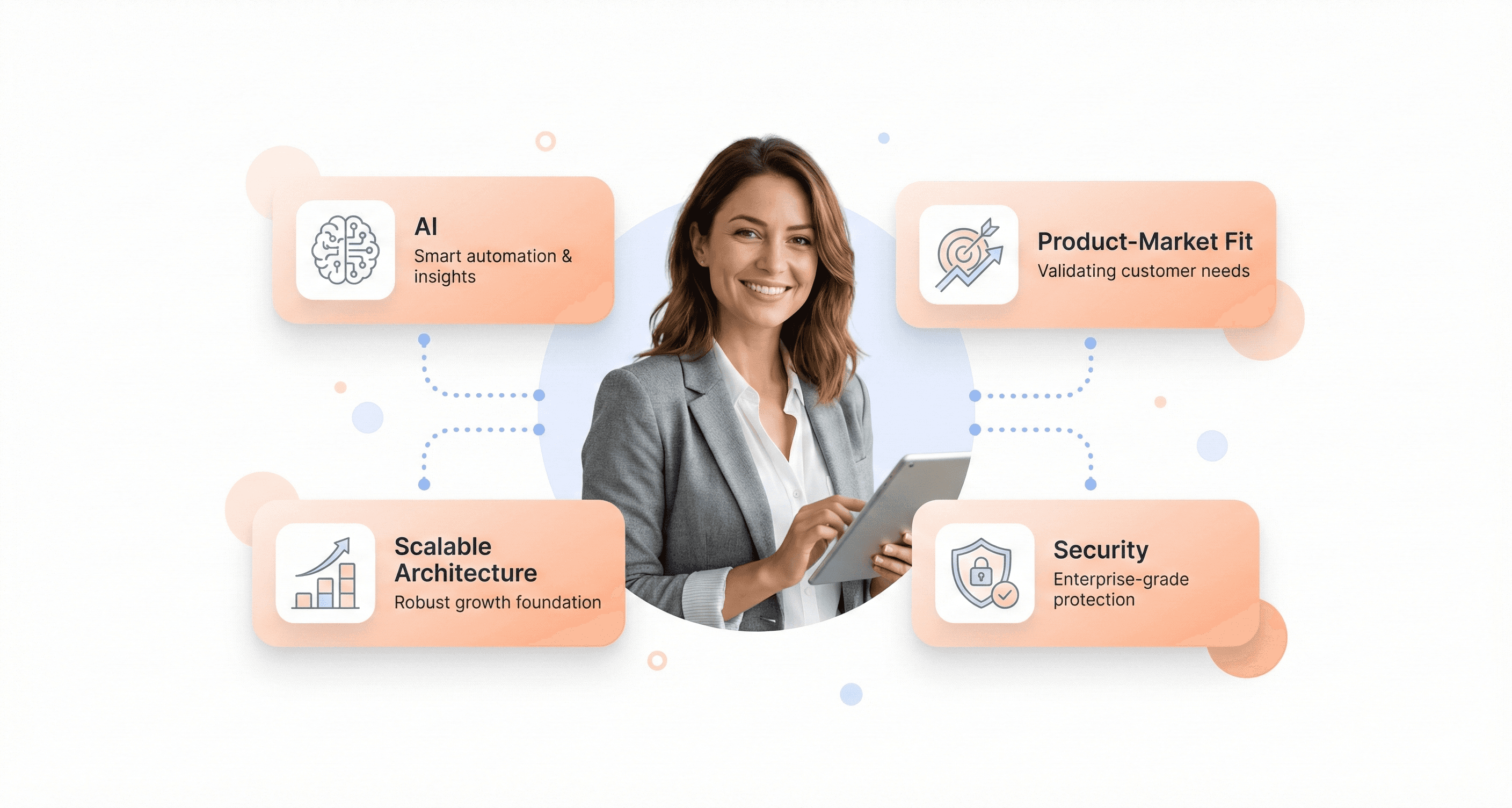
SaaS product development trends are reshaping how companies build and scale cloud solutions in 2026. This guide is for product managers, startup founders, and product development teams who want to stay ahead in the competitive SaaS landscape.
The SaaS market continues exploding with over 17% growth expected this year, but success depends on more than just riding the wave. You'll discover how achieving product-market fit creates the foundation for sustainable growth, while AI integration transforms basic features into intelligent, personalized experiences that users can't live without.
We'll also cover building scalable architecture that won't break when your user base suddenly doubles, and creating development teams with the right mix of skills to handle everything from machine learning to security compliance. These aren't just nice-to-have strategies – they're essential building blocks that separate thriving SaaS companies from those struggling to keep up.
Achieving Product-Market Fit for SaaS Success
Defining Your Ideal Customer Avatar
Achieving product-market fit begins with precisely identifying your target market through comprehensive customer avatar definition. This foundational step requires diving deep into understanding your potential customers' demographics, psychographics, pain points, and desired outcomes. Your ideal customer avatar should encompass who they are, where they work, what their typical workday looks like, and the specific challenges they face that your SaaS solution addresses.
Regularly update this customer definition as you gather new insights from conversations, interviews, and surveys. As a SaaS startup, your product will likely serve a small market segment initially, but as you grow, your understanding of the problem you're solving will expand, causing your customer profile to evolve accordingly.
The key is to avoid building for everyone and instead focus on creating a tailored solution for users who share your vision and fit your target niche. This targeted approach ensures that you're developing features and capabilities that truly resonate with your intended audience rather than diluting your efforts across multiple customer segments.
Solving High-Stakes Pain Points
Product-market fit fundamentally depends on addressing genuine, high-impact problems for your target market. Your SaaS solution must serve as a vital answer to pressing needs that your substantial audience is actively seeking to resolve. This requires going beyond surface-level market research to conduct an in-depth mission that unearths the authentic challenges your potential customers face.
Understanding these pain points involves asking targeted questions about what your customers need to accomplish, what obstacles they encounter, what solutions they've previously tried, and how they currently address these challenges. The goal is to identify problems that are significant enough that customers are willing to pay for a solution.
Your value proposition becomes the beacon in this quest—not merely marketing copy, but a powerful declaration of the unique benefits and solutions your product delivers. When you successfully address high-stakes pain points, customer acquisition transforms from a constant struggle into a natural outcome of your market resonance, creating organic growth and word-of-mouth referrals.
Tracking User Retention and Loyalty Metrics
Measuring product-market fit requires monitoring key retention and loyalty metrics that indicate how well your SaaS solution aligns with market needs. Customer retention serves as a critical factor in assessing product-market fit, as your ability to keep customers engaged and satisfied demonstrates whether you're effectively meeting their requirements.
Essential metrics include churn rate, which measures the percentage of customers who discontinue using your product over a defined period. A lower churn rate indicates stronger product-market fit. Monthly Recurring Revenue (MRR) tracking reveals consistency and growth patterns, with rising MRR signaling increasing market acceptance.
Customer Lifetime Value (CLV) evaluates the total value a customer brings throughout their relationship with your product, while Customer Acquisition Cost (CAC) analysis helps determine the sustainability of your business model. Higher CLV compared to CAC suggests healthy product-market alignment.
Additional vital metrics include Net Promoter Score (NPS) surveys to measure customer loyalty and likelihood of recommendations, Customer Satisfaction Score (CSAT) through surveys and feedback mechanisms, and feature usage analytics to understand which product capabilities deliver the most value to users.
Implementing Continuous Feedback Loops
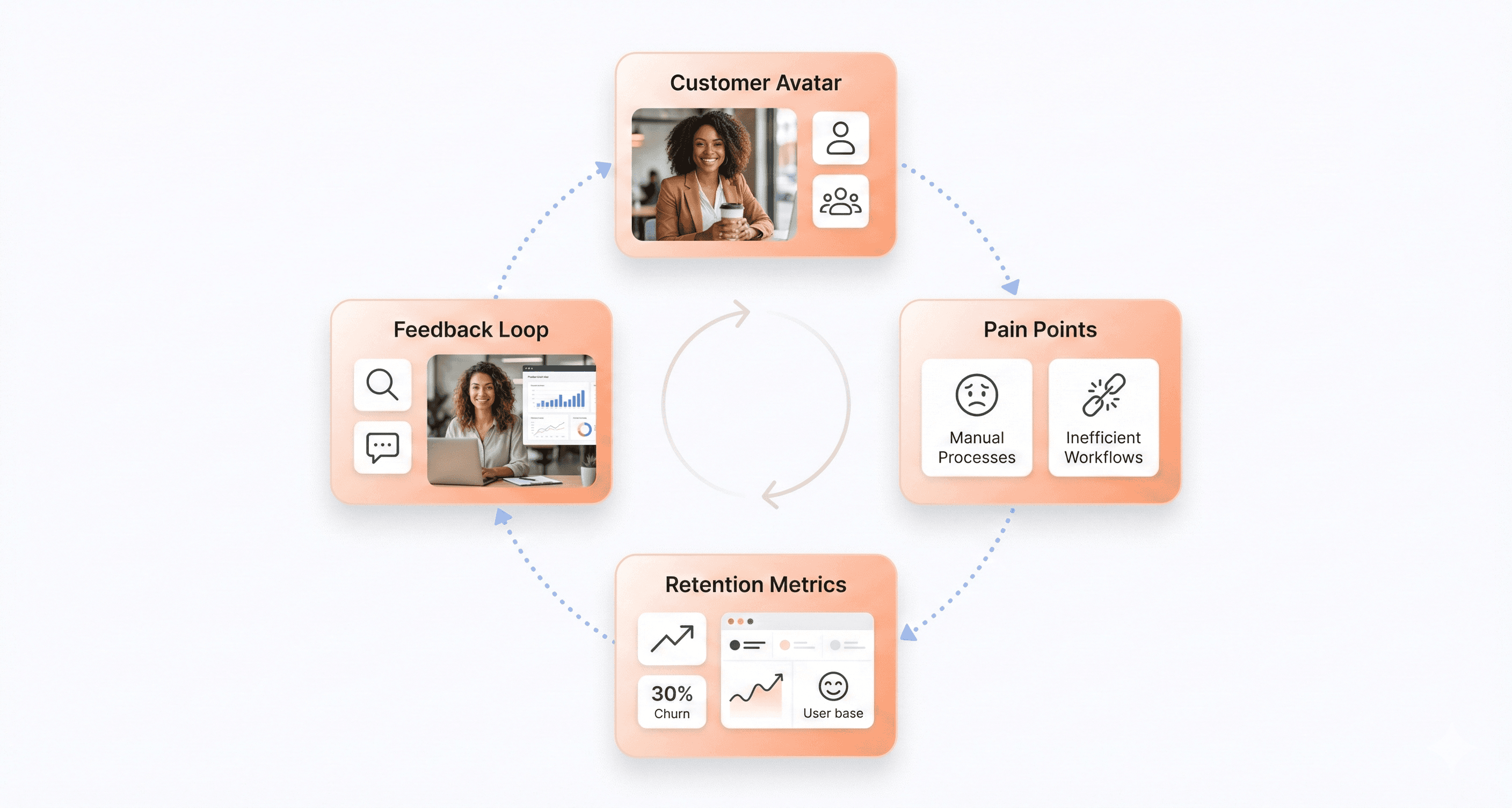
Establishing robust feedback mechanisms is essential for both achieving and maintaining product-market fit in the dynamic SaaS landscape. This involves creating systematic processes for gathering, analyzing, and acting upon customer insights throughout your product development lifecycle.
Regular customer conversations form the cornerstone of effective feedback loops. Schedule ongoing interviews with target customers, asking open-ended questions about their experiences, challenges, and evolving needs. The frequency of these conversations directly correlates with how quickly you'll identify misalignments between customer expectations and your product capabilities.
Leverage multiple feedback channels including customer support interactions, feedback widgets, feature requests, and user surveys. However, strategically weight this feedback based on customer value and engagement levels—insights from daily-using, paying customers carry more significance than feedback from inactive free-tier users.
Implement structured processes for your team to report and store customer needs and problems. Create systems that allow customer support, sales, and product teams to share insights about user experiences and emerging patterns. This cross-functional approach ensures that valuable customer intelligence doesn't get lost in organizational silos.
The key to successful feedback loops is not just collection but strategic response. Analyze feedback contextually, segment it by user type and engagement level, and prioritize actions based on your current business objectives. Remember that maintaining product-market fit requires continuous adaptation as market conditions, customer needs, and competitive landscapes evolve.
Crafting a Clear and Actionable SaaS Product Vision
Defining Transformational Outcomes for Users
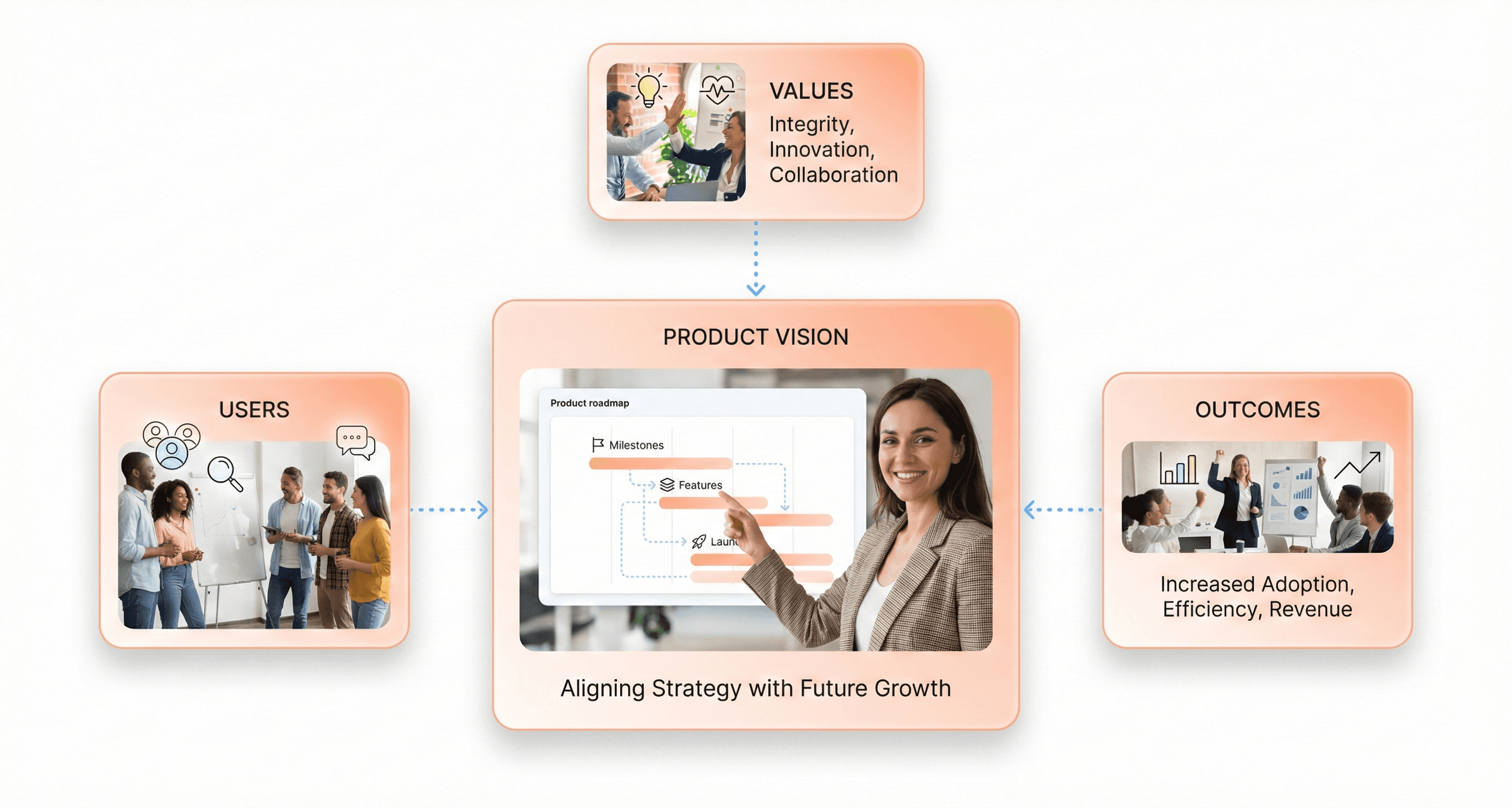
A strong SaaS product vision begins with clearly defining transformational outcomes for your users. Rather than focusing on features or technical capabilities, effective product visions articulate the meaningful change your product will create in users' lives or businesses. As the reference content emphasizes, "A good Product Vision expresses the value the Product should deliver and to whom that value is delivered."
Consider how successful SaaS companies frame their transformational outcomes. LinkedIn's vision "Create economic opportunity for every member of the global workforce" focuses entirely on the life-changing impact for users, not on networking features or profile functionality. Similarly, Slack's vision "Make work life simpler, more pleasant and more productive" emphasizes the workplace transformation users will experience.
When defining transformational outcomes for your SaaS product development trends, start with deep customer research. You must understand your target customer's needs, desires, and pain points, as well as their demographic and psychographic characteristics. This research ensures your vision addresses real user problems and aspirations.
The transformational outcome should answer the fundamental question: "Why should customers choose your product over others?" Your value proposition must highlight unique benefits and demonstrate how your SaaS solution will solve customer problems or enhance their lives in ways competitors cannot match.
Aligning Vision with Core Values
Product vision alignment with core company values creates authenticity and consistency across your SaaS development roadmap. An effective product vision must support and enhance your overall business strategy while resonating with your company's mission and ethos. This alignment ensures consistency across different product lines and reinforces your brand identity.
The connection between vision and values goes beyond surface-level messaging. When your product vision genuinely reflects your company's core beliefs, it becomes easier to make strategic decisions during development. Teams can evaluate features, priorities, and trade-offs against both the vision and underlying values, creating a coherent development approach.
Values-aligned visions also inspire teams more effectively. When team members understand not just what they're building but why it matters to the organization's deeper purpose, their performance on execution improves dramatically. This emotional connection becomes particularly important for SaaS development teams working on complex, long-term projects.
Consider Ben and Jerry's vision: "To make, distribute, and sell the finest-quality ice cream and euphoric concoctions with a continued commitment to incorporating wholesome, natural ingredients and promoting business practices that respect the Earth and the Environment." This vision seamlessly integrates product goals with environmental and quality values, creating a unified direction for all business decisions.
For SaaS products, values alignment might manifest through commitments to user privacy, accessibility, sustainability, or ethical AI integration—all increasingly important considerations in modern SaaS product development trends.
Future-Proofing Your Vision for Market Changes
While product strategies and roadmaps can change to address market developments, your product vision should remain relatively stable yet adaptable enough to stay relevant amid changing circumstances. This balance between stability and flexibility represents one of the most challenging aspects of vision crafting.
Future-proofing requires envisioning your product's long-term success and scalability. Your vision should anticipate how the product can scale, adapt, and remain relevant as it grows and market conditions evolve. Consider not just immediate impact but potential to drive enduring success over the typical 2-5 year timeline for software products.
Market adaptability means building resilience into your vision statement without making it so broad as to be meaningless. Amazon's evolution from e-commerce to cloud services demonstrates how a clear understanding of core purpose enables successful pivots. They succeeded because they understood their "why"—not just what they were selling, but the fundamental value they provided to customers.
For SaaS companies navigating AI integration trends, future-proofing might mean crafting visions that emphasize enhanced user capabilities rather than specific AI technologies. This approach allows your vision to remain relevant as AI capabilities evolve while maintaining focus on user transformation.
Regular vision review processes help ensure continued market relevance. While the core vision remains stable, you may need to adjust emphasis or interpretation as new technologies, competitive dynamics, or user behaviors emerge. The key is maintaining the aspirational and actionable balance that makes visions effective while allowing for strategic evolution.
Building Agile Development Roadmaps That Scale
Creating Measurable Short and Long-Term Milestones
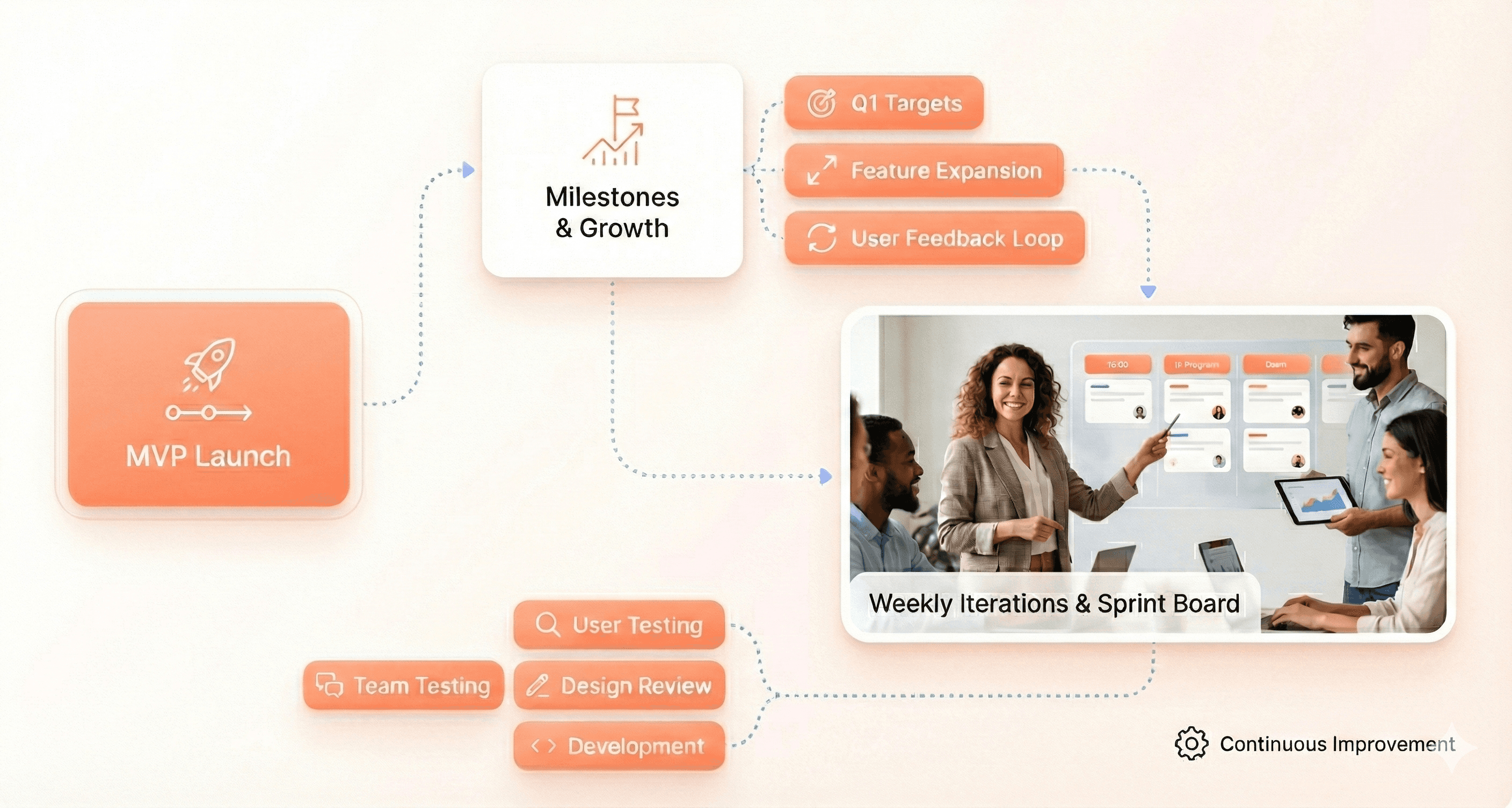
Successful SaaS development roadmaps require clearly defined milestones that balance immediate deliverables with strategic long-term objectives. Short-term milestones should focus on delivering working software within 1-2 week sprints, allowing teams to maintain momentum and respond quickly to market feedback. These immediate goals include feature completions, bug fixes, and iterative improvements that directly impact user experience.
Long-term milestones align with broader product vision and market positioning, typically spanning 3-6 months. These strategic objectives should encompass major feature releases, market expansion initiatives, and scalability improvements. The key is establishing measurable criteria for each milestone, whether it's user adoption rates, performance metrics, or revenue targets.
Starting with MVP for Rapid Market Validation
The MVP (Minimum Viable Product) approach forms the foundation of effective SaaS development roadmaps. By breaking down development into small increments with integrated testing, agile methodologies reduce the risk of large-scale project failures while enabling rapid market validation.
Starting with an MVP allows SaaS companies to release new features or updates quickly and establish a consistent development rhythm. This iterative approach emphasizes working software over comprehensive documentation, speeding up the validation process. The MVP strategy enables teams to gather real user feedback early, informing future development decisions and ensuring alignment with customer needs.
Prioritizing Features Based on Impact
Feature prioritization requires balancing customer demands with technical feasibility and business objectives. Agile methodologies emphasize frequent customer feedback loops, helping SaaS companies align product development with actual user needs rather than assumed requirements.
The most effective prioritization frameworks consider multiple factors: user impact, development complexity, revenue potential, and strategic importance. Teams should identify critical features and requirements, prioritizing them to ensure the most important capabilities are delivered first. This approach reduces the risk of delays while increasing the chances of product success.
However, agile's flexibility can lead to scope creep, where project scope expands continuously without clear boundaries. Maintaining focus on high-impact features requires disciplined decision-making and regular roadmap reviews to prevent feature bloat.
Implementing Visual Progress Tracking
Visual progress tracking transforms abstract development goals into tangible, measurable outcomes. Agile frameworks like Scrum and Kanban foster transparent communication and collaboration within teams, enhancing productivity and alignment across different departments in SaaS companies.
Effective visual tracking systems should display sprint progress, feature completion rates, and milestone achievements in real-time. These systems help teams identify potential issues early and maintain accountability throughout the development process. Visual dashboards also facilitate stakeholder communication, providing clear insights into development velocity and project health.
The key is using appropriate metrics and tracking mechanisms that focus on meaningful progress indicators rather than vanity metrics. Teams should monitor both technical achievements and business outcomes to ensure development efforts translate into customer value and business growth.
Integrating AI to Drive Growth and Personalization
Embedding AI in Core Workflows
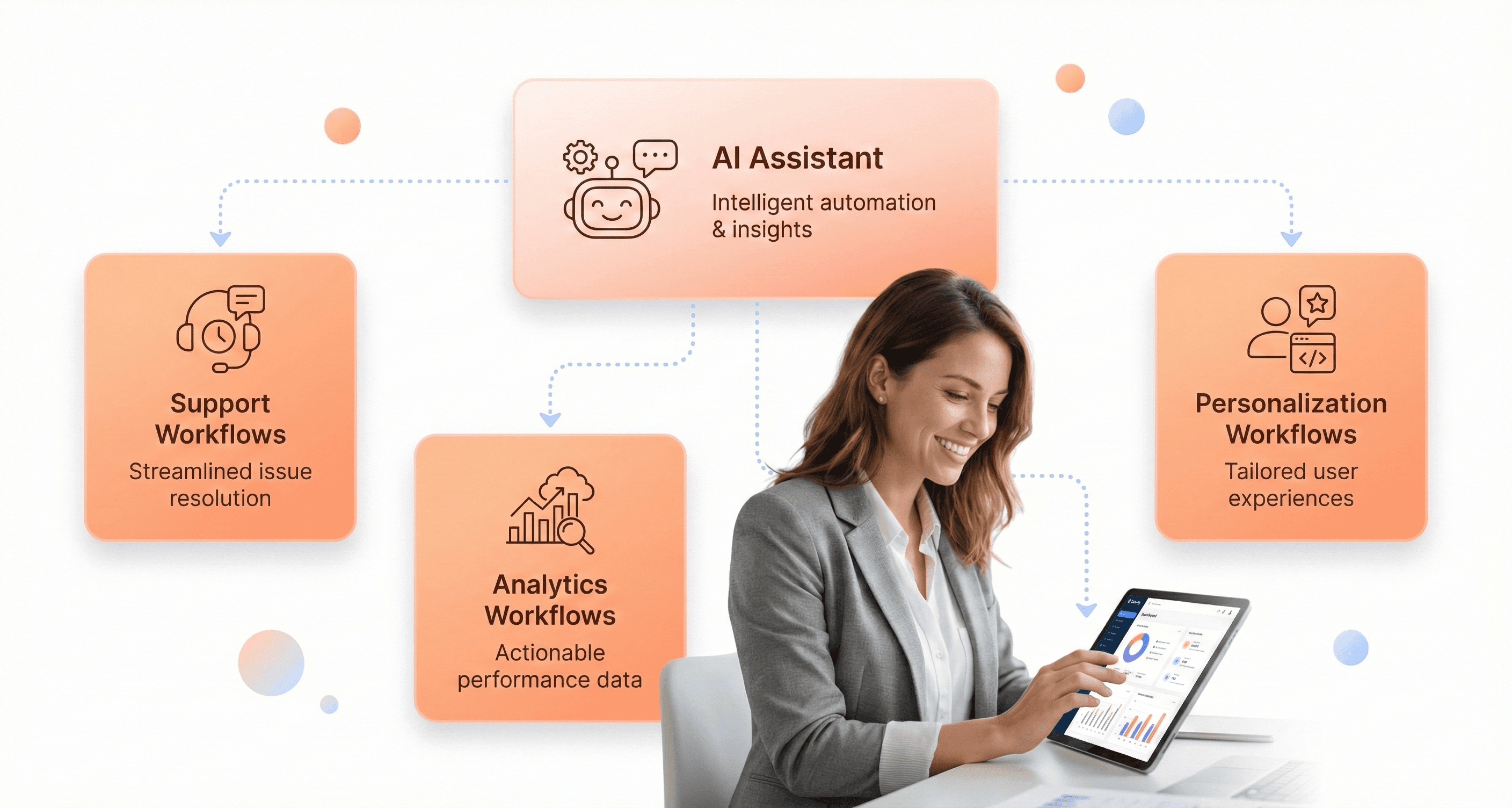
Previously, I've discussed the foundation of SaaS product development, but now that we've covered the strategic elements, it's time to explore how AI integration SaaS products can transform your development approach. Successful AI integration requires embedding artificial intelligence directly into core business workflows rather than treating it as an add-on feature.
The statistics reveal that 60%+ of enterprise SaaS products now have embedded AI features, marking a significant shift from supplementary tools to core functionality. This embedded intelligence approach allows SaaS companies to deliver smarter, more personalized experiences that directly impact key metrics like ARR (annual recurring revenue) and customer retention.
To achieve effective AI integration, focus on workflows where automation can deliver immediate value. Research shows that 40% of organizations use AI in customer service/support automation, while 45% leverage AI in IT service management applications. These use cases demonstrate tangible ROI and provide a foundation for expanding AI capabilities across other workflows.
Choosing High-Impact AI Use Cases
With this embedded approach in mind, next we'll see how selecting the right AI use cases determines the success of your integration efforts. The global AI SaaS market is expected to grow at a 38.28% CAGR, from $71.54 billion in 2023 to $775.44 billion by 2031, indicating massive opportunities for companies that identify high-impact applications.
Predictive analytics represents one of the most valuable AI use cases, enabling SaaS businesses to predict customer behavior and optimize retention strategies. Companies implementing AI-driven predictive models see improved LTV/CAC ratios and stronger recurring revenue growth, making these investments attractive to growth capital providers.
Customer success automation stands out as another high-impact area. AI can analyze user behavior patterns, identify at-risk accounts, and trigger automated interventions before churn occurs. This proactive approach to customer management has become essential as SaaS companies face increasing pressure to demonstrate capital efficiency and predictable revenue growth.
Operational efficiency through intelligent automation also delivers measurable results. Organizations report that 76% of SaaS companies use or are exploring AI for operations, with many achieving significant improvements in productivity and cost management through automated workflows.
Building Clean Data Pipelines for AI Success
Now that we have covered high-impact use cases, the foundation of successful AI implementation rests on clean, well-structured data pipelines. Without quality data infrastructure, even the most sophisticated AI models will fail to deliver meaningful results for your SaaS product development trends.
Data quality directly impacts AI performance and business outcomes. Organizations with robust data pipelines can leverage machine learning and natural language processing more effectively, leading to better predictive accuracy and more personalized user experiences. This infrastructure investment becomes critical as 92% of SaaS companies plan to increase their use of AI in their products in 2025.
Establishing proper data governance ensures consistency across all AI applications within your SaaS platform. This includes implementing data validation processes, maintaining data lineage documentation, and creating standardized formats that support multiple AI use cases simultaneously. These practices enable scalable AI deployment across different product features and workflows.
Real-time data processing capabilities become essential for AI applications that require immediate responses, such as fraud detection, personalization engines, and automated customer support. Companies that invest in streaming data architectures can deliver more responsive AI-powered features, directly improving user satisfaction and retention metrics.
Training In-House AI Talent
Previously, I've outlined the technical requirements for AI integration, but building internal AI capabilities requires dedicated talent development strategies. The rapid growth in AI SaaS applications means that 95% of companies have invested in AI-driven use cases, creating intense competition for skilled AI professionals.
Developing in-house expertise starts with identifying team members who show aptitude for machine learning concepts and data analysis. Many successful SaaS companies create internal training programs that combine theoretical AI knowledge with hands-on experience using their specific data sets and business challenges.
Cross-functional AI literacy becomes crucial as AI integration touches multiple departments beyond engineering. Sales teams need to understand AI-powered lead scoring, customer success teams require knowledge of predictive analytics, and product managers must grasp how AI features impact user experience and business metrics.
Strategic partnerships with AI education providers and consultants can accelerate talent development while building long-term internal capabilities. This approach allows companies to maintain control over their AI roadmap while accessing specialized expertise during critical implementation phases, supporting the broader goal of creating scalable SaaS architecture and high-performance development teams.
Designing Scalable Architecture for Growth
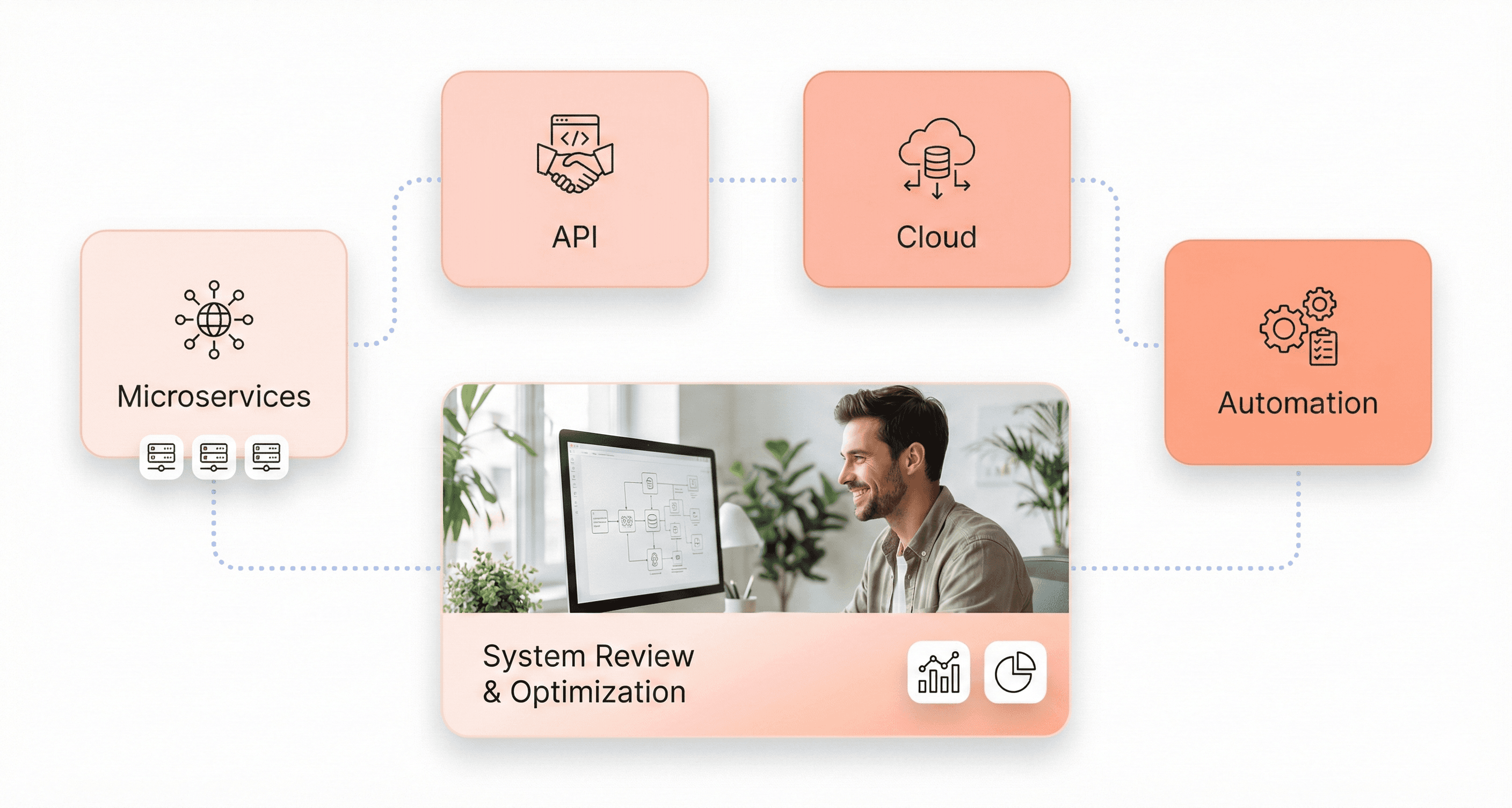
Implementing Microservices for Flexibility
Modern SaaS platforms achieve superior scalability by breaking functionality into smaller, independent services rather than building one massive application. This microservices approach enables each service to handle specific tasks like user authentication, payment processing, and data analytics independently, allowing for targeted updates and scaling without affecting the entire system.
When your payment service requires an upgrade or analytics functionality experiences heavy traffic during end-of-month reporting, you can address that specific component without disrupting other platform functions. This architectural pattern accelerates development by enabling different teams to work on separate services simultaneously, reducing conflicts and deployment dependencies.
The strategic advantage becomes clear when handling growth - if one service experiences increased demand, you can scale only that component rather than provisioning resources for the entire application. This targeted scaling approach transforms unpredictable infrastructure costs into manageable expenses that align with actual usage patterns.
Adopting Cloud-Native Infrastructure
Cloud-native infrastructure forms the backbone of scalable SaaS architecture, providing the foundation for automatic scaling and reliable performance. Modern SaaS platforms leverage cloud providers like AWS, Azure, or Google Cloud to transform rapid user growth from a technical challenge into a business opportunity.
This approach enables pay-as-you-go resource allocation, where infrastructure costs scale proportionally with revenue. When starting with a handful of users, costs remain minimal. As your user base expands from 100 to 1,000 customers, infrastructure expenses grow alongside your business success rather than requiring expensive upfront investments in dedicated servers.
Automated scaling capabilities monitor key metrics including CPU usage, memory consumption, and request queues, automatically adjusting resources to match current demands. During marketing campaigns that bring user surges, additional servers spin up automatically, while excess resources scale down during off-peak periods to optimize costs.
Multi-cloud strategies distribute platforms across multiple providers, reducing vulnerability to outages while leveraging each provider's unique strengths. This approach provides negotiation leverage and enables taking advantage of AWS's broad service range, Azure's Microsoft ecosystem integration, or Google Cloud's AI/ML capabilities.
Creating API-Centric Systems
API-centric architecture enables seamless integration with third-party services while providing the flexibility to adapt to future technological needs. By designing integration points and APIs strategically, SaaS platforms can easily connect with external services and evolve without major restructuring.
This modular approach facilitates gradual feature expansion, allowing new functionality to be developed and tested in isolation before integration into the main system. The architecture supports third-party integrations and enables adopting new technologies without disrupting existing user experiences.
Well-designed APIs ensure data flows efficiently between services while maintaining security protocols and access controls. This foundation supports both current operational needs and future growth plans, providing the flexibility essential for evolving market demands.
Automating Infrastructure Management
Infrastructure automation eliminates manual intervention requirements while maintaining optimal performance across varying demand patterns. Smart load balancing distributes incoming traffic across multiple servers, preventing individual servers from becoming overwhelmed while ensuring consistent response times regardless of user location.
Proper load balancers monitor server health continuously, redirect users to the closest geographical servers, and automatically remove problematic servers from rotation. This ensures users in different regions receive equally responsive experiences while maintaining system reliability.
Automated systems watch performance metrics and adjust resources dynamically, maintaining optimal functionality without requiring constant manual oversight. When activity increases, additional resources activate automatically; when demand decreases, excess capacity scales down to control costs.
This automation extends to disaster recovery mechanisms, including scheduled backups, multi-region redundancy, and automated failover systems. These systems ensure data preservation, protect against localized outages, and provide seamless service switching during disruptions, all while maintaining strict uptime guarantees through comprehensive Service Level Agreements.
Building High-Performance SaaS Development Teams
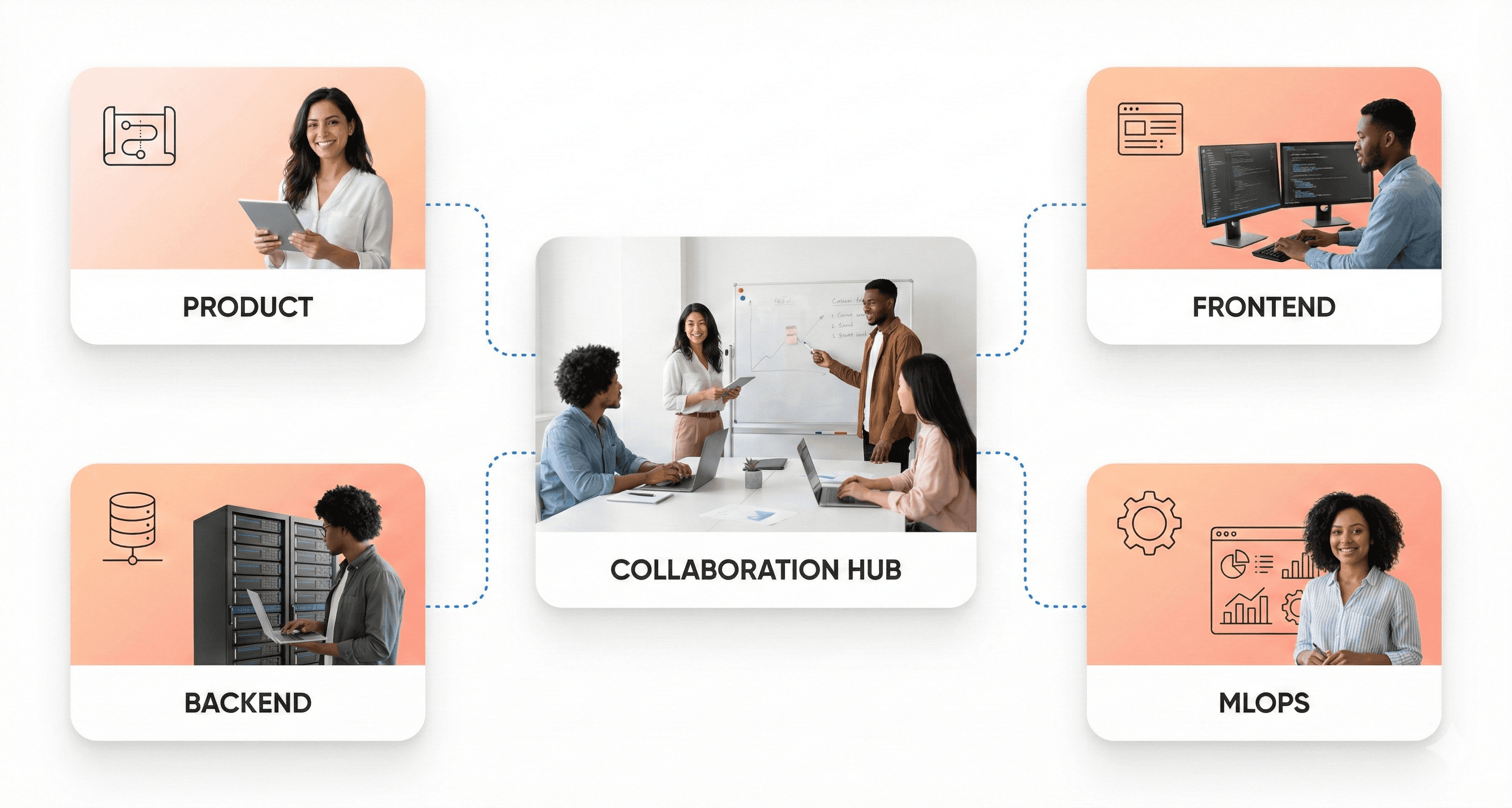
Defining Key Roles and Responsibilities
Building high-performance SaaS development teams requires establishing clear roles and responsibilities that align with your company's growth stage and business objectives. The organizational structure of SaaS development teams evolves significantly as companies scale from startup to enterprise level.
In early-stage SaaS companies with 1-10 employees, team members typically wear multiple hats with loosely defined responsibilities. The founder often leads product vision while handling sales and marketing functions, while co-founders or key team members manage product development and technology delivery alongside administrative operations.
As teams grow to 25-50 employees, more formal structure emerges with dedicated roles including Sales Manager, Product Development Manager, and Marketing Manager. The organizational chart begins following traditional hierarchy patterns with executives, departments, managers, and employees having assigned responsibilities.
At the 50-75 employee level, C-suite positions become essential, typically introducing Chief Executive Officer (CEO) and Chief Financial Officer (CFO) roles. Many companies also add Chief Information Officer (CIO) or Chief Information Security Officer (CISO) positions to oversee technical operations and security.
For larger organizations with 75+ employees, formal departmental structures emerge with Vice Presidents heading defined areas including Sales, Marketing, Finance, Product Development, Customer Support, and Human Resources. Within each functional area, managers or leads oversee specific functional groups, creating clear chains of command and accountability.
Hiring Essential Technical Specialists
Now that we've covered organizational structure, let's examine the critical technical roles that drive SaaS development success. The composition of technical specialists varies significantly based on annual recurring revenue (ARR) milestones and company growth stage.
For companies with ARR up to $1 million, technical teams typically center around core engineering roles with leads for key functions. The median team structure shows heavy investment in engineering, with 12 engineers supporting 6 sales team members and 4 marketing professionals.
As ARR grows to $1-5 million, companies maintain strong engineering focus while scaling go-to-market teams. The ratio of engineers to salespeople begins shifting from 2:1 toward 1:1 as customer acquisition and support become increasingly important.
Essential technical specialist roles include:
Product Managers who bridge business requirements with technical implementation
Software Developers responsible for core platform development
App Engineers focusing on user interface and experience
Feature Development Specialists who drive product enhancement initiatives
Technical Support Specialists providing customer-facing technical assistance
Product Support Coordinators managing technical customer success initiatives
Companies reaching $5-20 million ARR typically see 10x growth in sales staffing compared to 5x growth in engineering teams, requiring careful balance between technical development capacity and market-facing capabilities.
Balancing Frontend and Backend Development Skills
With this organizational foundation in mind, next we'll explore the critical balance between frontend and backend development capabilities. Modern SaaS development requires seamless integration between user-facing interfaces and robust backend infrastructure to deliver scalable, performance-driven applications.
Frontend development teams focus on user experience, interface design, and customer interaction points. These specialists work closely with Product and Engineering departments to create intuitive, responsive interfaces that drive user engagement and satisfaction. Frontend roles typically include user experience designers, interface developers, and customer-facing application engineers.
Backend development specialists concentrate on server-side logic, database management, API development, and system architecture. These technical experts ensure platform scalability, data security, and integration capabilities that support growing user bases and feature sets.
The optimal balance between frontend and backend resources depends on your SaaS product's complexity and customer interaction model. Companies with heavily interactive user interfaces may require higher frontend-to-backend ratios, while enterprise SaaS platforms with complex data processing needs often emphasize backend development capacity.
Cross-functional collaboration becomes essential as teams scale. Product managers coordinate between frontend and backend teams to ensure cohesive development roadmaps, while technical leads establish architecture standards that support both user experience goals and system performance requirements.
Integrating MLOps and Quality Assurance
Previously, I've discussed core development roles, but modern SaaS development increasingly requires specialized capabilities in machine learning operations (MLOps) and comprehensive quality assurance frameworks. These functions represent critical differentiators for competitive SaaS products.
MLOps specialists bridge the gap between data science initiatives and production deployment, ensuring AI-driven features integrate seamlessly into existing SaaS platforms. These roles become increasingly important as companies leverage artificial intelligence for personalization, automation, and predictive analytics capabilities.
Quality assurance teams ensure product reliability, security, and performance standards across all development cycles. QA specialists collaborate with both frontend and backend development teams to establish testing protocols, automated quality checks, and continuous integration processes that maintain product excellence as features expand.
Modern SaaS development teams integrate QA processes throughout development cycles rather than treating quality assurance as end-stage validation. This approach requires QA specialists who understand both technical architecture and user experience requirements, enabling comprehensive testing strategies that address functionality, security, performance, and usability simultaneously.
The integration of MLOps and QA functions requires careful coordination with existing development workflows, ensuring these specialized capabilities enhance rather than complicate development processes while maintaining the agility and innovation focus that characterizes successful SaaS development teams.
Implementing Security and Compliance Best Practices
Prioritizing End-to-End Encryption
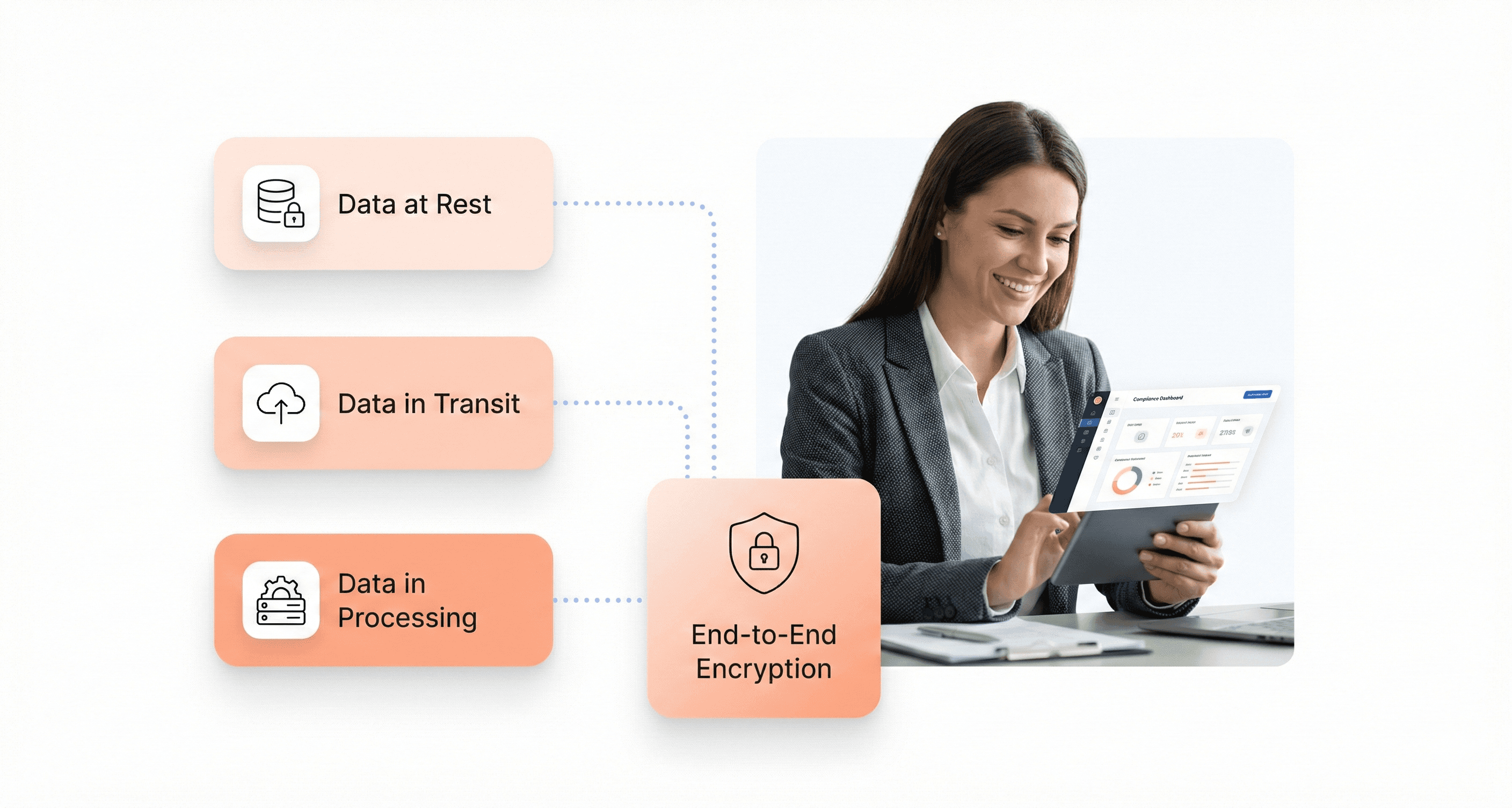
End-to-end encryption serves as a fundamental security control for protecting sensitive data throughout its entire lifecycle in SaaS applications. This comprehensive approach ensures that data remains secure whether at rest, in transit, or during processing, establishing a critical foundation for SaaS security compliance.
Implementing robust encryption requires careful consideration of various data protection scenarios. Financial reporting regulations like the Sarbanes-Oxley Act (SOX) and ASC 606 demand accurate revenue recognition and financial data integrity, making granular access controls and data encryption essential for protecting financial information. Similarly, SaaS providers handling healthcare data must implement strong encryption as part of their HIPAA compliance strategy to safeguard protected health information (PHI).
For organizations processing payment card data, PCI DSS compliance mandates encryption as a core requirement alongside firewalls, access controls, and security audits to protect sensitive cardholder information. This multi-layered encryption approach ensures that even if unauthorized access occurs, the data remains unreadable and unusable.
Controlling Access with Strict Permissions
Access management represents a critical component of SaaS security compliance, requiring organizations to regularly review and reduce excessive permissions to limit data exposure. Effective access control strategies ensure that access levels comply with major frameworks including SOC 2, HIPAA, ISO 27001, and NIST standards.
SOC 2 compliance specifically evaluates how organizations manage customer data across five trust principles: security, availability, processing integrity, confidentiality, and privacy. Implementing strict access controls demonstrates commitment to these principles while reducing the risk of unauthorized data exposure. Organizations must establish granular permission structures that align with the principle of least privilege, ensuring users only access the data necessary for their specific roles.
Multi-factor authentication emerges as an essential security measure within access control frameworks. This additional layer of protection significantly reduces the likelihood of unauthorized access, even when credentials are compromised. Regular access reviews and automated permission auditing help maintain compliance while identifying potentially risky over-privileged accounts or unused integrations that could expose sensitive data.
Adopting Zero-Trust Network Architecture
Zero-trust architecture fundamentally transforms traditional security approaches by eliminating implicit trust and requiring verification for every access request. This model aligns perfectly with modern SaaS security compliance requirements, particularly as organizations manage increasingly distributed and dynamic environments.
The National Institute of Standards and Technology Cybersecurity Framework (NIST CSF) provides guidelines for managing cybersecurity threats through identification, protection, detection, response, and recovery phases. Zero-trust principles support this framework by ensuring continuous verification and validation of all network traffic and access requests, regardless of their origin.
This architecture proves especially valuable in addressing the compliance challenges inherent in SaaS environments, where data fragmentation across multiple applications complicates governance and compliance tracking. By implementing zero-trust principles, organizations can maintain better visibility and control over data access patterns, supporting compliance with frameworks like GDPR, which emphasizes data protection by design and by default.
Automating Threat Detection and Response
Automated threat detection and response systems provide essential capabilities for maintaining continuous compliance monitoring and addressing security incidents promptly. These systems enable organizations to detect suspicious activities in real-time while maintaining comprehensive audit trails required for various compliance frameworks.
The Center for Internet Security (CIS) Controls emphasize the importance of automated security monitoring as part of critical guidelines for securing information systems, including SaaS applications. Automated systems can continuously assess security configurations, identify potential vulnerabilities, and respond to threats before they escalate into significant breaches.
Effective incident response planning requires well-defined protocols for identifying, containing, eradicating, recovering, and learning from security incidents. Automated systems support these protocols by providing immediate alerting, evidence collection, and initial containment measures. This capability proves crucial for meeting compliance requirements that mandate timely breach notifications, such as GDPR's requirement for reporting breaches within 72 hours.
Organizations implementing automated threat detection must also maintain comprehensive logging across all SaaS applications to streamline audits and demonstrate adherence to SOC standards. These logs provide the detailed documentation necessary for external audits and regulatory reporting, while automated analysis helps identify patterns that might indicate compliance violations or security risks.
Managing SaaS Development Costs and Budgets
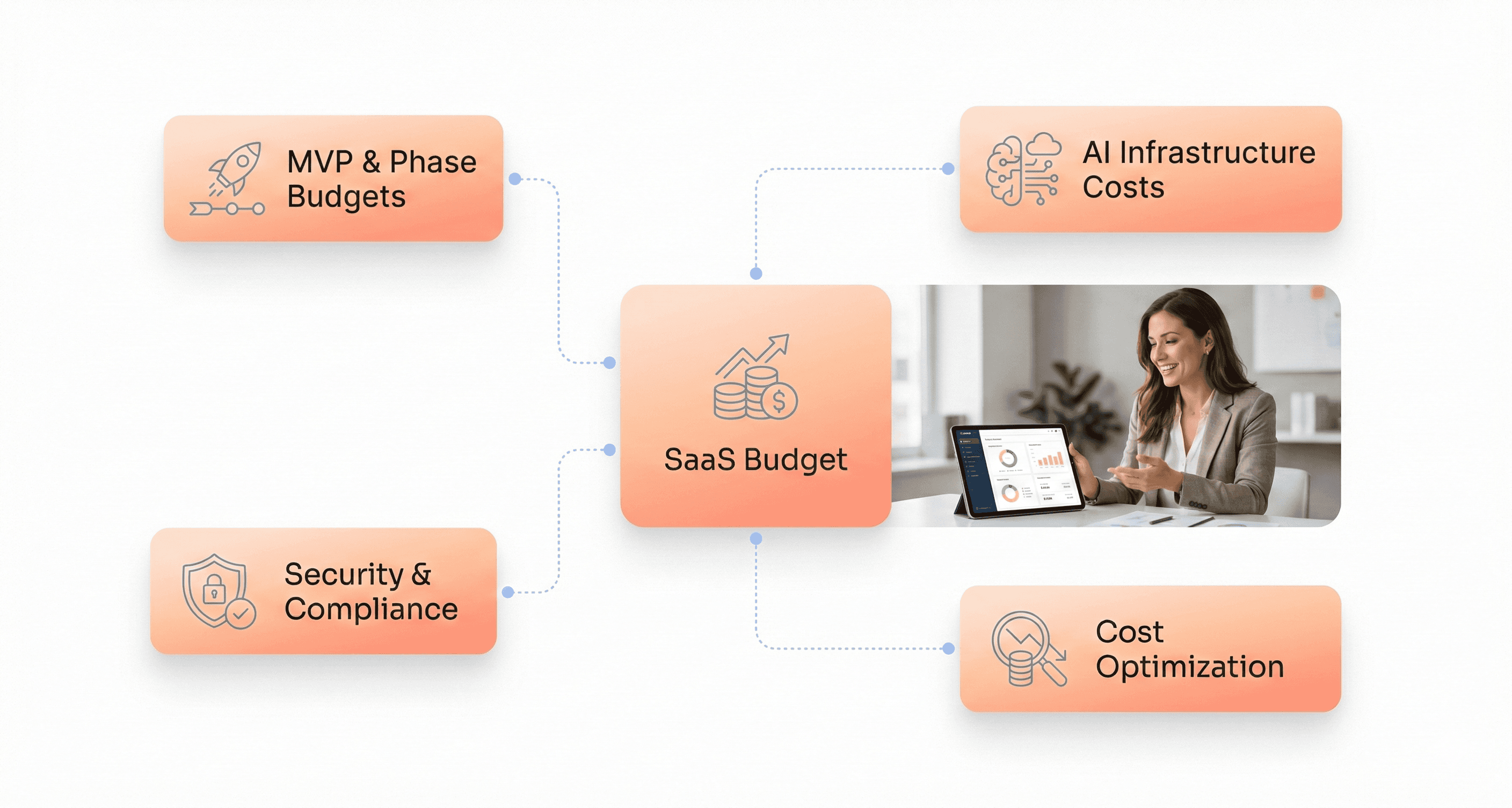
Setting Clear MVP and Phase Budgets
Establishing precise budget frameworks for SaaS development costs begins with understanding that cloud hosting expenses typically represent 6%-12% of SaaS revenue for most companies. When planning your MVP budget, prioritize core functionality that validates product-market fit while minimizing infrastructure overhead. Start with essential features that demonstrate value to early users, avoiding the temptation to over-engineer the initial release.
Phase-based budgeting requires careful consideration of development milestones and corresponding infrastructure scaling needs. Each development phase should have clearly defined cost parameters, including personnel, infrastructure, and third-party service expenses. Monitor these budgets closely, as SaaS development costs can escalate quickly when teams lack cost-aware culture and oversight.
Planning for AI and Infrastructure Scaling Costs
AI integration represents a significant cost driver in modern SaaS development, requiring specialized infrastructure and computing resources. Machine learning and artificial intelligence capabilities demand substantial cloud resources, often increasing hosting costs beyond traditional SaaS applications. Plan for these elevated expenses by evaluating the specific AI technologies your product requires and their associated infrastructure needs.
Infrastructure scaling costs must be projected based on user growth patterns and feature complexity. Cloud hosting expenses scale with usage, making it crucial to model different growth scenarios and their financial impact. Consider factors like data processing volumes, storage requirements, and compute-intensive operations when forecasting these costs. Implement monitoring systems early to track actual usage against projections and adjust budgets accordingly.
Budgeting for Ongoing Security and Compliance
Security and compliance costs represent ongoing operational expenses that must be factored into long-term SaaS development budgets. These costs encompass security tools, compliance auditing, data protection measures, and specialized personnel. Unlike one-time development expenses, security and compliance costs continue throughout the product lifecycle and often increase as regulatory requirements evolve.
Plan for regular security assessments, compliance certifications, and ongoing monitoring services. Budget for both preventive measures and incident response capabilities, as security breaches can result in significant unplanned expenses. Consider the specific compliance requirements for your target market, as different industries and regions may have varying regulatory costs.
Leveraging Cost-Saving Opportunities
Effective SaaS cost management focuses on identifying and eliminating unnecessary expenses through systematic optimization. Begin by conducting comprehensive audits of all development-related expenses, including shadow IT purchases where individual team members acquire tools using corporate credit cards or expense reimbursements. Studies indicate that approximately 51% of SaaS-related transactions are not properly tagged as software expenses, making comprehensive discovery crucial.
Rationalize overlapping tools and services by identifying functional redundancies in your development stack. Common areas for consolidation include collaboration platforms, project management tools, and development utilities. Standardizing on approved tools across teams can yield significant savings through volume discounts and reduced administrative overhead.
License optimization presents substantial cost-saving opportunities, with research showing that approximately 53% of SaaS licenses remain underutilized in typical 30-day periods. Implement regular license audits to identify unused or underutilized seats, then reallocate or eliminate these licenses to reduce waste. This process becomes particularly important during team transitions or project completions.
Negotiate with vendors for better terms, especially when approaching renewal dates. Many SaaS providers offer flexibility during economic downturns or for long-term commitments. Consider options like shifting to usage-based pricing, extending contract terms for better rates, or bundling services for volume discounts. Research vendor positioning and revenue models to identify negotiation opportunities that benefit both parties.
Creating User-Centered SaaS Design Guidelines
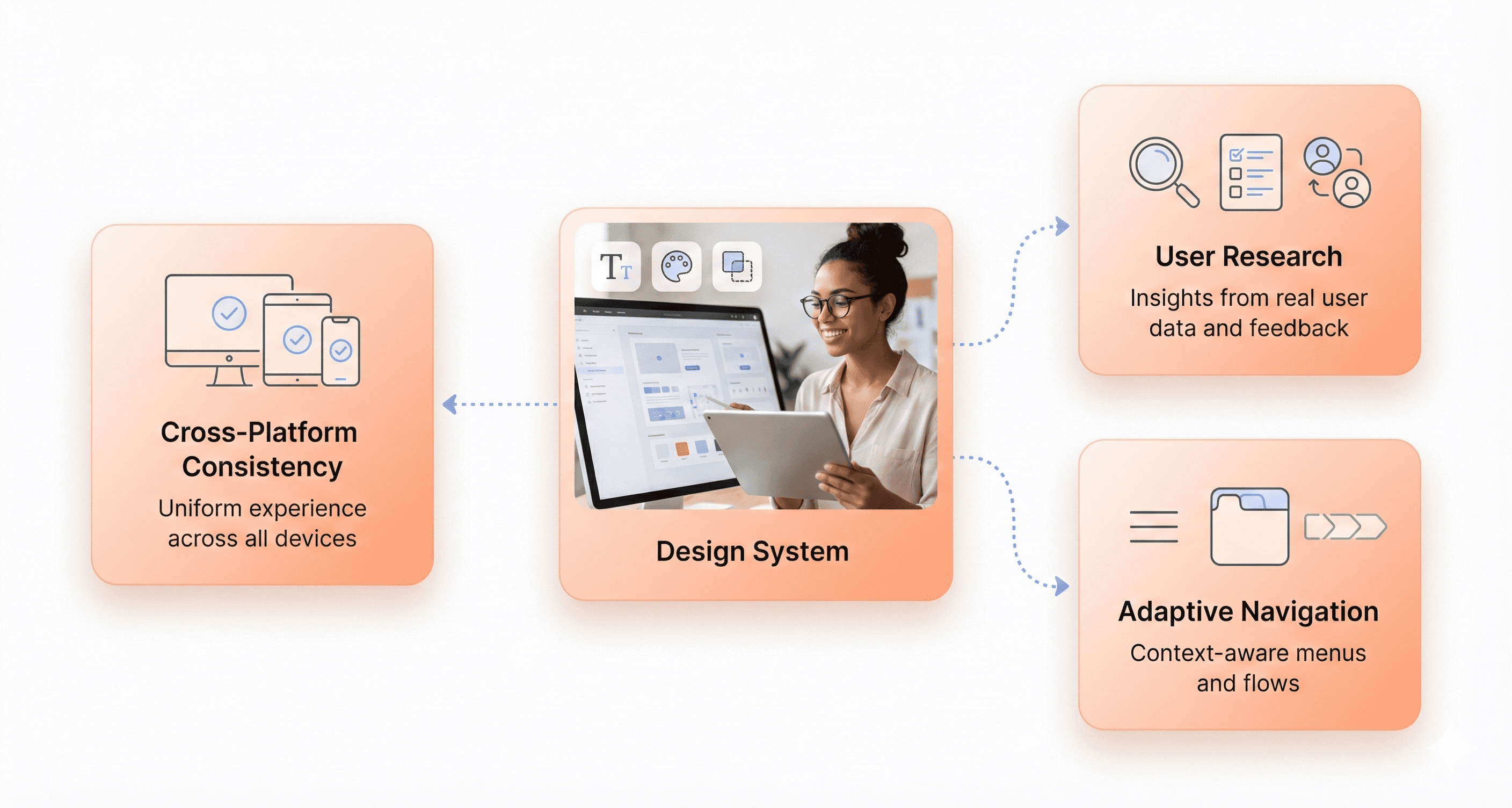
Establishing Unified Visual Language
A unified visual language forms the foundation of successful user-centered SaaS design by creating consistency across all user interactions. This approach involves developing a comprehensive design system that includes standardized color palettes, typography, iconography, and UI components. When SaaS platforms maintain consistent visual elements, users develop familiarity with interface patterns, reducing cognitive load and improving overall user experience.
The design process begins with establishing core visual principles that align with user expectations and brand identity. SaaS companies benefit from creating style guides that define spacing, button styles, form elements, and interactive states. This systematic approach ensures every interface element follows predictable patterns, helping users navigate complex workflows with confidence.
Visual consistency also extends to micro-interactions and animations that provide feedback during user interactions. When these elements follow unified principles, they create intuitive experiences that guide users naturally through SaaS apps without confusion or hesitation.
Building Visual Consistency Across Platforms
Visual consistency becomes critical as SaaS platforms expand across desktop, mobile, and tablet devices. Users expect familiar interface patterns regardless of their chosen device, making cross-platform design consistency essential for maintaining user satisfaction and engagement.
Responsive design principles ensure that core visual elements adapt appropriately to different screen sizes while maintaining recognizable patterns. This includes consistent navigation structures, button placement, and information hierarchy that users can rely on across all touchpoints. SaaS companies that prioritize visual consistency see improved user adoption rates and reduced support costs.
The development process should include regular reviews to ensure new features maintain established visual standards. Design systems help development teams implement consistent components quickly while preserving the unified experience that users have come to expect from the platform.
Conducting User Research to Bridge Experience Gaps
User research plays a fundamental role in identifying and addressing experience gaps within SaaS platforms. Through structured research methods including interviews, surveys, and usability testing, teams uncover pain points that affect user satisfaction and engagement. This data-driven approach reveals where users struggle with navigation, feature discovery, or task completion.
User personas developed from research insights help teams understand different user segments and their specific needs throughout the user journey. These personas guide design decisions by highlighting how various user types interact with SaaS apps and what interface patterns work best for each group.
Continuous user feedback collection through multiple channels provides ongoing insights into evolving user expectations. Regular usability testing sessions validate design decisions before full implementation, reducing risk and ensuring interface changes actually improve the user experience rather than creating new friction points.
Tailoring Navigation for Different Devices
Navigation design must adapt to the unique constraints and opportunities of each device type while maintaining core usability principles. Mobile devices require simplified navigation structures with touch-friendly elements, while desktop interfaces can accommodate more complex menu systems and multi-level navigation.
Responsive navigation patterns ensure users can access core functionality efficiently regardless of their device. This includes implementing appropriate menu structures, search functionality, and quick access to frequently used features. SaaS platforms that excel at device-specific navigation see higher user engagement and task completion rates across all platforms.
The design process should account for different user behaviors on various devices. Mobile users often need quick access to specific features, while desktop users may engage in more complex, multi-step workflows. Tailoring navigation to these usage patterns improves overall user satisfaction and supports diverse user needs effectively.
Overcoming Common SaaS Development Challenges
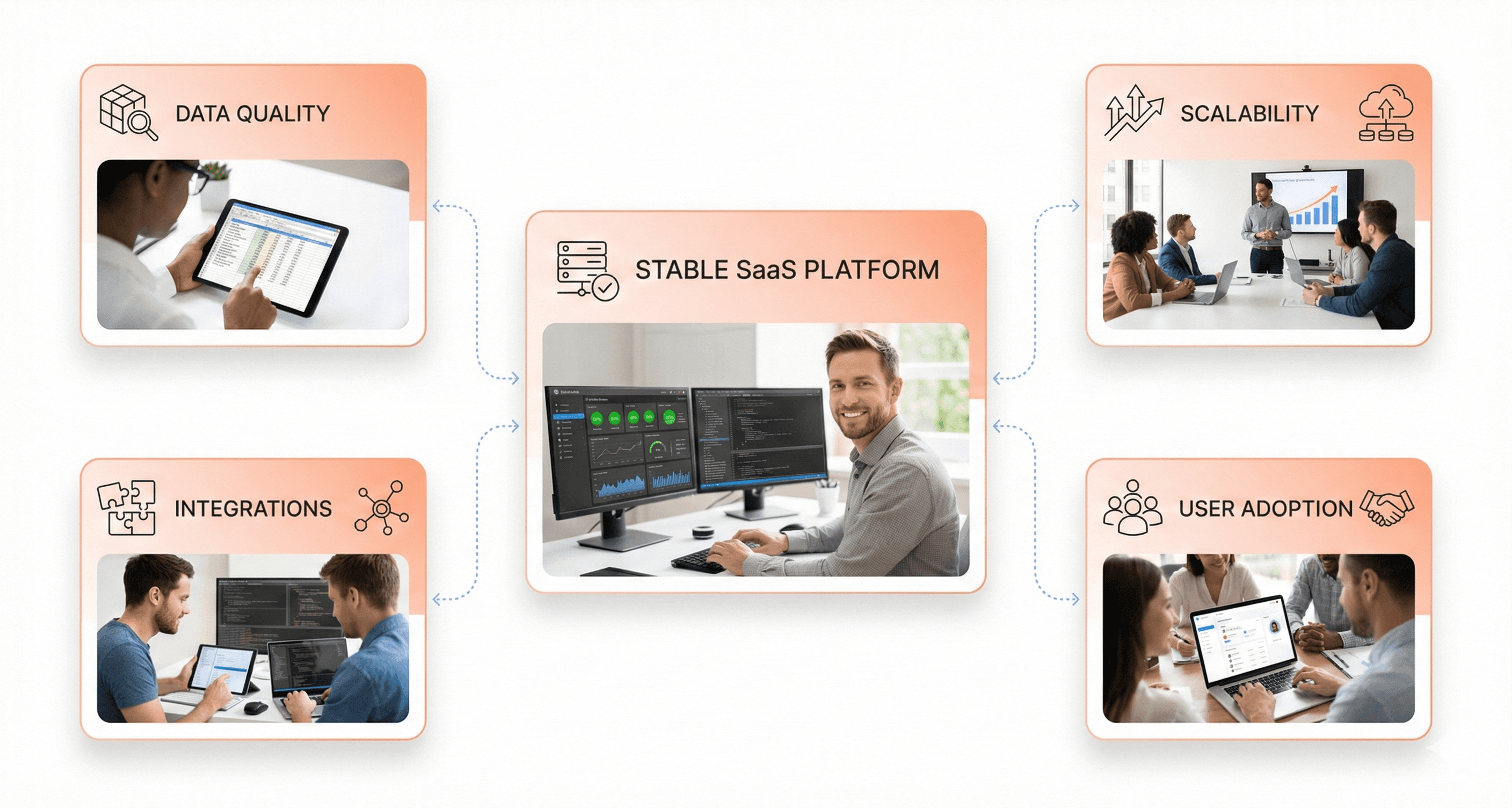
Fixing Data Quality Issues Early
Data quality challenges represent one of the most critical obstacles in SaaS development that can severely impact system performance and user experience. Poor data management can lead to inconsistencies across different system components, causing integration failures and undermining the reliability of your entire platform. The key to addressing these issues lies in establishing robust data validation processes from the beginning of your development cycle.
Data inconsistency often manifests when different parts of the code are implemented independently without proper coordination or when there's a delay in syncing data between servers. To prevent this, development teams must ensure comprehensive understanding of how each component interacts with others and implement thorough testing procedures before releasing updates. Standardized data formats like JSON or XML facilitate smooth data exchange between your platform and third-party systems, reducing complexity and streamlining integration processes.
Implementing automated validation rules at the database level and establishing clear data governance protocols ensures consistency across all system components. Regular data audits and monitoring systems help identify quality issues before they impact end users, maintaining the integrity of your SaaS platform.
Scaling Models Without Performance Loss
Scalability challenges in SaaS development become increasingly complex as user bases grow and system demands intensify. Without proper architectural planning, growing traffic can lead to performance bottlenecks, slow response times, and system crashes that severely impact user satisfaction and business continuity.
The solution lies in building for horizontal scaling rather than relying solely on vertical scaling approaches. Instead of upgrading a single server to handle increased traffic, deploy additional servers or instances to distribute the load effectively. Cloud infrastructure providers like AWS, Google Cloud, or Microsoft Azure enable easy resource scaling as applications grow, supporting dynamic capacity adjustments based on real-time demand.
Containerization technologies like Docker and orchestration tools such as Kubernetes are critical for managing scaling processes effectively. These technologies enable automatic scaling capabilities that can dynamically adjust capacity based on current load conditions, preventing potential service outages during traffic spikes.
Adopting a microservices architecture provides additional scalability benefits by allowing different application components to scale independently. This approach enables resource allocation to areas experiencing the highest demand while maintaining optimal performance across the entire system. Self-scaling systems that automatically bring extra capacity online when traffic increases ensure consistent performance during unexpected usage surges.
Solving Integration Nightmares
Modern SaaS applications rarely operate in isolation, requiring seamless integration with third-party APIs, enterprise software, and legacy systems. Integration complexity presents significant challenges that can lead to system inefficiencies, data inconsistencies, and complete system failures if not properly addressed.
The foundation for solving integration challenges lies in using open standards and providing well-documented APIs. RESTful APIs have become the industry standard for building scalable and easily integrable applications, ensuring external systems can connect effortlessly to your platform.
Key integration strategies include implementing standardized data formats like JSON or XML to facilitate smooth data exchange between systems. When integrating with third-party services, ensure they provide reliable and well-documented APIs while monitoring API versioning to prevent compatibility issues and security vulnerabilities.
For scenarios where direct API integration isn't possible, middleware solutions can bridge gaps between different systems. These platforms simplify integration processes by handling data transformation and ensuring smooth communication between disparate systems. By designing your SaaS product with integration in mind from the beginning, you create a more connected and unified user experience that appeals to customers in an increasingly interconnected business environment.
Accelerating User Adoption Rates
User experience design challenges significantly impact adoption rates and customer retention in SaaS development. Complicated interfaces, confusing workflows, and poor navigation drive users away, leading to higher churn rates and decreased satisfaction. Overcoming these challenges requires a comprehensive user-centric design approach that prioritizes usability and accessibility.
Conducting in-depth user research forms the foundation of improved adoption rates. This includes surveys, user interviews, and usability testing to understand pain points and needs of your target audience. Understanding how users interact with your platform provides valuable insights for design improvements that directly impact adoption success.
Simplifying navigation through intuitive and streamlined design prevents user confusion and abandonment. Avoid cluttered dashboards and focus on providing easy access to essential features using consistent design elements. Responsive design ensures seamless functionality across devices including mobile phones, tablets, and desktops, enhancing usability and accessibility.
Implementing smooth onboarding processes significantly improves user retention and accelerates adoption. Use guided tours, tooltips, and tutorials to help new users understand the platform quickly with minimal effort required. A well-designed onboarding experience can make the difference between user retention and abandonment, directly impacting your SaaS product's success in the market.
Launching and Iterating Your SaaS Product
Starting with MVP for Fast User Feedback
Building a minimum viable product is the cornerstone of successful SaaS product launch strategy. An MVP represents the simplest, most essential version of your product that solves a real problem for your customers. Rather than attempting to launch with every feature imaginable, focus on solving one or two customer needs exceptionally well.
The primary purpose of an MVP is to test whether your product can achieve product-market fit. As emphasized in successful launch strategies, it's not about creating perfection from the start—it's about building something that resonates enough for customers to sign up and stick around. This approach helps you avoid analysis paralysis and concentrate on what matters most: delivering real value to your audience.
When developing your MVP, prioritize collecting feedback to iterate and refine your product. Use this feedback to prove your product has staying power, as retention is the single most important metric for growth. A well-designed MVP allows you to test your core assumptions about customer needs while minimizing development time and resources.
Focus your MVP on addressing the most pressing pain points identified during your market research. This targeted approach ensures that early adopters can immediately see the value proposition, making them more likely to provide meaningful feedback and become advocates for your product.
Building Continuous Feedback Loops
Establishing robust feedback mechanisms is essential for ongoing product improvement and customer satisfaction. Once your product is live, the insights gained from initial customer feedback become your most valuable resource for understanding what's working and identifying areas for enhancement.
Create multiple channels for users to share their thoughts, including surveys, in-app feedback forms, and direct communication through customer support channels. This multi-channel approach ensures that you capture feedback from users with different communication preferences and usage patterns.
Active listening to users helps you identify pain points, understand successful features, and uncover new opportunities to enhance the user experience. The key is not just collecting feedback but analyzing it systematically to identify patterns and prioritize improvements that will have the greatest impact on user satisfaction and retention.
Consider implementing dedicated feedback collection tools within your product interface. These can include simple rating systems, feature request forms, or contextual prompts that appear after users complete specific actions. This approach captures feedback when users' experiences are fresh in their minds.
Implementing Weekly Iteration Cycles
Continuous iteration is essential for maintaining relevance and value in the competitive SaaS environment. Weekly iteration cycles provide a structured approach to incorporating user feedback while maintaining development momentum and team alignment.
Map out a product roadmap that incorporates user suggestions and aligns with your long-term goals. Focus on delivering updates and new product features that address critical user needs while improving overall functionality. This requires careful prioritization to ensure that your engineering and product teams are aligned on which features, modules, or integrations are high-priority on your product roadmap.
Weekly cycles allow for rapid response to user feedback while providing enough time to implement meaningful changes. This frequency prevents the accumulation of technical debt while ensuring that user concerns are addressed promptly. Each iteration should include planning, development, testing, and deployment phases within the weekly timeframe.
Document each iteration's goals, changes implemented, and results achieved. This documentation helps track progress over time and provides valuable insights for future planning cycles. Regular iteration also demonstrates to customers that their feedback is valued and acted upon quickly.
Monitoring Critical Post-Launch Metrics
Tracking key performance indicators is essential for understanding the effectiveness of your launch efforts and staying aligned with growth objectives. Critical post-launch metrics provide valuable insights into your product's performance and guide data-driven decision making.
Focus on metrics like customer acquisition cost (CAC), churn rate, and lifetime value (LTV) to understand your product's financial performance. Additionally, monitor user acquisition metrics such as signups, conversion rates, and cost per acquisition to evaluate the effectiveness of your marketing efforts.
Engagement metrics including daily or monthly active users (DAUs/MAUs), session duration, and feature adoption rates reveal how users interact with your product. These metrics help identify which features provide the most value and which areas may need improvement or better user education.
Revenue metrics such as average revenue per user (ARPU) and customer lifetime value provide insights into your business model's sustainability. Monitor these metrics regularly using dashboards or analytics tools to consolidate and analyze data from various sources.
Establish realistic, time-bound milestones for your key metrics. Examples include reaching 1,000 paying customers within three months of launch, achieving a 70% customer retention rate by the end of the first quarter, or maintaining specific engagement levels. These milestones help keep your team focused on measurable outcomes and provide clear indicators of progress toward your business objectives.
Conclusion
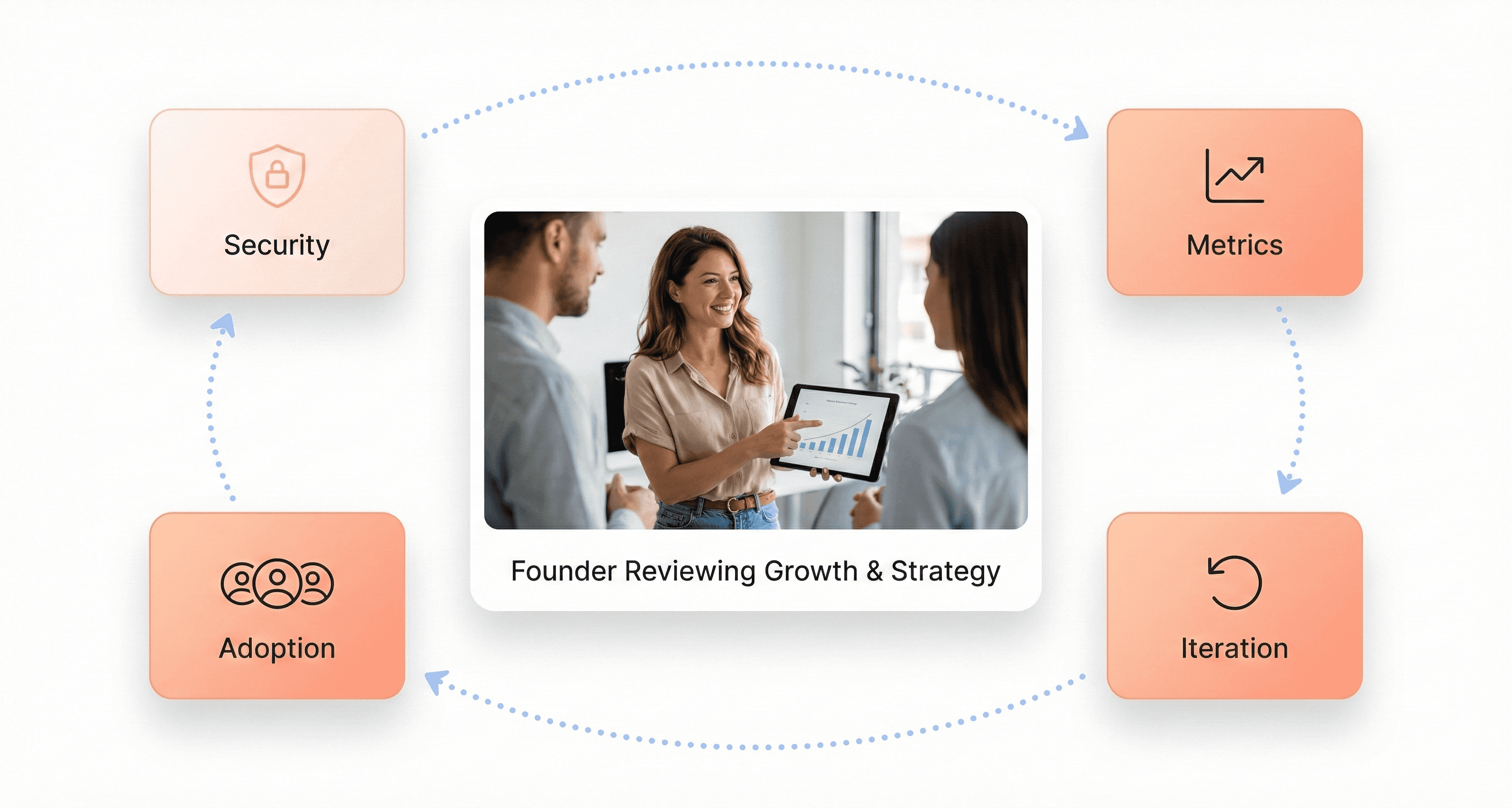
The SaaS landscape of 2026 demands more than just functional software—it requires products that seamlessly blend user-centered design, scalable architecture, and intelligent AI integration. Success hinges on achieving genuine product-market fit, building agile development teams, and maintaining unwavering focus on security and compliance. From crafting compelling product visions to implementing cost-effective development strategies, every element must work in harmony to create solutions that users genuinely need and love.
The companies that will dominate this space are those that embrace continuous iteration, listen relentlessly to user feedback, and pivot boldly when data demands it. Your SaaS product's journey doesn't end at launch—it begins there. Stay agile, prioritize core functionality over feature creep, and remember that the best SaaS solutions solve real problems with elegant simplicity. The market is ready, the tools are available, and the opportunity is now. Build with purpose, launch with confidence, and scale with intelligence.
SaaS product development trends are reshaping how companies build and scale cloud solutions in 2026. This guide is for product managers, startup founders, and product development teams who want to stay ahead in the competitive SaaS landscape.
The SaaS market continues exploding with over 17% growth expected this year, but success depends on more than just riding the wave. You'll discover how achieving product-market fit creates the foundation for sustainable growth, while AI integration transforms basic features into intelligent, personalized experiences that users can't live without.
We'll also cover building scalable architecture that won't break when your user base suddenly doubles, and creating development teams with the right mix of skills to handle everything from machine learning to security compliance. These aren't just nice-to-have strategies – they're essential building blocks that separate thriving SaaS companies from those struggling to keep up.
Achieving Product-Market Fit for SaaS Success
Defining Your Ideal Customer Avatar
Achieving product-market fit begins with precisely identifying your target market through comprehensive customer avatar definition. This foundational step requires diving deep into understanding your potential customers' demographics, psychographics, pain points, and desired outcomes. Your ideal customer avatar should encompass who they are, where they work, what their typical workday looks like, and the specific challenges they face that your SaaS solution addresses.
Regularly update this customer definition as you gather new insights from conversations, interviews, and surveys. As a SaaS startup, your product will likely serve a small market segment initially, but as you grow, your understanding of the problem you're solving will expand, causing your customer profile to evolve accordingly.
The key is to avoid building for everyone and instead focus on creating a tailored solution for users who share your vision and fit your target niche. This targeted approach ensures that you're developing features and capabilities that truly resonate with your intended audience rather than diluting your efforts across multiple customer segments.
Solving High-Stakes Pain Points
Product-market fit fundamentally depends on addressing genuine, high-impact problems for your target market. Your SaaS solution must serve as a vital answer to pressing needs that your substantial audience is actively seeking to resolve. This requires going beyond surface-level market research to conduct an in-depth mission that unearths the authentic challenges your potential customers face.
Understanding these pain points involves asking targeted questions about what your customers need to accomplish, what obstacles they encounter, what solutions they've previously tried, and how they currently address these challenges. The goal is to identify problems that are significant enough that customers are willing to pay for a solution.
Your value proposition becomes the beacon in this quest—not merely marketing copy, but a powerful declaration of the unique benefits and solutions your product delivers. When you successfully address high-stakes pain points, customer acquisition transforms from a constant struggle into a natural outcome of your market resonance, creating organic growth and word-of-mouth referrals.
Tracking User Retention and Loyalty Metrics
Measuring product-market fit requires monitoring key retention and loyalty metrics that indicate how well your SaaS solution aligns with market needs. Customer retention serves as a critical factor in assessing product-market fit, as your ability to keep customers engaged and satisfied demonstrates whether you're effectively meeting their requirements.
Essential metrics include churn rate, which measures the percentage of customers who discontinue using your product over a defined period. A lower churn rate indicates stronger product-market fit. Monthly Recurring Revenue (MRR) tracking reveals consistency and growth patterns, with rising MRR signaling increasing market acceptance.
Customer Lifetime Value (CLV) evaluates the total value a customer brings throughout their relationship with your product, while Customer Acquisition Cost (CAC) analysis helps determine the sustainability of your business model. Higher CLV compared to CAC suggests healthy product-market alignment.
Additional vital metrics include Net Promoter Score (NPS) surveys to measure customer loyalty and likelihood of recommendations, Customer Satisfaction Score (CSAT) through surveys and feedback mechanisms, and feature usage analytics to understand which product capabilities deliver the most value to users.
Implementing Continuous Feedback Loops

Establishing robust feedback mechanisms is essential for both achieving and maintaining product-market fit in the dynamic SaaS landscape. This involves creating systematic processes for gathering, analyzing, and acting upon customer insights throughout your product development lifecycle.
Regular customer conversations form the cornerstone of effective feedback loops. Schedule ongoing interviews with target customers, asking open-ended questions about their experiences, challenges, and evolving needs. The frequency of these conversations directly correlates with how quickly you'll identify misalignments between customer expectations and your product capabilities.
Leverage multiple feedback channels including customer support interactions, feedback widgets, feature requests, and user surveys. However, strategically weight this feedback based on customer value and engagement levels—insights from daily-using, paying customers carry more significance than feedback from inactive free-tier users.
Implement structured processes for your team to report and store customer needs and problems. Create systems that allow customer support, sales, and product teams to share insights about user experiences and emerging patterns. This cross-functional approach ensures that valuable customer intelligence doesn't get lost in organizational silos.
The key to successful feedback loops is not just collection but strategic response. Analyze feedback contextually, segment it by user type and engagement level, and prioritize actions based on your current business objectives. Remember that maintaining product-market fit requires continuous adaptation as market conditions, customer needs, and competitive landscapes evolve.
Crafting a Clear and Actionable SaaS Product Vision

Defining Transformational Outcomes for Users
A strong SaaS product vision begins with clearly defining transformational outcomes for your users. Rather than focusing on features or technical capabilities, effective product visions articulate the meaningful change your product will create in users' lives or businesses. As the reference content emphasizes, "A good Product Vision expresses the value the Product should deliver and to whom that value is delivered."
Consider how successful SaaS companies frame their transformational outcomes. LinkedIn's vision "Create economic opportunity for every member of the global workforce" focuses entirely on the life-changing impact for users, not on networking features or profile functionality. Similarly, Slack's vision "Make work life simpler, more pleasant and more productive" emphasizes the workplace transformation users will experience.
When defining transformational outcomes for your SaaS product development trends, start with deep customer research. You must understand your target customer's needs, desires, and pain points, as well as their demographic and psychographic characteristics. This research ensures your vision addresses real user problems and aspirations.
The transformational outcome should answer the fundamental question: "Why should customers choose your product over others?" Your value proposition must highlight unique benefits and demonstrate how your SaaS solution will solve customer problems or enhance their lives in ways competitors cannot match.
Aligning Vision with Core Values
Product vision alignment with core company values creates authenticity and consistency across your SaaS development roadmap. An effective product vision must support and enhance your overall business strategy while resonating with your company's mission and ethos. This alignment ensures consistency across different product lines and reinforces your brand identity.
The connection between vision and values goes beyond surface-level messaging. When your product vision genuinely reflects your company's core beliefs, it becomes easier to make strategic decisions during development. Teams can evaluate features, priorities, and trade-offs against both the vision and underlying values, creating a coherent development approach.
Values-aligned visions also inspire teams more effectively. When team members understand not just what they're building but why it matters to the organization's deeper purpose, their performance on execution improves dramatically. This emotional connection becomes particularly important for SaaS development teams working on complex, long-term projects.
Consider Ben and Jerry's vision: "To make, distribute, and sell the finest-quality ice cream and euphoric concoctions with a continued commitment to incorporating wholesome, natural ingredients and promoting business practices that respect the Earth and the Environment." This vision seamlessly integrates product goals with environmental and quality values, creating a unified direction for all business decisions.
For SaaS products, values alignment might manifest through commitments to user privacy, accessibility, sustainability, or ethical AI integration—all increasingly important considerations in modern SaaS product development trends.
Future-Proofing Your Vision for Market Changes
While product strategies and roadmaps can change to address market developments, your product vision should remain relatively stable yet adaptable enough to stay relevant amid changing circumstances. This balance between stability and flexibility represents one of the most challenging aspects of vision crafting.
Future-proofing requires envisioning your product's long-term success and scalability. Your vision should anticipate how the product can scale, adapt, and remain relevant as it grows and market conditions evolve. Consider not just immediate impact but potential to drive enduring success over the typical 2-5 year timeline for software products.
Market adaptability means building resilience into your vision statement without making it so broad as to be meaningless. Amazon's evolution from e-commerce to cloud services demonstrates how a clear understanding of core purpose enables successful pivots. They succeeded because they understood their "why"—not just what they were selling, but the fundamental value they provided to customers.
For SaaS companies navigating AI integration trends, future-proofing might mean crafting visions that emphasize enhanced user capabilities rather than specific AI technologies. This approach allows your vision to remain relevant as AI capabilities evolve while maintaining focus on user transformation.
Regular vision review processes help ensure continued market relevance. While the core vision remains stable, you may need to adjust emphasis or interpretation as new technologies, competitive dynamics, or user behaviors emerge. The key is maintaining the aspirational and actionable balance that makes visions effective while allowing for strategic evolution.
Building Agile Development Roadmaps That Scale

Creating Measurable Short and Long-Term Milestones
Successful SaaS development roadmaps require clearly defined milestones that balance immediate deliverables with strategic long-term objectives. Short-term milestones should focus on delivering working software within 1-2 week sprints, allowing teams to maintain momentum and respond quickly to market feedback. These immediate goals include feature completions, bug fixes, and iterative improvements that directly impact user experience.
Long-term milestones align with broader product vision and market positioning, typically spanning 3-6 months. These strategic objectives should encompass major feature releases, market expansion initiatives, and scalability improvements. The key is establishing measurable criteria for each milestone, whether it's user adoption rates, performance metrics, or revenue targets.
Starting with MVP for Rapid Market Validation
The MVP (Minimum Viable Product) approach forms the foundation of effective SaaS development roadmaps. By breaking down development into small increments with integrated testing, agile methodologies reduce the risk of large-scale project failures while enabling rapid market validation.
Starting with an MVP allows SaaS companies to release new features or updates quickly and establish a consistent development rhythm. This iterative approach emphasizes working software over comprehensive documentation, speeding up the validation process. The MVP strategy enables teams to gather real user feedback early, informing future development decisions and ensuring alignment with customer needs.
Prioritizing Features Based on Impact
Feature prioritization requires balancing customer demands with technical feasibility and business objectives. Agile methodologies emphasize frequent customer feedback loops, helping SaaS companies align product development with actual user needs rather than assumed requirements.
The most effective prioritization frameworks consider multiple factors: user impact, development complexity, revenue potential, and strategic importance. Teams should identify critical features and requirements, prioritizing them to ensure the most important capabilities are delivered first. This approach reduces the risk of delays while increasing the chances of product success.
However, agile's flexibility can lead to scope creep, where project scope expands continuously without clear boundaries. Maintaining focus on high-impact features requires disciplined decision-making and regular roadmap reviews to prevent feature bloat.
Implementing Visual Progress Tracking
Visual progress tracking transforms abstract development goals into tangible, measurable outcomes. Agile frameworks like Scrum and Kanban foster transparent communication and collaboration within teams, enhancing productivity and alignment across different departments in SaaS companies.
Effective visual tracking systems should display sprint progress, feature completion rates, and milestone achievements in real-time. These systems help teams identify potential issues early and maintain accountability throughout the development process. Visual dashboards also facilitate stakeholder communication, providing clear insights into development velocity and project health.
The key is using appropriate metrics and tracking mechanisms that focus on meaningful progress indicators rather than vanity metrics. Teams should monitor both technical achievements and business outcomes to ensure development efforts translate into customer value and business growth.
Integrating AI to Drive Growth and Personalization

Embedding AI in Core Workflows
Previously, I've discussed the foundation of SaaS product development, but now that we've covered the strategic elements, it's time to explore how AI integration SaaS products can transform your development approach. Successful AI integration requires embedding artificial intelligence directly into core business workflows rather than treating it as an add-on feature.
The statistics reveal that 60%+ of enterprise SaaS products now have embedded AI features, marking a significant shift from supplementary tools to core functionality. This embedded intelligence approach allows SaaS companies to deliver smarter, more personalized experiences that directly impact key metrics like ARR (annual recurring revenue) and customer retention.
To achieve effective AI integration, focus on workflows where automation can deliver immediate value. Research shows that 40% of organizations use AI in customer service/support automation, while 45% leverage AI in IT service management applications. These use cases demonstrate tangible ROI and provide a foundation for expanding AI capabilities across other workflows.
Choosing High-Impact AI Use Cases
With this embedded approach in mind, next we'll see how selecting the right AI use cases determines the success of your integration efforts. The global AI SaaS market is expected to grow at a 38.28% CAGR, from $71.54 billion in 2023 to $775.44 billion by 2031, indicating massive opportunities for companies that identify high-impact applications.
Predictive analytics represents one of the most valuable AI use cases, enabling SaaS businesses to predict customer behavior and optimize retention strategies. Companies implementing AI-driven predictive models see improved LTV/CAC ratios and stronger recurring revenue growth, making these investments attractive to growth capital providers.
Customer success automation stands out as another high-impact area. AI can analyze user behavior patterns, identify at-risk accounts, and trigger automated interventions before churn occurs. This proactive approach to customer management has become essential as SaaS companies face increasing pressure to demonstrate capital efficiency and predictable revenue growth.
Operational efficiency through intelligent automation also delivers measurable results. Organizations report that 76% of SaaS companies use or are exploring AI for operations, with many achieving significant improvements in productivity and cost management through automated workflows.
Building Clean Data Pipelines for AI Success
Now that we have covered high-impact use cases, the foundation of successful AI implementation rests on clean, well-structured data pipelines. Without quality data infrastructure, even the most sophisticated AI models will fail to deliver meaningful results for your SaaS product development trends.
Data quality directly impacts AI performance and business outcomes. Organizations with robust data pipelines can leverage machine learning and natural language processing more effectively, leading to better predictive accuracy and more personalized user experiences. This infrastructure investment becomes critical as 92% of SaaS companies plan to increase their use of AI in their products in 2025.
Establishing proper data governance ensures consistency across all AI applications within your SaaS platform. This includes implementing data validation processes, maintaining data lineage documentation, and creating standardized formats that support multiple AI use cases simultaneously. These practices enable scalable AI deployment across different product features and workflows.
Real-time data processing capabilities become essential for AI applications that require immediate responses, such as fraud detection, personalization engines, and automated customer support. Companies that invest in streaming data architectures can deliver more responsive AI-powered features, directly improving user satisfaction and retention metrics.
Training In-House AI Talent
Previously, I've outlined the technical requirements for AI integration, but building internal AI capabilities requires dedicated talent development strategies. The rapid growth in AI SaaS applications means that 95% of companies have invested in AI-driven use cases, creating intense competition for skilled AI professionals.
Developing in-house expertise starts with identifying team members who show aptitude for machine learning concepts and data analysis. Many successful SaaS companies create internal training programs that combine theoretical AI knowledge with hands-on experience using their specific data sets and business challenges.
Cross-functional AI literacy becomes crucial as AI integration touches multiple departments beyond engineering. Sales teams need to understand AI-powered lead scoring, customer success teams require knowledge of predictive analytics, and product managers must grasp how AI features impact user experience and business metrics.
Strategic partnerships with AI education providers and consultants can accelerate talent development while building long-term internal capabilities. This approach allows companies to maintain control over their AI roadmap while accessing specialized expertise during critical implementation phases, supporting the broader goal of creating scalable SaaS architecture and high-performance development teams.
Designing Scalable Architecture for Growth

Implementing Microservices for Flexibility
Modern SaaS platforms achieve superior scalability by breaking functionality into smaller, independent services rather than building one massive application. This microservices approach enables each service to handle specific tasks like user authentication, payment processing, and data analytics independently, allowing for targeted updates and scaling without affecting the entire system.
When your payment service requires an upgrade or analytics functionality experiences heavy traffic during end-of-month reporting, you can address that specific component without disrupting other platform functions. This architectural pattern accelerates development by enabling different teams to work on separate services simultaneously, reducing conflicts and deployment dependencies.
The strategic advantage becomes clear when handling growth - if one service experiences increased demand, you can scale only that component rather than provisioning resources for the entire application. This targeted scaling approach transforms unpredictable infrastructure costs into manageable expenses that align with actual usage patterns.
Adopting Cloud-Native Infrastructure
Cloud-native infrastructure forms the backbone of scalable SaaS architecture, providing the foundation for automatic scaling and reliable performance. Modern SaaS platforms leverage cloud providers like AWS, Azure, or Google Cloud to transform rapid user growth from a technical challenge into a business opportunity.
This approach enables pay-as-you-go resource allocation, where infrastructure costs scale proportionally with revenue. When starting with a handful of users, costs remain minimal. As your user base expands from 100 to 1,000 customers, infrastructure expenses grow alongside your business success rather than requiring expensive upfront investments in dedicated servers.
Automated scaling capabilities monitor key metrics including CPU usage, memory consumption, and request queues, automatically adjusting resources to match current demands. During marketing campaigns that bring user surges, additional servers spin up automatically, while excess resources scale down during off-peak periods to optimize costs.
Multi-cloud strategies distribute platforms across multiple providers, reducing vulnerability to outages while leveraging each provider's unique strengths. This approach provides negotiation leverage and enables taking advantage of AWS's broad service range, Azure's Microsoft ecosystem integration, or Google Cloud's AI/ML capabilities.
Creating API-Centric Systems
API-centric architecture enables seamless integration with third-party services while providing the flexibility to adapt to future technological needs. By designing integration points and APIs strategically, SaaS platforms can easily connect with external services and evolve without major restructuring.
This modular approach facilitates gradual feature expansion, allowing new functionality to be developed and tested in isolation before integration into the main system. The architecture supports third-party integrations and enables adopting new technologies without disrupting existing user experiences.
Well-designed APIs ensure data flows efficiently between services while maintaining security protocols and access controls. This foundation supports both current operational needs and future growth plans, providing the flexibility essential for evolving market demands.
Automating Infrastructure Management
Infrastructure automation eliminates manual intervention requirements while maintaining optimal performance across varying demand patterns. Smart load balancing distributes incoming traffic across multiple servers, preventing individual servers from becoming overwhelmed while ensuring consistent response times regardless of user location.
Proper load balancers monitor server health continuously, redirect users to the closest geographical servers, and automatically remove problematic servers from rotation. This ensures users in different regions receive equally responsive experiences while maintaining system reliability.
Automated systems watch performance metrics and adjust resources dynamically, maintaining optimal functionality without requiring constant manual oversight. When activity increases, additional resources activate automatically; when demand decreases, excess capacity scales down to control costs.
This automation extends to disaster recovery mechanisms, including scheduled backups, multi-region redundancy, and automated failover systems. These systems ensure data preservation, protect against localized outages, and provide seamless service switching during disruptions, all while maintaining strict uptime guarantees through comprehensive Service Level Agreements.
Building High-Performance SaaS Development Teams

Defining Key Roles and Responsibilities
Building high-performance SaaS development teams requires establishing clear roles and responsibilities that align with your company's growth stage and business objectives. The organizational structure of SaaS development teams evolves significantly as companies scale from startup to enterprise level.
In early-stage SaaS companies with 1-10 employees, team members typically wear multiple hats with loosely defined responsibilities. The founder often leads product vision while handling sales and marketing functions, while co-founders or key team members manage product development and technology delivery alongside administrative operations.
As teams grow to 25-50 employees, more formal structure emerges with dedicated roles including Sales Manager, Product Development Manager, and Marketing Manager. The organizational chart begins following traditional hierarchy patterns with executives, departments, managers, and employees having assigned responsibilities.
At the 50-75 employee level, C-suite positions become essential, typically introducing Chief Executive Officer (CEO) and Chief Financial Officer (CFO) roles. Many companies also add Chief Information Officer (CIO) or Chief Information Security Officer (CISO) positions to oversee technical operations and security.
For larger organizations with 75+ employees, formal departmental structures emerge with Vice Presidents heading defined areas including Sales, Marketing, Finance, Product Development, Customer Support, and Human Resources. Within each functional area, managers or leads oversee specific functional groups, creating clear chains of command and accountability.
Hiring Essential Technical Specialists
Now that we've covered organizational structure, let's examine the critical technical roles that drive SaaS development success. The composition of technical specialists varies significantly based on annual recurring revenue (ARR) milestones and company growth stage.
For companies with ARR up to $1 million, technical teams typically center around core engineering roles with leads for key functions. The median team structure shows heavy investment in engineering, with 12 engineers supporting 6 sales team members and 4 marketing professionals.
As ARR grows to $1-5 million, companies maintain strong engineering focus while scaling go-to-market teams. The ratio of engineers to salespeople begins shifting from 2:1 toward 1:1 as customer acquisition and support become increasingly important.
Essential technical specialist roles include:
Product Managers who bridge business requirements with technical implementation
Software Developers responsible for core platform development
App Engineers focusing on user interface and experience
Feature Development Specialists who drive product enhancement initiatives
Technical Support Specialists providing customer-facing technical assistance
Product Support Coordinators managing technical customer success initiatives
Companies reaching $5-20 million ARR typically see 10x growth in sales staffing compared to 5x growth in engineering teams, requiring careful balance between technical development capacity and market-facing capabilities.
Balancing Frontend and Backend Development Skills
With this organizational foundation in mind, next we'll explore the critical balance between frontend and backend development capabilities. Modern SaaS development requires seamless integration between user-facing interfaces and robust backend infrastructure to deliver scalable, performance-driven applications.
Frontend development teams focus on user experience, interface design, and customer interaction points. These specialists work closely with Product and Engineering departments to create intuitive, responsive interfaces that drive user engagement and satisfaction. Frontend roles typically include user experience designers, interface developers, and customer-facing application engineers.
Backend development specialists concentrate on server-side logic, database management, API development, and system architecture. These technical experts ensure platform scalability, data security, and integration capabilities that support growing user bases and feature sets.
The optimal balance between frontend and backend resources depends on your SaaS product's complexity and customer interaction model. Companies with heavily interactive user interfaces may require higher frontend-to-backend ratios, while enterprise SaaS platforms with complex data processing needs often emphasize backend development capacity.
Cross-functional collaboration becomes essential as teams scale. Product managers coordinate between frontend and backend teams to ensure cohesive development roadmaps, while technical leads establish architecture standards that support both user experience goals and system performance requirements.
Integrating MLOps and Quality Assurance
Previously, I've discussed core development roles, but modern SaaS development increasingly requires specialized capabilities in machine learning operations (MLOps) and comprehensive quality assurance frameworks. These functions represent critical differentiators for competitive SaaS products.
MLOps specialists bridge the gap between data science initiatives and production deployment, ensuring AI-driven features integrate seamlessly into existing SaaS platforms. These roles become increasingly important as companies leverage artificial intelligence for personalization, automation, and predictive analytics capabilities.
Quality assurance teams ensure product reliability, security, and performance standards across all development cycles. QA specialists collaborate with both frontend and backend development teams to establish testing protocols, automated quality checks, and continuous integration processes that maintain product excellence as features expand.
Modern SaaS development teams integrate QA processes throughout development cycles rather than treating quality assurance as end-stage validation. This approach requires QA specialists who understand both technical architecture and user experience requirements, enabling comprehensive testing strategies that address functionality, security, performance, and usability simultaneously.
The integration of MLOps and QA functions requires careful coordination with existing development workflows, ensuring these specialized capabilities enhance rather than complicate development processes while maintaining the agility and innovation focus that characterizes successful SaaS development teams.
Implementing Security and Compliance Best Practices
Prioritizing End-to-End Encryption

End-to-end encryption serves as a fundamental security control for protecting sensitive data throughout its entire lifecycle in SaaS applications. This comprehensive approach ensures that data remains secure whether at rest, in transit, or during processing, establishing a critical foundation for SaaS security compliance.
Implementing robust encryption requires careful consideration of various data protection scenarios. Financial reporting regulations like the Sarbanes-Oxley Act (SOX) and ASC 606 demand accurate revenue recognition and financial data integrity, making granular access controls and data encryption essential for protecting financial information. Similarly, SaaS providers handling healthcare data must implement strong encryption as part of their HIPAA compliance strategy to safeguard protected health information (PHI).
For organizations processing payment card data, PCI DSS compliance mandates encryption as a core requirement alongside firewalls, access controls, and security audits to protect sensitive cardholder information. This multi-layered encryption approach ensures that even if unauthorized access occurs, the data remains unreadable and unusable.
Controlling Access with Strict Permissions
Access management represents a critical component of SaaS security compliance, requiring organizations to regularly review and reduce excessive permissions to limit data exposure. Effective access control strategies ensure that access levels comply with major frameworks including SOC 2, HIPAA, ISO 27001, and NIST standards.
SOC 2 compliance specifically evaluates how organizations manage customer data across five trust principles: security, availability, processing integrity, confidentiality, and privacy. Implementing strict access controls demonstrates commitment to these principles while reducing the risk of unauthorized data exposure. Organizations must establish granular permission structures that align with the principle of least privilege, ensuring users only access the data necessary for their specific roles.
Multi-factor authentication emerges as an essential security measure within access control frameworks. This additional layer of protection significantly reduces the likelihood of unauthorized access, even when credentials are compromised. Regular access reviews and automated permission auditing help maintain compliance while identifying potentially risky over-privileged accounts or unused integrations that could expose sensitive data.
Adopting Zero-Trust Network Architecture
Zero-trust architecture fundamentally transforms traditional security approaches by eliminating implicit trust and requiring verification for every access request. This model aligns perfectly with modern SaaS security compliance requirements, particularly as organizations manage increasingly distributed and dynamic environments.
The National Institute of Standards and Technology Cybersecurity Framework (NIST CSF) provides guidelines for managing cybersecurity threats through identification, protection, detection, response, and recovery phases. Zero-trust principles support this framework by ensuring continuous verification and validation of all network traffic and access requests, regardless of their origin.
This architecture proves especially valuable in addressing the compliance challenges inherent in SaaS environments, where data fragmentation across multiple applications complicates governance and compliance tracking. By implementing zero-trust principles, organizations can maintain better visibility and control over data access patterns, supporting compliance with frameworks like GDPR, which emphasizes data protection by design and by default.
Automating Threat Detection and Response
Automated threat detection and response systems provide essential capabilities for maintaining continuous compliance monitoring and addressing security incidents promptly. These systems enable organizations to detect suspicious activities in real-time while maintaining comprehensive audit trails required for various compliance frameworks.
The Center for Internet Security (CIS) Controls emphasize the importance of automated security monitoring as part of critical guidelines for securing information systems, including SaaS applications. Automated systems can continuously assess security configurations, identify potential vulnerabilities, and respond to threats before they escalate into significant breaches.
Effective incident response planning requires well-defined protocols for identifying, containing, eradicating, recovering, and learning from security incidents. Automated systems support these protocols by providing immediate alerting, evidence collection, and initial containment measures. This capability proves crucial for meeting compliance requirements that mandate timely breach notifications, such as GDPR's requirement for reporting breaches within 72 hours.
Organizations implementing automated threat detection must also maintain comprehensive logging across all SaaS applications to streamline audits and demonstrate adherence to SOC standards. These logs provide the detailed documentation necessary for external audits and regulatory reporting, while automated analysis helps identify patterns that might indicate compliance violations or security risks.
Managing SaaS Development Costs and Budgets

Setting Clear MVP and Phase Budgets
Establishing precise budget frameworks for SaaS development costs begins with understanding that cloud hosting expenses typically represent 6%-12% of SaaS revenue for most companies. When planning your MVP budget, prioritize core functionality that validates product-market fit while minimizing infrastructure overhead. Start with essential features that demonstrate value to early users, avoiding the temptation to over-engineer the initial release.
Phase-based budgeting requires careful consideration of development milestones and corresponding infrastructure scaling needs. Each development phase should have clearly defined cost parameters, including personnel, infrastructure, and third-party service expenses. Monitor these budgets closely, as SaaS development costs can escalate quickly when teams lack cost-aware culture and oversight.
Planning for AI and Infrastructure Scaling Costs
AI integration represents a significant cost driver in modern SaaS development, requiring specialized infrastructure and computing resources. Machine learning and artificial intelligence capabilities demand substantial cloud resources, often increasing hosting costs beyond traditional SaaS applications. Plan for these elevated expenses by evaluating the specific AI technologies your product requires and their associated infrastructure needs.
Infrastructure scaling costs must be projected based on user growth patterns and feature complexity. Cloud hosting expenses scale with usage, making it crucial to model different growth scenarios and their financial impact. Consider factors like data processing volumes, storage requirements, and compute-intensive operations when forecasting these costs. Implement monitoring systems early to track actual usage against projections and adjust budgets accordingly.
Budgeting for Ongoing Security and Compliance
Security and compliance costs represent ongoing operational expenses that must be factored into long-term SaaS development budgets. These costs encompass security tools, compliance auditing, data protection measures, and specialized personnel. Unlike one-time development expenses, security and compliance costs continue throughout the product lifecycle and often increase as regulatory requirements evolve.
Plan for regular security assessments, compliance certifications, and ongoing monitoring services. Budget for both preventive measures and incident response capabilities, as security breaches can result in significant unplanned expenses. Consider the specific compliance requirements for your target market, as different industries and regions may have varying regulatory costs.
Leveraging Cost-Saving Opportunities
Effective SaaS cost management focuses on identifying and eliminating unnecessary expenses through systematic optimization. Begin by conducting comprehensive audits of all development-related expenses, including shadow IT purchases where individual team members acquire tools using corporate credit cards or expense reimbursements. Studies indicate that approximately 51% of SaaS-related transactions are not properly tagged as software expenses, making comprehensive discovery crucial.
Rationalize overlapping tools and services by identifying functional redundancies in your development stack. Common areas for consolidation include collaboration platforms, project management tools, and development utilities. Standardizing on approved tools across teams can yield significant savings through volume discounts and reduced administrative overhead.
License optimization presents substantial cost-saving opportunities, with research showing that approximately 53% of SaaS licenses remain underutilized in typical 30-day periods. Implement regular license audits to identify unused or underutilized seats, then reallocate or eliminate these licenses to reduce waste. This process becomes particularly important during team transitions or project completions.
Negotiate with vendors for better terms, especially when approaching renewal dates. Many SaaS providers offer flexibility during economic downturns or for long-term commitments. Consider options like shifting to usage-based pricing, extending contract terms for better rates, or bundling services for volume discounts. Research vendor positioning and revenue models to identify negotiation opportunities that benefit both parties.
Creating User-Centered SaaS Design Guidelines

Establishing Unified Visual Language
A unified visual language forms the foundation of successful user-centered SaaS design by creating consistency across all user interactions. This approach involves developing a comprehensive design system that includes standardized color palettes, typography, iconography, and UI components. When SaaS platforms maintain consistent visual elements, users develop familiarity with interface patterns, reducing cognitive load and improving overall user experience.
The design process begins with establishing core visual principles that align with user expectations and brand identity. SaaS companies benefit from creating style guides that define spacing, button styles, form elements, and interactive states. This systematic approach ensures every interface element follows predictable patterns, helping users navigate complex workflows with confidence.
Visual consistency also extends to micro-interactions and animations that provide feedback during user interactions. When these elements follow unified principles, they create intuitive experiences that guide users naturally through SaaS apps without confusion or hesitation.
Building Visual Consistency Across Platforms
Visual consistency becomes critical as SaaS platforms expand across desktop, mobile, and tablet devices. Users expect familiar interface patterns regardless of their chosen device, making cross-platform design consistency essential for maintaining user satisfaction and engagement.
Responsive design principles ensure that core visual elements adapt appropriately to different screen sizes while maintaining recognizable patterns. This includes consistent navigation structures, button placement, and information hierarchy that users can rely on across all touchpoints. SaaS companies that prioritize visual consistency see improved user adoption rates and reduced support costs.
The development process should include regular reviews to ensure new features maintain established visual standards. Design systems help development teams implement consistent components quickly while preserving the unified experience that users have come to expect from the platform.
Conducting User Research to Bridge Experience Gaps
User research plays a fundamental role in identifying and addressing experience gaps within SaaS platforms. Through structured research methods including interviews, surveys, and usability testing, teams uncover pain points that affect user satisfaction and engagement. This data-driven approach reveals where users struggle with navigation, feature discovery, or task completion.
User personas developed from research insights help teams understand different user segments and their specific needs throughout the user journey. These personas guide design decisions by highlighting how various user types interact with SaaS apps and what interface patterns work best for each group.
Continuous user feedback collection through multiple channels provides ongoing insights into evolving user expectations. Regular usability testing sessions validate design decisions before full implementation, reducing risk and ensuring interface changes actually improve the user experience rather than creating new friction points.
Tailoring Navigation for Different Devices
Navigation design must adapt to the unique constraints and opportunities of each device type while maintaining core usability principles. Mobile devices require simplified navigation structures with touch-friendly elements, while desktop interfaces can accommodate more complex menu systems and multi-level navigation.
Responsive navigation patterns ensure users can access core functionality efficiently regardless of their device. This includes implementing appropriate menu structures, search functionality, and quick access to frequently used features. SaaS platforms that excel at device-specific navigation see higher user engagement and task completion rates across all platforms.
The design process should account for different user behaviors on various devices. Mobile users often need quick access to specific features, while desktop users may engage in more complex, multi-step workflows. Tailoring navigation to these usage patterns improves overall user satisfaction and supports diverse user needs effectively.
Overcoming Common SaaS Development Challenges

Fixing Data Quality Issues Early
Data quality challenges represent one of the most critical obstacles in SaaS development that can severely impact system performance and user experience. Poor data management can lead to inconsistencies across different system components, causing integration failures and undermining the reliability of your entire platform. The key to addressing these issues lies in establishing robust data validation processes from the beginning of your development cycle.
Data inconsistency often manifests when different parts of the code are implemented independently without proper coordination or when there's a delay in syncing data between servers. To prevent this, development teams must ensure comprehensive understanding of how each component interacts with others and implement thorough testing procedures before releasing updates. Standardized data formats like JSON or XML facilitate smooth data exchange between your platform and third-party systems, reducing complexity and streamlining integration processes.
Implementing automated validation rules at the database level and establishing clear data governance protocols ensures consistency across all system components. Regular data audits and monitoring systems help identify quality issues before they impact end users, maintaining the integrity of your SaaS platform.
Scaling Models Without Performance Loss
Scalability challenges in SaaS development become increasingly complex as user bases grow and system demands intensify. Without proper architectural planning, growing traffic can lead to performance bottlenecks, slow response times, and system crashes that severely impact user satisfaction and business continuity.
The solution lies in building for horizontal scaling rather than relying solely on vertical scaling approaches. Instead of upgrading a single server to handle increased traffic, deploy additional servers or instances to distribute the load effectively. Cloud infrastructure providers like AWS, Google Cloud, or Microsoft Azure enable easy resource scaling as applications grow, supporting dynamic capacity adjustments based on real-time demand.
Containerization technologies like Docker and orchestration tools such as Kubernetes are critical for managing scaling processes effectively. These technologies enable automatic scaling capabilities that can dynamically adjust capacity based on current load conditions, preventing potential service outages during traffic spikes.
Adopting a microservices architecture provides additional scalability benefits by allowing different application components to scale independently. This approach enables resource allocation to areas experiencing the highest demand while maintaining optimal performance across the entire system. Self-scaling systems that automatically bring extra capacity online when traffic increases ensure consistent performance during unexpected usage surges.
Solving Integration Nightmares
Modern SaaS applications rarely operate in isolation, requiring seamless integration with third-party APIs, enterprise software, and legacy systems. Integration complexity presents significant challenges that can lead to system inefficiencies, data inconsistencies, and complete system failures if not properly addressed.
The foundation for solving integration challenges lies in using open standards and providing well-documented APIs. RESTful APIs have become the industry standard for building scalable and easily integrable applications, ensuring external systems can connect effortlessly to your platform.
Key integration strategies include implementing standardized data formats like JSON or XML to facilitate smooth data exchange between systems. When integrating with third-party services, ensure they provide reliable and well-documented APIs while monitoring API versioning to prevent compatibility issues and security vulnerabilities.
For scenarios where direct API integration isn't possible, middleware solutions can bridge gaps between different systems. These platforms simplify integration processes by handling data transformation and ensuring smooth communication between disparate systems. By designing your SaaS product with integration in mind from the beginning, you create a more connected and unified user experience that appeals to customers in an increasingly interconnected business environment.
Accelerating User Adoption Rates
User experience design challenges significantly impact adoption rates and customer retention in SaaS development. Complicated interfaces, confusing workflows, and poor navigation drive users away, leading to higher churn rates and decreased satisfaction. Overcoming these challenges requires a comprehensive user-centric design approach that prioritizes usability and accessibility.
Conducting in-depth user research forms the foundation of improved adoption rates. This includes surveys, user interviews, and usability testing to understand pain points and needs of your target audience. Understanding how users interact with your platform provides valuable insights for design improvements that directly impact adoption success.
Simplifying navigation through intuitive and streamlined design prevents user confusion and abandonment. Avoid cluttered dashboards and focus on providing easy access to essential features using consistent design elements. Responsive design ensures seamless functionality across devices including mobile phones, tablets, and desktops, enhancing usability and accessibility.
Implementing smooth onboarding processes significantly improves user retention and accelerates adoption. Use guided tours, tooltips, and tutorials to help new users understand the platform quickly with minimal effort required. A well-designed onboarding experience can make the difference between user retention and abandonment, directly impacting your SaaS product's success in the market.
Launching and Iterating Your SaaS Product
Starting with MVP for Fast User Feedback
Building a minimum viable product is the cornerstone of successful SaaS product launch strategy. An MVP represents the simplest, most essential version of your product that solves a real problem for your customers. Rather than attempting to launch with every feature imaginable, focus on solving one or two customer needs exceptionally well.
The primary purpose of an MVP is to test whether your product can achieve product-market fit. As emphasized in successful launch strategies, it's not about creating perfection from the start—it's about building something that resonates enough for customers to sign up and stick around. This approach helps you avoid analysis paralysis and concentrate on what matters most: delivering real value to your audience.
When developing your MVP, prioritize collecting feedback to iterate and refine your product. Use this feedback to prove your product has staying power, as retention is the single most important metric for growth. A well-designed MVP allows you to test your core assumptions about customer needs while minimizing development time and resources.
Focus your MVP on addressing the most pressing pain points identified during your market research. This targeted approach ensures that early adopters can immediately see the value proposition, making them more likely to provide meaningful feedback and become advocates for your product.
Building Continuous Feedback Loops
Establishing robust feedback mechanisms is essential for ongoing product improvement and customer satisfaction. Once your product is live, the insights gained from initial customer feedback become your most valuable resource for understanding what's working and identifying areas for enhancement.
Create multiple channels for users to share their thoughts, including surveys, in-app feedback forms, and direct communication through customer support channels. This multi-channel approach ensures that you capture feedback from users with different communication preferences and usage patterns.
Active listening to users helps you identify pain points, understand successful features, and uncover new opportunities to enhance the user experience. The key is not just collecting feedback but analyzing it systematically to identify patterns and prioritize improvements that will have the greatest impact on user satisfaction and retention.
Consider implementing dedicated feedback collection tools within your product interface. These can include simple rating systems, feature request forms, or contextual prompts that appear after users complete specific actions. This approach captures feedback when users' experiences are fresh in their minds.
Implementing Weekly Iteration Cycles
Continuous iteration is essential for maintaining relevance and value in the competitive SaaS environment. Weekly iteration cycles provide a structured approach to incorporating user feedback while maintaining development momentum and team alignment.
Map out a product roadmap that incorporates user suggestions and aligns with your long-term goals. Focus on delivering updates and new product features that address critical user needs while improving overall functionality. This requires careful prioritization to ensure that your engineering and product teams are aligned on which features, modules, or integrations are high-priority on your product roadmap.
Weekly cycles allow for rapid response to user feedback while providing enough time to implement meaningful changes. This frequency prevents the accumulation of technical debt while ensuring that user concerns are addressed promptly. Each iteration should include planning, development, testing, and deployment phases within the weekly timeframe.
Document each iteration's goals, changes implemented, and results achieved. This documentation helps track progress over time and provides valuable insights for future planning cycles. Regular iteration also demonstrates to customers that their feedback is valued and acted upon quickly.
Monitoring Critical Post-Launch Metrics
Tracking key performance indicators is essential for understanding the effectiveness of your launch efforts and staying aligned with growth objectives. Critical post-launch metrics provide valuable insights into your product's performance and guide data-driven decision making.
Focus on metrics like customer acquisition cost (CAC), churn rate, and lifetime value (LTV) to understand your product's financial performance. Additionally, monitor user acquisition metrics such as signups, conversion rates, and cost per acquisition to evaluate the effectiveness of your marketing efforts.
Engagement metrics including daily or monthly active users (DAUs/MAUs), session duration, and feature adoption rates reveal how users interact with your product. These metrics help identify which features provide the most value and which areas may need improvement or better user education.
Revenue metrics such as average revenue per user (ARPU) and customer lifetime value provide insights into your business model's sustainability. Monitor these metrics regularly using dashboards or analytics tools to consolidate and analyze data from various sources.
Establish realistic, time-bound milestones for your key metrics. Examples include reaching 1,000 paying customers within three months of launch, achieving a 70% customer retention rate by the end of the first quarter, or maintaining specific engagement levels. These milestones help keep your team focused on measurable outcomes and provide clear indicators of progress toward your business objectives.

Conclusion
The SaaS landscape of 2026 demands more than just functional software—it requires products that seamlessly blend user-centered design, scalable architecture, and intelligent AI integration. Success hinges on achieving genuine product-market fit, building agile development teams, and maintaining unwavering focus on security and compliance. From crafting compelling product visions to implementing cost-effective development strategies, every element must work in harmony to create solutions that users genuinely need and love.
The companies that will dominate this space are those that embrace continuous iteration, listen relentlessly to user feedback, and pivot boldly when data demands it. Your SaaS product's journey doesn't end at launch—it begins there. Stay agile, prioritize core functionality over feature creep, and remember that the best SaaS solutions solve real problems with elegant simplicity. The market is ready, the tools are available, and the opportunity is now. Build with purpose, launch with confidence, and scale with intelligence.


Stuck with slow releases and high IT costs?
▶︎
Launch 2.5x faster with our AI-driven frontend workflows, specialized for SaaS.
▶︎
Cut IT costs by up to 50% and boost user adoption by 2x with our proprietary frameworks.

Stuck with slow releases and high IT costs?
▶︎
Launch 2.5x faster with our AI-driven frontend workflows, specialized for SaaS.
▶︎
Cut IT costs by up to 50% and boost user adoption by 2x with our proprietary frameworks.

Stuck with slow releases and high IT costs?
▶︎
Launch 2.5x faster with our AI-driven frontend workflows, specialized for SaaS.
▶︎
Cut IT costs by up to 50% and boost user adoption by 2x with our proprietary frameworks.
Frequently Asked Questions
We're ready to answer your questions
Slow releases, clunky dashboards, and frustrated users? You've got questions about how to fix them. We have the Frontend-First answers that unlock growth. Let's talk solutions.
AI-powered platforms, low-code and no-code tools, micro-SaaS models, and highly personalized user experiences are the dominant SaaS product development trends in 2026. Businesses are focusing on faster releases, intelligent automation, and modular architectures to stay competitive and deliver measurable value to customers. These trends show how SaaS is shifting from feature-heavy tools to outcome-driven platforms. Companies prioritize speed to market, AI assistance, and flexible systems that adapt to changing user needs.
Answer
What are the top SaaS product development trends in 2026?
Question
AI integration in SaaS products in 2026 is enabling smarter automation, predictive insights, and deep personalization that improve productivity and decision making. SaaS platforms are embedding AI into core workflows rather than treating it as an add-on feature, making software more proactive and self-optimizing. This transformation helps businesses reduce manual effort, detect risks early, and deliver tailored experiences. AI has become a central pillar of modern SaaS product development trends.
Answer
How is AI integration transforming SaaS products in 2026?
Question
Security and compliance are critical for SaaS in 2026 because platforms manage sensitive customer and business data across global markets. Strong encryption, identity controls, and regulatory alignment are now essential to maintain trust and avoid legal and financial risks. As cyber threats grow more advanced, SaaS providers are adopting AI-driven monitoring and zero-trust models. Security is now a core element of any SaaS product launch strategy.
Answer
Why is security and compliance critical for SaaS in 2026?
Question
User experience directly determines SaaS adoption and retention in 2026 by making complex tools simple and engaging to use. Platforms with intuitive design and personalized flows achieve higher activation rates and lower churn compared to feature-heavy but confusing alternatives. User-centered SaaS design has become a growth engine rather than a visual layer. Companies that invest in UX see stronger loyalty and faster revenue expansion.
Answer
What role does user experience play in SaaS success in 2026?
Question
Scalable SaaS architecture in 2026 relies on cloud-native infrastructure, microservices, API-first systems, and automated DevOps pipelines. These technologies allow platforms to handle sudden user growth without performance loss while keeping costs predictable. This approach enables independent scaling of features, rapid deployments, and seamless integrations. Building scalable SaaS architecture is essential for long-term market competitiveness.
Answer
What technologies support scalable SaaS architecture in 2026?
Question
Frequently Asked Questions
We're ready to answer your questions
Slow releases, clunky dashboards, and frustrated users? You've got questions about how to fix them. We have the Frontend-First answers that unlock growth. Let's talk solutions.
AI-powered platforms, low-code and no-code tools, micro-SaaS models, and highly personalized user experiences are the dominant SaaS product development trends in 2026. Businesses are focusing on faster releases, intelligent automation, and modular architectures to stay competitive and deliver measurable value to customers. These trends show how SaaS is shifting from feature-heavy tools to outcome-driven platforms. Companies prioritize speed to market, AI assistance, and flexible systems that adapt to changing user needs.
Answer
What are the top SaaS product development trends in 2026?
Question
AI integration in SaaS products in 2026 is enabling smarter automation, predictive insights, and deep personalization that improve productivity and decision making. SaaS platforms are embedding AI into core workflows rather than treating it as an add-on feature, making software more proactive and self-optimizing. This transformation helps businesses reduce manual effort, detect risks early, and deliver tailored experiences. AI has become a central pillar of modern SaaS product development trends.
Answer
How is AI integration transforming SaaS products in 2026?
Question
Security and compliance are critical for SaaS in 2026 because platforms manage sensitive customer and business data across global markets. Strong encryption, identity controls, and regulatory alignment are now essential to maintain trust and avoid legal and financial risks. As cyber threats grow more advanced, SaaS providers are adopting AI-driven monitoring and zero-trust models. Security is now a core element of any SaaS product launch strategy.
Answer
Why is security and compliance critical for SaaS in 2026?
Question
User experience directly determines SaaS adoption and retention in 2026 by making complex tools simple and engaging to use. Platforms with intuitive design and personalized flows achieve higher activation rates and lower churn compared to feature-heavy but confusing alternatives. User-centered SaaS design has become a growth engine rather than a visual layer. Companies that invest in UX see stronger loyalty and faster revenue expansion.
Answer
What role does user experience play in SaaS success in 2026?
Question
Scalable SaaS architecture in 2026 relies on cloud-native infrastructure, microservices, API-first systems, and automated DevOps pipelines. These technologies allow platforms to handle sudden user growth without performance loss while keeping costs predictable. This approach enables independent scaling of features, rapid deployments, and seamless integrations. Building scalable SaaS architecture is essential for long-term market competitiveness.
Answer
What technologies support scalable SaaS architecture in 2026?
Question
Frequently Asked Questions
We're ready to answer your questions
Slow releases, clunky dashboards, and frustrated users? You've got questions about how to fix them. We have the Frontend-First answers that unlock growth. Let's talk solutions.
AI-powered platforms, low-code and no-code tools, micro-SaaS models, and highly personalized user experiences are the dominant SaaS product development trends in 2026. Businesses are focusing on faster releases, intelligent automation, and modular architectures to stay competitive and deliver measurable value to customers. These trends show how SaaS is shifting from feature-heavy tools to outcome-driven platforms. Companies prioritize speed to market, AI assistance, and flexible systems that adapt to changing user needs.
Answer
What are the top SaaS product development trends in 2026?
Question
AI integration in SaaS products in 2026 is enabling smarter automation, predictive insights, and deep personalization that improve productivity and decision making. SaaS platforms are embedding AI into core workflows rather than treating it as an add-on feature, making software more proactive and self-optimizing. This transformation helps businesses reduce manual effort, detect risks early, and deliver tailored experiences. AI has become a central pillar of modern SaaS product development trends.
Answer
How is AI integration transforming SaaS products in 2026?
Question
Security and compliance are critical for SaaS in 2026 because platforms manage sensitive customer and business data across global markets. Strong encryption, identity controls, and regulatory alignment are now essential to maintain trust and avoid legal and financial risks. As cyber threats grow more advanced, SaaS providers are adopting AI-driven monitoring and zero-trust models. Security is now a core element of any SaaS product launch strategy.
Answer
Why is security and compliance critical for SaaS in 2026?
Question
User experience directly determines SaaS adoption and retention in 2026 by making complex tools simple and engaging to use. Platforms with intuitive design and personalized flows achieve higher activation rates and lower churn compared to feature-heavy but confusing alternatives. User-centered SaaS design has become a growth engine rather than a visual layer. Companies that invest in UX see stronger loyalty and faster revenue expansion.
Answer
What role does user experience play in SaaS success in 2026?
Question
Scalable SaaS architecture in 2026 relies on cloud-native infrastructure, microservices, API-first systems, and automated DevOps pipelines. These technologies allow platforms to handle sudden user growth without performance loss while keeping costs predictable. This approach enables independent scaling of features, rapid deployments, and seamless integrations. Building scalable SaaS architecture is essential for long-term market competitiveness.
Answer
What technologies support scalable SaaS architecture in 2026?
Question

About the author
Author Name:
Parth G
|
Founder of
Hashbyt
I’m the founder of Hashbyt, an AI-first frontend and UI/UX SaaS partner helping 200+ SaaS companies scale faster through intelligent, growth-driven design. My work focuses on building modern frontend systems, design frameworks, and product modernization strategies that boost revenue, improve user adoption, and help SaaS founders turn their UI into a true growth engine.
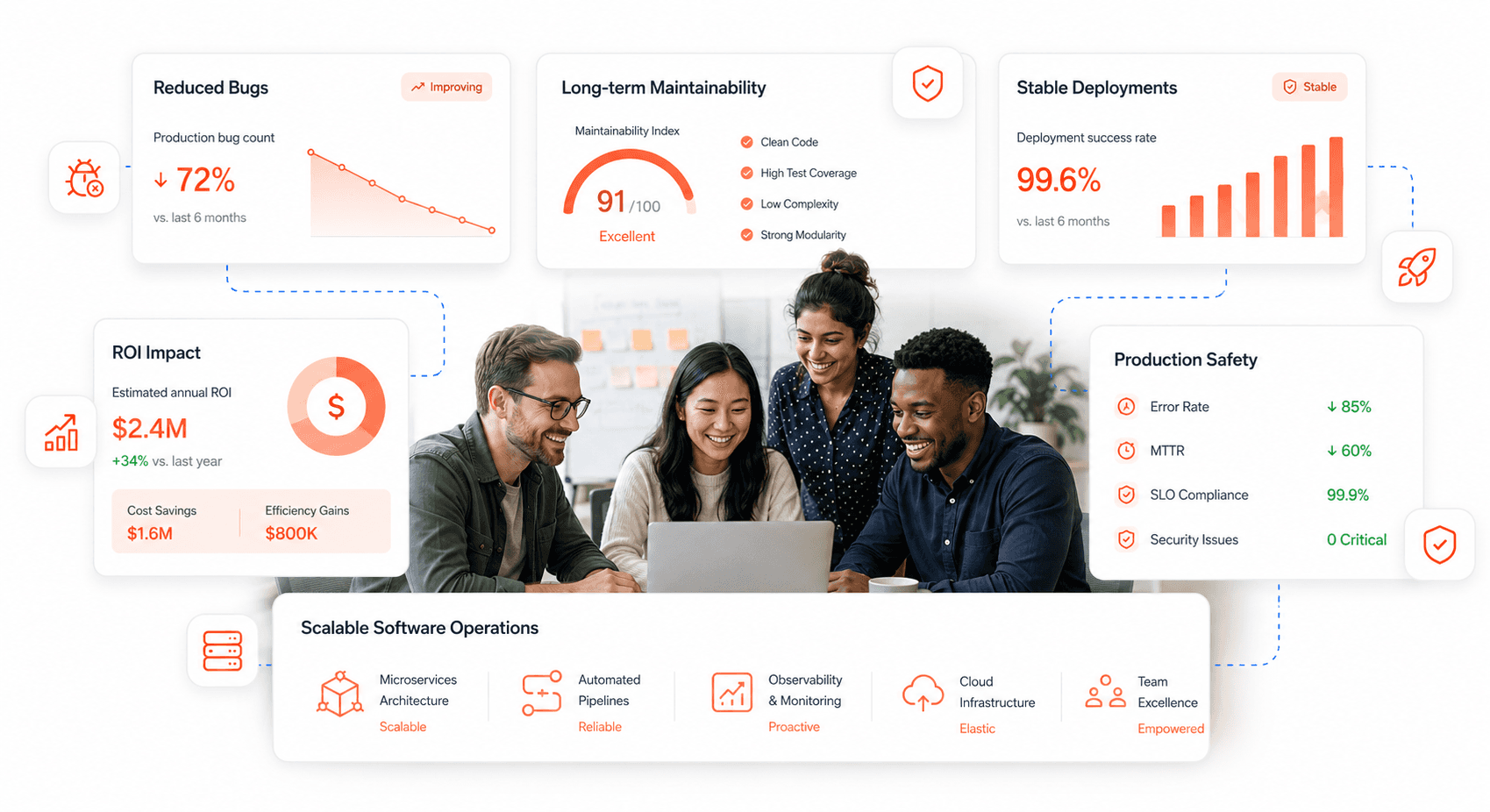
Related Blogs
Related Blogs
Is a clunky UI holding back your growth?
▶︎
Transform slow, frustrating dashboards into intuitive interfaces that ensure effortless user adoption.
▶︎
Transform slow, frustrating dashboards into intuitive interfaces that ensure effortless user adoption.
Is a clunky UI holding back your growth?
▶︎
Transform slow, frustrating dashboards into intuitive interfaces that ensure effortless user adoption.
▶︎
Transform slow, frustrating dashboards into intuitive interfaces that ensure effortless user adoption.
Is a clunky UI holding back your growth?
▶︎
Transform slow, frustrating dashboards into intuitive interfaces that ensure effortless user adoption.
▶︎
Transform slow, frustrating dashboards into intuitive interfaces that ensure effortless user adoption.