

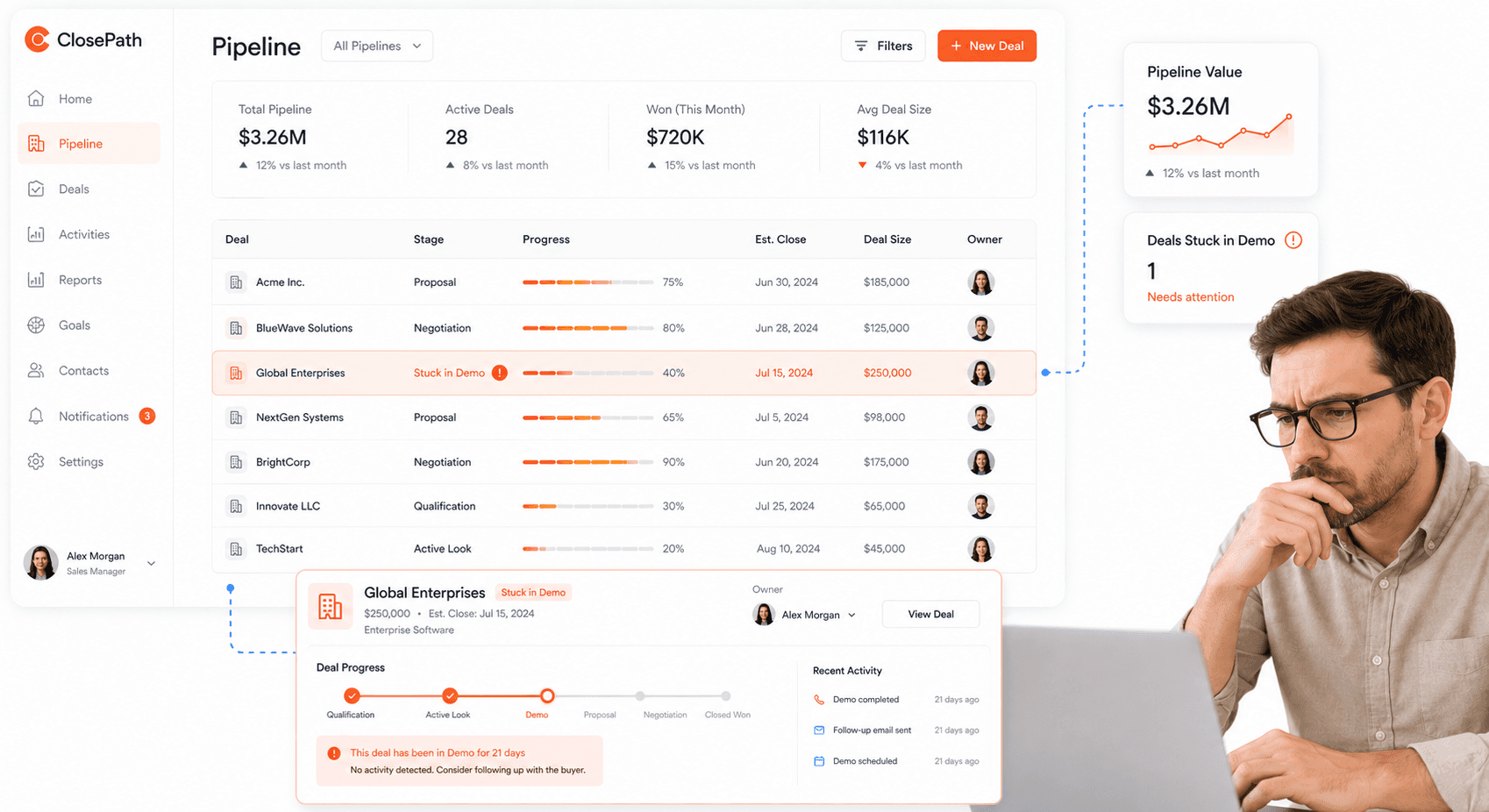
You've probably watched deals mysteriously stall even when your pipeline looks healthy. Your reps deliver compelling demos, stakeholders seem engaged, and the buyer keeps saying they're interested, but weeks turn into months with no movement. Sound familiar?
If you're a sales leader or enterprise account executive struggling with stalled deals despite full pipelines, you're not alone. The problem isn't your product or your team's selling skills. It's that most sales organizations treat complex pre-sales like improvisation when it should be treated like project management.
In this article, we'll examine why enterprise deals get stuck after the demo stage and explore practical solutions. First, we'll walk through Bob Moesta's demand-side sales framework, which reveals the six stages every buyer moves through and why they sometimes go backwards. Next, we'll show you how the four Forces of Progress either drive deals forward or create friction that stalls momentum. Finally, we'll demonstrate how applying work breakdown structure thinking to your pre-sales process creates repeatable, buyer-aligned execution that gets deals unstuck.
The Real Reasons Enterprise Deals Stall Despite Full Pipelines
Relationship gaps prevent deal progression regardless of CRM activity
Your CRM might show impressive engagement metrics multiple touchpoints, regular check-ins, and consistent follow-ups but if you haven't built the right relationships, your enterprise deals will stall. The fundamental truth is that enterprise deals stall because the relationship work that drives decisions has not been done, regardless of how active your CRM activity appears.
You can measure these relationship gaps through what's called a Vitality Index, which reveals the true health of your deal relationships beyond surface-level interactions. Your pipeline might look robust on paper, but without meaningful connections to the people who actually influence and make decisions, you're operating in a vacuum. These relationship gaps create invisible barriers that prevent your deals from moving forward, even when everything else appears to be progressing smoothly.
The challenge you face is that relationship building in enterprise sales isn't just about frequency of contact, it's about building trust and credibility with the right stakeholders at the right levels. When these foundational relationships are missing, your deals become vulnerable to competitive threats, budget freezes, and internal political dynamics that you can't navigate effectively.
Executive access problems leave deals managed at wrong organizational levels
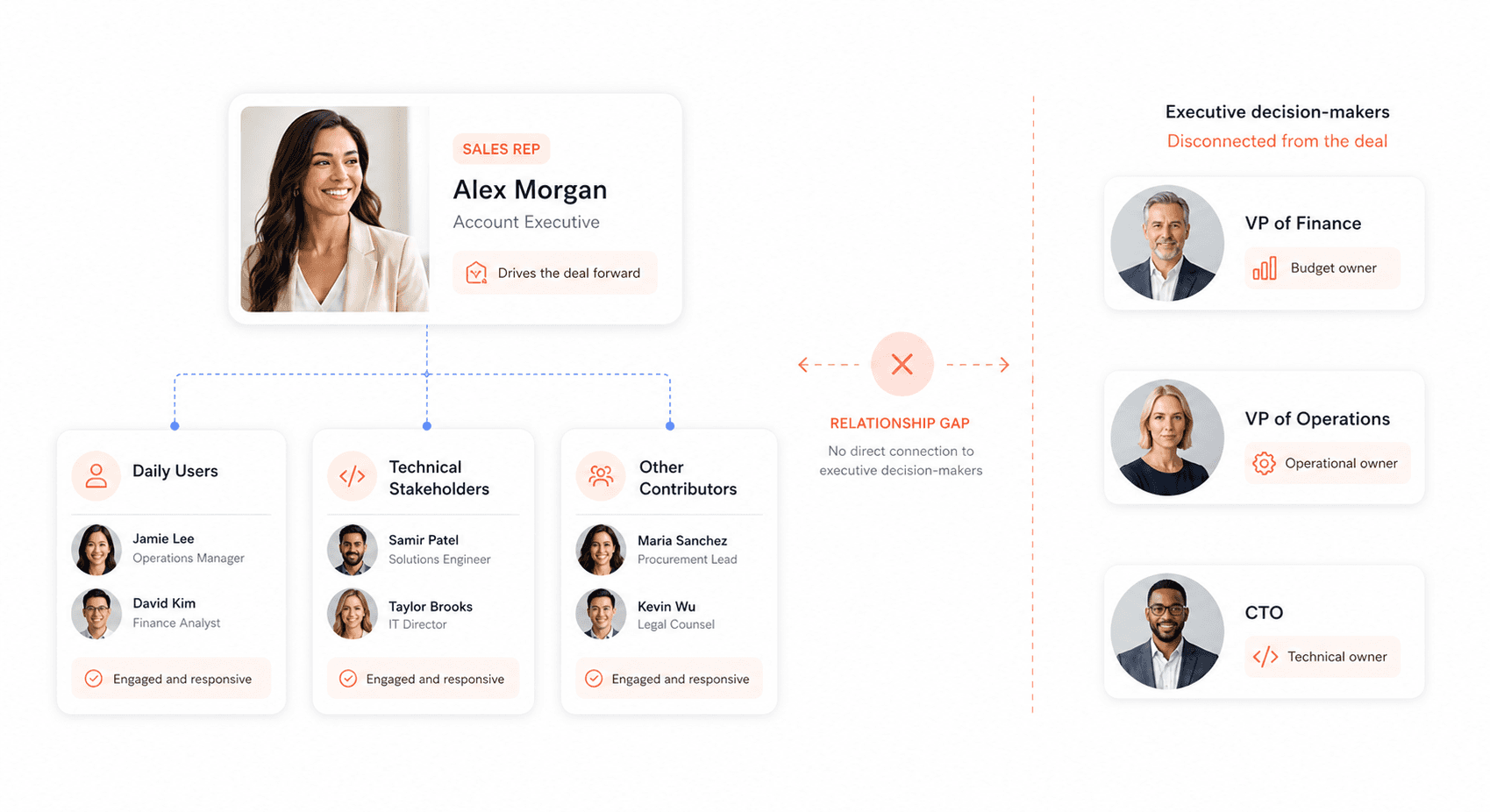
Your deal progression suffers when you have executive access problems that force you to manage deals at the wrong organizational level. You might have cultivated strong relationships with your day-to-day contacts the users, influencers, and technical evaluators who engage with your solution regularly. These relationships feel productive and give you confidence in your deal's momentum.
However, these same contacts often lack access to the executive sponsors who actually control budgets and make final purchasing decisions. When you're managing deals primarily through these lower-level relationships, you're essentially operating without visibility into the real decision-making process. Your day-to-day contacts may be enthusiastic about your solution, but they don't have the authority or influence to push the deal across the finish line.
This organizational misalignment creates a dangerous disconnect between where you think your deal stands and where it actually sits in the decision hierarchy. You end up investing time and resources in relationships that, while valuable, cannot drive the final outcome you need.
Weak competitive differentiation allows price-focused decision making
Your competitive positioning becomes critical when weak differentiation transforms your enterprise deal into a price-focused decision. When your value proposition sounds like everyone else in your category, you create an environment where clients struggle to understand what they would lose by choosing a competitor over your solution.
This lack of clear differentiation puts you in a commoditized position where price becomes the primary deciding factor. Your prospects can't articulate why your solution is uniquely valuable, so they default to comparing costs across vendors. This scenario is particularly damaging in enterprise sales because it undermines all the relationship building and solution positioning work you've invested in throughout the sales cycle.
The result is that your deals become vulnerable to competitors who may offer lower prices, even if their solutions are inferior. Without strong competitive differentiation, you lose control over the narrative and allow external factors rather than your solution's unique value to drive the decision-making process.
Missing internal champions reduce advocacy within client organizations
Your deal progression relies heavily on having internal champions within the client organization who can advocate for your solution when you're not present. The absence of these internal champions creates a significant vulnerability because it makes deal progression solely dependent on your external navigation as the sales representative.
Internal champions serve as your voice inside the organization, defending your solution in meetings you can't attend and influencing decision-makers through their existing relationships and credibility. Without these advocates, your deal lacks internal momentum and becomes susceptible to competing priorities, budget reallocations, or negative influences from stakeholders you haven't engaged.
When you lack internal champions, you're essentially fighting an uphill battle where every interaction must be driven by your external efforts. This creates unsustainable pressure on your sales process and leaves your deal vulnerable to internal dynamics you can't control or influence effectively.
Understanding the Buyer's Six-Stage Decision Timeline
First Thought Stage Creates Initial Struggling Moments That Open Mental Space
Your enterprise buyers don't wake up one morning deciding they need your solution. Instead, their journey begins with what you should recognize as the First Thought stage a critical moment when a struggling situation forces them to open their mental space for new possibilities. This stage serves as the seed of all demand you'll eventually capture.
You need to understand that these struggling moments come in various forms. Perhaps your prospect just experienced a failed quarter that exposed gaps in their current processes. Maybe there's been a leadership change that's brought new priorities and expectations. These moments create the initial crack in their status quo thinking, making them receptive to considering alternatives they previously wouldn't have entertained.
When you're prospecting or nurturing leads, you're essentially waiting for or trying to identify these struggling moments. Your timing becomes crucial because buyers in this stage are just beginning to acknowledge that their current approach might not be sufficient. They're not yet ready for your detailed product demonstrations or pricing discussions—they're still processing the reality that change might be necessary.
Passive Looking Phase Involves Window Shopping and Problem Framing
Once your buyers move past their initial struggling moment, they enter what you should recognize as the Passive Looking phase. During this stage, your prospects are essentially window shopping, they're noticing new things in their environment and beginning to frame and prioritize the problems they're facing, but they haven't yet committed to taking action or actively searching for solutions.
You'll find that buyers in this phase are gathering information in a relatively casual manner. They might be reading industry reports, attending webinars, or having informal conversations with peers about challenges they're experiencing. They're building their understanding of what's possible and what problems deserve their attention, but they're not yet evaluating specific vendors or solutions.
Your role during this phase requires patience and value-driven content. Your prospects are forming their problem definitions and understanding the landscape of potential solutions. They're determining which issues should be prioritized and which ones might be worth addressing later. This is where your thought leadership content, educational resources, and industry insights become most valuable in shaping their understanding.
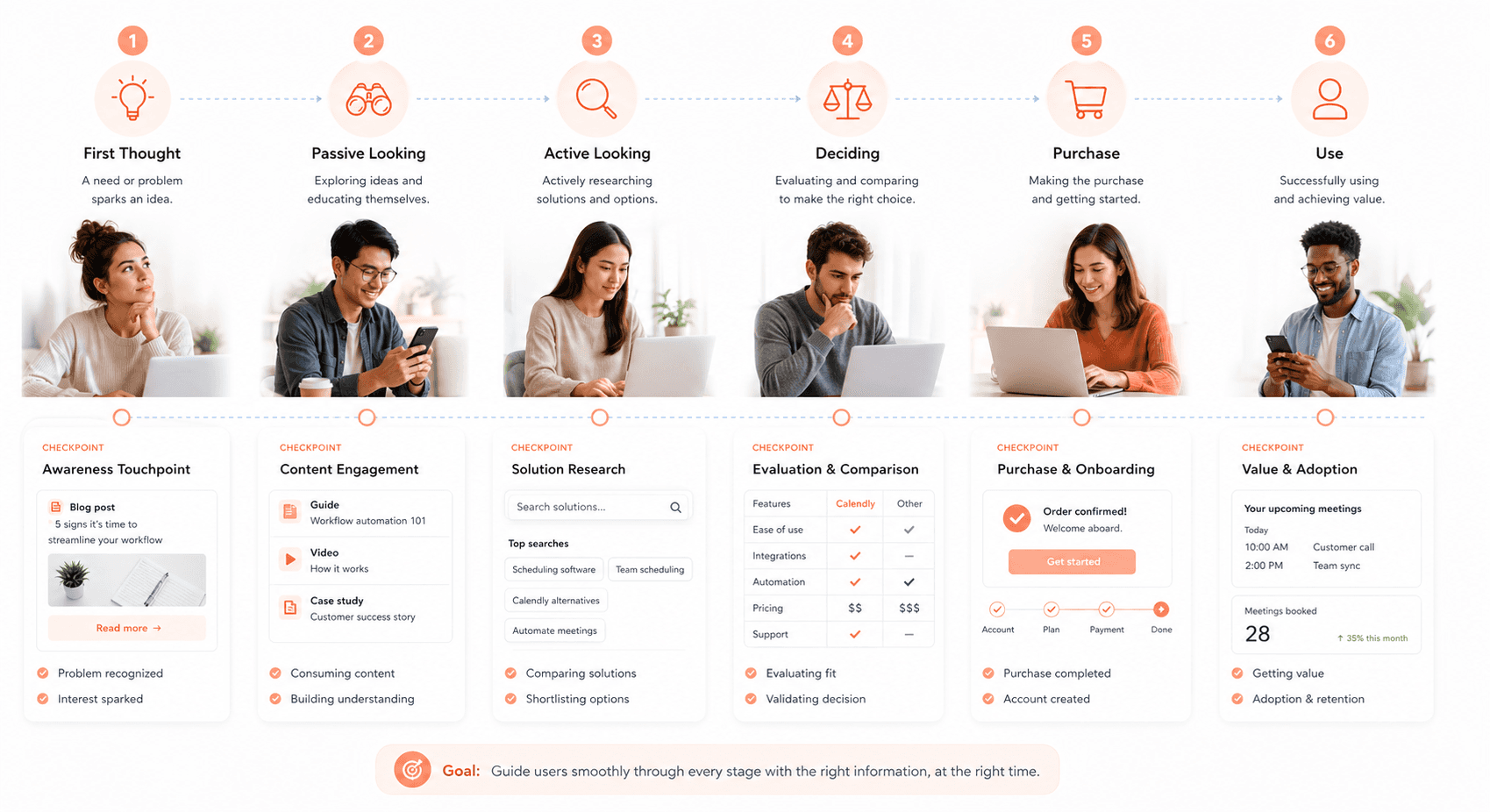
Active Looking Requires Deliberate Evaluation With Established Time Walls
When your buyers transition to the Active Looking phase, you'll notice a significant shift in their behavior. This phase requires deliberate evaluation where they actively search for solutions, frame trade-offs between different options, and systematically rule possibilities in or out. Your prospects are now committed to finding a solution and are willing to invest time and energy in the evaluation process.
You must understand that a crucial element needed to move buyers from this phase to making a decision is what's called a 'time wall' an artificial deadline or time-bound event that creates urgency. Without this time wall, buyers can remain in the Active Looking phase indefinitely, continuously evaluating options without ever committing to a decision.
During this phase, your prospects are conducting thorough evaluations, requesting demos, comparing features, and assessing how different solutions might fit into their environment. They're building detailed criteria for evaluation and systematically working through their options. Your sales process needs to align with their evaluation methodology while helping them establish appropriate time boundaries for their decision-making process.
Deciding Stage Focuses on Trade-offs and Internal Buy-in Processes
The final stage your buyers navigate is the Deciding stage, where they focus on making concrete trade-offs, establishing value, and gaining internal buy-in from their group. This stage is fundamentally about choosing the best path for progress rather than finding compromise solutions that please everyone but solve nothing.
You'll find that buyers in this stage are setting clear expectations for what success will look like with their chosen solution. They're working through the internal politics of their organization, building consensus among stakeholders, and addressing concerns from various departments that will be affected by the implementation.
Your prospects are weighing the trade-offs between different solutions, not just in terms of features and pricing, but also considering implementation complexity, organizational change requirements, and long-term strategic alignment. They're building the internal business case that will justify their decision and secure the necessary resources for implementation.
Understanding that this stage is about progress rather than compromise helps you position your solution more effectively. Your buyers aren't looking for the solution that makes everyone happy, they're looking for the solution that will drive the most meaningful progress toward their goals, even if it requires difficult trade-offs along the way.
The Forces of Progress That Drive or Stall Deal Movement
Push Forces Create Dissatisfaction with Current Status Quo Situations
When you understand push forces, you recognize the pain points that make your prospects eager to move away from their existing situation. These forces manifest as growing frustration with current limitations, inefficiencies, or failures that create mounting pressure within your prospect's organization. You need to identify and amplify these dissatisfactions throughout your pre-sales process.
Push forces typically emerge when your prospect's current systems, processes, or solutions no longer meet their evolving business requirements. You'll often encounter situations where manual processes are consuming excessive resources, legacy systems are creating bottlenecks, or competitive pressures are demanding operational improvements. Your role involves helping prospects articulate these pain points clearly and quantify their impact on business outcomes.
During your discovery conversations, you should probe deeply into the symptoms of dissatisfaction. Ask your prospects about the costs of maintaining the status quo, both in terms of direct expenses and opportunity costs. When you can help them visualize the cumulative effect of these problems over time, you strengthen the push forces that motivate change.
Pull Forces Generate Appeal Toward Better Future State Solutions
Pull forces represent the magnetic attraction your solution creates by painting a compelling vision of improved outcomes. When you effectively demonstrate how your solution addresses specific challenges and delivers tangible benefits, you generate powerful pull forces that draw prospects toward your offering. These forces become strongest when you connect your solution's capabilities directly to your prospect's strategic objectives and desired business outcomes.
Your demonstration strategy should focus on creating vivid pictures of the improved future state. Show your prospects how their daily workflows will improve, how their teams will become more productive, and how their organization will achieve competitive advantages. You need to make these benefits feel real and attainable, not just theoretical possibilities.
Quantifying the positive outcomes strengthens pull forces significantly. When you can demonstrate specific metrics like time savings, cost reductions, or revenue increases, you transform abstract benefits into concrete value propositions. Your prospects need to see themselves succeeding with your solution, experiencing the improvements firsthand during your demonstrations.
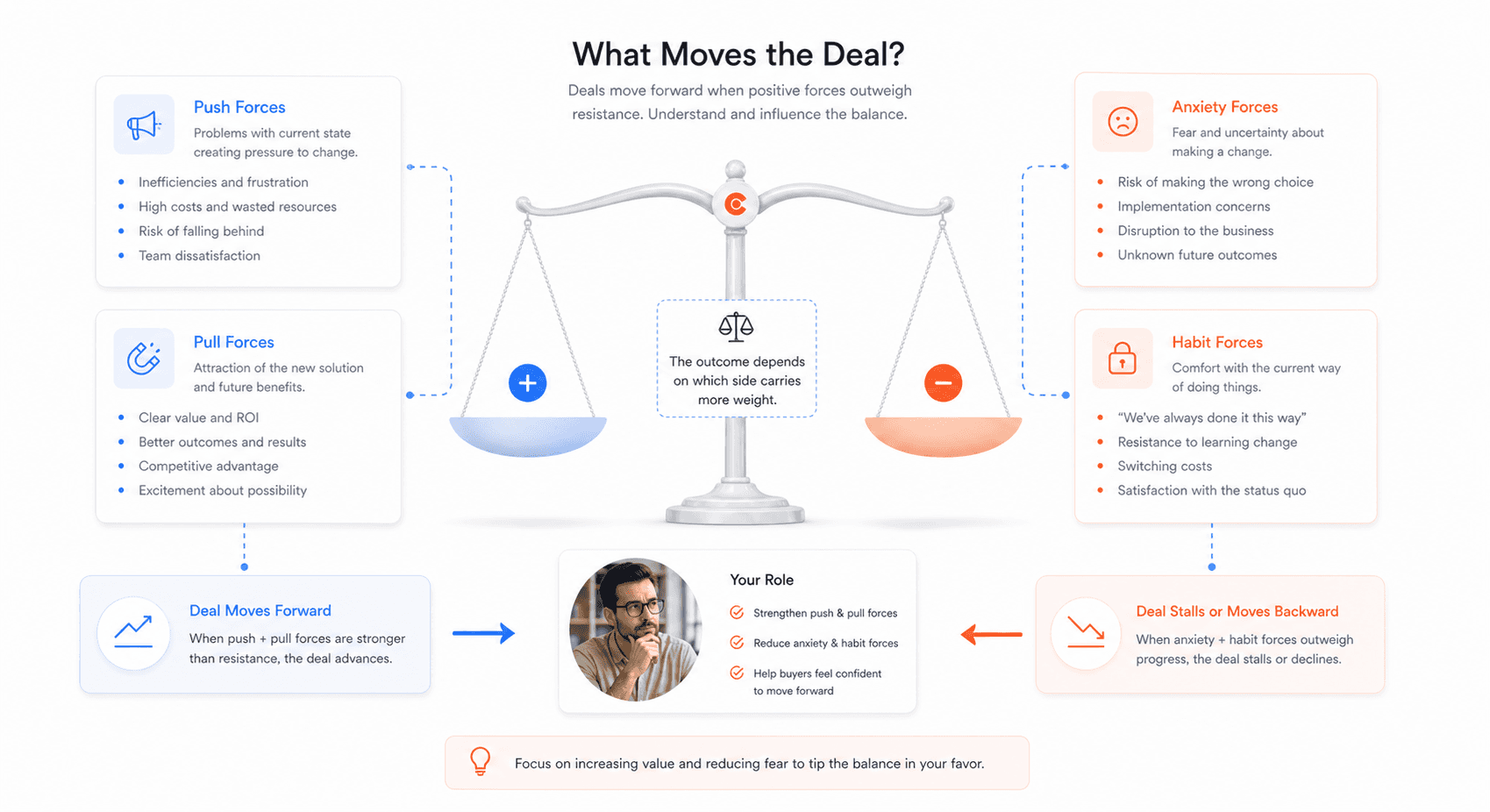
Anxiety Forces Create Fear of Unknown Risks and Implementation Challenges
Anxiety forces represent the fears and concerns that prevent your prospects from moving forward, even when they recognize problems with their current situation and see value in your solution. You'll encounter anxiety around implementation complexity, integration challenges, switching costs, and the risk of disrupting existing operations. These forces can paralyze decision-making and extend your sales cycles indefinitely.
Your prospects worry about unknown risks that might emerge during implementation. They fear potential downtime, data migration issues, user adoption challenges, and the possibility that your solution might not work as promised in their specific environment. You must address these anxieties proactively throughout your pre-sales process.
Successful anxiety reduction requires thorough planning and transparent communication. You should provide detailed implementation roadmaps, share relevant case studies from similar organizations, and offer proof-of-concept opportunities when possible. When you can demonstrate that others have successfully navigated similar transitions, you reduce the perceived risk and lower anxiety barriers.
Habit Forces Maintain Comfort with Existing Processes Despite Problems
Habit forces represent the powerful tendency to maintain familiar processes and systems, even when they're clearly problematic. Your prospects often stick with known inefficiencies because change requires effort, learning, and adaptation. You'll find that familiarity frequently outweighs perceived benefits, creating significant resistance to your solution regardless of its obvious advantages.
These forces manifest as preference for incremental improvements over transformational change. Your prospects might acknowledge their current systems' limitations while simultaneously expressing comfort with workarounds they've developed over time. They know how to operate within existing constraints, even if those constraints are costly and limiting.
Overcoming habit forces requires patience and persistent value demonstration. You need to show your prospects that the effort required for change will be worthwhile and that your solution won't just solve their problems but will actually be easier to use than their current approach. When you can demonstrate that change leads to simplification rather than additional complexity, you begin to erode the comfort associated with existing habits.
For your sales efforts to succeed, the combined strength of push and pull forces must outweigh the combined resistance from anxiety and habit forces. Every pre-sales activity you undertake should aim to amplify the motivating forces or reduce the restraining forces, creating the momentum necessary for your prospects to move forward with their purchasing decision.
Applying Project Management Discipline to Pre-Sales Execution
Structured Work Breakdown Structure eliminates guesswork and improvisation
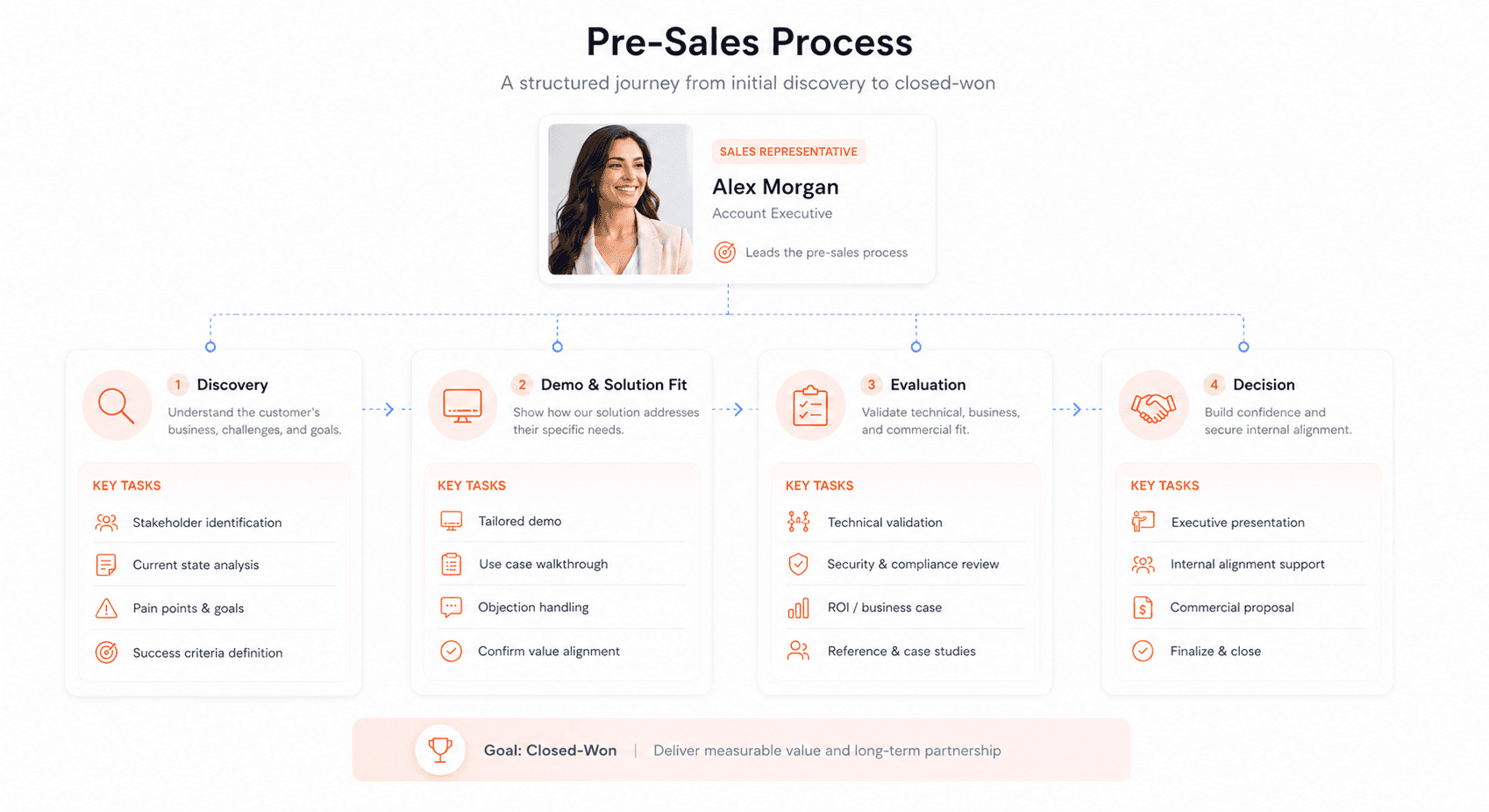
Your pre-sales process doesn't have to rely on intuition and ad-hoc decision-making. When you implement a structured Work Breakdown Structure (WBS), you transform your pre-sales activities from guesswork and improvisation into a planned project with clearly defined parameters. This systematic approach requires you to define the total scope of work and break it down into manageable pieces that your team can execute with precision.
The power of this structured approach lies in how it forces you to think systematically about every aspect of your deal progression. Instead of wondering what comes next or improvising responses to buyer requests, you'll have a predetermined roadmap that accounts for all necessary activities. This eliminates the uncertainty that often leads to missed opportunities and stalled deals, giving you the confidence to move forward with purpose and direction.
When you establish this structured foundation, you create a framework that can be applied consistently across all your enterprise opportunities. Your pre-sales process becomes predictable and reliable, which is essential when dealing with complex enterprise buyers who expect professional, organized engagement throughout their decision-making process.
Visibility through hierarchical task decomposition prevents forgotten activities
Now that you understand the importance of structure, you need to ensure that no critical pre-sales activity falls through the cracks. Hierarchical task decomposition creates visibility by laying out each effort as a structured breakdown, ensuring that every component of your pre-sales process is accounted for and tracked systematically.
This comprehensive visibility means you'll never again lose track of whether you've completed discovery calls, delivered technical specifications, or submitted proposal drafts. Each activity becomes a visible component within your overall structure, making it impossible to overlook critical steps that could determine the success or failure of your deal.
The hierarchical nature of this approach allows you to zoom in and out of detail levels as needed. You can view high-level milestones for executive reporting while simultaneously tracking granular tasks that your solutions consultants need to complete. This multi-level visibility ensures that everyone on your team understands both the big picture and their specific responsibilities within the broader context.
Team alignment ensures shared understanding of deal status and next steps
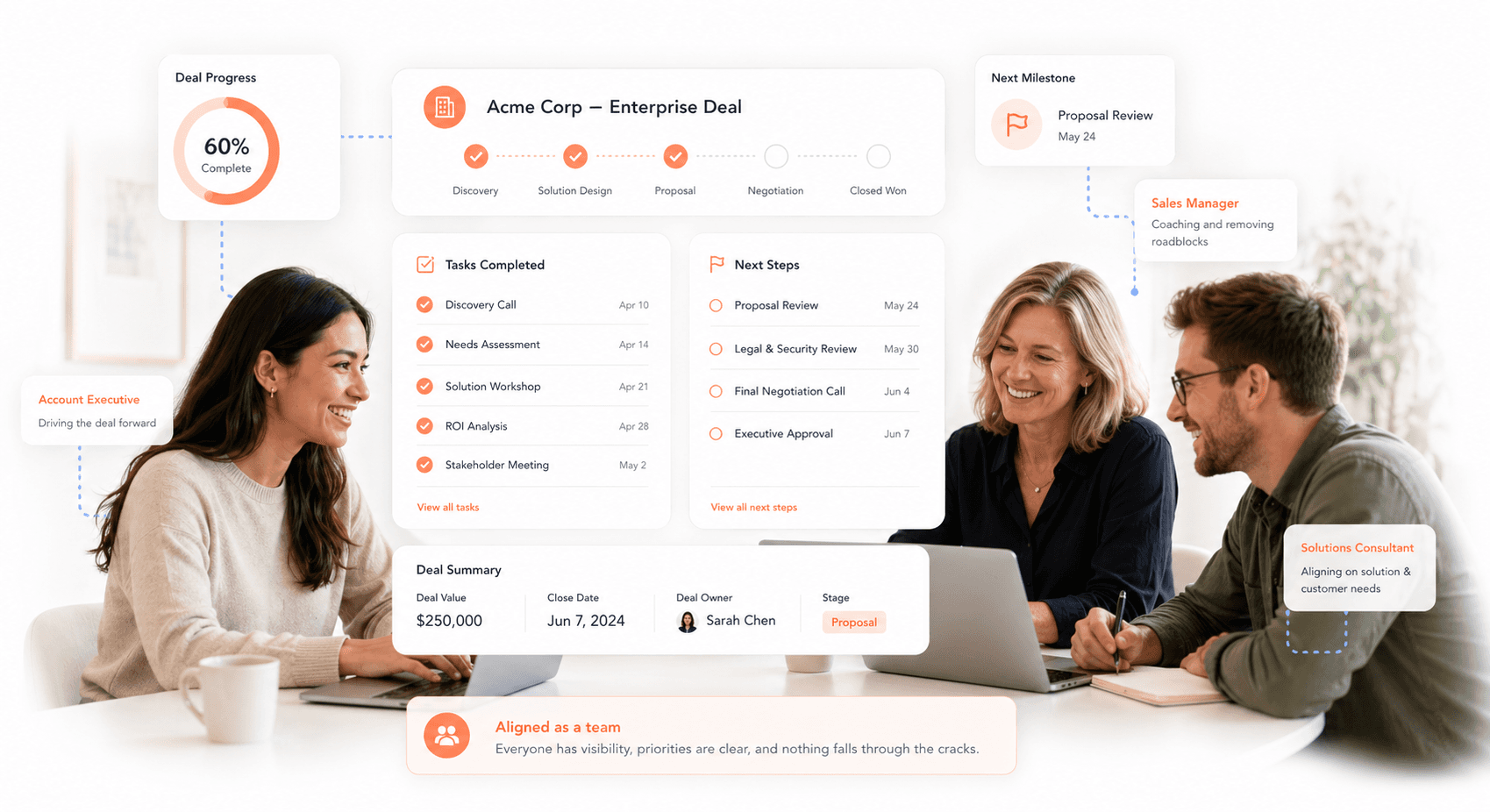
With proper visibility established, you can now focus on ensuring your entire team operates from the same playbook. When all members of your sales team, including your account executive, solutions consultant, and sales leader view the same WBS, you foster a shared understanding of deal status and next steps that eliminates confusion and miscommunication.
This alignment transforms your forecasting conversations from subjective opinions to concrete, data-driven discussions. Instead of relying on gut feelings about deal progression, you and your team can reference specific completed and pending activities to make accurate assessments about likelihood to close and timing.
The shared understanding created by this approach extends beyond just knowing what's been done and what's coming next. Your team members develop a common language for discussing deal progression, making handoffs smoother and ensuring that everyone contributes effectively to moving the opportunity forward.
Repeatable templates enable scalable execution across multiple opportunities
Previously, you may have found yourself starting from scratch with each new opportunity, trying to remember what worked in past deals and hoping you wouldn't forget critical steps. Repeatable templates for a well-built pre-sales WBS solve this challenge by enabling scalable execution across all your qualified opportunities.
When you develop these templates, you create proven structured plans that new opportunities can start with immediately. This means you're not reinventing the wheel for each deal—instead, you're leveraging the accumulated wisdom of your past successes and applying it systematically to new situations.
These templates also accelerate your new hire onboarding process significantly. Instead of requiring months for new team members to learn your pre-sales approach through trial and error, you can provide them with battle-tested templates that can be adapted to specific deal circumstances. This reduces ramp time and ensures consistent execution quality regardless of team member experience level.
Building Buyer-Aligned Work Breakdown Structures for Each Timeline Stage
First Thought Tasks Focus on Identifying and Articulating Struggling Moments
When your buyers enter the First Thought stage, your primary objective shifts to helping them clearly identify and articulate their struggling moments. This isn't about presenting solutions, it's about understanding their context deeply enough to guide them through their own discovery process.
You'll need to invest time researching their specific context before any meaningful conversation begins. This research goes beyond surface-level company information to understand the environmental factors, market pressures, and internal dynamics that might be creating friction in their current processes. Your goal is to map the Forces of Progress that are either pushing them toward change or holding them back.
Preparing discovery questions becomes crucial at this stage. These aren't generic qualification questions, but targeted inquiries designed to help your buyer surface and verbalize their struggling moments. You're essentially acting as a facilitative consultant, helping them connect the dots between their current pain and the potential for improvement.
Documentation plays a critical role here you must capture their narrative in their own words. This isn't about translating their problems into your solution's language, but preserving their authentic voice and perspective. This documentation becomes the foundation for all subsequent stages of their buying journey.
Passive Looking Activities Feed Learning Without Premature Sales Pressure
As your buyers move into Passive Looking, you become their learning facilitator rather than their sales representative. Your work breakdown structure for this stage focuses entirely on feeding their educational process without applying any pressure to engage with your sales process.
Content sharing becomes strategic rather than promotional. You'll send relevant materials that help them understand their problem space better, not materials that position your solution as the obvious answer. This might include industry research, case studies from similar contexts, or thought leadership pieces that expand their thinking about possible approaches.
Progress stories serve as powerful tools during this phase. These aren't traditional case studies focused on your solution's capabilities, but narratives that show how other organizations have navigated similar challenges. You're helping your buyer see themselves in these stories and understand the journey ahead.
Stakeholder identification becomes a collaborative effort. You'll work with your primary contact to identify other individuals who might be affected by or involved in addressing their struggling moments. More importantly, you'll help them understand the internal language these stakeholders use when discussing the problem, enabling more effective internal communication.
Active Looking Work Helps Buyers Evaluate Trade-offs and Establish Decision Deadlines
Now that you've established a foundation of trust and understanding, your Active Looking activities become more solution-focused while remaining buyer-centric. Your work breakdown structure emphasizes helping buyers evaluate their options systematically and establish realistic timelines for decision-making.
Tailored demonstrations replace generic product presentations. You'll craft these experiences specifically around the struggling moments and use cases your buyer has articulated, showing them exactly how different approaches might address their specific challenges. These demonstrations focus on outcomes rather than features.
Trial access and competitive differentiation work hand-in-hand during this stage. You provide opportunities for hands-on evaluation while simultaneously helping your buyer understand how different solutions compare across their specific criteria. This isn't about positioning competitors negatively, but about helping buyers make informed trade-off decisions.
Time wall identification or creation becomes essential for maintaining momentum. You'll either identify existing deadlines that create urgency around their decision, or work collaboratively to establish reasonable timelines that align with their organizational rhythms and resource availability.
Addressing switching anxieties requires evidence-based approaches. You'll anticipate the specific concerns your buyer might have about changing from their current state and prepare compelling evidence that directly addresses these worries.
Deciding Support Includes Internal Case Building and Procurement Navigation
Your final work breakdown structure centers on helping your buyer successfully navigate their internal decision-making and procurement processes. This stage requires the most collaborative and consultative approach, as you're essentially becoming an extension of their internal team.
Internal case building becomes a joint effort. You'll help develop business case documents and executive summaries that speak in your buyer's organizational language and address their specific decision-making criteria. These materials should empower your champion to advocate effectively within their organization.
Procurement and legal process navigation requires proactive planning. You'll work with your buyer to understand their purchasing requirements early and prepare documentation that streamlines these processes. This includes anticipating common legal concerns and preparing responses that align with their risk tolerance.
Success expectation setting ensures alignment between what your buyer hopes to achieve and what your solution can realistically deliver. You'll establish clear metrics and timelines that define progress from their perspective, not just from your implementation standpoint.
Contract execution logistics coordination involves managing all the moving pieces required to finalize the agreement according to your buyer's definition of progress and success.
Transforming Sales Culture Through Structured Pre-Sales Planning
Pipeline reviews become work-based rather than stage-based discussions
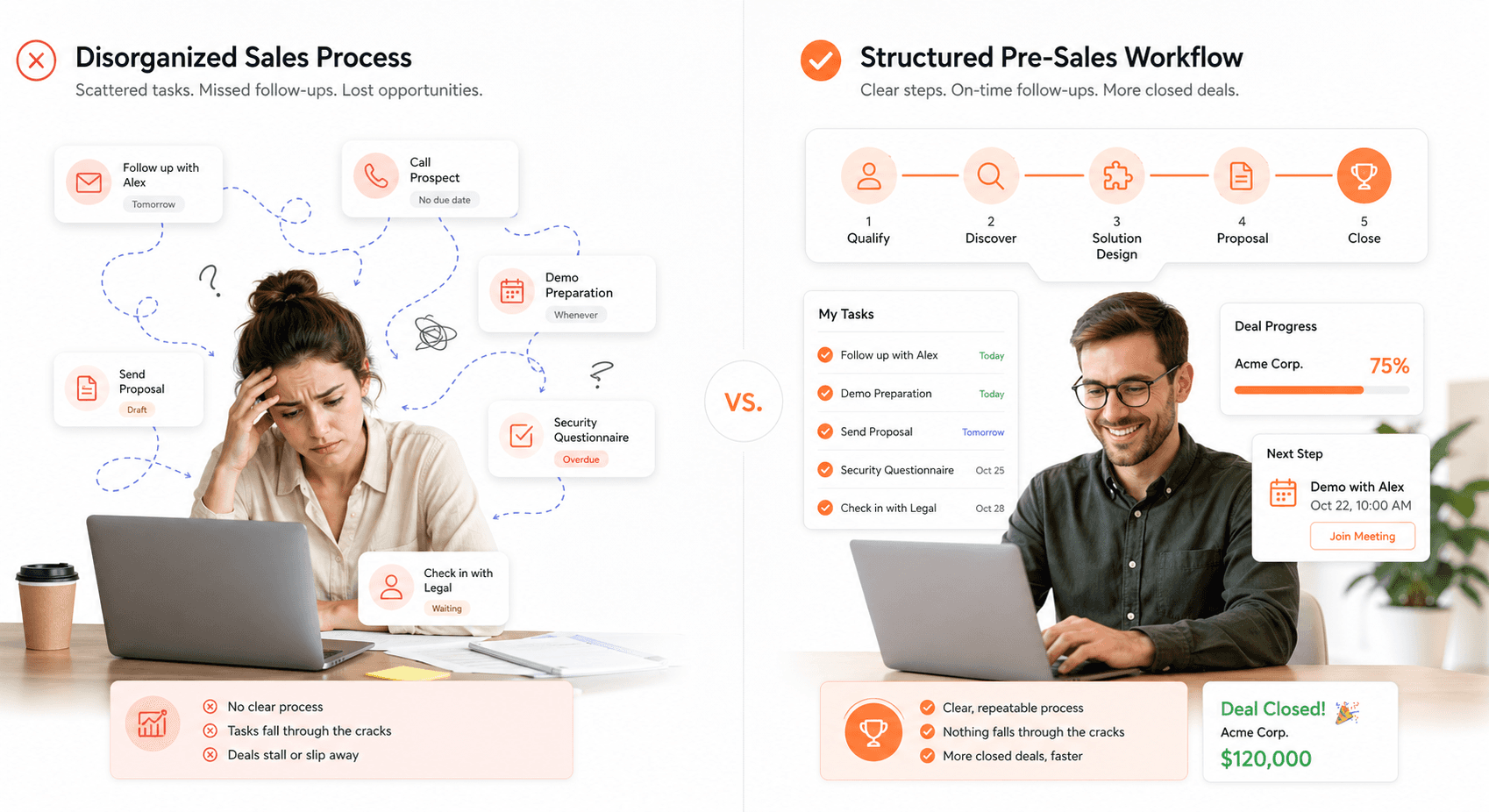
Now that we have explored the mechanics of buyer-aligned planning, you'll discover how this structured approach fundamentally transforms your team's pipeline review conversations. Instead of the traditional stage-based discussions that rely on vague assessments like "they're interested" or "we're in procurement," your pipeline reviews shift to work-based conversations that focus on completed and open tasks.
Your new review format centers on the specific Forces of Progress at play in each deal. You'll find yourself discussing concrete actions: Which stakeholder interviews have been completed? What technical validation tasks remain open? Which procurement requirements are still being clarified? This granular approach leads to concrete progress instead of the general optimism that often clouds traditional pipeline assessments.
You can immediately identify which deals are genuinely advancing through your buyer's decision process versus those that appear active in your CRM but are practically stalled. Your team discussions become more productive because everyone focuses on actionable next steps rather than speculating about buyer intent or timeline probability.
Forecasting accuracy improves through concrete task completion tracking
Previously, your forecasting relied heavily on subjective stage progression and gut feelings about deal momentum. With structured pre-sales planning, your forecasting accuracy improves significantly as work is decomposed and tracked systematically.
You gain visibility into genuine deal progression or stagnation through task completion metrics. When you can see that a buyer has completed their technical evaluation tasks but hasn't begun their procurement workstream, you understand exactly where the deal stands in their decision timeline. This clarity allows you to provide more accurate close date predictions to your leadership team.
Your ability to identify deals that appear active in CRM but are practically stalled becomes a competitive advantage. You'll notice patterns where certain types of tasks consistently create bottlenecks, enabling you to proactively address these challenges in future deals. The work-based tracking system provides leading indicators of deal health that traditional stage-based forecasting simply cannot deliver.
New hire onboarding accelerates with proven framework inheritance
With this framework in mind, your new hire onboarding process accelerates dramatically because reps inherit a structured pre-sales plan aligned with how buyers actually buy. Instead of requiring new team members to invent their own processes through trial and error, they can execute within a proven framework from day one.
Your new hires gain immediate clarity on what tasks to complete at each stage of the buyer's timeline, which stakeholders to engage, and how to facilitate buyer progress effectively. This structured approach eliminates the confusion that typically accompanies new sales roles, where representatives often struggle to understand how to move deals forward consistently.
You'll notice that new team members reach productivity milestones faster because they're working within established buyer-aligned processes rather than developing their own approaches through experience. The framework provides them with a roadmap for success that's based on buyer behavior patterns rather than internal sales methodologies.
Win rates increase through better buyer progress facilitation
Next, you'll see how this systematic approach directly impacts your bottom line through improved win rates. These increases occur as a direct result of improved planning and execution that aligns every task to help buyers make progress at each stage of their timeline.
Your sales teams execute more effectively than competitors who rely on intuition because you're operating with a clear understanding of what buyers need to accomplish. While your competitors are guessing about next steps or pushing their own agenda, you're systematically removing obstacles from your buyer's path to a decision.
You achieve this competitive advantage by ensuring that every interaction, every piece of content, and every task completion moves the buyer closer to their ultimate goal. Your structured approach enables you to anticipate buyer needs and provide the right support at the right time, significantly increasing your probability of winning competitive deals.
Conclusion
The difference between a full pipeline and a closed deal lies in the relationship work that drives enterprise decisions. When deals stall at the demo stage, it's rarely about your product, it's about missing executive access, weak competitive differentiation, or the absence of an internal champion who will advocate for you when you're not in the room. These relationship gaps create friction that no amount of follow-up emails can overcome.
Applying project management discipline to your pre-sales process transforms how you approach complex deals. By aligning your work breakdown structure to Bob Moesta's six-stage buyer timeline, from first thought through ongoing use you shift from seller-centric activities to buyer-aligned progress. Every task serves the Forces of Progress: amplifying push and pull while reducing anxiety and habit. This structured approach gives you visibility into where deals truly stand, creates alignment across your team, and builds the repeatability that turns individual success into scalable sales culture. Your pipeline may be full, but without this discipline, you're managing opportunities instead of orchestrating outcomes.




About the author
I’m the founder of Hashbyt, an AI-first frontend and UI/UX SaaS partner helping 200+ SaaS companies scale faster through intelligent, growth-driven design. My work focuses on building modern frontend systems, design frameworks, and product modernization strategies that boost revenue, improve user adoption, and help SaaS founders turn their UI into a true growth engine.
Is a clunky UI holding back your growth?
Is a clunky UI holding back your growth?
▶︎
Transform slow, frustrating dashboards into intuitive interfaces that ensure effortless user adoption.
▶︎
Transform slow, frustrating dashboards into intuitive interfaces that ensure effortless user adoption.
