
BOOK YOUR FREE STRATEGY CALL
Compliance-Ready Multi-Market Frontend Revamp
Rebuilding a Compliance-Ready, Multi-Market Frontend for a Property Management Platform


About the Project
About the Project
About the Project
Metro TechSolutions partnered with Hashbyt to rebuild their property platform frontend for scalable, compliance-ready multi-market expansion.
Metro TechSolutions partnered with Hashbyt to rebuild the frontend of their property management platform to support multi-market expansion. The goal was to deliver a UI that feels localized for each metro market, while staying scalable, consistent, and easy to use. The revamp focused on market-specific compliance, smoother workflows, faster onboarding, real-time dashboards, and mobile-first usability for on-site property managers.
Challenge
Challenge
The Core Technical Challenges Behind Scaling a Real Estate Platform Across Multiple Markets


Compliance-ready UI without hardcoding
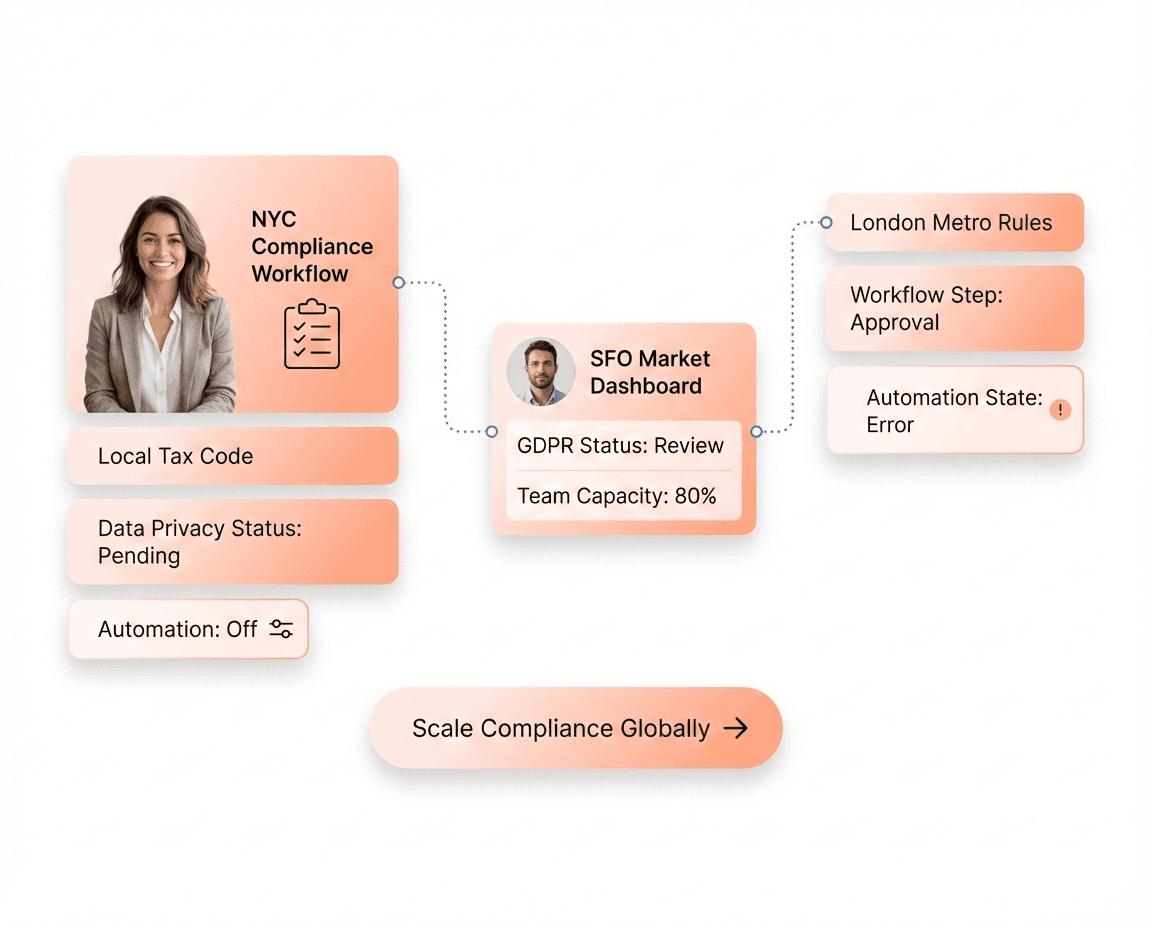
Each metro market had different compliance rules and workflow steps, but hardcoding conditions across screens would make the codebase unscalable. The challenge was designing UI flows that could adapt based on region while staying maintainable. The frontend needed to support dynamic rules without creating UI fragmentation.
Compliance-ready UI without hardcoding
Each metro market had different compliance rules and workflow steps, but hardcoding conditions across screens would make the codebase unscalable. The challenge was designing UI flows that could adapt based on region while staying maintainable. The frontend needed to support dynamic rules without creating UI fragmentation.
Scalable, maintainable frontend architecture
The existing UI wasn’t structured for fast product expansion. Components were difficult to reuse and workflows were tightly coupled with screens. The challenge was redesigning the frontend foundation so new modules and markets could be added without rewriting major parts.
Scalable, maintainable frontend architecture
The existing UI wasn’t structured for fast product expansion. Components were difficult to reuse and workflows were tightly coupled with screens. The challenge was redesigning the frontend foundation so new modules and markets could be added without rewriting major parts.
Faster real-world workflow performance
Property managers needed fast interactions across listings, onboarding, and management tasks, but existing UI patterns caused friction and slow task completion. The challenge was optimizing workflows at both UX and frontend levels. This included reducing redundant steps, improving navigation speed, and ensuring mobile responsiveness.
Faster real-world workflow performance
Property managers needed fast interactions across listings, onboarding, and management tasks, but existing UI patterns caused friction and slow task completion. The challenge was optimizing workflows at both UX and frontend levels. This included reducing redundant steps, improving navigation speed, and ensuring mobile responsiveness.
Real-time dashboards without UI lag
The analytics dashboard needed to show portfolio insights in near real-time, but naïve implementations cause frequent re-renders, heavy network usage, and unreadable dashboards. The challenge was presenting analytics in a way that was fast, structured, and actionable. The frontend needed to balance clarity, performance, and data freshness.
Real-time dashboards without UI lag
The analytics dashboard needed to show portfolio insights in near real-time, but naïve implementations cause frequent re-renders, heavy network usage, and unreadable dashboards. The challenge was presenting analytics in a way that was fast, structured, and actionable. The frontend needed to balance clarity, performance, and data freshness.
Reliable automation-driven workflows
Flows like rent collection, maintenance requests, and tenant communication require state tracking, validation, and error handling. The challenge was building automation-supported UI experiences that didn’t break when data was missing, delayed, or inconsistent. The frontend had to stay resilient with strong UX fallbacks and predictable states.
Reliable automation-driven workflows
Flows like rent collection, maintenance requests, and tenant communication require state tracking, validation, and error handling. The challenge was building automation-supported UI experiences that didn’t break when data was missing, delayed, or inconsistent. The frontend had to stay resilient with strong UX fallbacks and predictable states.
Challenge
The Core Technical Challenges Behind Scaling a Real Estate Platform Across Multiple Markets

Compliance-ready UI without hardcoding
Each metro market had different compliance rules and workflow steps, but hardcoding conditions across screens would make the codebase unscalable. The challenge was designing UI flows that could adapt based on region while staying maintainable. The frontend needed to support dynamic rules without creating UI fragmentation.
Scalable, maintainable frontend architecture
The existing UI wasn’t structured for fast product expansion. Components were difficult to reuse and workflows were tightly coupled with screens. The challenge was redesigning the frontend foundation so new modules and markets could be added without rewriting major parts.
Faster real-world workflow performance
Property managers needed fast interactions across listings, onboarding, and management tasks, but existing UI patterns caused friction and slow task completion. The challenge was optimizing workflows at both UX and frontend levels. This included reducing redundant steps, improving navigation speed, and ensuring mobile responsiveness.
Real-time dashboards without UI lag
The analytics dashboard needed to show portfolio insights in near real-time, but naïve implementations cause frequent re-renders, heavy network usage, and unreadable dashboards. The challenge was presenting analytics in a way that was fast, structured, and actionable. The frontend needed to balance clarity, performance, and data freshness.
Reliable automation-driven workflows
Flows like rent collection, maintenance requests, and tenant communication require state tracking, validation, and error handling. The challenge was building automation-supported UI experiences that didn’t break when data was missing, delayed, or inconsistent. The frontend had to stay resilient with strong UX fallbacks and predictable states.
Our Technology Stack
Built on a Foundation of Modern Tech
From Figma prototypes to Cypress testing, our stack ensures speed and quality.
Frontend
Angular
React
Vue.js
Next.js
Vite
Webpack
Micro-Frontends
UI Libraries
Material UI
Tailwind
Bootstrap
Shadcn
Design Tool
Figma
Framer
Sketch
Adobe Creative Suite
Testing & QA Tools
Jest
React Testing Library
Cypress
State Management
Redux Toolkit
Zustand
TanStack Query
NGRX
Design Systems
Storybook
Design Tokens
CSS Variables
Monorepos
Performance
Lighthouse
Web Vitals
Sentry
LogRocket
New Relic
Compliance
WCAG 2.1 AA
ARIA
axe DevTools
Accessibility Audits
CI/CD & DevOps
GitHub Actions
Vercel
Netlify
Docker
Enterprise Security
OWASP
RBAC / Permission UI
Audit Logs UI
HIPAA / GDPR
Frontend
Angular
React
Vue.js
Next.js
Vite
Webpack
Micro-Frontends
UI Libraries
Material UI
Tailwind
Bootstrap
Shadcn
Design Tool
Figma
Framer
Sketch
Adobe Creative Suite
Testing & QA Tools
Jest
React Testing Library
Cypress
State Management
Redux Toolkit
Zustand
TanStack Query
NGRX
Design Systems
Storybook
Design Tokens
CSS Variables
Monorepos
Performance
Lighthouse
Web Vitals
Sentry
LogRocket
New Relic
Compliance
WCAG 2.1 AA
ARIA
axe DevTools
Accessibility Audits
CI/CD & DevOps
GitHub Actions
Vercel
Netlify
Docker
Enterprise Security
OWASP
RBAC / Permission UI
Audit Logs UI
HIPAA / GDPR
Solution
Solution
Solution
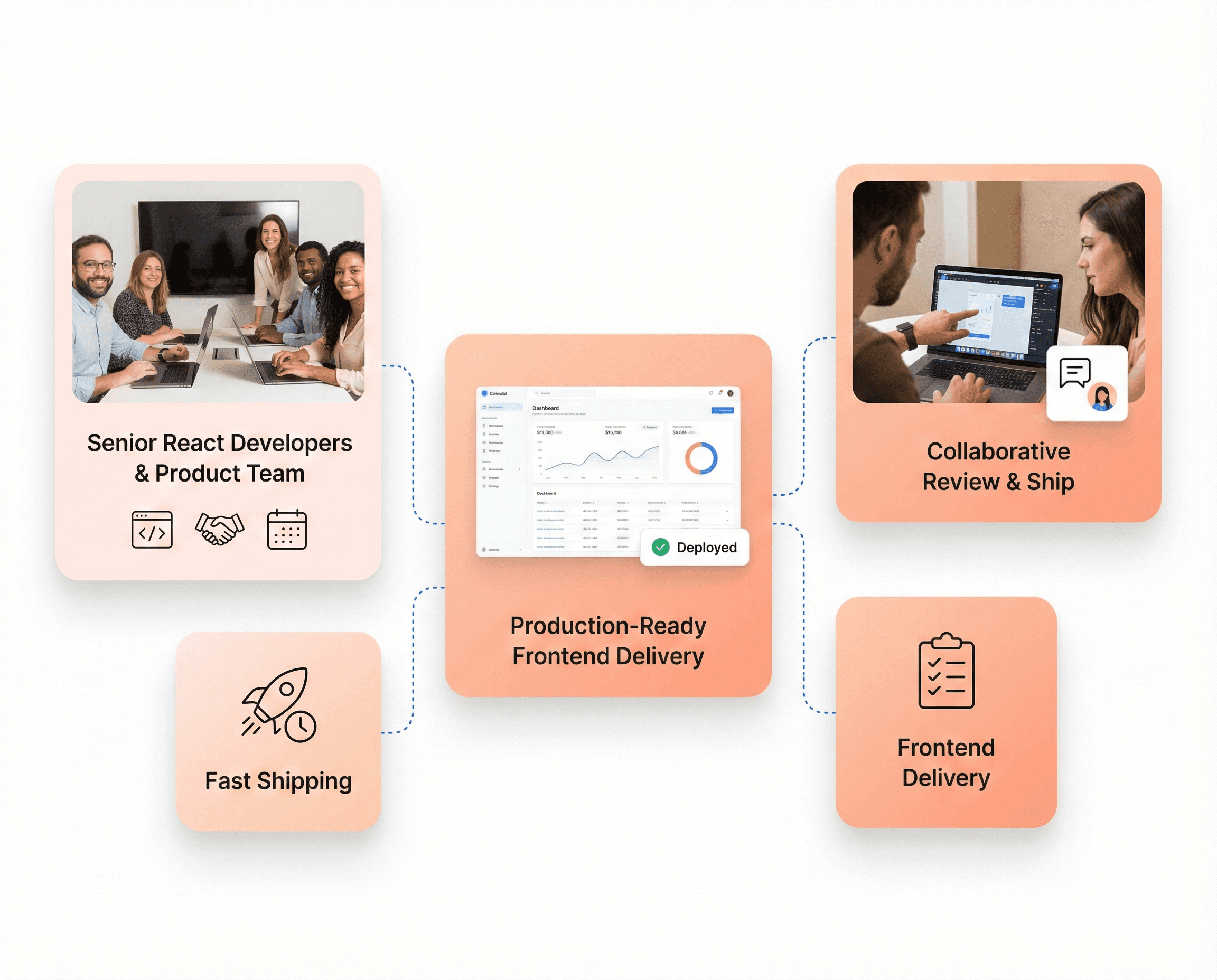
How We Designed a Config-Driven, Component-First Frontend System Built for Scale and Speed
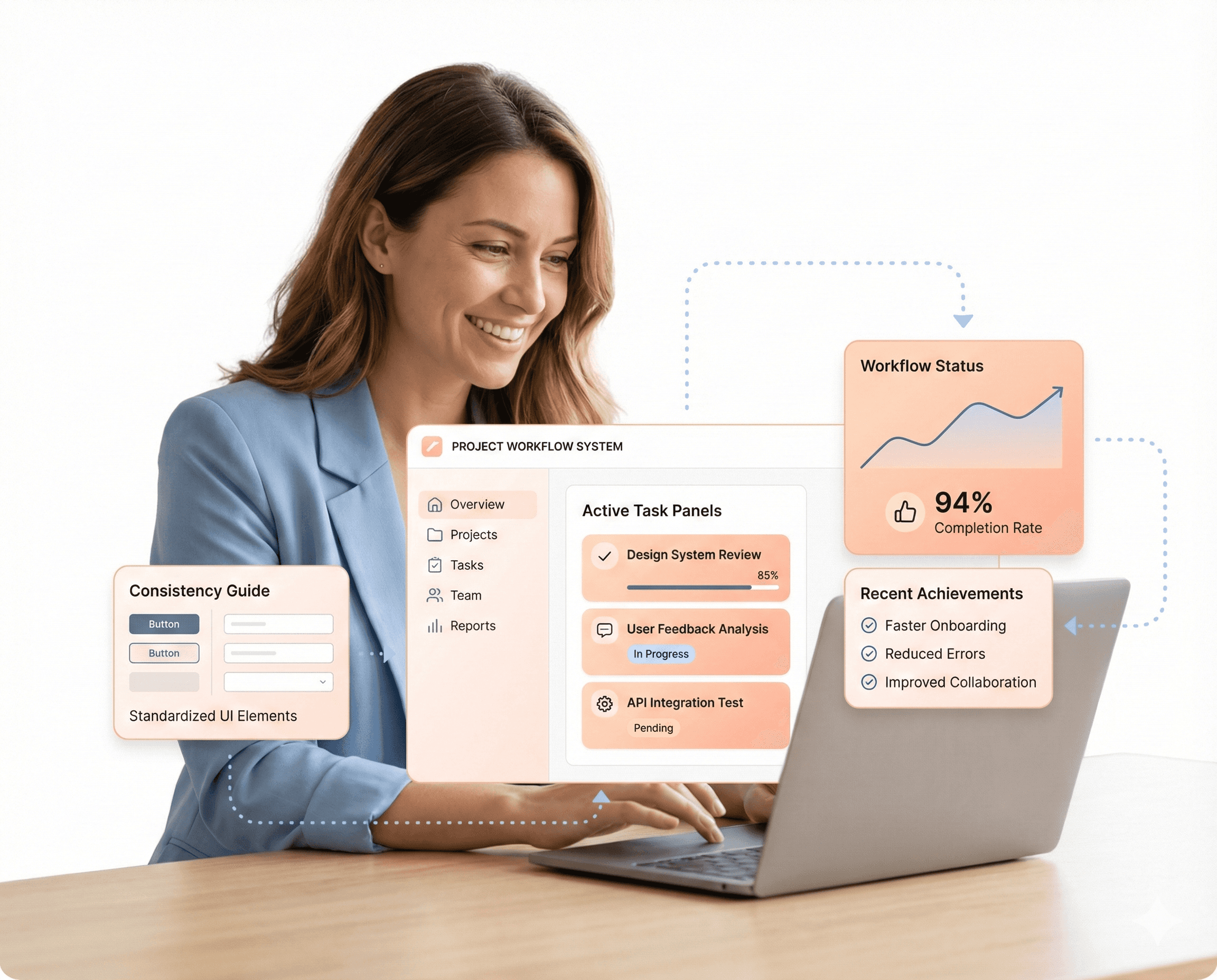
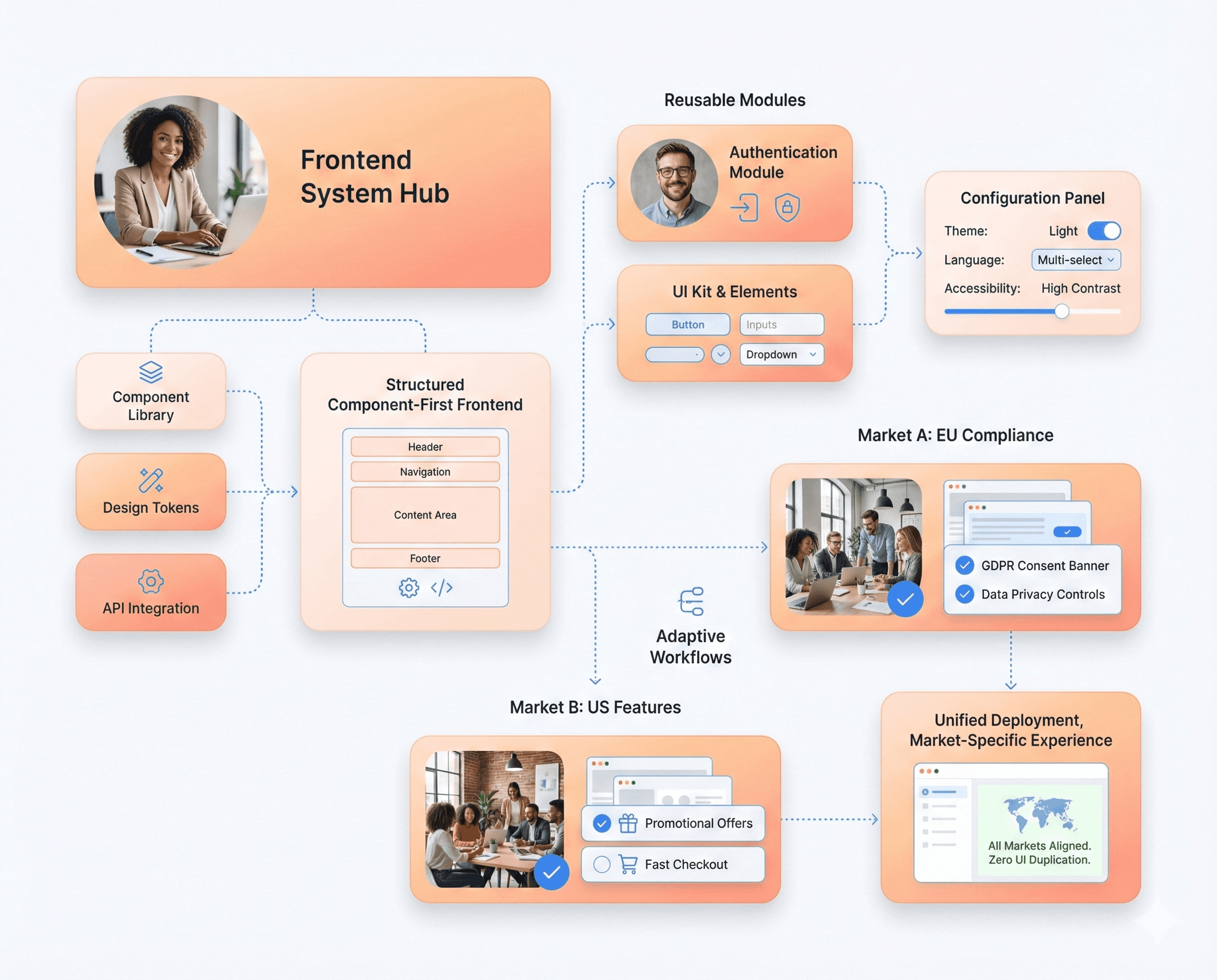
Config-driven market-adaptive UI
Hashbyt implemented a market-adaptive UI approach where compliance variations could be supported through structured UI logic instead of scattered conditional rendering. This allowed workflows to adapt based on region while keeping UI patterns consistent. It reduced duplication and made the frontend easier to extend.
Config-driven market-adaptive UI
Hashbyt implemented a market-adaptive UI approach where compliance variations could be supported through structured UI logic instead of scattered conditional rendering. This allowed workflows to adapt based on region while keeping UI patterns consistent. It reduced duplication and made the frontend easier to extend.
Config-driven market-adaptive UI
Hashbyt implemented a market-adaptive UI approach where compliance variations could be supported through structured UI logic instead of scattered conditional rendering. This allowed workflows to adapt based on region while keeping UI patterns consistent. It reduced duplication and made the frontend easier to extend.
Component-first scalable frontend rebuild
The UI was rebuilt with reusable components and workflow-oriented screen structure. This improved maintainability, reduced UI inconsistencies, and made new features easier to ship. It also ensured the platform could scale into new markets without rebuilding the experience from scratch.
Component-first scalable frontend rebuild
The UI was rebuilt with reusable components and workflow-oriented screen structure. This improved maintainability, reduced UI inconsistencies, and made new features easier to ship. It also ensured the platform could scale into new markets without rebuilding the experience from scratch.
Component-first scalable frontend rebuild
The UI was rebuilt with reusable components and workflow-oriented screen structure. This improved maintainability, reduced UI inconsistencies, and made new features easier to ship. It also ensured the platform could scale into new markets without rebuilding the experience from scratch.
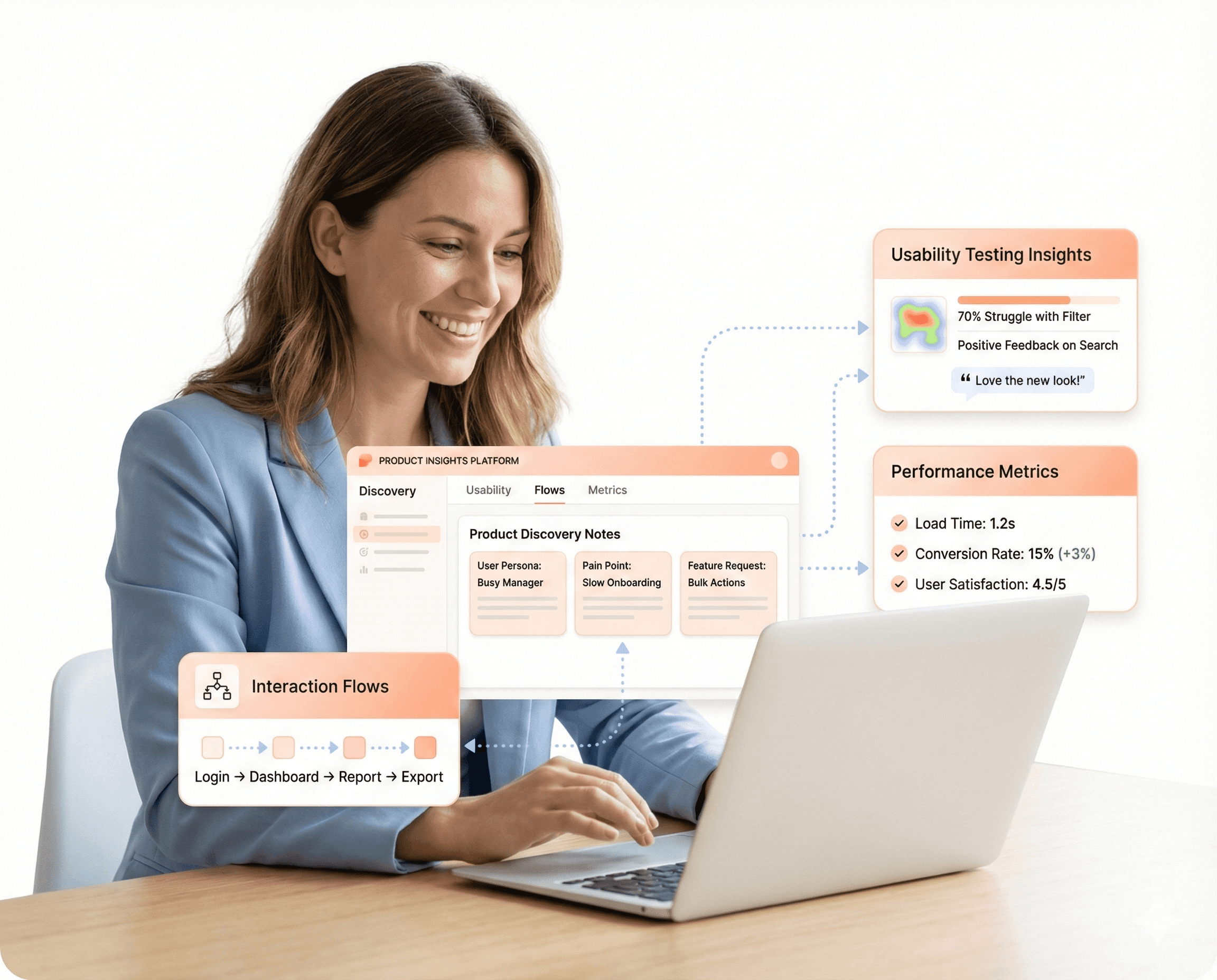
Workflow-first UX + mobile-first execution
Key workflows (tenant onboarding, property listings, property actions) were redesigned to remove friction and speed up completion. The UI was built mobile-first so field teams could perform actions quickly without zooming, scrolling overload, or layout breaks. The outcome was faster execution across both desktop and mobile users.
Workflow-first UX + mobile-first execution
Key workflows (tenant onboarding, property listings, property actions) were redesigned to remove friction and speed up completion. The UI was built mobile-first so field teams could perform actions quickly without zooming, scrolling overload, or layout breaks. The outcome was faster execution across both desktop and mobile users.
Workflow-first UX + mobile-first execution
Key workflows (tenant onboarding, property listings, property actions) were redesigned to remove friction and speed up completion. The UI was built mobile-first so field teams could perform actions quickly without zooming, scrolling overload, or layout breaks. The outcome was faster execution across both desktop and mobile users.
Decision-optimized analytics dashboards
Dashboards were designed as actionable modules instead of raw charts and numbers. The UI prioritized the most important KPIs and portfolio insights for property managers. This improved clarity, reduced time-to-insight, and enabled faster operational decisions directly from the interface.
Decision-optimized analytics dashboards
Dashboards were designed as actionable modules instead of raw charts and numbers. The UI prioritized the most important KPIs and portfolio insights for property managers. This improved clarity, reduced time-to-insight, and enabled faster operational decisions directly from the interface.
Decision-optimized analytics dashboards
Dashboards were designed as actionable modules instead of raw charts and numbers. The UI prioritized the most important KPIs and portfolio insights for property managers. This improved clarity, reduced time-to-insight, and enabled faster operational decisions directly from the interface.
Automation UX with strong state handling
Automation flows were supported with clear UI states (pending, processing, success, failed) to keep user trust high. The system reduced manual work while ensuring reliability through consistent validations and fallback handling. This prevented automation from feeling “invisible” or confusing for users.
Automation UX with strong state handling
Automation flows were supported with clear UI states (pending, processing, success, failed) to keep user trust high. The system reduced manual work while ensuring reliability through consistent validations and fallback handling. This prevented automation from feeling “invisible” or confusing for users.
Automation UX with strong state handling
Automation flows were supported with clear UI states (pending, processing, success, failed) to keep user trust high. The system reduced manual work while ensuring reliability through consistent validations and fallback handling. This prevented automation from feeling “invisible” or confusing for users.


Why they chose Hashbyt
"Hashbyt rebuilt our property management platform frontend with a scalable, compliance-ready UI that supports multiple metro markets. Their mobile-first workflow improvements reduced onboarding time by 40%, and the new dashboards helped property managers make decisions 50% faster. They were agile, responsive, and delivered on schedule even as requirements evolved."

David Merchant
CEO, Metro TechSolutions
"Hashbyt rebuilt our property management platform frontend with a scalable, compliance-ready UI that supports multiple metro markets. Their mobile-first workflow improvements reduced onboarding time by 40%, and the new dashboards helped property managers make decisions 50% faster. They were agile, responsive, and delivered on schedule even as requirements evolved."

David Merchant
CEO, Metro TechSolutions
"Hashbyt rebuilt our property management platform frontend with a scalable, compliance-ready UI that supports multiple metro markets. Their mobile-first workflow improvements reduced onboarding time by 40%, and the new dashboards helped property managers make decisions 50% faster. They were agile, responsive, and delivered on schedule even as requirements evolved."

David Merchant
CEO, Metro TechSolutions
Impact
Impact
Impact
The Measurable Product Impact After Launch: Faster Onboarding, Better Decisions, and Higher Adoption


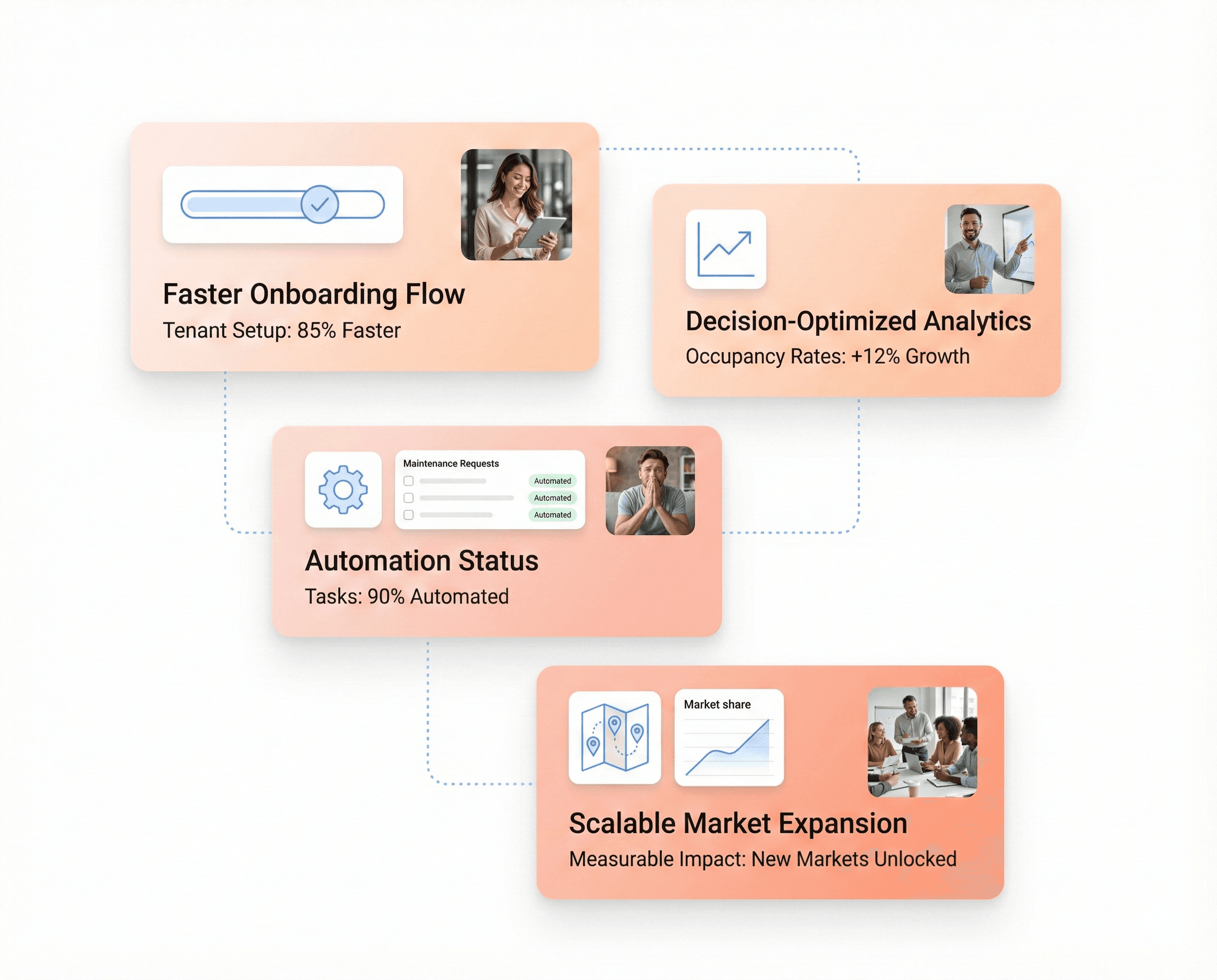
40% faster tenant onboarding
Tenant onboarding became faster due to fewer steps, clearer workflows, and mobile-friendly form design. This reduced user friction and improved activation. The frontend improvements directly cut time-to-completion by 40%.
40% faster tenant onboarding
Tenant onboarding became faster due to fewer steps, clearer workflows, and mobile-friendly form design. This reduced user friction and improved activation. The frontend improvements directly cut time-to-completion by 40%.
40% faster tenant onboarding
Tenant onboarding became faster due to fewer steps, clearer workflows, and mobile-friendly form design. This reduced user friction and improved activation. The frontend improvements directly cut time-to-completion by 40%.
50% faster decision-making
Property managers were able to access and interpret portfolio insights faster. The dashboard reduced context switching and improved time-to-action. This led to a 50% improvement in decision-making speed across daily operations.
50% faster decision-making
Property managers were able to access and interpret portfolio insights faster. The dashboard reduced context switching and improved time-to-action. This led to a 50% improvement in decision-making speed across daily operations.
50% faster decision-making
Property managers were able to access and interpret portfolio insights faster. The dashboard reduced context switching and improved time-to-action. This led to a 50% improvement in decision-making speed across daily operations.
35% increase in daily active users
Daily active usage increased because workflows became easier to complete and faster to navigate. Both tenants and property managers engaged more consistently post-launch. The platform saw a 35% increase in daily active users within 90 days.
35% increase in daily active users
Daily active usage increased because workflows became easier to complete and faster to navigate. Both tenants and property managers engaged more consistently post-launch. The platform saw a 35% increase in daily active users within 90 days.
35% increase in daily active users
Daily active usage increased because workflows became easier to complete and faster to navigate. Both tenants and property managers engaged more consistently post-launch. The platform saw a 35% increase in daily active users within 90 days.
60% reduction in manual processing
Operational tasks like rent collection and maintenance handling became automation-assisted instead of manual-heavy. The UI enabled tracking and managing automated tasks reliably. This cut manual processing time by 60%, improving efficiency for internal teams.
60% reduction in manual processing
Operational tasks like rent collection and maintenance handling became automation-assisted instead of manual-heavy. The UI enabled tracking and managing automated tasks reliably. This cut manual processing time by 60%, improving efficiency for internal teams.
60% reduction in manual processing
Operational tasks like rent collection and maintenance handling became automation-assisted instead of manual-heavy. The UI enabled tracking and managing automated tasks reliably. This cut manual processing time by 60%, improving efficiency for internal teams.
Faster expansion into new markets
The platform successfully launched into 3 new metropolitan markets within 6 months without major frontend redesign. The market-adaptive UI approach reduced implementation overhead for each rollout. This proved the frontend architecture was built for scalable expansion.
Faster expansion into new markets
The platform successfully launched into 3 new metropolitan markets within 6 months without major frontend redesign. The market-adaptive UI approach reduced implementation overhead for each rollout. This proved the frontend architecture was built for scalable expansion.
Faster expansion into new markets
The platform successfully launched into 3 new metropolitan markets within 6 months without major frontend redesign. The market-adaptive UI approach reduced implementation overhead for each rollout. This proved the frontend architecture was built for scalable expansion.
Our services
Our services
Our services
SaaS Experience. Built on Data, Driven by AI.
We turn your vision into high-performance, user-loved SaaS products.
More Projects
Built on a Foundation of Modern Tech
From Figma prototypes to Cypress testing, our stack ensures speed and quality.
Our Technology Stack
Frontend
Angular
React
Vue.js
Next.js
Vite
Webpack
Micro-Frontends
UI Libraries
Material UI
Tailwind
Bootstrap
Shadcn
Design Tool
Figma
Framer
Sketch
Adobe Creative Suite
Testing & QA Tools
Jest
React Testing Library
Cypress
State Management
Redux Toolkit
Zustand
TanStack Query
NGRX
Design Systems
Storybook
Design Tokens
CSS Variables
Monorepos
Performance
Lighthouse
Web Vitals
Sentry
LogRocket
New Relic
Compliance
WCAG 2.1 AA
ARIA
axe DevTools
Accessibility Audits
CI/CD & DevOps
GitHub Actions
Vercel
Netlify
Docker
Enterprise Security
OWASP
RBAC / Permission UI
Audit Logs UI
HIPAA / GDPR
Frontend
Angular
React
Vue.js
Next.js
Vite
Webpack
Micro-Frontends
UI Libraries
Material UI
Tailwind
Bootstrap
Shadcn
Design Tool
Figma
Framer
Sketch
Adobe Creative Suite
Testing & QA Tools
Jest
React Testing Library
Cypress
State Management
Redux Toolkit
Zustand
TanStack Query
NGRX
Design Systems
Storybook
Design Tokens
CSS Variables
Monorepos
Performance
Lighthouse
Web Vitals
Sentry
LogRocket
New Relic
Compliance
WCAG 2.1 AA
ARIA
axe DevTools
Accessibility Audits
CI/CD & DevOps
GitHub Actions
Vercel
Netlify
Docker
Enterprise Security
OWASP
RBAC / Permission UI
Audit Logs UI
HIPAA / GDPR